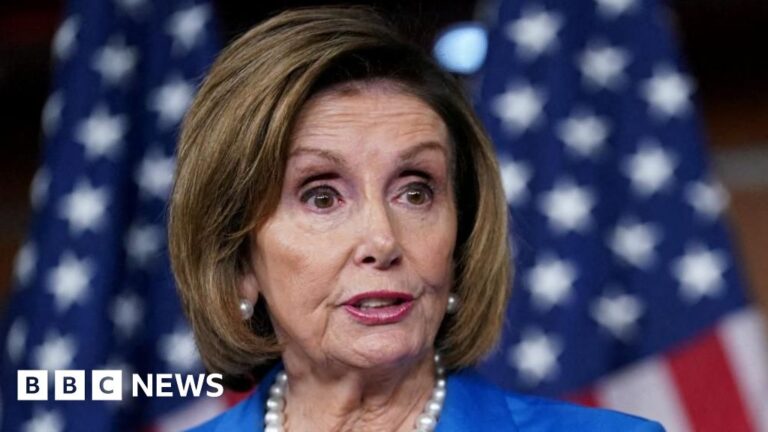
Nancy Pelosi has announced her retirement from Congress, ending a decades-long career that saw the California Democrat become one of the most powerful figures in US politics.
In a video message on Thursday, Pelosi said she will not be seeking re-election to Congress at the end of her term in January 2027.
It marks the end of a storied political career: Pelosi, 85, became the first woman to serve as Speaker of the House and led her party in the lower chamber of Congress from 2003 until 2023.
“We have made history, we have made progress,” Pelosi said in her message.
“We have always led the way, and now we must continue to do so by remaining full participants in our democracy, and fighting for the American ideals we hold dear.”
“As we go forward, my message to the city I love is this: San Francisco, know your power,” Pelosi added.
Pelosi was first elected to Congress to represent San Francisco in 1987 aged 47, and quickly rose through the ranks.
She was elected by her party to be speaker of the House in 2007, becoming the first woman to serve in that role. She served until 2011, when Democrats lost control of the lower chamber, before returning to the speaker’s chair from 2019 to 2023.
Speaker of the House is the one congressional job detailed in the US Constitution. After the vice-president, it is next in line to the presidency.
In that role, Pelosi played a critical role in advancing – or thwarting – the agendas of multiple presidents during her long career on Capitol Hill.
She is widely credited with marshalling the passage of former President Barack Obama’s signature healthcare legislation, as well as bills to address infrastructure and climate change during Joe Biden’s presidency.
Pelosi also directly challenged Donald Trump throughout his presidency, famously ripping up a copy of his State of the Union address behind his back.
By then she was also a lightning rod for Republican anger – in their eyes, representing the coastal elites pushing a big-spending, radical platform.
She led two impeachment efforts against Trump – the first in 2019 over his dealings with Ukraine. Trump was accused of pressing Ukraine to dig up damaging information on Biden, and of using military aid as leverage. He was later acquitted in the Republican-controlled Senate.
The second was in 2021, when he was accused by the House of inciting the storming of the Capitol – the seat of the US Congress – with a speech on 6 January to supporters outside the White House. That effort ultimately failed and Trump was acquitted once again.
On Thursday, when asked about Pelosi’s retirement, Trump said she was “an evil woman”.
“I’m glad she’s retiring. I think she did the country a great service by retiring,” he told reporters in the Oval Office. “I think she was a tremendous liability for the country.”
After Trump’s first term, Pelosi worked with Biden to shepherd much of his legislative agenda through her chamber despite the razor-thin margins.
In less than two years, Democrats in the House pushed through a Covid relief bill, a bipartisan infrastructure spending package, a multi-trillion-dollar environment and social spending programme, and legislation protecting gay marriage.
She was succeeded as Democratic leader in the House by New York Representative Hakeem Jeffries in 2022.
Since leaving her speakership, she has remained a major political influence. Most recently, she played a key role in helping to pass Proposition 50 in California – a state redistricting effort aimed at flipping five House seats to Democrats during the midterms in 2026.
The early-season dual meets have come and gone and now teams across the NCAA are preparing for their first taper opportunities of the 2025-26 season.
After SIU hosts the A3 Performance Invitational next week and a few other diving-only meets run, the vast majority of midseason invitational meets will run in two weeks (Nov. 18-23), and then after the Thanksgiving break, the last few invites will take place during the first week of December.
Other meets featuring teams ranked in SwimSwam’s top 10 of the last edition of the Power Rankings include the Texas Hall of Fame Invite with the host Longhorns and the Stanford women, the UGA Fall Invite with the host Bulldogs and Florida, the Ohio State Fall Invite with Indiana and Louisville, the Wolfpack Elite Invite with host NC State, and the Minnesota Invite with the Cal Golden Bears.
SwimSwam has been in contact with the host schools of this year’s invites, tracking down a definitive list of which teams are racing where. Below, find the full list provided by the schools.
If we’re missing any invites featuring D1 schools, let us know in the comments below.
President Donald Trump has warned that the United States will be rendered “defenseless’’ and possibly “reduced to almost Third World status” if the Supreme Court strikes down the tariffs he imposed this year on nearly every country on earth.
The justices sounded skeptical during oral arguments Wednesday of his sweeping claims of authority to impose tariffs as he sees fit.
The truth, though, is that Trump will still have plenty of options to keep taxing imports aggressively even if the court rules against him. He can re-use tariff powers he deployed in his first term and can reach for others, including one that dates back to the Great Depression.
“It’s hard to see any pathway here where tariffs end,” said Georgetown trade law professor Kathleen Claussen. “I am pretty convinced he could rebuild the tariff landscape he has now using other authorities.”
At Wednesday’s hearing, in fact, lawyer Neal Katyal, representing small businesses suing to get the tariffs struck down, argued that Trump didn’t need the boundless authority he’s claimed to impose tariffs under 1977 International Emergency Economic Powers Act (IEEPA). That is because Congress delegated tariff power to the White House in several other statutes — though it carefully limited the ways the president could use the authority.
“Congress knows exactly how to delegate its tariff powers,” Katyal said.
Tariffs have become a cornerstone of Trump’s foreign policy in his second term, with double-digit “reciprocal” tariffs imposed on most countries, which he has justified by declaring America’s longstanding trade deficits a national emergency.
The average U.S. tariff has gone from 2.5% when Trump returned to the White House in January to 17.9%, the highest since 1934, according to calculations by Yale University’s Budget Lab.
Still, Trump “will have other tools that can cause pain,’’ said Stratos Pahis of Brooklyn Law School. Here’s a look at some of his options:
Countering unfair trade practices
The United States has long had a handy cudgel to wallop countries it accuses of engaging in “unjustifiable,” “unreasonable” or “discriminatory” trade practices. That is Section 301 of the Trade Act of 1974.
And Trump has made aggressive use of it himself — especially against China. In his first term, he cited Section 301 to impose sweeping tariffs on Chinese imports in a dispute over the sharp-elbowed tactics that Beijing was using to challenge America’s technological dominance. The U.S. is also using 301 powers to counter what it calls unfair Chinese practices in the shipbuilding industry.
“You’ve had Section 301 tariffs in place against China for years,” said Ryan Majerus, a partner at King & Spalding and a trade official in Trump’s first administration and in Biden’s.
There are no limits on the size of Section 301 tariffs. They expire after four years but can be extended.
But the administration’s trade representative must conduct an investigation and typically hold a public hearing before imposing 301 tariffs.
John Veroneau, general counsel for the U.S. trade representative in the George W. Bush administration, said Section 301 is useful in taking on China. But it has drawbacks when it comes to dealing with the smaller countries that Trump has hammered with reciprocal tariffs.
“Undertaking dozens and dozens of 301 investigations of all of those countries is a laborious process,” Veroneau said.
Targeting trade deficits
In striking down Trump’s reciprocal tariffs in May, the U.S. Court of International Trade ruled that the president couldn’t use emergency powers to combat trade deficits.
That is partly because Congress had specifically given the White House limited authority to address the problem in another statute: Section 122, also of the Trade Act of 1974. That allows the president to impose tariffs of up to 15% for up to 150 days in response to unbalanced trade. The administration doesn’t even have to conduct an investigation beforehand.
But Section 122 authority has never been used to apply tariffs, and there is some uncertainty about how it would work.
Protecting national security
In both of his terms, Trump has made aggressive use of his power — under Section 232 of Trade Expansion Act of 1962 — to impose tariffs on imports that he deems a threat to national security.
In 2018, he slapped tariffs on foreign steel and aluminum, levies he’s expanded since returning to the White House. He also plastered Section 232 tariffs on autos, auto parts, copper, lumber.
In September, the president even levied Section 232 tariffs on kitchen cabinets, bathroom vanities and upholstered furniture. “Even though people might roll their eyes” at the notion that imported furniture poses a threat to national security, Veroneau said, “it’s difficult to get courts to second-guess a determination by a president on a national security matter.”
Section 232 tariffs are not limited by law but do require an investigation by the U.S. Commerce Department. It’s the administration itself that does the investigating – also true for Section 301 cases — “so they have a lot of control over the outcome,” Veroneau said.
Reviving Depression-era tariffs
Nearly a century ago, with the U.S. and world economies in collapse, Congress passed the Tariff Act of 1930, imposing hefty taxes on imports. Known as the Smoot-Hawley tariffs (for their congressional sponsors), these levies have been widely condemned by economists and historians for limiting world commerce and making the Great Depression worse. They also got a memorable pop culture shoutout in the 1986 movie “Ferris Bueller’s Day Off.”
Section 338 of the law authorizes the president to impose tariffs of up to 50% on imports from countries that have discriminated against U.S. businesses. No investigation is required, and there’s no limit on how long the tariffs can stay in place.
Those tariffs have never been imposed — U.S. trade negotiators traditionally have favored Section 301 sanctions instead — though the United States used the threat of them as a bargaining chip in trade talks in the 1930s.
In September, Treasury Secretary Scott Bessent told Reuters that the administration was considering Section 338 as a Plan B if the Supreme Court ruled against Trump’s use of emergency powers tariffs.
The Smoot-Hawley legislation has a bad reputation, Veroneau said, but Trump might find it appealing. “To be the first president to ever use it could have some cache.”
A new poll commissioned by the American Psychological Association (APA) has shed light on a disturbing trend among residents in the US. An increased sense of division is leading to a cascade of other negative effects.
Called “Stress in America 2025,” the poll was carried out between August 4-24 of this year and included responses from 3,199 adults over the age of 18 who reside in the US. The participants were selected to be a nationally representative sample based on the March 2024 Current Population Survey by the US Census Bureau.
Among its many findings, the poll highlighted the effect an increased sense of division is having on the nation. Those who said they found societal division to be a significant source of stress also reported feeling isolated at a rate of 61%, versus 43% of those not citing it as a factor. Those stressed by the division also had higher negative markers in other areas of their lives than those not as affected: 60% versus 49% said they were more likely to lose patience with family members; 53% versus 37% said they were unable to plan for the future; and 55% versus 37% said they cancel plans due to the stress.
Feelings of being divided socially are driving other negative thoughts
American Psychological Association
“This year’s findings show that people across the nation are not just feeling divided, they’re feeling disconnected,” said Arthur C. Evans Jr., CEO of APA. “Research tells us that a sense of isolation and social fragmentation can have real consequences for our ability to manage stress and stay healthy.”
The survey also showed that Americans aren’t feeling too great about their country overall, with 75% saying they are now more stressed than ever about the country’s future. They also chose a varied mix of terms when asked to select those that best represents their country today: freedom (41%), corruption (38%); opportunity (37%); division (36%); hope (35%); and fear (32%).
Additionally, the survey brought the effects of America’s loneliness trend to light. Sixty-five percent of those who reported the highest levels of loneliness also said they felt depressed or sad; 60% said they felt nervous or anxious; 54% reported fatigue; and 48% had headaches. That’s in comparison to 15%, 24%, 24%, and 25% respectively for those not reporting feelings of loneliness.
Loneliness is spilling over into other aspects of Americans’ lives
American Psychological Association
“Psychological research shows us that loneliness and isolation may increase the risk of premature mortality and are also linked with depression, poor sleep and cognitive decline,” said Evans. “We also know that social support is one of the strongest predictors of people’s well-being, reinforcing that connection is vital to our health. Reaching out, showing up and building community are not optional, they’re essential.”
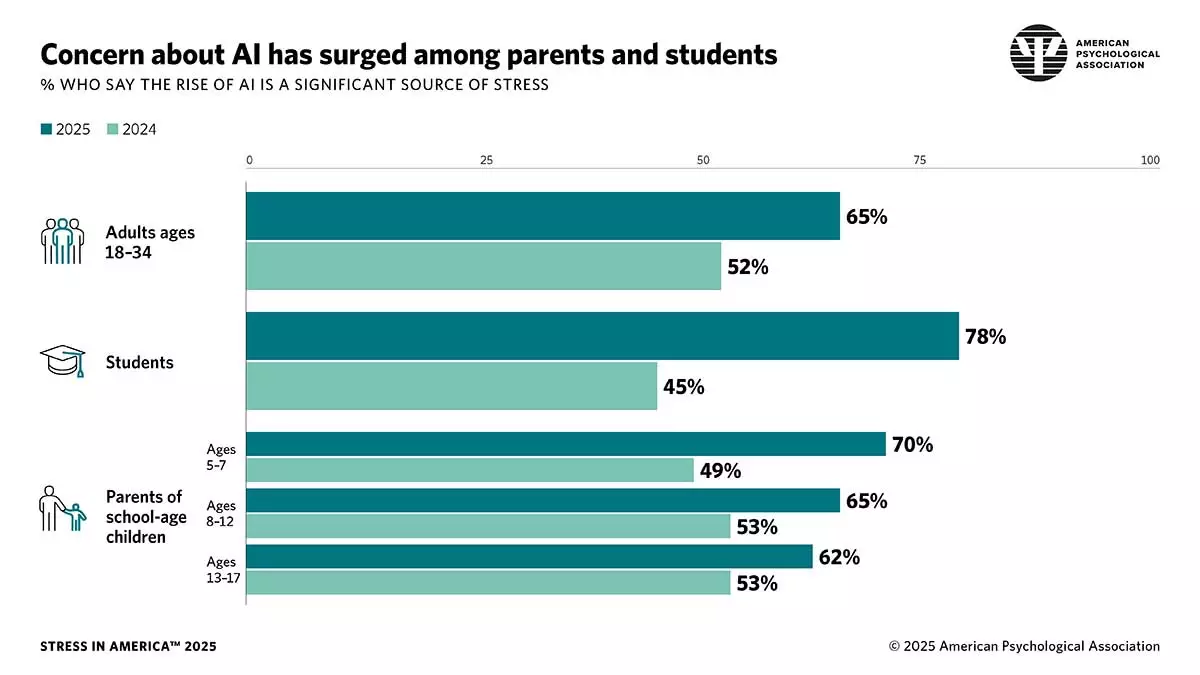
There was a growing unease with AI and disinformation among survey participants, too. Sixty-nine percent said the spread of misleading information was a source of stress, which is up from 62% in last year’s survey, while 57% were stressed by the rise in AI, which exceeds last year’s number of 49%.
Stress about disinformation and the rise of AI is increasing
American Psychological Association
All of that being said, America’s optimism still shined through in the survey. Eighty-four percent of respondents said they felt they could still create a good life, and 73% said they believed they could help shape the country’s future for the better. The survey also probed where Americans find meaning: family (77%), friendships (62%), romantic relationships (47%); and pets (39%). In terms of future goals or aspirations, financial stability and security got 64%, followed by improving health and spending time with family and friends.
“People may be reevaluating what gives their lives meaning, but they haven’t given up on finding that purpose,” said Evans. “Even as many feel disillusioned, they’re focusing on what they can control – nurturing their relationships, building financial stability and improving their health. That mix of hope and concern captures where America is today: Anxious, yes, but still striving for fulfillment.”
Warner Music Group has announced a significant new executive hire to drive what it calls its “always on artist & fan-focused” catalog marketing strategy.
Leda Chang has been appointed to the newly created role of SVP, Global Brand & Audience for WMG’s Global Catalog division.
According to WMG, in this new post, she will work closely with Global Catalog President Kevin Gore and his senior team to “turbocharge the company’s ‘always on’ marketing strategy”.
WMG added that the Los Angeles-based exec will spearhead “a holistic, artist-centric approach to long-term catalog development and legacy building,” and will lead efforts to “deepen audience engagement and mine untapped opportunities to drive fresh growth for WMG’s legendary artists”.
WMG said on Thursday (November 6) that the addition of Chang to its Global Catalog team marks the latest in a series of moves “designed to amplify the company’s catalog marketing strategy”.
Most recently, Orla Lee-Fisher was appointed Head of Dual Catalog Strategy, a new role designed to “champion” catalogs represented by WMG across both Recorded Music and Music Publishing.
Chang joins WMG with two decades of experience in digital and social marketing across a variety of top media and music companies, including senior posts at Peacock, Paramount Pictures, Universal Music Group, and Edelman Digital.
The exec was previously VP of Social Brand Strategy at Peacock, where she led “high-impact social and digital campaigns”.
Prior to Peacock, Chang spent five years at Paramount Pictures, guiding the company’s home entertainment digital marketing team and managing campaigns for high-profile releases.
Her other posts included VP, Digital & Social Marketing at Universal Music Group, Digital Account Supervisor at Edelman, Head of Digital Marketing at RedBullRecords, and Product Manager at TheOrchard.
“Welcoming Leda to our Global Catalog team marks an exciting step forward in our marketing evolution.”
Kevin Gore
“Welcoming Leda to our Global Catalog team marks an exciting step forward in our marketing evolution,” said Gore.
“Her future-forward mindset and proven strength in storytelling, connecting audiences, and enhancing brands will further strengthen our role as a growth engine, as we take a more aggressive, all-encompassing approach to galvanizing fans, cultivating discovery, and building legacies.”
“I’m both energized and humbled to elevate the stories of these iconic artists and their timeless music to invigorate both core fans and new audiences wherever they are in the world.”
Leda Chang
Chang added: “The caliber of Warner Music Group’s artists is unmatched, and the passion from Kevin and the team is palpable.
“I’m both energized and humbled to elevate the stories of these iconic artists and their timeless music to invigorate both core fans and new audiences wherever they are in the world.”Music Business Worldwide
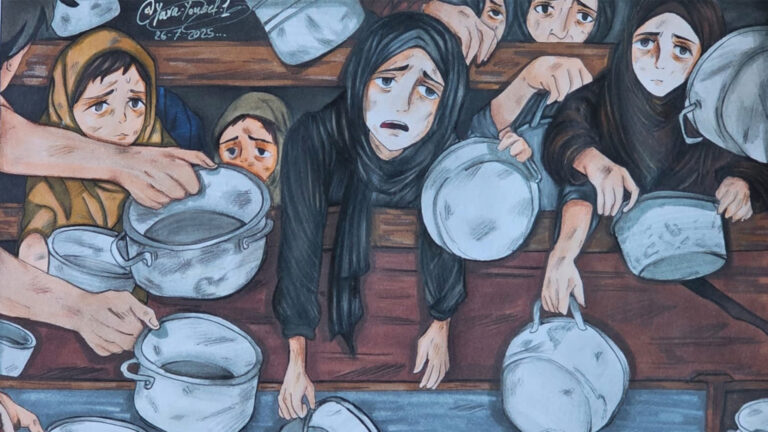
A 16-year-old Palestinian girl in Gaza is using art as an outlet for her trauma and grief from Israel’s war, drawing anime cartoons of the suffering she and others have experienced.
A required part of this site couldn’t load. This may be due to a browser
extension, network issues, or browser settings. Please check your
connection, disable any ad blockers, or try using a different browser.
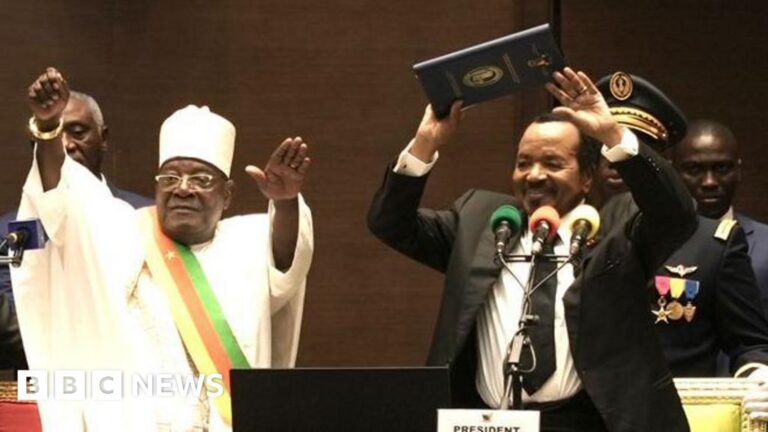
Cameroon’s 92-year-old leader Paul Biya has been sworn in for another seven years as president in a ceremony at the country’s parliament in Yaoundé.
Biya won a controversial eighth term in a fiercely disputed election last month.
He has been in power for 43 years, and addressed only one campaign rally before the election.
The nonagenarian, the world’s oldest head of state, won 54% of the vote, compared to the 35% of Issa Tchiroma Bakary, according to the official results. Tchiroma Bakary maintains he was the rightful winner of the poll and has accused the authorities of fraud, which they have denied.
The announcement of the result led to deadly protests across the country.
The authorities say at least four people were killed but the Reuters news agency puts the figure at 48, citing two United Nations sources.
Judges on the Constitutional Council had dismissed eight complaints about the election, citing insufficient evidence of irregularities or a lack of jurisdiction to annul results.
Earlier this week, Tchiroma Bakary’s call for a stay-at-home protest was heeded by many people, with streets deserted especially in his strongholds of Garoua and Douala.
The opposition leader was a former government information minister who broke ranks with Biya to challenge him for power.