Here are the key events from day 1,348 of Russia’s war on Ukraine.
Published On 3 Nov 20253 Nov 2025
Share
Here is how things stand on Monday, November 3, 2025:
Fighting
Russia fired a wave of drones and missiles at Ukraine overnight on Sunday, killing at least 15 people, including two children, the Kyiv Independent reported.
The attacks cut electricity to nearly 60,000 residents in the southern front-line region of Zaporizhia, Ukrainian authorities said.
Ukrainian forces launched a drone attack on one of Russia’s main Black Sea oil ports, Tuapse, causing a fire and damaging at least two foreign vessels there, according to local officials.
The overnight attack on Sunday forced the temporary closure of dozens of Russian airports, chiefly in the country’s south and west, for safety reasons, Russia’s aviation watchdog Rosaviatsiya said on Telegram.
Ukrainians attend knife-fighting training for civilians, organised by the Centre for Training Citizens for National Resistance in Kharkiv, northeastern Ukraine [Sergey Kozlov/EPA]
Weapons
United States President Donald Trump said that he is not considering a deal that would allow Ukraine to obtain the long-range Tomahawk missiles for use against Russia.
Sanctions
Turkiye’s largest oil refineries are buying more non-Russian oil in response to the latest Western sanctions on Russia, two people with direct knowledge of the matter and several industry sources told the Reuters news agency. Turkiye is a major buyer of Russian crude, along with China and India.
Politics and diplomacy
Ukrainian President Volodymyr Zelenskyy said the continuing deadly Russian attacks on his country proved that Moscow was aiming to “inflict harm” on civilians, and announced that Kyiv had beefed up its air defences in response.
Kremlin spokesman Dmitry Peskov said that “painstaking work” on the details of a possible agreement is needed to resolve the war in Ukraine, and not a meeting between Trump and Russian President Vladimir Putin.
A required part of this site couldn’t load. This may be due to a browser
extension, network issues, or browser settings. Please check your
connection, disable any ad blockers, or try using a different browser.
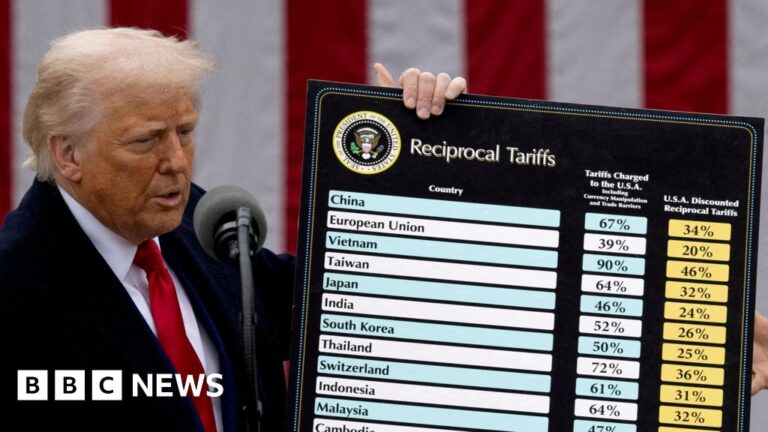
Trump announced new tariffs in the Rose Garden at the White House in April
What may be the biggest battle yet in Donald Trump’s trade war is about to begin.
The Trump administration heads to the US Supreme Court on Wednesday, facing off against small businesses and a group of states who contend most of the tariffs it has put in place are illegal and should be struck down.
If the court agrees with them, Trump’s trade strategy would be upended, including the sweeping global tariffs he first announced in April. The government would also likely have to refund some of the billions of dollars it has collected through the tariffs, which are taxes on imports.
The final decision from the justices will come after what could be months of poring over the arguments and discussing the merits of the case. Eventually they will hold a vote.
Trump has described the fight in epic terms, warning a loss would tie his hands in trade negotiations and imperil national security.
On Sunday, the president said he will not attend the hearing in person as he did not want to cause a distraction.
“I wanted to go so badly… I just don’t want to do anything to deflect the importance of that decision,” he said. “It’s not about me, it’s about our country.”
Trump previously said that if he does not win the case the US will be “weakened” and in a “financial mess” for many years to come.
The stakes feel just as high for many businesses in the US and abroad, which have been paying the price while getting whipped about by fast-changing policies.
Trump’s tariffs will cost Learning Resources, a US seller of toys made mostly overseas and one of the businesses suing the government, $14m (£10.66m) this year. That is seven times what it spent on tariffs in 2024, according to CEO Rick Woldenberg.
“They’ve thrown our business into unbelievable disruption,” he said, noting the company has had to shift the manufacturing of hundreds of items since January.
Few businesses, though, are banking on a win at the court.
“We are hopeful that this is going to be ruled illegal but we’re all also trying to prepare that it’s setting in,” said Bill Harris, co-founder of Georgia-based Cooperative Coffees.
His co-op, which imports coffee from more than a dozen countries, has already paid roughly $1.3m in tariffs since April.
A test to Trump’s presidential power
In deciding this case, the Supreme Court will have to take on a broader question: How far does presidential power go?
Legal analysts say it is hard to predict the justices’ answer, but a ruling siding with Trump will give him and future White House occupants greater reach.
Specifically, the case concerns tariffs that the Trump administration imposed using the 1977 International Emergency Economic Powers Act (IEEPA), which the White House has embraced for its speed and flexibility.By declaring an emergency under the law, Trump can issue immediate orders and bypass longer, established processes.
Trump first invoked the law in February to tax goods from China, Mexico and Canada, saying drug trafficking from those countries constituted an emergency.
He deployed it again in April, ordering levies ranging from 10% to 50% on goods fromalmost every country in the world. This time, he said the US trade deficit – where the US imports more than it exports – posed an “extraordinary and unusual threat”.
Those tariffs took hold in fits and starts this summer while the US pushed countries to strike “deals”.
Opponents say the law authorises the president to regulate trade but never mentions the word “tariffs”, and they contend that only Congress can establish taxes under the US Constitution.
They have also challenged whether the issues cited by the White House, especially the trade deficit, represent emergencies.
Members of Congress from both parties have asserted the Constitution gives them responsibility for creating tariffs, duties and taxes, as well.
More than 200 Democrats in both chambers and one Republican, Senator Lisa Murkowski, filed a brief to the Supreme Court, where they also argued the emergency law did not grant the president power to use tariffs as a tool for gaining leverage in trade talks.
Meanwhile, last week the Senate made a symbolic and bipartisan move to pass three resolutions rejecting Trump’s tariffs, including one to end the national emergency he declared. They are not expected to be approved in the House.
Still, business groups said they hoped the rebuke would send a message to the justices.
‘An energy drain like I’ve never seen’
Three lower courts have ruled against the administration. After the Supreme Court hears arguments on Wednesday it will have until June to issue its decision, although most expect a ruling to come by January.
Whatever it decides has implications for an estimated $90bn worth of import taxes already paid – roughly half the tariff revenue the US collected this year through September, according to Wells Fargo analysts.
Trump officials have warned that sum could swell to $1tn if the court takes until June.
Cafe Campesino
Trip Pomeroy, chief executive of Cafe Campesino, one of the 23 roasteries that owns Cooperative Coffees, on a recent trip to Peru with a partner farmer
If the government is forced to issue refunds, Cooperative Coffees will “absolutely” try to recoup its money, said Mr Harris, but that would not make up for all the disruption.
His business has had to take out an extra line of credit, raise prices and find ways to survive with lower profits.
“This is an energy drain like I’ve never seen,” said Mr Harris, who is also chief financial officer of Cafe Campesino, one of the 23 roasteries that own Cooperative Coffees. “It dominates all the conversations and it just kind of sucks the life out of you.”
What could happen next?
The White House says that if it loses, it will impose levies via other means, such as a law allowing the president to put tariffs of up to 15% in place for 150 days.
Even then, businesses would have some relief, since those other means require steps like issuing formal notices, which take time and deliberation, said trade lawyer Ted Murphy of Sidley Austin.
“This is not just about the money,” he said. “The president has announced tariffs on Sunday that go into effect on Wednesday, without advance notice, without any real process.”
“I think that’s the bigger thing for this case for businesses – whether or not that is going to be in our future,” he added.
There is no clear sign of how the court will rule.
In recent years it has struck down major policies, such as Biden-era student loan forgiveness, as White House overreach.
But the nine justices, six of whom were appointed by Republicans, including three by Trump,have shown deference to this president in other recent disputes and historically have given leeway to the White House on questions of national security.
“I really do think arguments are available for the Supreme Court to go in all different directions,” said Greta Peisch, partner at Wiley and former trade lawyer in the Biden administration.
Adam White, senior fellow at the American Enterprise Institute, said he expected the court to strike down the tariffs, but avoid questions like what constitutes a national emergency.
Reuters
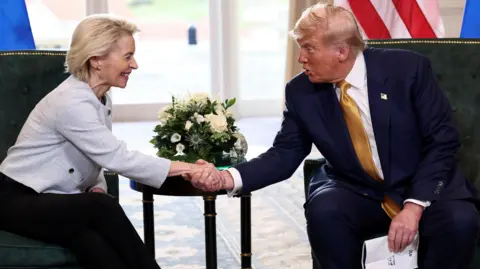
European Commission President Ursula von der Leyen and Trump announcing a deal in July
The case has already complicated the White House’s trade deals, such as one struck in July with the European Union.
The European Parliament is currently considering ratifying the agreement, which sets US tariffs on European goods at 15% in exchange for promises including allowing in more US agricultural products.
“They’re not going to act on this until they see the outcome of the Supreme Court decision,” said John Clarke, former director for international trade at the European Commission.
Chocolats Camille Bloch
Swiss chocolatier Daniel Bloch says he is not confident the Supreme Court will resolve the tariff issues facing his business
In Switzerland, which recently downgraded its outlook for economic growth citing America’s 39% tariff on its goods, chocolatier Daniel Bloch said he’d welcome a ruling against the Trump administration.
His business Chocolats Camille Bloch is absorbing about a third of the cost of new tariffs on kosher chocolate that his firm has exported to the US for decades, aiming to blunt price increases and maintain sales. That decision has wiped out profits for the unit and is not sustainable, he said.
He hopes Trump will reconsider his tariffs altogether, because “that would be easiest”.
“If the court were to make the tariffs go away of course we would see that as a positive sign,” he said. “But we don’t trust that that will bring the solution.”
Fitter and Faster Swim Camps is the proud sponsor of SwimSwam’s College Recruiting Channel and all commitment news. For many, swimming in college is a lifelong dream that is pursued with dedication and determination. Fitter and Faster is proud to honor these athletes and those who supported them on their journey.
Ethan Chung from Morton Grove, Illinois, has announced his verbal commitment to the admission process* at the University of Pennsylvania for 2026-27. He wrote on social media:
“I’m thrilled to announce my verbal commitment to the admissions process at the University of Pennsylvania, to continue my academic and athletic career! I want to thank my parents, family, coaches, teammates, and friends for their continuous support throughout the years. I am extremely grateful to Coach Mike and the rest of the Penn coaching staff for this amazing opportunity! GO QUAKERS!”
A senior at Niles West High School, Chung swims year-round with NASA Wildcat Aquatics and specializes in butterfly. We recognized him as a “Best of the Rest” recruit on our list of the top boys’ swimmers in the high school class of 2026 after their junior year.
In high school swimming, Chung came in 3rd in the 100 fly (47.37) and 8th in the 100 back (50.05) at the 2025 IHSA Boys’ State Championships. His 100 fly was a lifetime best and nearly 2 seconds faster than what he’d been as a sophomore at the Illinois State meet.
Chung updated nearly all of his best SCY times at the NCSA Spring Championships, where he placed 4th in the 100 fly, 7th in the 50 fly, 15th in the 100 free, 21st in the 50 back, and 30th in the 100 back. He took home PBs in the 50 free (21.02), 100 free (44.94), 50 back (23.28), 100 back (49.76), 50 fly (21.62), and 100 fly (47.21).
In long-course season, he had a strong showing at Madison Futures, finaling in the 50 fly (6th), 100 fly (7th), 50 free (26th), and 100 free (23rd). He clocked PBs in the 50 free (23.88), 100 free (52.01), 50 fly (24.70), and 100 fly (54.41), hitting Summer Nationals cuts in both butterfly distances.
Best SCY times:
50 fly – 21.62
100 fly – 47.21
200 fly – 1:49.68
50 free – 21.02
100 free – 44.94
Chung will join the Quakers in the class of 2030 with “Honorable Mention” recruit Matt Vatev, swimmers Lewis Zhang and Velizar Filipov, and Tristan Yang, the #4 diver in the cohort. His butterfly times are already fast enough to score at the Ivy League Men’s Championships in the ‘B’ final of the 100 fly and the ‘C’ final of the 200 fly.
*Note: A verbal commitment between an Ivy League coach and a prospective student-athlete is not an offer of admission, as only the Admission Office has that authority. The coach can only commit his or her support in the admission process. Ivy League Admission Offices do not issue “Likely Letters” before October 1 of the prospective student-athlete’s senior year of high school. The Likely Letter, while issued after an initial read of the student’s application, is not an offer of admission to the university.
If you have a commitment to report, please send an email with a photo (landscape, or horizontal, looks best) and a quote to Recruits@swimswam.com.
About the Fitter and Faster Swim Tour
Fitter & Faster Swim Camps feature the most innovative teaching platforms for competitive swimmers of all levels. Camps are produced year-round throughout the USA and Canada. All camps are led by elite swimmers and coaches. Visit fitterandfaster.com to find or request a swim camp near you.
Starting cannabis use before the age of 15 may set the stage for future health struggles, according to a new study linking early cannabis use to higher odds of both mental and physical health problems in young adulthood.
Around the world, cannabis is one of the most commonly used substances during adolescence. However, adolescence is a critical development period. It’s marked by significant brain development, where the emotional part of the brain develops faster than the region responsible for planning and judgment, which continues to mature into the mid-20s.
New research led by McGill University in Québec, Canada, has examined how starting cannabis use before or after age 15 affects physical and mental health in early adulthood.
“Youth under 15 are in a critical period of brain growth, which may make them more susceptible to cannabis’ effects on mental health,” said senior author Massimiliano Orri, PhD, Assistant Professor in McGill’s Department of Psychiatry and Principal Investigator at the Douglas Research Center. “Cannabis can also impair attention and cognition, which may increase the likelihood of accidents causing injuries.”
The researchers followed 1,591 participants from the Québec Longitudinal Study of Child Development (QLSCD) from birth to age 23. Data sources included participants’ self-reported cannabis use (at ages 12, 13, 15, and 17), plus official medical records for mental and physical health care received between ages 18 and 23.
The researchers identified three usage patterns using group-based trajectory modeling: Non-users (never used cannabis), late-onset users (started after 15, used infrequently), and early-onset, frequent users (started before 15, used often), around 60%, 20%, and 20%, respectively. The models were adjusted for 32 confounding factors, including family background, socioeconomic status, parental substance use, early childhood behavior problems, and preexisting medical issues, to isolate cannabis effects from other influences.
In terms of mental health, frequent cannabis users had 51% higher odds of medical visits for any mental disorder. They had 57% higher odds of treatment for common mental disorders, such as depression and anxiety, for example. Regarding physical health, frequent users had 86% higher odds of care for any physical conditions. They had significantly more visits for injuries and poisoning. The researchers found no clear link to respiratory diseases or suicide-related behaviors.
By comparison, for late-onset cannabis users, the researchers found no significant increase in mental health care needs. There were higher odds of care for physical conditions, especially injuries and poisoning. Non-users, which served as the baseline comparison group, had lower rates of health service use across all categories, as might be expected.
“Even when we considered several pre-existing risk factors for cannabis use, we still found increasing risks of using healthcare services for mental and physical health problems for youth with early-onset cannabis use,” said Pablo Martínez, PhD, the study’s lead author and a postdoctoral fellow at McGill. “That suggests cannabis itself may play a role.”
The authors note several caveats to their findings. First, unmeasured genetic or personality traits could still influence both cannabis use and later health outcomes. Also, males and lower-income participants were more likely to drop out. Medical records don’t capture milder conditions that don’t result in healthcare visits. Underreporting of cannabis use is possible. Finally, the study took place before Canada legalized cannabis (2018), so patterns may differ today with higher-potency products and changing norms.
Nonetheless, the findings add new evidence to the ongoing debate about the safety of cannabis use during adolescence.
“Efforts to steer youth away from consuming cannabis too young are important,” said Orri. “Public health initiatives should focus on identifying young people likely to start early and use frequently, as they may benefit from clinical interventions to reduce long-term risks.”
Note: Map shows the area with a shake intensity of 4 or greater, which U.S.G.S. defines as “light,” though the earthquake may be felt outside the areas shown. All times on the map are Afghanistan time.The New York Times
A strong, 6.3-magnitude earthquake struck in Afghanistan on Monday, according to the United States Geological Survey.
The temblor happened at 12:59 a.m. Afghanistan time about 14 miles southwest of Khulm, Afghanistan, data from the agency shows.
As seismologists review available data, they may revise the earthquake’s reported magnitude. Additional information collected about the earthquake may also prompt U.S.G.S. scientists to update the shake-severity map.
Source: United States Geological Survey | Notes: Shaking categories are based on the Modified Mercalli Intensity scale. When aftershock data is available, the corresponding maps and charts include earthquakes within 100 miles and seven days of the initial quake. All times above are Afghanistan time. Shake data is as of Sunday, Nov. 2 at 4:01 p.m. Eastern. Aftershocks data is as of Sunday, Nov. 2 at 5:44 p.m. Eastern.
After huge rallies or selloffs, it’s often pointed out that the stock market is not the economy, or that Wall Street is not Main Street. But that divide is getting blurrier.
That’s because higher asset prices are spurring consumers to spend more freely than before, and consumption represents about 70% of GDP. In fact, this so-called wealth effect has become more potent in just the last 15 years.
Today, every 1% increase in stock wealth translates to a 0.05% uptick in consumer spending, according to a note last week from Oxford Economics lead U.S. economist Bernard Yaros.
In other words, a $1 increase in stock wealth leads to a $0.05 marginal propensity to consume, up from less than $0.02 in 2010. Meanwhile, every $1 increase in housing wealth leads to a $0.04 bump in consumption, up from $0.03.
“As households see their wealth rise, they turn more sanguine about their personal financial situation and are more inclined to loosen their purse strings,” Yaros wrote. “Increases in wealth will also propel spending by allowing homeowners to extract more equity from their houses or to liquidate appreciated stocks to fund their current consumption.”
He sees the wealth effect sending the marginal propensity to consume even higher in the coming years because retirees will comprise a bigger share of the population.
Given that they already enjoy a bigger net worth than younger generations do, retirees will rely more on their wealth to support consumption after they stop working and earning an income, Yaros explained.
On top of that, the ubiquity of digital media means consumer sentiment reacts even quicker to market news, reinforcing these wealth effects, he added.
This more powerful wealth effect could help explain why consumer spending has stayed resilient. Even as President Donald Trump’s trade war has kept inflation sticky and made businesses more nervous about adding workers in an uncertain landscape, AI is still propelling the stock market to new record high after record high.
At the same time, the stock market has grown more dependent on AI-related stocks, such as chip leader Nvidia along with so-called hyperscalers like Microsoft and Google.
Based on his wealth-to-spending math, Yaros estimated that stock market gains in the last 12 months from the tech sector alone will boost annual consumption by nearly $250 billion, which would account for more than 20% of the cumulative spending increase.
“While the stock market is not the economy, the latter risks greater whiplash from the ups and downs in the former,” he wrote.
Analysts at JPMorgan also looked at the the link between the AI boom and consumers in a note last month. They estimated U.S. households gained more than $5 trillion wealth in the last year from 30 AI-linked stocks, raising their annualized level of spending by about $180 billion.
That represents just 0.9% of total consumption, but JPMorgan noted that it could go higher if AI spurs gains in a broader array of stocks or in other assets like real estate.
And stocks are not limited to wealthier Americans either. A survey released last month from the BlackRock Foundation and Commonwealth showed that over 54% of Americans earning $30,000-$79,999 a year are retail investors in the capital markets. And more than half of that cohort began investing in the past five years.
To be sure, the wealthiest still spend the most dollars, and the emerging K-shaped economy has magnified their impact. Research from Moody’s found that the top 10% of earners accounted for half of spending in the second quarter, a record high.
Michael Brown, senior research strategist at Pepperstone, attributed that to the wealth effect from stock and real estate gains as well as from income disparities.
“Tying all this together produces two things — an economy increasingly reliant on discretionary spending among higher earners, and higher earners whose discretionary spending is reliant on risk assets remaining buoyant,” he said in a note on Tuesday.
This dynamic means central bankers at the Fed who control monetary policy and lawmakers in Congress who control fiscal policy have a greater incentive to support the stock market, Brown added.
That’s because the wealth effect can work in the reverse direction, meaning falling assets prices will slow spending and the economy.
“What we have, then, is an economy that’s tied increasingly closely to the fortunes of the equity market, and an equity market that’s increasingly tied to overall consumer spending, which coupled together result in stronger ‘put’ structure to backstop risk assets, with fiscal stimulus continuing, and monetary backdrops becoming looser,” he said.
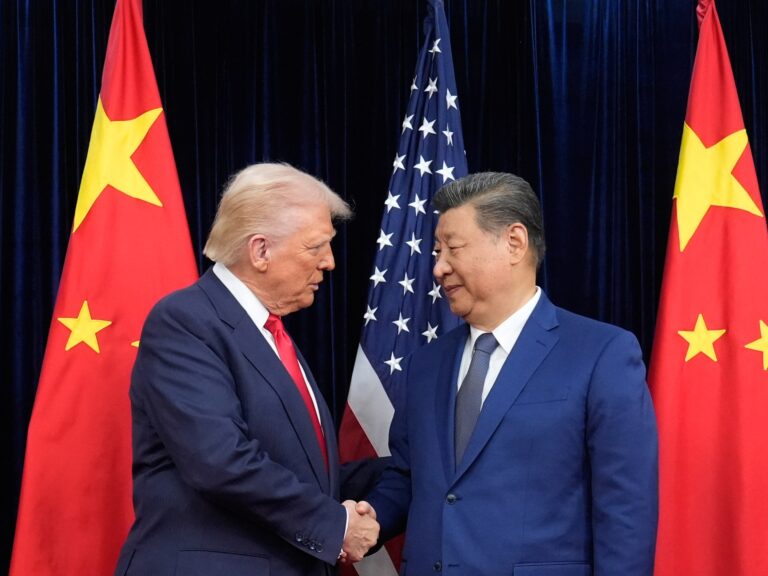
US president claims Chinese leader has ‘openly said’ Beijing would never act on Taiwan while Trump’s in the White House ‘because they know the consequences’.
Published On 2 Nov 20252 Nov 2025
Share
United States President Donald Trump has said that his Chinese counterpart Xi Jinping has assured him that Beijing will not attempt to unify Taiwan with mainland China while the Republican leader is in office.
Trump said on Sunday that the long-contentious issue of Taiwan “never even came up as a subject” when he met with Xi in South Korea on Thursday for their first face-to-face meeting in six years. The meeting largely focused on US-China trade tensions.
Recommended Stories
list of 3 itemsend of list
Asked on US media outlet CBS’s “60 Minutes” programme whether he would order US forces into action if China moved militarily on Taiwan, Trump demurred.
The US, under both Republican and Democratic administrations, has maintained a policy of “strategic ambiguity” on Taiwan — trying not to tip their hands on whether the US would come to the island’s aid in such a scenario.
“You’ll find out if it happens, and he understands the answer to that,” said Trump, referring to Xi.
But Trump declined to spell out what he meant in the interview conducted Friday at his Mar-a-Lago resort in Florida, adding: “I can’t give away my secrets. The other side knows.”
The US president claimed that Xi and those close to him had “openly said” that “‘we would never do anything while President Trump is president,’ because they know the consequences.”
US officials have long been concerned about the possibility of China using military force against Taiwan, the self-ruled island democracy claimed by Beijing as part of its territory.
The 1979 Taiwan Relations Act, which has governed US relations with the island, does not require the US to step in militarily if China invades but makes it US policy to ensure Taiwan has the resources to defend itself and to prevent any unilateral change of status by Beijing.
Liu Pengyu, spokesman for the Chinese embassy in Washington, did not respond directly to a query from The Associated Press news agency about whether Trump has received any assurances from Xi or Chinese officials about Taiwan. He insisted in a statement that China “will never allow any person or force to separate Taiwan from China in any way.”
“The Taiwan question is China’s internal affair, and it is the core of China’s core interests. How to resolve the Taiwan question is a matter for the Chinese people ourselves, and only the Chinese people can decide it,” the statement added.
The White House also did not provide further details about when Xi or Chinese officials have conveyed to Trump that military action on Taiwan was off-the-table for the duration of the Republican’s presidency.
The “60 Minutes” interview marked Trump’s first appearance on the show since he settled a lawsuit this summer with CBS News over its interview with then-Vice-President Kamala Harris. Trump alleged that the interview had been deceptively edited to benefit the Democratic Party before the 2024 election. Trump initially sought $10bn in damages, later raising the claim to $20bn.
Major AI music-related news just keeps rolling in.
Universal Music Group has now entered into a strategic alliance with Stability AI to develop “next-generation professional music creation tools.”
UMG said that these tools will be powered by “responsibly trained generative AI and built to support the creative process of artists, producers and songwriters globally”.
According to the announcement today (October 30), through this alliance, Stability AI’s research and product teams will “work closely with UMG and its artists to research artist needs and technical approaches for the next generation of music creation tools”.
It added: “Together, they will explore new recording and composition concepts, gather insights into artists’ needs, and better understand how artists adopt and engage with these technologies.”
The news marks Universal Music Group’s second significant AI music-making-related partnership in as many days. On Wednesday (October 29), UMG revealed that it has settled its copyright infringement lawsuit against AI music platform Udio. The companies also agreed to collaborate on a new platform featuring licensed AI music, slated to launch in 2026.
Stability AI, known for its Stable Diffusion image generator and Stable Audio AI music model, will work with UMG’s research and product teams to build software trained on licensed music catalogs.
The partnership with Stability AI will put UMG artists directly in the development process, gathering feedback on what creators need from AI-powered recording and composition tools, and “better understand how artists adopt and engage with these technologies.”
Through feedback with creators, UMG and Stability AI aim to create “fully licensed, commercially safe AI music tools” that “supports both artists and rightsholders while preserving the integrity of the art form”.
StabilityAI claims to be “the industry leader in commercially safe generative audio”. It said that its “Stable Audio family of models was built specifically for professionals and trained exclusively on licensed data to support responsible, high-quality music and sound generation”.
Commenting on the deal with Stability AI, Michael Nash, Chief Digital Officer & EVP, Universal Music Group, said: “This agreement is an extension of our fundamental orientation that our artists and songwriters are the cornerstone of our business.
“With AI, as with everything else we do, we start with what best supports our work to help them achieve creative and commercial success and build from that foundation to forge new and better commercial and creative opportunities.
“This agreement is an extension of our fundamental orientation that our artists and songwriters are the cornerstone of our business.”
Michael Nash, Universal Music Group
Added Nash: “And as we’ve made abundantly clear, we will only consider advancing AI tools and products based on models that are trained responsibly. We’re looking forward to working with Stability AI to deeply integrate AI tools development with the vision and creative ambitions of our artists and to the results and rewards this initiative offers to all.”
PremAkkaraju, CEO of Stability AI, added: “UMG has long been a leader in technological innovation in music. This partnership marks the next chapter of music creation.
“At Stability AI, we put the artist at the center and build AI around their unique needs because real transformation has always come from a combination of art and science.”
“UMG has long been a leader in technological innovation in music. This partnership marks the next chapter of music creation.”
Prem Akkaraju, Stability AI
UMG says its deals with Udio and Stability AI are among the “industry-first AI-related agreements” that it has struck with companies including YouTube, TikTok, Meta, KDDI, KLAY Vision, BandLab, Soundlabs and Pro-Rata, among others.
For Stability AI, the UMG deal follows its recent strategic partnership withElectronic Arts to develop generative AI tools for game development and with marketing firm WPP for advertising applications. The UMG deal extends its strategy into music production.
In July, Akkarajutold the Financial Times in an interview that Stability AI is looking at developing a marketplace where artists can license their work for AI training. The marketplace would reportedly allow creators to voluntarily submit artwork and receive compensation when AI companies use their content for model training.
Stability AI is currently facing multiple copyright infringement lawsuits. In one case, Seattle-based Getty Imagessued Stability AI in both the UK and the US, alleging that the company illegally used 12 million images without permission or compensation.
Separately, illustrators Sarah Andersen, Kelly McKernan, and Karla Ortizfiled a class action lawsuit in January 2023 against Stability AI and two other companies, challenging the use of their works for AI model training.
In August, Stability AI researchers said AI is creating “potentially new” music genres. “Before, musicians had to dedicate years to learn a specific genre. Now, AI can blend and produce music in multiple (and potentially new) genres,” the researchers found.