


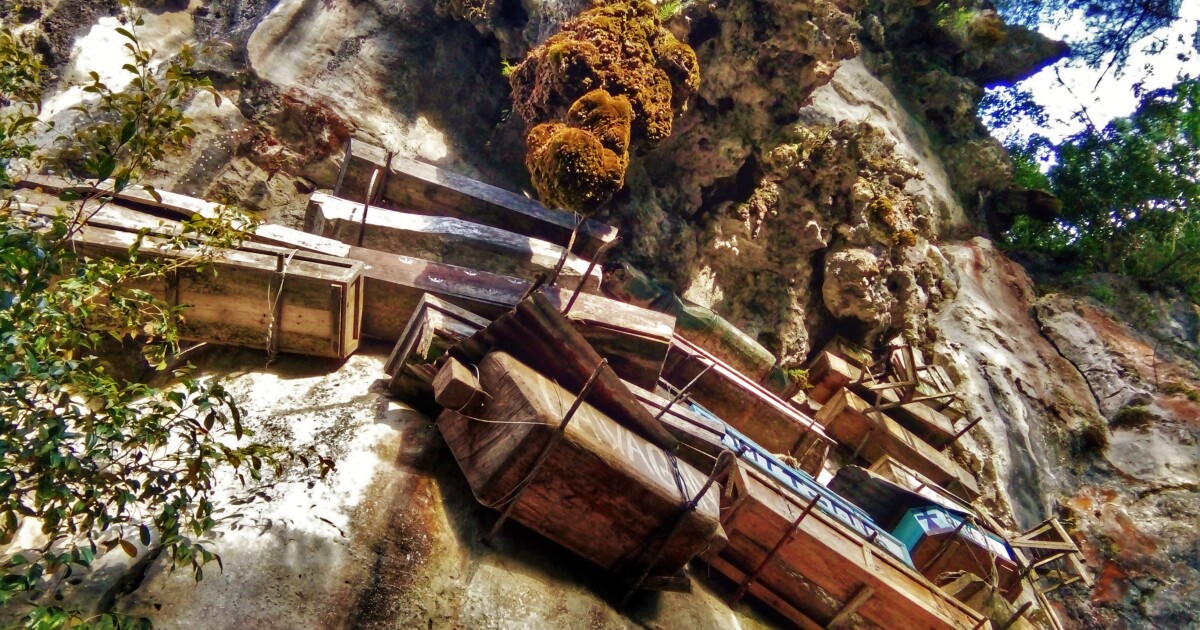
High on the sheer limestone cliffs in southwest China, ancient wooden coffins remain wedged into rock faces hundreds of feet above the ground. Long treated as archaeological curiosities, these dramatic burials are now being re-examined using ancient DNA, and they point to a broader practice where separate cultures across Asia all paid their respects to the dead at similar “sky graveyards.”
In a new DNA study by scientists from the Kunming Institute of Zoology under the Chinese Academy of Sciences (CAS) and Shanghai’s Fudan University, researchers have been able to answer some of the longstanding questions surrounding these ancient open-air cemeteries. Firstly, they found that they were made by locally rooted communities whose descendants still live in the region today. Until now, archeologists knew what the coffins looked like and where they could be found, but not whether the people behind them were a single population or many. Sequencing DNA from ancient cliff-buried individuals at sites in Yunnan and Guangxi, they found that today’s Bo people – a population of around 6,800 – are indeed biologically connected to the original hanging-coffin builders.
Xie Peixia/China Folklore Photography Association and the Zhaotong Municipal Bureau of Cultural Relics
But just as fascinating was what the researchers found when they also looked at similar high-elevation burial traditions elsewhere in Asia, most notably by the ancient Log Coffin people in Thailand. Here, they found no evidence of a shared population or migration, suggesting independent cultural practices had emerged, rather than a single tradition spreading across the continent.
Radiocarbon dating and archeological evidence revealed that China’s hanging coffins were used for more than a millennium, from around 500 BCE through to the 14th century, with many of the caskets dating back 1,200 years. In contrast, the log coffin burials in northwestern Thailand date from roughly 200 BCE to 1000 CE. While the two traditions overlap in time, they differ in execution, setting and population, again reinforcing that these similar burial solutions arose independently rather than through migration or cultural exchange.
So while the CAS study successfully traces the origins of China’s cliff-burial people, the broader story is what’s perhaps more fascinating: How did locals in remote China, Thailand and also the Philippines all partake in challenging rituals of cliffside hanging coffins without shared ancestry?

For this, we’ll start in China. The reason behind these hanging coffins has been difficult to confirm for archeologists, but several investigations have pointed to a combination of symbolism, practicality and social meaning. Elevating the dead above the ground may have been a way to keep bodies safe from wild animals and environmental influences like flooding, while placing ancestors closer to the sky and mountains – a recurring theme in ancient belief systems across southern China – intended to guide the dead safely into the afterlife.
Historical texts describe high burials as a mark of respect, and much like the placement of the dragon stones in Armenia, the effort involved suggests these were carefully planned and important memorials.
The landscape itself likely played a central role, too – the steep cliffs of Yunnan and Guangxi that rise above river valleys and travel routes are highly visible vantage points. Placing coffins on cliffs would have turned burial sites into long-lasting landmarks that signposted territory and ancestral claims over land. In this sense, the cliffs functioned not just as cemeteries, but as some sort of social marker in the remote wilderness.
As for how the coffins were placed, archeological evidence suggests that some caskets were slotted into natural or carved niches in the rock face, while others were placed on wooden beams that had been driven into cliff faces for support. Interestingly, a collection of tool marks, holes for the beams and the position of coffins closer to the top of the cliffs suggest that they were lowered down from above, rather than hoisted up (which would have required dangerous cliff-face scaling, even without a coffin in tow).
“The Bo people’s Hanging Coffin custom is unique in that it stands in stark contrast to the surrounding cultures, many of which traditionally buried their dead,” noted the researchers. “The Bo people placed their deceased in a wooden coffin carved from a single tree and then suspended it from sheer cliff faces dozens or hundreds of meters in the air.”
Importantly, and where this latest DNA study adds more to the picture, the genetic diversity of those placed at the same sites suggests that the hanging coffin tradition was not the work of a single lineage or tightly bounded group but a cultural practice shared by communities with varied backgrounds – and one that had been carried over centuries as populations changed.

In the northern Philippines, particularly around the mountain town of Sagada in the Cordillera region of Luzon, hanging coffins are a well known aspect of oral history and, until recently, common. Among indigenous Igorot groups, especially the Kankanaey, wooden coffins were placed on cliff faces or inside elevated caves, often just a few feet above ground and sometimes stacked up over generations.
Unlike China’s ancient cliff coffins, many of the Sagada coffins were put into position in the last few centuries, with some burials continuing into the early 1900s before the practice declined under colonial and religious change. And like in China, researchers have found that the placement of coffins was a deliberate way to keep the dead close to ancestral spirits, protect bodies from scavenging animals and symbolically elevate the deceased above the land they spent their life on.
Here, the dead were placed in small coffins and hauled up cliff faces using ropes, ladders and carved footholds. The difficulty of the burial was itself meaningful, reflecting a great degree of respect for elders and social standing within the community. The elevated position also makes the coffins visible from a distance, in a similar way to those in China.
Archeological studies have suggested that cliff-face and cave-based burials here may stretch back as far as 2,000 years, though these old caskets no longer exist on their elevated resting spots. But given the likelihood of continuity in this tradition through time, the hanging coffins that are visible in Sagada today may represent only the most recent chapter in a much longer tradition of cliffside burial. And, once again, genetic and historical research has found no evidence of any crossover with other regions practicing cave and cliff burials, adding more weight to the theory that these similar traditions emerged completely independent of each other.

In northwestern Thailand, in the Pang Mapha district and Mae Hong Son province, there’s yet another example of elevated cave burial – though no cliff suspension is evident, possibly due to the suitability of the environment. Here, there’s long-running tradition of log coffin burials, where bodies of the deceased had been set in caskets carved from a single teak trunk and then placed inside elevated caves and rock shelters. These burials date from roughly 200 BCE to 1000 CE, overlapping with China’s hanging coffins, and possibly the Philippines. And again, radiocarbon dating has shown that this is a continual tradition through generations of local people, rather than a practice that arrived from somewhere else.
While the coffins weren’t suspended on cliff faces, many were elevated on stilts and placed in hard-to-access caverns, again suggesting a purposeful and ceremonial ritual. Like in China, a mix of social and environmental factors appear to be at play, with the coffins’ conspicuous placement likely carrying a meaning, rather than being purely about disposal.
Last year, researchers from the Max Planck Institute for Evolutionary Anthropology in Leipzig and the Prehistoric Population and Cultural Dynamics in Highland Pang Mapha Project in Bangkok undertook extensive genetic testing on samples from what is now known as the Iron Age Log Coffin culture.
“In combination with high mitochondrial haplogroup diversity and genome-wide homogeneity, the Log Coffin-associated groups from northwestern Thailand seem to have been a large, well-connected community, where genetic relatedness played a significant role in the mortuary ritual,” the team noted.
In the latest study, a comparative analysis found that the Log Coffin populations were genetically distinct from China’s hanging coffin community, reinforcing the theory that similar burial strategies arose independently.

While there’s a lot we don’t know about these unusual, distinct burial rituals, it’s nonetheless fascinating to see how many disparate cultures shared such similar traditions without knowing the others existed. But there are throughlines that tie them together: Protection from animals and disturbance, visibility, spiritual symbolism and territorial marking.
And thanks to modern tools like genomic analysis, we’re slowly learning more about these ancient practices and, in turn, the people who carried them out. The CAS scientists plan to gather more samples from early hanging-coffin sites in Fujian, China, as well as from Southeast Asia and the Pacific, to better understand the rituals and populations.
“Future studies with more samples covering more relic sites are needed to test the proposed dispersal pattern of the Hanging Coffin custom,” noted the researchers, who also point to similar traditions being undertaken on the islands of Taiwan and Indonesia.
Sources: Nature Communications, iScience

