Note: Map shows the area with a shake intensity of 4 or greater, which U.S.G.S. defines as “light,” though the earthquake may be felt outside the areas shown. All times on the map are Colombia time.The New York Times
A strong, 6.3-magnitude earthquake struck in Colombia on Sunday, according to the United States Geological Survey.
The temblor happened at 8:08 a.m. Colombia time about 72 miles east of Bogota, Colombia, data from the agency shows.
As seismologists review available data, they may revise the earthquake’s reported magnitude. Additional information collected about the earthquake may also prompt U.S.G.S. scientists to update the shake-severity map.
Aftershocks in the region
An aftershock is usually a smaller earthquake that follows a larger one in the same general area. Aftershocks are typically minor adjustments along the portion of a fault that slipped at the time of the initial earthquake.
Quakes and aftershocks within 100 miles
Aftershocks can occur days, weeks or even years after the first earthquake. These events can be of equal or larger magnitude to the initial earthquake, and they can continue to affect already damaged locations.
When quakes and aftershocks occurred
Source: United States Geological Survey | Notes: Shaking categories are based on the Modified Mercalli Intensity scale. When aftershock data is available, the corresponding maps and charts include earthquakes within 100 miles and seven days of the initial quake. All times above are Colombia time. Shake data is as of Sunday, June 8 at 9:24 a.m. Eastern. Aftershocks data is as of Sunday 8 de June a la 1:21 p.m. Eastern.
Reservoir Media has struck what it calls “a multifaceted deal” with independent record label Fool’s Gold Records.
The deal sees Reservoir acquire the catalog master rights of the label’s artists A-Trak, Danny Brown, Grande Marshall, The Brothers Macklovitch, and Low Pros.
Reservoir will also exclusively market and distribute all other recordings on Fool’s Gold, including future releases, via the Reservoir label platform.
This deal, which was facilitated by Fool’s Gold Chief Financial Officer Jorge Mejias, label manager Nathaniel Heller, and A-Trak’s management team at TMWRK, sees Fool’s Gold join Reservoir’s recorded music division alongside “cornerstone” independent labels Chrysalis Records, Tommy Boy Music, and the newly acquired New State, among others.
Reservoir acquired Tommy Boy Music in 2021 in a deal valued at approximately $100 million. In February, the company acquired UK dance and electronic label New State, and the label’s entire recorded music catalog of over 13,000 tracks.
Reservoir acquired the Chrysalis Records catalog for an undisclosed fee in 2019.
Fool’s Gold will be marketed and distributed through Reservoir’s label platform.
As part of the deal, Reservoir will also now distribute A-Trak & Friends, a new sub-label of Fool’s Gold featuring music by A-Trak and several other artists.
The first release off A-Track & Friends was Reaching by James Juke feat. LION BABE, which was released last month.
Commenting on the deal, A-Trak said: “I’ve been thoroughly impressed by Reservoir ever since the first time we all spoke. Everyone at the company has a deep passion for quality music.
“A big part of what’s helped Fool’s Gold navigate 18 years in the music biz is staying very nimble and malleable. Reservoir was able to craft a creative deal with us that showed real agility — that’s exactly what we were looking for in a new partner.”
“We’re proud to welcome A-Trak, Fool’s Gold, and its artists into the Reservoir family as we continue to champion culturally significant independent music.”
Reservoir President and Chief Operating Officer Rell Lafargue added: “As both founder and artist, A-Trak has built Fool’s Gold into a genre-blurring label that has been at the forefront of hip-hop, house, and everything in between for nearly two decades.
“We’re proud to welcome A-Trak, Fool’s Gold, and its artists into the Reservoir family as we continue to champion culturally significant independent music.
“This multifaceted deal also highlights Reservoir’s ongoing expansion in recorded music and our team’s ability to deliver across the full spectrum of the music business.”
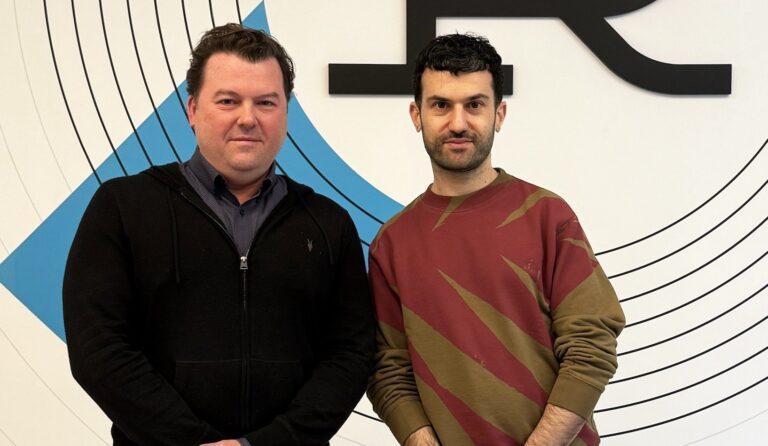
Brooklyn-based Fool’s Gold was founded in 2007 by DJs A-Trak (Alain Macklovitch), Nick Catchdubs (Nick Barat), musician Dave 1 (David Macklovitch), and the late Dust La Rock (Joshua Prince).
The label saw early success from releases by Kid Cudi, Kid Sister, Flosstradamus, Danny Brown (with songs including Grown Up and 25 Bucks), as well as A-Trak’s own music.
In 2010, his duo Duck Sauce released viral hit single Barbra Streisand, which reached No.3 in the UK and No.1 on Billboard’s Dance Club Songs chart, and earned a Grammy nomination for Best Dance Recording.
The song was later included on Duck Sauce’s 2014 Top 10 Billboard Dance/Electronic album, Quack, which Reservoir now distributes.
A-Trak also earned success as a solo artist with his remix of the Yeah Yeah Yeahs’ Heads Will Roll and singles including Ray Ban Vision, Believe, DJ’s Gotta Dance More, and My Own Way. The Fool’s Gold catalog also includes releases by Treasure Fingers, Hoodboi, Tommy Trash, Falcons, G-Worthy, Malaa, and Michael Christmas.
Reservoir spent over $115 million on acquisitions and advances in its latest fiscal year, while its annual revenues jumped 10% YoY to $158.7 million.Music Business Worldwide
Also among the crowds were people with ties and ancestry from other Commonwealth nations.
“Despite my Pakistani roots, I was born here and I feel being part of the Commonwealth at some stage, many years ago now, but still I have that affinity for the royal family,” Rifat Soyfoo said.
“I thought that this is the ultimate occasion to pay my respects,” Soyfoo added. “Everyone keeps saying, ‘The queen god bless her soul worked tirelessly, so selflessly,’ [and talking about] how she brought the nation together no matter what creed, color, community you’re from.”
“She gave us so much,” said Chris Imafidon, a British Nigerian professor. “She was not just a monarch high up there; she was modest. She worked with my charity in the inner city and invited our students to come to the palaces.”
Roula Khalaf, Editor of the FT, selects her favourite stories in this weekly newsletter.
Hard-pressed areas of the British state including councils and the police face a further squeeze in the spending review as the government prioritises the NHS and defence at the expense of other services.
Chancellor Rachel Reeves will on Wednesday set out the government’s spending plans until the next general election, making a political bet that improving the health service is critical to Labour’s chances of re-election.
The chancellor is set to give the NHS a 2.8 per cent real-terms rise in annual day-to-day health spending over the three-year spending review period starting April next year, according to officials.
Although the rise is less than the long-term average increase since the service was founded in 1948, the £30bn-a-year rise in cash terms by 2028-29 is significantly better than some in the service had feared.
Matthew Taylor, chief executive of the NHS Confederation that represents health managers, said the service’s leaders recognised that all public services were under enormous pressure.
“The government committing to provide a greater proportion of funding to the NHS is going to be incredibly tough for services such as housing, education and welfare, particularly as they can affect people’s healthcare needs,” he added.
Defence is also expected to see an above-inflation increase, reflecting Britain’s changing priorities as the US pressures European countries to spend more on their own militaries. The government has already vowed to increase defence spending to 2.5 per cent of GDP by 2027.
In the Budget last year, Reeves set the parameters for overall day-to-day spending that envisioned overall growth of 1.2 per cent a year in real-terms between 2026-27 and 2028-29.
But Max Warner, an economist at the Institute for Fiscal Studies, said the money Reeves had devoted to the NHS and defence would mean a squeeze for other parts of the state in the order of 0.3 per cent annual real-terms reductions in day-to-day spending.
“Health is coming back to its traditional place as a spending review winner,” said Warner. Still, the 2.8 per cent settlement, first reported by The Times, was less than the historical long-term growth rate of 3.6 per cent a year in real terms, he noted.
Areas facing real-terms day-to-day spending cuts are those that have already endured salami-slicing over the past decade from the previous Conservative government, such as courts, councils and transport.
Treasury officials confirmed some departments will have real-terms cuts over the three years. But one said: “Nobody can really think that every department should have a real-terms increase.”
Security, health and the economy will be the three main themes in Reeves’ speech on Wednesday. She will also highlight £113bn of extra capital spending funded by borrowing, enabled by a tweak to the government’s fiscal rules last autumn.
The chancellor will say that new investments across the country will only be possible because of her “choices”, a mix of general fiscal discipline on day-to-day spending as well as a Labour plan to borrow for investment. “This money is only available because of her decisions,” said one aide.
Pensions minister Torsten Bell said on X on Sunday: “I’ve seen claims that we’re going back to austerity: there is one word for that — garbage.”
Among the choices Reeves will reveal on Wednesday is an extra £4.5bn a year by 2028/29 for the core schools budget, which covers pupils aged 5 to 16.
On an annual schools budget of £64bn that implies a rise of about 7 per cent over three years. One education expert said: “It’s hard to say what this means in practice until we get the full details, but these figures suggest schools will be relatively protected.”
Reeves is likely to depict allocations for some other departments as an exercise in magnanimity, even where the numbers are only treading water with inflation.
The government said on Sunday that the spending review would allocate £86bn to research and development over four years, without giving details of its distribution. The 2025-26 figure of £20.4bn would rise to £22.5bn by 2029-30.
Despite ministers calling this “transformative”, in reality R&D spending will stay broadly flat in real terms, according to the Campaign for Science and Engineering.
While most departments have settled with the Treasury ahead of Wednesday, officials admitted that the negotiations had not been plain sailing. “It’s not a pain-free moment,” said one.
Home secretary Yvette Cooper is still holding out for a more generous settlement for the police, arguing the service needs more cash to hit ambitious crime-fighting targets.
The Home Office is also struggling to cut how much foreign aid it spends on hotel bills for asylum seekers in the UK, with an estimate of just under £2.2bn for this financial year, close to the £2.3bn the previous year.
Angela Rayner, deputy prime minister with responsibility for housing and local government, has been locked in last-minute negotiations over the fine details of funding for councils, although a ballpark figure has been agreed, according to Treasury officials.
Additional reporting by Laura Hughes and Clive Cookson
After the conclusion of the 100 backstroke on Friday, all four stroke 100’s have been and gone in Indianapolis. The World Record holders in the 100 backstroke and butterfly won their respective events, while on breaststroke Lilly King was dethroned by Kate Douglass in her final race in the US. Torri Huske backed up her breakout freestyle performances in Paris with a new American Record of 52.43 to round out the quartet.
All of the swimmers from the World Record-setting relay last year will be in Singapore and available for this relay. Kate Douglass and Lilly King will battle it out in the individual 100 breaststroke to decide who the coaches put on the breaststroke leg, but the other three are locked down.
So, what does all this mean for Team USA’s 4×100 medley relay this summer? We now know who will be on the team – and what a team it is.
Stroke-By-Stroke
Three of last year’s 100m champions won one of the 100s this year, with new champions in the 100 breaststroke and 100 freestyle. The math works out there because Douglass showcased her unparalleled versatility by sliding across to win the 100 breaststroke after placing 1st in the 100 freestyle in 2024.
The four winners from this year along with Lilly King give Team USA head coach Braden Holloway an almost ludicrous number of lineup options. Walsh and Huske took the top two spots between them in both the freestyle and butterfly, and Kate Douglass, 1:05.79 in the breaststroke, holds the fastest-ever 100 freestyle split from an American woman (51.79, 2023).
In fact, all four of the stroke 100 champions are 56.4 or better on the 100 fly. If you know of any other relay in history with that level of switchability, let us know.
Walsh and Huske will almost certainly swim fly-free after doing so on two relays (women’s and mixed) in Paris, but of the two it is likely Walsh’s spot that is safest. Kate Douglass could slide across to freestyle if needed, or drop out entirely if Lilly King caps off her final Worlds with some vintage breaststroke performances.
For all four women, as well as the second place finishers (King and Katharine Berkoff, this will be at least their third World or Olympic Championships. All four have swum on at least one World Record-setting relay in the past. That kind of experience cannot be understated.
First off, Regan Smith seems to save her best for relays. She has swum her best time of the meet on the relay at the last three international championships (2023 LC Worlds, 2024 Olympics, 2024 SC Worlds) and gives the US a reliable 57-mid or better split.
Katharine Berkoff is a stunningly overqualified replacement for prelims – the fifth-fastest swimmer of all time. She also has a relay World Record on her resume; the 4×100 free for the 2024 SC World Championships that Douglass and Walsh were on.
However, despite that there isn’t a debate on who will be in the final. Smith is the World record holder and has been the top American in this event since 2019. Barring injury or illness, she will swim the backstroke leg.
Breaststroke is the one leg where there is some debate. Lilly King has been a mainstay on the medley relay over the last few years, but her second place finish in the 100 does cast some doubt over that.
Douglass does have only one swim under 1:06, but like at the Tokyo Olympics the decision will come down to the individual event.
With Australia in transition this year China may be the strongest competitors, but cannot live with America’s pace on the backstroke and butterfly legs. Wan Letian, Tang Qiangting, Zhang Yufei and Yang Junxuan are their best team, although Yang recently opted out of Chinese nationals. Regardless, they have the most complete team even if someone like Wu Qingfeng replaces her.
The US should run away with this relay in Singapore. They set the World record of 3:49.63 in Paris to win by 3.5 seconds, and the add-up this year is only 0.31 slower than in 2024.
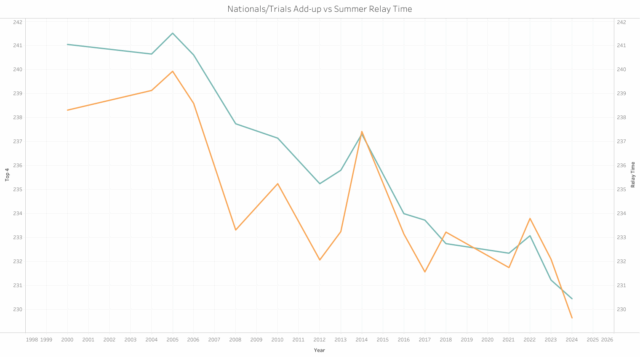
Once again, we’ll have a brief look back at the drops that the medley relay team has had from their Trials add-up, and a very rough prediction for what they may do in Singapore.
Here was what the gaps look like between the add-up from the top four at Nationals and the relay times swum later that summer since 2000.
The Numbers
Fastest three flat-start times of the four stroke 100 champions:
Fastest international three relay splits of the four stroke 100 champions:
Flat-start add-up (last 24 months):
Flat start + relay split add-up (last 24 months):
There are a lot of other ways to put this relay together, ranging from the ‘What are you doing?’
(All times are from the past 24 months)
To the covering an off/injured swimmer
To the two which are most likely
The only real question is whether it will be Kate Douglass or Lilly King on the breaststroke leg, and the answer to that will come in the individual event. Douglass’ 100 freestyle also does not appear to quite be at the level it was in 2023, so expecting another sub-52 split may be overzealous.
Due to the overlap between Huske and Walsh for the top two spots in free and fly, Claire Curzan and Simone Manuel may be pulled onto the relay for prelims. Curzan qualified in the 200 backstroke, but has a best of 56.2 in the 100 fly and was 57.24 at Olympic Trials last year.
The US has not necessarily been faster on the relay than their add-up, especially in the last few years. That is what happens when you have three world record holders all on one relay – they tend to be very fast when not swimming on relays as well.
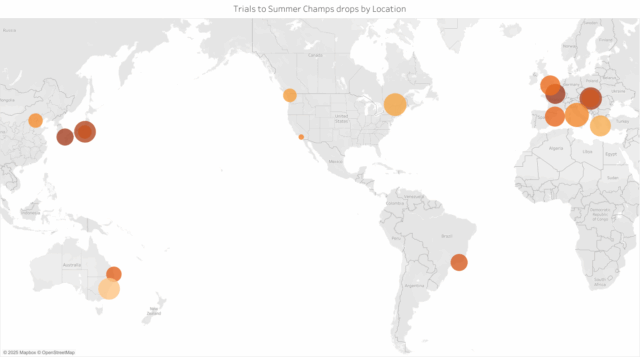
And then just for fun, here are the U.S. Nationals/Trials to summer relay drops since 2000 based on location. The circles get darker as the year gets later, and any hollow circles indicate a negative drop – that is, an increase.
Few sights are as mesmerising as a bioluminescent sea, glowing with the light of jellyfish or microscopic algae. This natural phenomenon has inspired the development of an innovative material with potential applications in construction and urban environments. Swiss researchers have harnessed a parasitic fungus and combined it with wood—an abundant and renewable resource—to achieve this breakthrough. The key lies in a component called luciferin. In this article, we explore the discovery and its possible applications.
What is luciferin?
First, it is important to clarify that luciferin is a key organic molecule in the process of bioluminescence—the ability of certain living organisms to emit light. This glow occurs when luciferin reacts with luciferase, an enzyme that catalyses its oxidation in the presence of oxygen and adenosine triphosphate (ATP). This highly efficient mechanism produces light with minimal heat, enabling various species to use it for courtship, communication, or as a defence mechanism in dark environments such as the deep sea or nocturnal forests.
Different forms of luciferin have evolved in nature, adapted to the organisms that produce them. Some of the most well-known bioluminescent species include fireflies (Lampyridae), lantern fish (Photoblepharon), and luminous squid (Watasenia scintillans). While bioluminescence is rarer in the plant kingdom, it does occur in bacteria that colonise plant roots and tissues, as well as in certain fungi, such as foxfire (Panellus stipticus). This fungus has now paved the way for the development of an eye-catching bioluminescent wood.
Innovative materials: Balsa wood enhanced with bioluminescent fungi
More than 2,300 years ago, Aristotle documented an unusual phenomenon: in certain forests, pieces of wood appeared to glow mysteriously at night. He called it “cold fire,” a term later translated as foxfire or fairy fire. Scientists later discovered that a parasitic fungus was behind the glow, thanks to the presence of luciferin.
Today, science continues to drive the development of innovative building materials, from those that provide thermal insulation to others that harden under pressure. The latest addition to this expanding toolkit is bioluminescent wood, which capitalises on the phenomenon first observed by Aristotle. Swiss mycological researcher Francis Schwarze has turned to Desarmillaria tabescens, one of more than seventy known species of bioluminescent fungi, to create this novel material.
The research, published in Advanced Science, describes a biohybrid material combining balsa wood with the fungus. Experiments revealed that the fungus metabolises the lignin in the wood and generates bioluminescence in the process, all without compromising the wood’s strength, as its cellulose remains intact.
The painstaking production process requires three months of incubation and moisture absorption to achieve peak luminosity. The resulting glow, a greenish light with a wavelength of 560 nanometres, is triggered when the material comes into contact with air.
Schwarze and his team suggest that this bioluminescent wood could have a range of applications, from urban signage and park lighting to home furnishings and even glowing architectural structures. As a self-illuminating material derived from sustainably sourced wood, it also offers the advantage of a lower carbon footprint.
However, the technology still has some limitations. At present, the bioluminescent effect lasts for only around ten days, though researchers are working on ways to extend its lifespan through modifications to the production process.
Beyond bioluminescent coatings and structures, fungi are also being explored as sustainable materials for construction and furniture manufacturing with lower carbon emissions. You can read more about this emerging field, known as mycotecture, in this article. And if you want to stay up to date with innovations in building materials, be sure to subscribe to our newsletter at the bottom of this page.
Watch: Clashes continue in LA over immigration raids
US President Donald Trump has ordered 2,000 National Guardsmen to Los Angeles to deal with unrest over raids on undocumented migrants.
Trump said the federal government would “step in and solve the problem”, after the Californian city saw a second day of clashes between protesters and federal agents.
Tear gas was used to disperse crowds as residents of the predominantly Latino Paramount district clashed with Immigration and Customs Enforcement (ICE) agents earlier in the day.
As many as 118 arrests were made in LA this week as a result of ICE operations, including 44 on Friday. California Governor Gavin Newsom has condemned the raids as “cruel”.
Trump thanked the National Guard for a “job well done” in Los Angeles late on Saturday night. Despite this, the troops did not appear to have arrived in the city.
Early on Sunday the New York Times website quoted a federal official as saying that the force would arrive within 24 hours.
Trump criticised the city’s Democratic governor and mayor in a post on his Truth Social platform, calling them “incompetent”. He also said protesters would no longer be allowed to wear masks.
Newsom said the federal government’s takeover of the National Guard was “purposefully inflammatory” and would “only escalate tensions”.
The National Guard is usually called by a state’s governor, but Trump has used a provision that allows him to take control himself, Newsom’s office told the AP news agency.
Trump had earlier hit out at the governor on social media, saying that if he and LA Mayor Karen Bass could not do their jobs, “then the Federal Government will step in and solve the problem, RIOTS & LOOTERS, the way it should be solved!!!”
Defence Secretary Pete Hegseth later threatened to mobilise active-duty marines if violence continued, saying troops at nearby Camp Pendleton were on “high alert”. Newsom described this threat as “deranged behaviour”.
The Paramount district had calmed considerably late on Saturday evening, but clashes between protesters and law enforcement were still happening.
Outside the Home Depot hardware store where the protests first erupted, the air was thick with tear gas and smoke.
LA county sheriffs fired flash bangs and tear gas every few minutes to try to clear protesters away.
Neighbours and protesters said migrants were locked inside local businesses afraid to come out. Paramount’s population is more than 80% Hispanic.
More protests are expected in the LA area on Sunday.
Reuters
Clashes continued into the evening on Saturday
A White House press release said: “In recent days, violent mobs have attacked ICE Officers and Federal Law Enforcement Agents carrying out basic deportation operations in Los Angeles, California.”
The statement added that “California’s feckless Democrat leaders” had “abdicated their responsibility” to protect citizens, which was “why President Trump has signed a Presidential Memorandum deploying 2,000 National Guardsmen”.
Speaking in Los Angeles, where he had travelled to personally supervise the continuing ICE operations, Trump’s “border tsar” Tom Homan warned that there would be “zero tolerance” of any violence or damage to private property.
In a post on X, FBI Deputy Director Dan Bongino also issued a warning to protesters: “You bring chaos, and we’ll bring handcuffs. Law and order will prevail.”
Governor Newsom said the federal government “wants a spectacle” and urged people not to give them one by becoming violent.
In a statement on Friday, he said: “Continued chaotic federal sweeps, across California, to meet an arbitrary arrest quota are as reckless as they are cruel”.
Earlier, Mayor Bass accused ICE agents of “sowing terror” in Los Angeles.
Angelica Salas, who leads the Coalition for Humane Immigrant Rights, told a recent rally: “Our community is under attack and is being terrorised. These are workers. These are fathers. These are mothers. And this has to stop.”
The CEO of the cookie dough empire Sweet Loren’s gives a personality test to all prospective hires. Loren Castle says she’s looking for positive, passionate people with the energy to work at the sweets startup set to rake in $120 million this year. Corporate stiffs who can’t keep up with the craziness won’t make the cut.
Myers-Briggs has found that many entrepreneurs have extraverted, intuitive traits—ENFPs like Quentin Tarantino, and ENTPs like Thomas Edison. When it comes to astrology, the biggest U.S. CEOs are most likely to have the Taurus sign, like Mark Zuckerberg.
Certain qualities can be linked to success, so one chief executive is using a personality test to find her star workers and weed out the bad candidates. Loren Castle, CEO of frozen cookie dough empire Sweet Loren’s, runs her business with the energy of a start-up—and needs her workers to thrive off that craziness. Castle hands out the CliftonStrengths assessment to every candidate she interviews to sort out the bad eggs.
One red flag that she’s always looking for? Corporate stiffs: “People that have too much corporate training and no experience with startups or fast-growing smaller brands,” Castle explains to Fortune.
“I just don’t know if they’re actually going to like this world. It’s totally different.”
The millennial CEO says she looks to snag talent who have both corporate and start-up experience so they’re prepared for the intensity of running a fast-paced small business—which rolled in $97 million in gross sales last year, and has a projected $120 million run rate this year. Sweet Loren’s has expanded to 35,000 retail locations, taking over the frozen aisles of Target, Whole Foods, Publix, Kroger, and Walmart.
The green flags she looks for in talent, after previous hiring woes
Castle says she hasn’t always had a solid team behind her; in the beginning it was difficult for her to fully understand what the culture at Sweet Loren’s would look like, and who would be the best people to work there. But now, she has a keen eye to spot those applicant green and red-flags.
“It’s hard to hire the right team. That’s the hardest part of this: to really understand what your culture is and attract the best people,” Castle says. “Not everyone wants to work this hard. It’s definitely not easy—this is not a coasting job.”
“We’re really mindful now when we’re building out teams,” she says, adding that when a candidate completes the test, she’s looking at: Are they analytical? Are they really strategic? Or perhaps, they’re empathetic?
Castle is looking for employees with a few core traits: they need a positive attitude, passion, and teamwork skills.
“We have less than 30 people on our team, and we run a profitable business,” she continues. “So we really need smart, passionate people on the team—you can’t kind of hide. It took us a while to get there.”
There’s another winning characteristic Castle looks for in her next Sweet Loren’s hire, that can’t be parsed out through a personality test: they have to have relevant experience, even if they aren’t in the consumer packaged goods (CPG) space. One of the several things she won’t tolerate? Job-seekers with big egos.
“Rounding out each team, we’re going in eyes wide open,” Castle says. “They shouldn’t have an ego—we want everyone to be driven for their own personal fulfillment.”
The personality test given out to every applicant
Personality and talent assessments like Hogan Assessments and the Myers-Briggs Type Indicator have long been an employer strategy in culling a talent pool. Here’s a peek inside the test job-seekers have to pass to work at Sweet Loren’s.
The CliftonStrengths assessment is a 30-minute test made by American analytics company Gallup which analyzes unique skills, thinking patterns, feelings, and behaviors. Questions are framed on a sliding scale: it asks job-seekers to rate their relatability to two statements, each on opposing ends of the query.
For example, the statement “I want everyone to like me” is on one end, while another saying “I want people to adore me” is on the other. Test-takers choose if one declaration “strongly describes” them, or float to a “neutral” option in the middle if neither statement resonates.
The test then categorizes the results into 34 themes across four domains: strategic thinking, relationship building, influencing, and executing. Test-takers can be described as talented in certain ways—maybe they’re a “learner” when it comes to strategic thinking, or are a stellar “developer” in relationship building.