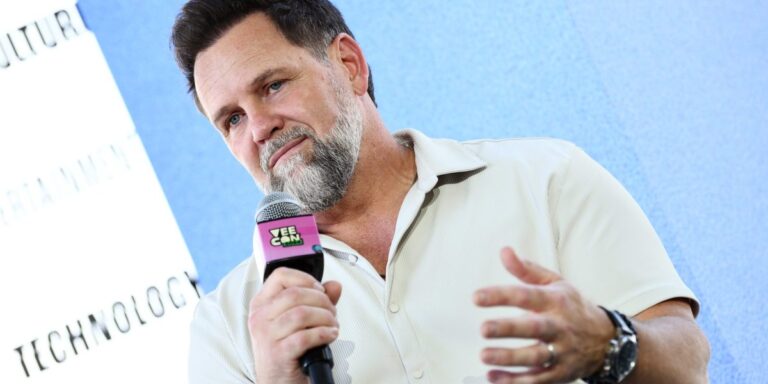
It started as a handshake deal between two guys who both believed in helping people deal with chronic pain, said Michael Wasilisin, known as Dr. Mike of MoveU on social media. Initially, after Wasilisin met and talked with Therabody founder and chiropractor Jason Wersland, the deal was for a boat, Wasilisin told Fortune.
“I trusted him because we were friends,” said Wasilisin. “The original agreement was that when they became successful, they’d buy me a boat—and the bigger the boat, the more I helped them sell.”
According to Wasilisin, he held up his end of the deal but claims he has yet to get the boat—or any compensation from Theragun sales, despite promoting the massage devices to his millions of followers on Instagram, YouTube, TikTok, and Facebook. In a lawsuit filed in California on Tuesday, Wasilisin accused Therabody of improperly leaving his name off two patents for the thumb and wedge tips that attach to the percussive massage devices. He’s seeking corrections to both patents to list him as the sole inventor, compensatory and punitive damages, and an accounting of all the Therabody products that have been sold with the attachments Wasilisin says he designed. David Hecht, a lawyer for Wasilisin, estimated the case could be in the multi millions.
In a statement, Therabody general counsel Jonathan Feldman told Fortune the claims in the lawsuit are without merit.
“Therabody has a proud history of innovation and collaboration, and we take intellectual property rights very seriously,” Feldman said. “We intend to vigorously defend ourselves against these allegations and look forward to sharing the facts through the appropriate legal process.”
Therabody manufactures and sells a variety of fitness recovery and other devices, including its flagship Theragun. The high-end massager retails for $650, and includes a variety of tips to target different areas of the body and a multitude of muscle aches and pains.
“At a high level, there’s a pool of revenue attributable to these attachments, and we’re seeking an appropriate portion given that these are Dr. Mike’s designs,” said lawyer Tanner Murphy, who is also representing Wasilisin.
Therabody was founded by Wersland, who goes by Dr. Jason, after a 2007 motorcycle accident in Los Angeles in which Wersland T-boned a Volkswagen Jetta and went flying over the car. Wersland walked away from the accident without broken bones, but he suffered severe soft-tissue damage. To deal with the pain, he created the original Theragun using a Makita jigsaw and a dish towel. The company has since grown into a health and wellness empire, and raised hundreds of millions from private investors over the years.
According to Wasilisin’s lawsuit, he reached out to Wersland in August 2017 and the two met up in Los Angeles. At that meeting, Wasilisin allegedly showed Wersland his thumb and wedge tip designs, prototypes, drawings and other documentation. He claims he agreed that Therabody could patent his designs, but only if he was listed as the inventor on patents and paid for his work. Two months later, he shipped the thumb and wedge attachments to Therabody’s offices in California.
Wasilisin claims that five months after the LA meeting, Therabody filed two patents for the thumb and wedge massage tips—and didn’t inform him or list his name. Instead, Wersland’s name was listed on the patent along with two others. Wasilisin claims the three had nothing to do with his design and development.
In 2021, three years after the February 2018 patent filings, Wersland allegedly texted Wasilisin, “I will sign something for every idea you’ve give [sic] me. I will not take your ideas without you. You’re listed on the patent for the thumb. That’s how we do.”
However, it wasn’t until two years later, to his horror, Wasilisin looked up the patents and saw his name wasn’t listed. He immediately texted Wersland.
“Dude, my heart just sank to the floor when I saw this. What happened?” he wrote, according to the lawsuit.
“I don’t know,” Wersland wrote back, according to the suit. “I’ll find out. I will fix this.”
Wersland and the two others all signed inventor oaths, the suit states. The U.S. Patent and Trademark Office requires an oath or declaration statement confirming that an inventor, or joint inventor, believes they created or co-created what is being patented. A Therabody executive reached out to Wasilisin about one of the patents, but another year went by before Therabody offered to pay Wasilisin for the thumb attachment sales, he said.
“I’d been promoting Theragun on all my channels for free, never received a penny in affiliate commission, got them hundreds of millions of views—and I did it because I believed in the product and trusted Jason,” Wasilisin told Fortune. “This is about lost friendship and lack of trust.”
Wasilisin believed that, eventually, his involvement would be formalized and he would be meaningfully compensated for his contributions. But he ultimately concluded he was never going to paid fairly without a fight, he said.
Wasilisin said Therabody offered him what he called a “bogus contract.” He ran the text through Grok AI and the analysis told him not to sign it by any means. He called Wersland and his former friend’s response utterly devastated him. He said Wersland allegedly told him, “Why can’t you just drop this?”
“Those words run through me like, he’s in the know that they’re trying to make me leave,” Wasilisin said. “This is somebody I trusted as a friend, and I loved this guy—still want to love him—and it’s so f—ing hurtful.”
Wasilisin said he wants to see Therabody—and his ex-friend Wersland—succeed but he also wants acknowledgement for his work, he said.
“This is the rare case where I don’t think Therabody can dispute that they’re using his thing,” said Hecht.
Keiny, now 20, started working as a webcam model when she was 17
One afternoon, as Isabella left school for the day, someone thrust a leaflet into her hand. “Do you want to make money with your beauty?” it asked.
She says a studio looking for models seemed to be targeting teenage pupils in her area in Bogotá, Colombia’s capital.
At 17, with a two-year-old son to support, she desperately needed money, so went along to find out more.
She says when she got there, it was a sexcam studio, run by a couple in a house in a run-down neighbourhood – it had eight rooms decorated like bedrooms.
Studios range from small, low-budget operations to large businesses with individual rooms set up with lights, computers, webcams and an internet connection. Models perform sexual acts which are streamed to viewers around the world, who message them and make requests via intermediaries, also known as monitors.
The next day Isabella, whose real name we are not using, says she started work – even though it is illegal in Colombia for studios to employ webcam models under 18.
She told the BBC World Service there was no written contract detailing how much she would be paid or what her rights were. “They had me streaming without teaching me anything. They said, ’Here’s the camera, let’s go.'”
Isabella says the studio soon suggested she do a livestream from school, so as classmates around her were learning English, she quietly took out her phone and started to film herself at her desk.
She describes how viewers began to ask her to perform specific sexual acts, so she asked her teacher for permission to go to the toilet and, locked in a cubicle, did what the customers had requested.
Her teacher had no idea what was happening, “so I started doing it from other classes”, says Isabella. “I kept thinking, ‘It’s for my child. I’m doing it for him.’ That gave me the strength.”
Recycled accounts and fake IDs
Jorge Calle / BBC
Models told the BBC that some studios use fake IDs for underage performers
The global sexcam industry is booming.
The number of monthly views of webcam platforms globally has more than tripled since 2017, reaching nearly 1.3 billion, in April 2025, according to analytics firm Semrush.
Colombia is now estimated to have more models than any other country – 400,000 – and 12,000 sexcam studios, according to Fenalweb, an organisation representing the country’s adult webcam sector.
These studios film performers and feed the content to global webcam platforms, which broadcast to millions of paying viewers around the world who make requests of models, give tips and buy them gifts.
Many of the models who work in studios do so because they lack privacy, equipment or a stable internet connection at home – often if they’re poor or young and still living with parents.
Performers told the BBC that studios often try to attract people with the promise of making easy money in a country where a third of the population lives in poverty.
Models explained that while some studios are well run and offer performers technical and other support, abuse is rife at unscrupulous operators.
And Colombia’s President, Gustavo Petro, has described studio owners as “slave masters” who trick women and girls, like Isabella, into believing they can earn good money.
The four biggest webcam platforms that stream material from the studios, BongaCams, Chaturbate, LiveJasmin and StripChat, which are based in Europe and the United States, have checks that are supposed to ensure performers are 18 or older. EU and US laws prohibit the distribution of sexually explicit material involving anyone under 18.
But models told the BBC these checks are too easily sidestepped if a studio wants to employ under-age girls.
They say one way of doing this is to “recycle” old accounts of models who are of legal age but no longer perform, and give them to under-age girls.
Isabella says this is how she was able to appear on both Chaturbate and StripChat when she was 17.
“The studio owner said it was no problem that I was under-age,” Isabella, now 18, says. “She used the account of another woman, and then I started working under that identity.”
Other models the BBC spoke to say they were given fake IDs by studios. One, Keiny, says this enabled her to appear on BongaCams when she was 17.
Milley Achinte, a BongaCams representative in Colombia, says she visits studios to check on working conditions
Milley Achinte, a BongaCams representative in Colombia, told the BBC they do not allow under-18s to perform and they shut accounts that break this rule. She added that the platform checks IDs on a Colombian government website and if a “model contacts us and we are aware that the model left the studio, we give them their password so they can close their account”.
In a statement, Chaturbate said it has “categorically” stopped the use of fake IDs, and models must regularly submit live images of themselves standing next to government-issued photo IDs, which are checked digitally and manually. It said it has “an average of one reviewer to fewer than 10 broadcasters” and any attempt to recycle accounts “would be unsuccessful” because “the age verification process continues as each and every broadcast is constantly reviewed and checked”.
StripChat also sent a statement saying it has a “zero-tolerance policy regarding under-age models” and that performers “must undergo a thorough age verification process”, adding that its in-house moderation team works with third-party verification services to “validate models’ identities”.
It said that recycled accounts cannot be used on its platform, and recent changes to its rules mean that the account holder must be present on every stream. “So, if a model moves to a new account to work independently, the original account tied to them becomes inactive and unusable by the studio.”
LiveJasmin did not respond to the BBC’s requests for comment.
Viewers ‘like it when you look young’
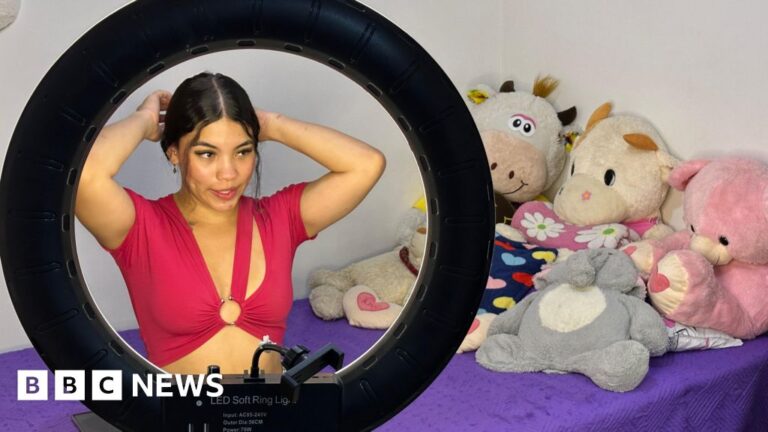
Colombian webcam model, Keiny prepares to start streaming
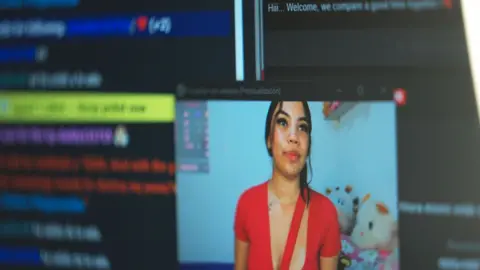
Keiny is now 20 and works from her bedroom at home in Medellín – streaming through another studio which provides a route to big international platforms.
And if it wasn’t for the high-tech equipment – several ring lights, a camera, and a large screen – this could pass for a child’s room. There are about a dozen stuffed animals, pink unicorns and teddy bears.
Viewers “really like it when you look young”, she says.
“Sometimes I think that’s problematic. Some clients ask that you act like an actual child, and that’s not OK.”
She says she got into the business to help her family financially after her parents decided to divorce.
Her father knows what she’s doing and she says he’s supportive.
Looking back, Keiny thinks she was too young when she started at the age of 17, but even so, she isn’t critical of her former employers.
Instead, she believes they helped her into a job which she says now earns her about $2,000 (£1,500) a month – far more than the minimum wage in Colombia, which is about $300 (£225) a month.
“Thanks to this job, I’m helping my mum, my dad, and my sister – my whole family,” she says.
That point of view is echoed by the studios – some of which are keen to demonstrate they look after their performers.
We visited one of the biggest, AJ Studios, where we were introduced to an in-house psychologist, employed to support models’ mental health. We were also shown a spa which offers pedicures, massages, botox and lip fillers at a “discount” or as prizes for “employees of the month” who may be high earners or people who are collaborative and support fellow models.
Fined for a toilet break
But as the country’s president has pointed out, not every performer is treated well or makes good money. And the industry is waiting to see if his new labour law will pave the way for tighter regulations.
Models and studios told the BBC that streaming platforms typically take 50% of the fees paid by viewers, studios take 20-30%, and the models get what’s left. This means that if a show makes $100 (£75), the model would usually get between $20 (£15) and $30 (£22). They explained that unscrupulous studios often take much more.
Models say there have been times when they logged on for sessions of up to eight hours and made as little as $5 (£4) – which can happen if a performance doesn’t have many viewers.
Others say they have been pressured into streaming for up to 18 hours without breaks and fined for stopping to eat or go to the toilet.
These accounts are supported by a report from the campaign group Human Rights Watch, published in December 2024. The author, Erin Kilbride, who did additional research on this story for the BBC, found some people were being filmed in cramped, dirty cubicles infested with bedbugs and cockroaches and were being coerced into performing sexual acts they found painful and degrading.
Jorge Calle / BBC
Sofi says a studio where she worked pressured her into performing sexual acts that she did not want to do
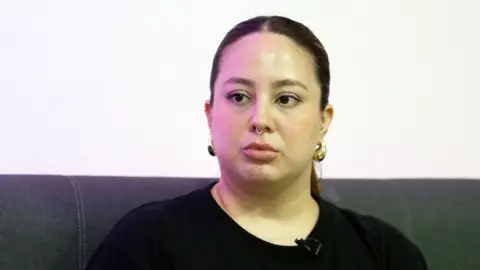
Sofi, a mother-of-two from Medellín, had been a waitress in a nightclub but, fed up with being insulted by customers, moved into webcam modelling.
But the 26-year-old says a studio she worked for pressured her into carrying out painful and degrading sexual acts, including performing with three other girls.
She explains that these requests were made by customers and agreed to by studio monitors – the staff employed to act as intermediaries between models and viewers.
Sofi says she told the studio she didn’t want to perform these acts, “but they said I had no choice”.
“In the end, I had to do it because it was either that, or they would ban my account,” she adds, explaining that means her account would effectively be closed down.
Sofi continues working in webcam studios because she says a typical salary in Colombia would not be enough to support her and her two children. She is now saving to start a law degree.
Sofi says her work in the sexcam industry means she can support her children and save for a law degree
It’s not just Colombia that is facing these issues, says Erin Kilbride.
She found that between them, the big four streaming platforms also broadcast material from studios in 10 more countries – Bulgaria, Canada, the Czech Republic, Hungary, India, Romania, Russia, South Africa, Ukraine, and the US.
And she says she identified “gaps in platform policies and protocols that facilitate or exacerbate human rights abuses”.
When we asked platforms about conditions at the studios they stream, Milley Achinte from BongaCams said she is part of a team of eight women who visit some studios in Colombia “making sure that the models are getting paid, that the rooms are clean, that models are not getting violated”.
StripChat and Chaturbate do not visit studios and said they are not direct employers of performers and therefore do not intervene in the terms set between studios and models. But they both told us they are committed to a safe working environment. StripChat also said it expects studios to ensure “respectful and comfortable working conditions”.
BongaCams, StripChat and Chaturbate all said they have teams to intervene if they believe a model is being forced or coerced to do something.
‘They deceived me’
After two months of waking up at 05:00 to juggle webcamming, secondary school, and caring for her son, Isabella says she was eager to receive her first payment.
But after the platform and the studio took their cut, Isabella explains she was paid just 174,000 Colombian pesos ($42; £31) – far less than she expected. She believes that the studio paid her a much lower percentage than agreed and also stole most of her earnings.
The money was a pittance, she says, adding that she used some of it to buy milk and nappies. “They deceived me.”
Isabella, who is still at school, only worked as a webcam model for a few months before quitting.
The way she says she was treated at such a young age left her deeply traumatised. She couldn’t stop crying, so her mother arranged for her to see a psychologist.
She and six other former employees of the studio have got together to file an official complaint with the state prosecutor’s office. Collectively, they have accused the studio of exploitation of minors, labour exploitation and economic abuse.
“There are video recordings of me still online, under-age,” she says, explaining she feels powerless when it comes to trying to get them removed. “It’s affected me a lot and I don’t want to think about it any more.”
SoundCloud has extended its exclusive advertising partnership with SiriusXM subsidiary AdsWizz, extending the latter’s role as the audio streaming platform’s primary ad sales representative across 14 European markets through 2025.
The alliance, first established in 2021, covers Germany, France, the Netherlands, Belgium, Ireland, Italy, Sweden, Denmark, Spain, Switzerland, Austria, Portugal, Finland, and Norway.
AdsWizz maintains exclusive rights to sell SoundCloud‘s audio inventory in these territories while securing additional non-exclusive access to the platform’s video and display advertising space.
The renewal comes as SoundCloud’s advertising inventory has more than doubled since the initial agreement. The Berlin-based platform now serves over 50 million global users and 20 million creators, according to the press release.
“This is a major opportunity for brands to reach new, engaged, and diverse audiences in Europe, while leveraging our contextual targeting, measurement, and ad tech capabilities.”
Paul Brown, AdsWizz
Their partnership has seen AdsWizz integrating several targeting capabilities into SoundCloud’s advertising infrastructure including mood-based targeting that allows advertisers to align campaigns with a targetable music mood.
Paul Brown, VP, European Business & Operations at AdsWizz, said: “We’re thrilled to extend our exclusive agreement and continue connecting advertisers with SoundCloud’s growing and passionate global audience of creators and music fans.”
“This is a major opportunity for brands to reach new, engaged, and diverse audiences in Europe, while leveraging our contextual targeting, measurement, and ad tech capabilities.”
Jonathan Kopitko, Senior Director, Global Partnerships at SoundCloud, said: “Renewing our deal with AdsWizz reflects SoundCloud’s continued investment in the growth of our ad-supported business across Europe.”
“This collaboration ensures we’re delivering meaningful opportunities for advertisers to connect with engaged, culturally relevant audiences—powered by innovative technology that enhances both targeting and reach.”
Jonathan Kopitko, SoundCloud
“As our global community of artists and fans expands, this collaboration ensures we’re delivering meaningful opportunities for advertisers to connect with engaged, culturally relevant audiences—powered by innovative technology that enhances both targeting and reach.”
Advertisers can access SoundCloud’s European inventory through multiple channels, including AdsWizz’s DSP AudioMatic, direct insertion orders, and the AdsWizz Marketplace.
AdsWizz was acquired by Pandora in 2018 before the latter was acquired by SiriusXM the following year.
Meanwhile, SiriusXM Media will remain SoundCloud’s sole advertising representative in the US until the end of 2025. They renewed their advertising partnership in January 2023. They first teamed up in 2018. Two years later, SoundCloud secured$75 million in investment from SiriusXM.
The State Department has offered up to $3m for information leading to the arrest of Giovanni Vicente Mosquera Serrano.
The United States Treasury Department has sanctioned the alleged leader of Tren de Aragua (TDA), a Venezuelan gang that the administration of President Donald Trump has used as justification for its immigration crackdown.
In a statement released on Tuesday, the Treasury’s Office of Foreign Assets Control said Giovanni Vicente Mosquera Serrano was not only sanctioned but also indicted by the Department of Justice.
According to unsealed court documents, Mosquera Serrano faces charges related to drug trafficking and terrorism. He was also added to the FBI’s Ten Most Wanted list, with a $3m reward offered for information leading to his arrest or conviction.
In the statement, Treasury Secretary Scott Bessent accused Tren de Aragua, under Mosquera Serrano’s leadership, of “terrorizing our communities and facilitating the flow of illicit narcotics into our country”.
It was the latest effort in the Trump administration’s campaign to crack down on criminal activity that it claims is tied to the proliferation of foreign gangs and criminal networks in the US.
Earlier this year, the Trump administration designated Tren de Aragua and other Latin American gangs as “foreign terrorist organisations”, a category more commonly used to describe international groups with violent political aims.
But Trump has used the threat of criminal networks based abroad to justify the use of emergency powers during his second term.
For instance, the Trump administration has claimed that Tren de Aragua is coordinating its US activities with the government of Venezuelan President Nicolas Maduro. That allegation was then used to justify the use of a rare wartime law: the Alien Enemies Act of 1798.
Claiming that the presence of groups like Tren de Aragua constituted a foreign “invasion” on US soil, Trump leveraged the Alien Enemies Act as the legal basis for pursuing the expedited deportations of alleged gang members.
More than 200 people were sent to a maximum-security prison in El Salvador, where many of them remain to this day.
Those deportations have drawn widespread criticism, along with a slew of legal challenges. Critics have said that the expedited deportations violated the immigrants’ rights to due process. They also pointed out that many of the deported men did not have criminal records.
Lawyers for some of the men have argued that they appear to have been imprisoned based on their tattoos and wardrobe choices. The Department of Homeland Security, however, has disputed that allegation.
At least one top US official has acknowledged that Maduro’s government may not direct Tren de Aragua.
An April memo from the Office of the Director of National Intelligence, obtained by news outlets like NPR and The New York Times, likewise cast doubt on the idea that Venezuela was controlling the gang’s movements in the US.
Rather, the memo said that the Maduro government likely sees Tren de Aragua as a threat.
“While Venezuela’s permissive environment enables TDA to operate, the Maduro regime probably does not have a policy of cooperating with TDA and is not directing TDA movement to and operations in the United States,” the memo reads.
Last July, the US and Colombia offered joint multimillion-dollar rewards for information leading to the arrest of Mosquera Serrano and two other men believed to lead Tren de Aragua.
The group was also sanctioned in the same month as a transnational criminal organisation for “engaging in diverse criminal activities, such as human smuggling and trafficking, gender-based violence, money laundering, and illicit drug trafficking”, according to a Treasury Department statement.
Numerous countries in Latin America have struggled with the gang’s rapid growth, which has been linked to political assassinations and widespread human trafficking, though experts say there is little to suggest the gang has infiltrated the US.
Fitter and Faster Swim Camps is the proud sponsor of SwimSwam’s College Recruiting Channel and all commitment news. For many, swimming in college is a lifelong dream that is pursued with dedication and determination. Fitter and Faster is proud to honor these athletes and those who supported them on their journey.
Maximus Dexter, a sprint freestyler, has committed to the University of Wisconsin-Milaukee for this fall.
“I’m very happy to announce my commitment to The University of Wisconsin-Milwaukee. After 13 years of swimming I’m still excited to progress at the collegiate level. I want to thank Coach Alex and Coach Kyle for the opportunity to swim at UWM. Along with that I want to thank Coach Erica and Coach Austin for helping me progress to this level. Lastly my Mom and Dad for all of the love and support.”
Dexter attends Henry Ford II High School and swims at Utica Shelby Swim Club in Rochester Hills.
He is the Michigan High School Division 2 State Champion in the boys 50 free, swimming a personal best 20.75 en route to the gold. Also at his high school state meet, he swam the 100 freestyle, grabbing the silver medal in another personal best time of 45.73.
Dexter primarily swims the sprint freestyle events, but his breaststroke saw significant improvement this year. At the MAC Red Championships meet in February, he went 57.45 in the 100 breast. This marked a three second drop from his preseason best time of 1:00.78.
Best SCY Times
50 Free- 20.75
100 Free- 45.73
100 Breast- 57.45
Dexter will be a strong addition for the University of Wisconsin-Milwaukee. The Panthers are a member of the Horizon League where they finished 4th last year, and they are graduating their strongest sprint freestyler.
Dexter would have been 4th in the 50 and 100 freestyle events on last year’s team, with the top 50 freestyler and the 2nd fastest 100 freestyler, Ben Lorenz graduating. Charlie House will take over the top spot in the 50 and he already held the fastest time in the 100, and Dexter will only add to their sprint freestyle depth and improve their freestyle relays.
Dexter would have been just outside scoring positions in both the 50 and 100 freestyles at the Horizon League Championships this year.. In the 50, he would have tied for 19th and in the 100 he would have been 20th overall, but he has almost a year to improve before he will be attempting to score points.
Dexter will join Emre Arican, Josh Crook, Logan Beebe, Aleks Piljevic, Dragos Cozma, and transfer Sam Lorenz as newcomers on campus.
If you have a commitment to report, please send an email with a photo (landscape, or horizontal, looks best) and a quote to [email protected].
About the Fitter and Faster Swim Tour
Fitter & Faster Swim Camps feature the most innovative teaching platforms for competitive swimmers of all levels. Camps are produced year-round throughout the USA and Canada. All camps are led by elite swimmers and coaches. Visit fitterandfaster.com to find or request a swim camp near you.
In the animal kingdom, creatures like lobsters regularly shed their exoskeletons as they grow. Similarly, snakes shed their skin as they age. Wind energy has undergone a comparable transformation over the past few decades, both in terms of total energy production and the performance of wind turbines. As turbines have increased in size and power, wind energy has essentially been “shedding its skin.” This process of adapting wind farms to accommodate the latest generation of machines is known as repowering, and in this article, we will break down everything you need to know.
In this article you will find the following topics:
Simply put, repowering involves replacing existing wind turbines at a wind farm with more advanced models that are larger and more powerful, typically after a certain period of time has passed since the initial installation. The concept of repowering is gaining traction as wind farms age and wind turbine technology continues to make significant leaps forward since the first installations in the 1980s.
If Moore’s Law applies to microchips—where the number of transistors doubles every two years—wind turbines follow a similar trend. Every five years, they increase in power, size, and height by 50% to 100%. For example, while a standard wind turbine in 1980 produced 50 kW with a diameter of 15 meters and a height of 24 meters, today’s latest-generation turbines can generate up to 20 MW, with diameters of 200 meters and heights reaching 250 meters.
Beyond just power, modern wind turbines benefit from better materials, more advanced electronics, and improved aerodynamics, leading to greater efficiency. But when is the best time to upgrade a wind farm?
The best candidates for repowering
Several factors should be considered when deciding to repower, beyond just legal aspects such as regulatory changes:
Age of wind turbines: Typically, a wind turbine has a useful life of 25 to 30 years, but it isn’t always necessary to wait until the end of this life cycle to consider repowering. In many cases, turbines have been fully amortized after ten years, making it more logical to replace them with newer, more advanced machines.
Capacity and efficiency: If existing turbines have low power or efficiency compared to current technologies, repowering can significantly boost energy production. Generally, this applies to turbines with a capacity of less than 750 kW.
Location and site conditions. Wind farms located in areas with optimal wind conditions can benefit greatly from installing more modern turbines. Typically, the first wind farms in a country are in the best locations, making them ideal candidates for repowering.
Overall, the most suitable countries for this strategy are those with older wind turbine fleets. In Europe, Denmark, Spain, and Portugal are prime examples, with average turbine ages exceeding twelve years. Repowering is already a fairly common practice across Europe, where 170 wind farms have been repowered to date.
Ten advantages of repowering
Considering the points above, the benefits of repowering are clear. Here are the top ten advantages:
More energy production using the same or less land area, thanks to the introduction of new machines.
Increased energy output with fewer turbines, due to higher power and better aerodynamics.
Improved grid integration, as new systems are better suited to current requirements.
Reduced visual impact with fewer turbines.
Lower maintenance costs with the installation of more modern units.
Faster payback periods for modern turbines, thanks to their higher efficiency.
Reduced environmental impact by utilizing existing access routes and infrastructure.
Lower installation costs compared to building a new farm, by leveraging existing infrastructure.
Creation of local jobs in installation and maintenance.
Progress toward decarbonization goals without the need for additional land dedicated to renewable energy.
A real case: El Cabrito
A real-world example from Spain—one of the first countries to embrace wind energy—illustrates the impact of repowering. Several Spanish wind farms have now reached 25 years of operation, demonstrating the significant benefits that repowering can bring.
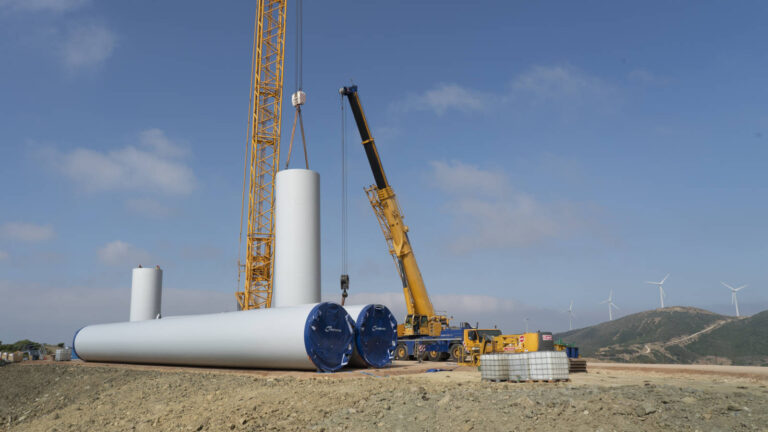
El Cabrito, an ACCIONA wind farm in Cadiz province, is a prime example. Operating for 24 years, its original setup included 90 turbines, each with a capacity of 330 kW, totaling 29.7 MW. After repowering, the number of turbines was reduced to twelve, consisting of eight 3 MW models and four 1.5 MW models from Nordex-ACCIONA Windpower. The repowering also introduced several key improvements:
Removal of 3.4 kilometers of access roads and 31 transformer sheds, restoring a total of 24,000 m² of land.
Enhanced environmental conditions due to reduced visual and noise impact from fewer turbines.
Easier passage for birds, thanks to the increased spacing between turbines and slower blade rotation speeds.
A modest increase in capacity from 29.7 to 30 MW, but with a significant 16% improvement in efficiency.
Apart from these enhancements, the repowering of El Cabrito has utilised the existing transformer substation and power evacuation line.
Repowering is just one of many ways renewable energy efficiency is being improved. Another strategy is hybridization—combining wind and photovoltaic farms within a single site, as explained in this article.
Roula Khalaf, Editor of the FT, selects her favourite stories in this weekly newsletter.
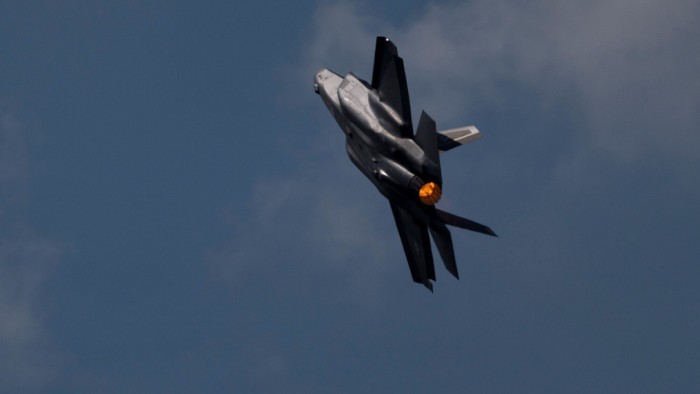
The UK is to purchase 12 US-made F-35 stealth fighter jets capable of carrying nuclear weapons, in a sweeping overhaul of the country’s defence strategy.
Under the plans, Britain will join Nato’s airborne nuclear mission, and the F-35A jets are expected to carry American atomic bombs, as the military alliance contends with the growing threat of Russia.
The UK government’s purchase of the aircraft marks a significant expansion of the country’s nuclear deterrent. Currently, Britain can only launch nuclear weapons from its Vanguard class submarines, which carry them on Trident ballistic missiles.
UK Prime Minister Sir Keir Starmer will announce the acquisition of the F-35A jets on Wednesday at a Nato summit in The Hague, where US President Donald Trump is expected to press European members of the alliance to increase their spending on defence.
Starmer said: “In an era of radical uncertainty we can no longer take peace for granted, which is why my government is investing in our national security, ensuring our armed forces have the equipment they need and communities up and down the country reap the benefits from our defence dividend.”
The F-35 jet is made by Lockheed Martin of the US, but crucial components are manufactured in Britain.
The Nato summit is likely to be contentious due to Trump’s demands that European members of the alliance increase their defence spending to 5 per cent of GDP.
Mark Rutte, Nato secretary-general, has drawn up plans for allies to allocate 3.5 per cent of their GDP to core military spending and 1.5 per cent to areas such as cyber and infrastructure by 2035, to fill gaps in European capabilities.
Rutte praised the UK commitment to buy the F-35A jets. “The UK has declared its nuclear deterrent to Nato for many decades, and I strongly welcome [the] announcement that the UK will now also join Nato’s nuclear mission and procure the F-35A.”
The UK purchase restores an atomic role to the Royal Air Force for the first time since the country retired its air-launched nuclear weapons at the end of the cold war.
The F-35A can carry both nuclear and conventional weapons, and the new jets will be based at RAF Marham in Norfolk.
The UK is already operating dozens of F-35B jets, notably from two Royal Navy aircraft carriers, but they are not capable of carrying nuclear weapons.
The government said it was committed to buying 138 F-35s in total.
Watch: Trump responds to reports US strikes did not destroy Iran nuclear programme
The US strikes on Iran’s nuclear facilities did not destroy the country’s nuclear programme and probably only set it back by months, according to an early Pentagon intelligence assessment of the attack.
The Islamic Republic’s stockpile of enriched uranium was not eliminated in Saturday’s bombings, sources familiar with the Defense Intelligence Agency evaluation told the BBC’s US partner CBS.
The White House said the “flat-out wrong” assessment was leaked by “a low-level loser in the intelligence community”.
President Donald Trump again declared the nuclear sites in Iran “completely destroyed” and accused media of “an attempt to demean one of the most successful military strikes in history”.
The US struck three nuclear facilities in Iran – Fordo, Natanz and Isfahan – with “bunker buster” bombs capable of penetrating 18m (60ft) of concrete or 61m (200ft) of earth before exploding.
But sources familiar with the Pentagon’s intelligence assessment say Iran’s centrifuges are largely “intact” and the impact was limited to aboveground structures.
Entrances to two nuclear facilities were sealed off, and some infrastructure was destroyed or damaged, but much of the facilities, which are deep underground, escaped the brunt of the blasts.
The anonymous sources told US media it is estimated the attack only set Iran back “a few months, tops”, and that any resumption of its nuclear programme may be based on how long it takes the country to dig out and make repairs.
Sources also confirmed to CBS that some of Iran’s enriched uranium stockpile was moved before the strikes, according to the intelligence assessment.
The US 30,000lb (14,000kg) Massive Ordnance Penetrator bomb was thought to be the only weapon capable of destroying Iran’s underground enrichment facilities. Tehran had always said its nuclear programme is for peaceful purposes.
Satellite image (c) 2025 Maxar Technologies via Getty Images
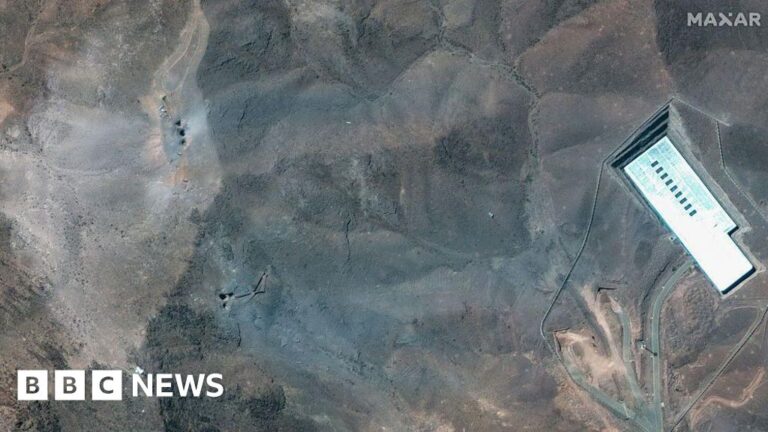
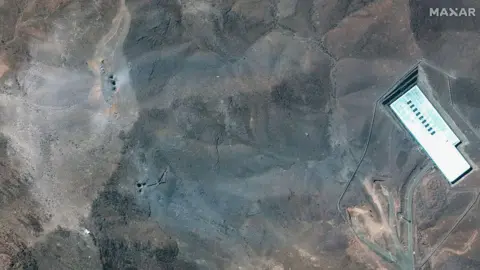
Satellite images after the US attack show large craters visible at the Fordo nuclear site in Iran
In the hours that followed the Saturday strikes, Gen Dan Caine, chairman of the joint chiefs of staff, told reporters that it would take time to assess the damage to the facilities.
But he added that “all three sites sustained extremely severe damage and destruction”. Satellite images showed six fresh craters clustered around two entry points at the Fordo nuclear sites, as well as grey dust and debris.
It is unclear from the images, however, how much damage the sites sustained below the surface.
Hassan Abedini, the deputy political director of Iran’s state broadcaster, claimed the three sites targeted by the US had been evacuated a “while ago”, and that Iran “didn’t suffer a major blow because the materials had already been taken out”.
US officials, on the other hand, hailed the mission as a success, as have Israeli officials.
In a statement on Tuesday, Defence Secretary Pete Hegseth said that “based on everything we have seen – and I’ve seen it all – our bombing campaign obliterated Iran’s ability to create nuclear weapons”.
“Anyone who says the bombs were not devastating is just trying to undermine the President and the successful mission,” Hegseth said.
US Congressman Brad Sherman, a Democratic member of the House Foreign Affairs Committee, told the BBC the Trump administration was using vague terms to declare victory – when it’s still unclear what the bombing mission accomplished.
He said the administration hasn’t said whether the strikes destroyed Iran’s ability to weaponise its uranium, its uranium-enriching centrifuges or depleted its stockpile, which he said would be enough to create nine nuclear weapons.
“When they say obliterate the programme, they’re not even saying whether it’s obliterated the centrifuges and the ability to create uranium in the future or whether it is obliterating the stockpile,” Sherman told BBC.
“All indications, including Vice-President Vance’s statement, indicate that we don’t think we got the stockpile,” he said, noting images that show trucks going to one of the facilities days before the strikes.
US didn’t hit ‘stockpile’ in Iran nuclear sites strikes, says Congressman Sherman
Prime Minister Benjamin Netanyahu said on Tuesday that since hostilities with Iran began on 13 June, Israel has been successful in curbing Iran’s nuclear ambitions, as well as destroying its missiles arsenal.
“We have removed two immediate existential threats to us – the threat of nuclear annihilation and the threat of annihilation by 20,000 ballistic missiles,” Netanyahu said in video remarks issued by his office.
A report in Saudi news outlet Al Hadath, citing an unnamed Israeli source, said that Israel believes most of Iran’s enriched uranium is buried under the rubble.
The US has 18 intelligence agencies, which sometimes produce conflicting reports based on their mission and area expertise. For example, the American intelligence community is still not in agreement over the origins of Covid-19.
It is possible future intelligence reports will include more information showing a different level of damage to the facilities.
David Albright, president of the Institute for Science and International Security and an expert on secret nuclear weapons development, said the damage Iran sustained by the US attacks will mean “it will take significant time, investment and energy” for it to restore its nuclear programme.
In a post on X, Albright added that Iran is “under intense scrutiny and observation from the United States and Israel”, and it risks further attacks if it tries to rebuild.
On Monday, Iran retaliated against the US airstrikes by launching a missile attack on Al-Udeid Air Base in Qatar, which is home to thousands of US troops.
That attack was largely intercepted, and no casualties or injuries were reported.
Since Iran’s retaliation, an Iran-Israel ceasefire – brokered by President Trump and Qatari mediators – is in place.
Christina Goldbaum, a New York Times reporter, and Katrin Bennhold, a senior writer on the international desk, discuss how the power dynamics in the Middle East could change as Iran has become more isolated.