13.2 C
New York
Sunday, April 5, 2026
Home Blog Page 603

Attack wounds US aid workers

0

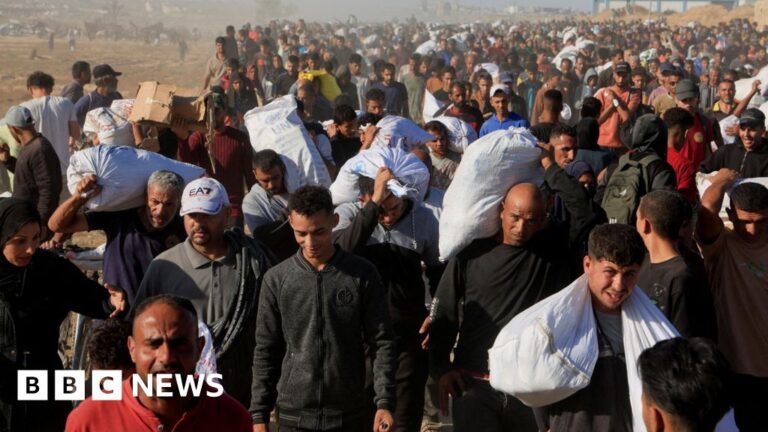
A controversial aid operation for Gaza backed by Israel and the US says two of its workers have been injured in an attack while giving out relief.

Two militants threw grenades at the aid centre in Khan Younis, the Gaza Humanitarian Foundation (GHF) said. It blamed Hamas for Saturday’s incident.

The injured US workers are in a stable condition and are receiving medical treatment. No other aid workers or civilians were harmed, the group added.

The GHF began its operations in May, distributing aid from several sites in southern and central Gaza. The system has been widely criticised for forcing vast numbers of people to walk through combat zones.

Since the GHF was launched, Israeli forces have killed more than 400 Palestinians trying to collect food aid, the UN and local doctors say. Israel says the new distribution system stops aid going to Hamas.

The attack comes as Hamas has indicated it is ready for talks on a ceasefire with Israel.

The GHF said the incident “occurred at the conclusion of an otherwise successful distribution in which thousands of Gazans safely received food”.

The organisation added it had “repeatedly warned of credible threats from Hamas”, including plans to target American personnel, Palestinian aid workers and civilians.

Hamas has not commented on the incident.

Meanwhile, Gaza’s civil defence agency said 32 Palestinians have been killed by Israeli military operations on Saturday.

On Friday, Hamas said it was ready for more talks on a ceasefire agreement put forward by the US.

The plan is believed to include the staggered release of Israeli hostages in exchange for Palestinian prisoners held in Israeli jails.

The BBC understands that Hamas wants amendments to the draft, including a US guarantee that hostilities will not resume when the ceasefire ends.

Hamas also wants the GHF to be scrapped and aid to be distributed by the UN and its partners only. Israel has previously rejected such demands.

Fifty hostages are still being held in Gaza, at least 20 of whom are believed to be alive.

According to Gaza’s health ministry, at least 70 people have been killed in the territory by Israeli forces in the last 24 hours.

The ministry said the total death toll in Gaza has risen to 57,338 during Israel’s war against Hamas.

The Israeli military launched its campaign in response to the Hamas attacks on 7 October 2023, in which about 1,200 people were killed and 251 others were taken hostage.

Virgin Music Group executives denounce opponents of Downtown acquisition for spreading ‘immature and offensive misinformation’

0

Virgin Music Group is having its say.

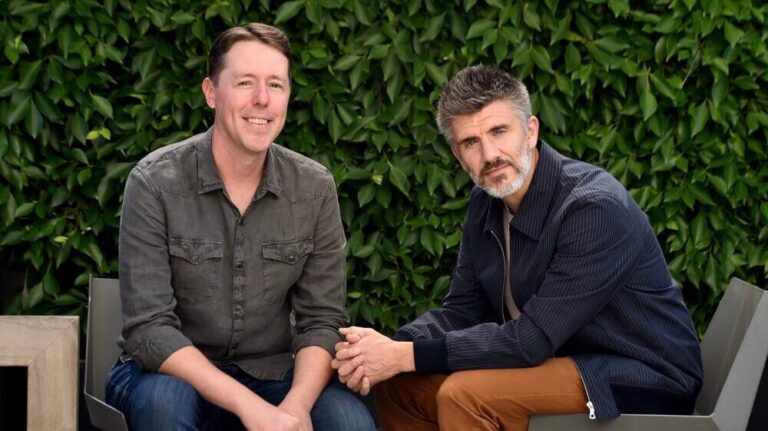
To date, JT Myers and Nat Pastor, the co-CEOs of the global services company, have publicly refrained from discussing opposition to Virgin’s proposed $775 million takeover of Downtown Music Holdings.

That just changed.

In a new letter to VMG staff, obtained by MBW, Myers and Pastor address several accusations made about Virgin – and its parent company, Universal Music Group – from parties who want regulators to block the Downtown acquisition.

Myers and Pastor, who co-founded mtheory before joining Virgin, don’t name particular individuals or companies in their letter.

However, they respond to a number of specific public statements, including:

  • An accusation from IMPALA, which represents the interests of a group of independent labels in Europe, that Virgin will exploit the customer data of Downtown (and subsidiary FUGA) to feed UMG a market advantage. Myers and Pastor respond: “Betraying the trust our clients have bestowed on us would be self-destructive: they would quickly, and quite rightly, end the relationship. Which is why we’re proud to say that since the day we entered this business, we have never had a single complaint of misuse of client information of any kind.”
  • A surprising recent claim from IMPALA’s Helen Smith – citing an unnamed data source – that Universal gained recorded music market share in Europe (ex-UK) between 2012 and 2023. For a full decade during this period, UMG was legally blocked from making significant acquisitions in the EU, a condition of its 2012 buyout of EMI Music. During the same decade, EU-based distributors such as Believe and Amuse rapidly grew, while rival Sony went on an acquisition tear, buying indies like Phonofile (Norway), finetunes (Germany), and Century Media (Germany). Pastor and Myers argue: “There is ZERO credible data to support [Smith’s market share claim]… and for a very good reason: It’s not true. The reality is that during this period the independent sector’s marketshare has grown materially, while UMG’s marketshare has not.”
  • A warning from Beggars Group boss Martin Mills, issued in December, that Virgin’s proposed Downtown acquisition would be “another step on the road of UMG’s pretence to be the independents’ fairy godmother. But there’s a wolf under that cape”. To this, Myers takes particular umbrage. He writes: “Nat and I are used to a bit of name-calling. But the insinuation that Virgin is anything but a positive force in the independent marketplace is an insult to all of you who comprise the Virgin Music Group family… Any assertions to the contrary are juvenile, offensive, and are just falsehoods being spread by those who are willing say anything to hurt the chances of this deal happening.”

Myers and Pastor’s letter was sent to Virgin employees earlier today (July 3).

You can read it in full below.

To the Virgin Music Group team:

As you all know by now, we are tremendously excited about the pending combination of Downtown and Virgin.

Given the bold visions of the future and the mutual respect our companies share, we are confident our combined business will be able to deliver enormous added value to our clients.

We are writing this note to you now for two reasons: first, to briefly update you on the regulatory status of the proposed acquisition, and second, to clear up some of the falsehoods that opponents of the deal are perpetuating, which I’m sure might even be confusing or concerning to you.

First, an update on the status of the merger: Last month, the European Commission initiated ‘Phase I’ of its review of Virgin’s acquisition of Downtown. In the coming weeks, the Commission is expected to announce whether it has no objection to the deal, in which case we will then proceed to close the transaction, or whether the Commission has decided to afford itself more time to review the case – for example by moving into “Phase II”.

Now to those falsehoods:

While the merger has rightly been under regulatory review around the world for the last six months, our priority has naturally been to present to the regulators our position on the transaction. We nevertheless want to bring truth to bear against some of the fictions and falsehoods being spread by the familiar cast of characters, including professional lobbyists, who oppose our companies’ coming together.

Here are a few examples:


1. FICTION: Virgin will exploit Downtown’s customer data to gain a competitive edge for UMG.

FACT: Virgin will not exploit Downtown’s customer base for any reason.

Virgin will not only uphold Downtown’s data privacy policies, we will also expand and strengthen them. Virgin already handles – with the care and confidentiality they deserve – the sensitive client data of hundreds of partners.

Betraying the trust our clients have bestowed on us would be self-destructive: they would quickly, and quite rightly, end the relationship. Which is why we’re proud to say that since the day we entered this business, we have never had a single complaint of misuse of client information of any kind.


2. FICTION: Virgin will restrict or shut down services such as FUGA, Curve, CD Baby, Downtown Music Publishing, or Songtrust.

FACT: Virgin is doing this deal for exactly the opposite reason. We see the extraordinary value of investing in and expanding access to these and other platforms.

Over the last three years, we’ve been building Virgin within UMG as a standalone, global services business with its own leadership, tech stack, and autonomy. The deal with Downtown will strengthen the foundation we’ve built thus far.

Our motivation for the merger and our excitement about it are rooted in this singular opportunity: by combining Downtown’s and Virgin’s unique capabilities, the unified company will offer an even more robust and flexible suite of services to independent labels everywhere.


3. FICTION: UMG’s market share in Europe (ex-UK) has skyrocketed by 18 percentage points since the EMI acquisition in 2012.

FACT: There is ZERO credible data to support this … and for a very good reason: It’s not true. The reality is that during this period the independent sector’s marketshare has grown materially, while UMG’s marketshare has not.

Why? Well, the growth of the independent community has been the product of several factors: private and venture capital has poured into both indie labels and services providers; artists have more tools than ever; streaming has democratized music; and a new generation of companies has flourished.

“Today, approximately one hundred services companies are competing to partner with independent labels and artists”

Competition among the services businesses is thriving precisely because of the continued investment in them and the flood of new entrepreneurs – label executives and artists themselves – into the marketplace. The more investment that flows into the services businesses, the more independent labels benefit, because more investment means better resources and greater competition among services providers.

Today, approximately one hundred services companies are competing to partner with independent labels and artists. The stronger the provider of services, the greater the chance that the independent label and artist has to succeed in today’s market.


Finally, we want to address a series of personal attacks that have been levelled against Virgin and us during this lobbying effort in the press. We have been called “wolves behind the cape” – that is, that we’re secretly preying on the very community we claim to serve.

Nat and I are used to a bit of name-calling. But the insinuation that Virgin is anything but a positive force in the independent marketplace is an insult to all of you who comprise the Virgin Music Group family, who work tirelessly every day to help independent labels and artists achieve their goals. Any assertions to the contrary are juvenile, offensive, and are just falsehoods being spread by those who are willing say anything to hurt the chances of this deal happening.

“[These assertions are] juvenile, offensive, and are just falsehoods being spread by those who are willing say anything to hurt the chances of this deal happening.”

The independent sector isn’t monolithic, as you know. It’s comprised of thousands of labels and artists all over the world. Some subscribe to the reductive “major = bad, indie = good” worldview, others don’t. We personally think that in an independent space this dynamic – comprised of the legendary “old guard” of iconic independent labels as well as a generation building the iconic companies of the future; of bootstrapped companies alongside ones backed by some of the largest private equity, venture capital and technology companies in the world; of artists just beginning their careers next to some of the largest global superstars – that things just aren’t that simple anymore.

But that’s just our opinion. We don’t get to decide for the whole independent space, but neither does anybody else. Every member of the independent community gets to make their own choice, based on their own value system. And that goes for their choice of service provider – companies can choose Virgin, Downtown or any of the scores of other partners, independent or major, based on their commercial needs and preferences.

“The independent sector isn’t monolithic, as you know. It’s comprised of thousands of labels and artists all over the world. Some subscribe to the reductive ‘major = bad, indie = good’ worldview, others don’t.”

That’s why, in 2022 the two of us joined Virgin to try and develop another choice – one that we felt would be a good one for entrepreneurs like us, one that we didn’t think was being provided by the many existing players in the market. With the acquisition of Downtown, we see a significant opportunity to provide independents with something even more effective to advance their commercial and creative goals. We also know that we will be competing every day with dozens of other global service providers, so in order to win we will have to be the best partners the indie community can work with. And that is exactly what we are going to be.

We are so excited about everything to come, and I know all of us at Virgin look forward to speaking directly with all of our Downtown colleagues very soon.

Wishing you all the best,

Nat & JT

Pastor and Myers’ letter follows a widely-read op/ed from Kenny Gates on the subject of IMPALA vs. UMG/Downtown, published on MBW yesterday (July 2).

Gates is co-founder of both IMPALA and [PIAS]. Universal fully acquired the latter company last year.

He wrote: “I have always been a proud co-founder of IMPALA (there’s a reason it’s headquartered in Brussels). Yet it’s a great shame that it’s become a small-minded, inward-looking organization, more concerned with focusing on imaginary problems than contributing solutions that actually help the music industry.

“The times, they are a-changing… and make no mistake: the times have changed.

“Independent music rightsholders – whether artists or labels – are thriving in a new ecosystem. The whole binary ‘indies vs. majors’ narrative is passé.”Music Business Worldwide


More than 700 Palestinians killed while seeking aid in Gaza during Israel-Palestine conflict

0

More than 700 Palestinians have been killed trying to get food in the Gaza Strip over the past few weeks, according to new figures from the Gaza Health Ministry, spurring renewed condemnation of a contentious United States and Israeli-backed aid scheme.

The Health Ministry said on Saturday that at least 743 Palestinians were killed and more than 4,891 others were injured while seeking assistance at Gaza Humanitarian Foundation (GHF) distribution sites.

The GHF, which began operating in the bombarded Palestinian enclave in late May, has drawn widespread criticism amid multiple reports that its contractors as well as Israeli forces have opened fire on aid seekers.

“The tragedy is that this is again a conservative reading of casualties who were at these distribution points, waiting for food parcels,” Al Jazeera’s Hani Mahmoud said of the ministry’s latest figures.

Reporting from Gaza City, Mahmoud said the attacks on aid seekers come as Palestinian families are desperate to feed their families amid dire shortages caused by Israel’s blockade of Gaza.

“People are going hungry. People are rationing supplies. A lot of families are not eating. Mothers here skip meals in order to provide for their children,” he said.

Earlier this week, a report by The Associated Press news agency quoted American contractors who said live ammunition and stun grenades have been fired at Palestinian civilians seeking aid at GHF distribution points.

Two unnamed US contractors told AP that heavily armed staff members appeared to be doing whatever they wanted.

The GHF denied the news agency’s reporting as “categorically false” and said it takes “the safety and security of [its] sites extremely seriously”.

The administration of US President Donald Trump also has stood by the GHF, with a State Department spokesperson telling reporters on Wednesday that the group is the “one entity that has gotten food and aid into the Gaza Strip”.

In late June, the Trump administration pledged $30m in direct funding for the organisation.

On Saturday, the GHF said two US workers at one of its sites in southern Gaza’s Khan Younis were injured when grenades were thrown at them at the end of food distribution. “The injured Americans are receiving medical treatment and are in stable condition,” the group said.

It was not immediately clear who was responsible for the attack.

Leading humanitarian and human rights groups have demanded the immediate closure of the GHF, which they accused of “forcing two million people into overcrowded, militarized zones where they face daily gunfire and mass casualties”.

Amnesty International has described the group’s operations as an “inhumane and deadly militarized scheme”.

“All the evidence gathered, including testimonies which Amnesty International is receiving from victims and witnesses, suggest that the GHF was designed so as to placate international concerns while constituting another tool of Israel’s genocide,” Amnesty said.

Still, faced with dire shortages of food, water and other humanitarian supplies under Israel’s blockade, many Palestinians in Gaza say they have no choice but to seek assistance from the group, despite the risks.

“I was forced to go to the aid distribution centre simply because my kids had not eaten for three days in a row,” Majid Abu Laban, a Palestinian man who was wounded in an attack at a GHF site, told Al Jazeera.

“We try to fool our children by all means, but they are starving,” Abu Laban said.

“So I decided to risk my life and head to [an aid distribution point] at Netzarim,” he said, referring to an Israeli military-established corridor south of Gaza City.

“I took the road at midnight hoping to get some food. As crowds rushed in, Israeli forces fired artillery shells at us. In the chaos, everyone was just trying to survive.”

Challenging the Client

0


Client Challenge


JavaScript is disabled in your browser.

Please enable JavaScript to proceed.

A required part of this site couldn’t load. This may be due to a browser
extension, network issues, or browser settings. Please check your
connection, disable any ad blockers, or try using a different browser.

Australian Prime Minister promises to use full legal power in response to arson attack on Melbourne synagogue

0

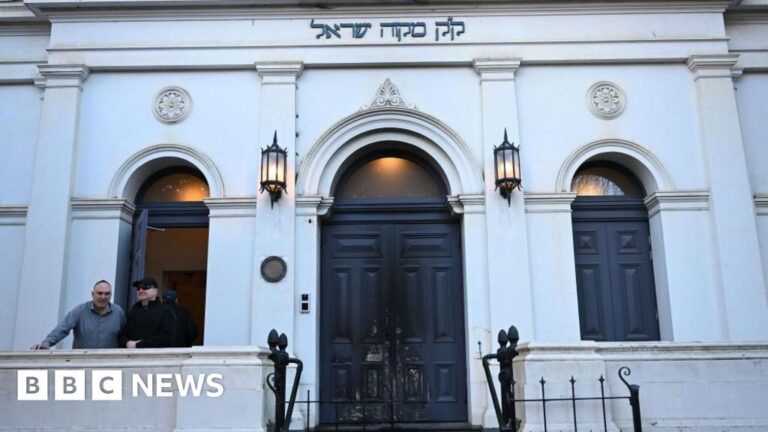
JAMES ROSS/EPA/Shutterstock Fire marks on the blue door of the East Melbourne Hebrew Congregation in Melbourne, with two men to the left in front of an open windowJAMES ROSS/EPA/Shutterstock

Inside the synagogue, some 20 people had sat down for dinner when the attack occurred

Australia’s prime minister has promised to take strong action following an apparent arson attack on a synagogue in Melbourne.

Police are looking for a man who poured liquid on the synagogue’s front door before setting it on fire on Friday night. Some 20 people having dinner inside at the time were evacuated without any injuries.

Police are also trying to determine if the incident is linked to an attack against a Jewish-owned restaurant in the city on the same night.

A string of antisemitic attacks have occurred in Australia in the past few months, sparked by tensions over the Israel-Hamas war.

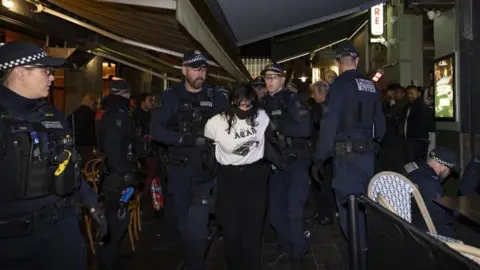
JOSH STANYER/EPA/Shutterstock Police take away an anti-Israeli protester with a black face mask, long dark hair and a white top from the restaurant where more police officers and others can be seenJOSH STANYER/EPA/Shutterstock

Protesters at the restaurant shouted slogans against the Israeli military

The Australian government has appointed a special envoy to combat antisemitism, and passed tougher laws against hate crimes following a wave of high-profile attacks.

“Antisemitism has no place in Australia,” Prime Minister Anthony Albanese said following the attack on the East Melbourne synagogue.

“Those responsible for these shocking acts must face the full force of the law and my government will provide all necessary support toward this effort,” Albanese said.

It is not clear if the incident was linked to the attack on the Miznon restaurant in the city’s business district during which rioters broke in, throwing chairs and other objects while chanting “death to the IDF [Israel Defense Forces]”. Some of the attackers were led away in handcuffs.

“These events are a severe escalation directed towards our community,” said Alex Ryvchin, co-chief executive of the Executive Council of Australian Jewry.

“There have been too many antisemitic attacks in Australia,” Israel’s Foreign Minister Gideon Saar said.

“The Australian government must do more to fight this toxic disease.”

The ongoing conflict in the Middle East has become a volatile political issue in Australia.

It has resulted in protests from both Jewish and Muslim communities, as well as a sharp uptick in Islamophobia and antisemitism.

The Israeli military launched a campaign in Gaza in response to the 7 October 2023 attack, in which about 1,200 people were killed and 251 others were taken hostage.

At least 57,268 people have been killed in Gaza since then, according to the territory’s health ministry.

24 Dead in Texas Flash Floods; Two Dozen Young Campers Still Missing

0

At least 24 dead in Texas flash flooding; two dozen young campers missing

US-Israel discussions intend to enforce a decision at a later date

0

Political analyst Xavier Abu Eid says US-Israel talks may aim to shape a Gaza deal before negotiations with Hamas begin.

Increased Number of Retailers Adding Coffee Shops to Cater to Budget-Conscious Customers

0

Café Dior in Chengdu. Carhartt Coffee in London. Santander Work Café in Brooklyn.

Around the world, brands ranging from luxury fashion houses to workwear to banks are opening up coffee shops.

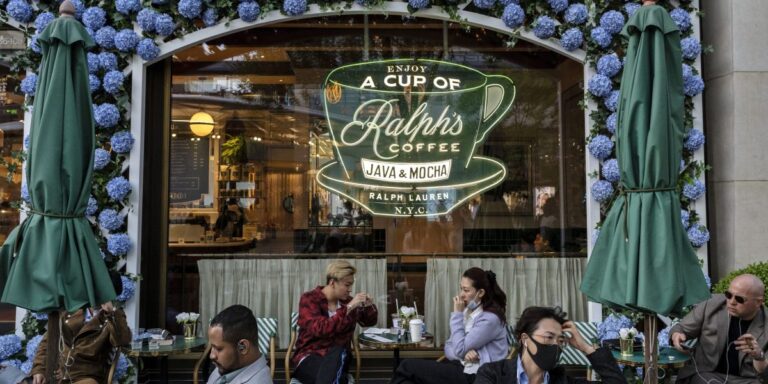
The phenomenon of retailers hosting coffee shops isn’t exactly new, as anyone who’s ever been to a Starbucks inside of a Target can tell you. But the number of brand-owned and -operated coffee shops seems to be creeping up. Ralph’s Coffee, owned by Ralph Lauren, opened in Manhattan in 2014, and is now neighbored by the Blue Box Café at Tiffany & Co., a Capital One Café, and a Uniqlo Coffee around its Fifth Avenue location. (And that’s not even including the brand restaurants.)

Post-Covid, there’s been a resurgence of interest in preserving or even establishing “third places,” which refers to places to spend time outside of home and work at the same time that brands are seeking to broaden their customer bases on- and offline by investing in customer experiences. Coffee shops, it seems, are working to satisfy both sides.

Sip, sip, pass

Earlier this year, Japanese-owned clothing retailer Uniqlo opened a coffee shop—its first in North America—at its store on Fifth Avenue to “enhance the shopping experience” for customers and project a welcoming brand persona, Nicolas Cessot, head of marketing for Uniqlo North America, told us.

“It’s a great branding proposition for us,” Cessot said. “It is a global flagship, so for us, it’s a global opportunity to continue to spread our brand [awareness] to customers from all over the world.”

Uniqlo has existing coffee shops in Tokyo, where Cessot said customer experience and hospitality is a cultural priority, and Manila. Other retailers, like French fashion brand Maison Kitsuné, also started their journey into coffee in Asia, with the first Café Kitsuné opening in 2013 in Okayama, Japan. Earlier this year, Japanese lifestyle brand Muji opened a food market in Manhattan, its first in the States.

It’s not just brands from overseas expanding their hospitality offerings. American brands Kate Spade and Coach have been experimenting in the hospitality space in Dubai and Jakarta, Indonesia, respectively, while Coach has also opened up coffee shops in Texas and New Jersey.

Beyond reaching new customers around the world, brand coffee shops allow retailers to reach customers across different interests—including those who might not want new clothes, but do want a cup of joe, Cessot said. That seems to be a key reason why higher-end brands like Dior and Ralph Lauren are opening cafés: to reach customers outside of their usual demo, specifically those who may not be able to or may not want to spend big bucks on a purse, but can justify a $7 iced latte.

“It’s giving people this opportunity to engage with the brand from a lifestyle standpoint, even if they can’t purchase a product,” Michelle Baumann, chief strategy officer, commerce at VML, told us.

That being said, a small purchase like a coffee can increase customer “dwell time,” which could mean more time to consider a larger buy. “The longer you’re in [store], the more likely you are to browse, the more likely you are to purchase,” Baumann said.

And, it seems, more likely to post. Canadian clothing brand Aritzia has been operating its in-store A-OK Cafes since 2018, and customers often share videos and images of drink tokens online, Baumann noted. Daniel Boulud, chef at Tiffany & Co.’s Blue Box Café, told Food & Wine earlier this year that “with social media today, [the café] has even more appeal” with its colorful interior.

“[Cafés are] doing a lot in terms of the amplification and being able to create that earned equity,” Baumann said. “You’ve got Instagrammable spaces and a lot of social media exposure.”

After opening its Fifth Avenue coffee shop, Cessot said Uniqlo saw plenty of user-generated content about the location on TikTok and Instagram.

“We’re…encouraging people to create and generate more content so we can continue to spread the news and spread our brand awareness across the country,” he said.

“How do you personify a brand?

Whether it’s a YSL Café in Paris or an Ikea cafeteria, a unifying purpose among them all seems to be a desire to enhance the customer experience, Baumann said.

At Capital One, which opened its first Capital One Café in 2014, that is certainly the case, said Jennifer Windbeck, SVP of retail bank channels and operations, who told us the move was inspired, in part, by the insight that customers value in-person interactions around customer service and money management needs.

“There’s a major purpose of the café that’s not just basic banking,” Windbeck said.. “It is, ‘How do you personify a brand, and what is that in-person experience?’”

Capital One now operates more than 60 cafés in metropolitan areas across the country, the latest of which opened in New York’s SoHo neighborhood earlier this month. Inside the cafés, the brand hosts events ranging from coding classes to financial literacy workshops, which Windbeck said has helped build Capital One’s brand image as more than a credit-card company. Capital One Cafés also run promos that aim to encourage repeat foot traffic, including one where visitors get free drinks every Monday of the MLB season.

While the ultimate goal is to drive customer sign-ups, Windbeck said the cafés (and deals) are for everyone, not just Capital One customers. Offering amenities like free wi-fi allows Capital One to market to the masses “in a very intentionally non-sales” and “organic way,” she said.

Light roast ahead?

While there are plenty of benefits, opening a coffee shop can be a costly endeavor when considering the labor and materials, not to mention the potential for stains from coffee spills. (Neither Uniqlo nor Capital One would disclose operating costs or whether the cafés are revenue generators, although Windbeck said the continued expansion of Capital One Cafés could be seen as a sign of Capital One’s satisfaction with its results.))

There can also be reputational risks. Besides possibly getting roasted like the beans it’s serving, Baumann noted that a brand coffee shop could be a threat to a brand’s image if the location doesn’t provide an adequate level of service. That’s especially true if the coffee isn’t free she said.

“If you have poor service, if people are waiting for a long time, all of a sudden that’s actually going to detract from the overall shopping experience,” she said.

For help on those fronts, some retailers choose to work with existing coffee brands like Verve Coffee, Capital One’s coffee partner of choice; La Colombe, which is served at Ralph’s; and Allpress, which has worked with Carhartt and Patagonia to help ensure product quality. But as with any business, there can also be risks for partners, Baumann said, citing Ralph’s growing reputation as a tourist destination.

Still, she said, she expects more brands to get in on the trend, especially since it can serve as a way to introduce novelty and surprise customers with additional offerings. If nothing else, visitors to these stores can know one thing for certain: No one’s going to ask them to leave their coffee cups at the door.

This report was originally published by Marketing Brew.

Swimmers welcome back to Waters after hundred-year prohibition

0

Thomas Mackintosh

BBC News

Reuters People swim in the River Seine at the Bras Marie siteReuters

There are now three designated areas in Paris for swimming in the Seine

The River Seine in Paris has reopened publicly to swimmers for the first time since 1923 after a century-long ban.

The seasonal opening of the Seine for swimming is viewed as a key legacy of the Paris 2024 Olympics, when open water swimmers and triathletes competed in its waters which were specially cleaned for the event.

On Saturday morning at 08:00 local time (07:00 BST) a few dozen swimmers arrived ahead of the opening and dived into the water when they were able to do so.

There are three designated areas for public swimming in the Seine – one near the Eiffel Tower, another close to Notre Dame Cathedral and a third in eastern Paris.

Zones have changing rooms, showers, and beach-style furniture, which allow for up to 300 people to lay out their towels.

Until the end of August, the three swimming sites will be open for free at scheduled times to anyone with a minimum age of 10 or 14 years, depending on the location.

Lifeguards will also be present keeping an eye on those in the river.

The promise to lift the swimming ban dates back to 1988, when then-mayor of Paris and future president Jacques Chirac first advocated for its reversal.

Improvements over the last 20 years have already led to a sharp reduction in faecal bacteria entering the river.

For 100 years swimming was banned in the river because of the levels of water pollution that could make people ill.

A map of central Paris showing the river seine flowing through the city and three areas plotted as to where the open swimming will be allowed during seasons

Ahead of last summer’s Olympics more than €1.4bn (£1.2bn; $1.6bn) was invested into cleaning up the Seine.

But, in the lead up to the games there were doubts as to whether the River Seine would be ready for the Olympics after it was revealed it failed water quality tests.

Organisers blamed rainfall for the increased pollution which limited athletes’ abilities to train for the triathlon, marathon swimming and paratriathlon.

Last July, Paris Mayor Anne Hidalgo and other members of the Olympic committee went into the Seine to prove that it was safe to swim in.

Last summer BBC correspondent Hugh Schofield was among those who took a dip in the Seine.

Warner Music Finland purchases the music catalog of independent record label Skorpioni

0

Warner Music Finland has acquired the catalog of independent record company Skorpioni.

The indie label announced earlier this year that it would be ceasing operations.

The press release announcing the acquisition noted that it marks “a significant transition in the local industry as Warner Music Finland will now be responsible for the distribution, administration, licensing, and promotion of Skorpioni’s repertoire to new audiences”.

The announcement on Thursday (July 3) added that Skorpioni “redefined what a record company could look and sound like in Finland” and that “it leaves behind an exceptional legacy, which includes numerous critically acclaimed and widely beloved releases that have played a central role in shaping Finland’s domestic music scene”.

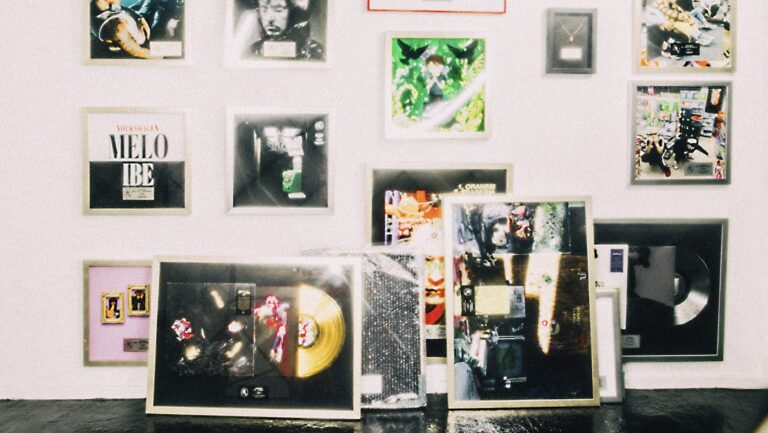
Skorpioni’s signings over the years included the likes of ibe, MELO, Turisti, DJ Ibusal, Sliki & Hamuelos, Fabe, and many others.

The label was known, according to Warner Music Finland, “for its uncompromising vision, brave artist choices, and ability to bring forth new voices, many of whom have grown into key figures of their generation”.

Skorpioni said in a statement: “Skorpioni has always been more than just a brand – it has been a vision and a love for music.

“We wanted a home for the catalog that understands its significance and value.”

Skorpioni

The statement continued: “When the decision was made to close down, it was absolutely desired that the songs would live on. We wanted a home for the catalog that understands its significance and value.

“We trust that our catalog will be in good hands at Warner Music in the future.”

“It is a great honor to take responsibility for such an influential catalog.”

Ramona Forsström, Warner Music Finland

Ramona Forsström, CEO of Warner Music Finland, added: “Skorpioni has been a trendsetter in Finnish music – brave, visual, loud, and heartfelt. It is a great honor to take responsibility for such an influential catalog.

“We’re committed to ensuring that its music lives and grows with new generations.”


Forsström was promoted to the role of Managing Director of Warner Music Finland, effective November 2023. Forsström had been General Manager of the business since 2021.

The exec succeeded Niko Nordström, who stepped down from his position as MD, Warner Music Finland and EVP, Warner Music Nordics later that year.Music Business Worldwide