

10.2 C
New York
Tuesday, April 7, 2026
Home Blog Page 585

Families of victims from Air India crash demand explanations following release of report

0

Samira Hussain

South Asia correspondent

BBC Inayat Syed, 49, with his wife Nafeesa, along with their son and daughterBBC

For days, Imtiyaz Ali had been anxiously awaiting the findings of a preliminary report into last month’s Air India crash that killed his brother, sister-in-law, and their two young children.

When the report was finally released early on Saturday in India, he read it carefully – only to be disappointed by what he said “reads like a product description”.

“Other than the pilots’ final conversation, there’s nothing in it that really points to what caused the crash.”

He hopes more details will be made public in the months to come.

“This matters to us,” Ali said. “We want to know exactly what happened. It won’t change anything for us now, we continue grieving – just as we have since that day. But at least we’ll have some answers.”


Javid Ali, hair short and wearing a brown button-down shirt, stands holding his daughter Amani, wearing a dress, beside his wife Maryam Ali, wearing a belted dress, glasses, and her dark hair short. Their son Zayn stands in front of them, Javid's arm around him.

Javid and Maryam Ali with their children Zayn and Amani, who died in the crash

The London-bound Air India flight 171 crashed into a suburban neighbourhood in the western Indian city of Ahmedabad shortly after take-off on 12 June, killing 241 of the 242 people on board and 19 others on the ground.

A preliminary investigative report released on Saturday in India said fuel to the engines of the plane cut off just seconds after take-off. The circumstances around how or why that happened remain unclear.

The report said that in recovered cockpit voice recordings, one of the pilots can be heard asking “why did you cut off?” – to which the other pilot replied he “did not do so”.

A final report into the crash is expected in 12 months.

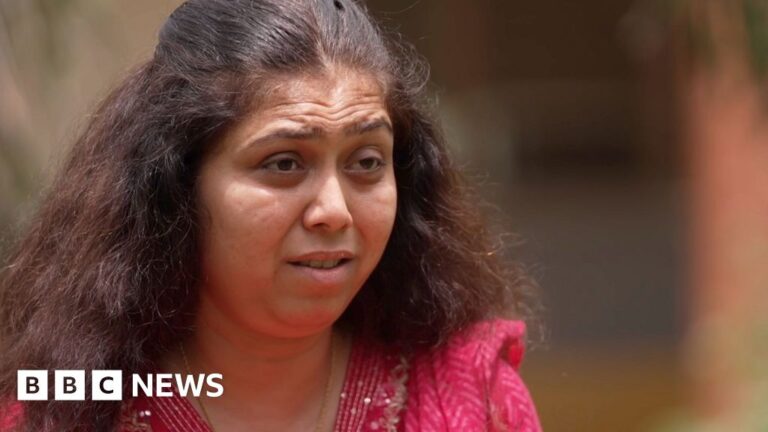
Shweta Parihar, 41, also wants answers. Her husband, Abhinav Parishar, 43, was on his way back to London. He was meant to fly later in the month but decided to come home early and ended up on the ill-fated flight.

She laments that no investigation will ever bring her husband back.

“For those of us that have lost loved ones, we’ve lost them, they are not coming back,” she said.

“What will they do in the investigation, tell us how it happened? The life of how many people, 250 passengers, what will they say, sorry? Everything is done, everything is finished.”

Parihar becomes emotional when she talks about the impact of the loss on her 11-year-old son Vihaan.

“He misses his dad badly,” she said tearfully. Vihaan tells her that he won’t fly Air India ever again.

A family photo with Shweta Parihar and her husband, Abhinav Parishar, and their son Vihaan

Abhinav and Shweta Parihar with their son Vihaan

Badasab Syed, 59, lost his brother, sister-in-law, and their two children in the crash.

He was hoping for answers from the preliminary report, but after watching the news, said he was left with more questions.

“The report mentions the pilots discussing who turned off fuel and a possible issue with the fuel control switch. We don’t know, what does that mean? Was this avoidable?”

Inayat Syed, 49, with his wife Nafeesa, along with their son and daughter

Inayat and Nafeesa Syed pictured with their son and daughter

Badasab Syed says his younger brother, Inayat Syed, 49 was the heart of the family. Losing him, his wife and children, has shattered the entire family. The grief has been especially difficult on his 83-year-old mother, Bibi Sab.

“Losing her son and grandchildren has made her weak. I think she is not able to even tell us how she feels,” he said.

Challenging Client

0


Client Challenge


JavaScript is disabled in your browser.

Please enable JavaScript to proceed.

A required part of this site couldn’t load. This may be due to a browser
extension, network issues, or browser settings. Please check your
connection, disable any ad blockers, or try using a different browser.

Utilizing the Power of the Ocean with an Underwater Kite

0

Experiencing the challenge of flying a kite on a breezy day gives a glimpse into the power of nature’s forces. Drawing inspiration from this, a forward-thinking company has applied the concept beneath the waves, creating an innovative tidal energy system resembling a kite. This apparatus harnesses the sea’s tidal movements and underwater currents to generate power. While many attempts have been made to utilize this form of renewable energy, only a select few have reached commercial viability. The underwater kite, recently launched in the Faroe Islands, stands out as a significant achievement in this domain.

Generating power from the sea with a tidal kite

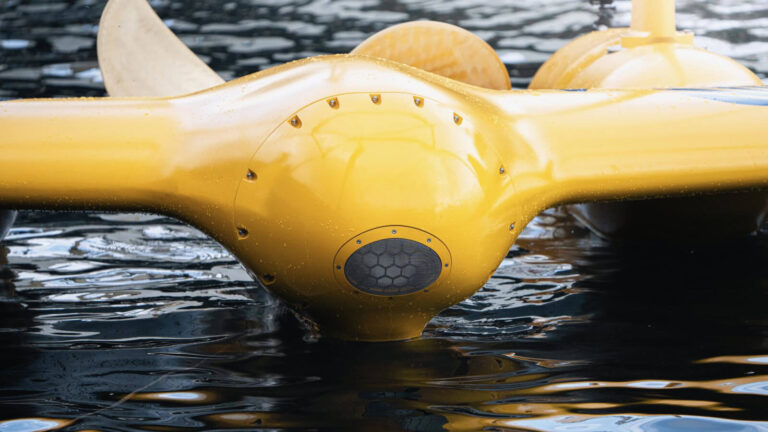
Designed by a Swedish firm, this contraption more closely resembles an underwater plane than a traditional kite. Despite its hefty twenty-eight-ton weight and twelve-meter wingspan, the “Dragon 12” earns its kite moniker through its sea-floor anchorage via a lengthy tether. This tidal kite is equipped with a main wing, rudder, lifting propellers, a gear system, a turbine, and an electric generator. But what’s the process for converting sea movements into energy?

Initially mentioned, the kite’s operation mimics the aerodynamics of kite flying. It utilizes hydrodynamic lift from the sea’s current to navigate in a controlled figure-eight path. This movement drags the turbine through the water at speeds multiple times faster than the current itself, similar to how a kite gains speed by moving laterally. The turbine powers a generator, which feeds electricity to the grid through a cable. An integrated autonomous control system ensures the kite’s operation under various conditions without human intervention.

Strategically placed in a channel between two Faroe Islands, the kite taps into tidal undercurrents to drive a central turbine, generating up to 1.2 MWh—enough to sustain around 1,000 homes with clean energy. One of the project’s highlighted benefits is its continuous energy production, thanks to the predictable nature of tides. The developers also point out that, compared to other tidal energy endeavors, this system is more cost-effective due to its minimal infrastructural demands.

What is ocean energy and what types are there?

Ocean energy presents a valuable renewable resource, accessible through kinetic, thermal, or molecular approaches. Here’s a brief overview of the primary oceanic energy types and their potential to enhance the renewable energy landscape:

  • Tidal energy: Capitalizes on tidal movements to drive turbines for electricity generation. It’s a dependable source, though its applicability is somewhat geographically restricted.
  • Wave energy: Harnesses wave motion to generate power, boasting significant potential due to the ocean’s perpetual dynamics.
  • Ocean thermal energy: Known as OTEC, this method leverages the temperature disparity between surface waters and the cold depths, suited especially for tropical areas.
  • Saline energy: Investigates electricity generation from the salinity gradient between seawater and river water, currently under exploration.

While not classified under the same category, offshore wind energy emerges as the most effective solution thus far. For those keen on exploring further into renewable and sustainable energy sources, subscribing to our newsletter will provide you with all the necessary updates and insights.


Source:

Image:

Cambodia’s Sites of Khmer Rouge Atrocities Recognized on UNESCO List | Arts and Culture Update

0

Added to the World Heritage list are two prisons: Tuol Sleng and M-13, as well as the execution site Choeung Ek.

Three notorious locations used by Cambodia’s brutal Khmer Rouge regime as torture and execution sites to perpetrate the genocide of Year Zero five decades ago have been added to UNESCO’s World Heritage list.

Two prisons and an execution site were inscribed on the list by the United Nations cultural agency on Friday during the 47th Session of the World Heritage Committee in Paris.

It coincided with the 50th anniversary of the rise to power by the communist Khmer Rouge, which caused the deaths of an estimated 1.7 million Cambodians through starvation, torture and mass executions during a four-year reign of violence from 1975 to 1979 before it was brought to an end by an invasion from neighbouring Vietnam.

UNESCO’s World Heritage list lists sites considered important to humanity and includes the Great Wall of China, the Pyramids of Giza in Egypt, the Taj Mahal in India and Cambodia’s Angkor archaeological complex.

Cambodian Prime Minister Hun Manet issued a message on Friday directing people to beat drums simultaneously across the country on Sunday morning to mark the UNESCO listing.

“May this inscription serve as a lasting reminder that peace must always be defended,” Hun Manet said in a video message aired by state-run television TVK. “From the darkest chapters of history, we can draw strength to build a better future for humanity.”

Two sites added to the list are in the capital, Phnom Penh – the Tuol Sleng Genocide Museum and the Choeung Ek Genocide Centre.

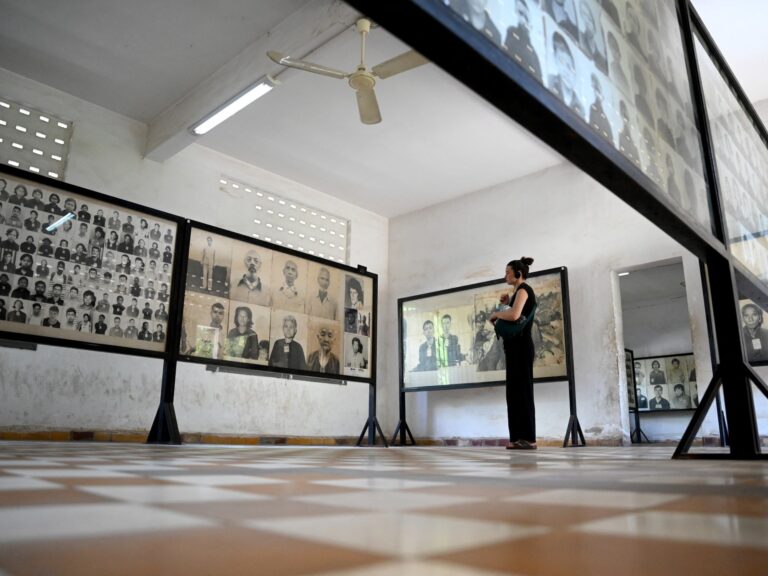
Tuol Sleng is a former high school that was converted into a notorious prison known as S-21, where an estimated 15,000 people were imprisoned and tortured.

Today, the site is a space for commemoration and education, housing the black-and-white mugshots of its many victims and the preserved equipment used by Khmer Rouge tormentors.

The UNESCO inscription was Cambodia’s first nomination for a modern and non-classical archaeological site and is among the first in the world to be submitted as a site associated with recent conflict, Cambodia’s Ministry of Culture and Fine Arts said in a statement on Friday.

‘The Killing Fields’

Choeung Ek – a former Chinese cemetery – was a notorious “killing field” where S-21 prisoners were executed nightly. The story of the atrocities committed there is the focus of the 1984 film “The Killing Fields”, based on the experiences of New York Times photojournalist Dith Pran and correspondent Sydney Schanberg.

More than 6,000 bodies were exhumed from at least 100 mass graves at the ground in the early 1980s, according to Cambodian government documents filed with UNESCO.

Every year, hundreds hold remembrance prayers in front of the site’s memorial displaying victims’ skulls, and watch students stage dramatic re-enactments of the Khmer Rouge’s bloody crimes.

Another prison site, known as M-13 and located in a rural area in central Kampong Chhnang province, was one of the most important prisons of the early Khmer Rouge, where its cadres “invented and tested various methods of interrogation, torture and killing” but is today only a patch of derelict land.

A special tribunal sponsored by the UN, costing $337m and working over 16 years, only convicted three key Khmer Rouge figures, including S-21 chief torturer Kaing Guek Eav, before ceasing operations in 2022.

Pol Pot, leader of the Khmer Rouge regime, died in 1998 before he could be brought to trial.

Buddhist monks line up to receive food and alms during the annual ‘Day of Remembrance’ for the victims of the Khmer Rouge regime at the Choeung Ek memorial in Phnom Penh, Cambodia, on May 20, 2025 [Tang Chhin Sothy/AFP]

Two killed in Russian drone and missile attack on western Ukraine

0

Russia attacks west Ukraine with drones and missiles, kills two

Report on Air India crash may provide answers, but closure remains elusive

0

The preliminary report into last month’s Air India crash provides some insight into what caused it.

It says that both fuel control switches were moved to the cut-off position – a step that usually turns off the engines – moments before the plane crashed.

But as experts analyse the findings of the report, it provides little comfort to the families who lost their loved ones.

The BBC’s Samira Hussain met Shweta Parihar, whose husband died in the crash. “We trusted the airline. What is the point of the investigation now?” she said.

Trump argues in new DOJ lawsuit that Americans pay the price for California pampering its chickens

0

The Trump administration is suing the state of California to block animal welfare laws that it says unconstitutionally helped send egg prices soaring. But a group that spearheaded the requirements pushed back, blaming bird flu for the hit to consumers’ pocketbooks.

The lawsuit, filed in federal court in California on Wednesday, challenges voter initiatives that passed in 2018 and 2008. They require that all eggs sold in California come from cage-free hens.

The Trump administration says the law imposes burdensome red tape on the production of eggs and egg products across the country because of the state’s outsize role in the national economy.

“It is one thing if California passes laws that affects its own State, it is another when those laws affect other States in violation of the U.S. Constitution,” U.S. Agriculture Brooke Rollins said in a statement Thursday. “Thankfully, President Trump is standing up against this overreach.”

Egg prices soared last year and earlier this year due in large part to bird flu, which has forced producers to destroy nearly 175 million birds since early 2022. But prices have come down sharply recently. While the Trump administration claims credit for that, seasonal factors are also important. Avian influenza, which is spread by wild birds, tends to spike during the spring and fall migrations and drop in summer.

“Pointing fingers won’t change the fact that it is the President’s economic policies that have been destructive,” the California Department of Justice said in a statement Friday. “We’ll see him in court.”

The average national price for a dozen Grade A eggs declined to $5.12 in April and $4.55 in May after reaching a record $6.23 in March, according to the U.S. Bureau of Labor Statistics. But the May price was still 68.5% higher than a year earlier.

“Trump’s back to his favorite hobby: blaming California for literally everything,” Gov. Gavin Newsom’s office said in a social media post.

The federal complaint alleges that California contributed to the rise in egg prices with regulations that forced farmers across the country to adopt more expensive production practices. The lawsuit also asserts that it is the federal government’s legal prerogative to regulate egg production. So it seeks to permanently block enforcement of the California regulations that flowed from the two ballot measures.

“Americans across the country have suffered the consequences of liberal policies causing massive inflation for everyday items like eggs,” Attorney General Pam Bondi said in a statement. “Under President Trump’s leadership, we will use the full extent of federal law to ensure that American families are free from oppressive regulatory burdens and restore American prosperity.”

While 2018’s Proposition 12 also banned the sale of pork and veal in California from animals raised in cages that don’t meet minimum size requirements, the lawsuit only focuses on the state’s egg rules.

Humane World for Animals, which was named the Humane Society of the United States when it spearheaded the passage of Proposition 12, says avian influenza and other factors drove up egg prices, not animal welfare laws. And it says much of the U.S. egg industry went cage-free anyway because of demand from consumers who don’t want eggs from hens confined to tiny spaces.

“California has prohibited the sale of cruelly produced eggs for more than a decade — law that has been upheld by courts at every level, including the Supreme Court. Blaming 2025 egg prices on these established animal welfare standards shows that this case is about pure politics, not constitutional law,” Sara Amundson, president of the Humane World Action Fund, said in a statement.

The American Egg Board, which represents the industry, said Friday that it will monitor the progress of the lawsuit while continuing to comply with California’s laws, and that it appreciates Rollins’ efforts to support farmers in their fight against bird flu and to stabilize the egg supply.

“Egg farmers have been both responsive and responsible in meeting changing demand for cage-free eggs, while supporting all types of egg production, and continuing to provide options in the egg case for consumers,” the board said in a statement.

Death of worker in California cannabis farms after immigration raids | Latest news on Donald Trump

0

A farmworker has died from injuries he sustained in immigration raids on two California cannabis farms, as United States authorities confirmed they arrested 200 workers after a tense standoff with protesters.

The United Farm Workers advocacy group confirmed the death of Jaime Alanis, who was injured after a 30-foot (nine-metre) fall during one of the raids, in a post on X on Friday.

“We tragically can confirm that a farm worker has died of injuries they sustained as a result of yesterday’s immigration enforcement action,” it said.

Federal immigration authorities confirmed on Friday that they had arrested about 200 immigrants suspected of being in the US illegally in raids on Thursday at two cannabis farms in Carpinteria and Camarillo, Southern California.

The Department of Homeland Security said in a statement that they also found at least 10 immigrant children during the raids who were rescued from “potential exploitation, forced labour, and human trafficking”.

The statement said four US citizens had been arrested for their role in violent confrontations between agents and protesters. Authorities are also offering a $50,000 reward for information leading to the arrest of another person suspected of firing a gun at the federal agents.

“During the operation, more than 500 rioters attempted to disrupt operations. Four US citizens are being criminally processed for assaulting or resisting officers. The rioters damaged vehicles, and one violent agitator fired a gun at law enforcement officers,” the statement said.

One of the raids saw immigration agents clad in military-style helmets and uniforms storm Glass House Farms – a licensed cannabis grower which also grows tomatoes and cucumbers – in Camarillo on Thursday.

Agents faced off with the demonstrators outside the farm, as crowds of people gathered to seek information about their relatives and to oppose the raids.

Andrew Dowd, a spokesperson for the Ventura County Fire Department, said at least 12 people were injured as a result of the raid and protest.

Jaime Alanis inside Ventura County Medical Center after he was injured during an immigration raid on July 10, 2025, in Camarillo, California [AP Photo]

During the raid, Alanis, who had reportedly worked at Glass House Farms picking tomatoes for 10 years, called his family in Mexico to say he was hiding from authorities.

“The next thing we heard was that he was in the hospital with broken hands, ribs and a broken neck,” said Juan Duran, Alanis’s brother-in-law, according to The Associated Press news agency.

In a statement, Glass House said immigration agents held valid warrants, and it is helping provide detained workers with legal representation.

“Glass House has never knowingly violated applicable hiring practices and does not and has never employed minors,” the statement said.

United Farm Workers said in a statement that some US citizens who worked at the firm are not yet accounted for.

The raid is the latest to take place as part of the Trump administration’s controversial all-out campaign cracking down on immigration in the US.

Since returning to the White House, Trump has unleashed groups of immigration agents to round up undocumented migrants and sent accused gang members to a maximum-security prison in El Salvador without due process.

But in the wake of Thursday’s raids, Federal Judge Maame E Frimpong ordered a temporary halt to the Trump administration’s indiscriminate immigration stops and arrests in seven California counties, including Los Angeles.

The Friday ruling comes in response to a lawsuit filed by immigrant advocacy groups in the US District Court last week, accusing the Trump administration of systematically targeting brown-skinned people during immigration raids in Southern California.

The filing asked the judge to block the administration from using what they called unconstitutional tactics.

In her ruling, which remains in place for 10 days, Judge Frimpong agreed that “roving patrols” of immigration agents without reasonable suspicion violated the Fourth Amendment, protecting individuals from unreasonable searches and seizures, and the Fifth Amendment, ensuring due process of law.

Frimpong directed agents to stop racially profiling people and ordered the federal government to ensure detainees have access to legal counsel.

Al Jazeera correspondent in Washington, DC, Shihab Rattansi, said the case gets to the “heart of whether we can have these marauding sort of gangs of ICE agents without any identification” sweeping people up.

“[The plaintiffs argue there is] no probable cause to suspect they’re breaking any kind of immigration laws. And we know a lot of people who are citizens are being swept up too,” Rattansi said.

Judge reduces T.I. and Tiny’s award in OMG Girlz copyright infringement case involving toy dolls, hinting at possible fourth jury trial

0

Atlanta rapper Clifford ‘T.I.’ Harris and spouse Tameka ‘Tiny’ Harris may be headed to yet another jury trial against a toy company they accuse of ripping off their OMG Girlz pop group.

In the latest development in a case that’s been running for five years, a federal court judge in California reduced the award a jury granted to T.I., Tiny and OMG Girlz last fall by three quarters.

The jury had awarded the artists $17.8 million in actual damages and $53.6 million in punitive damages, for a total award of around $71.5 million. In an order issued on Tuesday (July 8), Judge James V. Selna reduced the punitive damages to $1, effectively cutting the total award by 75%.

Judge Selna ruled that the jury’s awarding of punitive damages was incorrect because the artists’ lawyers had not proven that toy company MGA Entertainment’s infringement was “willful.”

Per the judge’s order, T.I. and Tiny now have the choice of accepting the lowered award, or requesting a new jury trial. They have two weeks to file a response with the court.

It’s unclear which option the artists will choose, but Judge Selna, in his order, which can be read in full here, noted that in earlier oral arguments, the artists had said they would reject a reduced payment and go back before a jury.

The legal battle began in 2020, when T.I. and Tiny accused MGA Entertainment of ripping off the girl group they had developed and launched, OMG Girlz, with a line of toy dolls dubbed LOL Surprise! OMG, which MGA launched in 2019. They said the dolls clearly copied the OMG Girlz’ fashion and hairstyles.


Following a cease-and-desist letter from T.I. and Tiny’s lawyers, MGA Entertainment sued the artists in 2020, alleging that their claim that the OMG dolls infringed on OMG Girlz had damaged their business. T.I. and Tiny countersued in 2021, accusing MGA of infringement of copyright.

This led to no fewer than three jury trials. The first, held in early 2023, ended with Judge Selna declaring a mistrial, after jurors heard an argument that MGA’s actions amounted to “cultural appropriation” of Black culture – an argument that the judge barred from the jury trial.

“There was no reliable evidence that MGA had any knowledge of the group’s trade dress or desire to use their likeness to create the infringing dolls.”

Judge James V. Selna

The second trial, held later in 2023, ended with a victory for MGA. However, the artists’ were given leave to re-try the case after a US Supreme Court ruling – in an unrelated case – which limited the freedom of expression defense in IP infringement cases.

The third trial, held over three weeks in September 2024, saw MGA’s founder, Isaac Larian, testify that that OMG Girlz played no role in the development of the LOL Surprise! OMG dolls, and called the three members of OMG Girlz “extortionists.”

The trial ended with the jury siding with the artists and awarding them the $71.5 million.

In his order overturning that award, Judge Selna wrote that while MGA’s designers “lost credibility” during the trial when they tried to “explain away” obvious similarities between their dolls and certain celebrities – for instance, a doll called Piano King that “clearly looks like Elton John” – the evidence still “falls short of clear and convincing” when it comes to the OMG Girlz.

“There was no reliable evidence that MGA had any knowledge of the group’s trade dress or desire to use their likeness to create the infringing dolls,” Judge Selna wrote.

“The strong appearance that MGA copied other celebrities does not provide clear and convincing evidence that such was the case for the OMG Girlz.”

Under these circumstances, per California law, an award of punitive damages is inappropriate, the judge concluded. “Therefore, the jury’s verdict on punitive damages cannot be sustained.”

“If in the end there is another mini-trial on just the punitive damages, we expect another jury will be similarly offended by MGA’s maliciousness and copying.”

John Keville, Sheppard Mullin

A lawyer for the artists, John Keville of law firm Sheppard Mullin, told Rolling Stone in a statement that T.I. and Tiny plan to “reject” the $1 in punitive damages and the legal team are “considering [their] options as to next steps.”

However, “if in the end there is another mini-trial on just the punitive damages, we expect another jury will be similarly offended by MGA’s maliciousness and copying,” Keville stated.

“The court’s order confirms what the jury found, that there was more than sufficient evidence to find MGA wrongly misappropriated and infringed the OMG Girlz’ rights.”

The OMG Girlz were formed in 2009, composed of Bahja “Beauty” Rodriguez, Breaunna “Babydoll” Womack, and Tiny’s daughter, Zonnique “Star” Pullins.

The group disbanded in 2015, but reunited in 2023, releasing Lover Boy, their first single in over a decade. In 2024 they toured with Xscape and SWV as part of the Queens of R&B Tour, and in March of this year they released a follow-up single, Make a Scene.Music Business Worldwide

Federal judge rules that lawsuit involving voiceover artists and AI can proceed

0

A federal judge in New York has allowed a lawsuit to move forward from two voice-over artists alleging their voices were stolen by an AI voice startup.

The judge dismissed artists Paul Skye Lehrman and Linnea Sage claims that their voices were subject to federal copyright.

But claims from the artists of breach of contract and deceptive business practices, as well as separate copyright claims alleging that the voices were improperly used as part of the AI’s training data, will, however, move forward.

California-based Lovo Inc. had asked for the case to be dismissed entirely. The company has not yet responded to the BBC’s request for comment.

The judge’s decision comes after a flood of cases from artists against artificial intelligence companies alleging misuse of their work to train AI models.

The artists’ attorney, Steve Cohen, has called the decision a “spectacular” victory for his clients, saying he was confident a future jury will “hold big tech accountable”.

Lawyers for Lovo had called the artists’ allegations a “kitchen sink approach” saying the artists’ claims failed to make an actionable claim against the company.

The artists, a couple living in New York City, filed a proposed class action lawsuit in 2024 after learning alleged clones of their voices were for sale via Lovo’s text-to-speech platform Genny.

The couple claim they were separately approached by anonymous Lovo employees for voice-over work through the online freelance marketplace Fiverr.

Lehrman was paid $1200 (around £890). Sage received $800 (almost £600).

In messages shared with the BBC, the anonymous client can be seen saying Lehrman and Sage’s voices would be used for “academic research purposes only” and “test scripts for radio ads” respectively.

The anonymous messenger said the voice-overs would “not be disclosed externally and will only be consumed internally”.

Months later, while driving near their home in New York City, the couple listened to a podcast about the ongoing strikes in Hollywood and how artificial intelligence (AI) could affect the industry.

This episode had a unique hook – an interview with an AI-powered chatbot, equipped with text-to-speech software. It was asked how it thought the use of AI would affect jobs in Hollywood.

But, when it spoke, it sounded just like Mr Lehrman.

“We needed to pull the car over,” Mr Lehrman told the BBC in an interview last year. “The irony that AI is coming for the entertainment industry, and here is my voice talking about the potential destruction of the industry, was really quite shocking.”

Upon returning home, the couple found voices with the names Kyle Snow and Sally Coleman available for use by paid Lovo subscribers.

They later found Sage’s alleged clone voicing a fundraising video for the platform –while Lehrman’s had been used in an advertisement on the company’s YouTube page.

The company eventually removed the voices, saying both voices were not popular on the platform.

The case is now set to move ahead in the US District Court in Manhattan.