The International Criminal Court says German authorities arrested Khaled Mohamed Ali El Hishri on 16 July
A Libyan man suspected of committing war crimes and crimes against humanity has been arrested in Germany on a warrant issued by the International Criminal Court (ICC).
Khaled Mohamed Ali El Hishri, commonly known as “Al-Buti”, is alleged to have been one of the most senior officials at the Mitiga Prison complex in the capital, Tripoli, where thousands of people were detained.
He is suspected of having committed, ordered or overseen crimes including murder, torture and rape.
The atrocities were allegedly committed in the detention unit near Tripoli in the five years from 2015. There is no record of him commenting on the allegations.
The ICC has issued 11 arrest warrants in connection with alleged war crimes and crimes against humanity committed in Libya since the ousting and killing of the country’s long-time leader, Muammar Gaddafi, which plunged Libya into civil war.
The situation was referred to the court by the United Nations Security Council in February 2011, at the start of the protests which led to Gaddafi’s ousting later that year, with the help of Nato forces.
In its referral, the Security Council condemned the “violence and use of force against civilians… the gross and systematic violation of human rights, including the repression of peaceful demonstrators”.
It also expressed “deep concern at the deaths of civilians”, while “rejecting unequivocally the incitement to hostility and violence against the civilian population made from the highest level of the Libyan government”, then under Gaddafi.
Since the overthrow of Gaddafi, after six decades in power, Libya has been split into areas controlled by various militias and is currently divided between two rival governments.
Mr Hishri was part of the Special Deterrence Force, also known as SDF/Rada, aligned to the interior ministry of the internationally recognised government based in Tripoli.
Getty Images
Thousands of people, including migrants trying to reach Europe, are kept in Libyan detention centres, often in brutal conditions
On 12 May 2025, Libya accepted the ICC’s jurisdiction over its territory from 2011 to the end of 2027.
Eight other public ICC arrest warrants are still pending in connection with the violence that followed the fall of Gaddafi.
Amnesty International says Mitiga Prison was the scene of “horrific violations committed with total impunity”.
Some of those kept in Mitiga are migrants trying to reach Europe.
Mr Najim was freed due to a legal technicality, according to sources in Italy’s interior ministry.
The ICC said Mr Najim had been released by Italy “without prior notice or consultation with the Court” and issued another arrest warrant for him. He remains a fugitive.
Mr Hishri will remain in detention in Germany until arrangements are made for him to be surrendered to the ICC’s custody and extradited to face justice in The Hague.
The ICC thanked “all the victims and witnesses from Libya who have stepped forward to cooperate in the investigation. Their strength, courage and commitment make these important developments possible.”
Mr Hishri’s case will join others in the court’s ongoing efforts to address crimes committed during Libya’s conflict, though other suspects remain at large.
The removal of 21 children from the custody of a Los Angeles-area couple has put a spotlight on the practice of using surrogates to build a family. Surrogacy has no federal regulation, leaving it up to states to set the rules if they choose to allow it.
The kids — 15 at the couple’s mansion and six more living elsewhere — were taken by an LA County child welfare agency in May after the parents were accused of failing to intervene in the abuse of a baby by a nanny, police in Arcadia said.
The children range in age from 2 months to 13 years, with most between 1 and 3, police said. The FBI won’t comment but agents are investigating. Silvia Zhang, 38, and Guojun Xuan, 65, have not responded to emails seeking comment.
Police believe Zhang gave birth to one or two of the children while the rest were born by surrogate. Some women who were paid surrogates for the couple now say they were unaware that the couple was accumulating a supersize family, raising questions about their intentions.
“What were they going to do with these children?” said Deborah Wald, a lawyer in San Francisco whose expertise includes surrogacy law.
What is surrogacy?
Surrogacy is an agreement between parties to have a woman become pregnant, typically through an embryo transfer, and deliver a baby. The intended parent or parents might struggle with infertility. They also could be same-sex couples.
There’s no limit on how many children someone can have through surrogates or any other method, said Wald, who is not involved in the Arcadia case.
She acknowledged that California is considered a “surrogacy-friendly state” because it has clear laws around the process.
Both sides are required to have lawyers, and there must be a written, notarized contract before an embryo transfer, Wald said.
“The legitimate surrogacy community in California is very distressed when things like this happen,” Wald said of surrogates feeling deceived. ”We’ve worked very hard on legal and ethical standards. It hurts everyone when something like this happens.”
Matchmaker role
There are businesses that act as matchmakers, connecting surrogates to people who want to have children. State business records show a company called Mark Surrogacy Investment LLC had been registered at the Arcadia address of Zhang and Xuan.
It’s not clear if Zhang and Xuan set up the business solely to find surrogates for themselves. State records show the company terminated its business license in June.
Wald said there are no special licensing requirements in California for businesses that match surrogates with intended parents.
Many questions remain
Wald said there should have been plenty of checks and balances in the process, noting the role of fertility clinics in handling embryos.
“The first place typically is the matching program that matches the surrogate with an intended parent. But in this situation the intended parents were the matching program,” Wald said. “I am not familiar with any other prior case where that was true.”
Arcadia police said the six children who were not at the couple’s home were found with family friends. The couple’s house was “set up for a school environment,” Lt. Kollin Cieadlo said.
Zhang and Xuan were accused of neglect and arrested in May. Charges were not formally pursued at that time in order for an abuse investigation to continue, and detectives now believe there were other instances of abuse, Cieadlo said.
A 2-month-old infant with a traumatic head injury, allegedly at the hands of a nanny, remains in a hospital in stable condition, he said.
Keeping the family together
California law requires child welfare agencies to prioritize placing children who cannot safely be with their parents in homes with extended family, and requires siblings to be kept together unless it would endanger the child to do so, said Leslie Heimov, the executive director of the Children’s Law Center of California.
The Children’s Law Center has worked with some families with 10 to 12 children, Heimov said. A family with 20 children or more is “unusual,” she added.
It’s more complicated to find foster homes for larger families that can accommodate all the children’s needs, especially for infants, Heimov said.
In addition to expenses and limited space, it’s hard to give infants the proper stimulation and care they need if they are in a home with many other children, she said.
In cases involving many children, the state will sometimes get creative to make sure that siblings can maintain relationships with each other, like placing them in the same neighborhood, or placing them in different but related households, Heimov said.
A case involving over 20 children conceived through surrogacy would “present some legal questions,” said Heimov. “But it would not change our advocacy — we want every child we represent to be in a loving, safe home.”
__
White reported from Detroit and Riddle from Montgomery, Alabama.
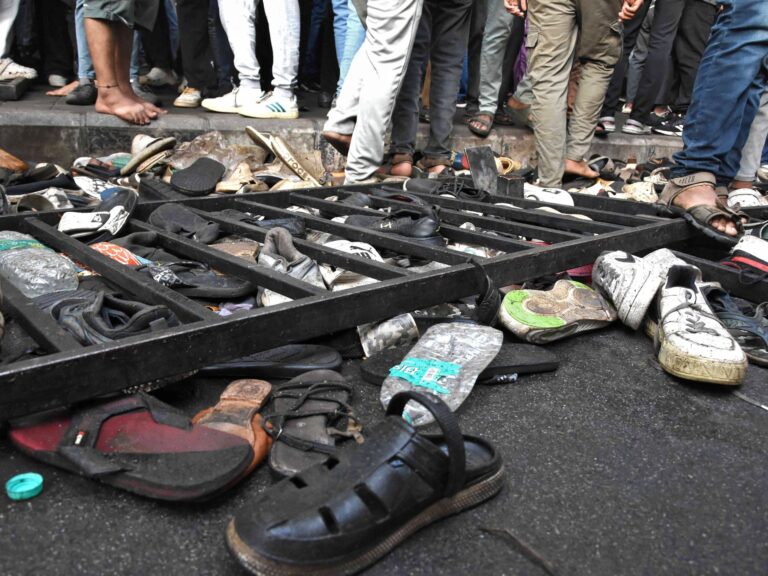
Karnataka state authorities singled out RCB, its partners and the state cricket for their mismanagement of stampede.
State authorities have blamed the management of India’s Royal Challengers Bengaluru cricket team for last month’s deadly stampede during celebrations for their first Indian Premier League (IPL) title.
Karnataka state authorities singled out the RCB, its partners and the state cricket association for their mismanagement of the event in a report made public on Thursday.
Eleven fans were crushed to death and more than 50 wounded in a stampede near the M Chinnaswamy Stadium after hundreds of thousands packed the streets in the southern city of Bengaluru on June 4, to cheer their hero Virat Kohli and other RCB team members.
The report said organisers had not submitted a “formal request” or provided enough detail for permission to be granted for the celebrations.
“Consequently, the permission was not granted,” it said.
The team went ahead with its victory parade despite police rejecting RCB’s request, according to the report.
The RCB did not offer any comment on the report.
An ambulance moves following the stampede outside the cricket stadium in Bengaluru on June 4 [Reuters]
Four people, including a senior executive at RCB, representatives of event organisers DNA, and the Karnataka State Cricket Association, were detained by police in the days following the stampede.
Players were parading the trophy near the stadium a day after their win over Punjab Kings in the final in Ahmedabad when the stampede occurred.
The dead were aged between 14 and 29.
Prime Minister Narendra Modi called it “absolutely heartrending”, and Kohli, who top-scored in the final, was “at a loss for words” after it unfolded.
India coach Gautam Gambhir said he was never a fan of roadshows, and the authorities should not have allowed the mass celebrations if they were not prepared.
Béis is a luggage brand with a focus on function and utility whilst presenting it in a suave and attractive package. Being featured in many notable editorials such as Oprah Magazine, Forbes, and People Magazine, Béis also has a very strong social media following, which shows the attractiveness and appeal of their luggage lineup.
Unsurprisingly, Beis is such a hit with many, as it was founded by actress Shay Mitchell, who many may know as Emily on the show Pretty Little Liars. Béis is one of the best luggage brands if you’re looking for that perfect balance of function and style.
Most of Béis’s catalog is made out of polyester fabric and water-resistant lining, which not only makes them lightweight and durable but also functional to keep your belongings safe and sound. Their catalog is also pretty extensive, spanning from luggage to totes, backpacks, and diaper bags, making Béis a huge hit with women and mothers.
I tested and reviewed Béis luggage and found that they outperform competitors by combining ultra-practical, functional features with a sleek, minimalist design. For example, the water-resistant Nylon zipper tape helps to keep your items dry, and their hard-side construction with the Hinomoto 360 wheels ensures your bag is long-lasting and easy to use when moving about.
Furthermore, Béis has special additions that aim to make your travel extra comfortable, with cushioned handles, a retractable attach strap, and a side-carry handle fitted with a weight indicator so you know exactly how heavy your luggage is.
There are other alternatives if you’re a frequent traveler seeking a long-lasting investment. I’ve compared Béis and Monosand I’ve been happy with suitcases from both brands, and they both performed well in our testing. Monos only costs a little more than Béis, and their suitcases are more durable and refined (and come with a better warranty). I don’t think you can go wrong either way, the choice just comes down to what you prioritize.
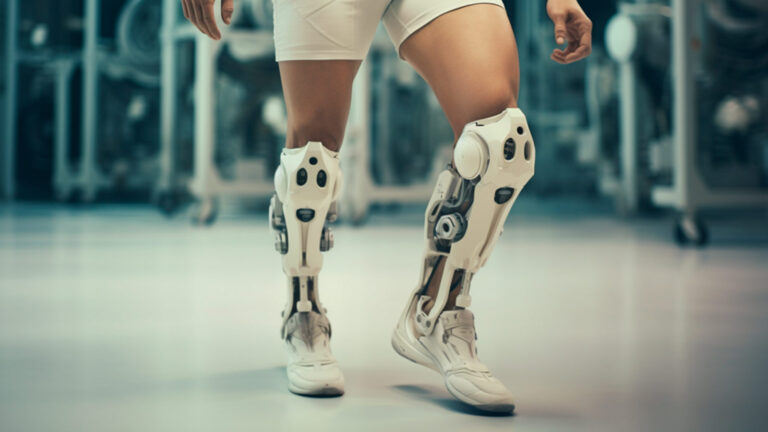
Technology fundamentally serves as an amplifier of human capabilities. Take the telephone, extending our voices across distances, or the swiftness of a train compared to walking. In line with this concept, a robotic exoskeleton stands as a direct enhancement of human abilities, enabling users to lift heavier loads, surmount locomotor constraints, or execute tasks more swiftly. The technology holds promising potential, as projected by the consulting firm ABI Research, estimating a market value of $7.3 billion by 2030.
The latest breakthrough arises from the researchers at Simon Fraser University in Canada, unveiling a human exoskeleton capable of deciphering brain waves and translating them into physical movement. Notably, a woman paralyzed in both legs since 2015 was able to walk again after years confined to a wheelchair. Will such transformative applications become more prevalent in the near future? What trajectory lies ahead for this evolving technology?
This article covers the following topics:
What is a robotic exoskeleton?
Technically, it’s a wearable mechanical device designed to enhance physical capabilities externally, aimed at preventing injury, augmenting strength, or improving mobility. Its name stems from its resemblance to an external skeleton, akin to the protective shells in invertebrates like underwater arthropods or land-dwelling Coleoptera.
In the animal kingdom, the term “exoskeleton” is often applied to invertebrates such as arthropods in the underwater world or Coleoptera on land. In their case, it is a shell that protects soft tissues from predators or the elements.
Types of exoskeleton
Along with the type of material they are made of – soft, rigid or hybrid – these devices can be classified according to the part of the body they assist:
Lower extremities: Aid in faster movement or leg rehabilitation.
Upper extremities: Assist in lifting weights in industrial settings and restoring arm mobility.
Full body: Offer comprehensive support to the back, arms, and legs, particularly useful in medical or industrial environments.
Primary technologies
Although there are also passive devices, i.e., without energy of their own, the focus here is on active exoskeletons, which are usually equipped with motors, sensors, and control systems that respond to the user’s movements, assisting as needed. To achieve this, they use hydraulic and pneumatic systems, as well as servomotors. In addition, thanks to the use of batteries, they can offer an autonomy of several hours.
As technology advances, exoskeletons are evolving to become lighter, more efficient, and more versatile. Especially full-body models, which, for now, are the most bulky. Thus, they are expected to join smart textiles to help users daily.
Main applications
Despite being in its early stages, human exoskeleton technology demonstrates significant potential across various sectors:
Construction. This is one of the areas that is arousing most interest, with machines that already allow operators to lift up to 90 kilograms effortlessly. After all, there are already building materials inspired by an animal exoskeleton.
Healthcare. The main users of exoskeletons in this sector promise to be people with neuromuscular diseases such as cerebral palsy and those undergoing rehabilitation, which will complement the new generation of prostheses and materials developed in biomedicine.
Senior citizens. Elderly people will be able to use these devices in their daily lives to carry out simple tasks such as shopping or lifting objects at home, reducing the risk of falls and injuries.
Sports. This is perhaps the closest modality to science fiction. Still, depending on the user’s needs, some devices are already being developed that can propel the legs – or offer resistance to enhance muscle work.
How much will they cost?
The initial cost of robotic exoskeletons, primarily intended for healthcare and industry, ranges from $5,000 for passive models to $100,000 for advanced full-body models. However, as the technology matures, costs are expected to decrease, aligning with the projections of the consulting firm mentioned earlier. Perhaps, in the not-so-distant future, exoskeletons will transition from being a niche technology to a commonplace tool, akin to cell phones or augmented reality glasses.
MBW Explains is a series of analytical features in which we explore the context behind major music industry talking points – and suggest what might happen next. Only MBW+ subscribers have unlimited access to these articles.
The following MBW Explains article was written by Will Page (pictured inset), the author of Pivot: Eight Principles for Transforming Your Business and the former Chief Economist for both Spotify and PRS for Music. He is a regular contributor to MBW. You can find out more about him and his work here. Over to Will..
Over 1.5 million will see Oasis perform this summer — that’s comparable to the combined populations of Manchester, (where they’re from), Glasgow (where they got signed) and Edinburgh — where my older brother watched them perform for just £4 in 1994.
Inflation, huh?
Ask those 1.5 million Oasis fans who successfully queued online (or the millions who weren’t so lucky) what their favourite song is, and you can expect a range of responses. Sure, Wonderwall will be up there, but so too will a lot of others. For me, it’s “She’s Electric” as I’ll never forget the time I walked into a Tesco’s late one winter night and witnessed staff and customers spontaneously sing along with it.
Oasis’s catalog reminds me of a lesson that Neil Finn of Crowded House once said, which is that: “Music is the alchemy in the room that draws us all together” — we’re witnessing how the Gallagher brothers can do just that — be it soulless Tesco’s or sold-out stadiums.
And it’s not just one-or-two songs that brings us together, it’s a body of work.
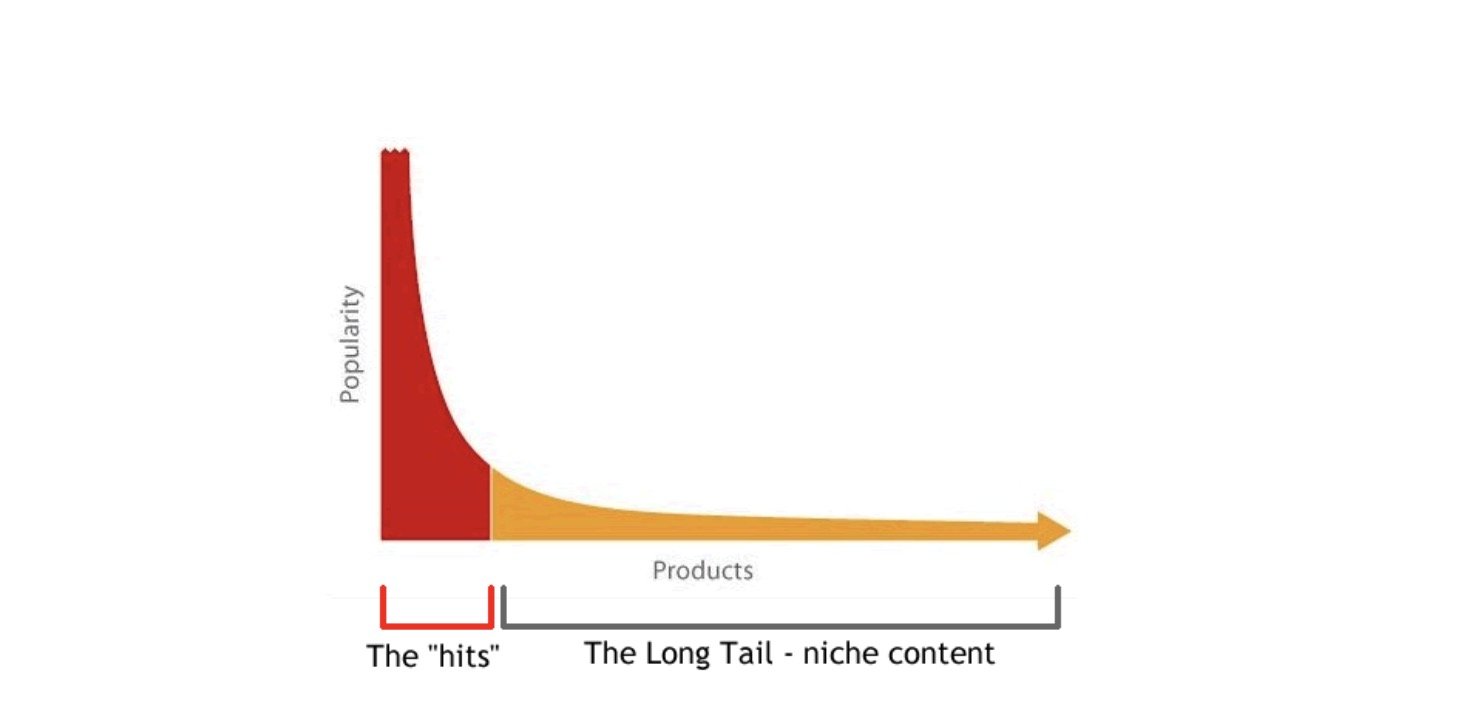
Which brings us to the long tail. Chris Anderson popularized the long tail in a seminal 2004 blog, showing how a small number of items make up a large amount of sales (e.g. the front of a book store will stack ‘em high and sell ‘em cheap).
Therefore, a large amount of niche items make up a small amount of sales (e.g. the back of the bookstore). This is where us economists grab red pens and descend towards a white board to draw this:
Long-tail distributions can be found in recordings. Typically, the top three ‘killer’ songs of an album (i.e. singles) can make up 97% of their streams, meaning the ‘filler’ songs make up only 3%.
Think about this as an ‘organic greatest hits’ where the consumer, not the creator, decides what merits inclusion into the head of the distribution, and what gets left in the tail.
But here’s the twist. Oasis has a long tail, but on this occasion, that tail is fat.
Now, data scientists listen up.
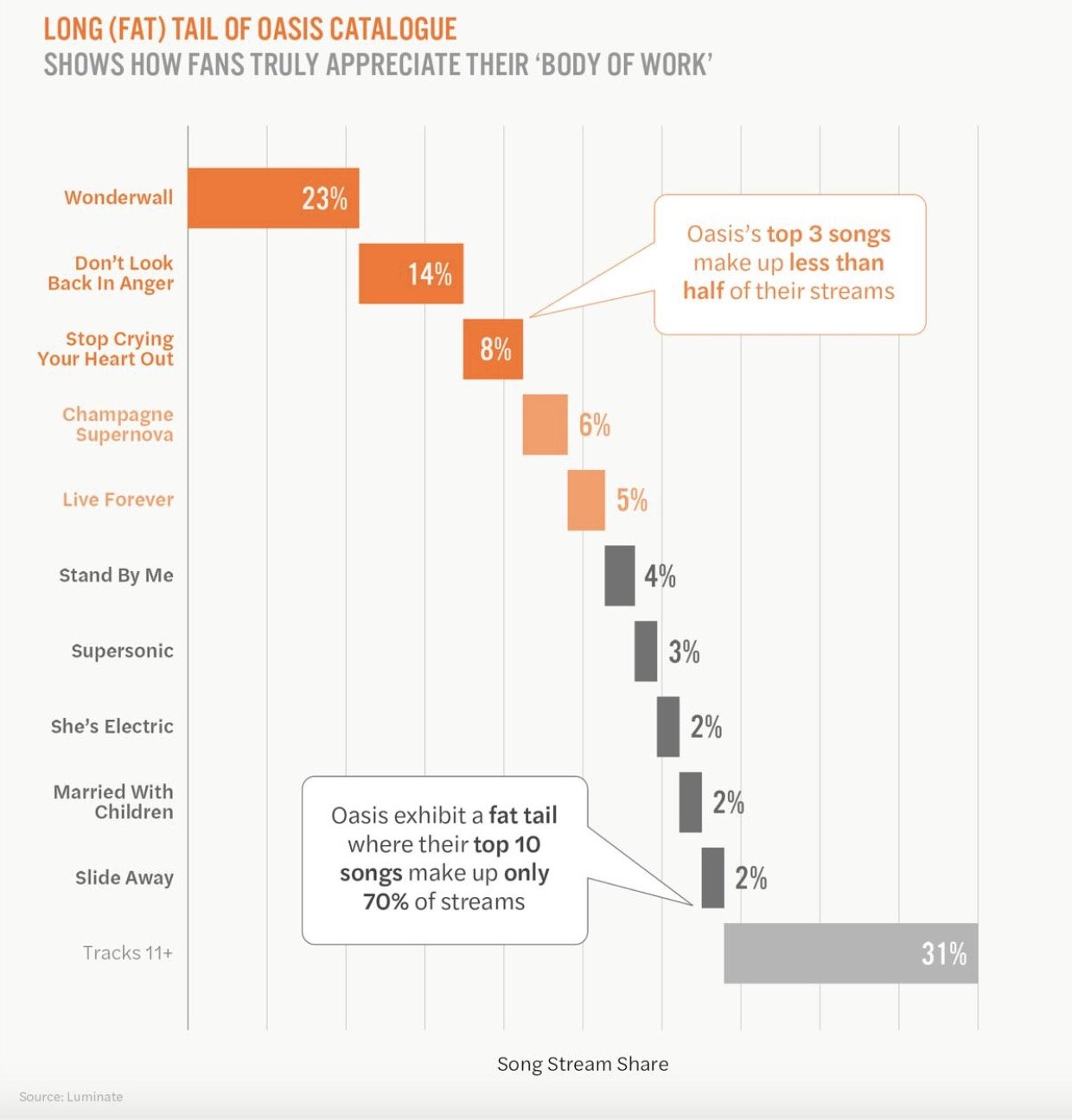
The best way to illustrate this fat tail is not the classic down-and-to-the-right long tail chart but a ‘rotated waterfall’.
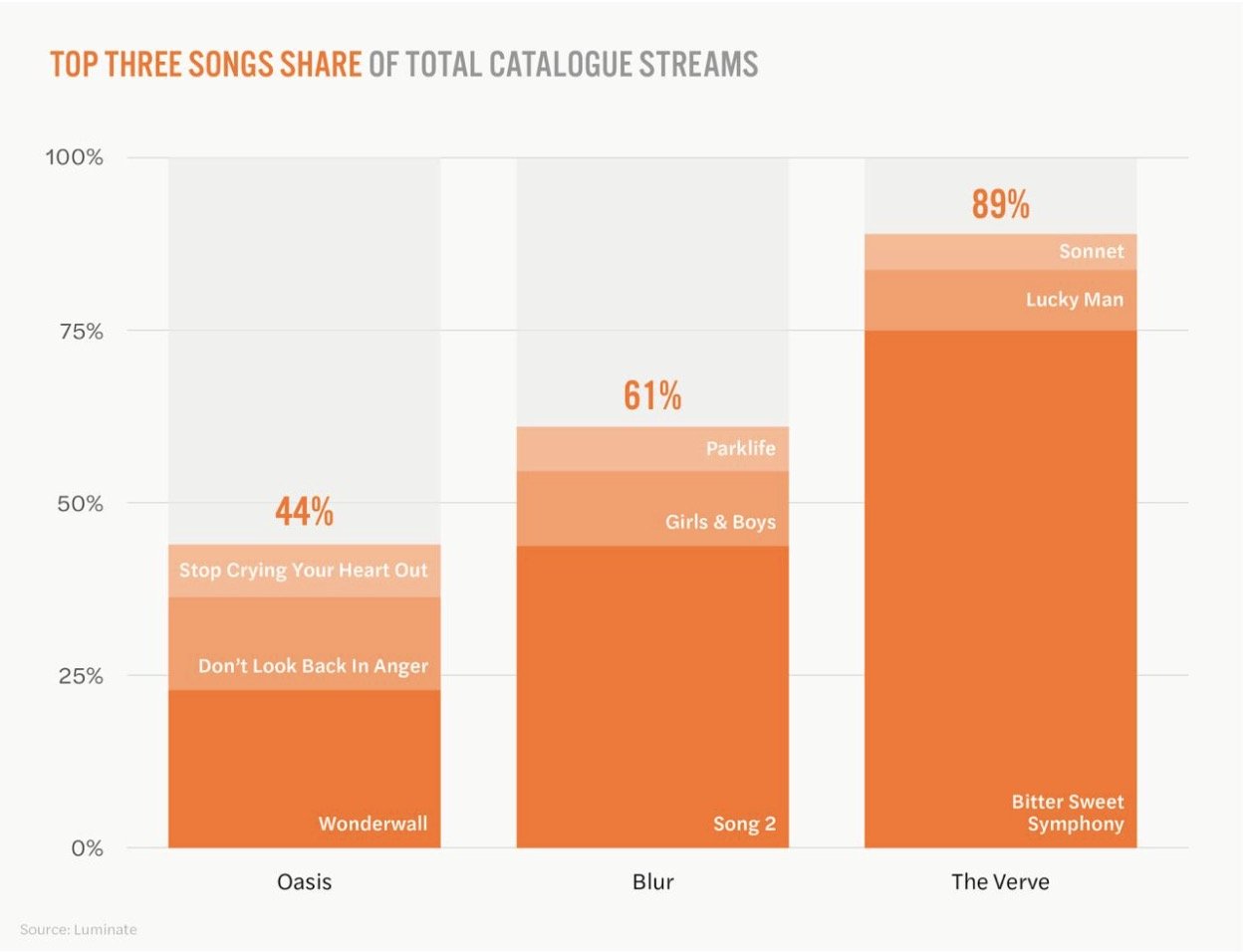
To do this, I pulled a year’s worth of Oasis global audio and video streams on Luminate’s impressive new dashboard and stacked the stream share of each song from their 188-strong catalog. Wonderwall grabbed 23% of all streams, followed by Don’t Look Back in Anger (14%) then Stop Crying Your Heart Out (8%).
All in all, their top five songs make up only half of demand. Stretch it out further, and their top ten songs make up only 70% of demand, meaning the other 100+ songs down in the long tail make up 30%. That’s a lot of hits and a fat tail to boot.
That ‘fat tail’ is what those two brothers can be proud of — their fans, old and new, demonstrate an appreciation for a genuine body of work. Ralph Simon, the Zelig of the music business, is quick to point out that the band now occupy three of the top four positions in the UK album chart — “not the first time this has happened” reflects Simon.
Whataboutisms?
That fat tail would fizzle out if we didn’t have context and comparisons. Jaime Marconette at Luminate gives us context, noting that when Oasis announced their reunion last year, the explosion in streams propelled their global artist rank on Luminate from #400 to #40.
For comparisons, ChartMetric’s Related Artist tees up Blur and The Verve. Blur are more hit heavy, with Song 2, Girls & Boys and Parklife making up just under a third of all streams.
The Verve is dominated by Bitter Sweet Symphony, with Lucky Man and Sonnet added to their podium.
Oasis have a long and very fat tail in absolute and relative terms. Their fans are streaming the many, not the few. Which begs the question why?
One explanation is that Oasis are a scene, not a band. They embody a culture that resonates across generations, from late baby-boomers, Gen X, Millennials and Gen Z’ers. Their fans copied Gallagher’s hairstyle back then, and baldness permitting, they’ll likely do so now. The same can’t be said for Damon Alburn’s haircut, nor Richard Ashcroft’s parker jacket — neither then nor now.
Another is that their music feels impervious to virality — their catalog hasn’t produced a breakout hit on TikTok yet. What is going viral is intimate conversations between (and in between) the two brothers, recalling hilarious stories from yesteryear, such as the infamous fork in the champagne tale. Another unusual source of virality is FOMO content: fans gathering for free outside the fence on Gallagher Hill to sing along with those who queued for hours to pay. Intimacy, again.
“Words like ‘timeless’ and ‘seminal’ are often bandied about in the music industry, but there are few bands out there who can truly walk the walk. Oasis is one of them.”
Last word to Dan Chalmers, Head Of Music, YouTube, EMEA who reflected on his recent pilgrimage to Manchester’s Heaton Park: “Words like ‘timeless’ and ‘seminal’ are often bandied about in the music industry, but there are few bands out there who can truly walk the walk.
“Oasis is one of them. They’ve successfully crossed over to a new generation in the post-digital era, where the depth and breadth of consumption across their catalog underscores their rightful place as master craftsmen of enduring music”.
Reservoir (Nasdaq: RSVR) is a publicly traded, global independent music company with operations across music publishing, recorded music, and artist management.Music Business Worldwide
North Korea has announced that its newly opened seaside resort will not be receiving foreign tourists.
The Wonsan Kalma Coastal Tourist Zone, opened on 1 July, has been touted as a key part of North Korean leader Kim Jong Un’s ambitions to boost tourism.
In the lead-up to its opening, the resort was promoted as an attraction for both locals and foreigners. But as of this week, a notice on North Korea’s tourism website says that foreigners are “temporarily” not allowed to visit.
Last week, the first Russian tourists reportedly arrived at the resort in Wonsan – around the same time that Russian foreign minister Sergei Lavrov met Kim in the city.
Lavrov hailed the seaside development as a “good tourist attraction”, and said he hoped it would become popular among Russians, AFP reported. The two countries are set to launch direct flights between Moscow and Pyongyang by the end of the month.
A Russian tour guide previously told NK News that they had planned several more trips to the resort in the coming months.
Wonsan, a city along North Korea’s east coast, is home to some of the country’s missile facilities and a large maritime complex. It’s also where Kim spent much of his youth, among holiday villas belonging to the country’s elites.
The new seaside resort has lined 4km (2.5 miles) of its beachfront with hotels, restaurants, shopping malls and a water park. It has a capacity of some 20,000 people, according to state media.
However, since the resort began construction in 2018, human rights groups have protested the alleged mistreatment of its workers. They point to reports of people being forced to work long hours to finish the massive project, under harsh conditions and inadequate compensation.
Russian ambassadors attended the resort’s completion ceremony on 24 June, along with Kim and his family.
Last year, North Korea allowed Russian tourists to visit North Korea after a years-long suspension of tourism during the pandemic.
In February, North Korea also started to receive tourists from the West, including Australia, France, Germany and the UK. It abruptly halted tourism weeks later, however, without saying why.
A required part of this site couldn’t load. This may be due to a browser
extension, network issues, or browser settings. Please check your
connection, disable any ad blockers, or try using a different browser.




 Getty Images
 Getty Images
 Getty Images/BBC