
8.6 C
New York
Wednesday, April 22, 2026
Home Blog Page 535

Trump warns India of potential 25% duties if agreement not reached

0

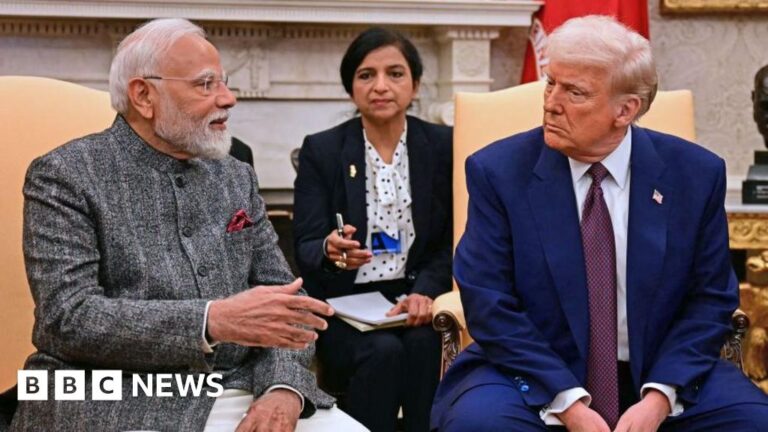
India could face tariffs as high as 25% if it fails to finalise a trade deal with the US this week, President Donald Trump has said.

“Yeah, I think so,” he told reporters on Tuesday when asked whether Delhi would face higher tariffs in the absence of an agreement.

The US has set a 1 August deadline for India and several other countries to either reach a trade agreement or face increased tariffs.

Indian and American officials have been negotiating a trade deal for the past few months, but officials have alternated between sounding optimistic and cautious about when it will be announced.

When asked about what he expected from a potential deal with India, Trump said: “We’re going to see. India has been a good friend, but India has charged basically more tariffs than almost any other country”.

“But now I’m in charge, and you just can’t do that,” he added.

The BBC has reached out to India’s commerce ministry for a comment.

Tariffs are taxes charged on goods imported from other countries. The US president has repeatedly taken aim at India’s high tariffs, branding it a “tariff king” and a “big abuser” of trade ties.

Trump has not yet sent a letter to India setting a new tariff rate – as he has with more than a dozen other trading partners.

Back in April, Trump had announced tariffs of up to 27% on Indian goods, which was later paused.

Since then, both sides have been racing to negotiate an agreement, with officials sometimes sounding positive and at other times, measured.

“We continue to speak with our Indian counterparts. We’ve always had very constructive discussions with them,” US Trade Representative Jamieson Greer said earlier this week.

He also acknowledged that although he had earlier said a deal with India might be “imminent”, it needed to be understood that Delhi’s trade policy has been “protectionist for a very long time” and has been “premised on strongly protecting their domestic market”.

Greer added that Trump has been focused on securing deals that substantially open other markets to the US.

Agriculture and dairy are among the key sticking points for both countries.

For years, Washington has pushed for greater access to India’s farm sector, seeing it as a major untapped market. But India has fiercely protected it, citing food security, livelihoods and the interests of millions of small farmers.

Last week, Indian Commerce Minister Piyush Goyal told CNBC that the agriculture sector is sensitive for India and that it will make sure that farmers’ interests are “well protected”.

Goyal also told news agencies that India remains “optimistic” about striking a deal with Washington soon.

Speaking to Reuters, he said that India was making “fantastic progress” in talks with the US and that he hoped they were able to “conclude a very consequential partnership”.

Until recently, the US was India’s largest trading partner, with bilateral trade reaching $190bn in 2024. Trump and Modi have set a target to more than double this figure to $500bn.

India has already reduced tariffs on a range of goods – including Bourbon whiskey and motorcycles – but the US continues to run a $45bn (£33bn) trade deficit with India, which Trump is keen to reduce.

Follow BBC News India on Instagram, YouTube, Twitter and Facebook.

Live Nation acquires additional stake in Mexico’s OCESA in $646 million deal

0

Live Nation Entertainment is set to acquire an additional 24% stake in Mexican concert promoter OCESA, accelerating a purchase agreement.

The USD $646 million transaction, announced Tuesday (July 29), will see Live Nation increase its ownership in OCESA to 75% from its current 51% stakeholding.

Former OCESA owner, CIE (Corporación Interamericana de Entretenimiento), will retain a 25% stake.

In addition, Live Nation has secured a contract with OCESA boss Alejandro Soberón to remain CEO of the company through 2032.

The deal is now expected to close by the end of August, following approval at the upcoming CIE shareholder vote.

A put/call agreement for CIE’s remaining 25% stake has been pushed back to 2032.

Live Nation originally acquired a controlling 51% stake in OCESA in December 2021 for MXN $8.835 billion (USD $416 million at 2021 exchange rates), following a deal that was initially agreed in 2019 but delayed due to the pandemic.

Live Nation has confirmed to MBW that its new acquisition of the additional 24% in OCESA will cost just over MXN $12 billion (USD $646 million).

Across the two transactions (the 51% in 2021 and 24% in 2025), that’s comfortably more than a billion dollars changing hands.

The rise in value in OCESA’s equity over the past four years will have been influenced by the rapid commercial growth of the Mexican live market in the same timeframe.

Speaking today, Michael Rapino, President and CEO of Live Nation Entertainment, said: “Our investment in OCESA has been incredibly successful, and Alejandro and his team have done a tremendous job utilizing the global Live Nation infrastructure to drive growth in Mexico.

“Together we have more than tripled the number of fans attending our concerts in Mexico since 2019, making Mexico now the 3rd largest music market in the world, and I expect we have many years of strong growth ahead of us.”

OCESA operates 13 venues across Mexico and promotes thousands of events annually. Its ticketing arm, Ticketmaster Mexico, sells around 20 million tickets per year.

Alejandro Soberón, Founder, Executive Chairman, and CEO of Grupo CIE, as well as Founder and CEO of OCESA, said: “Live Nation and Michael Rapino have been ideal partners.

“The combination of our market knowledge and Live Nation’s expertise have come together to create more opportunities for artists to perform in Mexico and for fans to enjoy these shows.”

The OCESA deal forms part of Live Nation’s broader Latin American expansion strategy.

In May, the company acquired Dominican Republic promoter SD Concerts, citing fan attendance in the region up over 25% in the first quarter of 2025.

Live Nation has also expanded into Colombia through OCESA’s acquisition of Páramo Presenta, the promoter behind major festivals including Estereo Picnic.Music Business Worldwide

How is Israel’s conflict affecting the children of Gaza?

0

The war on Gaza is leaving behind a generation of orphans. Many children survive, but they will grow up without parents.

Chris Paul’s Main Focus is Winning with the LA Clippers

0

Chris Paul Wants to Win Before Retiring

Chris Paul has made it clear: the 2024-25 NBA season isn’t just about chasing a long-elusive championship. It’s also about enjoying the journey — perhaps more than ever before.

The 12-time All-Star is returning to the Los Angeles Clippers, a team he once led to multiple playoff appearances, and a franchise he still holds close. After departing the San Antonio Spurs this summer and weighing retirement, Paul ultimately chose the Clippers because he believes in their ability to contend.

“I’m just so excited about the moves that the team has made this offseason – Brad coming to the team, Brook Lopez, all the young guys,” Paul said. “I talked to James [Harden], I talked to Kawhi [Leonard], and I’m even more excited about what I think we have a chance to do.”

Accepting Bench Role

Though Paul initially hoped to start on his next team, he’s accepted a bench role — a major shift after two decades as a floor general. But Paul isn’t backing down from leadership responsibilities.

“My role on this team is obviously different from what it’s been in the past 20 years, being in the NBA,” he explained. “But showing up every day, if I can show some of the guys what it looks like every day to clock in and clock out, I’m excited for it.”

VIDEO: Chris Paul Focused On Winning With LA ClippersVIDEO: Chris Paul Focused On Winning With LA Clippers

At 40 years old, Paul knows his NBA clock is winding down. This could very well be his final season. That’s part of why he’s approaching it with a fresh mindset.

“You all who have seen me play for a while, I’m going to try to do better and try to smile a little bit more this year,” Paul said during his Clippers press conference, via ESPN. “I’m grateful. I’m going to come out every single night, whatever that looks like, and try to make sure I show up for the team.”

With the additions of Bradley Beal and Brook Lopez, and a motivated Paul accepting a new role, the Clippers could be a serious title threat — and Paul might just find joy in the chase as much as the goal.

Challenging Client Situation

0


Client Challenge


JavaScript is disabled in your browser.

Please enable JavaScript to proceed.

A required part of this site couldn’t load. This may be due to a browser
extension, network issues, or browser settings. Please check your
connection, disable any ad blockers, or try using a different browser.

Heatwaves May Reduce the Effectiveness of Electric Fans

0

A fan might feel like a lifeline in a heatwave, and for older adults it may be of some help – but not as much as it might seem. A new study has found that while high-speed fan use slightly reduced core body temperature and improved comfort in humid heat, it doesn’t stop internal heat buildup entirely. And in extremely hot and dry conditions, where fan use has previously been shown to raise heart strain, it can do more harm than good.

Researchers from Australia’s University of Sydney, Monash University, the University of Adelaide, along with the Montreal Heart Institute, investigated the effect of electric fan use during different temperature conditions on a cohort of 58 older adults aged 60 years and over (mean age 68 years).

In the randomized crossover trial, 27 participants had a history of coronary artery disease, while 31 did not. All participants underwent four three-hour heat exposures separated by at least 72 hours: Fan only (around 4 m/s airflow), skin wetting without fan, skin wetting with fan and no intervention (control). The fan was placed just over three feet (1 m) from the subject.

In the skin-wetting sessions, warm water was misted onto the exposed skin of participants to simulate sweat. And the fan used was a standard high-speed household pedestal unit.

The participants were exposed to ambient room temperatures of 100.4  °F (38 °C) with 60% relative humidity, representing high indoor heatwave conditions.

The researchers found that fan use alone slightly reduced core body temperature of participants by an average of 0.18  °F (0.1 °C), compared to no fan or skin wetting, showing some benefit of using a high-speed electric fan. There was an increase in sweating, too, and people reported feeling cooler and more comfortable.

Interestingly, using a fan with skin wetting didn’t change core body temperature, though it did make people feel the most comfortable overall. The research suggests that the skin wetting suppressed natural sweat responses that remove heat from the body.

And skin wetting alone did nothing to shift core body temperature, even if people reported they felt a little more comfortable than during the control heat exposure.

However, when it came to different temperatures and humidity, the results were flipped. Given the risk to heart issues in people with coronary artery disease, only the 31 healthy participants took part in the fan study (the remaining 27 individuals just underwent skin wetting/no skin wetting conditions).

What they found was that in hot and dry conditions – 113  °F (45  °C) with 15% humidity – using a fan alone actually increased core body temperature by 0.5 °F (0.3 °C), showing that fan actually drove heat into the body, compared to not using a fan at all. Neither skin wetting tests proved significant in cooling down participants.

And people also reported they felt hotter using the fan in this test, showing that as their core temperature rose, their comfort levels reflected the internal shift.

Overall, the study shows that it’s not just the temperature number but the water content in the air that determines how well a high-speed electric fan is going to work in actually cooling the body.

The link between heat exposure and cardiovascular disease is well documented, with a large body of evidence showing how higher temperatures can put the heart under increased strain. Risk of heart-related death has been shown to triple when the mercury rises during a heat wave.

Earlier research from the University of Sydney and the Montreal Heart Institute found that accessible interventions such as wetting the skin was able to negate the heating effect of fans when temperatures and air dryness resulted in heating the body. In this study, however, a slight drop in core temperature wasn’t statistically significant, so its benefits are negligible even if it is perceived as more comfortable.

The study suggests that a fan may not be enough to negate health risks during a heatwave, and for those without access to an air-conditioner, other interventions like community cooling shelters and more nuanced heat risk warnings could better protect older adults during extreme weather events.

The research was published in the journal JAMA Network Open.

Source: The University of Sydney via Scimex

Brazil’s new development law poses a risk of increased deforestation in the Amazon

0

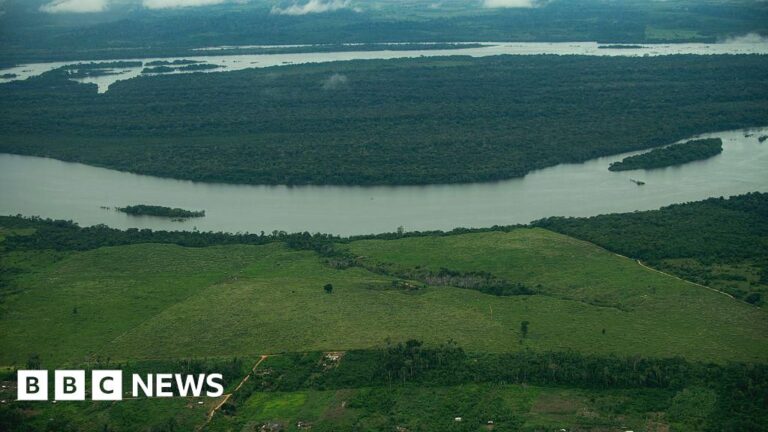
A new law in Brazil could cause “significant environmental harm and human rights violations”, and represents a “rollback for decades” of protections in Brazil, including for the Amazon, a UN expert has told BBC News.

Plans to speed up approvals for development projects were criticised by Astrid Puentes Riaño, a UN special rapporteur, as the country prepares to host the COP30 climate summit this year.

Lawmakers passed plans to simplify environmental licences for infrastructure including roads, dams, energy and mines this month, though the president has not formally approved the bill.

Critics have dubbed it the “devastation bill” and say it could lead to environmental abuses and deforestation.

Proponents say a new nationwide licensing regime would simplify the long and complex process that companies face to prove to authorities that planned developments do not cause unacceptable environmental harm.

Under the changes, some developers would be able to self-declare their environmental impact through an online form for projects deemed smaller – a move supporters say would reduce bureaucracy but critics feel is a major concern.

Ms Riaño told the BBC she feared the lighter regulations would “apply to some mining projects” and will “impact the Amazon region”.

She also said was “very worried” about plans for automatic renewal of some projects’ licences where no major changes have occurred, saying: “This will prevent environmental impact assessments from being done on these projects. Some of the projects will include mining projects or infrastructure projects where a full assessment is needed.

“It will also cause deforestation. Modifications or continuations of projects might mean deforestation in the Amazon without a proper assessment.”

A lot of deforestation and land-clearing in the Amazon has been driven by agriculture and mining, sometimes illegally – but Ms Riaño said the bill is “going backwards” on efforts to prevent that.

Her intervention comes two months after new analysis was published showing vast swathes of the Amazon were destroyed in 2024, with forest fires fuelled by drought adding to man-made deforestation pressures.

Under the new law, environmental agencies would have 12 months – extendable to 24 – to make a decision about whether to grant a licence for strategic projects. If that deadline was missed, a licence could be automatically granted.

Supporters say this would give businesses certainty by preventing delays that have plagued projects, including hydroelectric dams for clean energy, or rail lines to transport grain.

Ms Riaño said she understood the need for more efficient systems but assessments must be “comprehensive” and “based on the science.”

The law would also relax the requirement to consult indigenous or traditional quilombola communities – descendents of Afro-Brazilian slaves – in some situations unless they are directly impacted.

UN experts raised concerns that fast-tracking assessments could remove some participation and affect human rights.

Supporters of the bill say it will encourage economic development, including for renewable energy projects, held to grow the economy, and reduce costs for businesses and the state.

But critics fear weakening environmental protections could increase the risk of environmental disasters and violate indigenous rights.

In particular, UN experts argue it could contradict constitutional rights guaranteeing the right to an ecologically balanced environment – which means legal challenges could lie ahead.

The Senate and Chamber of Deputies have approved the bill and it is now pending presidential approval.

President Lula da Silva has until 8 August to decide whether to approve or veto the new law.

Brazil’s Environment and Climate Change minister, Marina Silva, has strongly opposed the bill, condemning it as a “death blow” to environmental protections.

But she has been at odds with the president on other issues in the past, including proposals to explore oil drilling in the Amazon basin.

Even if the president vetoes it, there is a chance the conservative-leaning congress could try to overturn that.

Brazil’s Climate Observatory has called the bill the “biggest environmental setback” since Brazil’s military dictatorship, in which the construction of roads and agricultural expansion led to increased Amazon deforestation and the displacement of many indigenous people.

Ms Riaño said scientists in Brazil estimate the bill “will lift protections for more than 18 million hectares in the country, the size of Uruguay,” adding “the consequences are huge”.

AUKUS defence pact under review in the US this autumn

0

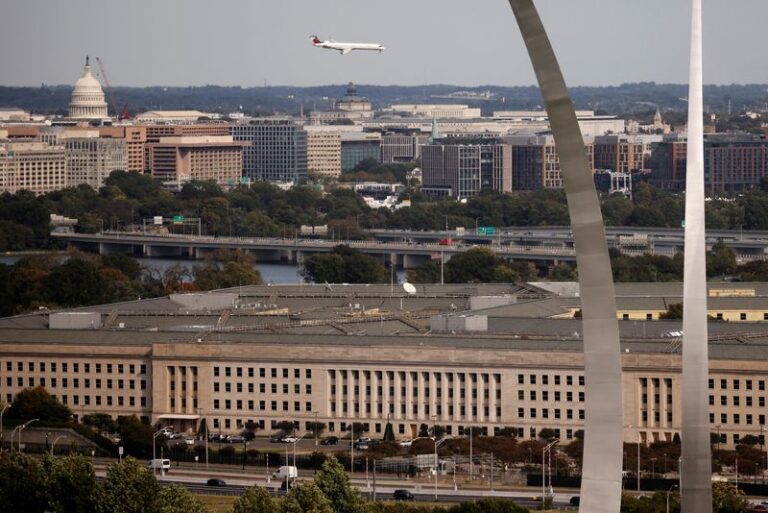
US to complete review into AUKUS defence pact in autumn

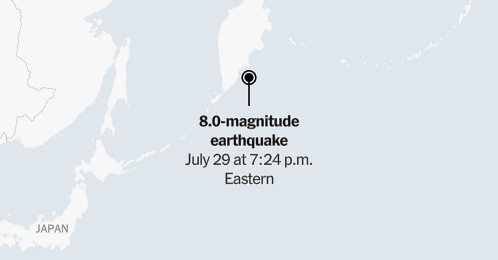
Tracking a Potential Tsunami in the North Pacific Ocean: Using a Map

0

Source: U.S. Tsunami Warning System  Note: Sensor data is available only for selected locations, mainly in North America. The New York Times

Alerts for a potential tsunami were issued for parts of the Aleutian Islands in Alaska, Hawaii, the coastline of Russia and Japan after an 8.7-magnitude earthquake struck in the North Pacific Ocean off Russia’s northern Pacific coast, according to the U.S. Tsunami Warning System, which is part of the National Weather Service.

A tsunami advisory, which means people should get out of coastal waters and stay away from beaches and waterways, was issued for parts of the Aleutian Islands. A tsunami watch, which means experts are evaluating the threat, was issued for Hawaii and Guam.

U.S. officials said a tsunami threat exists for parts of Russia and Japan, but they deferred to authorities in other countries for official advisories and warnings. No tsunami warnings — the highest alert — were in place for North America.

Tsunamis are a series of long waves caused by a large and sudden displacement of water in the ocean, usually from a large earthquake on or below the ocean floor. Tsunamis radiate in all directions from the epicenter and can cause dangerous coastal flooding and powerful currents that can last for hours or days.

Experts warn that just before a tsunami hits shore, seawater can first be drawn out to sea — exposing large swaths of beach and giving people along the water a false sense that a coast is safe.

As more information becomes available, officials may update, add or cancel tsunami alerts.

Camille Baker and Natasha Cornelissen contributed reporting.

Ghislaine Maxwell seeks immunity in exchange for providing testimony to Congress

0

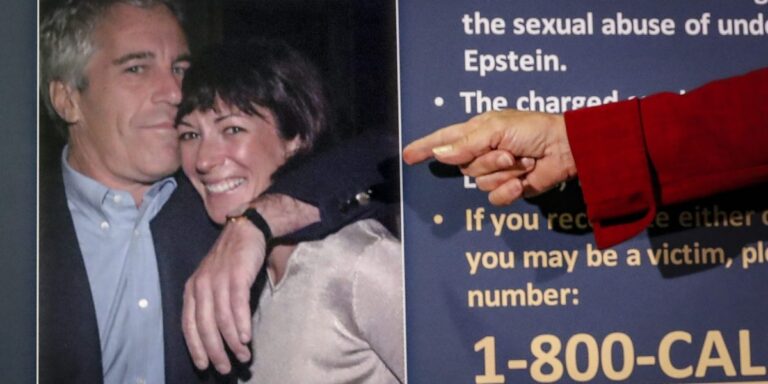
Ghislaine Maxwell, the imprisoned former girlfriend of disgraced financier Jeffrey Epstein, is open to answering questions from Congress — but only if she is granted immunity from future prosecution for her testimony, her lawyers said Tuesday.

A spokeswoman for the committee that wants to interview her responded with a terse statement saying it would not consider offering her immunity.

Maxwell’s lawyers also asked that they be provided with any questions in advance and that any interview with her be scheduled after her petition to the U.S. Supreme Court to take up her case has been resolved.

The conditions were laid out in a letter sent by Maxwell’s attorneys to Rep. James Comer, the Republican chair of the House Oversight Committee who last week issued a subpoena for her deposition at the Florida prison where she is serving a 20-year-prison sentence on a conviction of conspiring with Epstein to sexually abuse underage girls.

The request to interview her is part of a frenzied, renewed interest in the Epstein saga following the Justice Department’s July statement that it would not be releasing any additional records from the investigation, an abrupt announcement that stunned online sleuths, conspiracy theorists and elements of President Donald Trump’s base who had been hoping to find proof of a government coverup.

Since then, the Trump administration has sought to present itself as promoting transparency, with the department urging courts to unseal grand jury transcripts from the sex-trafficking investigation and Deputy Attorney General Todd Blanche interviewing Maxwell over the course of two days at a Florida courthouse last week.

In a letter Tuesday, Maxwell’s attorneys said that though their initial instinct was for Maxwell to invoke her Fifth Amendment right against self-incrimination, they are open to having her cooperate provided that lawmakers satisfy their request for immunity and other conditions.

But the Oversight Committee seemed to reject that offer outright.

“The Oversight Committee will respond to Ms. Maxwell’s attorney soon, but it will not consider granting congressional immunity for her testimony,” a spokesperson said.

Separately, Maxwell’s attorneys have urged the Supreme Court to review her conviction, saying she dd not receive a fair trial. They also say that one way she would testify “openly and honestly, in public,” is in the event of a pardon by Trump, who has told reporters that such a move is within his rights but that he has not been not asked to make it.

“She welcomes the opportunity to share the truth and to dispel the many misconceptions and misstatements that have plagued this case from the beginning,” he said.

Introducing the 2025 Fortune 500, the definitive ranking of the biggest companies in America. Explore this year’s list.