new video loaded: Why Trump’s Tariffs Are Closing Factories in Lesotho
Recent episodes in Latest Video
Whether it’s reporting on conflicts abroad and political divisions at home, or covering the latest style trends and scientific developments, Times Video journalists provide a revealing and unforgettable view of the world.
Whether it’s reporting on conflicts abroad and political divisions at home, or covering the latest style trends and scientific developments, Times Video journalists provide a revealing and unforgettable view of the world.
Landing a lucrative tech job has never been easy—but this year in particular has presented unique challenges thanks to AI’s revolution of the job market and a worsening labor market.
Some companies are using AI to boost productivity. Others are using it as a reason to slash headcount. Firms like Intel, Google, and Microsoft have cut jobs in recent months, but while their leaders haven’t solely blamed the technology, others haven’t minced words.
“We will need fewer people doing some of the jobs that are being done today, and more people doing other types of jobs,” Amazon CEO Andy Jassy wrote in a recent internal memo. “In the next few years, we expect that this will reduce our total corporate workforce as we get efficiency gains from using AI extensively across the company.”
But there are still opportunities for workers to find success in today’s job market. Walmart, the No. 1 company on the Fortune 500 list, is on the hunt for experienced software engineers, data scientists, IT product managers, and more—with dozens of open job postings making six-figures, with some roles extending to over $300,000.
The perks and paychecks on offer at Walmart
Pickleball classes, hydromassages, and rooftop lounges.
Those are the perks you could be enjoying if you’re willing to pack your bags and move to Bentonville, Arkansas, and take a job at Walmart’s new 350-acre luxury campus.
And while the office alone might not convince you to relocate to small-town America, the retail giant is still willing to shell out high-paying salaries for competitive tech talent. Walmart is on the hunt for experienced software engineers, data scientists, IT product managers, and more.
Group director, software engineering: $195,000-$370,000
Director, data science: $169,000-$338,000
Senior director, data science: $160,000-$320,000
These numbers were sourced based on Fortune analysis of active job postings, but the exact compensation package, including salary, bonus opportunities, and stock award, will likely vary by role and depend heavily on a candidate’s experience. Location, too, is a factor, with Walmart also recruiting for its satellite locations like in California and Washington.
Fortune reached out to Walmart for comment.
The secrets to landing a job in today’s rocky market
Despite this revolution, some best practices still hold true for landing a high-paying gig. But because careers are changing faster than ever, Jassy encourages Gen Z to stop worrying about what their job will look like in 10 years—and focus on finding a passion.
“I have a 21-year-old son and a 24-year-old daughter, and one of the things I see with them and their peers is they all feel like they have to know what they want to do for their life at that age,” Jassy said on the podcast, How Leaders Lead with David Novak. “And I really don’t believe that’s true.”
And it’s a practice he learned from personally; Jassy experimented in sportscasting, soccer coaching, and investment banking before landing at Amazon.
“I tried a lot of things, and I think that early on, it’s just as important to learn what you don’t want to do as what you want to do, because it actually helps you figure out what you want to do.”
For Walmart CEO Doug McMillion, one of the secrets for success is simple: raising your hand and being a team player. “Nothing happens through the work of just an individual,” McMillon told Stanford’s Graduate School of Business this May. “We all do this together.”
Sweden striker Alexander Isak heavily linked to Liverpool move after reportedly telling Newcastle he wants to leave.
Newcastle have rejected Liverpool’s opening bid to sign unsettled Sweden striker Alexander Isak, according to reports.
Isak has been training at his old club Real Sociedad this week after reportedly telling Newcastle he wants to leave St James’ Park.
The 25-year-old has been linked with Liverpool since the end of last season, and the Premier League champions are now believed to have formalised their interest with an offer of about 110 million pounds ($146m) plus potential add-ons.
But Newcastle, who reportedly value Isak at 150 million pounds ($199m), remain eager to hold on to their prize asset and have rebuffed Liverpool’s initial bid.
Isak, who joined Newcastle in a 60-million-pound ($80m) move from Real Sociedad in 2022, scored 23 Premier League goals last season to help Newcastle qualify for the Champions League.
He has three years left on his Newcastle contract, but did not travel to Asia for the Magpies’ ongoing preseason tour, with the club saying he had a minor thigh injury.
On Thursday, Real Sociedad confirmed he was at their Zubieta facility with his own trainers.
It was reported on Friday that Newcastle had told Isak he could agree a new deal containing a get-out clause for next year, but he responded by insisting he wants to move now.
Liverpool manager Arne Slot has already bolstered his attacking options by signing Eintracht Frankfurt striker Hugo Ekitike and Bayer Leverkusen playmaker Florian Wirtz during the current transfer window.
But the Reds are eager to make their forward line even more formidable by adding Isak, as they look to win back-to-back English titles for the first time since the 1980s.
Newcastle boss Eddie Howe struck a defiant note earlier this week when he said: “He is still our player. He’s contracted to us.
“We, to a degree, control what is next for him. I would love to believe all possibilities are still available to us.
“My wish is that he stays, but that’s not in my full control.”
Liverpool have spent more than 250 million pounds ($332m) so far in the summer window, with Milos Kerkez, Jeremie Frimpong and Giorgi Mamardashvili joining Wirtz and Ekitike at Anfield.
Lyrics licensing company Musixmatch has fired back against rival LyricFind’s claims in an antitrust lawsuit involving the rights to license lyrics from publisher Warner Chappell Music.
In new court filing, lawyers for Musixmatch argued that LyricFind doesn’t have standing to sue its rival under US antitrust laws because there’s no reason to believe that Warner Chappell would have continued doing business with LyricFind if it hadn’t signed a deal with Musixmatch.
LyricFind “would have suffered the same alleged injury if WCM had instead licensed those rights exclusively to a smaller rival or on a non-exclusive basis to multiple other companies but not LyricFind,” Musixmatch’s lawyers wrote.
“LyricFind’s alleged injury is thus not one the antitrust laws are designed to address.”
In a statement to MBW, a Musixmatch spokesperson asserted that LyricFind sued its rival because “it failed to secure rights and win a contract” with Warner Chappell.
“LyricFind is relying on bluster to distract from its business failures,” the spokesperson wrote. “Rights owners and digital service providers have a choice about whom they do business with and we’re proud that our partners continue to choose us.”
LyricFind filed the antitrust suit against Musixmatch in March, arguing that the Musixmatch/Warner Chappell deal – which made Musixmatch the exclusive provider of lyrics rights licensing and lyric data services for songs published by WCM, even for licensees that have a direct deal with the publisher – made it impossible for LyricFind to offer a comprehensive catalog of lyrics.
It also ties the hands of music streaming services by requiring them to license WCM lyrics through Musixmatch “at monopolistic prices,” LyricFind said.
“That’s not just a hypothetical – it’s exactly what happened with Spotify last year, who had completed onboarding with LyricFind but were robbed of the opportunity to select the lyric provider of its choice,” LyricFind founder and CEO Darryl Ballantyne wrote in an open letter.
In June, Musixmatch filed a motion to dismiss the case, arguing that the California court doesn’t have jurisdiction, as LyricFind is a Canadian company, Musixmatch is Italian, and the agreement between WCM and Musixmatch is governed by the laws of the United Kingdom.
“LyricFind is relying on bluster to distract from its business failures.”
Musixmatch
Musixmatch also argued that Warner Chappell, as owner of the lyrics, “indisputably has the right to exclusively license and distribute its intellectual property as it sees fit.”
In a response to that motion, LyricFind’s lawyers argued that the federal court in California does have jurisdiction, because Musixmatch “purposefully directed its anti-competitive conduct at the United States and California. The United States is the epicenter of the lyric-services industry, home to WCM’s licensing business, much of Musixmatch’s leadership, and nearly all major DSPs impacted” by the Musixmatch-WCM agreement.
In a reply in support of its dismissal motion, filed on July 30 in the US District Court for the Southern District of California, Musixmatch rejected that argument.
“If LyricFind’s ephemeral ‘epicenter’ standard were the test, there would be no limits to the Court’s ability to exercise personal jurisdiction over foreign defendants: any plaintiff in the world could plausibly allege that the United States, the world’s largest economy, is the ‘epicenter’ of whatever industry is relevant to their case, and thus establish jurisdiction.”
It also argues that nothing LyricFind claimed “rebuts the simple fact that the purported injury to LyricFind was caused by WCM’s decision not to grant LyricFind a license. LyricFind does not allege that WCM would have continued to deal with it absent the WCM/Musixmatch agreement. This is fatal to LyricFind’s antitrust standing.”
LyricFind also released an unredacted version of its original complaint, showing that it alleged Musixmatch had attempted to “buy or bury” its rival, starting with a bid to buy LyricFind in 2023.
“Spotify… completed onboarding with LyricFind but were robbed of the opportunity to select the lyric provider of its choice.”
Darryl Ballantyne, LyricFind
Musixmatch and its investor TPG – which LyricFind is also suing in the antitrust case – “embarked on a multi-faceted ‘buy or bury’ scheme to exclude LyricFind and other providers from the market so it could continue charging unlawfully inflated prices without the risk of losing business,” LyricFind said in the unredacted complaint.
LyricFind alleged that when this didn’t pan out, Musixmatch switched tactics and focused on the deal with Warner Chappell.
Notably, LyricFind has signed at least one exclusive licensing deal of its own, with Universal Music Publishing Group in 2014, which gave LyricFind exclusive rights to sublicense UMPG lyrics. However, that deal differs from the Musixmatch-WCM deal in that UMPG retained the right to license its lyrics directly, while Musixmatch’s deal gives it full exclusivity to license Warner Chappell lyrics.Music Business Worldwide
Ukrainian president Volodymyr Zelensky has called for stronger international sanctions on Russia after a deadly attack on Kyiv killed at least 31 people.
Zelensky said five children – the youngest aged two – were among the dead and 159 people had been wounded in the assault on Thursday.
“No matter how much the Kremlin denies their effectiveness, sanctions do work – and they must be strengthened,” he said.
Kyiv observed a day of mourning after the attack on the capital collapsed an apartment block and damaged a hospital, school, nursery and university.
Russia launched more than 300 drones and eight cruise missiles in the overnight assault, Ukraine’s air force said. The attack was one of the deadliest Kyiv has experienced since Russia launched its large-scale invasion in February 2022.
US president Donald Trump condemned Russia’s actions in Ukraine and suggested new sanctions against Moscow were coming.
“Russia, I think it’s disgusting what they’re doing. I think it’s disgusting,” he told journalists.
On Monday, Trump issued a new “10 or 12” day deadline for Russia to agree to a ceasefire in Ukraine.
John Kelley, the acting US representative to the United Nations, told the UN Security Council on Thursday that Russia and Ukraine “must negotiate a ceasefire and durable peace”.
“It is time to make a deal,” he said.
Ukrainian officials on Friday said Kyiv had received “positive signals” from the US about potential new sanctions, particularly targeting Russian oil and secondary markets.
Ukraine’s foreign minister Andrii Sybiha said Trump has been “generous and patient”, but that “now is the time to put maximum pressure on Moscow”.
Meanwhile, Germany pledged on Friday to deliver two additional US-made Patriot air defence systems in the coming days.
Zelensky said in July alone, Russia launched more than 5,100 glide bombs, 3,800 Shahed drones, and 260 missiles, including 128 ballistic.
“Every day matters,” he said. “This can only be stopped through joint efforts – by America, Europe, and other global actors.”
A required part of this site couldn’t load. This may be due to a browser
extension, network issues, or browser settings. Please check your
connection, disable any ad blockers, or try using a different browser.
Note: All July data is incomplete. Malnutrition data has about a two-week delay.
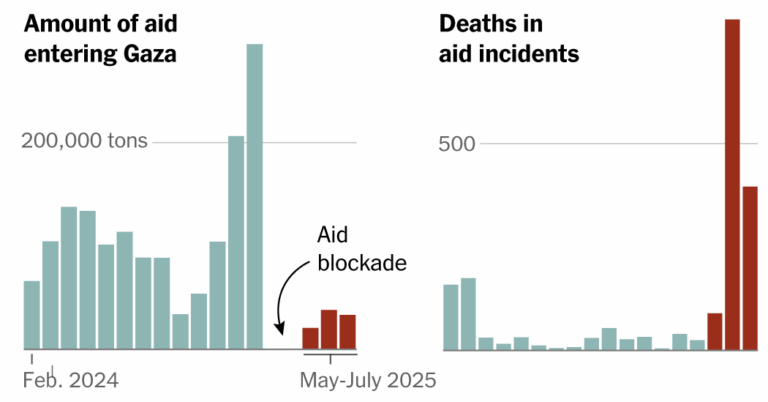
Over the past several weeks, obtaining food in Gaza has been more than difficult — it has been deadly.
Hundreds of Palestinians have been killed while heading toward aid sites, many of them by Israeli forces. Many others have serious malnutrition, which Gazan health officials say has caused scores of deaths.
According to Israel’s own data, less food is going into Gaza now than during most other times in the war, when deliveries were generally far below what aid agencies said was necessary and people often went hungry.
How did it get so much worse?
Videos by Saher Alghorra for The New York Times
After a total aid blockade, an Israeli plan created fewer and farther aid sites
In March, Israel imposed an aid blockade on Gaza in an effort to squeeze concessions from Hamas; it also said, without providing evidence, that the militant group was systematically stealing the supplies. That didn’t force the group to accept Israel’s terms, but it did cause widespread hunger among Gazans.
Amid growing international pressure, Israel established a new aid system in May in southern and central Gaza that would allow it greater control over aid deliveries.
Much of the aid used to go in through a system coordinated by the United Nations, which distributed it at hundreds of sites across the Gaza Strip.
Israel’s new system, run by the Gaza Humanitarian Foundation (G.H.F.), had just four sites. At times, only one would be open per day. And none were in northern Gaza.
The result: Gazans would often have to walk for hours through a war zone to get food from the sites.
Sources: Gaza Humanitarian Foundation (aid sites); U.N. Office for the Coordination of Humanitarian Affairs (Israeli militarized zone)
Note: Distances are based on a 4 km/h walking speed. There are additional areas outside the Israeli militarized zone that have been under evacuation orders since March.
The New York Times
When Israel resumed allowing food into Gaza in late May, it also permitted the United Nations to bring in some aid, as well — albeit in a diminished role. Israel has blamed the U.N. for not bringing in more food, while the U.N. argues that Israel frequently denies or delays its requests to bring in convoys, among other challenges.
People are being asked to cross military lines
Israel wanted the new G.H.F. aid sites to be in zones controlled by the Israeli military. Israeli officials said that was the only way to ensure the food wouldn’t get into the hands of Hamas.
But that meant thousands of Palestinians would have to cross Israeli military lines to get a box of food from the distribution points.
Sources: Gaza Humanitarian Foundation (aid sites); U.N. Office for the Coordination of Humanitarian Affairs (Israeli militarized zone); New York Times analysis of satellite imagery; Satellite imagery from Planet Labs.
The New York Times
The result has been deadly. More than 600 people have been killed while trying to reach the new Gaza Humanitarian Foundation sites, according to the Gazan health ministry. The G.H.F. has disputed reports of shootings at or around its sites, although they acknowledge the areas beyond their perimeter are still an active war zone.
Photos and videos near the sites have shown crowds of people in close proximity to Israeli tanks.
Source: Photo by Abdel Kareem Hana/Associated Press
The New York Times
The military has used live ammunition
Palestinian witnesses say Israeli soldiers have used live fire near aid hubs as Gazans headed toward the sites. The Israeli military says its forces have opened fire to disperse crowds or as warning shots when people approached in what it says was a threatening manner.
Source: Video from Ehab Nuor via Storyful
The New York Times
An Israeli military official who briefed reporters later conceded that Israeli forces had killed at least some people, including with artillery shells, as huge crowds tried to reach the sites.
The official said they were isolated episodes and argued that the overall death toll was exaggerated. The person spoke on the condition of anonymity to comply with military protocol.
Source: Armed Conflict Location and Event Data
The New York Times
Sites are open for very short, unpredictable amounts of time
Gazans have frequently found it hard to know when and how to get aid from the Israeli-backed sites, creating further chaos and confusion.
The new distribution points have opened with little warning and have closed almost immediately as food runs out. Hoping to secure a box of food, Palestinians began arriving hours in advance, waiting in the middle of the night for the sites to open.
Source: Satellite imagery taken on July 13 by Planet Labs.
Note: Walking time estimate is based on a 4 km/h walking speed.
The New York Times
In mid-June, the G.H.F. announced via Facebook only about a half-hour or less in advance that sites would open. The sites then closed less than 15 minutes later, with the G.H.F. saying the food had run out.
Opening and closing announcement times at the Saudi District G.H.F. site
Post announcing site opening
Post announcing site closure
Source: Gaza Humanitarian Foundation Facebook page (announcements of opening and closing times)
Note: Walking time estimates are based on a 4 km/h walking speed.
The New York Times
People have tried to cut ahead in line, sometimes leaving the routes mandated by the G.H.F. At times, Israeli soldiers have opened fire when crowds of Palestinians approached them when the sites weren’t open, according to the Israeli military.
The safe routes to the sites have not always been clear. The Israeli military says it has since added signs in an effort to make sure Palestinians know where to go.
The foundation defends its record, saying that it has delivered more than one million boxes of aid at its sites to Gazans under challenging circumstances.
Sites don’t have the basic protections that aid organizations say should be standard
When the new Israeli-backed sites open generally for very short periods of time, Palestinians have often found themselves in a desperate race for food. Instead of forming an orderly line to receive aid, the strongest and fastest run as fast as they can to grab whatever’s lying on the ground. Many others have left empty-handed.
The Gaza Humanitarian Foundation sites don’t appear to have well-organized infrastructure or even shade. Footage from the scene suggests a flattened area with some fences surrounded by dirt barriers. In a rush to obtain food, people hurdle down the site’s steep barriers and climb over what appears to be barbed wire at the top of the fences.
Sometimes, the American security contractors at the sites have thrown tear gas grenades at people crowded into narrow, fenced-in lines with seemingly nowhere to go, footage shows. About 20 people were killed in a stampede at one of the sites in mid-July; the foundation claimed Hamas-linked instigators had started it.
The danger created more desperation
Doctors in Gaza are reporting spiraling rates of malnutrition. The World Food Program says more than one in three people aren’t eating for multiple days. Gaza health officials say severely malnourished children have died.
In addition to the new distribution system, the United Nations has been delivering aid in areas of Gaza where Israel allows it to operate. As global outrage grew over the past week, Israel paused its operations in parts of Gaza for several hours per day and designated secure routes for U.N. convoys.
But Palestinians say finding food remains incredibly difficult and dangerous. In recent days, hundreds of people have converged on U.N. convoys, desperate for food.
Source: Satellite image from Planet Labs.
The New York Times
Videos from near aid trucks show crowds of men jostling for food.
Aid seekers in northern Gaza rush to grab sacks of flour off an aid truck on July 22.
AFP
Many Gazans are too old, too weak or too terrified to risk going to the aid sites. Instead, they pay astronomical prices for whatever food — much of it resold aid — reaches the enclave’s markets.
The cost is onerous for people already impoverished by 22 months of war and devastation. A kilogram of tomatoes can cost around $30, while a kilogram of sugar can cost more than $100, according to the Gaza Chamber of Commerce and Industry.
Airdrops of aid are unlikely to solve the problem
After growing international fury over the humanitarian crisis, the Israeli military announced on Saturday that it would revive airdrops of aid into Gazas.
Some countries, including Jordan and the United Arab Emirates, have begun dropping boxes of aid.
An aircraft drops aid in Gaza on July 27.
Saher Alghorra for The New York Times
Aid experts warn that airdrops are dangerous, expensive and insufficient to tackle the widening hunger crisis there. It costs many times as much as sending in an equivalent amount of aid through land crossings, which Israel controls.
The airdrops have at times included roughly 10 tons of supplies per drop. A single truck crossing the Gaza border can carry double that far more cheaply.
Last year, other countries stopped parachuting aid into Gaza after several people were killed by the airdrops. In other attempts, the aid has landed in Israel or out at sea.
“Airdrops alone are not the answer,” Britain’s foreign ministry wrote on social media on Wednesday. “Only trucks can deliver at the scale needed.”
Things will be fast paced on Day 6 of the 2025 World Championships as we’ve got four individual finals, four sets of semi-finals, and an exciting curtain call, the men’s 4×200 free relay, on the schedule tonight.
Things will kick off with the final of the women’s 100 freestyle, where Mollie O’Callaghan will be aiming to complete the 100/200 free double for the second time in her career after she swept the two events for the first time at the 2023 World Championships. The Australian could also win the world title in the 100 free for the third time after topping the podium in both 2022 and 2023.
Her main rival figures to be Dutchwoman Marrit Steenbergen, who was the only other swimmer to break 53 seconds in the semis, while American Torri Huske is one to watch as she’s the 2024 Olympic silver medalist, but has been battling illness all week.
In fact, Huske, O’Callaghan and Steenbergen are the only three women who were in last summer’s Olympic final who will be contesting the 100 free tonight in Singapore.
The next final of the night will be the men’s 200 breast, which looks wide open given the absence of reigning Olympic champion Leon Marchand and former world champion Zac Stubblety-Cook, while world record holder and 100 breast winner Qin Haiyang hasn’t looked his best over the 200 distance and barely squeaked into the final in 8th.
That will be followed by the men’s 200 back, which has leveled up over the last 12 months with four swimmers breaking 1:55 in the semis and 1:55.6 being required to earn a lane in the final. Last summer in Paris, only the three medalists broke 1:55 in the final, and 1:56.52 was good enough to crack the top eight.
Leading the field is South African Pieter Coetze, who followed up his 100 back victory by shattering the African Record in the 200 in a time of 1:54.22, while France’s Yohann Ndoye-Brouard (1:54.47), Switzerland’s Roman Mityukov (1:54.83), Canada’s Blake Tierney (1:55.03) and the Czech Republic’s Jan Cejka (1:55.46) also set National Records to advance to the final.
Qualifying 3rd overall was Hungarian Hubert Kos, the reigning Olympic champion and 2023 world champion, who put up a time of 1:54.64 shortly after winning bronze in the 200 IM last night.
The last individual final of the night will be the women’s 200 breast, where we’ll see Olympic champion Kate Douglass and world record holder Evgeniia Chikunova go head-to-head for gold.
The two of them have distanced themselves from the rest of the field heading into the final, with Chikunova qualifying 1st out of the semis in 2:20.65, while Douglass cruised through to win her semi in 2:20.96 and advance in 2nd.
The night will close with the men’s 4×200 free relay, where Great Britain comes in as the team to beat after winning the world title in 2023 and then following up with Olympic gold last summer in Paris. The U.S. team looks to be formidable, however, led by 200 free silver medalist Luke Hobson, who will swim third along with Henry McFadden, Gabriel Jett and Rex Maurer.
Another EV company has entered the game, this time from Denmark. Diem Motors has just unveiled its first concept bike, the X-01. And I must admit, it’s a pretty little thing.
Diem was founded by Daniel Kemnitz and Manvendra Shaktawat, both seasoned designers with experience working alongside companies such as Red Bull Advanced Technologies, BMW, Tata, and Piaggio. The X-01 is the startup’s debut machine.
It embraces a fresh approach to engineering and design, with a single-beam frame, a hub-mounted axial flux motor, and a single-sided swingarm – all of which give it a sleek, modern look. But perhaps what really works in its favor is that it doesn’t try to mimic other electric motos on the market.
There are no exposed sprockets, no chain, and no gearbox on the X-01
Diem Motors
The axial-flux hub motor directly powers the rear wheel – an unusual but effective choice. It produces around 47 horsepower, which should be more than enough for everyday riding. That said, the hub placement might raise concerns around unsprung weight, which could affect handling.
Aside from that, there are no exposed sprockets, no chain, and no gearbox, meaning you’ll likely spend more time riding and less time maintaining the bike.
And if you’re assuming they skimped on components like many electric moto prototypes, you’d be wrong. The X-01 is equipped with a fully functional TFT display, LED lighting, a Showa inverted fork, and Brembo brakes.
What’s more, Diem develops key components, including the frame, motor, and battery, in-house. This helps ensure quality control, hardware optimization, and software integration remain a crucial part of the production process.
The X-01 was presented in Berlin last month, after first appearing on stage in January at the MBE trade show in Verona
Diem Motors
Aesthetically, it’s an impressive package. From the side, it reminds me of the Indian-made Ultraviolette F99 and the short-lived Aston Martin AMB 001 – clean lines, minimal clutter, and a sporty, futuristic silhouette.
But for now, that’s about all we can say. There’s no official word on detailed specifications, production plans, or release dates. We don’t even know if it will make it to production – and we’ve seen far too many EV startups make big promises, only to fade into obscurity.
Still, Diem seems serious. The company is focused on refining the bike and, more importantly, finding the right partners to bring the prototype to market.
The X-01 draws a crowd
Diem Motors
It’s also refreshing that the team isn’t making grandiose claims about “revolutionizing” the industry. The X-01 was quietly unveiled in Berlin without much fanfare or marketing bluster in June, following its first appearance on stage at the MBE trade show in Verona in January. So for now, we’ll wait for real-world tests or official specs before forming a final opinion.