


BYD shares fall on 10% drop in July m/m sales
BYD shares decline as July sales drop by 10%
Day 8 Oceania Recap 2025: Harris Seizes Gold with Remarkable Performance
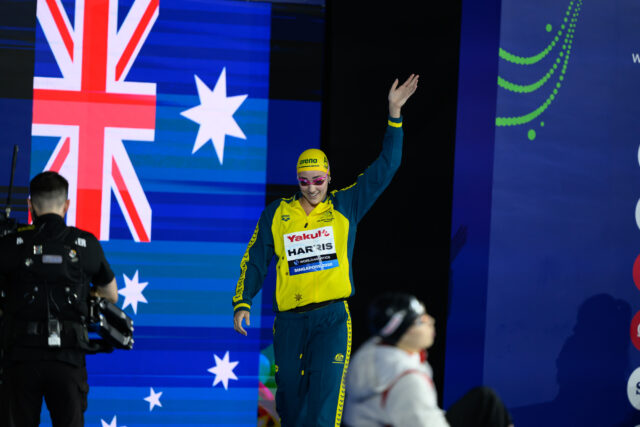
By Sean Griffin on SwimSwam

2025 World Championships
- July 27 – August 3, 2025 (pool swimming)
- Singapore, Singapore
- World Aquatics Championships Arena
- LCM (50m)
- Meet Central
- How To Watch
- SwimSwam Preview Index
- Entry Book
- Live Results
- Live Recaps

Meg Harris standing atop the Singapore podium. (Photo Credit: Nardia Mulkerrins)
Meg Harris has been a key contributor to the Australian team for years, helping secure multiple Olympic and World Championship relay titles, including a 51.87 split on the 4×100 freestyle earlier in the meet. Tonight, for the first time, she became an individual world champion.
The 23-year-old claimed the women’s 50m free title with a time of 24.02, winning by over two-tenths of a second. She got off to a strong start, staying within striking distance of American underwater specialist Gretchen Walsh—who swept both sprint butterfly events—before taking the lead after the first few strokes and never relinquishing it.
“Starting low, finishing strong, I’m pretty happy with that,” Harris said of her race strategy. “That’s the most fun I’ve had in a race.”
The win represents a significant milestone for Harris, who earned her first individual Olympic medal last summer with a silver in this distance.
The triumph culminates an event refocus for Harris, who previously concentrated on the 100m and 200m free for most of her senior international career. Harris first rose to prominence at the 2019 World Junior Championships, where the then-17-year-old captured double bronze in the 50m (24.89) and 100m (54.58) free.
Following the 2019 World Juniors and leading up to the Tokyo Olympics, Harris was training full-time under Dean Boxall, known for his freestyle expertise. While Harris didn’t abandon the 50m entirely, the focus shifted to the 100m and 200m events. This strategy paid off at the 2021 Australian Olympic Trials, where she qualified for the relay pool in both events, eventually swimming on the finals 4x100m relay that won gold and the preliminary 4x200m relay that earned bronze.
Harris still improved her 50m free under Boxall, lowering her 24.89 World Juniors time to 24.64 during Trials prelims, before recording 24.51 for 4th in the final. However, the emphasis was clearly molded around targeting the best opportunities to make the Australian team. At the time, Emma McKeon and Cate Campbell had virtually locked up the two 50m spots, while more opportunities existed through a top-six finish in the 100m and 200m.
Post-Paris, Harris left Boxall to train under Peter Bishop, and the 50m free became a renewed focus. She regressed slightly in the 200m, finishing about half a second off her personal best at Trials, but nearly equaled her best 100m time. She achieved a best in the 50m at that meet, touching at 24.50 for second behind Shayna Jack (24.14).

2022 Worlds, 50 Free Podium (Photo Credit: Fabio Cetti)
Come the 2022 World Championships, Harris seized the opportunity to swim the race individually for the first time since her junior years. She moved through the rounds like a veteran, recording 24.68 for third after the preliminary heats and hitting a lifetime best of 24.39 to maintain the same seed heading into finals.
When it mattered most, Harris delivered another career best of 24.38, chopping 0.01 off her semifinal time to tie American Erika Brown for bronze. Swedish world record holder Sjostrom (23.98) and Poland’s veteran Katarzyna Wasick (24.18) were the class of that field. Just weeks later, Harris capped off her season by capturing silver at the Commonwealth Games with yet another personal best of 24.32.
Harris continued to improve her 50m free through the 2023 season, producing a lifetime best of 24.30 at the Australian World Trials. However, she finished third and missed qualification for an individual berth at Worlds. She did qualify via the 4x100m free relay, where she remained a staple, but missed out on the 4x200m relay again.
After the 2023 World Championships in Fukuoka, Harris once again reevaluated her training environment, moving to train under Damien Jones in preparation for the Paris Olympics. The coaching change paid dividends for her shorter distances, even though Jones’ more recent successes have come in events 200 meters and longer. She elevated her 100m free throughout the season, breaking 53 seconds for the first time in nearly three years, and doing so multiple times. Her 50m free continued its steady improvement as well. She finished second behind Shayna Jack at the Olympic Trials with a time of 24.26, while Jack broke 24 seconds for the first time and entered Paris as a heavy medal favorite.
Harris stepped up when it counted, opening the meet with a sub-52 anchor leg on Australia’s gold medal-winning 4x100m free relay. She then tackled the 50m free rounds with composure, producing 24.50 in the heats to easily advance to the semifinals ranked fifth. She dropped to 24.33 to sit sixth heading into the final, but hadn’t shown all her cards just yet. In the final, she delivered the swim of her life, breaking through the 24-second barrier to win silver in 23.97. While Swedish legend Sjostrom delivered the dominant performance many expected, few foresaw Harris claiming a medal, let alone breaking 24 seconds for silver.
The Olympic success brought its own challenges. Reflecting on her journey this season, Harris said, “It was a bit of a tough one. I felt such a high coming off that, and then starting out this year I had to find a new motivation, not just coming in and doing the exact same thing. I tried for the first couple months, but something just wasn’t working. I needed to find a new way to do it. So I stripped everything back and started with the basics—all the things like the reasons I started swimming. I love sprinting, I love racing. So we just took that all back, did everything that I love.”
That renewed approach clearly worked. Tonight’s victory, while not a personal best time, demonstrates that when medals are on the line—whether relay or individual—Harris rises to the occasion. Although Sjostrom is sitting out this season as she expects her first child, and several swimmers in the field have faster career bests, she still got the job done.

Meg Harris with coach Damien Jones post-gold medal swim. (Photo Credit: Nardia Mulkerrins)
Her pre-race nerves had been building throughout the week. Speaking about her mindset before the race, she stated, “For a while, I’ve been pretty nervous, especially specifically training for this, but decided to try and relax and talk to the girls in marshalling. And it seemed to work.” The relaxed approach paid off, even when her race plan didn’t unfold exactly as practiced.
“I’ve also been working on not taking a breath, but I took a breath,” Harris explained. “Pretty much my whole training has been to focus on not taking a breath. But it didn’t feel so great in the semis, so I just tried to do whatever came naturally, and the breath came naturally. It’s usually always about 35 meters in. I have my eyes on the lines around there.”
Harris also addressed her unique habit of swimming with her eyes closed, something that’s become part of her signature style. When asked about it, she said, “It’s normal for me. I do it a lot in the 50m and in the 100m—I always do it on the second lap. I do it in training as well, but I guess it’s just like trying to focus on my stroke. That’s just what happens.”
The victory represents the fulfillment of a long-held dream, though Harris struggled to find words immediately after the race. “I mean, I really actually have nothing to say. I’m sure I’ll process it later, but I’m so happy,” she said, still catching her breath. Later, she reflected more on what the achievement meant: “I mean, stoked. There’s not much more I could say—I achieved the dream that I’ve been dreaming of this whole time. This is why I swim, also for the enjoyment, but it is nice winning.”
The Green and Gold team dynamic seemed to lift everyone, including Harris.
“This team’s been amazing this week. It’s been one to remember,” she said. “We started so strong with the girls at the start of the week. This team has been incredible this week, and it’s just nice to finish it off.”
When asked about the moment, Harris kept it simple, saying, “I’m not quite sure. I still can’t even put it into words. It’ll take a while to process, but I’m just happy to finish off the week strong.”For a swimmer who’s been a key part of Australia’s relay success, this individual world title adds another layer to her rise as one of the sport’s top sprinters.
For anyone concerned that Harris might drop the 100 moving forward, there’s no need to worry. She confirmed after the race that she plans to keep swimming both the 50 and 100 through to the Los Angeles 2028 Olympics. At this year’s Australian Trials, she posted a time of 53.01 in the 100m heats before scratching from the final to focus on the 50.
Other Day 8 Oceania Finalists:
- After a tough 2024 campaign, Dean Boxall-trained Jenna Forrester returned to top form in the 400 IM. After winning World bronze in 2023 with her current best time of 4:32.76, she failed to make the final in Paris, touching 9th in 4:40.55. This year, she clocked her fastest time since 2023 with a 4:36.19 to finish second at Trials, recorded a season-best 4:36.17 in the semifinals, and then scorched a 4:33.26 to snag a share of the silver medal in the final. “I’m so stoked. I feel like it’s been a really tough two years. Obviously last year I didn’t perform the way that I wanted to. It was a massive fight to get on the Olympic team in Paris and then to just miss the final was a bit disappointing. So to make a comeback like that this year, I’m super proud of myself. I’m super grateful to have the support team around me, my coach, my family, my friends. It really means the world to me. And I feel like that swim was for everyone who helped me get here,” she said post-race.
- Defending world champion Isaac Cooper was unable to retain his 50 backstroke title. The 21-year-old Australian, who has shifted his focus to only swimming 50s, produced 24.61 to hit the wall 7th. He logged a season-best 24.53 in the semifinals, though it remained well off his 24.12 career best from his gold medal performance at the 2024 Worlds.
- Tokyo Olympic bronze medalist Brendon Smith has been unable to replicate the form that garnered him Olympic bronze, and he settled for 8th tonight in the 400 IM. The 25-year-old stopped the clock in 4:13.28, two tenths slower than his 4:13.08 preliminary marker and off his season-best 4:12.81 posted en route to winning Trials in June. His best remains the 4:09.27 he swam four years ago. Smith moved to train at St. Peters Western under the guidance of Boxall this past season, so he is still adjusting to a new training environment. This offers a glimmer of hope as his best time would have placed him about a tenth away from bronze tonight.
- It was business as usual for the Green and Gold’s women’s 4×100 medley relay, as they defended their Olympic silver and backed up their 2nd place showings from the 2022 and 2023 World Championships. Kaylee McKeown was a bit off her best leading off in 57.69. Ella Ramsay notched 1:06.49 on the breaststroke split which was faster than her flatstart PB of 1:06.86. Alex Perkins was solid on butterfly, a tenth over her flatstart best at 56.21. Freestyle ace Mollie O’Callaghan brought the team home with a solid 52.23, slower than her flatstart best but four tenths faster than she was in the individual final (52.67) earlier in the week. They finished in 3:52.67, just about a second off their Australian record (3:51.60) and 3.33 seconds behind the Americans.
Final Oceania Medal Table
| Rank |
Nation
|
Gold | Silver | Bronze | Total |
| 1 |
Australia
|
8 | 6 | 6 | 20 |
Final Overall Medal Table
| Rank | Nation | Gold | Silver | Bronze | Total |
| 1 |
U.S.
|
9 | 11 | 9 | 29 |
| 2 |
Australia
|
8 | 6 | 6 | 20 |
| 3 | France | 4 | 1 | 3 | 8 |
| 4 | Canada | 4 | 0 | 4 | 8 |
| 5 | NAB | 3 | 4 | 1 | 8 |
| 6 | China | 2 | 6 | 6 | 14 |
| 7 | Germany | 2 | 2 | 1 | 5 |
| 8 | Romania | 2 | 0 | 0 | 2 |
| 8 | Tunisia | 2 | 0 | 0 | 2 |
| 10 | Italy | 1 | 4 | 2 | 7 |
| 11 | South Africa | 1 | 2 | 1 | 4 |
| 12 | Great Britain | 1 | 1 | 0 | 2 |
| 13 | Netherlands | 1 | 0 | 2 | 3 |
| 14 | Hungary | 1 | 0 | 1 | 2 |
| 15 | Lithuania | 1 | 0 | 0 | 1 |
| 16 | Japan | 0 | 3 | 1 | 4 |
| 17 | Switzerland | 0 | 2 | 0 | 2 |
| 18 | Belgium | 0 | 1 | 1 | 2 |
| 19 | Poland | 0 | 1 | 0 | 1 |
| 20 | Kyrgyzstan | 0 | 0 | 1 | 1 |
| 20 | South Korea | 0 | 0 | 1 | 1 |
| 20 | NAA | 0 | 0 | 1 | 1 |
Read the full story on SwimSwam: 2025 Worlds, Day 8 Oceania Recap: Harris’ Ability To Rise To The Occasion Leads Her to Gold
Moving Towards Glasses-Free 3D Videoconferencing with Project Starline
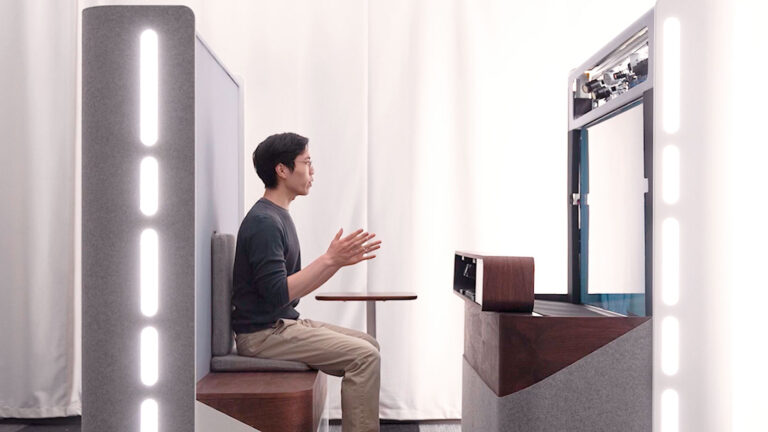
The first commercial 3D cinema experiences date back more than a century, with the film The Power of Love shown in Los Angeles in 1920. Back then, stereoscopic glasses were already being used to achieve the effect. Today, when we talk about metaverses and mixed reality, it is still necessary to use some glasses to achieve the three-dimensional effect. Unless, of course, Google gets its way and succeeds in making its new glasses-free 3D video conferencing system standard. Enter Project Starline.
In this article, you will read about:
How Starline 3D videoconferencing works
Mainly due to remote work, videoconferencing has become increasingly popular in recent years. The problem is that the 2D visualization of current systems generates cognitive dissonance in the user, the so-called “Zoom fatigue.” Hence, research is being made into other options.
The Starline 3D telepresence project was introduced in 2021, although at that time, an entire booth was required for the user to enjoy the effect. In that first model, a series of infrared cameras and other sensors were used to analyze the speaker’s image and then translate it onto a 3D screen using a light field system. Starline’s basic technology consists of these three phases:
- Capturing and 3D mapping of the interlocutor
- Compression of data for transmission over networks
- 3D monitor display
Of course, installing a booth in a work environment was not a realistic alternative to the current video conferencing, regardless of the 3D perks. Finally, in early 2023, Google announced that it had improved its system so much that it had dispensed with most of the sensors used in the first Starline prototype. According to the developers, using several standard cameras and artificial intelligence software suffices to offer glasses-free 3D video conferencing.
At first glance, the new version of the Project Starline is a simple screen, similar to that of an LED TV, which is equipped with three sensors on the sides and top strip, respectively. It is a working prototype that Google has distributed to partners such as T-Mobile, Salesforce, and WeWork for real-world testing.
Main advantages of 3D videoconferencing
As mentioned, 2D videoconferencing can create fatigue due to the lack of connection to real space. In addition, using virtual or augmented reality glasses for long periods still causes some discomfort due to the weight of the devices and, in some cases, dizziness due to latency issues, i.e., the speed of reaction between what is seen and what is happening.
New 3D videoconferencing systems like Project Starline are expected to improve productivity in professional environments and, more importantly, the human connection between call participants.
Glasses-free 3D video conferencing alternatives
Of course, Google is not the only developer interested in this field. One of the alternatives to Project Starline is the approach of a U.S. company that has designed a booth where the speaker can be shown in full body. It is enough to record the person with a white background and a basic camera – the company indicates that a cell phone can be used – and then transmit the data to the booth, which consists of a 4K screen two and a half meters high and can be installed in any space, be it an office, a shopping mall or an airport.
The developer describes this concept as “holoportation.” Artificial intelligence makes it possible to generate a sensation of depth when looking at the screen. The main drawback of the technology at the moment is that the full-size unit costs seventy-five thousand dollars, which rules it out as a device for everyday use.
In addition to the technologies above, there are other somewhat less expensive alternatives to improve the usability of videoconferences. One of them transfers the images of the participants to a realistically rendered 3D space so that all of them are integrated into it as if it were a conference room. You can see how it works in this video.
If you want to know more about virtual reality applications and holographic systems such as Project Starline, as well as many other technological innovations, you can subscribe to our newsletter at the bottom of this page.
Source:
Russia-Ukraine War: Recap of Important Events on Day 1,257 | Latest Updates on Russia-Ukraine Conflict

Here is how things stand on Monday, August 4:
Fighting
- A Russian attack killed three people in Ukraine’s southeastern Zaporizhia region on Sunday, Governor Ivan Fedorov wrote on Telegram.
- A Ukrainian drone attack sparked a major fire at an oil depot in Sochi in southern Russia, the governor of Russia’s Krasnodar region, Veniamin Kondratiev, said on Sunday. The fire was extinguished hours later after 120 firefighters were deployed, officials said. Russia’s civil aviation authority, Rosaviatsia, briefly halted flights at Sochi’s airport during the fire.
- Ukraine’s military says it used drones to target several sites inside Russia, including refineries, an airfield and an electronics plant.
- The governor of the Voronezh region in southern Russia said four people were injured in a Ukrainian drone attack that caused several fires,
- A Russian attack injured seven people and destroyed dozens of houses and apartments in the southern Ukrainian city of Mykolaiv, Mayor Oleksandr Senkevych said on Telegram early on Sunday.
- The Ukrainian air force said on Sunday that Russia launched 76 drones and seven missiles against Ukraine. It said 60 drones and one missile were intercepted, but 16 drones and six missiles hit eight different locations across Ukraine.
- The Russian Ministry of Defence said its air defence units destroyed 93 Ukrainian drones overnight, including one over the Krasnodar region and 60 over the waters of the Black Sea. It did not specify how many drones were fired in total.
Politics and Diplomacy
- Ukrainian President Volodymyr Zelenskyy announced that Ukraine and Russia have agreed to exchange 1,200 prisoners following negotiations in Istanbul, adding that “work on the lists [of prisoners to be released] is ongoing”. There was no immediate comment from Russia.
- Zelenskyy announced he had appointed Anatolii Kryvonozhko as Commander of Ukraine’s air force, a role Kryvonozhko has been serving in as Acting Commander for nearly a year.
- Zelenskyy also said that Ukraine has prepared three new sanctions packages, including sanctions against the captains of Russia’s shadow fleet of oil tankers.
- China and Russia began joint naval drills in the Sea of Japan in waters near the Russian port of Vladivostok, China’s Ministry of National Defence said in a statement on Sunday. The drills will last for three days.
- Speaking to a crowd of one million young Catholics on the outskirts of Rome, Pope Leo said: “We are with the young people of Gaza; we are with the young people of Ukraine.”
Today’s stock market: Dow futures fall as recession concerns grow
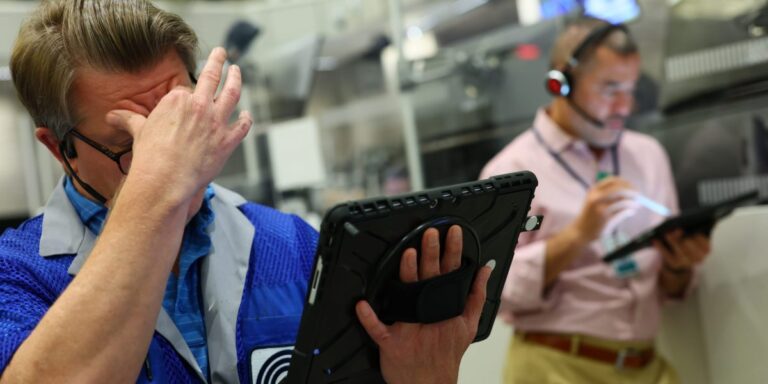
Markets were pointing toward another selloff Sunday evening after startling jobs data delivered a rude awakening to Wall Street bulls.
Futures tied to the Dow Jones Industrial Average fell 47 points, or 0.11%. S&P 500 futures were down 0.17%, and Nasdaq futures slipped 0.23%.
The yield on the 10-year Treasury was flat at 4.216% after plunging Friday on greater expectations for Fed rate cuts. The U.S. dollar was steady against the euro and down 0.09% against the yen.
Gold rose 0.44% to $3,414.10 per ounce. U.S. oil prices dropped 0.67% to $66.88 per barrel, and Brent crude fell 0.72% to $69.17, as OPEC+ announced another surge in production.
After investors marveled at how resilient the economy appeared in the face of President Donald Trump’s tariffs, it turns out conditions were actually much weaker, with job gains over the last three months averaging just 35,000.
Combined with separate indicators showing deterioration in consumer spending, housing, and manufacturing, the overall picture is one of an economy “on the precipice of recession,” according to Mark Zandi from Moody’s Analytics. That followed a similar warning from economists at JPMorgan.
Others had previously sounded the alarm on glaring red flags. But in the days leading up to the jobs report, some top commentators were still trying to explain why doomsday predictions about Trump’s “Liberation Day” tariffs had yet to materialize.
On Thursday, former White House economic adviser Jason Furman attributed it in part to “tariff derangement syndrome.” And last Sunday, Rockefeller International Chair Ruchir Sharma said the negative effects of tariffs were likely being offset by other factors like the AI spending splurge and lower inflationary pressure from housing, cars and energy.
With Wall Street now more attuned to economic risks like Trump’s trade war, the tariffs that will go into effect on Thursday may get more scrutiny. That includes steeper duties on trading partners like Canada and Switzerland.
Meanwhile, the calendar of economic reports thins out in the coming week after several big ones last week. On Tuesday, the trade deficit for June comes out, providing an update on how much tariffs are impacting imports. On Thursday, second-quarter productivity is due.
Earnings season has passed its peak, but several top names will issue quarterly reports. Palantir Technologies reports Monday after securing a $10 billion software and data contract from the Army.
Chip giant Advanced Micro Devices will report on Tuesday—potentially offering hints at Nvidia’s results, which don’t come out until Aug. 27.
Other companies scheduled to release earnings in the coming week include Caterpillar, Disney, and McDonald’s. It will also be a busy time for pharmaceutical and biotech giants like Amgen, Pfizer, and Eli Lilly as Trump weighs steep tariffs on drugs.
Rescuers in Chile discover the body of the final trapped miner
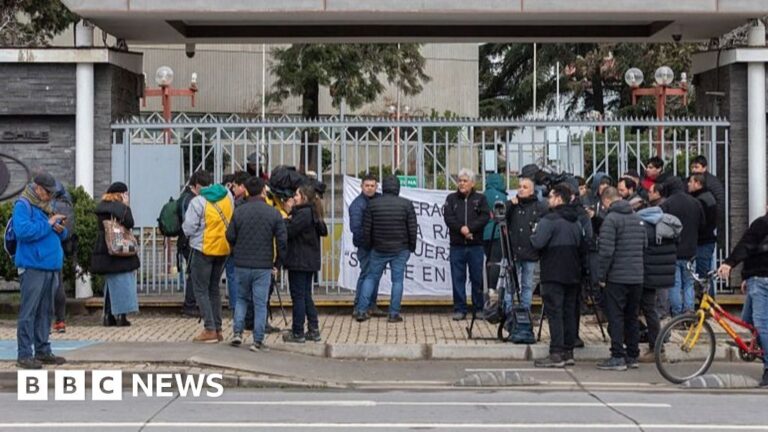
Rescuers in Chile have found the body of the last of five workers who had been trapped in the world’s largest underground copper mine after an earthquake on Thursday.
The announcement was made by regional prosecutor Aquiles Cubillos, who said the focus now was on a criminal investigation into the incident at El Teniente mine, run by the state-owned Codelco company.
The four other bodies had been discovered on Saturday and earlier on Sunday during a desperate search in collapsed mine tunnels, about 70km (43 miles) south-east of the capital Santiago.
The overall death toll is now confirmed at six, as another person was killed at the time of the incident on Thursday.
The collapse of some of the tunnels was caused by a 4.2 magnitude tremor on Thursday. Miners had been working deep below the surface.
Codelco has so far named two of the victims – Paulo Marín and Gonzalo Núñez Caroca – but said the others were yet to be identified “by the relevant authorities”.
“We share the anguish this situation causes their families and the entire community,” the copper mining company said.
Rescue teams had been using heavy machinery in an effort to clear the blocked passageways to try to reach the miners.
Codelco said rescue teams had cleared 24m (78.7ft) of blocked passages at the mine.
El Teniente is located high in the Andes mountains in central Chile.
Authorities have said they are investigating whether the cause of the earthquake was mining activity or natural tectonic shifts.
US District Judge rejects Shira Perlmutter’s request for preliminary injunction in Copyright Office dispute

A federal judge has denied former Register of Copyrights Shira Perlmutter’s motion for a preliminary injunction that would have restored her to her position while challenging her removal by the Trump administration.
US District Judge Timothy Kelly ruled on Wednesday (July 30) that Perlmutter failed to demonstrate irreparable harm warranting emergency relief.
Perlmutter filed her lawsuit in May, claiming her dismissal was “unlawful and ineffective” after President Trump fired both her and Librarian of Congress Carla Hayden via email.
The administration appointed Deputy Attorney General Todd Blanche as acting Librarian of Congress, who subsequently named Paul Perkins as acting Register of Copyrights.
In his memorandum opinion, Judge Kelly wrote that “the Court’s analysis begins and ends with irreparable harm,” explaining that Perlmutter failed to convince the court that she, the Library of Congress, or the Copyright Office faces irreparable damage from her temporary removal.
The judge noted that the Copyright Office can continue operating under Perkins’ leadership regardless of whether Perlmutter is ultimately reinstated.
“Perlmutter has not shown that the existence of the Copyright Office is at stake, or that her position will likely be irreparably changed without an injunction,” Kelly stated. “Yet again, Perlmutter has not shown that the Copyright Office will grind to a halt without her.”
The ruling represents the second setback for Perlmutter’s legal challenge, following the court’s denial of her temporary restraining order request in May. Judge Kelly had previously indicated skepticism about Perlmutter’s ability to meet the irreparable harm standard required for emergency injunctive relief.
Perlmutter promptly filed notice of appeal to the US Court of Appeals for the District of Columbia Circuit on Thursday (August 1), signaling her intention to continue the legal battle. The appeal comes as the Copyright Office faces questions about leadership continuity, particularly regarding its ongoing artificial intelligence report that Perlmutter had highlighted as urgent work requiring her oversight.
The dispute has broader implications for the music industry, given the Copyright Office’s role in regulating performance rights organizations and overseeing mechanical licensing through entities like The Mechanical Licensing Collective.
The office also plays a crucial role in AI-related copyright policy, an increasingly important area for music rights holders.
Perlmutter’s removal occurred shortly after the Copyright Office published the third installment of its comprehensive report on copyright and artificial intelligence, examining the use of copyrighted works in training generative AI systems. The timing raised questions about potential policy motivations behind the leadership changes.
The case centers on the legal authority to remove the Register of Copyrights, with Perlmutter arguing that Trump lacked the power to dismiss her directly. The administration maintains that the removal was lawful under existing federal statutes.
While the preliminary injunction denial keeps Perlmutter out of office for now, the underlying merits of her lawsuit remain to be decided. The appeal process could extend the legal proceedings for months, potentially overlapping with any decisions about permanent appointments to lead the Library of Congress and Copyright Office.
Music Business Worldwide
First Eruption of Russian Volcano in Centuries

new video loaded: Russian Volcano Erupts for the First Time in Centuries
By McKinnon de Kuyper•
Staff members have been evacuated from the area, a statement from the local nature reserve said, adding that the volcano was too far from towns to pose a danger to people.
Recent episodes in Europe
Challenging the Client

A required part of this site couldn’t load. This may be due to a browser
extension, network issues, or browser settings. Please check your
connection, disable any ad blockers, or try using a different browser.
Boat sinking off Yemeni coast claims lives of over 50 refugees and migrants

DEVELOPING STORYDEVELOPING STORY,
Rescue operations are ongoing to find dozens more missing, local authorities say.
At least 54 African refugees and migrants have died and dozens remain missing after a boat capsized off the coast of Yemen, according to health authorities in Abyan governorate in the south of the country.
Abdul Qader Bajamil, director of the health office in Zanzibar, said on Sunday that rescue teams had recovered 54 bodies from the beaches there and surrounding areas, while 12 survivors were transferred to Shaqra Hospital.
The boat carrying around 150 people, mostly from Ethiopia, capsized in the Arabian Sea off the coast of Shaqra, in the Abyan governorate, due to strong winds on Saturday evening.
Bajamil noted that authorities were making arrangements to bury the victims in an area near the city, while search operations continued amid difficult conditions.
The waterways between Yemen and the Horn of Africa are a common but perilous route for refugees and migrants travelling in both directions. The area saw a spike in Yemenis fleeing the country after the civil war broke out in 2014.
Houthi rebels and government forces reached a truce deal in April 2022 that has resulted in a decrease in violence and the slight easing of the ongoing humanitarian crisis in Yemen.
Meanwhile, some of those fleeing conflict in Africa, particularly in Somalia and Ethiopia, have sought refuge in Yemen or have sought to travel through the country to the more prosperous Gulf countries. The route remains one of the “busiest and most perilous” migration routes in the world, according to the United Nations’ International Organization for Migration (IOM).
To reach Yemen, people are taken by smugglers on often dangerous, overcrowded boats across the Red Sea or the Gulf of Aden.
According to the IOM, more than 60,000 refugees and migrants arrived in Yemen in 2024, marking a significant drop from the previous year’s total of 97,200.
The decreased numbers come amid increased patrols of the waters, according to an IOM report released in May.
This is a deadly route that has killed hundreds over the past two years. According to the IOM, 558 people died along the route last year.
Over the past decade, at least 2,082 people have disappeared along the route, including 693 known to have drowned, according to the IOM. Yemen currently houses around 380,000 refugees and migrants.