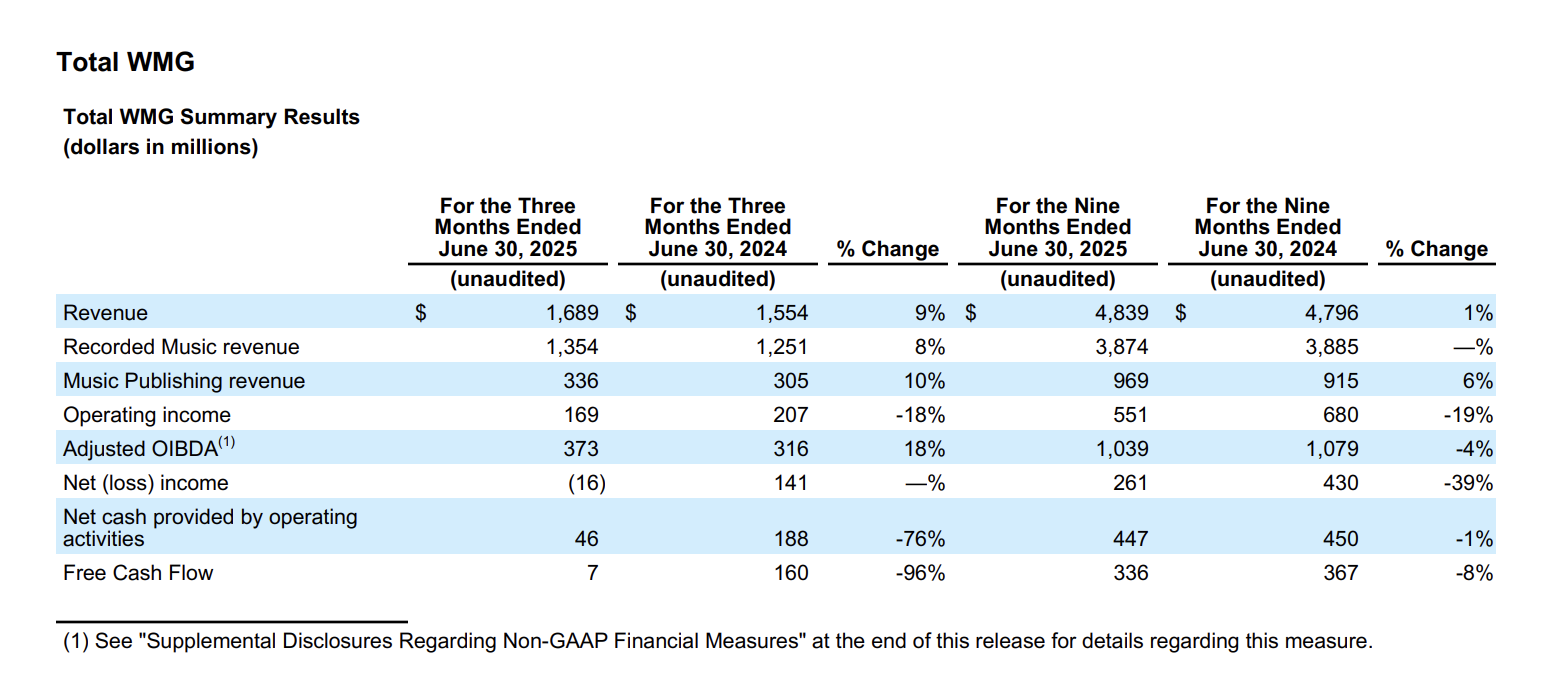
Warner Music Group has reported total revenue of $1.689 billion in calendar Q2 (fiscal Q3), representing a 7.0% YoY increase in constant currency.
Yet, when one-time items are excluded, the company’s underlying recorded music performance was significantly stronger than headline figures suggest.
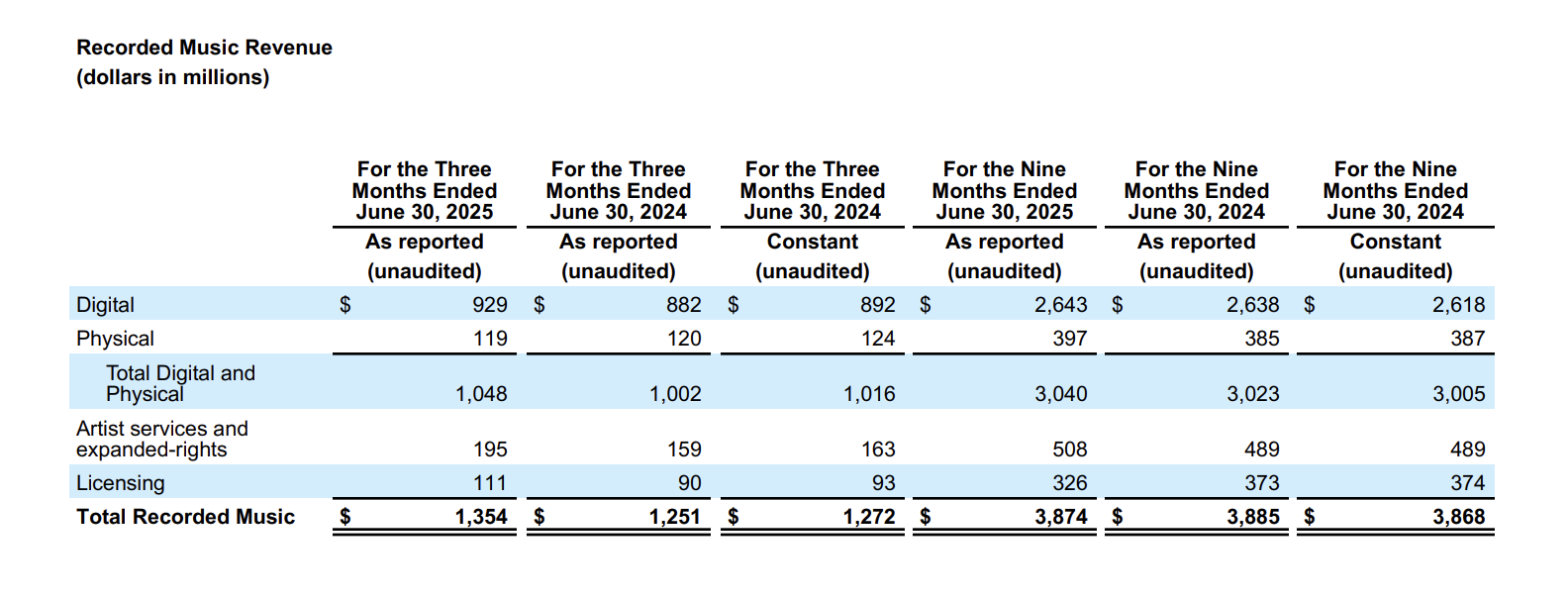
Warner’s quarterly recorded music revenue of $1.354 billion was officially up 6.4% YoY in constant currency. But excluding one-time items, the underlying growth was actually up 8.3% YoY in constant currency.
Perhaps most important for watching analysts: When the one-times are omitted, Warner Music Group’s underlying subscription streaming recorded music revenue was up 8.5% YoY in constant currency.
This figure represents a reacceleration of growth in perhaps WMG’s most critical metric for investors. (In the firm’s last quarter, calendar Q1, WMG’s recorded music subscription revenue was up by 3.2% YoY – while overall recorded music revenues were up just 0.7% YoY.)
Robert Kyncl, CEO, Warner Music Group, said today (August 7): “This quarter we delivered massive chart hits, breakthrough stars, strong revenue growth, and market share gains… all of which show our strategy is working.
“As we continue to evolve our company, we’re focusing on the artists, songwriters, and markets with the greatest potential, while expanding our iconic catalog, and building the dynamic teams and tools that will help our talent have the biggest global impact.”
WMG’s calendar Q2 2025 one-time adjustments cover two specific items:
(i) The prior-year quarter (calendar Q2 2024) was boosted by +$22 million in catch-up payments from a digital service provider for previous periods; and
(ii) Both quarters (calendar Q2 2024 and Q2 2025) were impacted by Warner’s terminated distribution agreement with BMG, which reduced current quarter revenue by $14 million compared to the prior year.
In addition, WMG’s recorded music result was impacted by +$16 million copyright settlement revenue in calendar Q2, which is also omitted to reach the underlying RM revenue growth figure.
Armin Zerza, CFO, Warner Music Group, said: “Our strong performance this quarter reflects our commitment to investing in great music, driving greater efficiency, and creating long-term value for our artists, songwriters, and shareholders.”
WMG’s calendar Q2: breaking down that $1.354B Recorded Music revenue
Within WMG’s $1.354 billion in recorded music revenue in calendar Q2, the firm’s streaming revenue (across ad-supported and subscription) totaled $895 million.
That was officially up 2.6% YoY in constant currency. However, excluding the one-time items, underlying streaming revenue growth was 5.8% YoY in constant currency.
Subscription recorded music streaming revenue reached $674 million, representing 4.2% YoY growth in constant currency. Yet on an underlying basis, as explained, this metric was up 8.5% YoY.
Ad-supported recorded music streaming revenue declined 1.8% YoY in constant currency to $221 million.
Warner’s biggest revenue-generating artists quarter included BAEKHYUN, ROSÉ, Bruno Mars, Grateful Dead and Teddy Swims.
Although WMG cited “strong market share gains in the US” to investors today, there was a particularly interesting geographic stat buried in its recorded music results: ex-US recorded music revenue grew significantly faster than revenue within the United States.
US-based recorded music revenue hit $536 million, up 4% YoY in constant currency (USD vs. USD); international recorded music revenue totaled $818 million, up 8% YoY in constant currency.
Elsewhere in WMG’s global recorded music results, physical revenue decreased 4.0% YoY in constant currency to $119 million, with the BMG termination accounting for $10 million of the decline.
Artist services and expanded-rights revenue increased 19.6% YoY in constant currency to $195 million, driven by higher concert promotion revenue primarily in France and Spain.
Licensing revenue increased 19.4% YoY in constant currency to $111 million, driven by licensing deals primarily in the U.K. and China, and timing of copyright infringement settlements.
WMG’s calendar Q2: Publishing generates $336 million
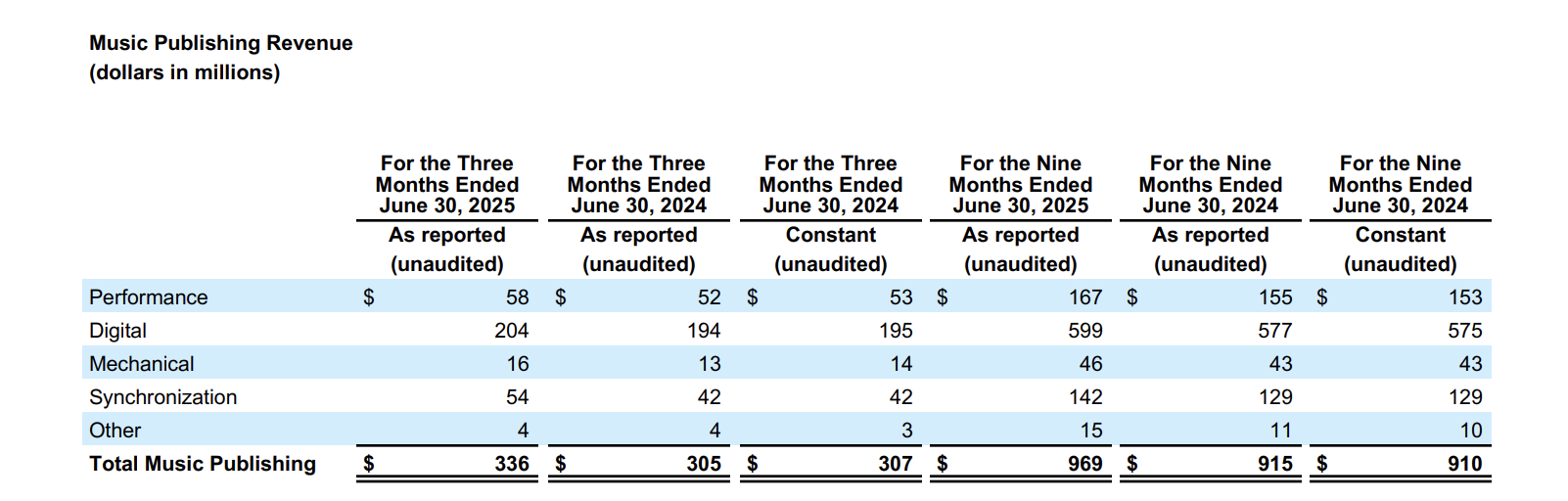
Warner’s music publishing division, led by Guy Moot and Carianne Marshall, posted $336 million in revenue, an increase of 9.4% YoY in constant currency.
Music publishing streaming revenue totaled $202 million, up 4.1% YoYin constant currency from $192 million in Q2 2024.
Total music publishing digital revenue reached $204 million, an increase of 4.6% YoY in constant currency.
WMG’s calendar Q2: Profits etc.
Warner’s adjusted OIBDA increased 15.8% YoY in constant currency to USD$373 million, with Adjusted OIBDA margin rising to 22.1% from 20.4% in constant currency.
Cash provided by operating activities decreased to $46 million compared to $188 million in the prior-year quarter, largely due to higher A&R spend and other movements in working capital.
The company reported a cash balance of $527 million as of June 30, 2025, with total debt of $4.363 billion and net debt of $3.836 billion.
A police officer has died from injuries sustained while responding to a shooting outside the headquarters of the US Centers for Disease Control and Prevention (CDC) in Atlanta.
The incident, which took place on Friday near Emory University, involved a “single shooter” who is now dead, the Atlanta police department said.
It said the officer, David Rose, had been taken to hospital and later died from his injuries. No civilian was wounded in the incident.
The motive is unclear, but US media, citing an unnamed law-enforcement official, reported a theory that the gunman believed he was sick as a result of a coronavirus vaccine.
Media reports also suggested the man’s father had called police on the day of the shooting believing his son was suicidal.
CDC Director Susan Monarez said the centre was “heartbroken” by the attack.
“DeKalb County police, CDC security, and Emory University responded immediately and decisively, helping to prevent further harm to our staff and community,” she wrote in a post on X.
In a press briefing on Friday, police said they became aware of a report of an active shooter at around 16:50 local time (21:50 BST) near the CDC campus.
Officers from multiple agencies responded. Emory University posted at the time on social media: “Active shooter on Emory Atlanta Campus at Emory Point CVS. RUN, HIDE, FIGHT.”
The CDC campus received multiple rounds of gunfire into buildings.
Police said they found the shooter “struck by gunfire” – but could not specify whether that was from law enforcement or self-inflicted.
Media outlets have reported that CDC employees have been asked to work remotely on Monday.
A required part of this site couldn’t load. This may be due to a browser
extension, network issues, or browser settings. Please check your
connection, disable any ad blockers, or try using a different browser.
new video loaded: Israel’s New Plan to Take Gaza City
By Adam Rasgon, Christina Shaman, Karen Hanley and Laura Salaberry•
Prime Minister Benjamin Netanyahu faced opposition at home and abroad on Friday as his office said that the Israeli military would take control of Gaza City. Adam Rasgon, a reporter for The New York Times in Jerusalem covering Israeli and Palestinian affairs, describes what’s happening.
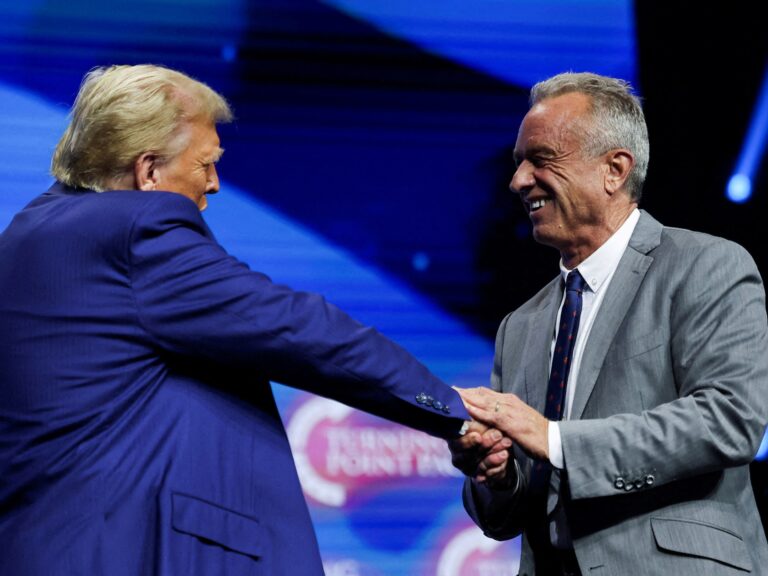
United States Health and Human Services Secretary Robert F Kennedy Jr has announced that the US is to cut funding for mRNA vaccine development – a move that health experts say is “dangerous” and could make the US much more vulnerable to future outbreaks of respiratory viruses like COVID-19.
Kennedy is known for his vaccine scepticism and recently ousted all 17 members of a scientific advisory panel on vaccines at the US Centers for Disease Control and Prevention (CDC) to be replaced with his own selections. However, this latest announcement is just part of a series of moves by President Donald Trump himself that appear to target the vaccine industry and give increasing weight to the arguments of vaccine sceptics in the US.
Trump has previously undermined the efficacy of vaccines and sought to cut funding to vaccine programmes. Public health experts sounded the alarm after his election win in November, warning there would likely be a “war on vaccines” under Trump.
“My main concern is that this is part of an increasingly ideological rather than evidence-based approach to healthcare and vaccination in particular that is being adopted in the US,” David Elliman, associate professor at University College London, told Al Jazeera.
“This is likely to increase vaccine hesitancy … [and] will result in more suffering and death, particularly for children. This would be a tragedy, even more so because it is avoidable.”
What new cuts to vaccine funding have been made?
In a statement posted on Tuesday on X, Kennedy said 22 projects on mRNA vaccine development worth nearly $500m will be cancelled. The main reason, he said, was that the Biomedical Advanced Research and Development Authority (BARDA) in his Department of Health and Human Services (HHS) had reviewed mRNA vaccines and found them to be “ineffective” in fighting mutating viruses.
“A single mutation can make mRNA vaccines ineffective,” Kennedy said in a video statement. “After reviewing the science and consulting top experts, … HHS has determined that mRNA technology poses more risk than benefits for these respiratory viruses.”
Instead, Kennedy said, the US will shift mRNA funding to other vaccine development technologies that are “safer” and “remain effective”.
Some notable institutions and companies that will be affected by the latest decision, as listed on the HHS website, include:
Emory University and Tiba Biotech (terminated contracts)
Pfizer, Sanofi Pasteur, CSL Seqirus (rejected or cancelled proposals)
Luminary Labs, ModeX (“descoped” or weakened contracts)
AstraZeneca and Moderna (“restructured” contracts)
What are mRNA vaccines, and are they really ineffective against virus mutations?
Messenger ribonucleic acid vaccines prompt the body to produce proteins that help it build immunity against certain microbes. They differ from traditional vaccines that introduce weakened or dead microbes into the body to stimulate immunity. Both types of vaccines have their strengths and weaknesses, but mRNA vaccines are notably faster to manufacture although they don’t provide the lifelong coverage that traditional vaccines might.
However, Elliman said virus mutations are a general problem for any vaccines and present a challenge scientists are still contending with.
“As yet, there are no vaccines in use that have solved this problem, so this is not a good reason for abandoning mRNA vaccines,” Elliman said. “The technology has great promise for vaccines and therapeutics, so ceasing research in the field without good evidence is unjustified.”
The move, he added, could discourage investors and scientists, both inside and outside the US, from keeping up research.
Dorit R Reiss, a law professor at the University of California, San Francisco, who focuses on vaccine law, told Al Jazeera that the decision is “troubling and shortsighted”.
“Procedurally, the decision was done in a very flawed manner. At the least, there should be notice and an opportunity for hearing and explanation under our administrative law, and there was instead a short and cursory X video with no references, no real data,” she said.
The move will not only hurt innovation, she said, but will also leave the country less prepared for emergencies.
Boxes of Pfizer-BioNTech, top, and Moderna COVID-19 vaccines [File: Joe Raedle/Getty Images]
What are RFK’s views on vaccines?
The health secretary has long been considered a vaccine sceptic.
Kennedy formerly chaired Children’s Health Defense – an anti-vaccine advocacy group formed in 2007 – until 2023 when he announced his run for the presidency. The organisation has also campaigned against the fortification of drinking water with fluoride, which prevents tooth decay.
During a 2013 autism conference, Kennedy compared the CDC’s childhood vaccine programme to Nazi-era crimes. “To me, this is like Nazi death camps, what happened to these kids,” he said, referring to an increasing number of children diagnosed with autism. “I can’t tell you why somebody would do something like that. I can’t tell you why ordinary Germans participated in the Holocaust.”
In a 2023 interview with Fox News, Kennedy claimed vaccines cause autism. He cited a widely debunked study by Andrew Wakefield, a discredited British doctor and antivaccine activist whose study on the matter has since been retracted from journals. In another 2023 podcast, Kennedy said, “No vaccine is safe or effective.”
Aside from his vaccine scepticism, Kennedy, also known as RFK Jr, has also made several controversial remarks about other health issues, such as COVID-19. He criticised vaccine mandates and lockdown restrictions during the pandemic under former President Joe Biden. He also claimed in a leaked video in 2022 that COVID-19 “attacked certain races disproportionately” because of their genetic makeup and Ashkenazi Jews were most immune to the virus. Several research studies, however, found that social inequalities were major influences on how COVID-19 affected different ethno-social groups because certain people had reduced access to care.
During a congressional hearing in the lead-up to his appointment in Trump’s administration, Kennedy denied making several of the controversial statements attributed to him in the past. He also promised to maintain existing vaccine standards.
What are Trump’s views on vaccines?
Trump has flip-flopped on this issue.
He has previously downplayed the usefulness of vaccines and, in particular, criticised the schedules under which children receive several vaccine doses within their first two years. In his election campaign last year, Trump promised to dismantle vaccine mandates in schools.
In a 2007 interview with the South Florida Sun-Sentinel, Trump claimed that an autism “epidemic” had arisen as a result of vaccines, a theory which has since been debunked. “My theory – and I study it because I have young children – my theory is the shots [vaccines]. We’re giving these massive injections at one time, and I really think it does something to the children.”
In subsequent interviews, Trump called childhood vaccines a “monster shot” and in 2015 during a debate among Republican presidential candidates said vaccines were “meant for a horse, not a child”.
In 2015, he told a reporter he had never received a flu shot.
But Trump has also spoken in favour of vaccines at times. During his first term as president, Trump said at a news briefing that children “have to get their shots” after outbreaks of measles emerged across the country. “The vaccinations are so important. This is really going around now,” he said.
Additionally, in his first term during the COVID-19 pandemic, his administration initially downplayed the virus, but it ultimately oversaw the rapid production of COVID-19 vaccines in a project it called Operation Warp Speed.
After Biden became president in 2021, Trump’s camp criticised his vaccine and face mask mandates, which critics said contributed to rising levels of antivaccine sentiment among conservative voters.
Trump also avoided using Operation Warp Speed’s success as a selling point in last year’s presidential campaign. He also did not publicly announce that he had received initial and booster COVID-19 vaccine shots before leaving the White House.
Has the Trump administration targeted vaccines more broadly?
During Trump’s second term, the US introduced vaccine regulations that some critics said undermine the country’s vaccine system.
Furthermore, the Trump administration has cut funding to the US Agency for International Development, which supported hundreds of vaccine development programmes across the world.
In February, Trump halted federal funding for schools that required students to have what his administration called “coercive” COVID-19 vaccines.
In May, Kennedy announced that the federal government would no longer recommend COVID-19 vaccines for healthy children and pregnant women without giving details about the reasons behind the change in policy. That went against the advice of US health officials who had previously urged boosters for young children.
In June, Kennedy fired all 17 members of a CDC panel of vaccine experts, claiming that the board was “rife with conflicts”. The panel, which had been appointed by Biden, was responsible for recommending how vaccines are used and for whom. Kennedy said the move would raise public confidence, stating that the US was “prioritising the restoration of public trust above any specific pro- or antivaccine agenda. However, the move drew condemnation from scientists and health bodies.
At the same time, the Food and Drug Administration, which also comes under the remit of the HHS, has approved at least one COVID-19 vaccine. In May, the FDA approved Novavax’s non-mRNA, protein-based COVID-19 vaccine although only for older adults and those over the age of 12 who also have underlying health conditions that put them at higher risk from the virus. That was unusual for the US, where vaccines are usually approved without such limitations.
The 2026 budget proposal to Congress does not include funding for the Global Vaccine Alliance (GAVI), a public-private entity formed in 2002 to support vaccine distribution to low and middle-income countries. GAVI was instrumental in securing vaccines for several countries in Africa and other regions during the COVID-19 pandemic when it was feared that richer countries could stockpile the available doses. The US currently provides more than 10 percent of GAVI’s funding. In 2024, that amounted to $300m.
Did Trump seek to undermine vaccine research and development during his first term as well?
Yes.
Trump’s health budget proposals in 2018 and subsequently proposed budget cuts to the National Institute of Health and the CDC would have impacted immunisation programmes and a wide range of life-saving research on vaccines. However, the proposals were rejected by Congress.
In May 2018, the Trump administration disbanded the Global Health and Biodefense Unit of the National Security Council. The team, which was set up to help prepare the US for pandemics and vaccine deployments, was formed in 2015 under President Barack Obama’s administration during an Ebola epidemic. Later, when the COVID-19 pandemic reached the US, scientists blamed the country’s vulnerability on Trump’s decision.
Stablecoins are the shiny new object on Wall Street. Once restricted to the niche world of crypto trading, stablecoins entered the mainstream of U.S. finance as Congress debated—and ultimately passed in July—a bill to legitimize them and expand their use. That has spurred a hype cycle as banks and Fortune 500 companies rush to explore the technology.
Stablecoins, which are typically pegged to the U.S. dollar and backed 1:1 to a pool of reserves, have been around for a decade. But their soaring popularity has brought mounting questions over how their growth could impact the broader economy. Financial experts and government officials alike are grappling with the implications of giant stablecoin issuers Tether and Circle becoming some of the largest holders of U.S. Treasuries, rivaling countries like South Korea and Saudi Arabia.
While crypto proponents argue that stablecoins will help extend dollar dominance across the globe, critics warn that they could lead to financial instability in the banking sector, even as they remain a tiny portion of overall markets.
A new financial plumbing
To get a sense of stablecoins’ growing popularity, it’s worth noting that their transaction volume surpassed Visa in early 2024. While much of this activity occured in the context of crypto trading, it supported advocates’ case that stablecoins’ low fees and near-instantaneous speeds make them a superior vehicle to older technology like SWIFT, especially when it comes to moving money across borders. That argument has broken out of the crypto industry, with the fintech giant Stripeacquiring the stablecoin startup Bridge last year for $1.1 billion.
In order to ensure a stablecoin maintains on par with a dollar, most issuers purchase large quantities of Treasury bills to serve as the bulk of their reserves. Tether, the largest stablecoin issuer, holds over $100 billion in T-bills, according to its latest attestation, which ranks it ahead of countries such as the United Arab Emirates and Germany. According to a July report from Apollo, the stablecoin industry as a whole is now the 18th largest external holder of Treasuries.
To be fair, this is still a blip compared to the U.S. money market fund sector, which stands at around $7 trillion, mostly comprised of Treasuries. But, especially with July’s passage of the Genius Act, stablecoins are only likely to grow, with Apollo estimating that the sector could reach $2 trillion by 2028. The market cap of USDC, the second-largest stablecoin, has grown 90% over the past year to $65 billion. Its parent company, Circle, went public in June, delivering the largest two-day IPO pop in decades.
At a time when longtime holders of U.S. Treasuries, including China and Japan, are signaling they will move away from the asset class, the emergence of stablecoin issuers as a new buyer of T-bills could serve as an escape valve for the U.S. government. “Having stablecoin issuers always be there is a massive boost in terms of giving confidence to the Treasury [Department] about where to place debt,” said Yesha Yadav, a professor at Vanderbilt Law School who wrote a recent paper on the relationship between stablecoins and the U.S. Treasury market.
Crypto proponents go even further, arguing that the benefits could ripple across the U.S. economy and beyond. They say the growth of stablecoins could consolidate the dollar’s dominance as a method of payment for foreign payments, similar to the “eurodollar” (a term that signals dollar deposits held outside the U.S.), and could help the U.S. government enforce sanctions abroad. David Sacks, the White House’s AI and crypto czar, went so far as to argue that new demand for U.S. Treasuries from stablecoin companies could lower long-term interest rates.
Others—including Yadav and State Street’s global head of cash and digital asset, Kim Hochfeld—are more skeptical, especially given the nascent sector’s footprint. “There’s a lot of hype, and the numbers are still tiny compared to what we see in normal TradFi,” Hochfeld told Fortune. “While I don’t deny this is the start of a big trend, the numbers are still not enough to make us either super excited or super nervous.”
Some critics, including bank lobbying groups, have warned that stablecoins could siphon money away from bank deposits as customers shift holdings to stablecoins. Because deposits serve as necessary liquidity for lending, they argue, stablecoins could threaten the credit system. One stablecoin executive, who spoke with Fortune on the condition of anonymity to discuss sensitive industry relationships, described the argument as “politically expedient,” pointing out that bank lobbying groups have previously invoked the argument to resist the introduction of now commonplace financial instruments like money market funds.
“There are trillions of dollars in money market funds,” said the executive, “Ultimately, it didn’t affect banks being able to make loans.”
Yadav said that stablecoins’ growth could still lead to unintended outcomes, especially as they hoover up short-term Treasuries, which many Wall Street institutions rely on for risk management and other forms of financial engineering. “What that means for the rest of the financial system as [stablecoins] become gargantuan is anybody’s guess,” she told Fortune.
On the new Fortune Crypto Playbook vodcast,Fortune’s senior crypto experts decode the biggest forces shaping crypto today. Watch or listen now
Ukrainian President Volodymyr Zelensky has underlined he will make no territorial concessions to Russia ahead of a scheduled meeting between Donald Trump and Vladimir Putin on the future of the war in Ukraine.
The US-Russia meeting is due to take place in Alaska on 15 August.
Hours before announcing the meeting, Trump had signalled Ukraine might have to cede territory to end the war, which began with Russia’s full-scale invasion in February 2022.
Zelensky said in a Telegram post on Saturday that “Ukrainians will not give their land to the occupier”. He reiterated that Ukraine must be involved in any solution for peace, and said he is ready to work with partners for a “real” and “lasting” peace.
Zelensky said Ukraine “will not give Russia awards for what it has done”.
“The answer to the Ukrainian territorial issue is already in the Constitution of Ukraine. No one will and cannot deviate from this,” he added.
His statement followed comments from Trump at the White House on Friday that there “will be some swapping of territories, to the betterment of both”.
“You’re looking at territory that’s been fought over for three and a half years, a lot of Russians have died. A lot of Ukrainians have died,” the US president said.
He did not provide further details on what any such proposal would look like.
Sacrificing land for peace has been the Trump position all along. Zelensky has always made clear that is unacceptable under Ukraine’s constitution and would only reward Russia for starting the war.
While Ukraine’s president has been careful not to criticise Trump, his post on social media makes clear that he will not accept it.
Trump announced his meeting with Putin – which was later confirmed by the Kremlin – on Friday, saying details would follow.
Zelensky on Saturday said that Ukraine is ready for “real solutions that can bring peace” but underlined that Ukraine needed to be involved.
“Any solutions that are against us, any solutions that are without Ukraine, are simultaneously solutions against peace,” he said.
“We are ready, together with President Trump, together with all partners, to work for a real, and most importantly, lasting peace – a peace that will not collapse because of Moscow’s wishes.”
This is what Ukraine, and many European allies, were always worried about – Trump and Putin trying to do a deal without Ukraine present.
Trump’s words on Russia may have hardened in recent months, but for Ukraine they have yet to be followed by tangible actions.
The US president’s deadline for Russia to agree to a ceasefire or face more sanctions has passed without any apparent consequences. Now, reports suggest Trump is still willing to discuss Ukraine giving up some of its territory in return for a ceasefire when he meets Putin in Alaska next week.
The BBC’s US partner CBS News, citing a senior White House official, reported that it remains possible Zelensky could end up being involved in some way, as planning for the Friday meeting is still fluid.
On the ground there is a resignation that any initial peace talks may not include Ukraine.
Among soldiers and civilians the BBC spoke to there is a strong desire for peace. There is exhaustion from the constant fighting and Russian drone and missile attacks.
But there is little evidence that Ukraine is willing to accept a peace at any price – much less one that will be forced on it without its voice being heard.
ONErpm has signed four notable artists across multiple genres in recent weeks, as the firm continues to expand its artist roster.
The North American signings align with ONErpm’s broader growth strategy to develop numerous genre-based business units in the US and abroad.
Founder Emmanuel ZunztoldMusic Business Worldwide last month that the company’s growth is being fuelled by “more market penetration and geographic expansion, as well as buying more assets and doing higher margin deals with the artists who want to do them.”
While the company has prioritized expansion in Africa and Asia recently, Zunz noted that ONErpm is determined to remain “a significant force in the United States”.
The new signings include Grammy-winning pop artist Daya, Philadelphia-based blues-hip-hop fusion act G. Love & Special Sauce, Toronto bedroom pop artist Verzache, and Florida rapper Cochise. The signings reflect ONErpm’s strategy of working across multiple genres and career stages.
For G. Love & Special Sauce, signed by Director of A&R Ryan Cunningham, ONErpm will make five previously physical-only albums available digitally for the first time ever. These include Back In The Day (1997), In The King’s Court (1998), Has Gone Country (1998), Front Porch Loungin’ (2000), and Moonshine Lemonade (2011). The company will also release two new projects later this year: Ode to R.L., a tribute album to late blues legend R.L. Boyce, and a live album from the band’s 2024 30th Anniversary tour.
Daya, who won a Grammy for Don’t Let Me Down with The Chainsmokers, will release her second full-length album Til Every Petal Drops on October 10. The artist has also been nominated for Billboard Music Awards, Kids’ Choice Awards, and Latin American Music Awards.
Toronto’s Verzache, described by NME as the city’s “bedroom pop titan,” has amassed nearly 1 billion streams independently. The signing marks his first time working with a global team.
Florida rapper Cochise, signed by ONErpm’s Tony Tuesday, has achieved viral success with tracks like Hatchback and Tell Em (which reached No. 22 on the Billboard charts and accumulated over 670 million streams). His recent single “I LIE” has generated nearly 3 million streams across all platforms.
“Signing with ONErpm is the greatest honor of my career,” stated G. Love. “2025 marks my 31st year as a recording artist and I am truly creatively ready to deliver more than ever for the continuum.”
“It feels unbelievably full circle that almost a decade since I initially reached out to Verzache as a huge fan, he is now part of the ONErpm family.”
Yasmin Damoui, ONErpm
Yasmin Damoui, Senior A&R and Business Development at ONErpm, was involved in securing both the Daya and Verzache deals.
“It feels unbelievably full circle that almost a decade since I initially reached out to Verzache as a huge fan, he is now part of the ONErpm family,” said Damoui.
ONErpm, founded in 2010 by Emmanuel Zunz, operates 43 offices globally with over 600 employees.
The company works with over 300,000 artists, music labels and video creators worldwide and claims a 2.7% worldwide market share on Spotify.
The company launched its publishing administration service ONE Publishing in 2022, expanding from its core distribution and services offering. ONErpm is on track to hit around $300 million in gross revenue this year, according to founder Zunz.
Its other high-profile signings have included producer Malibu Babie, who worked on Nicki Minaj’s Super Freaky Girl in October 2024.Music Business Worldwide
Day two of this year’s Queensland Short Course Championships has concluded, leaving no shortage of fast swims and top times. Brisbane Grammar’s Max Cunningham swam a 48.65 in the 100 free to equal Aussie legend Kyle Chalmers for #2 all time in the 16 year old age group. Only Flynn Southam, who went 48.05 in 2021, has been faster. Cunningham was out in 23.34 before coming home strong in a 25.31. This swim obliterated his previous best of 52.03, a time he swam just earlier this year in April at the Australia Age Group Championships. Beyond winning against his age group, Cunningham had the fastest swim overall as well. He went on to win the 100 back for 16 year olds in a new best time of 55.16, just over 3 seconds faster than his PB of 58.28.
Edward Sommerville, who swam the long course version of this event in Singapore just last week—finishing 17th in prelims– shaved 0.05 seconds off his PB in the 200 free. He swam a 1:40.59, just two tenths off of Maximillian Giuliani‘s 1:40.36 Australian record from 2024 SC Worlds. Sommerville remains the #2 performer in Australian history, with his previous PB being the former Australian record. Sommerville was out like a rocket—faster than Luke Hobson‘s world record time at the 100—but paid for it dearly. He split 47.32/53.27, though his opening 100 was fast enough to get him under his previous PB.