9.4 C
New York
Saturday, April 25, 2026
Home Blog Page 494

Smart Interior Design Maximizes Space in Affordable Tiny House

0

The Hirondelle tiny house combines a very small size with a surprisingly affordable price. Measuring just 3.5 m (11.5 ft) in length, it starts at €38,900 (US$45,000) and features a space-saving interior layout that’s suitable for up to two people.

The Hirondelle was designed by French firm Quadrapol. Its floorspace of 12.1 sq m (130 sq ft) makes it one of the smaller models on the market at the moment, and it would be a good fit for a vacation home, overnight office, or for regular towing.

The home is based on a double-axle trailer and finished in thermally treated wood. It’s topped by a steel roof, with an external storage box.

The layout on this one is a little different to the norm, and won’t suit everyone. Its entrance opens onto where you’d expect the living room to be, but instead of a sofa it has an office desk, plus some storage and a chair. A netted storage loft area is situated above too. Nearby is the kitchen. This includes a two-burner induction cooktop, a sink, built-in fridge, and some cabinetry.

The Hirondelle’s upstairs bedroom is reached by a removable wooden ladder

Quadrapol

Remaining on the Hirondelle’s ground floor, on the opposite side of the home to the desk area and entrance lies the bathroom. It’s accessed by a sliding door and includes a small sink, a shower, and a toilet.

This tiny house has one bedroom, which is reached by a removable ladder. It’s a standard tiny house loft, with a low ceiling and space for a double bed, plus possibly a little storage.

The Hirondelle can be customized with different colors and other options, all of which may raise the cost. It’s available throughout Europe, though we’ve no word on delivery costs.

Source: Quadrapol

What are Zelenskyy and Europe asking of Trump before Putin summit? | Latest updates on Russia-Ukraine conflict

0

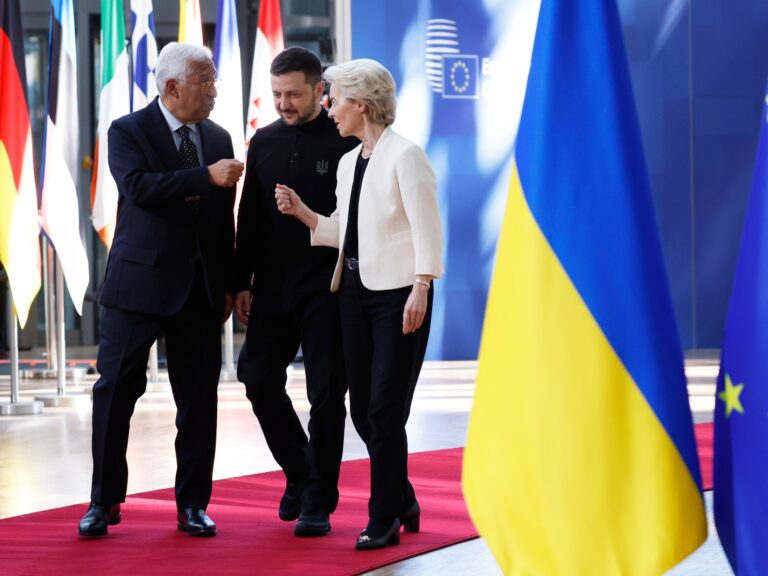
European leaders are scrambling to convince United States President Donald Trump to use his upcoming summit with his Russian counterpart, Vladimir Putin, to amplify pressure on Moscow to end the war in Ukraine on terms acceptable to Kyiv.

Trump, who has promised to end the three-year war, plans to meet Putin in Alaska on Friday, saying the parties are close to a deal that could resolve the conflict.

Trump recently told reporters that, “I’m going in to speak to Vladimir Putin, and I’m going to be telling him, ‘You’ve got to end this war. You’ve got to end it.’”

The US president said Kyiv and Moscow would both have to cede land in a compromise. “There’ll be some land swapping going on,” he said. Trump has, in the past, discussed the possibility of land swaps. However, neither Russia nor Ukraine have been interested in ceding land to each other as part of a peace agreement.

European leaders worry that major concessions to Russia could create security problems for the region in the future. On Wednesday, August 13, major European leaders are first convening among themselves and with Ukrainian President Volodymyr Zelenskyy and are then scheduled to speak to Trump and US Vice President JD Vance.

Here’s what Europe and Ukraine request of Trump, as he prepares for the meeting with Putin;

Keep Ukraine in the room

Speaking to journalists on Tuesday, Zelenskyy said he would not be at the summit in Alaska, the first face-to-face meeting between Trump and Putin with both in office since 2018.

But he said he hoped it would be followed by “a trilateral meeting” with Trump and Putin, though the Russian leader has so far said he is not willing to meet Zelenskyy.

The Ukrainian president added that, “I believe that Trump represents the United States of America. He is acting as a mediator – he is in the middle, not on Russia’s side. Let him not be on our side but in the middle.”

On August 9, heads of state from France, Italy, Germany, Poland, the United Kingdom and the European Commission issued a statement in support of Ukraine. “We underline our unwavering commitment to the sovereignty, independence and territorial integrity of Ukraine,” they said, adding: “We continue to stand firmly alongside Ukraine.”

The statement also insisted that “the path to peace in Ukraine cannot be decided without Ukraine”.

German Chancellor Friedrich Merz, who is convening a video call on Wednesday involving Trump, Vice President JD Vance, Zelenskyy and several European leaders to discuss Ukraine, has since doubled down on that message.

“We cannot accept that territorial issues between Russia and America are discussed or even decided over the heads of Europeans, over the heads of Ukrainians,” Merz said in a television interview on Sunday.

“I assume that the American government sees it the same way. That is why there is this close coordination,” he added.

The EU’s top diplomat, Kaja Kallas, said on August 10 that “the US has the power to force Russia to negotiate seriously”, but “any deal between the US and Russia must have Ukraine and the EU included, for it is a matter of Ukraine’s and the whole of Europe’s security.”

Ceasefire first

Last week, Putin presented the Trump administration with a ceasefire proposal, demanding major territorial concessions from Kyiv in eastern Ukraine in exchange for an end to the fighting, according to European officials.

The offer, which Putin shared with US special envoy Steve Witkoff on August 6, set off a scramble to obtain further information. According to Zelenskyy, Putin has asked that Russia be handed over all of Ukraine’s eastern Donetsk region, a third of which Kyiv still holds.

But European leaders and Ukraine have responded with a counterproposal of their own, forwarded in a meeting with top US officials in Britain on Saturday. The European plan rejected Russia’s proposal to trade Donetsk for a ceasefire.

It also included demands that a ceasefire take place before any other steps are taken and insisted that territory can only be exchanged in a reciprocal manner.

Finally, the proposal stipulates that any territorial concessions made by Kyiv must be safeguarded by security guarantees, including potential NATO membership for Ukraine.

Ukraine, too, has long argued that a halt in fighting must precede any longer-term peace agreement. Russia on the other hand, has insisted on a larger peace settlement as a condition for a ceasefire.

What else has Zelenskyy said?

Last weekend, Zelenskyy said that Kyiv “will not give Russia any awards for what it has done,” and that “Ukrainians will not give their land to the occupier”.

Zelenskyy also pointed out that he doesn’t have the authority to sign off on land swaps. He said that changing Ukraine’s 1991 borders runs counter to the country’s constitution.

Elsewhere, Zelenskyy said in a video message posted to his social media account on Monday night that “he [Putin] is definitely not preparing for a ceasefire or an end to the war”.

“There is no indication whatsoever that the Russians have received signals to prepare for a post-war situation,” he said.

“On the contrary, they are redeploying their troops and forces in ways that suggest preparations for new offensive operations. If someone is preparing for peace, this is not what he does,” he added.

What else has Trump said?

On Monday, Trump criticised Zelenskyy over the Ukrainian leader’s resistance to ceding territory to Russia, saying he disagrees “very, very severely” with Zelenskyy.

“I get along with Zelenskyy, but, you know, I disagree with what he’s done. Very, very severely disagree. This is a war that should have never happened,” Trump told reporters at the White House.

Trump went on to say that “I was a little bothered by the fact that Zelenskyy was saying, ‘Well, I have to get constitutional approval.’ I mean, he’s got approval to go into war and kill everybody, but he needs approval to do a land swap – because there’ll be some land swapping going on,” Trump said.

He added that the land swap will be “for the good of Ukraine,” before adding that a possible deal will also involve “some bad stuff for both” Kyiv and Moscow.

“So, it’s good and there’s bad, but it’s very complex, because you have lines that are very uneven, and there’ll be some swapping. There’ll be some changes in land,” Trump said.

“We’re going to have a meeting with Vladimir Putin, and at the end of that meeting, probably in the first two minutes, I’ll know exactly whether or not a deal can be made,” he said.

“Ultimately, I’m going to put the two of them in a room. I’ll be there, or I won’t be there, and I think it’ll get solved,” Trump added.


Spotify now available in Waymo robotaxis in three US cities

0

Alphabet’s self-driving unit Waymo has partnered with Spotify to embed the music streaming service directly into its robotaxis.

The integration went live in Phoenix, San Francisco, and Los Angeles, allowing passengers to access their personal Spotify libraries through the vehicle’s touchscreen display or by connecting via the Waymo mobile app.

Waymo riders can set up the connection by either linking their account before booking through the Waymo app, or scanning a QR code from the car’s screen during transit. Once connected, Waymo will remember users’ account for future trips until they choose to disconnect it, Waymo explained.

According to Google’s support page: “At the end of your trip, your music will automatically stop playing, and the next rider won’t be able to use your account.”

Waymo explained that by default, only the person who hailed the ride can select songs. However, a Premium user can start a “Jam” session, allowing other Spotify users to join and add songs to a shared queue. Passengers must use current versions of the Waymo app to access the Spotify integration.

The system includes audio customization features, with an equalizer allowing passengers to adjust the balance and fade, subwoofer, bass, and treble of the car’s speakers. Riders can choose tracks either on the in-car screens, Waymo app, or Spotify app.

To promote the launch, Waymo and Spotify tapped rapper Saweetie, who recently collaborated with K-pop group Twice on a new single called superstars.

The Spotify integration marks the latest for Waymo after partnering with iHeartRadio in 2023. This integration allowed riders to choose from a selection of curated iHeartRadio stations and podcasts.

For Spotify, the Waymo integration comes nine years after the streaming giant teamed up with Uber, allowing riders to play their on-demand library ad free. Spotify also partnered with Google Maps in 2018, with Waze in 2022, and with car manufacturers including Ford, Volvo, and Tesla.

Beyond the automotive sector, Spotify also integrated with other brands like Samsung, Peloton and Starbucks.

The company has built these partnerships to further expand its reach and grow its user base, and to make it a part of people’s daily lives. Spotify has previously teamed up with Sony to launch on the PlayStation network, allowing users to listen to songs on Spotify while playing games.

The streaming company has also introduced live event discovery offerings on its platform via integrations with ticketing companies like the UK’s Skiddle, Japan’s ZAIKO, and the Netherlands’ Stager.

Music Business Worldwide

What is the reason behind the opposition’s protest against India’s election commission?

0

Neyaz Farooquee

BBC News, Delhi

AFP via Getty Images  A woman shows her inked finger after casting her ballot to vote at a polling station as voting starts during the first phase of India's general election in India in June 2024.AFP via Getty Images

There were nearly a billion registered voters in the 2024 elections

A political row has erupted in India over allegations of “vote theft”, with opposition parties accusing the country’s election body of irregularities, which they say favoured the ruling Bharatiya Janata Party (BJP) in the 2024 general elections.

On Tuesday, parliament was adjourned after opposition MPs demanded a debate on the integrity of India’s electoral process.

A day earlier, dozens of opposition leaders, including Congress party leader Rahul Gandhi, were briefly detained by the police in the capital Delhi, as they tried to march to the Election Commission of India’s (ECI) headquarters.

Gandhi first raised the issue at a 7 August press conference in Delhi, and has since managed to galvanise strong support from hundreds of opposition lawmakers.

The Election Commission and the BJP have aggressively rejected the allegations.

What are Rahul Gandhi’s allegations against the Election Commission?

Gandhi has alleged widespread voter manipulation during the 2024 parliamentary elections, citing granular data obtained from the electoral body itself – though the ECI and the ruling party dispute his interpretation.

Prime Minister Narendra Modi secured a historic third term in the elections, but his BJP-led alliance fell short of the sweeping majority predicted. Voter turnout averaged 66% in the world’s largest election, with nearly a billion registered voters – one in eight people on Earth.

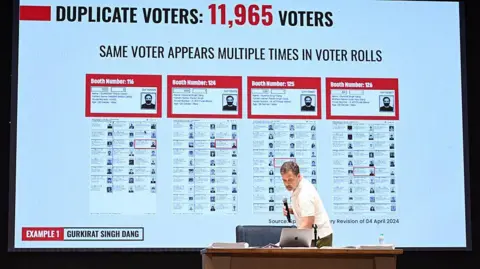
Gandhi cited electoral data for Mahadevapura, a part of the Bangalore Central parliamentary constituency, and claimed that the voter list had more than 100,000 manipulated entries, including duplicate voters, invalid addresses, and bulk registrations of votes at single locations.

He presented examples of voters like Shakun Rani, who he claimed cast her ballots twice – a claim disputed by the election body.

Gandhi also alleged CCTV footage from polling booths was deleted and pointed out an instance of 80 people registered in a single address in Mahadevapura.

The Congress leader says his party lost at least 48 seats in the elections due to such irregularities and has accused India’s election body of failing to enforce the “one man, one vote” principle. The Congress won 99 of the 543 seats in the elections, behind BJP’s 240.

Gandhi has demanded that the ECI release digital voter rolls, so that they can be audited by his party and the public.

The BBC hasn’t independently verified Gandhi’s claims.

Getty Images Congress MP Rahul Gandhi addresses a press conference in New Delhi, India with election data on the screen behind him.Getty Images

Gandhi cited constituency data to allege large-scale poll manipulation

What have the ECI and BJP said?

Soon after Gandhi’s press conference, ECI responded on social media platform X, calling his allegations “absurd” and denying many of his claims.

The polling body has demanded that he either submit a signed declaration under oath or apologise to the nation.

ECI’s Karnataka state unit further said that the Congress didn’t file formal objections when the electoral roll was being revised ahead of the 2024 parliamentary elections.

The poll body earlier said it keeps CCTV footage only for 45 days after results – the window for filing election disputes.

BJP leaders have also strongly rebutted the allegations.

“This anarchy is extremely worrying and dangerous for democracy,” BJP leader and federal education minister Dharmendra Pradhan said.

Federal agriculture minister Shivraj Singh Chouhan said Gandhi and the opposition alliance were “defaming democracy, tearing it to shreds, and tampering with the dignity of constitutional institutions”.

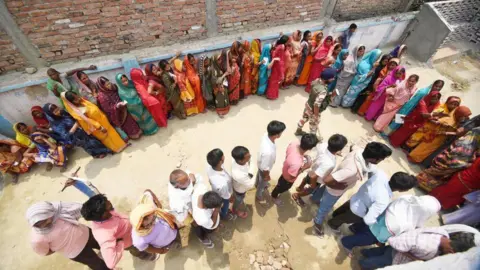
Getty Images Voters standing in a long queue for casting their votes at a polling booth during Lok Sabha election on May 20, 2024 in Saran, India. Getty Images

The new draft rolls for Bihar have 72.4 million names – 6.5 million fewer than before

What has been the political fallout?

Gandhi’s allegations have led to an uproar as they come in the backdrop of a controversy over a month-long revision of electoral rolls in Bihar state, where key elections are scheduled for November.

The Special Intensive Revision (SIR), held between June and July, saw officials visit all 78.9 million voters in the state for verification – the first update since 2003.

The ECI says the drive targets duplicate and deceased voters, but critics say its haste has disenfranchised many, especially migrants and minorities.

Many voters in Bihar have told the BBC that the draft rolls have wrong photos and include dead people.

India’s Supreme Court is currently hearing a batch of petitions challenging the SIR, with petitioners demanding publication of the deleted names – about 6.5 million – with reasons for their removal.

The election body says deletions include 2.2 million dead, 700,000 enrolled more than once and 3.6 million who have migrated from the state.

Corrections are open until 1 September, with over 165,000 applications received. A similar review will be conducted nationwide to verify nearly a billion voters.

The court has said that the allegations of disenfranchisement “largely appears to be a case of trust deficit, nothing else” and that it would “step in immediately” if mass exclusion of voters is proven.

On 12 August, Gandhi escalated his claims of vote theft, saying such manipulation was happening “at a national level and systematically”.

Highlighting the case of a 124-year-old voter’s name found in the draft electoral list of Bihar he said: “There are unlimited cases like that. ‘Abhi picture baki hai’ [the story is not over yet].”

Client Challenge: Overcoming Obstacles for Success

0


Client Challenge


JavaScript is disabled in your browser.

Please enable JavaScript to proceed.

A required part of this site couldn’t load. This may be due to a browser
extension, network issues, or browser settings. Please check your
connection, disable any ad blockers, or try using a different browser.

Doctor in Gaza Shares Insights into Israeli Attacks at GHF Sites | Coverage of Israel-Palestine Conflict

0

An American paediatrician who volunteered in the Gaza Strip says the injuries inflicted on Palestinian aid seekers at sites run by the Gaza Humanitarian Foundation (GHF) suggest that Israeli forces there shot the men and boys deliberately, by targeting and maiming specific body parts on specific days.

Ahmed Yousaf made the comments to Al Jazeera from the Jordanian capital, Amman, on Tuesday, hours after returning from Gaza, where he had spent two and a half weeks working at Al-Aqsa Hospital in central Deir el-Balah and al-Shifa Hospital in Gaza City.

The doctor said he witnessed “mass casualty incidents” from Israeli shootings at the food distribution points run by the United States-backed GHF on an almost daily basis.

The boys and young men came in with very specific injuries, “almost like a daily pattern”, he said.

“Meaning on a given day, say Monday, we’d get 40,60 patients coming in at a given time, and they would all be shot in the legs, or in the pelvic area, or the groin on a given day, just kind of a similar pattern. And the next day, we would see upper body, chest, thoracic pattern, and then there were days we saw only head wounds, upper neck bullet wounds. And what it felt like, at least for me, the position that I went with, was that somebody behind the gun that day was going to choose the way they were either going to maim or decide to kill people,” he said.

“It was age indiscriminate.”

Yousaf’s comments are the latest by medical staff in Gaza that accuse Israeli forces and US contractors of targeted and indiscriminate violence at the GHF sites.

Doctors Without Borders, known by its French acronym MSF, said last week that the GHF-run food distributions in famine-stricken Gaza have become sites of “orchestrated killing and dehumanisation“, while Human Rights Watch said the shootings amount to serious violations of international law and war crimes.

On Tuesday alone, at least 19 aid seekers were killed at GHF sites in Gaza, while many more were wounded, according to medics and witnesses.

At least 1,838 Palestinians have been killed while seeking aid, and another 13,409 have been wounded since the GHF began its operations in late May, official figures show.

Israel and the GHF deny the killings.

‘All of Gaza is a death trap’

Yousaf, the US paediatrician, said the victims at the sites were mainly boys and young men, as they are often the ones taking the risk to try to get food for their families, “given the dynamic of the risk associated with trying to carry a 5-pound [2.3kg] bag of flour, maybe kilometres, sometimes”.

“The people would tell us they were sometimes at the site, or around the area, or they were trying to leave… and they were shot indiscriminately; it was like they were being sprayed. It seemed quite obvious to them and to us, from a pattern-recognition perspective, in terms of who came to the ER [emergency room], that on a given day, whoever was making the decision behind the trigger was choosing a very specific pattern of fire,” he said.

The doctor went on to describe all of Gaza as a “death trap”.

“It is a cage in which people are being marked for death. It almost feels like there is a quota for the number of people that need to be killed on a given day,” Yousaf said.

On the days that Palestinians stayed away from the GHF sites, because Israel allowed in more aid trucks, there would be more intense air attacks, he said.

“The last four days that we were there, when there was a bit more aid access via food trucks that were allowed in, the risk profile changed and them going to the food distribution sites wasn’t nearly worth the risk because there was some food elsewhere, we saw a significant uptick in bomb blasts on the streets, homes, vehicles. So the pattern of the MCIs – the mass casualty incidents – changed from bullet wounds, mostly boys and young men, to just indiscriminate bombings. We saw women and children, elderly, on the days the bombs come in,” he told Al Jazeera.

The doctor described the Israeli atrocities in Gaza as a “genocide”.

One clear aspect of this, he said, was Israel’s refusal to let him and his colleagues take in medical supplies or baby formula.

“When we were screened by the [Israeli military] at the border, the vast majority of us had things confiscated from our bags. Things like food and multivitamins and antibiotics and medical supplies, like stethoscopes, everything you can imagine, that we wished we could have to treat the people on the ground in Gaza,” he said.

“And this resulted in a situation in which, when those patients came in, in different stages of dying, screaming in pain for their mothers… we knew that in any other environment, we could have done something for them, but in the environment of Gaza, in the death trap that is Gaza completely, we were unable to give them the aid that they deserve, to provide the human dignity and humanity that they deserve.”

VEON finalizes sale of Kyrgyzstan operations to government-controlled bank

0


VEON completes sale of Kyrgyzstan operations to state-owned bank

‘Do Kwon, the Crypto Crash King, Admits to Fraud’

0

A South Korean former tech executive accused of helping to spark a cryptocurrency crisis that cost investors more than $40bn (£31.8bn) has pleaded guilty to two criminal counts of fraud.

Do Kwon was the boss of Singapore-based Terraform Labs, which operated two cryptocurrencies – TerraUSD and Luna – both of which collapsed in 2022, triggering a wider sell-off in the crypto market.

The US says he was responsible for the failure of the two digital currencies, accusing him of “orchestrating a multi-billion dollar crypto asset securities fraud”.

As part of the plea deal, prosecutors have agreed to refrain from seeking a sentence longer than 12 years. Kwon is due to be sentenced on 11 December.

Kwon’s guilty plea “underscores the importance of accountability in the digital asset sector,” said Todd Snyder, who was appointed by US authorities and Terraform Labs to oversee the company’s liquidation.

He added that those who contributed to the collapse of Terraform Labs will be held to account by the firm and that assets will be recovered in the best interests of claimants.

Kwon’s guilty plea in a New York court comes after a lengthy legal battle.

He initially fled South Korea after a warrant for his arrest was issued in 2023, eventually ending up in Montenegro where he was arrested and jailed before being extradited to the US.

US prosecutors said Kwon misrepresented features that were supposed to keep the so-called stablecoin at $1 without outside intervention.

They alleged that in 2021, Kwon arranged for a trading firm to surreptitiously purchase millions of dollars worth of the token to restore TerraUSD’s value, even as he told investors that a computer algorithm called Terra Protocol was responsible.

Prosecutors say the alleged misrepresentation prompted a wide array of investors to buy Terraform’s offerings, which helped prop up the value of the company’s Luna token, which was closely linked to TerraUSD.

The following year, Kwon’s TerraUSD and the Luna cryptocurrency crashed.

“In 2021, I made false and misleading statements about why [TerraUSD] regained its peg,” he said in court on Tuesday.

“What I did was wrong and I want to apologise for my conduct,” he added.

Kwon had originally pleaded not guilty to nine counts stemming from the crash, including securities and wire fraud, and money laundering conspiracy.

He had faced up to 135 years in prison if convicted of the charges in the original indictment.

As part of his plea deal, Kwon agreed to refrain from challenging the allegations in the indictment.

He must also forfeit up to $19.3m plus interest and several properties and pay restitution.

While prosecutors have agreed to limit their requested sentence to 12 years, Judge Paul Engelmayer maintained that he was entitled to prescribe a longer sentence.

That sentence could be up to 25 years in prison.

He still faces charges in South Korea, according to his attorney.

Cuomo Calls Out Mamdani for Wealth, Urges Immediate Departure from Rent-Stabilized Unit

0

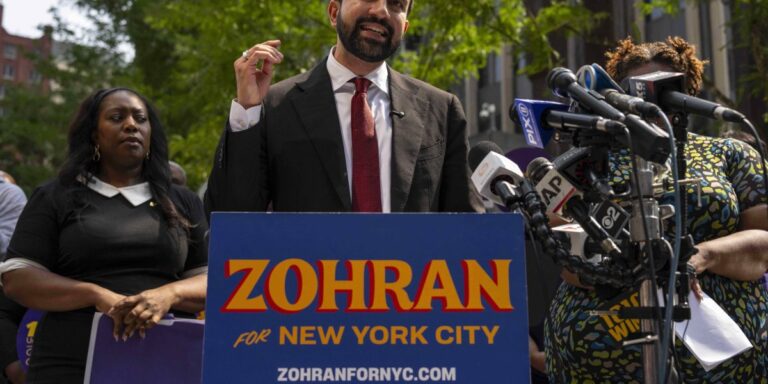
Andrew Cuomo is demanding that his opponent in New York City’s mayoral race, Zohran Mamdani, vacate his rent stabilized apartment, while pushing a longshot proposal that would bar other middle-class renters from accessing much of the city’s housing.

“I am calling on you to move out immediately,” Cuomo wrote in a widely-viewed social media post this weekend, casting Mamdani as “a very rich person” occupying an apartment that could otherwise be used by a homeless family.

The line of attack drew tens of millions of views online and revived a long-standing debate about who should have access to New York’s highly sought-after rent stabilized units, which make up roughly 40% of the city’s rental stock and are currently open to people of all incomes.

It also illustrated the rhetorical lengths that Cuomo is willing to go to as he mounts an independent bid for mayor against Mamdani, a democratic socialist who defeated him handily in the Democratic primary on a platform that centered on affordability and freezing rent on stabilized units.

Mamdani, who earns $143,000 annually as a state legislator, has said he pays $2,300 per month for a one-bedroom apartment in Queens that he shares with his wife — a living situation that Cuomo called “disgusting.”

By contrast, Cuomo, a multimillionaire who previously served as the state’s governor, spends roughly $8,000 monthly on an apartment in Midtown Manhattan that he moved to last year from Westchester County, a wealthy suburb.

In recent weeks, the 67-year-old Cuomo has adopted a more aggressive social media presence, earning both praise and mockery for his use of millennial internet-speak and repeated references to his opponent’s “privilege.” Mamdani’s mother is a successful independent filmmaker and his father is a Columbia University professor.

On Monday, Cuomo went a step further, releasing a formal proposal, which he dubbed “Zohran’s Law,” barring landlords from leasing vacant rent stabilized units to “wealthy tenants,” defined as those who would pay less than 30% of their income toward the existing rent.

The rent regulation program, which caps how much landlords can raise rent each year on roughly 1 million apartments, does not currently include any income restrictions — something opponents have long pushed to change.

While the average rent stabilized household makes $60,000 annually, it is not uncommon for middle- or higher-income New Yorkers to live in the units, which sometimes rent for several thousand dollars per month.

But Cuomo’s idea drew swift skepticism from some housing experts, who noted the cap would, by definition, mean all new tenants of rent stabilized units would give up a substantial portion of their income.

“The idea that we should only have people living in apartments they can’t afford seems to be setting people up for failure,” said Ellen Davidson, a housing attorney at The Legal Aid Society. “It’s not a proposal from somebody who knows anything about the housing market or New York City.”

The Real Estate Board of New York, a landlord group whose members overwhelmingly backed Cuomo in the primary, did not respond to an inquiry about whether they supported the proposal. But in an email, the group’s president, James Whelan, said that the “benefits of rent regulation are not well targeted” and that some form of means testing should be considered.

Under state law, hikes on rent-stabilized units are decided by an appointed board, rather than landlords.

“Rent stabilization has never been means tested because it’s not an affordable housing program, it’s a program about neighborhood stability,” said Davidson, the housing attorney, adding that the proposal would likely present a “bureaucratic nightmare.”

A spokesperson for Cuomo’s campaign, Rich Azzopardi, said in a text message that “the ultra wealthy and privileged should not be taking advantage of a program meant to aide working New Yorkers,” adding that the income threshold standards would fall under the same system that governs the city’s other programs for low-income housing.

Mamdani’s spokesperson, Dora Pekec, said the proposal proved that Cuomo was both desperate and out of touch.

“While Cuomo cares only for the well-being of his Republican donors, Zohran believes city government’s job is to guarantee a life of dignity, not determine who is worth one,” she added.

Introducing the 2025 Fortune Global 500, the definitive ranking of the biggest companies in the world. Explore this year’s list.

Ethan Reniewicki to Join Ohio State in the Fall of 2025 as an “Honorable Mention”

0

By Anne Lepesant on SwimSwam

Fitter and Faster Swim Camps is the proud sponsor of SwimSwam’s College Recruiting Channel and all commitment news. For many, swimming in college is a lifelong dream that is pursued with dedication and determination. Fitter and Faster is proud to honor these athletes and those who supported them on their journey.

Ethan Reniewicki from Scottsdale Aquatic Club in Scottsdale, Arizona, is headed to Columbus, Ohio, in the fall to swim and study at The Ohio State University. He will join the class of 2029 with Cooper Burt, Ernest Braitenbach, Gherman Prudnikau, Mason Francis, Mattaus Rammel, Matthew Yuan, Max Vorobiev, Rayburn Kohl, Ricky Lottering, and Shmuel Vaisburg. Transfers Isaac Fleig, Jack Schuster, and Rasmus Hanson will also be new to the squad this season.

Reniewicki committed to the Buckeyes last July and signed a contract in November. At the time of his verbal, he wrote:

“I am extremely excited to announce my verbal commitment to continue my athletic and academic career at The Ohio State University. I would not be where I am today without the continued support from my family, friends, and teammates. I would like to thank coaches Bill Dorenkott and Norman Wright for this opportunity and my Scottsdale Coaches for all of their support. Go Bucks! 🌰🅾

The Chaparral High School graduate was a 2-time AIA Division I individual state champion his senior year. He won the 200 free (1:38.39) and 100 fly (48.55) and led off the Chaparral 200 free relay with a lifetime-best 50 free (20.58). That was a huge improvement from junior year, when he placed 9th in the 50 free with a PB of 21.51 and 3rd in the 100 fly (50.11).

Reniewicki’s rapid rise in the ranks led us to name him to the “Honorable Mention” section of our last re-rank of the top boys recruits in the high school class of 2025. At the time, his best sprint free times were 19.8/43.0/1:36.3 and his fly times were 47.7/1:47.8. He had unleashed a torrent of PBs at Winter Juniors West, including the 50 free (20.24) 100 free (43.27), 200 free (1:36.50), and 100 fly (47.48), and he had placed 5th in the 100 free, 5th in the 200 free, and 7th in the 100 fly. He then lowered 2 more times at Four Corners Sectionals in March: 200 free (1:36.39) and 200 fly (1:47.85).

He kicked off the summer at Nationals with 3 new long course bests, including 22.98 in the 50 free, 50.06 in the 100 free, and 24.34 in the 50 fly. At Mt. Hood Sectionals in July, he won the 50 free (22.90) and 200 free (1:50.36) with new PBs, was runner-up in the 100 free (50.53), and placed 3rd in the 100 fly with a PB (54.56).

A week later, he swam at SAC’s Short Course Qualifier and unleashed a pair of sprint free times that completed a trajectory of year-over-year improvements of 1.3 seconds in the 50 and 2.3 seconds in the 100.

Best SCY times:

  • 50 free – 19.26
  • 100 free – 42.93
  • 200 free – 1:36.39
  • 100 fly – 47.48
  • 200 fly – 1:47.85

Reniewicki’s best 50/100 times would have scored in the ‘B’ finals, barely missing the ‘A’ finals (it took 19.22/ 42.38 to make top 8), at the 2025 Big Ten Championships. He will also be a strong addition to the OSU relays.

If you have a commitment to report, please send an email with a photo (landscape, or horizontal, looks best) and a quote to Recruits@swimswam.com.

About the Fitter and Faster Swim Tour 

Fitter & Faster Swim Camps feature the most innovative teaching platforms for competitive swimmers of all levels. Camps are produced year-round throughout the USA and Canada. All camps are led by elite swimmers and coaches. Visit fitterandfaster.com to find or request a swim camp near you.

FFT SOCIAL

Instagram – @fitterandfasterswimtour
Facebook – @fitterandfastertour
Twitter – @fitterandfaster

FFT is a SwimSwam partner.

Read the full story on SwimSwam: 2025 “Honorable Mention” Ethan Reniewicki to Join Ohio State in the Fall