The US Federal Trade Commission has filed a major lawsuit against a Maryland-based ticket brokering operation, alleging the company used illegal tactics to circumvent ticket purchase limits and resell hundreds of thousands of tickets at inflated prices, including for Taylor Swift’s blockbuster Eras Tour.
The action (which you can read in full here) targets Key Investment Group LLC and its network of affiliated companies, along with three individual executives.
They allegedly violated the Better Online Ticket Sales Act (BOTS Act) through a sophisticated scheme that generated approximately USD $64 million in secondary market sales revenue.
According to the FTC complaint filed Monday in the U.S. District Court for the District of Maryland, the defendants purchased at least 379,776 tickets from Ticketmaster between November 2022 and December 2023 at a cost of nearly $57 million, then resold a portion of them on secondary platforms for $64 million.
The operation particularly targeted high-demand concerts, with the complaint detailing extensive purchases for Taylor Swift’s Eras Tour and Bruce Springsteen shows.
FTC Chairman Andrew N. Ferguson today emphasized the action’s connection to broader Trump administration priorities, stating: “President Trump made it clear in his March Executive Order that unscrupulous middlemen who harm fans and jack up prices through anticompetitive methods will hear from us.
“Today’s action puts brokers on notice that the Trump-Vance FTC will police operations that unlawfully circumvent ticket sellers’ purchase limits, ensuring that consumers have an opportunity to buy tickets at fair prices.”
“Today’s action puts brokers on notice that the Trump-Vance FTC will police operations that unlawfully circumvent ticket sellers’ purchase limits.”
Andrew N. Ferguson, FTC
For one single Taylor Swift concert on March 25, 2023, at Allegiant Stadium, defendants used 49 different accounts to purchase 273 tickets, dramatically exceeding The Eras Tour’s six-ticket purchase limit, then marked up and resold these tickets, netting $119,227 in revenue.
Across 38 Taylor Swift concerts between March and August 2023, the brokers purchased 2,280 tickets for a total of $744,970 and resold them for $1,961,981, generating over $1.2 million in profit, according to court documents.
The scheme wasn’t limited to Swift.
For a Bruce Springsteen show at MetLife Stadium on September 1, 2023, defendants used 277 different accounts to purchase 1,530 tickets, far exceeding Springsteen and the E Street Band’s four-ticket limit.
They then marked up and resold these tickets for a net profit of $20,901.
The FTC alleges that Key Investment Group, operating under names including Epic Seats, TotalTickets.com LLC, and Totally Tix LLC, employed an arsenal of technology to defeat Ticketmaster’s anti-scalping measures, including:
Thousands of fake accounts: The complaint reveals that by September 2018, Ticketmaster had identified over 3,100 active and fictitious accounts controlled by Key Investment Group, with the company ultimately creating or obtaining more than 13,000 accounts.
Virtual credit cards: Defendants used thousands of virtual and traditional credit card numbers to avoid detection by Ticketmaster’s fraud prevention systems.
IP masking: The brokers employed proxy services and spoofed IP addresses to hide their true locations and circumvent geographic purchase restrictions.
SIM farms: Perhaps most notably, the operation used “SIM banks” – devices housing dozens of SIM cards – to automatically receive and process the verification codes Ticketmaster sends to verify legitimate fan accounts.
The complaint details how the defendants actively recruited others to create fake accounts through physical flyers distributed in Baltimore, Maryland.
These flyers promised participants could “Make Money Doing Verified Fan Sign Ups” in “3 Easy Steps” – creating generic Gmail accounts, using them to make Ticketmaster accounts with fake information, and earning $5 for account creation plus $5-20 for each Verified Fan presale code received.
The operation continued even after increased scrutiny.
In February 2024, after learning of the FTC investigation, the company voluntarily disclosed to Ticketmaster that it had used 19 accounts to purchase 61 tickets for a single Bad Bunny concert
Taylor Swift appeared to publicly criticize Ticketmaster in 2022 after the platform was overwhelmed during the on-sale for her Eras tour – thanks to a mix of fans, resellers, and bots.
“There are a multitude of reasons why people had such a hard time trying to get tickets and I’m trying to figure out how this situation can be improved moving forward,” Swift posted to her Instagram story.
“I’m not going to make excuses for anyone because we asked them, multiple times, if they could handle this kind of demand and we were assured they could. It’s truly amazing that 2.4 million people got tickets, but it really pisses me off that a lot of them feel like they went through several bear attacks to get them.”
The FTC case represents one of the most significant enforcement actions under the BOTS Act since its passage in 2016. The law specifically prohibits circumventing security measures used by ticket sellers to enforce purchase limits and makes it illegal to sell tickets obtained through such violations.
The lawsuit names Key Investment Group CEO Yair D. Rozmaryn, Chief Financial Officer Elan N. Rozmaryn, and Chief Strategic Officer Taylor Kurth as individual defendants.
Notably, Taylor Kurth had previously entered a consent decree with Washington State in 2018 regarding similar practices involving software to circumvent Ticketmaster’s security measures.
The corporate defendants operated as an interconnected network of companies with shared ownership, officers, and revenue streams, according to the complaint.
This common enterprise structure allowed them to conduct ticket brokering operations across multiple business entities while pursuing what the FTC characterizes as a unified scheme.
Ongoing Consumer Harm
The FTC argues that the defendants’ practices directly harmed consumers who would otherwise have access to tickets at face value. By using technological advantages unavailable to regular fans, the brokers could purchase tickets “more rapidly and in a greater volume than a consumer who has not been circumventing security measures,” according to the complaint.
The agency is seeking permanent injunctions to prevent future violations and civil penalties for each violation of the BOTS Act.
The case highlights ongoing challenges in the live music industry around ticket accessibility and pricing, particularly for major artists like Taylor Swift whose tours generate unprecedented demand.
The defendants have not yet responded publicly to the allegations. The case will now proceed through federal court, where it could set important precedents for enforcement of anti-bot ticketing laws in the music industry.
Key Investment Group sued the FTC in July in an attempt to block its investigation, saying that its ticket purchases did not use automated software, or bots, and did not violate the Better Online Ticket Sales (BOTS) Act.Music Business Worldwide
new video loaded: Israelis Rally to Demand Release of Hostages in Gaza
By Nader Ibrahim•
Thousands of Israelis protested on Sunday to pressure the government into a truce with Hamas for the release of hostages held in Gaza. The group that organized the protests, which represents some of the hostages’ families, estimated the crowd to be over 400,000.
Your guide to what Trump’s second term means for Washington, business and the world
Ukraine will promise to buy $100bn of American weapons financed by Europe in a bid to obtain US guarantees for its security after a peace settlement with Russia, according to a document seen by the Financial Times.
Under the proposals, Kyiv and Washington would also strike a $50bn deal to produce drones with Ukrainian companies that have pioneered the technology since Russia’s full-scale invasion in 2022.
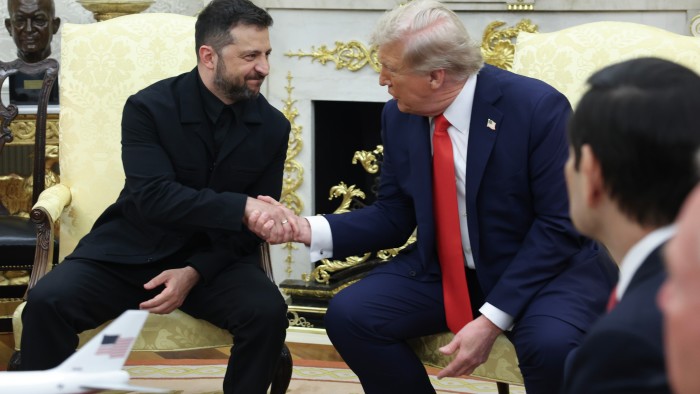
Kyiv shared the proposals for new security deals with the US, which have not been previously reported, in a list of talking points with European allies ahead of a meeting with US President Donald Trump in the White House on Monday, according to four people familiar with the matter.
The document does not state which weapons Ukraine is asking to procure as part of a deal but Kyiv has been clear about its desire to buy at least 10 US-made Patriot air defence systems to protect its cities and critical infrastructure, along with other missiles and equipment. The document does not specify how much of the drone deal would be procurement or investment.
Ukraine’s pitch is intended to appeal to Trump’s desire to benefit American industry. Asked on Monday at the White House about further US military aid for Ukraine, Trump said: “We’re not giving anything. We’re selling weapons.”
The document details how Ukraine intends to make a counter-pitch to the US after Trump appeared to align himself with Russia’s position for ending the war following his meeting with President Vladimir Putin in Alaska last week.
It reiterates Ukraine’s call for a ceasefire which Trump had espoused but then dropped after his Putin meeting in favour of the pursuit of a comprehensive peace settlement.
German Chancellor Friedrich Merz told Trump on Monday during a public portion of the meeting with Ukrainian President Volodymyr Zelenskyy and other European leaders in Washington that the group would like the US president’s help to secure a ceasefire before any next steps.
“I can’t imagine that the next meeting would take place without a ceasefire,” he said. “So let’s work on that and let’s try to put pressure on Russia because the credibility of these efforts we are undertaking today depends on at least a ceasefire.”
The document says a “lasting peace shall be based not on concessions and free gifts to Putin, but on [a] strong security framework that will prevent future aggression”.
It adds that recent footage in Russian media shows that the Kremlin is not serious about a potential peace deal and holds a low opinion of Trump’s leadership, citing disparaging comments about the US president made by prominent television host Vladimir Solovyov.
In one, he mocks Trump for “threatening” Russia, saying Moscow could “destroy [the US] with nuclear weapons”.
Ukraine will not accept any deal including territorial concessions to Russia and insists on a ceasefire as the first step towards a full peace agreement, according to the document.
According to the document, Kyiv also rejects the proposal Putin made to Trump in Alaska to freeze the rest of the frontline if Ukraine withdraws troops from the partly occupied eastern regions of Donetsk and Luhansk. Doing so would create “a foothold for a further and rapid advance of Russian forces towards the city of Dnipro” and enable Putin to “achieve the goals of aggression by other means”, it says.
Ukraine believes Russia’s attempt to settle territorial issues before further talks on a lasting peace agreement would create a fait accompli on the ground while doing nothing to ensure Kyiv’s future security, according to the document.
Kyiv also insists it be given full compensation from Russia for wartime damages, potentially paid for by the $300bn in Russian sovereign assets frozen in western countries. Any sanctions relief should only be granted if Russia complies with the future peace agreement and “plays [a] fair game”, the document adds.
The US television network has been building its own news division separate from NBC News, and will also remove NBC’s peacock symbol from its new logo.
The MSNBC news network has said it will change its name to become My Source News Opinion World, or MS NOW for short, as part of its corporate divorce from NBC.
The TV network, which appeals to liberal audiences with a stable of personalities including Rachel Maddow, Ari Melber and Nicolle Wallace, made the announcement on Monday. It has been building its own separate news division from NBC News and will also remove NBC’s peacock symbol from its logo as part of the change, which will take effect later this year.
The name change was ordered by NBC Universal, which last November spun off cable networks USA, CNBC, MSNBC, E! Entertainment, Oxygen and the Golf Channel into its own company, called Versant. None of the other networks are changing their names.
MSNBC got its name upon its formation in 1996, as a partnership between Microsoft and NBC. Even back then, it was a puzzling moniker to many. But it stuck, even after the NBC partnership with Microsoft that produced it ended.
Versant CEO Mark Lazarus said in the initial days of the spinoff that the name MSNBC would stay, making Monday’s announcement an unexpected about-face.
Name changes always carry an inherent risk, and MSNBC President Rebecca Kutler said that for employees, it is hard to imagine the network under a different name. “This was not a decision that was made quickly or without significant debate,” she said in a memo to staff.
“During this time of transition, NBC Universal decided that our brand requires a new, separate identity,” she said. “This decision now allows us to set our own course and assert our independence as we continue to build our own modern newsgathering organization.”
Kutler said the network’s editorial direction will remain the same. “While our name will be changing, who we are and what we do will not,” she said.
Still, it’s noteworthy that the business channel CNBC is leaving “NBC” in its name. MSNBC argues that CNBC has always maintained a greater separation and, with its business focus, is less likely to cover many of the same topics.
The affiliation between a news division that stresses objectivity and one that doesn’t hide its liberal bent has long caused tension. US President Donald Trump refers to the cable network as “MSDNC,” for Democratic National Committee.
Maddow, in a recent episode of Pivot, noted that MSNBC will no longer have to compete with NBC News programmes for reporting product from out in the field — meaning it will no longer get the “leftovers”.
“In this case, we can apply our own instincts, our own queries, our own priorities, to getting stuff that we need from reporters and correspondents,” Maddow said. “And so it’s gonna be better.”
MSNBC host Joe Scarborough revealed the network’s new logo on his show Monday morning. “It looks very sporty,” he said.
Hamas has agreed to the latest proposal from regional mediators for a Gaza ceasefire and hostage release deal with Israel, a source in the Palestinian armed group has told the BBC.
The proposal from Egypt and Qatar is said to be based on a two-stage framework put forward by US envoy Steve Witkoff in June.
It would see Hamas free around half of the 50 remaining Israeli hostages – 20 of whom are believed to be alive – in two batches during an initial 60-day truce. There would also be negotiations on a permanent ceasefire.
It is unclear what Israel’s response will be, as Prime Minister Benjamin Netanyahu’s office has said it will now only accept a deal if “all the hostages are released in one go”.
In a video released after the reports of Hamas’s approval emerged, Netanyahu did not comment directly but said he got the impression that the group was “under immense pressure”.
Later this week, his cabinet is expected to approve the Israeli military’s plan to occupy Gaza City, where intensifying Israeli strikes have prompted thousands of Palestinians to flee.
The prime minister announced Israel’s intention to widen its offensive and conquer all of Gaza – including the areas where most of its two million residents have sought refuge – after indirect talks with Hamas on a ceasefire deal broke down last month.
On Sunday, hundreds of thousands of Israelis gathered in Tel Aviv to demand that their government agree a deal with Hamas to bring all the hostages home now and end the war.
Netanyahu accused the demonstrators of hardening Hamas’s negotiating position.
He has said the war will only end once all the hostages are released and Hamas disarms. He also wants Gaza to be demilitarised, kept under Israeli security control, and run by an administration not linked to Hamas or the Palestinian Authority.
Hamas has called for a comprehensive deal that would see the hostages it is holding exchanged for Palestinian prisoners in Israeli jails, as well as an end to the war and the full withdrawal of Israeli forces from Gaza. It says it will not disarm unless an independent Palestinian state is created.
The Israeli military launched a campaign in Gaza in response to the Hamas-led attack on southern Israel on 7 October 2023, in which about 1,200 people were killed and 251 others were taken hostage.
At least 62,004 people have been killed in Gaza since then, according to the territory’s Hamas-run health ministry.
The 10th edition of the World Aquatics Junior World Championships begins in less than 24 hours in Otopeni, Romania.
Prelims are slated to begin at 9:30 a.m. local time (2:30 a.m. EDT), with finals occurring at 6:00 p.m. local time (11:00 a.m. EDT).
Here is a list of all the links you need to keep up with the action this week. The event schedule, live stream information, and session start time zone conversions are also included below.
Unlike the senior World Championships, the meet will not be streamed on Peacock in the United States, and there are limited ways to watch.
Americas
Network
Countries/Territories
DirecTV (finals only)
Argentina, Bolivia, Chile, Colombia, Ecuador, Paraguay, Peru, Uruguay, Venezuela
Europe
Network
Countries/Territories
MTVA
Hungary
RAI
Italy
Other European countries can watch the competition on the Eurovision Sport platform which is providing coverage for more than 50 countries and territories.
Asia
Network
Countries/Territories
TV Asahi (finals only)
Japan
CMG/CCTV5
China & Macau
All other countries, including the United States, can stream the event on the World Aquatics Recast Channel.
The streaming service is not free. A seven-day pass is 590 credits, which will cost USD $8.26. The seven-day period begins at the time of purchase.
You can also purchase credits for individual sessions. Each prelims session will be 100 credits and each finals session is 150 credits. The credits are not available for purchase in amounts less than 200, which costs USD $2.80.
Ruin bars are all the rage in Budapest and have been around since the founding of Szimpla Kert, the mecca of all ruin bars, in 2002. These bars are built in Budapest’s old District VII neighborhood (the old Jewish quarter) in the ruins of abandoned buildings, stores, or lots. This neighborhood was left to decay after World War II, so it was a perfect place to develop an underground bar scene. These places were very off the beaten path, rough around the edges, and catered to artists, students, and alternative people.
But they became very popular and well known by 2010 and have nice gone mainstream, though their setting has not changed.
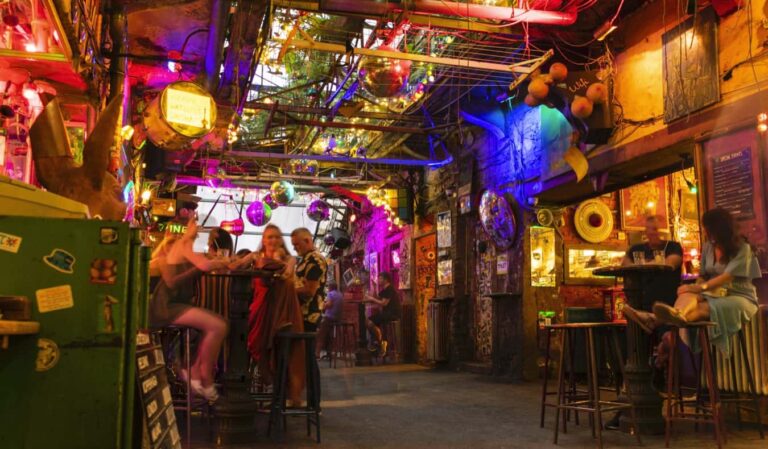
From the outside, these bars look like normal buildings. They don’t have large signs pointing the way, you don’t hear any loud noise, and there’s no line of people waiting to get in. But once you walk in and enter the inner courtyard, you find yourself in the middle of a hip, artsy, and funky bar bustling with crowds talking, dancing, and enjoying the laid-back atmosphere. Large bouncers, along with posted signs, ensure that people are quiet on their way out so as to not disturb the neighbors.
Each of these ruin bars has its own personality, but they all follow a few basic principles: find an old, abandoned place, rent it out, set up a bar, fill it with flea market furniture, have a few artists come in to leave their mark on the walls and ceiling, add in some weird antiques, serve alcohol, and watch people flock in.
When you’re in these bars, you feel like you’re drinking at your local thrift store. None of the furniture matches. It’s all old. It’s eclectic. It feels like they just ransacked your grandmother’s house. The ceilings are all designed differently and the places haven’t been repaired or fixed up, and there are still holes in the walls and visible pipes everywhere.
Though the Ruin Bar movement has become mainstream, many of the bars have done a good job of keeping their character and staying true to their roots — even as they fill up with more tourists.
Here is a list of the best ruin bars of Budapest:
Szimpla Kert
This was the original ruin bar. It opened in 2001, starting this trend. It’s one of the biggest ruin bars and still one of the most popular. Once an abandoned factory, now there’s a large open courtyard, a top floor filled with eclectic furniture, cocktail bars, music, and even an old, stripped-down Trabant (a communist car) to have a drink in. All the rooms have a different theme. They also sell pizza, which, after a few drinks, makes for the perfect walking-home snack. Everyone I take here says it’s one of the coolest bars they’ve ever been to. If you just visit one bar, make it this one.
Grandio
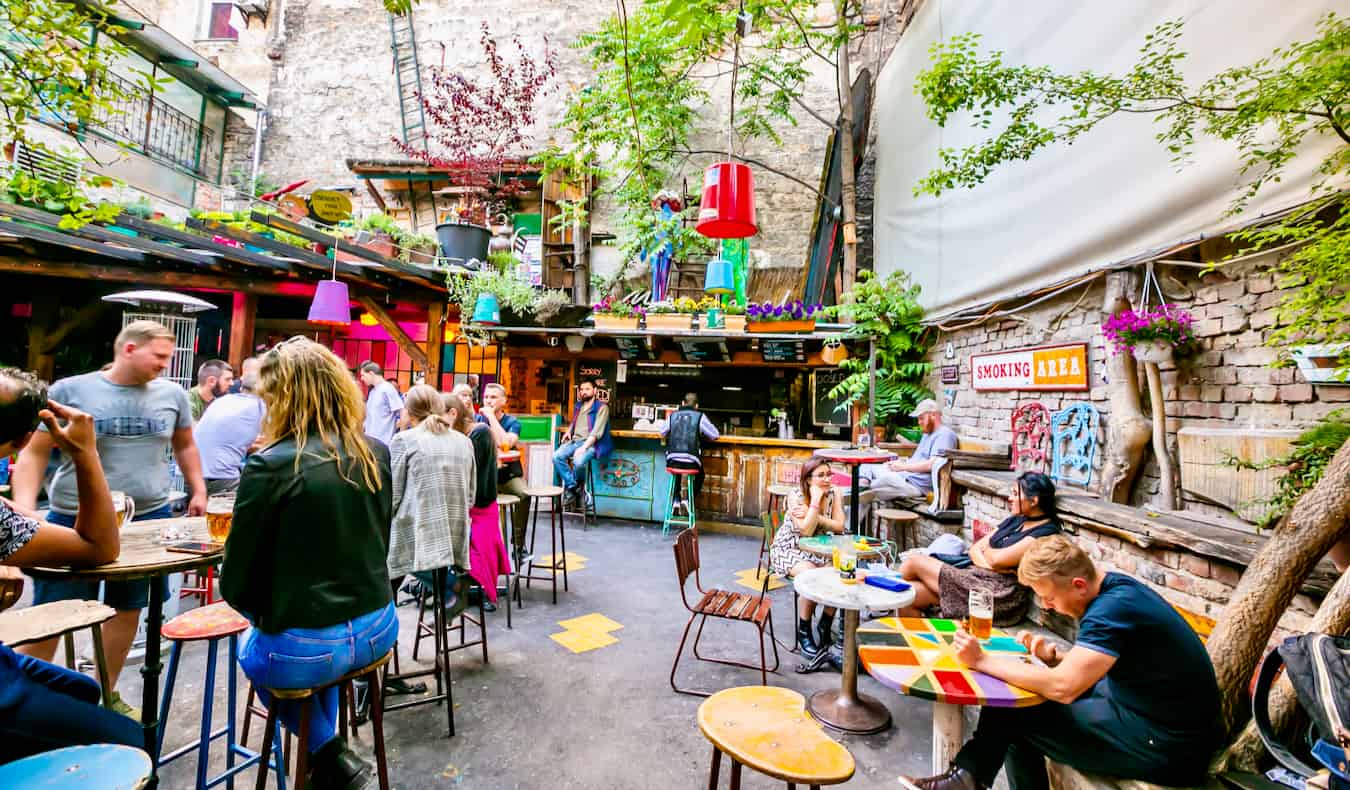
Grandio is a ruin bar and hostel in one. It’s famous for its outdoor, tree-filled courtyard but is mostly filled with travelers and people on bar crawls since it’s also a hostel. This is a good place to start your night and meet other travelers. During the day you can find locals relaxing here with a drink in the garden. It’s not quite as rowdy as the other bars and, since it’s smaller, it has a bit more of a laid-back and intimate vibe.
Dürer Kert
A former university building, this ruin bar and music venue lets you tap into your inner college student as you drink a few beers while playing foosball, Ping-Pong, darts, and a French game called pétanque (it’s fun). The courtyard garden is a good spot to enjoy all the live music that happens in this bar. The space is really big and there’s a lot of activity here. Plus, I love how the art and paintings on the wall.
Instant-Fogas Complex
The Instant-Fogas Complex is located in an entire apartment building and the biggest ruin bar in the city. There are over 20 rooms, 18 different bars, multiple dance floors, and 2 gardens. It’s one of the more club-like ruin bars. In Instant, you can sit in what were once individual apartments and relax on furniture that looks like it was found on the street. They’ve knocked down many of the walls to connect the apartments and make space for the DJs and dancing. Given its popularity and the fact that it’s more “clubby,” drinks here are a little more expensive than in other ruin bars. If you want to dance away the night, this is the bar for you.
Doboz
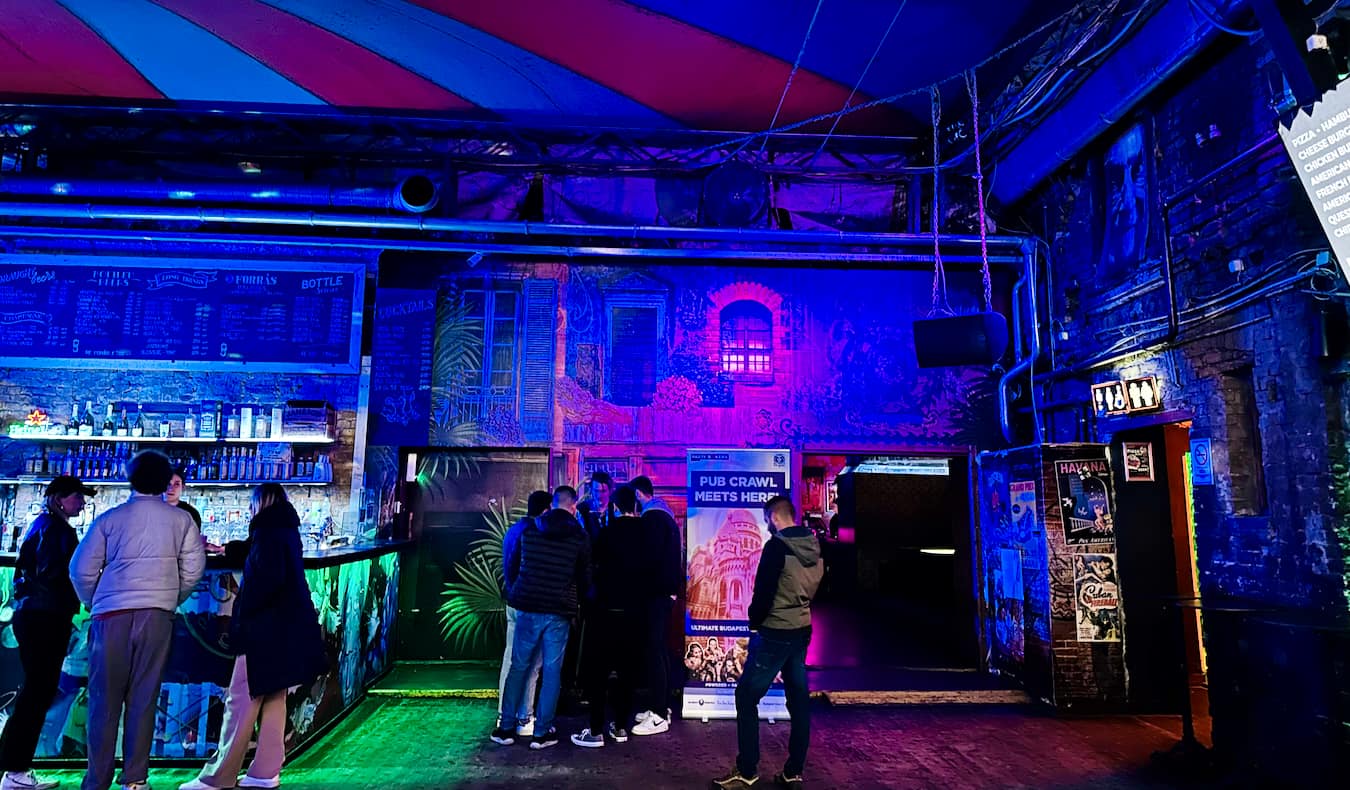
I’m not entirely sure if this place fits into the ruin bar culture. It was much fancier and trendier than the other bars I visited. It was like being in a “real” bar. However, I was taken there as part of a ruin bar tour, and, regardless, I loved this place. You walk into the courtyard and are greeted by a tree with a red-eyed robot attached to it. It looks like a Transformer is about to attack you. There are two main rooms: one red, the other blue. They play a lot of dance music, and this place fills up toward the end of the night. The only downside is that it has more limited opening hours than other bars.
Mazel Tov
This is one of Budapest’s newest ruin bars. Mazel Tov (located in the old Jewish quarter) is a community center and restaurant serving traditional Jewish cuisine by day. At night, the courtyard is a party with DJs and live entertainment entertaining guests. There’s also a restaurant here. I wouldn’t call this a “ruin bar” in the traditional sense but it’s a nice atmosphere, the decor is nice, and it’s got great drinks. It’s fancier than all the others so don’t expect something so “rough and tumble.”
Csendes Letterem Café & Bar
If you’re looking for a more laid-back vibe to balance out the party atmosphere of some of the other ruin bars but don’t want to sacrifice the cool vintage aesthetic, this is the bar for you. It’s located right in the heart of Budapest and is the perfect place to relax and share drinks with friends or settle in for an evening of conversation. The bar also serves food and has Wi-Fi, so you’ll often find digital nomads mingling here.
***
Budapest may sell itself on history and thermal baths, but the ruin bars are by far the most unique thing about this city. Even if you don’t drink, come spend time at these ruin bars because they are such a funky way to see a popular and totally unique aspect of life in Budapest (you can even take a self-guided tour of a few bars that includes skip-the-line entry). You’ll meet a lot of locals when you visit too! So, don’t miss them.
Get Your In-Depth Budget Guide to Europe!
My detailed 200+ page guidebook is made for budget travelers like you! It cuts out the fluff found in other guides and gets straight to the practical information you need to travel while in Europe. It has suggested itineraries, budgets, ways to save money, on and off the beaten path things to see and do, non-touristy restaurants, markets, bars, safety tips, and much more! Click here to learn more and get your copy today.
Plan your trip to Europe like a pro
Get all my best Europe travel tips as well as free planning guides sent straight to you and see more of the country for less!
Book Your Trip to Budapest: Logistical Tips and Tricks
Book Your Flight Use Skyscanner to find a cheap flight. They are my favorite search engine because they search websites and airlines around the globe so you always know no stone is left unturned.
Book Your Accommodation You can book your hostel with Hostelworld as they have the biggest inventory and best deals. If you want to stay somewhere other than a hostel, use Booking.com as they consistently return the cheapest rates for guesthouses and cheap hotels.
Don’t Forget Travel Insurance Travel insurance will protect you against illness, injury, theft, and cancellations. It’s comprehensive protection in case anything goes wrong. I never go on a trip without it as I’ve had to use it many times in the past. My favorite companies that offer the best service and value are:
Looking for the Best Companies to Save Money With? Check out my resource page for the best companies to use when you travel. I list all the ones I use to save money when I’m on the road. They will save you money when you travel too.
Kumail Nanjiani, the 47-year-old star of HBO’s acclaimed comedy Silicon Valley, which ran from 2014 to 2019, recently revealed he has met many people from the real-world Silicon Valley, and not everyone was a fan of the show’s depiction of startup culture. Chief among those people, he said, was Elon Musk, the CEO of Tesla and world’s richest man.
Speaking on Mike Birbiglia’s podcast, Nanjiani was asked if he ever met the tech billionaires his show would lampoon, and Nanjiani said yes, he had met Musk and Meta CEO Mark Zuckerberg, among others. But when Birbiglia asked if Musk liked the show or gave any feedback, Nanjiani replied, “He didn’t like the show.”
“He was like, all the parties I go to are much cooler than these parties. I was like, yeah man, you’re one of the richest people in the world. We’re, like, losers on the show,” he said. “Of course your parties are better than my parties.”
Created by Mike Judge of Beavis and Butthead and King of the Hill fame, HBO’s Silicon Valley ran for 53 episodes spanning six seasons. The series followed Richard Hendricks, a brilliant but awkward programmer, who builds a startup with his friends called Pied Piper. While its accuracy was often debated, the show satirized Big Tech and corporate culture, and critics commended its sharp, pointed writing that made fun of “brogrammer culture” and eccentric billionaires. Silicon Valley received five consecutive Emmy nominations for Outstanding Comedy Series.
To Musk’s point, parties in the real Silicon Valley are probably “cooler” than the ones on the HBO show, but, like Big Tech itself, many have reported on their tendency to push boundaries. Emily Chang’s 2018 book, Brotopia, described secretive gatherings featuring drug use and open sexual behavior among tech elites. Chang said these events, attended by venture capitalists and founders, often involved drugs like MDMA and “cuddle puddles” that encouraged intimacy, with women reporting stigma and exclusion depending on whether they participated or abstained.
Chang’s book claimed Musk attended at least one such party in 2017, held at investor Steve Jurvetson’s house, but Musk has since vigorously disputed the characterization of the event as a “sex party.” Musk said he believed the gathering was a costume party, saw no signs of inappropriate behavior, and left early. He provided the following statement to Wired in 2018: “Nerds on a couch are not a ‘cuddle puddle.’ I was hounded all night by DFJ-funded entrepreneurs, so went to sleep around 1am. Nothing remotely worth writing about happened,” he said.
You can stream all six seasons of Silicon Valley on HBO Max.
For this story, Fortune used generative AI to help with an initial draft. An editor verified the accuracy of the information before publishing.
Introducing the 2025 Fortune Global 500, the definitive ranking of the biggest companies in the world. Explore this year’s list.
The US Navy’s secretive F/A-XX sixth-generation fighter plane is a bit less secret after program competitor Northrop Grumman unveiled a new concept image of its version of the carrier-based warplane, giving us a few design clues.
Like the US Air Force, the Navy is keen on getting its hands on a sixth-gen fighter. However, due to the need for specialized carrier aircraft and good old-fashioned inter-service rivalry, the Navy would much rather have a dedicated aircraft of its own rather than a carrier variant of the planned F-47 NGAD.
It’s a squabble that gets a lot of back channel chatter and the F/A-XX is often looked upon as the sacrificial lamb during defense budget talks as Congress questions whether America needs two advanced fighter aircraft in an age of budget cuts increasingly dominated by drone warfare.
Nevertheless, Northrop Grumman seems determined to show that it’s still in the running against rival Boeing to secure the F/A-XX contract if it’s finally approved.
The reason the Navy has given for the F/A-XX is that it has very different mission requirements from the Air Force. Aside from carrier operations, instead of concentrating on air superiority, the Navy prefers to deal in surface warfare, attacking ships and ground targets. In addition, the rising ambitions of China make longer-range fighters more suitable to operating in the Pacific Ocean.
The new image was posted without comment on the Naval Aviation section of the Northrop Grumman’s website and shows the forward section of the concept F/A-XX on the ground. Though we can’t see the wings or the aft section of the plane, we can make some deductions from the rendering.
First off, the lines of the concept are very similar to the Northrop Grumman YF-23 that the company is developing in competition for the Air Force’s Advanced Tactical Fighter program. There’s a sharp nose with a prominent chine blending the wings into the fuselage, which is optimized for stealth. This stealthiness is compounded by a top-mounted air intake, which is another indication of reducing the aircraft’s sensor profile.
Along with this, the profile suggests a large interior volume for carrying more fuel, weapons, and other payloads. Also, there’s a heavy-duty undercarriage with twin wheels, showing that it is designed for carrier operations where the fighter tends to land on the deck with a pretty hard thump.
The F/A-XX program is intended to replace the F/A-18E/F Super Hornet and EA-18G Growler sometime in the 2030s as a multi-role fighter that can operate in hostile territory. Though the specifications are still under wraps, the competition expects the winning design to have 25% more range than the F-35C, or about 837 nautical miles (964 miles, 1,551 km) and can aerial refuel from the MQ-25 Stingray tanker drone.
Speed is also a bit vague, but it’s supposed to be faster than current US combat aircraft. Other features include new sensors, advanced AI with advanced networking, and the ability to engage in manned-unmanned teaming (MUM-T) with Collaborative Combat Aircraft (CCA) – more familiarly known as Loyal Wingmen.
If the program continues to be funded, a decision is expected by 2028.