


Dollar drops against peers, euro gains after U.S. jobs data
Xi, Putin, and Kim present unified front with unveiling of new weapons
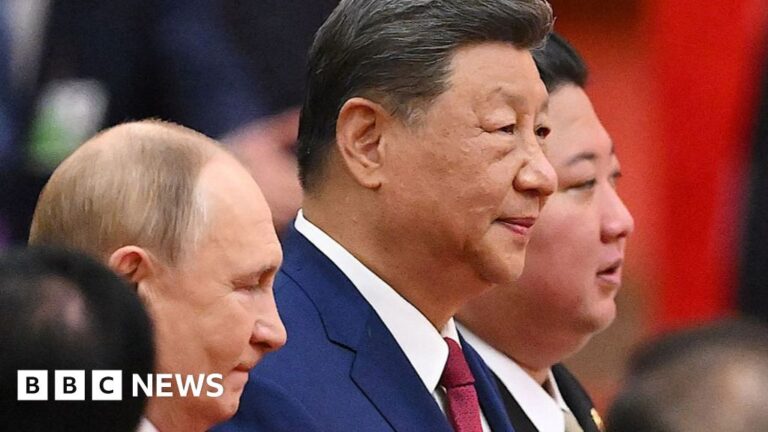
Laura BickerChina correspondent , Beijing and
Thomas MackintoshBBC News
The leaders of China, Russia and North Korea have appeared in public together for the first time in a show of solidarity at a massive military parade in Beijing.
President Xi Jinping said the world faced a choice between peace and war as China unveiled a huge arsenal of weapons – including nuclear missiles with a global reach – to mark the 80th anniversary of the end of World War Two.
The display was not just a look at where China has been, or how far it has come – it was a showcase of where the country is going.
Xi played the role of a global leader prepared to stand alongside two of the most sanctioned leaders in the world: Vladimir Putin and Kim Jong Un.
And, at the Chinese leader’s feet, a military which is being built to rival the West.
The parade was a choreographed spectacle of precision, power and patriotism. Thousands of soldiers paraded equipment on Wednesday, demonstrating China’s military modernisation programme.
But, one of the most enduring images of the parade took place before the first cannon was fired.
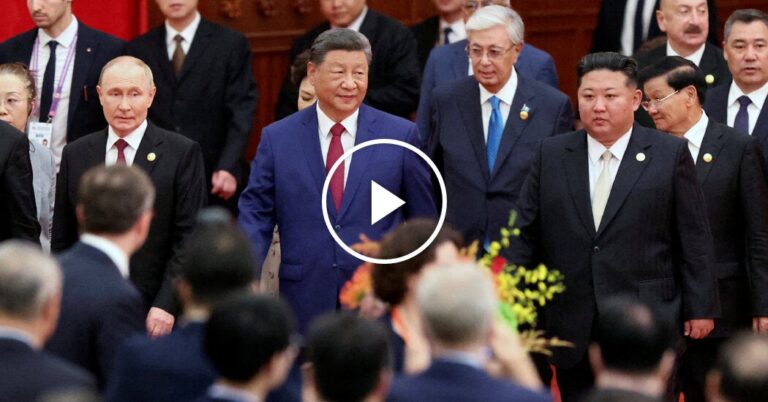
President Xi welcomed Kim with a long handshake, then moved on to greet Putin, before all three walked together to watch the parade.
This was the first time all three leaders have been seen in public together, and they really picked their moment.
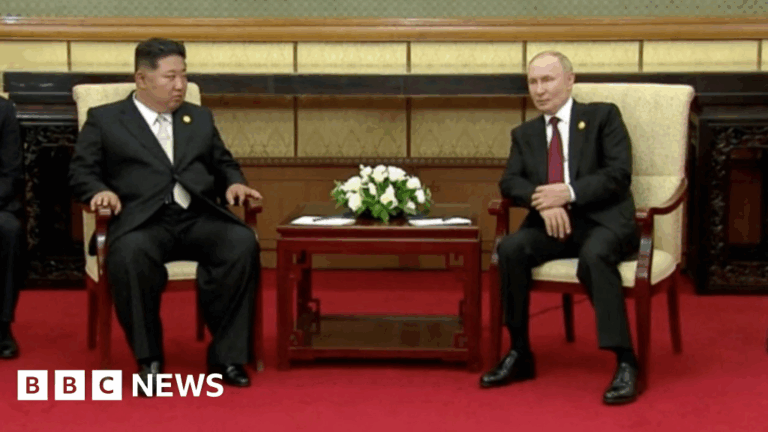
Later, on the sidelines, Putin and Kim met, with Putin praising Pyongyang for sending soldiers to fight in Ukraine.
Putin and Kim joined 24 other dignitaries who had been invited to the Beijing parade on behalf of Xi.
Former top leaders of China also stood at the Tiananmen viewing platform – but notably absent was former president Hu Jintao.
South Korea’s President Lee Jae Myung did get an invitation, but turned it down. Indian Prime Minister Narendra Modi – who met President Xi earlier this week – was also not present.
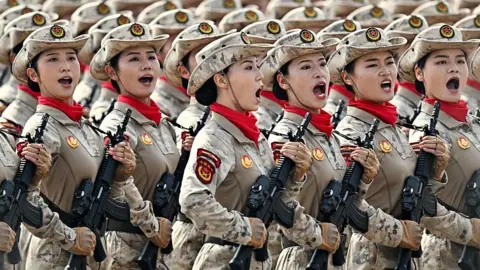 Getty Images
Among the world leaders attending were Iran’s President Masoud Pezeshkian, Pakistan’s PM Shehbaz Sharif, Vietnam’s Luong Cuong and Zimbabwe’s Emmerson Mnangagwa.
Most Western leaders opted not to attend China’s “Victory Day” parade.
The two that did make the journey – Slovakia’s Robert Fico and Aleksandar Vucic of Serbia – posed for photos with Putin after the main event.
They all watched on as around 50,000 spectators – all vetted in advance – attended the parade in Beijing’s Tiananmen Square.

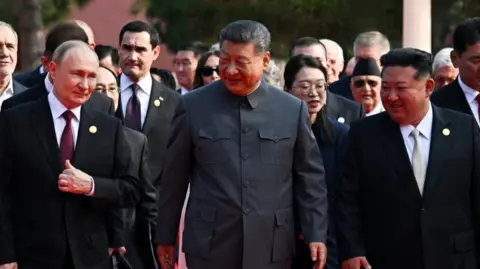 Reuters
President Xi inspected thousands of soldiers from different branches of the Chinese military who had gathered on Changan Avenue.
Laser weapons, robotic “wolves” and giant underwater nuclear drones were among new weapons on display.
China also showed off its stealth attack drones, dubbed the “loyal wingman”, as they are capable of flying alongside a manned fighter jet and aid it in its attacks.
Thousands of doves and balloons were later released into the skies above Tiananmen Square to mark the end of the parade.
Guests then enjoyed a lunch reception at the Great Hall of the People where they could choose between a red or white Chinese wine.
President Xi gave a toast to say the world must “never return to the law of the jungle”.
He did not address any Western nations specifically in his five-minute speech, but Chinese officials have previously called the US a “bully” for its imposition of tariffs on countries around the world.
Xi added: “We sincerely hope that all countries will draw lessons from history, value peace and work together to… create a brighter future for humanity”.
He concluded by toasting to “common prosperity for all humankind”.
Putin and Kim then held bilateral talks at Diaoyutai State Guesthouse in a meeting which lasted two-and-a-half hours.
The pair discussed North Korea’s contribution in the Ukraine war and reflected on an agreement struck last June between the two nations.
It is now estimated that up to 15,000 North Korean troops have joined Russian soldiers on the front lines in Ukraine.
North Korea has also supplied Russia with ammunition. In exchange, North Korea is believed to have received money and help with weapons development.
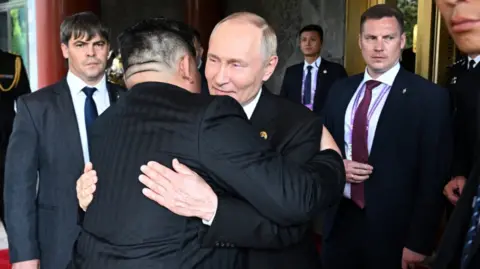 Reuters
It was the meeting between Xi, Kim and Putin – not just the weapons and troops on show – that appears to have grabbed the attention of Donald Trump.
The US president, who did not attend, took to his social media platform and accused President Xi of conspiring against the US with Russia and North Korea.
“Please give my warmest regards to Vladimir Putin, and Kim Jong Un, as you conspire against The United States of America,” Trump posted on Truth Social.
Kremlin spokesperson Yuri Ushakov rejected any suggestion of a conspiracy against the US, according to Russian state media.
Ushakov called Trump’s words “ironic” and said Putin, Xi and Kim are “not even thinking about a conspiracy against the United States” and that the three leaders understand Washington’s role “in the current international situation”.
Sean Quinn Named Competitor Coach of the Month

By James Sutherland on SwimSwam


Competitor Coach of the Month is a recurring SwimSwam feature shedding light on a U.S.-based coach who has risen above the competition. As with any item of recognition, Competitor Coach of the Month is a subjective exercise meant to highlight one coach whose work holds noteworthy context – perhaps a coach who was clearly in the limelight, or one whose work fell through the cracks a bit more among other stories. If your favorite coach wasn’t selected, feel free to respectfully recognize them in our comment section.
Mecklenburg Swim Association’s National Prep coach Sean Quinn lands Competitor Coach of the Month honors after placing three swimmers on the U.S. World Junior Championship team and earning a role on the American coaching staff as an assistant.
Quinn has been leading the National Prep group at Mecklenburg under head coach David Geyer since 2021, having spent three years as an assistant at UNC and then two at SwimMAC Carolina.
Qualifying for the U.S. World Junior team from Mecklenburg this year were Mike Rice, Kayda Geyer and Norvin Clontz, all of whom had strong performances.
Rice, 17, won a gold medal after leading off the winning U.S. mixed 4×100 free relay team in a time of 49.80, which was under his official personal best time of 49.84 set in mid-July.
Two days later, Rice set a new PB of 49.49 in the prelims of the boys’ 100 free, advancing 3rd into the semis. Despite adding just over a tenth and ultimately finishing 9th in the semis in 49.61, his new best time moved him into 27th all-time in the boys’ 17-18 age group.
Rice also recorded a pair of sub-49 relay splits for the U.S., including anchoring the boys’ 4×100 free relay in 48.85 en route to a bronze medal. He was also 48.95 in the prelims of the boys’ 4×100 free relay, and added 49.13 and 49.40 anchor legs on the boys’ 4×100 medley relay that finished 5th.
Geyer, also 17, earned a spot on the team after a standout summer that included a big personal best in the 100 breast (1:09.37) in mid-May and then cracking the ‘A’ final in the 200 breast at U.S. Nationals in June when she clocked 2:28.79 in the prelims.
At World Juniors, Geyer was again a finalist in the 200 breast, placing 8th in 2:29.58, and she made the semis in the 100 breast, finishing 14th in 1:09.73.
Clontz, 18, set a PB in the 200 free (1:49.32) and a season-best in the 400 free (3:51.26) at U.S. Nationals to earn a berth on the team, and went on to finish 9th in the 400 free (3:51.86) and 24th in the 200 free (1:51.25) at World Juniors. He also split 1:49.07 in the prelims of the 4×200 free relay before the U.S. team was disqualified for an early takeoff.
The U.S. team topped the medal table at World Juniors with 10 gold and 22 total medals, earning them the World Aquatics Team Trophy for the competition.
Mecklenburg also sent a number of swimmers to the U.S. Junior National Championships at the beginning of the month, including Eliza Wallace, who was an ‘A’ final in the 50 breast (31.99) and 100 breast (1:09.62), placing 5th and 6th, respectively.
Since 1960, Competitor Swim® has been the leader in the production of racing lanes and other swim products for competitions around the world. Competitor lane lines have been used in countless NCAA Championships, as well as 10 of the past 13 Olympic Games. Molded and assembled using U.S. – made components, Competitor lane lines are durable, easy to set up and are sold through distributors and dealers worldwide.

Competitor Swim is a SwimSwam partner.
Read the full story on SwimSwam: Competitor Coach of the Month: Sean Quinn
Comparison of AI Adoption: A Case Study of GM versus Toyota in the 1980s by 2 MIT Professors
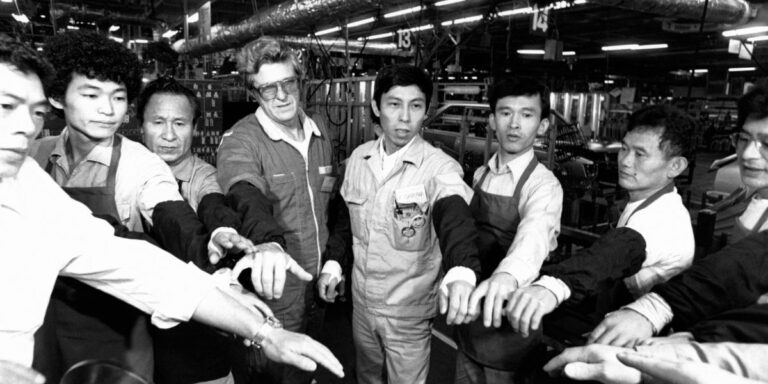
On October 20, 1984, The New York Times ran an article headlined, “GM Factory of the Future Will Run with Robots.” In it, Roger Smith, then GM’s CEO, claimed that automation would save the company from increasingly formidable Asian competitors.
But that didn’t happen. Smith’s robotic factories struggled to match the productivity of their human-run counterparts. Robots sometimes painted each other instead of cars or welded doors shut. And they carried much higher costs.
Today, the assembly of automobiles and countless other products is done primarily by robots. Smith had the right idea; he just went about it the wrong way. Artificial intelligence poses a similar challenge.
A recent report by our colleagues at MIT suggests that despite the $30 billion-$40 billion currently being invested in enterprise AI, 95% of pilots are getting zero return. Just as automation ultimately changed manufacturing, AI will undoubtedly reshape how companies operate; however, GM’s experience highlights the pitfalls of not thinking about its implementation carefully. Throwing technology at problems without understanding how work gets done day-to-day is a surefire way to waste money and breed cynicism.
Take a cue from Taiichi Ohno, the engineer known as the father of the Toyota Production System. He argued for “autonomation:” or automation with a human touch. Here’s how leaders can put his insight into practice with AI:
Step one: understand how work actually gets done
One of the students we taught at MIT Sloan School of Management likes to say, “There are few ways to lose money faster than automating a process you don’t understand.” That was Smith’s first error.
Automotive assembly plants are complex environments. Every process combines formal procedures and countless local refinements to get work done. Most of these tweaks, while necessary, are invisible to people one level up, let alone the CEO.
Knowledge work is even harder to map and is often shaped by thousands of micro adjustments. Consider all the emails and hallway conversations needed to move any decision forward. Leveraging automation requires understanding both the way work is supposed to be performed and how it’s actually done.
Successfully using AI requires a similar approach. You have to understand the work, otherwise you risk creating tools that, as the MIT report concluded about current AI applications, are “…brittle, overengineered, or misaligned with actual workflows.”
Next, run targeted trials
Smith’s second mistake was going too big, too fast—trying to replace entire systems overnight rather than proceeding incrementally with small, focused experiments.
Toyota pinpointed jobs where robots could make the work better by doing things like eliminating unsafe activities and physically taxing jobs. Then they ran experiments. Safety and productivity improved without upending the whole system, which allowed them to learn how to design work that robots could do repeatably. With this knowledge in hand, using robots for the next round of changes was easier and less disruptive.
The AI analogy is clear: repetitive tasks are dull and create the mental equivalent of repetitive stress injuries. Look for processes that are predictable and repeatable. Start where boredom is high and variability is low then use these simpler automation successes as learning experiences toward automating more sophisticated, complex work.
AI will never grasp the full context of your organization or the surrounding social and political dynamics. AI only knows what it has learned from experience. You still need employees who know the work and the organization to oversee AI to make sure its learning is headed in the right direction.
Then, redeploy, don’t just reduce
There’s little doubt that AI will eventually eliminate jobs, but if your company hopes to grow and thrive, choose this as a last resort. Smith didn’t think this way. His tenure was marked by plant closures and job losses. He famously told auto workers, “Every time you ask for another dollar in wages, a thousand more robots start looking practical.”
This is misguided. The “machines versus people” dynamic has fueled labor tensions, slowed technology adoption, and hurt organizational performance for over a century. It’s also bad business. Technology should improve productivity and fuel growth, not just slash costs.
AI frees up capacity. Use this newly available bandwidth to dust off ideas that have been sitting on the shelf: new services to offer, new markets to enter, and nagging problems to finally solve. Position employees where their skills are strongest; you know them, and they know the business.
Our approach requires a strong stomach, at least initially. At first, it’ll feel too small and too slow, especially when competitors boast about “doing AI everywhere.” But as you clear away work that is easily automated, building skills along the way, and delivering returns on the AI investment, more complex challenges will appear. Rinse and repeat with the next opportunity, ensuring that AI is not just cutting costs, it is helping you redesign and grow the business.
Much as robots are everywhere in factories now, AI will find a permanent place in most organizations. Your company will get there faster and with less heartache if you understand how work gets done, start with small experiments and prioritize growth over cuts.
The opinions expressed in Fortune.com commentary pieces are solely the views of their authors and do not necessarily reflect the opinions and beliefs of Fortune.
Fortune Global Forum returns Oct. 26–27, 2025 in Riyadh. CEOs and global leaders will gather for a dynamic, invitation-only event shaping the future of business. Apply for an invitation.
Prototype of Ola Diamondhead E-Superbike Unveiled: Confirmed Launch in 2027 and Pricing Details
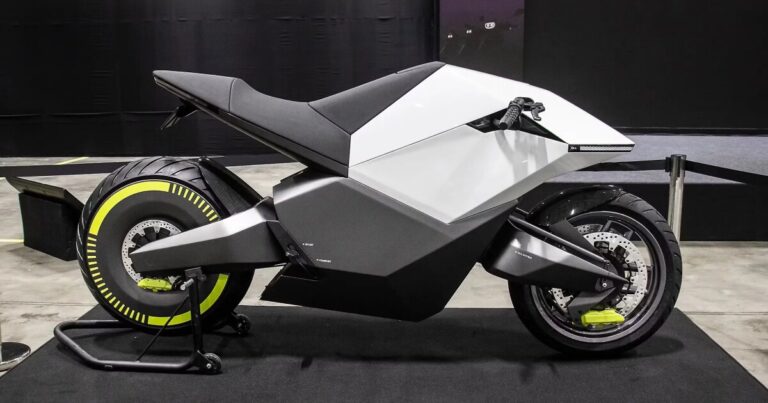
Ola Electric isn’t a new name in the electric mobility space. The Indian company has regularly made headlines, and this time, the news comes straight from the source. Ola CEO Bhavish Aggarwal has confirmed that the company’s long-awaited Diamondhead electric superbike will officially hit the streets in 2027.
The company also took the covers off the prototype – an actual working model that was ridden on stage at Ola’s annual event, Sankalp 2025, in India. That’s not all, an official price was also announced – INR 500,000 (around US$5,700).
Ola Electric
If that figure was attached to a basic city commuter, nobody would bat an eye. But considering the Diamondhead is a high-performance motorcycle with a claimed 0–60-mph (97-km/h) time of just 2 seconds, it’s bound to turn heads.
The build quality also looks promising. Ola says the bike incorporates space-grade aluminum, carbon fiber, and magnesium, all of which should reduce curb weight and boost performance. The Diamondhead is also expected to feature active aerodynamics, adaptive suspension, and “active ergonomics” – meaning the handlebars and foot pegs can be adjusted to improve control and rider comfort.
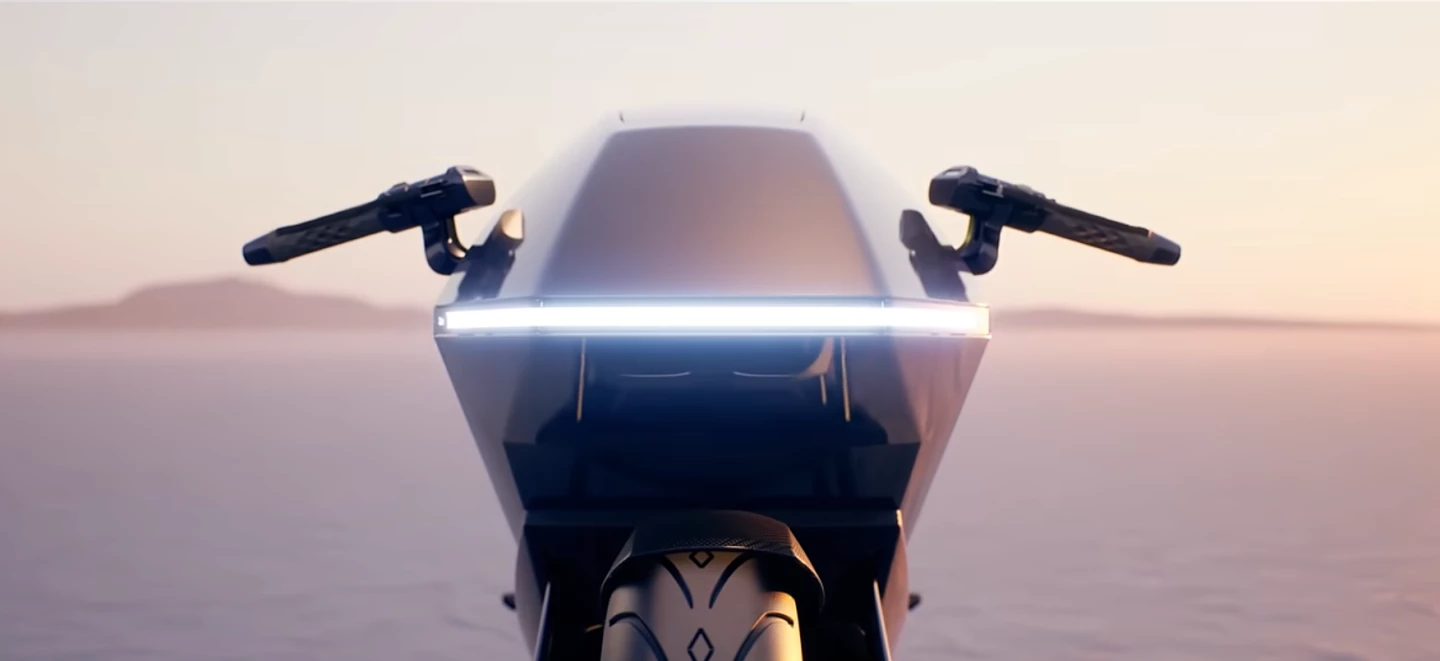
Ever since it was revealed as a concept some two years back, the Diamondhead’s radical styling has sparked plenty of discussion. The design includes a diamond-shaped front end with a slim horizontal LED strip, an inventive headlight, and an equally sharp tail section.
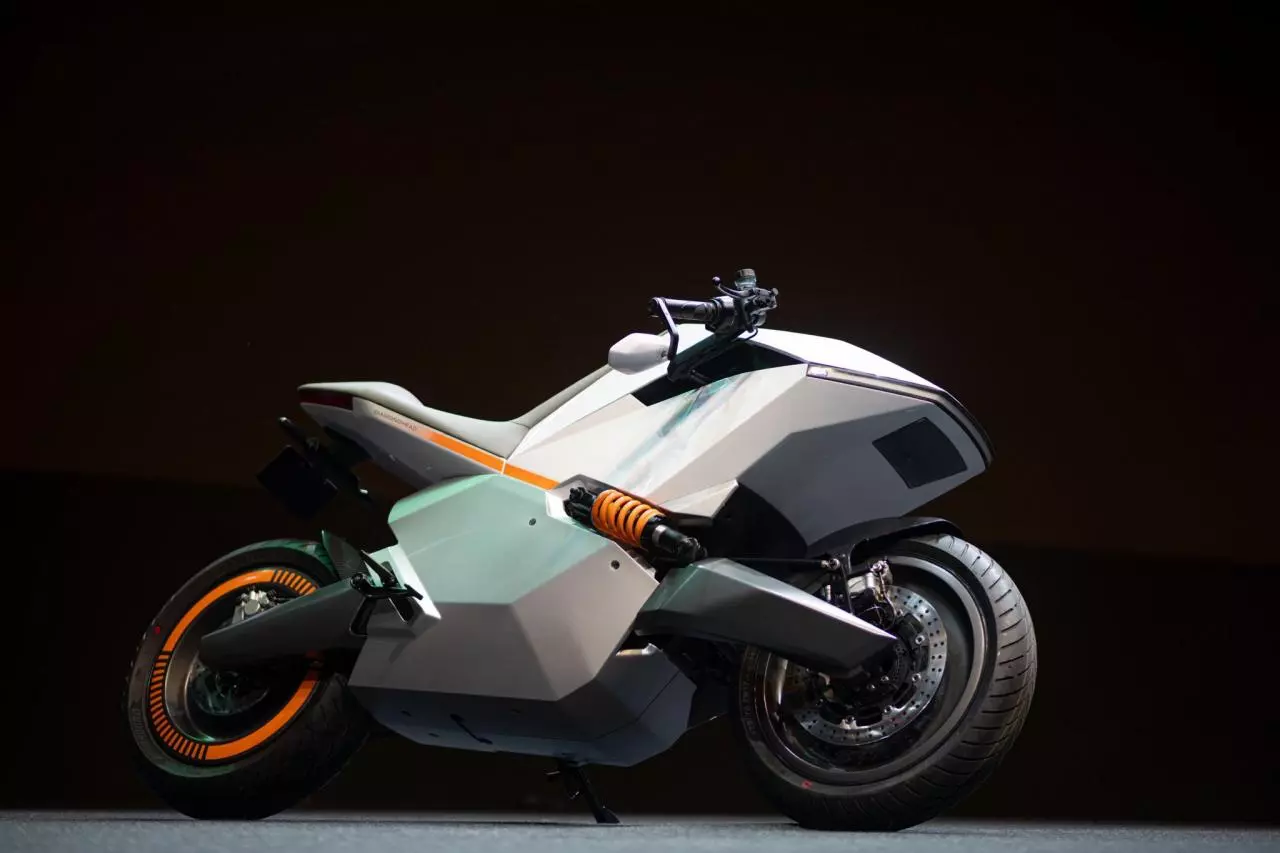
Ola Electric
The prototype showcases an exposed front monoshock, bar-end mirrors, and retains the concept’s hub-center steering – suggesting it will carry through to production. It rides on 17-inch alloy wheels with disc brakes at both ends and dual rotors up front.
Safety and tech integration appear to be key focuses. Ola is rumored to include ADAS, traction control, and AI-driven features, along with its own “Smart AR” helmet and other AI-backed wearables that sync seamlessly with the bike.
Under the skin, Ola plans to use its in-house 4680 Bharat cell. Engineers are apparently still refining the battery to maximize range and performance before launch. Exact numbers aren’t yet available, but current progress looks encouraging.
Ola Electric
By 2027, more than four years will have passed since Ola first teased its superbike. That might feel like a long gap, but if it ensures a well-polished debut – and avoids the lukewarm reception that greeted the Roadster motorcycle – then the wait may prove worthwhile.
For now, one lingering hope remains: that Ola provides original press images and test rides this time around. With Ola, you never quite know what to expect.
Via Car&Bike
China Demonstrates Military Strength at Parade Alongside Putin and Kim
new video loaded: China Projects Power at Parade With Putin and Kim
By Jiawei Wang•
President Xi Jinping of China oversaw the country’s ambitious display of military power and diplomatic influence during a parade attended by the leaders of Russia and North Korea.
Recent episodes in International
International video coverage from The New York Times.
International video coverage from The New York Times.
Dynamite Songs obtains the catalog of Grammy-winning producer Keith Harris

Music publisher Dynamite Songs has acquired the catalog of Grammy Award-winning producer, songwriter and multi-instrumentalist Keith Harris, adding over 200 songs to its portfolio.
Dynamite said that the deal covers the publishing rights to over 200 songs written by Harris, including performance royalties from the writer’s share on certain songs and Performance Rights Organisation (PRO) income on the others.
The catalog spans over 20 years, during which time Harris worked closely with global artists like The Black Eyed Peas, Estelle, Madonna, Usher, Robin Thicke and Chrisette Michele.
Harris, known for his partnership with Will.i.am, co-wrote several Black Eyed Peas hits including Meet Me Halfway and Imma Be from the group’s multi-platinum 2009 album, The E.N.D. Meet Me Halfway reached the top 10 on Billboard‘s Hot 100 and has generated over 1 billion streams, while I’mma Be became the group’s third number-one single in the US.
His other credits include Estelle’s Grammy-winning American Boy, Robin Thicke’s Feel Good, Madonna’s Gang Bang, Usher’s Can’t Stop Won’t Stop, and Chrisette Michele’s Be Okay and Let’s Rock.
“Keith Harris’s catalog reflects everything we look for at Dynamite: compositions with proven performance and continued relevance across formats and markets. These are songs that have consistently connected with broad audiences over time.”
Alan Wallis, Dynamite Songs
Alan Wallis, CEO of Dynamite Songs, said: “Keith Harris’s catalog reflects everything we look for at Dynamite: compositions with proven performance and continued relevance across formats and markets. These are songs that have consistently connected with broad audiences over time.
“Keith’s contribution to the sound of the past two decades is indelible, and we’re pleased to be supporting the next chapter of his catalogue’s long and promising life.”
The latest acquisition expands Dynamite’s portfolio to about 1,000 works. Launched by the team behind Mojo Music & Media, including valuation expert Alan Wallis, earlier this year, Dynamite said that it has already acquired catalogs of hits including rights to music by the likes of Ed Sheeran, Kendrick Lamar, Papa Roach, ATB and Dan + Shay.
Dynamite says it focuses on acquiring and managing smaller catalogs containing “high-quality, culturally significant music copyrights.”
The company is backed by investment giant Crestline Investors.
The deal comes amid strong activity in the music rights space. About three weeks ago, GoldState Music acquired the catalog of Grammy-nominated producer and entrepreneur Yung Lan, four months after raising $500 million for music rights acquisitions.
In July, Hopeless Records bought the catalog of influential independent punk label Fat Wreck Chords, founded in 1990 by NOFX’s Fat Mike (Michael John Burkett ) and Erin Burkett.
Earlier deals this year include Amsterdam-based investment fund Pythagoras Music Fund’s purchase of the music rights catalog of veteran rock producer Kevin Shirley, Create Music Group’s acquisition of the catalog of Pack Records, and Reservoir Media’s purchase of the publishing catalog of Lastrada Entertainment.
Music Business Worldwide
Trump claims US strike was aimed at Venezuelan drug smuggling vessel

Donald Trump says a US strike has killed 11 ‘narcoterrorists’ from a Venezuelan gang smuggling drugs in the Caribbean.
Challenge from the Client

A required part of this site couldn’t load. This may be due to a browser
extension, network issues, or browser settings. Please check your
connection, disable any ad blockers, or try using a different browser.
Vladimir Putin expresses gratitude to Kim Jong Un for North Korean support in Ukraine conflict
 Reuters
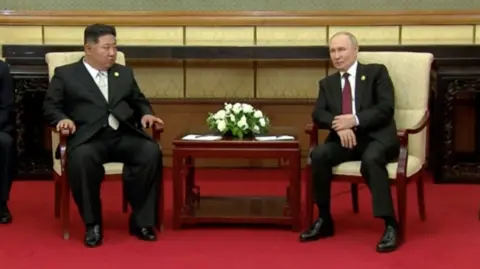
Russia’s Vladimir Putin has thanked North Korean leader Kim Jong Un for the courage of his soldiers who have been fighting in Ukraine on the Russian side.
Kim, in response, said he was willing to do “everything I can to assist” Russia.
The two leaders met on Wednesday in Beijing as China held one of its largest ever military parades, which marked 80 years since the end of the Second World War in Asia.
Putin, who launched a full-scale invasion of Ukraine in February 2022, said bilateral relations between Russia and North Korea are friendly and that Pyongyang’s military helped to liberate the Kursk region.
“Your soldiers fought courageously and heroically,” Putin told Kim during Wednesday’s talks.
“I would like to note that we will never forget the sacrifices that your armed forces and the families of your servicemen have suffered.”
Kim expressed his gratitude for the Russian leader’s acknowledgement of North Korea’s troops and said bilateral relations between the two countries had been “advancing across all areas” – referencing Pyongyang’s involvement in the “joint struggle” with Russia in Ukraine.
“If there is any way we can assist Russia, we will certainly do it as a fraternal duty.”
According to South Korea, the North has sent some 15,000 troops to aid Russia in its invasion, along with missiles and long-range weapons. In return, it is believed North Korea received food, money and technical help.
These soldiers have been involved in Moscow’s efforts to recapture parts of western Kursk – where Ukrainians are defending a small area of territory captured during a surprise incursion in August – and are thought to have sustained heavy losses.
Western officials said in January that at least 1,000 had died in just three months. Two months later, Seoul lawmakers said they believed there were about 4,700 North Korean casualties, including 600 deaths, out of a total deployment of 15,000.
The North Korean troops, none of whom will have any previous combat experience, are believed to have spent their first weeks in Russia in training and then in support roles.
 SPUTNIK/KREMLIN POOL/EPA/Shutterstock
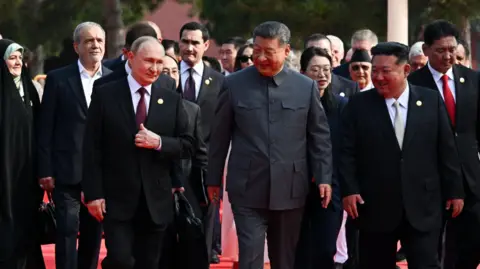
It is the third meeting in two years and at a time when Moscow and Pyongyang are deepening their co-operation.
Last June, Putin and Kim signed a deal pledging that Russia and North Korea will help each other in the event of “aggression” against either country.
At the time, Kim hailed the treaty as the “strongest ever”. He reaffirmed this support a few weeks ago when he offered Moscow his “unconditional support” on the war in Ukraine.
Pyongyang first publicly acknowledged sending troops to Russia in April, months after Ukraine and the West revealed the large-scale troop movement from North Korea to the Russian-Ukrainian frontline.
Apart from soldiers, North Korea also promised to send thousands of workers to help rebuild Russia’s war-torn Kursk region, Moscow’s security chief said in June.
Last week during a special ceremony, the North Korean leader met families of soldiers killed fighting for Russia against Ukraine.
During the event, Kim said he was filled with “sorrow” at failing to bring the soldiers back alive, pledging to build a monument in their honour and to look after their children.
“I thought a lot about other martyrs’ families who were not present [at the previous ceremony]… So, I had this meeting arranged as I wanted to meet and console the bereaved families of all the heroes and relieve them of their sorrow and anguish even a little,” state news agency KCNA reported Kim as saying.