MBW’s World’s Greatest Songwriters series celebrates the composers behind the globe’s biggest hits. Here we talk to Julian Bunetta about his start in the business, what he’s learned, AI, TikTok and his recent huge hits with Sabrina Carpenter and Teddy Swims. World’s Greatest Songwriters is supported by AMRA – the global digital music collection society which strives to maximize value for songwriters and publishers in the digital age.
Never mind the algorithm. Forget the focus groups. Chuck the AI models in the bin. If you really want to know whether a song is a game-changer, just keep your eyes trained on Julian Bunetta’s arm hair.
Because, across a remarkable 25-year career in songwriting and production, the thing that Bunetta calls his “spidey sense” has indicated the imminent success of anthems from One Direction’sBest Song Ever and Story Of My Life to Sabrina Carpenter’sEspresso and Teddy Swims’Lose Control.
“When you’re driving around listening to those songs before they come out, the only barometer you have is if the hair on your own arms stands up,” he chuckles. “And if you continuously put them on and then your friends and your parents request to hear them… It doesn’t necessarily mean it’s going to be a hit, but it means it’s going to stand out amongst the rest of that person’s repertoire and put them on the next step for their career.”
Bunetta’s arms have been working overtime of late. As well as multiple cuts with Sabrina and Teddy, he produced Gracie Abrams’ all-conquering That’s So True and has worked with everyone from country stars Thomas Rhett and Kelsea Ballerini to returning superstars 5 Seconds Of Summer.
He sees his current hot streak as a sort of second wind to his stellar body of work (“It’s nice to get this type of success at this stage of my career”) but, in truth, he has rarely been out of the charts since he signed his first publishing deal, aged 19, at the start of the new millennium.
He was immersed in the business even before that. His father Peter is a producer, while his uncle Al is a manager and label exec. Bunetta keeps his own career in the family as well. He’s managed by his brother Damon, and his Big Family Music company – which recently partnered with Stem to extend its artist services capabilities – works across records, publishing and management.
“My happy place has always been in the studio, with a couple of other people, figuring out a puzzle.”
“I didn’t think of music as a family business, I just loved being around it,” Bunetta says. “My happy place has always been in the studio, with a couple of other people, figuring out a puzzle.”
Bunetta started as a drummer and, over the years, occasionally toyed with starting his own artist career. But when a friend introduced him to Logic software, he became obsessed with production and then, after that first deal through publisher Judy Stakee, “I focused all of my energies on songwriting”.
That paid off big time; he worked closely with his regular collaborator John Ryan (“The yin to my yang”) and Simon Cowell on helping One Direction transcend their early reality TV stardom by writing more mature songs with wider appeal.
Bunetta – who recently signed to Sony Music Publishing – became close to the band, and has worked with many of them on solo records. When Liam Payne tragically passed away earlier this year, he posted on Instagram: “We wrote songs that changed my life. He encouraged and empowered me. He helped make my dreams come true”.
A move to Nashville saw Bunetta ditch the songwriting speed dates in favor of more long-term projects and also elevated his own craft to the point where he now operates in a huge range of genres, although – even with his phone currently ringing red hot after Carpenter and Swims’ chart domination – he remains choosy about who he works with.
“If somebody really wants to work with me and understands the way I work and how I am, and that’s the type of energy they want around them, then that’s who I want to work with,” he smiles as he talks to MBW in his Nashville studio. “The best chemistry comes from everybody just being themselves, and letting everybody else be themselves. If people dig what I bring to the buffet, then that’s a party I want to go to…”
Before that party gets re-started, however, he sits down with MBW to talk AI, A&R and why he doesn’t like some of his biggest hits…
HOW DOES YOUR CURRENT WAVE OF SUCCESS FEEL?
It feels great. I’d imagine having this type of success would be really difficult for a lot of people in their early twenties. It would have been really hard for me to handle the ego check.
To sustain a career, you have to develop really good habits, and it could be really difficult for some people that have success really fast, really young, to develop habits that will move them through the down times.
DO SONGWRITING AND PRODUCTION GO HAND-IN-HAND FOR YOU, OR ARE THEY SEPARATE DISCIPLINES?
Well, they always went together to me, but they are separate arts.
After this much time, I now see the value of having people who are just focused on a strength in a room, so that you have more perspectives to catch what’s swimming around in the air.
It takes a lot of hours to be a great songwriter and a lot of hours to be a great producer, so they are separate disciplines, but they all work hand-in-hand; it’s just taken a long time to put them all together for me.
I know songwriting has a shorter shelf life than production because there’s always new lingo. With new artists you have to talk the talk and, as you get older and more removed from it. But an elder statesman producer is really good to have in the room because you can help younger people identify hooks and give some wisdom.
“I’m still working on the craft of songwriting because it’s a never-ending journey.”
A lot of songs are written with the vigor of youth and blind ambition and the passionate feelings that you’re feeling when you’re going through break-ups, love affairs and whatever you’re going through in your twenties.
Most of the greatest songs ever written were written by people in their twenties, maybe their thirties. But a lot of those records were produced by people in their forties, fifties and sixties – the combination of the two together is really powerful.
There’s that beautiful balance – I’m still working on the craft of songwriting because it’s a never-ending journey but, at the same time, I’m also focused on my development as an older, wiser producer, wherever that leads me.
WHAT DID YOU LEARN FROM YOUR DAD?
He taught me by just being a good person. Paying your people and doing people right. Everybody has their own style, and it wasn’t like, ‘Hey, when you come to a pre-chorus, always make sure you do this…’; it was more holistic.
He always finds the time to talk to somebody about whatever they have going on. He asks questions, he’s genuinely interested in people. I’m more naturally a shy person, so I learned how to pull things out of people by watching him and how much people would open up when you take an interest in them.
So, if you’re trying to write a song with someone, just take the time to care about what is going on. People look to people in the room that they can trust and that are honest. He definitely taught me how to do that.
WHAT WAS IT LIKE WHEN YOU GOT INVOLVED WITH ONE DIRECTION?
Truthfully, when I was in the room with all five of them for the first time, I had a semi-out-of-body experience. The chemistry of the five of them in the room… I hadn’t ever seen anything like that. It was like it was scripted.
With their banter, their jokes and the chemistry of the five of them in the room, I was like, ‘Have you practised this? Is this a schtick?’ It was just so fluid and overwhelming, like, ‘Wow, I saw the future’. Like, whatever the fucking ‘it’ factor is that people talk about, I had seen it for the first time – like, bam! I remember it so well. I knew what I was feeling and I trusted my gut.
They were already big, so you hope for the best, but then, when it happens, you never imagine it the way it happens. I knew it would be big and I knew that, after we started writing some of the songs, that they were really good. But I wasn’t thinking 10 years into the future about what it would become.
YOUR SONGS SEEMED TO HELP WIDEN THEIR APPEAL…
Yeah. Historically, boy bands, after about album three, it fizzles out, they break up and go their separate ways. I knew that and figured the only way to keep it rolling is, you really have to change gear.
When I met them, they were singing songs at 20 that they’d recorded at 17, but they were about to be 22 or 23 in the blink of an eye. So, we had to start writing for them in the future, not where they were at when we met.
It was a decision on my part to try and intentionally write songs that they would grow into. Night Changes is one of those songs that has aged really well. When they were 20 singing that, it felt very mature for them, so did Story Of My Life. But, as they aged up a bit, it really worked.
That was just a product of taking cues from them and what they wanted to do, but also drawing on classic rock anthems from the ‘70s, ‘80s and ‘90s and steering them out of the traditional, choreographed boy band thing.
DID THAT EXPERIENCE HELP WHEN YOU WERE WORKING WITH SABRINA CARPENTER AND TEDDY SWIMS?
I hope so. They might express how crazy the whirlwind is, but they’re prepared for it. Sabrina’s been doing it for a long time and it’s the same for her; if this amount of success had come when she was 17, maybe she wouldn’t have been prepared for it as well.
Or maybe she would: she knows what she’s doing and she’s built this brick-by-brick, so she’s ready to stand on top of this mountain that she’s built.
And Teddy’s the same thing. He’s done it for a while, they keep their friends and family around them, so they are uniquely built to have continued success because the people they keep around them look out for them.
WHEN YOU WERE WORKING ON THOSE RECORDS, DID YOU REALIZE HOW SUCCESSFUL THEY WERE GOING TO BE?
I dreamed! I thought it, but when you’re just thinking in your head, there’s usually another voice saying, ‘Alright, chill out, don’t get too excited that this is going to be the biggest thing in the world. Don’t put all your eggs in this basket’.
You know, everybody’s going out to hit a home run. Every game, somebody’s trying to score and then, all of a sudden, the bases are loaded, two outs, bottom of the ninth and you just happen to hit a homer.
You dream of it, and you never know how or when or why it’s going to come, but I’m really proud of the records and I’m really happy they are successful because there have definitely been other songs that I wasn’t that proud of that have been released. And if they became hits, it would be great for the bank account but, deep down, I’d be like, ‘This isn’t my best work and everybody’s hearing it’s not my best’.
WHICH SONGS ARE THEY, THEN?
[Laughs] There have been so many over the last 15 years. Not every song is your best; sometimes you get the magic and sometimes you chisel it out and sometimes people are like, ‘This is great, I love it’ – and you disagree.
YOU SEEM TO LIKE TO DEVELOP LONG-TERM RELATIONSHIPS WITH ARTISTS. IS THAT HARDER TO DO IN THE AGE OF MULTIPLE CO-WRITES?
I actually think that it’s now going back to little pods of people that stay with themselves. Artists find their squad and stick with it, even if the first or second try doesn’t work.
“I enjoy really getting in the weeds with an artist on songs and sounds, that’s where the joy really comes.”
I’ve noticed a lot of artists building a trust and rapport with three or four people and just going back to the well. It’s awesome that they’re doing that, because that’s how you’re going to find something unique to you, as opposed to taking a piece of everybody else. I enjoy really getting in the weeds with an artist on songs and sounds, that’s where the joy really comes.
You never know which way the world turns. I’ve watched a lot of other people’s careers growing up, and some of the biggest people have so much success, and then that time goes away and a new trend happens. But the great ones find a second wind, because they’ve been tracking and listening and then the world turns again and they’re right back on top.
I’ve seen it happen to so many of my favorite producers through the ‘90s, 2000s and 2010s. So, I always thought that, as long as I stayed sharp and passionate about music, my chance would come again to run into an amazing artist – and I’m really fortunate that it has.
Teddy Swims
DO SONGWRITERS AND PRODUCERS GET ENOUGH RESPECT FROM THE MUSIC INDUSTRY?
Well, I feel respected. I don’t feel slighted. But I understand why some people would.
It’s always great to make more money. No one’s going to say no to more money, but when you have a big song, you make money and it’s wonderful. I’ve been very fortunate, but the way the money flows means it’s unfortunate that the songwriter gets the last remnants of what’s there – with the exception of radio, you still make money on radio.
I hope songwriters can be paid more on streaming, because there’s so much money being made right now for the labels and artists that own their own stuff, so it would be great for the songwriters to make enough to not have to do other jobs.
The paradigm is going to shift again at some point. The way people get paid is always going to evolve, and, however it is now, I don’t think it’ll be that way in 10 years, something will change. The way we make music is changing, so I have faith that the songwriter will persevere.
YOU SOLD YOUR CATALOG BEFORE IT WAS FASHIONABLE TO BIG DEAL, WHICH THEN GOT BOUGHT BY HIPGNOSIS. HOW DO YOU FEEL ABOUT ALL THE CHANGES SINCE YOU SOLD?
I don’t really follow it. Because it doesn’t really affect my day-to-day. I’m in the studio writing songs, so whatever’s happening business-wise with the company, doesn’t make my song better or worse. My job is to go in and write the best possible song every day with the artist I’m in with.
That’s another thing I learned from my dad – you can only control the quality of the song you write. There are so many other distractions but, when you write a magic song, it opens doors and that’s all I can really control.
Credit: 19 STUDIO/Shutterstock
DO YOU EVER THINK ABOUT TIKTOK WHEN YOU’RE IN THE STUDIO?
No. I try not to. People will put it on TikTok if they press play and it hits them the way a song has traditionally always hit somebody. People have to listen to it and love it from top to bottom. That’s always been the goal and always will be the goal.
“A content creator that just grabbed a song and did some dancing to it probably makes more than the songwriter.”
It makes everybody else money. A content creator that just grabbed a song and did some dancing to it probably makes more than the songwriter – unless it goes to radio.
HOW DO YOU FEEL ABOUT AI?
It’s just another piece of technology. I’d imagine that, when drum machines came out, they thought drummers would go away and, when autotune came out, they thought no one was ever going to have to sing – and it’s just not the case. Or, at least, it hasn’t been historically.
It will just be a new tool that will help us build sonic worlds that we’ve never even dreamed of or couldn’t imagine before the tool. You start with the hammer and nails, and then someone gives you a chainsaw and you can build crazier things. Then you have a crane, and you can build a different thing.
I’ve messed around with AI, but humans have a sixth sense for blood, sweat and tears. I think we would always gravitate towards the work that the human made, but we’ll see.
Worldwide protests have erupted following Israel’s interception of the Global Sumud Flotilla carrying humanitarian aid to Gaza, with demonstrators demanding stronger sanctions against Israel.
Across continents from Europe to Australia and South America, crowds gathered on Thursday to protest against the Israeli navy’s blockade of 41 ships carrying at least 400 people, including prominent figures like climate activist Greta Thunberg and politicians, who were attempting to reach Gaza, where the UN has reported famine conditions after nearly two years of Israel’s genocidal war.
In Barcelona, about 15,000 demonstrators marched, chanting “Gaza, you are not alone,” “Boycott Israel,” and “Freedom for Palestine”. Spanish television showed riot police forcibly repelling protesters who attempted to breach barriers. Former Barcelona mayor Ada Colau was among those intercepted at sea and now faces deportation along with fellow activists, including Nelson Mandela’s grandson, “Mandla” Mandela.
Several hundred protesters also gathered outside Ireland’s parliament in Dublin, where Palestinian solidarity is often linked to Ireland’s historical struggle against British colonialism. Miriam McNally, whose daughter joined the flotilla, told AFP: “I am worried sick for my daughter, but I am so proud of her and of what she’s doing. She is standing up for humanity in the face of grave danger.”
Paris saw approximately 1,000 protesters at Place de la Republique, while in Marseille, about 100 demonstrators were arrested after attempting to block access to Eurolinks, a weapons manufacturer accused of selling military components to Israel.
In Italy, where major unions have called for a Friday general strike in solidarity with the flotilla, demonstrations spread across major cities. Rome alone saw 10,000 participants, according to police, with protesters chanting: “We are prepared to block everything. The genocidal machine must stop immediately.”
Additional protests occurred in Berlin, The Hague, Tunis, Brasilia, Buenos Aires, Sydney, and Istanbul, where demonstrators marched to the Israeli embassy with banners calling for a “Total embargo on the occupation”. In Brussels, about 3,000 people gathered outside the European Parliament, urging the EU to “break the siege” amid smoke bombs and firecrackers.
A required part of this site couldn’t load. This may be due to a browser
extension, network issues, or browser settings. Please check your
connection, disable any ad blockers, or try using a different browser.
Germany’s Munich airport has reopened after several drone sightings forced it to close and cancel more than a dozen flights on Thursday night.
At least 17 flights were grounded in Munich, affecting nearly 3,000 passengers, while the airport said it diverted a further 15 flights to nearby cities.
On Friday, a spokesperson for German flag carrier Lufthansa said “flight operations have since resumed according to schedule”.
There was no immediate confirmation of where the drones had come from. Several airports across Europe have closed down in recent weeks because of unidentified drones.
Munich airport alerted authorities after the drones were detected.
Departing flights were “suspended”, the airport said, andit closed two hours ahead of its usual midnight to 05:00 curfew.
Air traffic control redirected flights that were due to land in Munich to Stuttgart, Nuremberg, Vienna, and Frankfurt.
“Nineteen Lufthansa flights were affected, either cancelled or re-routed, because of the the airport suspension,” the spokesperson said.
Because it was dark, no information on the type, size or origins of the drones was confirmed, Federal Police spokesperson Stefan Bayer told the Bild Newspaper. The drones were first seen at 21:30 local time (19:30 GMT), and then again an hour later, police said.
20 Russian drones crossed into Poland and Russian MiG-31 jets entered Estonian airspace in separate recent incidents.
Copenhagen and Oslo airports were forced to close after unidentified drones were spotted near airport and military airspaces.
Russia has denied any involvement, while Danish authorities say there was no evidence Moscow was involved.
Speaking to a summit in the Black Sea resort city of Sochi on Thursday, Russian President Vladimir Putin laughed off suggestions he ordered drones to Denmark.
“I won’t do it again. I won’t do it again – not to France or Denmark or Copenhagen”, Putin said.
Thousands of passengers were stranded at Munich overnight.
“Camp beds were set up, and blankets, drinks, and snacks were provided,” the airport said.
The city is currently hosting the annual Oktoberfest festival, which is due to end on 5 October. It attracts more than six million people a year, according to the official website.
Fitter and Faster Swim Camps is the proud sponsor of SwimSwam’s College Recruiting Channel and all commitment news. For many, swimming in college is a lifelong dream that is pursued with dedication and determination. Fitter and Faster is proud to honor these athletes and those who supported them on their journey.
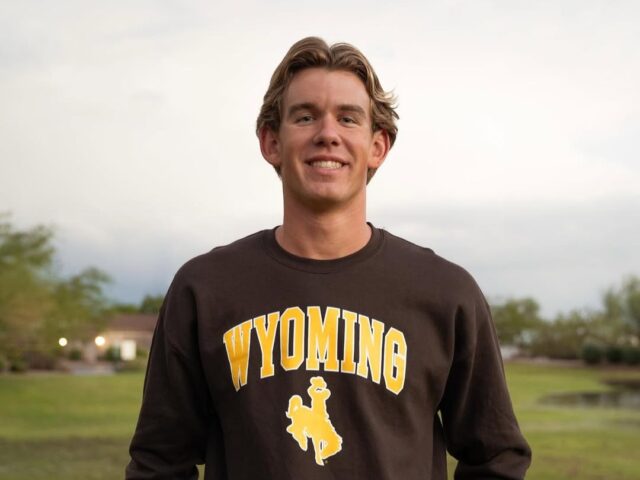
Stephen Argabright of Mesa, Arizona has announced his commitment to swim and study at the University of Wyoming, starting in the fall of 2026. He trains year-round with Mesa Aquatics Club and attends Red Mountain High School.
Argabright made the announcement on SwimCloud, writing:
I am extremely grateful and excited to announce my verbal commitment to continue my academic and athletic career at the University of Wyoming!! I want to thank Coach Dave and Coach Reeder for helping me through the journey, as well as my family for their continued support, and for my coaches and teammates who have been there from the start. GO COWBOYS!!
The future Cowboy is a distance freestyle specialist who has been on a steady improvement trajectory throughout his high school career.
Argabright’s two target meets of the 2024-25 season were the Arizona Interscholastic Association (AIA) Division I State Championships in November, where he represented his high school, and the Speedo Sectionals at the end of March, where he wrapped up his season with his club team.
At State, he picked up a pair of fourth-place finishes in the 200 and 500 free, logging personal bests of 1:43.15 and 4:36.28 in prelims before hitting the wall at 1:44.35 and 4:37.45 in finals. He also split 49.26 on the 400 free relay that hit the wall 13th.
Sectionals saw Argabright break through again in the longer 500 free, where he produced 4:34.15 in prelims and 4:35.79 in finals for 14th overall, both times under his best heading into the meet. He went on to dip under his lifetime best in the 1000 free, an event only offered at collegiate dual meets but not at championship settings, clocking 9:22.59 for 10th. He then demolished his best time in the mile with a 15:42.26 for 12th.
Argabright’s only other individual event at Sectionals was the 200 free, where he notched 1:43.21, coming just 0.06 shy of his lifetime best.
Top SCY Times:
200 Freestyle: 1:43.15
500 Freestyle: 4:34.15
1650 Freestyle: 15:42.26
The Wyoming men are led by head coach Dave Denniston, who has been at the helm of the program since 2017. The program finished fifth out of six teams at the 2025 Western Athletic Conference Championships.
Argabright is poised to make an immediate impact at the conference level, as his career best times in the 200 free and 500 free would have made the ‘C’ final in 2025. Additionally, his best in the mile, which is swum as a timed final, would have put him 15th.
According to the team’s 2024-25 depth chart, Argabright would have ranked third in the mile, sixth in the 500 free, and 11th in the 200 free. Senior Gavin Smith topped the charts in the 200 free with a 1:35.91, junior Caleb Ozenne was the team’s fastest 500 freestyler with his time of 4:23.59, and freshman Jakub Rynkiewicz was the team’s best miler at 15:28.41.
Argabright joins Marcel Jureko, Archer Sanchez, and Joey Sudermann in committing to Wyoming’s Class of 2030.
If you have a commitment to report, please send an email with a photo (landscape, or horizontal, looks best) and a quote to Recruits@swimswam.com.
About the Fitter and Faster Swim Tour
Fitter & Faster Swim Camps feature the most innovative teaching platforms for competitive swimmers of all levels. Camps are produced year-round throughout the USA and Canada. All camps are led by elite swimmers and coaches. Visit fitterandfaster.com to find or request a swim camp near you.
Scientists have developed a powerful new dual-imaging tool that maps the retina’s structure and oxygen use in unprecedented detail. This breakthrough could one day help doctors spot sight-stealing diseases long before symptoms appear.
Our retinas convert light into electrical signals that are transmitted to the brain, where they’re processed into images. It’s a process that requires a great deal of oxygen. If the oxygen supply is disrupted, for example, due to restricted blood flow, it can lead to serious, vision-affecting conditions such as glaucoma, age-related macular degeneration (AMD), and diabetic retinopathy.
In a new study, researchers from Johns Hopkins University and the University of Pennsylvania developed and tested a novel retinal imaging system that combines two cutting-edge techniques to map the retina’s structure and oxygen levels to better study oxygen metabolism.
The researchers’ dual-channel system used visible light optical coherence tomography (VIS-OCT) to capture ultra-detailed structural images of the eye and phosphorescence lifetime ophthalmoscopy (PLIM-SLO) to directly measure oxygen partial pressure (pO2) in the organ’s tiny blood vessels, or microvasculature. In simple terms, pO2 is the amount of oxygen dissolved in the blood at a given location. It is a key indicator of how much oxygen is available to the tissues.
Simultaneous collection of images using VIS-OCT (top) and PLIM (bottom)
Stephanie Nolen et al. (2025)
These methods were used to image the eyes of live mice. VIS-OCT uses visible light to create high-resolution 3D images of retinal layers and can also capture blood flow dynamics. PLIM-SLO involves injecting a safe, oxygen-sensitive dye called Oxyphor 2P, which emits light that changes depending on oxygen levels. By measuring how quickly this light fades (that is, its phosphorescence lifetime), the researchers could calculate pO2 at the capillary level. Both systems shared the same optical path, allowing them to capture structural and oxygenation data at the same time and in perfect alignment. The researchers also tested how pO2 readings changed as they varied the mice’s inhaled oxygen to validate the novel technique’s accuracy.
PLIM-SLO accurately measured oxygen levels in arterioles, venules, and capillaries. As the researchers had expected, PLIM-SLO revealed that arterioles (very small branches of arteries) had the highest oxygen, venules (the smallest veins that return deoxygenated blood) had the lowest, with capillaries in between. Adjusting the system’s focus allowed the researchers to image oxygen at different retinal depths, revealing the structure and oxygen profile of multiple vascular layers – something that previous methods couldn’t achieve. Changes in inhaled oxygen led to predictable changes in retinal oxygen levels, confirming that measurements reflected real physiological changes. Importantly, the system linked oxygen measurements with structural and flow data, laying the groundwork for future studies of retinal oxygen metabolism and disease processes.
Microvasculature oxygen partial pressure maps at systemic oxygen levels from 69% (left), 78% (middle), and 88% (right)
Stephanie Nolen et al. (2025)
Because the system was only tested in mice, its performance in humans hasn’t yet been evaluated. Additional limitations of the study include that the approach requires careful calibration to correct for light interference between the two systems, which is a technical challenge. Also, some physiological factors, such as pH and carbon dioxide levels, had to be estimated rather than directly measured, potentially introducing small errors.
Putting aside these limitations, this multimodal system could significantly advance eye disease research and diagnostics by providing a more complete picture of retinal health. It could help scientists understand how oxygen supply changes in diseases like diabetic retinopathy, glaucoma, and macular degeneration. Clinicians may one day use similar technology to detect early disease-related changes before vision is affected.
The study was financially supported by grants from the National Eye Institute, the National Institute of Biomedical Imaging and Bioengineering, and the National Science Foundation Graduate Research Fellowship Program. It was published in the journal Neurophotonics.
new video loaded: Three Killed During Anti-Government Protests in Morocco
Demonstrators across Morocco, upset over heavy government spending on the 2030 World Cup rather than public services, clashed with the police during protests, resulting in the deaths of three people.
That’s according to the Financial Times, which reported on Thursday (October 2), citing people familiar with the matter, that the companies “could each strike deals with artificial intelligence companies within weeks” in a bid to “set a precedent for how AI companies pay for music”.
According to the FT’s report, the negotiations center on licensing music for the creation of AI-generated tracks and allowing the music to train large language models.
Discussions have reportedly included AI startups ElevenLabs, Stability AI, Suno, Udio and KlayVision.
The labels are also negotiating with tech companies, including Google and Spotify, according to the report.
News of the reported impending deals arrives against a backdrop of active litigation between the majors and two of those companies: AI music generators Udio and Suno.
Universal, Warner, and the third major music company, Sony, sued these two startups in June last year over allegedly training their systems using the labels’ recordings without permission.
According to the FT’s report, it is hoped the talks with the startups will result in “licensing agreements that would include a settlement for past use of their music”.
One of the other AI companies cited by the FT is London and New York-headquartered AI audio startup ElevenLabs, which launched Eleven Music – a rival to Suno and Udio – in August.
Unlike Suno and Udio, however, Eleven Music has already inked licensing agreements with prominent rightsholders, including Merlin and a potentially precedent-setting deal with publisher Kobalt.
The Kobalt-ElevenLabs deal included a clause ensuring parity between publishing and recorded music revenues. Each side will receive an approximate 50/50 split of royalties generated from the AI platform.
Perhaps most significantly, as reported by MBW at the time, Kobalt secured a Most Favored Nation (MFN) clause in its deal with ElevenLabs, meaning that if any recorded music rightsholder now negotiates better terms than Kobalt’s, the publisher will automatically be upgraded to match them.
Separately, it’s also worth pointing out that Klay Vision, mentioned in the FT’s article, entered into a strategic partnership with Universal Music Group in October 2024 to work on “a pioneering commercial ethical foundational model for AI-generated music that works in collaboration with the music industry and its creators”.
According to the FT’s report, the labels are pushing for a payment model similar to streaming services, where each use would trigger a micropayment.
They want AI companies to develop attribution technology that is similar toYouTube‘s Content ID system to track when their music appears in AI outputs, the FT said.
However, the FT said executives warned that the negotiations face complexities that didn’t exist with streaming deals.
An unnamed senior label executive told the news outlet: “What’s different is when you take the entire history of music and feed it into a model that produces something unrecognizable. The question is: are artists going to get on board?”
The executive added: “It depends on the contract. Most say: ‘I trust you to do the right deals on my behalf.’ It would be impossible to go back to artists each time and ask, ‘Are you OK with this use of your music?’ At some point, there will be a big precedential deal.”
Bloomberg first reported on licensing talks between all three major labels with Suno and Udio in June. At the time, the newswire said the music giants were seeking license fees from the platforms plus “a small amount” of equity in both companies.
While UMG and WMG are reportedly nearing AI licensing deals, the FT cited a statement from Sony Music, which told the FT: “We are in discussions with companies that have ethically trained models and that benefit our artists and songwriters.”
The urgency stems from the flood of AI-generated music on streaming platforms. Last month, Deezerreported that nearly a third, or 28%, of all tracks uploaded on the platform are now fully AI-generated.
Spotify recently said it removed 75 million “spammy” AI tracks over the past year.
Here are the key events on day 1,317 of Russia’s war on Ukraine.
Published On 3 Oct 20253 Oct 2025
Share
Here is how things stand on Friday, October 3, 2025:
Fighting
Russian President Vladimir Putin warned Ukraine it was playing a dangerous game by striking near the Russian-occupied Zaporizhzhia nuclear plant and suggested Moscow could retaliate against nuclear plants controlled by Ukraine.
The plant, Europe’s largest nuclear power facility, has been cut off from external power sources for more than a week and is being cooled by emergency diesel generators, which were not designed for lengthy operations.
As both Ukraine and Russia blame each other for cutting off the external power at Zaporizhzhia and shelling the area, Ukrainian Foreign Minister Andrii Sybiha said Russia deliberately cut the external power as it was preparing to connect the station to its own grid.
Ukrainian Prime Minister Yulia Svyrydenko said power had been fully restored in two areas of the border Sumy region hit by overnight Russian attacks. Repairs to power were also proceeding in the neighbouring Chernihiv region, where more than 300,000 consumers had been left without electricity after Russian strikes on Wednesday.
The Trump administration’s desire to send long-range Tomahawk missiles to Ukraine may not be viable because current inventories are committed to the United States Navy and other uses, a US official and three sources have told the Reuters news agency.
President Putin warned any decision by the US to supply the missiles to Ukraine would trigger a major new escalation with Washington, but would not change the situation on the battlefield.
Ukraine and Russia have exchanged 185 service personnel and 20 civilians in the latest prisoner swap.
Regional security
Speaking at the Valdai Discussion Club in Sochi, southern Russia, Putin said Moscow would carry out a nuclear test if another nuclear power did so after saying that he had seen signs a country, which he did not name, was preparing to conduct tests.
Putin repeated his offer to the US of voluntarily rolling over an agreement capping the number of nuclear warheads in Russia’s arsenal when a key arms control treaty expires next year, if Washington agrees to do the same.
Putin said Moscow never had any issues with Sweden or Finland and that their decision to join the NATO military alliance was therefore “stupid”.
France’s detention of a tanker vessel suspected of operating for Russia’s “shadow fleet” is part of a new European strategy to block revenue funding Moscow’s war effort in Ukraine, President Emmanuel Macron said.
The Kremlin said France’s boarding of the tanker was “hysteria” that could create problems for global energy transportation routes, while Putin condemned it as an act of piracy.
Putin said the global economy would suffer without Russian oil, warning that prices would jump to more than $100 per barrel if its supplies were cut off.
Politics and diplomacy
German Chancellor Friedrich Merz said he saw great agreement among European leaders on supporting the use of frozen Russian assets to provide loans for Ukraine – to be repaid eventually using war reparations from Moscow – adding that he expects a concrete decision on the matter within three weeks.
Russia said the European Union’s idea was “delusional” and would prompt it to retaliate very harshly.
Maxim Kruglov, the deputy leader of Russia’s liberal Yabloko party, which opposes the war in Ukraine, has been charged with spreading lies about the Russian army and could face up to 10 years in jail if found guilty.
Kruglov’s lawyer said her client had been charged over two posts he had made on the Telegram messaging app: One post referred to UN data about the number of people killed in the port city of Mariupol in eastern Ukraine, which Russia took control of in May 2022, and another to events in Bucha, a town north of Kyiv, in March 2022.
Voters in the Czech Republic are likely to oust their centre-right government in an election on Friday and Saturday, with polls favouring populist billionaire Andrej Babis to return to power on pledges to raise wages and lift growth while reducing aid for Ukraine.