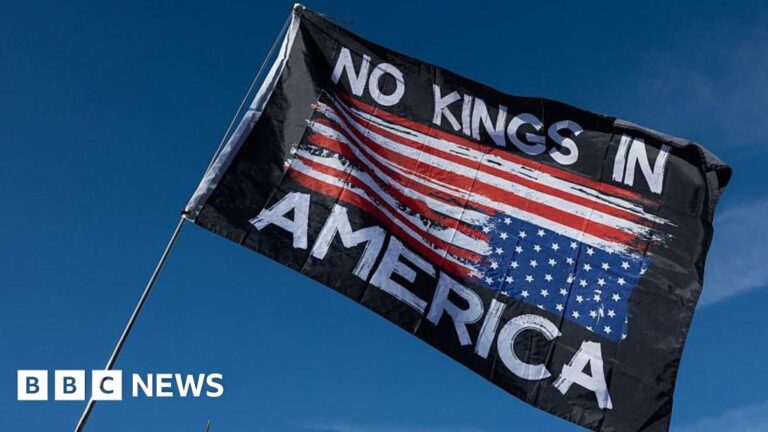
Republican governors in several US states have placed National Guard troops on standby in preparation for nationwide protests to oppose Donald Trump and his policies.
The organisers of the “No Kings” protests say that gatherings will take place at more than 2,500 locations around the US. Trump allies have accused the protesters of being allied with the far-left Antifa movement.
Governors in Texas and Virginia have activated their state’s National Guard troops, however it is unclear how visible the military presence will be.
Organisers say that at the last No Kings protest, held in June, more than five million people took to the streets to denounce Trump’s political agenda.
The protests are expected to kick off in New York City at 11:00 EST( 16:00 GMT) and continue across the country throughout the day.
The protest organisers say the protest will challenge Trump’s “authoritarianism”.
“The president thinks his rule is absolute,” they say on their website.
“But in America, we don’t have kings and we won’t back down against chaos, corruption, and cruelty.”
Throughout Europe, protestors have taken to the streets in Berlin, Madrid and Rome to show solidarity with their American counterparts.
In an interview with Fox News, set to air Sunday, but teased on Saturday, Trump appeared to address the upcoming rallies.
“A king! This is not an act,” Trump said in a preview clip of the interview. “You know – they’re referring to me as a king. ‘I’m not a king.'”
Some Republicans have dubbed the protests “Hate America” rallies.
“We’ll have to get the National Guard out,” Kansas Senator Roger Marshall said ahead of the rallies, according to CNN.
“Hopefully it’ll be peaceful. I doubt it.”
Texas Governor Greg Abbott on Thursday activated the state’s National Guard ahead of a protest scheduled in Austin, the state’s capital.
He said the troops would be needed due to the “planned antifa-linked demonstration”.
Democrats denounced the move, including the state’s top Democrat Gene Wu, who argued: “Sending armed soldiers to suppress peaceful protests is what kings and dictators do — and Greg Abbott just proved he’s one of them.”
Virginia Governor Glenn Youngkin also ordered the state National Guard to be activated.
Among the celebrities expected attend No Kings rallies are Jane Fonda, Kerry Washington, John Legend, Alan Cumming and John Leguizamo.
MBW’s World’s Greatest Managers series profiles the best artist managers in the global business. Here we talk to Ryan Richards, a rock drummer turned major manager currently guiding the career of one of the biggest breakout bands of the last few years, Sleep Token. World’s Greatest Managers is supported by Centtrip, a specialist in intelligent treasury, payments and foreign exchange – created with the music industry and its needs in mind.
Ryan Richards looked like he was on top of the world. He was the drummer/scream vocalist in Welsh post-hardcore legends Funeral For A Friend, one of the most successful UK rock bands of their generation, touring the world and playing to thousands of adoring fans.
After five albums and hundreds of gigs, however, in 2011 Richards found himself getting his thrills elsewhere. No, not in the sex-and-drugs-and-rock’n’roll lifestyle that has distracted so many drummers over the years, but in the little wins achieved by the local bands back in his native South Wales that he was advising and helping out.
It was that, combined with a desire to spend more time with his young family back in the Valleys, that saw him sit down for a chat with the band’s manager, Craig Jennings of Raw Power Management.
“I said, ‘I think my touring days are numbered’,” Richards recalls. “‘This management thing is where my passion is and where I see my future going forward’.
“A few days later, Craig rang me up and said, ‘If you’ve made up your mind to do that, why not come and work with us at Raw Power and learn there?’ It was a massive learning experience, and so helpful to my development as a manager. It was the perfect next step.”
Fourteen years on, Richards has his own management company, Future History, and is himself one of the most successful rock managers on the planet. In a UK industry starved of breakthroughs, the huge success of Sleep Token – one of three bands he had on his roster when he left Raw Power to set up Future History in 2018 – has been remarkable.
The mysterious, masked UK rockers have headlined Download Festival, signed to RCA in America and scored a No.1 record with their fourth album, Even In Arcadia, on both sides of the Atlantic. More to the point, their pop sensibilities, hyper-engaged fanbase and savvy use of online marketing have taken them to places other rock and metal bands can no longer reach: Hot 100 hits, late-night TV appearances and the biggest US streaming week for a hard rock band ever. That’s ever.
This is uncharted territory for a rock band in 2025, but Richards is taking it all in his stride.
“Not to self-aggrandise, but I always thought from the start that this is where it would end up,” he chuckles. “I was always a true believer.”
Nor is it likely to be a one-off. Richards has cultivated a roster of fast-rising rock acts, including the likes of Those Damn Crows, Holding Absence, Bambie Thug, President, Zetra and Dead Pony.
They’re the sort of bands Richards would have loved in his own South Wales youth, when he was encouraged in his musical abilities by his family, at first playing piano/keyboards before settling on the drums when his musical tastes – initially shaped by a babysitter who would play him Bon Jovi and Guns N’Roses – became too heavy for tickling the ivories to be involved.
He played in a number of local bands before joining Funeral For A Friend. He realised the band was going places when they scored a Kerrang! feature that tagged them, ‘The most exciting new band on the planet’.
“Then it was like, ‘Right, I guess we’d better get serious’,” he chuckles. The band signed to Atlantic Records UK and Sanctuary Artist Management (after Rod Smallwood saw them play at the Kerrang! Weekender in Camber Sands) and Richards settled into the unofficial role of liaison between band and industry advisors on their unstoppable rise to rock stardom, marking him out as a future exec in the making.
When Sanctuary dissolved, Funeral stayed under Craig Jennings’ wing at Raw Power (“I still consider Craig a mentor,” he says), while Richards started helping out local bands by passing on contacts and helping them secure gigs.
He joined Raw Power when he went full-time with such management concerns, working his way up before leaving when he found himself again spending too much time away from Bridgend (“Wales keeps drawing me back: the green, green grass of home that Tom Jones sang about really is that magnetic,” he laughs).
Initially, he worked alone from his home office, meaning he and his artists could weather the Covid shutdown due to his low overheads, but Future History is now expanding rapidly, with Download Festival boss Andy Copping joining as a director.
“with rock being such a growing genre, I’d like to think it might empower the scene to have more leverage or influence.”
Accordingly, Richards – who spent the summer back in the reformed Funeral For A Friend, playing the band’s biggest ever gigs, including a headline at Cardiff Castle – fizzes with plans for the likes of Bambie Thug (who just signed a publishing deal with Universal), President (“Out of any band I’ve ever worked with, that’s been the quickest out of the traps,” he declares) and the reviving rock genre in general.
“It’s hard work being a rock band,” he says in his mellifluous Welsh tones. “Climbing up that hill can be a slippery and steep slope. But, with rock being such a growing genre, I’d like to think it might empower the scene to have more leverage or influence. We’ll certainly keep trying…”
Before that, however, he sits down with MBW in his Bridgend home office on a classically rainy South Wales morning to talk streaming, mystique and why Sleep Token aren’t actually a metal band…
Unusually for a band in 2025, Sleep Token have mystique. How big a part has that played in their rise?
I love that stuff. I was listening to a music industry podcast recently and the topic of conversation was social media and how it’s changed the dynamic between band and fans, and how it’s a shame you can’t do things in the way you used to, when you had that mystique.
And I was thinking to myself, ‘Well, surely you can if you choose to?’ And that’s what it’s been. It’s about wanting to find that magic again, that deeper connection between fan and artist, which, conversely, comes from that separation, it engenders that deeper connection.
Because the band is operating the way it does, in terms of the anonymity and not connecting in the conventional ways with social media, interviews and press, it’s about putting everything around that and giving more substance to the whole story.
You go to a Sleep Token show and, even though the band doesn’t speak in words, there is that unspoken connection and dialogue between the band and the fanbase which is really special, quite unique and very powerful.
Picture: Andy Ford
Will you be able to keep all that up, or will there be a ‘Kiss without the make-up’ moment?
The difference there is, it doesn’t feel like anyone – certainly not the fanbase – wants that. They’re not trying to peek behind the curtain, dissect it and invade upon what the band is doing, or to break that fourth wall.
It’s not just about respecting it, but really indulging in it, buying into it and enjoying it for what it is. It was different back in the day with Kiss, and maybe even Slipknot, where it was like, ‘Oh, I wonder what they look like and who they are?’ Now, maybe because the dawn of the internet means information is always at your fingertips, people value having that mystique and separation.
With any movie or TV show that comes out, before you watch it, you can go online and find out the ending. You can spoil it for yourself – but why would you do that? I don’t see anything positive or helpful in that and it seems like people feel the same.
Conventional industry wisdom suggests rock music doesn’t work on streaming. How have you bucked that trend?
One of the big things is the understanding of where rock is now. A lot of the listening public have had a skewed vision or perception of what rock/metal/hard rock is and sounds like, informed by music from the past or what they define in their heads as rock or metal.
If you’re a person that never listens to metal, but you’ve heard Metallica, Iron Maiden, Judas Priest or any of the big, heritage metal acts and you don’t like any of those bands, and you’re seeing a band like Sleep Token described as metal, you’re probably not going to go and check it out.
“It’s like, ‘I don’t like Iron Maiden, I probably won’t like Sleep Token’ – which is to completely miss the point. When Sleep Token get put into the metal genre, it’s because that’s the most extreme touchpoint of what the band does.”
It’s like, ‘I don’t like Iron Maiden, I probably won’t like Sleep Token’ – which is to completely miss the point. When Sleep Token get put into the metal genre, it’s because that’s the most extreme touchpoint of what the band does. But there’s as much pop, R&B, electronic and piano-led music as there is heavy guitar; there’s perhaps even more of those other things.
But now the band has had more mainstream exposure and people have heard it by accident or been recommended it, they’re like, ‘That’s not metal’.
There are elements of it throughout the record, but it’s not a metal band: it’s just an artist painting with many colours to portray many different feelings and emotions, and that’s just one of them.
We keep hearing about how few British breakthroughs there are these days. Are Sleep Token getting the industry respect they deserve for their success?
There’s been this wave of optimism and positivity at the place that rock is in, where it’s going and the trajectory it’s on, so it’ll be interesting to see if that’s just in our little circle, or if it permeates into the outer reaches of the industry.
But I’ve been in this industry long enough to know it’s always been this really vibrant and exciting part of music culture and always will be. It never goes away, it never dies, that’s why it circles round to every generation – it remains to be seen if that’s what this is.
It’s not something that I really concern myself with, but it’ll be interesting to see when it comes to the next more mainstream awards. But the response from the fanbase is what it’s all about.
When you joined Funeral For A Friend, did you expect them to become so big?
Well, the difference then was, we measured success as ending up on a covermount CD for an independent music magazine. We were like, ‘We’ve done that, we’ve done a demo and we got to play London – we’ve made it!’ There was no grand plan.
So, we were like, ‘Maybe we could get signed to an indie label or have a booking agent and do some shows with bands we like’, and that was it. But it quickly escalated!
Has going through the ups and downs of being in a band helped you as a manager?
Absolutely. It’s been the biggest contributor to any success I’ve had in management.
It’s important that I make the distinction to the bands I work with. I say to them, ‘If I’m giving you advice on something, or steering you in a particular direction, it’s not because I’m a know-it-all, have this unique perspective, or have all the answers.
Richards drumming with Funeral For A Friend
I’ve learned as much or more from the wrong steps I’ve taken as a band member or as a manager’. You learn so much from your mistakes. They give you the knowledge.
I always say to them, ‘I’ll never ask you to do something that I haven’t done’ – and that’s pretty accurate really.
Andy Copping has joined Future History – what will he bring to the company?
He’s someone I’ve been close with for many years, and he’s always been a big supporter. When I was coming through with Funeral, he always believed in us, he always gave us really good opportunities through Download or other tours.
And, on a personal level, he’s always been a big supporter of mine. When I left Raw Power to start Future History, he was one of the first people on the phone to say, ‘Hey, if you ever need anything, I’m just a phone call away’.
Just having someone with the level of experience, knowledge, respect, contacts and everything else that Andy has, as well as being such a good friend to me and my family, just felt really right. He’s been a really important addition to the company with everything he brings to the table, it’s been a big factor in the successes we’ve had.
If you could change one thing about the music industry, right here and now, what would it be?
I’m sure I wouldn’t be the first person hoping for streaming compensation to be a little more attractive! Particularly for artists that are coming through.
It can be a real lifeblood and a real boost for new artists, being able to actually earn a decent income as they start, just to give them that freedom to remain independent as long as they need to, and give them that structure of being able to develop as an artist.
“It’s a shame when you come across a really good artist that has signed away recording or publishing rights on a deal that’s just not good for them, but they’ve been left with almost no choice because they weren’t getting paid any other way.”
It’s a shame when you come across a really good artist that has signed away recording or publishing rights on a deal that’s just not good for them, but they’ve been left with almost no choice because they weren’t getting paid any other way. They needed that cash injection, so they signed whatever was in front of them, just so they wouldn’t have to pack it in.
Then they get stuck in those deals, they get a little further down the line, they’ve spent their advance and they’re back to square one without any commodities to sell and they’re screwed. That’s not all the fault of royalties from DSPs, but that would help.
Is there a difference between Ryan Richards the rock star and Ryan Richards the manager?
[Laughs] No! When it comes to Funeral For A Friend, I’m quite happily back in that position where I’m the one arranging bits and pieces, getting stuff ready, liaising with promoters and booking agents – I don’t think there’s much of a distinction there.
If anything, it’s helped with being able to handle the band side of it in the right way. I certainly appreciate it more; it’s a nice treat to get out there, slip those drumming shoes back on, reconnect with the guys in the band and their families. It’s a nice thing to have on tap when the right opportunities come along, it’s nice that it’s still there.
There are no plans for anything else – perhaps there will be, perhaps there won’t but, if there isn’t, that [Cardiff Castle headline show] would a good one to sign off on.
And how big can Sleep Token get?
I don’t see any ceiling. Fundamentally, across any genre at the moment, you’re looking at one of the best songwriters and one of the most interesting and exciting live acts out there.
And, when you have those two things, then the sky’s the limit.
The final public viewing event in the western city of Kisumu has been preceded by deaths and injuries on previous days.
Dozens of people have been injured at a memorial event in Kenya’s western city of Kisumu as huge crowds gathered to view the body of revered former Prime Minister Raila Odinga, local media reported.
The injuries occurred on Saturday at Jomo Kenyatta International Stadium despite authorities deploying military units, police and aerial surveillance to prevent a recurrence of deadly and chaotic incidents that marked earlier memorial proceedings on Thursday and Friday.
Recommended Stories
list of 3 itemsend of list
Kenya Red Cross teams treated people who fainted from fatigue and distress, evacuating casualties as crowds surged inside the venue. Odinga’s body was being transported to his ancestral home in nearby Bondo for burial on Sunday, drawing tens of thousands throughout the region.
The additional precautions were put in place after violence and chaos killed at least five people during memorial proceedings for the 80-year-old opposition leader and statesman, who collapsed during a morning walk in India’s Kerala state on Wednesday.
Siaya Governor James Orengo urged restraint as arrangements progressed for transporting Odinga’s body to his ancestral home in Bondo, approximately 60km (40 miles) west of Kisumu, where the latest disruptions had occurred.
“I really entreat members of the public and the community in general to maintain the peace during this period,” Orengo told local media.
Thursday’s initial viewing descended into bloodshed when security forces fired weapons and tear gas into crowds surging towards a pavilion where Odinga’s coffin had been placed, killing at least three people at a Nairobi stadium.
A day later, panic swept through mourners exiting Friday’s state funeral service at a separate venue in the capital, triggering a crowd crush that killed two more and sent 163 to medical care.
Huge turnout has characterised every stage of the mourning period since Odinga’s body returned home on Thursday, with supporters walking nearly 30km (20 miles) from Nairobi’s airport to escort his remains.
Friday’s state ceremony drew tens of thousands who sang, danced and waved handkerchiefs as they celebrated a figure many affectionately called “Baba” – the Swahili word for father.
Dignitaries including President William Ruto and Somali President Hassan Sheikh Mohamud attended the service, where Odinga’s relatives pleaded for peaceful proceedings.
His brother Oburu told mourners: “Raila should not be teargassed in death. He has been teargassed enough when he was alive.”
Former United States President Barack Obama, whose father was Kenyan, honoured Odinga as “a true champion of democracy” who “endured decades of struggle and sacrifice for the broader cause of freedom and self-governance in Kenya”, in a post on X.
Obama noted that Odinga “was willing to choose the path of peaceful reconciliation without compromising his core values”.
Odinga never became president despite five attempts spanning three decades, but shaped Kenya’s democratic evolution more profoundly than many who held that office and has led to an outpouring of grief nationally and across Africa.
He spearheaded the country’s return to multiparty politics in the 1990s and drove the passage of a landmark 2010 constitution that distributed authority away from centralised executive power.
A required part of this site couldn’t load. This may be due to a browser
extension, network issues, or browser settings. Please check your
connection, disable any ad blockers, or try using a different browser.
Virginia Giuffre’s brother has told the BBC that his family has mixed emotions after Prince Andrew announced he was giving up his titles.
“We have a shed a lot of happy and sad tears today. I think happy because in a lot of ways this vindicates Virginia”, said Sky Roberts.
Prince Andrew has been under increasing pressure over his links with sex offender Jeffrey Epstein.
Ms Giuffre, who took her own life earlier this year, said that she was one of many vulnerable girls and young women who was sexually exploited by Epstein and his circle of wealthy connections.
She alleged that the prince had sex with her at his friend Ghislaine Maxwell’s house in London in 2001, when Ms Giuffre was 17 years old, and on two more occasions.
In statement released to announce the surrender of his titles, Andrew said he continued to “vigorously deny the accusations against me”.
Members of the International Maritime Organization (IMO) have voted to postpone approving a plan to curb shipping emissions, after United States President Donald Trump threatened to impose sanctions on countries that supported the measure.
The vote on Friday set back plans to regulate the shipping industry’s contributions to climate change by at least 12 months, even though the Net Zero Framework (NZF) had already been approved by members of the London-based IMO, a United Nations body, in April.
Recommended Stories
list of 4 itemsend of list
The decision to formally delay adopting the framework until late next year came a day after President Trump took to his Truth Social platform, saying: “I am outraged that the International Maritime Organization is voting in London this week to pass a global Carbon Tax.”
“The United States will NOT stand for this Global Green New Scam Tax on Shipping,” he said, telling countries to vote against the plan.
Washington also threatened to impose sanctions, visa restrictions and port levies on countries that supported the deal.
In advance of this week’s meeting in London, about 63 IMO members who had voted for the plan in April were expected to maintain their support for curbs on emissions, and others were expected to join the initiative to formally approve the framework.
Following Trump’s social media threat, delegates in London instead voted on a hastily arranged resolution to push back proceedings on the matter, which passed by 57 votes to 49.
The IMO, which comprises 176 member countries, is responsible for regulating the safety and security of international shipping and preventing pollution on the high seas.
Since returning to power in January, Trump has focused on reversing Washington’s course on climate change, encouraging fossil fuel use by deregulation, cutting funding for clean energy projects and promising businesses to “drill, baby drill”.
‘A missed opportunity’
A spokesman for UN chief Antonio Guterres called Friday’s decisions “a missed opportunity for member states to place the shipping sector on a clear, credible path towards net zero emissions”.
The International Chamber of Shipping, representing more than 80 percent of the world’s fleet, also expressed disappointment.
“Industry needs clarity to be able to make the investments needed to decarbonise the maritime sector,” the chamber’s Secretary-General Thomas Kazakos said in a statement.
Ralph Regenvanu, the minister for climate change for Vanuatu, said the decision to delay the vote by 12 months was “unacceptable given the urgency we face in light of accelerating climate change”.
“But we know that we have international law on our side and will continue to fight for our people and the planet,” Regenvanu added.
Leading up to Friday’s decision, China, the European Union, Brazil, Britain and several other members of the IMO had reaffirmed their support.
Countries that opposed the measures included Russia and Saudi Arabia.
A Russian delegate described the proceedings as “chaos” as he addressed the plenary on Friday after talks had lasted into the early hours.
Argentina and Singapore, two countries that had previously voted in support of the framework in April, were among those that voted to postpone introducing it this week.
If it had been formally adopted this week, the Net Zero Framework (NZF) would have been the first global carbon-pricing system, charging ships a penalty of $380 per metric tonne on every extra tonne of CO2-equivalent they emit while rewarding vessels that reduce their emissions by using alternatives.
The framework plan is intended to help the IMO reach its target of cutting net emissions from international shipping by 20 percent by 2030 and eliminating them by 2050.
Climate change is already beginning to affect shipping and the safety of seafarers, including by changing ocean currents and causing more frequent and severe storms.
Proposals to reduce reliance on dirtier bunker fuel in the shipping industry include using ammonia and methanol, as well as fitting cargo ships with special sails.
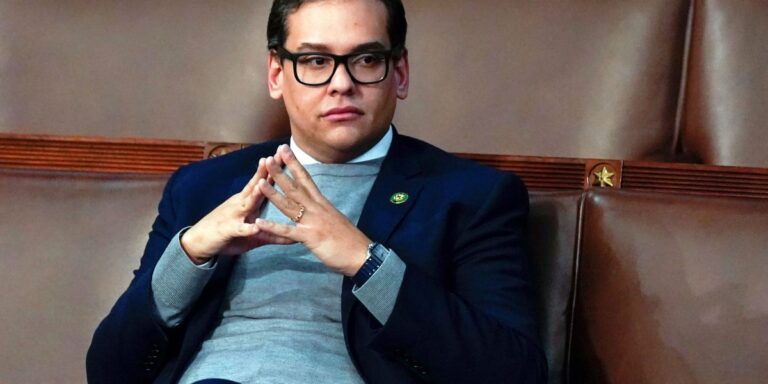
President Donald Trump said Friday he had commuted the sentence of former U.S. Rep. George Santos, who is serving more than seven years in federal prison after pleading guilty to fraud and identity theft charges.
The New York Republican was sentenced in April after admitting last year to deceiving donors and stealing the identities of 11 people — including his own family members — to make donations to his campaign.
He reported to Federal Correctional Institution in Fairton, in southern New Jersey, on July 25 and is being housed in a minimum security prison camp with fewer than 50 other inmates.
“I just signed a Commutation, releasing George Santos from prison, IMMEDIATELY,” Trump posted on his social media platform.
“George Santos was somewhat of a ‘rogue,’ but there are many rogues throughout our Country that aren’t forced to serve seven years in prison,” he wrote.
Andrew Mancilla, one of Santos’ lawyers, said Friday he was “very, very happy with the decision,” though he said it’s unclear at this point when Santos will be released.
“The defense team applauds President Trump for doing the right thing,” Mancilla said by phone. “The sentence was far too long.”
Santos has been in prison for 84 days. During his time behind bars, he has been writing regular dispatches in a local Long Island newspaper, The South Shore Press.
In his latest letter, published Oct. 13, Santos pleaded to Trump directly, citing his fealty to the president’s agenda and to the Republican Party.
“Sir, I appeal to your sense of justice and humanity — the same qualities that have inspired millions of Americans to believe in you,” he wrote. “I humbly ask that you consider the unusual pain and hardship of this environment and allow me the opportunity to return to my family, my friends, and my community.”
A prominent former House colleague, U.S. Rep. Marjorie Taylor Greene, also urged the White House to commute his sentence, saying in a letter sent just days into his prison bid that the punishment was “a grave injustice” and a product of judicial overreach.
The judge in Santos’ case had agreed with federal prosecutors that a stiffer sentence was warranted because Santos didn’t seem remorseful, despite what he and his lawyers claimed.
Santos’ commutation is Trump’s latest high-profile act of clemency for former Republican politicians since retaking the White House in January.
In late May, he pardoned former U.S. Rep. Michael Grimm, a New York Republican who in 2014 pleaded guilty to underreporting wages and revenue at a restaurant he ran in Manhattan.
He also pardoned former Connecticut Gov. John Rowland, whose promising political career was upended by a corruption scandal and two federal prison stints.
Trump himself was convicted in a New York court last year in a case involving hush money payments. He derided the case as part of a politically motivated witch hunt.
Santos was once an up-and-coming star for the GOP.
He became the first openly gay Republican elected to Congress in 2022, flipping a House seat representing parts of Queens and Long Island.
But Santos served less than a year in office after it was revealed that he had fabricated much of his life story, which in turn led to investigations into how the then-unknown politician had funded his winning campaign.
A son of Brazilian immigrants, Santos had claimed he was a successful business consultant with Wall Street cred and a sizable real estate portfolio.
He eventually admitted he had never graduated from Baruch College — or been a standout player on the Manhattan college’s volleyball team, as he had claimed. He had never worked at Citigroup and Goldman Sachs.
He wasn’t even Jewish. Santos insisted he meant he was “Jew-ish” because his mother’s family had a Jewish background, even though he was raised Catholic.
In truth, the then-34-year-old was struggling financially and even faced eviction.
Santos was charged in 2023 with stealing from donors and his campaign, fraudulently collecting unemployment benefits and lying to Congress about his wealth.
When Tilman Fertitta purchased the Houston Rockets in 2017 for $2.2 billion, he inherited a team on the brink of a championship. That squad, led by James Harden and Chris Paul, came within a game of the NBA Finals in 2018 before Paul’s hamstring injury derailed their hopes against the Golden State Warriors.
Just a few years later, everything changed. The Rockets traded away Harden and Russell Westbrook, while key contributors like PJ Tucker and Robert Covington also departed. General manager Daryl Morey and coach Mike D’Antoni exited, replaced by Rafael Stone and Stephen Silas. The franchise entered one of its darkest eras, struggling through multiple 20-win seasons.
The Turning Point: Ime Udoka Arrives
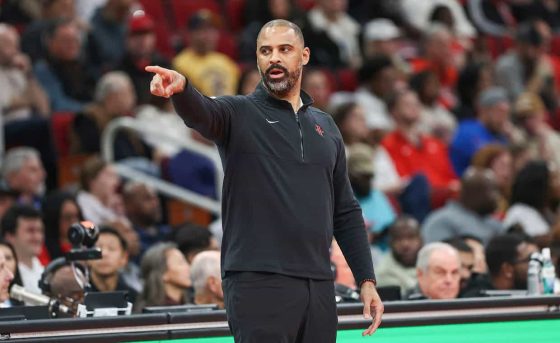
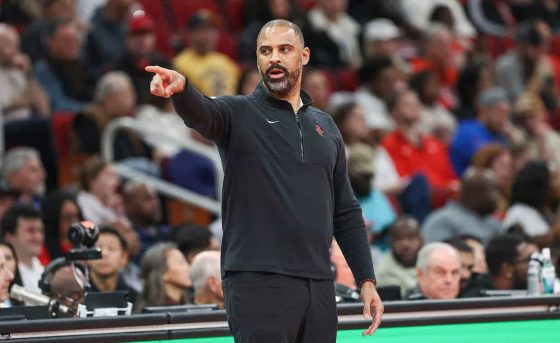
After years of frustration, Fertitta made a decisive move by hiring Ime Udoka, a coach known for discipline and accountability. Udoka’s first year produced a 41-41 record—Houston’s best mark in four seasons. His second year erased any remaining doubts. The Rockets won over 50 games and finished second in the Western Conference, ending their postseason drought.
This rapid turnaround reflected both Udoka’s leadership and the steady roster development under Stone’s management. As Fertitta noted, patience and culture change were key. The Rockets transitioned from one of the league’s worst defenses to a tough, cohesive unit ready to compete nightly.
Ime Udoka, Houston Rockets. Mandatory Credit: Troy Taormina-USA TODAY Sports.
A Billion-Dollar Payoff
The results have been spectacular—not just on the court, but financially. According to Sportico, the Rockets are now valued at $5.53 billion, ranking 10th among NBA teams. That figure represents a 16% increase from last season.
Fertitta’s long-term bet has paid off in every sense. The franchise that once required a full teardown is now among the league’s most stable and promising. With Udoka and Stone signed to extensions and Kevin Durant joining the roster this offseason, Houston’s championship aspirations feel realistic once again.
Fertitta, who once failed to buy the team for $81 million in 1993, now oversees one of basketball’s most valuable franchises. His persistence—and willingness to endure the lows—has transformed Houston’s fortunes.
Lead poisoning isn’t just an industrial-age problem. A new study reveals our ancestors, including Neanderthals, were exposed to lead for millions of years, shaping how their brains evolved and overturning what scientists thought about our toxic history.
Turns out that lead exposure isn’t a purely modern problem caused by industrial pollution. In a new study led by Southern Cross University (SCU), Australia, researchers analyzed teeth belonging to ancient primates and early humans and discovered that lead exposure has been occurring for at least two million years. And it shaped our ancestors’ brains and behavior.
“Our data show that lead exposure wasn’t just a product of the Industrial Revolution – it was part of our evolutionary landscape,” said co-corresponding author, Professor Renaud Joannes-Boyau, PhD, Head of the Geoarchaeology and Archaeometry Research Group (GARG) at SCU. “This means that the brains of our ancestors developed under the influence of a potent toxic metal, which may have shaped their social behavior and cognitive abilities over millennia.”
The team used laser ablation mass spectrometry (LA-MS), a technique that uses direct micro-scale sampling to provide high-precision elemental and isotope analyses of solid materials, to scan Neanderthal molars and other hominid fossils. The Neanderthal samples from Payre, southern France, dated to around 250,000 years ago, contained distinct “bands” of lead inside the teeth, but lead exposure was found in 73% of all the primate and hominid fossils tested, from Africa, Asia, and Europe.
These bands correspond to periods of high lead exposure during tooth formation, indicating that Neanderthals were repeatedly exposed to the metal, likely from natural geological sources such as lead-rich soil, volcanic dust, or, in the case of the Payre sample, water from the limestone environment around the Rhône Valley. Importantly, these patterns weren’t caused by later contamination; they match biological growth layers, proving that the lead was absorbed while the Neanderthals were alive.
The Neanderthal-like organoids used to test lead exposure
Alysson Muotri
The researchers were able to link this ancient exposure to potential neurological effects. In modern humans, lead is a neurotoxin known to impair cognition, learning, and social behavior. We carry the NOVA1 (short for Neuro-Oncological Ventral Antigen 1) gene, which helps control how other genes are used in neurons. In those cells, NOVA1 controls a process called alternative splicing, a kind of molecular “cut-and-paste” that lets one gene produce several different protein versions. By fine-tuning these proteins, NOVA1 helps shape how neurons connect and communicate with each other. Disruption of NOVA1’s activity has been linked to neurological conditions like autism and schizophrenia.
When the researchers introduced lead to human brain organoids – or “mini-brains” – carrying the archaic Neanderthal-like version of NOVA1, which is slightly different to the version that modern humans carry, it disrupted FOXP2, a gene critical for speech and language development. The modern human version of NOVA1 seemed more resistant to lead-related neuronal stress, suggesting that modern humans might have evolved greater resilience to environmental toxins such as lead.
The findings suggest that environmental lead exposure influenced which genetic traits were favored during human evolution, possibly giving modern humans a social or communication advantage over Neanderthals.
“These results suggest that our NOVA1 variant may have offered protection against the harmful neurological effects of lead,” said another of the study’s corresponding authors, Professor Alysson Muotri, from the School of Medicine at UC San Diego. “It’s an extraordinary example of how an environmental pressure, in this case, lead toxicity, could have driven genetic changes that improved survival and our ability to communicate using language, but which now also influence our vulnerability to modern lead exposure.”
“This study shows how our environmental exposures shaped our evolution,” added Professor Manish Arora, from the Department of Environmental Medicine at the Icahn School of Medicine at Mount Sinai, New York, and another corresponding author. “From the perspective of inter-species competition, the observation that toxic exposures can offer an overall survival advantage offers a fresh paradigm for environmental medicine to examine the evolutionary roots of disorders linked to environmental exposures.”