new video loaded: Flooding Remains in Some of the Hardest Hit Areas in Jamaica
Three days after Hurricane Melissa hit Jamaica, floodwaters have continued to rise in St. Elizabeth Parish because of blocked drainage system. As of Friday, homes and roads remained flooded, and power had not been restored.
A required part of this site couldn’t load. This may be due to a browser
extension, network issues, or browser settings. Please check your
connection, disable any ad blockers, or try using a different browser.
Lebanese President Joseph Aoun has accused Israel of responding to its offer to negotiate by intensifying air strikes, the latest of which killed a man riding a motorbike in southern Lebanon.
Despite a November 2024 ceasefire, Israel has kept troops in five areas of southern Lebanon and has continued near-daily air strikes, repeatedly violating the truce. Israel claims it is targeting Hezbollah, but civilians have also been killed.
Recommended Stories
list of 3 itemsend of list
Aoun had called for negotiations with Israel in mid-October, after United States President Donald Trump brokered a ceasefire in Gaza.
“Lebanon is ready for negotiations to end the Israeli occupation, but any negotiation … requires mutual willingness, which is not the case,” Aoun said on Friday.
Israel “is responding to this option by carrying out more attacks against Lebanon … and intensifying tensions”, he added during a meeting with German Foreign Minister Johann Wadephul.
Lebanon’s official National News Agency (NNA) said an Israeli drone targeted a man on a motorbike in the village of Kunin on Friday. The Ministry of Public Health reported one person was killed and another wounded.
The Israeli military claimed it had “eliminated … a Hezbollah maintenance officer” who was working to re-establish the group’s infrastructure sites in southern Lebanon.
In a separate attack on Friday, a second strike targeted a building in southern Lebanon’s Nabatieh, the NNA said, adding that a missile struck the roof of the building.
The explosion echoed loudly, causing “heightened tension and panic among residents”, it said. No casualties were reported.
Confronting ‘Israeli aggression’
Friday’s strikes came a day after the Israeli military killed municipal worker Ibrahim Salameh in an overnight raid in the Lebanese border village of Blida.
Aoun ordered the army on Thursday to confront such incursions “in defence of Lebanese territory and the safety of citizens”.
“True patriotism means sovereignty, independence, and freedom,” he said. “Everyone in Lebanon has a responsibility to confront occupation according to their role.”
The Lebanese forces, unlike the armed group Hezbollah, have generally stayed on the sidelines of the conflict with Israel. But Aoun, a former commander of the Lebanese army, appears to have finally lost his patience with the Israeli-forced status quo.
In an address on Friday, Hezbollah Secretary-General Naim Qassem called on the Lebanese government to address Israeli violations and “achieve national sovereignty by expelling the Israeli occupation”.
Qassem urged the government to develop a plan to support the army so it can confront Israeli “aggression”.
Hezbollah first began launching cross-border fire at Israel following the outbreak of Israel’s genocidal war on Gaza in October 2023, kicking off a more than year-long conflict that culminated in two months of open war before last year’s ceasefire was agreed.
Israeli attacks killed at least 25 people in October, including one Syrian, according to a toll based on figures from the Lebanese Health Ministry.
On Tuesday, the spokesman for the UN human rights commission, Jeremy Laurence, said Israeli forces had killed 111 civilians in Lebanon since the ceasefire went into effect.
Lebanese Foreign Minister Youssef Raggi asked his visiting German counterpart on Friday to “help put pressure on Israel to stop its attacks”.
“Only a diplomatic solution, not a military one, can ensure stability and guarantee calm in the south,” Raggi was quoted by the NNA as saying.
He added that “the Lebanese government is continuing to gradually implement its decision to place all weapons under its control”.
Hezbollah was badly weakened during the war, and the US has intensified pressure on Lebanese authorities to disarm the group, something it strongly opposes.
This Halloween, while ghosts and zombies are knocking on doors across the world asking for candy and treats, a very real monster is knocking on the doors of organizations of all sizes: tech debt. And this monster can be a scary one.
According to some estimates, tech debt, or the costs incurred when having to constantly fix aging or clunky software systems, has ballooned to more than $1.52 trillion in the U.S. alone. With technology like agentic AI being heavily embedded on top of companies’ aging technology systems and operations, this rising cost of tech debt makes sense.
Many organizations are quickly implementing new technologies without addressing underlying systems first. These haphazard tech foundations are starting to pile up and tip over, causing huge financial costs, heightened vulnerability, and long-term consequences and business issues.
It’s time to shine a light on tech debt, the monster lurking in the shadows of many organizations’ digital landscapes, and discuss how we can tame it.
Gen AI – a double-edged sword
It’s no secret that gen AI is changing the technological landscape, requiring companies to move faster at adopting and implementing technology that impacts huge portions of their businesses.
According to Accenture’s 2025 Pulse of Change report, 27% of organizations are already investing in AI agents across multiple parts of their enterprises, signifying the real value AI is creating. Within just the cybersecurity space, AI is helping companies accelerate code remediation, cut down on defect backlogs faster and improve business resiliency.
While its benefits are clearly immense, what happens when gen AI grows too quickly on top of an already complex tech foundation?
If not handled properly, AI can contribute to tech debt in major ways. The rapid evolution of gen AI models is leading to new layers of complexity and issues, especially if these models are integrated into sub-optimally designed systems. This ad hoc ecosystem of technology is creating a vicious cycle where the very technology meant to solve problems ends up creating more.
The cybersecurity ramifications alone are enough to bring concern. Tech debt can increase security vulnerabilities by causing systems to perform poorly or even break entirely. This breakage can create new vectors and opportunities for hackers, who are already regrouping for more high-profile attacks, to exploit.
The good news is that there are several steps organizations can take to both mitigate the complexity AI is introducing and effectively tackle tech debt.
Three actions to curb tech debt
So long as technology is improving and evolving, tech debt will always be an issue. But the gravity of its impact on a business can be managed. Here are three steps to manage tech debt.
First, categorize tech debt into principal, interest, liabilities and opportunity cost. This will help your organization prioritize remediation efforts and focus on principal costs that directly impact current operations. Second, create a tech debt inventory and a prioritization model to trace debt to its source. For example, you could use the PAID model, which helps IT leaders prioritize and sequence tech debt remediation efforts based on business value and urgency. Third, use metrics like tech debt density to measure the issue.
By focusing on the principal cost of tech debt and addressing the most critical areas first, organizations can effectively manage their tech debt and drive business growth.
Don’t wait for the monster to come knocking
Successful organizations treat tech debt like financial debt, managing it proactively with a strong digital core, agility and a culture of continuous improvement. However, if left unmanaged, the complex patchwork of technology and software comprising the digital foundation of many companies’ risks failing, leading to real and significant impacts.
Take a moment and think about how you can navigate constant technological change. It’s a lot to juggle, but by being intentional with how you stay strategic through these changes, you can address tech debt head-on and use technology like AI to your business advantage.
The opinions expressed in Fortune.com commentary pieces are solely the views of their authors and do not necessarily reflect the opinions and beliefs of Fortune.
Fortune Brainstorm AI returns to San Francisco Dec. 8–9 to convene the smartest people we know—technologists, entrepreneurs, Fortune Global 500 executives, investors, policymakers, and the brilliant minds in between—to explore and interrogate the most pressing questions about AI at another pivotal moment. Register here.
new video loaded: Prince Andrew Is Losing His Titles and His Home
transcript
transcript
Prince Andrew Is Losing His Titles and His Home
King Charles III’s younger brother, who fell from grace over his association with Jeffrey Epstein, will no longer be able to call himself a prince. The king is also evicting him from Royal Lodge, where he lives.
How long have you known about Andrew and Epstein? Fair enough for the Royal Lodge because, you know, it looks far too big for someone of his stature. It’s a disgrace. So I’m happy he’s got stripped of his titles, his royal titles as well. He should be kicked out of the country.
King Charles III’s younger brother, who fell from grace over his association with Jeffrey Epstein, will no longer be able to call himself a prince. The king is also evicting him from Royal Lodge, where he lives.
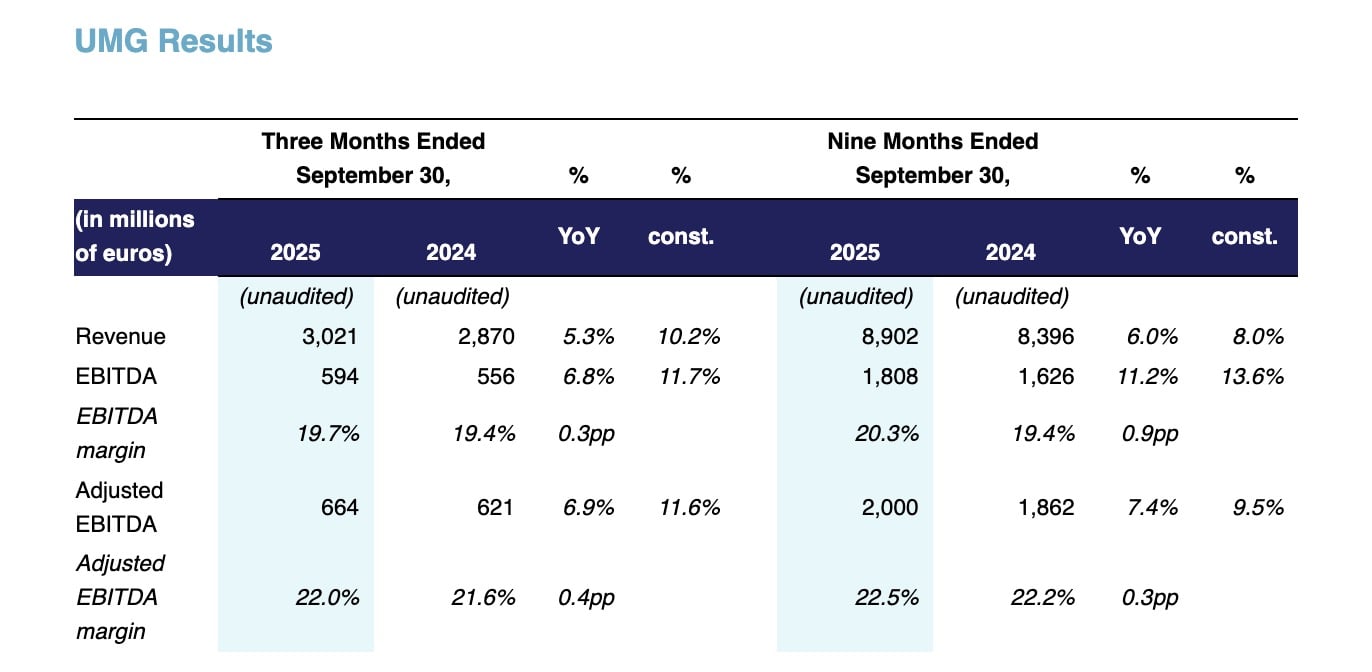
Universal Music Group generated revenues of €3.021 billion ($3.53bn) across all of its divisions (including recorded music, publishing, and more) in Q3.
That’s according to UMG’s fresh set of quarterly results, published today (October 30).
They reveal that UMG’s overall Q3 revenue figure was up 10.2% YoYat constant currency, driven, according to UMG, by growth in all segments.
Adjusted EBITDA weighed in at €664 million ($775m) – a margin of 22%.
Among the highlights within UMG’s latest results was the company’s recorded music subscription streaming revenues, which grew 8.7% YoY at constant currency to reach €1.178 billion ($1.37bn) in Q3, driven “primarily by the growth in global subscribers,” UMG said today.
Another big highlight came in the form of UMG’s physical revenues, which grew 23.1% YoY at constant currency to €341 million ($398.31m), driven, according to UMG, “by initial shipments of Taylor Swift’s The Life of a Showgirl and strength in new releases, particularly in Japan”.
Commenting on the Q3 earnings announcement, UMG’s Chairman and CEO, Sir Lucian Grainge, said: “As we position the company for long-term value creation, we continued to achieve strong results this quarter.”
Photo: Austin Hargrave
“As we position the company for long-term value creation, we continued to achieve strong results this quarter.”
Sir Lucian Grainge
He added: “Importantly, we continued to drive progress on our strategic plans, including our artists’ and songwriters’ creative and commercial success, our global expansion, the industry’s embrace of our responsible AI initiatives and the continued implementation of Streaming 2.0.”
Matt Ellis, UMG’s CFO, added: “We’re pleased that our strong quarter was driven by healthy results across all segments of our business: Recorded Music, Music Publishing and Merchandising.
“Our double-digit growth in both revenue and Adjusted EBITDA is a reflection of the breadth and depth of our global roster, the strength of our partnerships, and the consistent execution on our strategic plan.”
RECORDED MUSIC
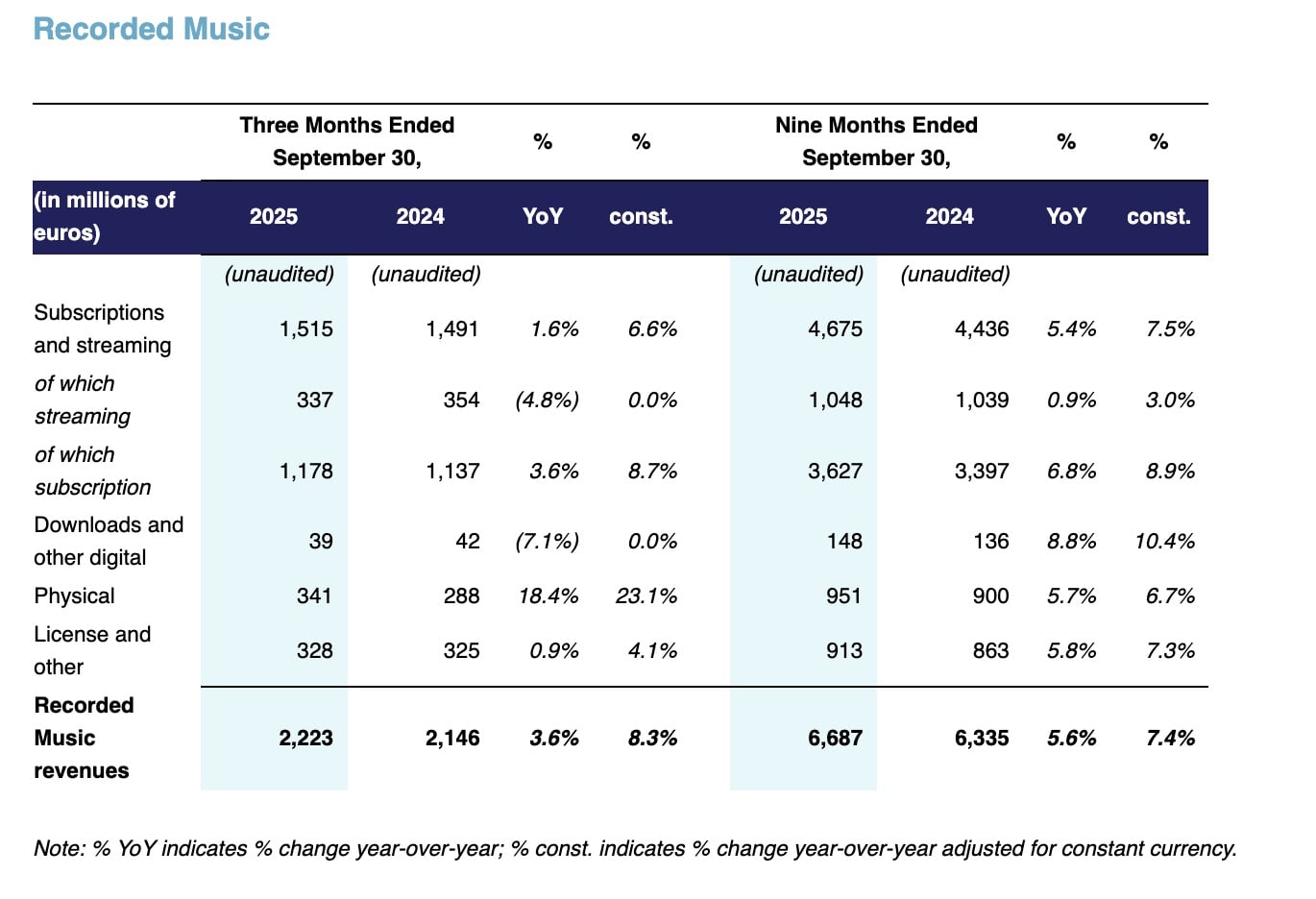
Universal’s overall Recorded Music revenue for the third quarter of 2025 was €2.223 billion ($2.59bn), up 8.3% YoY at constant currency.
Within the Recorded Music segment, UMG’s ‘Subscription and streaming revenues’ (including ad-supported and subscription streaming revenues) grew 6.6% YoY at constant currency to €1.515 billion ($1.77bn).
Breaking UMG’s recorded music streaming figure down further reveals that the company’s subscription streaming revenues specifically grew 8.7% YoYat constant currency to reach €1.178 billion ($1.37bn), driven primarily, according to UMG, “by the growth in global subscribers”.
Universal’s ad-supported recorded music streaming revenue reached €337 million($393.64m), which was flat YoY, “as consumption continues to shift from better monetized video platforms to short-form platforms, which are not yet as well monetized,” UMG said today.
Within Universal’s recorded music business, Physical revenue grew 23.1% YoY at constant currency to €341 million ($398.31m), driven, according to UMG, “by initial shipments of Taylor Swift’s The Life of a Showgirl and strength in new releases, particularly in Japan”.
‘License and other’ revenue grew 4.1%YoY at constant currency to €328 million ($383.13m), due to “improvements in live income”.
Downloads and other digital revenue reached €39 million ($45.55m), which was flat YoY (at constant currency).
Top sellers for the quarter included the KPop Demon Hunters soundtrack, Mrs. GREEN APPLE, Taylor Swift, Sabrina Carpenter and Morgan Wallen, while top sellers in the prior-year quarter included Taylor Swift, Sabrina Carpenter, Billie Eilish, Chappell Roan and Post Malone.
MUSIC PUBLISHING
Universal’s overall Music Publishing revenue for the third quarter of 2025 was €543 million ($634.27m), up 13.6% YoY at constant currency.
Digital publishing revenue grew 16.8% YoY at constant currency to €327 million ($381.96m), reflecting “continued growth of streaming and subscription revenue as well as new business wins”.
Performance revenue grew 17.3% YoY at constant currency to €115 million ($134.33m).
Synchronization revenue grew 3.3% YoYat constant currency to €63 million ($73.58m).
Mechanical revenue declined 3.7% YoY at constant currency to €26 million ($30.37m).
Other revenue reached €12 million ($14m), flat YoY at constant currency.
MERCHANDISING AND OTHER
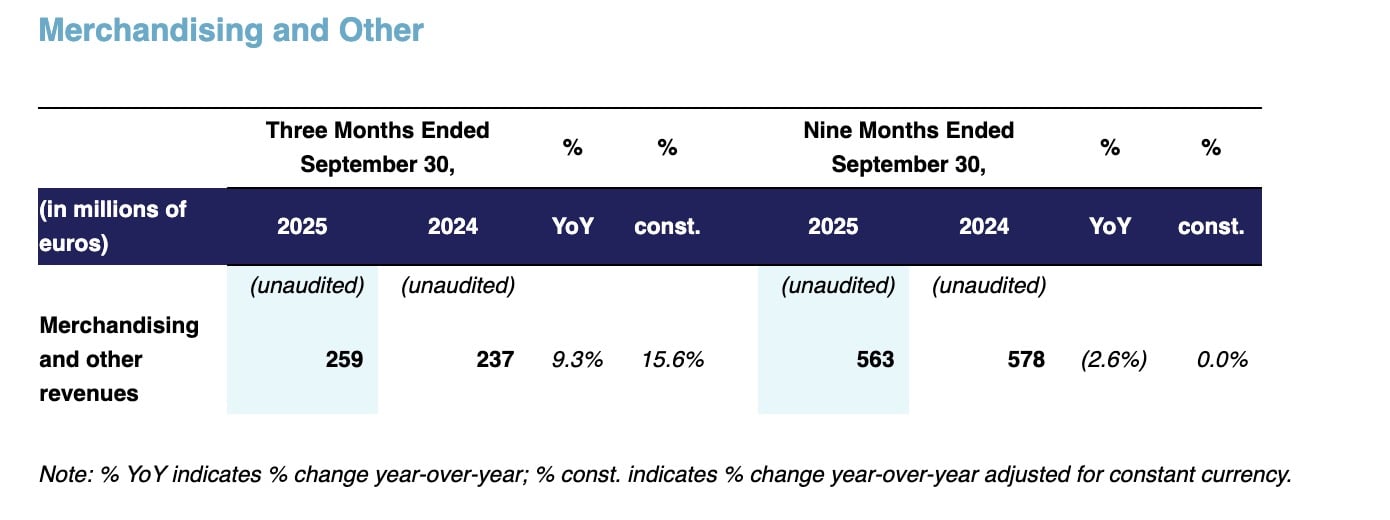
UMG’s ‘Merchandising and Other’ revenue in the third quarter of 2025 reached €259 million ($302.53m), an increase of 15.6% YoY at constant currency.
According to UMG, this was driven by “higher touring merchandise sales” and was “partially offset by lower direct-to-consumer sales due to the timing of product releases”.
EBITDA ETC.
In Q3 2025, UMG’s EBITDA (earnings before interest, taxes, and depreciation) grew 11.7% YoY at constant currency to €594 million ($693.84m).
EBITDA margin expanded to 19.7%, compared to 19.4% in the third quarter of 2024.
Adjusted EBITDA for Q3 was €664 million ($775.61m), up 11.6% YoY at constant currency.
Adjusted EBITDA margin improved to 22% compared to 21.6% in the third quarter of 2024,
All EUR-USD conversions made at the average rate of the relevant period according to the European Central Bank.Music Business Worldwide
Carla leads a fight in flood-damaged Valencia where climate change and tourism threaten turtles along Spain’s coastline.
Carla grew up witnessing her father’s fight to protect Valencia’s fragile beach ecosystems. Now, as climate change warms the Mediterranean, sea turtles – driven by rising sea temperatures – have begun arriving to lay their eggs on her city’s shoreline. But the beaches they rely on are under threat. Mass tourism, unchecked development, and the recent floods are eroding these vital habitats.
At 27, Carla is an environmental lawyer and conservationist who works with her father to restore the beaches and protect turtle nests, knowing the species’ survival depends on their efforts. After the catastrophic 2024 floods, Carla rallies her community to act fast to restore Valencia’s coastline. With turtle nesting coinciding with peak tourism, Carla urgently needs volunteers to protect each nest – and time is running out.
After the Floods is a documentary film by Adriana Cardoso and Rodrigo Hernandez.
Less than a week after setting a new 100 butterfly SCM World Record in his home country of Canada on the final stop of the World Cup, Florida’s Josh Liendo is riding that World Cup taper, blasting an 18.68 in the 50 free on the first day of a two day battle against conference foe Georgia in Gainesville.
Liendo dominated the field in the 50 free, finishing over a second ahead of runner-up finisher and Georgia sophomore Alex Painter in 19.69. For reference, Liendo’s fastest time in the 50 free from October of last season was 18.92.
That 50 free was not the first sign that Liendo was still on the momentum train; his first win came in the 50 butterfly, where Liendo was the only swimmer to swim under the 20 second barrier, clocking 19.69. Liendo’s junior teammate Scotty Buff clocked the only other sub-21 second performance in 20.88.
Other Notable Men’s Performances:
Florida junior Jonny Marshall took a narrow win over Ruard Van Renen of Georgia to claim the men’s 50 backstroke, out touching the Bulldog by six hundredths of a second, clocking 21.24.
Gator freshman Ahmed Jaouadi dominated the 1000 free, winning by nearly 15 seconds in 8:36.65.
The Gator men dominated on the boards; junior Conor Gesing took the 1-meter event in 373.73, while freshman teammate Jesus Agundez Mora notched the 3-meter crown (369.38).
Georgia sophomore Elliot Woodburn picked up the lone event win for the Bulldogs on day one with his 50 breast performance of 24.00.
The Florida women swept all five events in the pool, and claimed another two event wins on the boards.
Gator freshman Beatriz Bezerra comfortably won the 50 fly, winning by over half a second in 23.89.
Florida finished 1-2-3 in the 50 breast, leading the charge was sophomore Anita Bottazzo in 26.58, freshman Grace Rabb clocked 27.80, and junior Molly Mayne rounded out the top three in 27.90.
Florida sophomore Julie Brousseau took the six second win over Georgia’s Kennedi Dobson in the 1000 free, clocking 9:25.20.
Junior Catie Choate and freshman Sylvia Statkevicius rounded out the day 1 winners in between the lane lines for the gators, with Choate winning the 50 back (23.99) and Statkevicious claiming the 50 free (22.83).
Freshman diver Maria Garcia added big points on the boards for Florida, winning both 1-meter (325.20) and 3-meter (361.95).
Friday’s events will be a more traditional event format; with the events as follows: