
1.9 C
New York
Friday, February 20, 2026
Home Blog Page 236

Fallen Israeli Soldier Killed in Gaza in 2014 Finally Laid to Rest in Israel | Latest Updates on Israel-Palestine Conflict

0

If the body is identified as Israeli soldier Hadar Goldin, the remains of four other deceased captives are still in Gaza.

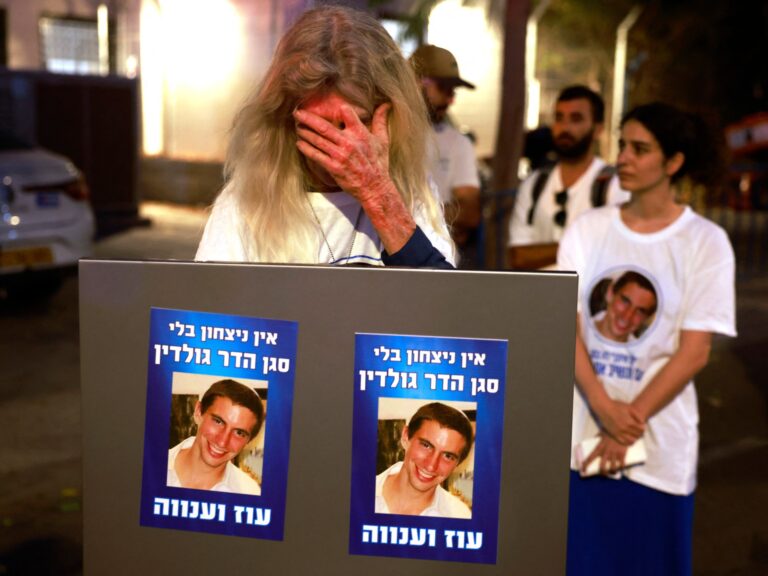
Israel has received the body of a soldier held in Gaza for more than a decade after he was killed in an ambush by Hamas fighters in 2014 during the last major ground assault in the enclave.

Prime Minister Benjamin Netanyahu’s office said on Sunday that the remains were handed over to Israeli forces in Gaza by the International Committee of the Red Cross (ICRC) after Hamas transferred the body to the aid organisation.

Recommended Stories

list of 4 itemsend of list

Formal identification of Lieutenant Hadar Goldin, 23, has not yet been confirmed by Israeli authorities.

At the start of a weekly cabinet meeting, Netanyahu said holding the body for so long has caused “great agony for his family, which will now be able to give him a Jewish burial”.

“Lieutenant Hadar Goldin fell in heroic combat during Operation Protective Edge,” Israel’s leader said.

The Qassam Brigades, Hamas’s military wing, said the body was retrieved on Saturday from a tunnel in the Yebna refugee camp in Rafah in southern Gaza.

Goldin was killed on August 1, 2014, two hours after a ceasefire took effect and ended that year’s war between Israel and Hamas. He was part of an Israeli unit tasked with locating and destroying Hamas tunnels.

Another Israeli soldier, Oron Shaul, was also killed in the six-week war, and his body was returned earlier this year.

If the body is identified as Goldin’s, there will be four deceased abductees remaining in Gaza to be returned under the terms of a ceasefire that began last month. Hamas has so far released 20 living captives and 23 bodies.

For each body returned, Israel has been releasing the remains of 15 Palestinians. Ahmed Dheir, director of forensic medicine at the Nasser Medical Complex in the southern Gaza city of Khan Younis, said 300 bodies have now been returned and 89 identified.

Israeli attacks continue

Israel has also released nearly 2,000 living Palestinian prisoners since the October 10 truce began. Palestinian authorities said more than 10,000 people still remain in Israeli detention.

Gaza’s Ministry of Health said 241 Palestinians have been killed and 619 wounded since the ceasefire began and 528 bodies have been recovered from under rubble and at attack sites.

Despite the truce, Israel’s military continues to carry out attacks across the Gaza Strip. On Sunday, one man was killed in the Bureij refugee camp in central Gaza, and two died in separate assaults in the north and south, the Health Ministry said.

In the occupied West Bank, Israeli forces killed a Palestinian man in the Far’a refugee camp near Tubas while Israeli settlers attacked Palestinian farmers in several areas, according to local reports.

According to Israeli authorities, Palestinian armed groups captured 251 people during Hamas’s attacks on southern Israel on October 7, 2023, and killed at least 1,139 people.

Israel began its war in Gaza on the same day. It has killed at least 68,875 Palestinians and wounded 170,679, according to the Health Ministry.


Challenging the Client

0


Client Challenge


JavaScript is disabled in your browser.

Please enable JavaScript to proceed.

A required part of this site couldn’t load. This may be due to a browser
extension, network issues, or browser settings. Please check your
connection, disable any ad blockers, or try using a different browser.

Super Typhoon Hits Philippines: BBC Reports on Luzon Island

0

Typhoon Fung-wong has made landfall in the Philippines, where more than 900,000 people have been evacuated.

The storm was upgraded to a super typhoon, with sustained winds around 185 km/h (115mph) and gusts of 230km/h (143mph).

The BBC’s Jonathan Head is on Luzon Island, and says there is “debris flying everywhere” and “people are sheltering in any solid building they can find”.

Read more on this story.

Super Typhoon Fung-wong approaches Philippines, leaving at least two dead

0

At least two dead as Super Typhoon Fung-wong nears landfall in the Philippines

Cinema Industry in Hollywood is Embracing Palestinian Stories and Becoming More Aware

0

Quotable

Cherien Dabis, a Palestinian-American director talks about the difficulties in providing audiences with Palestinian stories and distributing her film “All that’s left of you”.

Millennial Who Sold Business for $532 Million Finds Life of Leisure “Boring” and Returns to Work

0

This millennial has a message for anyone who thinks a million-dollar windfall—whether it’s from the sale of their business or the $124 trillion Great Wealth Transfer—will solve all your problems. 

If that was the case, Tom Grogan should have been living the dream. After cofounding Wingstop UK and selling a majority stake for £400 million ($532 million), most people would expect him to wake up every day feeling on top of the world. But the reality? Far from it. Wealth didn’t magically make life feel complete.

“For seven years, your whole mind is occupied on making a success of this business,” Grogan exclusively told Fortune. 

“It’s all you think about. And then when you get there, it’s just a bit surreal. It’s like, Okay, it’s done now. Now what? And money doesn’t necessarily fill that void either.”

After nearly a decade of building a UK brand from scratch—including one cold email to Texas, 50 investor rejections, and 57 restaurants later—he admits that navigating life after the sale is a whole other challenge.

From $5 an hour builder to multimillionaire sounds like the dream—but this founder says ‘it’s boring’

While Grogan’s rise from a construction worker to a founder (all in his 20s) was meteoric, the transition from entrepreneur to multimillionaire has been… unexpectedly slow-paced, he admitted.

“You have to now change your head from we’re not business building anymore. We’ve gone from being an entrepreneur to managing money—and they’re two different skill sets,” he said. “So we have to discover the world of financial instruments, stocks, bonds—all of that stuff that’s all new to us, but we’re being strategically careful.”

Instead of rushing to buy a mansion or a fleet of fast cars, Grogan added that he’s still renting. And along with his cofounders Herman Sahota and Saul Lewin, the trio gave the first half of this year to sit back and start thinking about what they want to do next.

But one thing is for sure: He won’t be resting on his laurels, enjoying the fruits of his labour and riding off into the sunset any time soon.

“It’s boring,” Grogan adds. “I can’t live life sat on a beach. I think we need something to occupy our minds, to challenge ourselves. You need a purpose every day to wake up for, which we don’t have right now.”

It’s why he’s already planning to get back to the grind—he doesn’t know what his next venture will be, “but it probably won’t be in the world of food and beverages.”

Brian Chesky called the Airbnb IPO ‘one of the saddest periods’ of his life

Grogan isn’t alone in feeling the emptiness that can follow a massive milestone. Years of relentless focus and sweat poured into a single venture can leave a strange void when it’s suddenly past the finish line.

In fact, Brian Chesky cofounder and CEO of Airbnb, previously admitted that his company’s IPO—despite making him a billionaire—was “one of the saddest periods” of his life. 

Growing up, Chesky admits he “desperately wanted to be successful” because he thought it would bring him adoration. Plus, having social worker parents who were by no standards rich, he also thought a large sum of money could “solve every problem.”

“I had this image that if I got successful I’d have all these people around me, all these friends, I’d have all this love, all this everything, and my life would be fixed,” he told Armchair Expert podcast. 

But actually, when Airbnb hit that $100 billion valuation and “everyone in high school” knew what he did, he was lonelier than ever, having poured all his energy into his work for up to 18 hours a day.

“At the bottom of the mountain, you have hope,” he concludes of his journey from scrappy start-up founder to billionaire. “But the problem is when you get to the top of the mountain oftentimes you are at the top by yourself, disconnected.”

UK military to provide assistance in protecting Belgium from drone incursions

0

Sir Richard Knighton: “We don’t yet know… the source of those drones”

UK military personnel and equipment are being sent to Belgium to help it bolster its defences after drone incursions on its airspace, suspected of being carried out by Russia.

The new head of the UK military, Sir Richard Knighton, told the BBC’s Sunday with Laura Kuenssberg that his Belgian counterpart asked for assistance earlier this week and that kit and personnel were on the way.

Belgium’s main airport Zavantem was forced to close temporarily on Thursday night after drones were spotted nearby. They were also spotted in other locations, including a military base.

Sir Richard said it was not known if the incursions were by Russia, but added it was “plausible” they had been ordered by Moscow.

He added that the decision to aid Belgium had been made alongside Defence Secretary John Healey.

Alongside Nato allies, he added that the UK would help Belgium “by providing our kit and capability” which he said was already being deployed. On Friday the German defence ministry said it would support Belgium with anti-drone measures after a request from Brussels.

About 3,000 Brussels Airlines passengers were affected by the disruption, and the carrier said it faced “considerable costs” from cancelling or diverting dozens of flights.

German Defence Minister Boris Pistorius and the Belgian security services have said they suspect Russia, but Belgian Defence Minister Theo Francken has previously admitted there is no accompanying evidence.

“At first, drones flying over our military bases were seen as our problem,” Francken said earlier this week.

“Now it has become a serious threat affecting civilian infrastructure across multiple European countries.”

Getty Images Photo shows a sign that reads 'No Drone Zone' near the Brussels-National Airport. A Brussels Airlines passenger jet can be seen coming in to land in the background.Getty Images

Drone incursions over Western Europe could have been sent by the Kremlin, Sir Richard said

More broadly, Sir Richard said Russia was “the most pressing threat right now” to Europe.

“The illegal invasion of Ukraine has shown the barbaric nature of Russia’s war efforts,” he told the programme.

He added that sabotage and killings had been carried out by Russia on UK soil, and that so-called hybrid warfare is where “we [The UK] need to strengthen ourselves”.

The shadow defence secretary welcomed the move, saying there was “a heightened threat environment” and a key part of deterring threats was “by acting with other countries through Nato”.

But James Cartlidge criticised the government’s approach to increasing defence spending, saying more urgency was needed.

In spring, the government announced defence spending would rise to 2.5% of GDP from April 2027, with an ambition to reach 3% in the next parliament.

Sir Richard said the funding was “more than I’ve ever known in my career”.

In recent months, a number of drone sightings have caused major flight disruptions across Europe, including in Sweden, Norway and Denmark.

Despite some officials blaming “hybrid warfare” by Russia, the Kremlin has denied any involvement.

Pistorious has suggested the latest sightings could be linked to European Union discussions to use frozen Russian assets to support Ukraine in the form of a €140bn loan.

While there is no public proof of Russia’s involvement, suspicions have been fuelled by more serious airspace incursions by Russia in Eastern Europe over recent months, involving fighter jets and larger attack drones.

The UK has recently sent RAF Typhoon jets to take part in defence missions over Poland as part of Nato’s mission to bolster the eastern flank in response to incursions.

Recap of Day 2 at Raleigh Rumble: NC State Dominates in Meets

0

By Madeline Folsom on SwimSwam

Raleigh Rumble

  • November 7-8, 2025
  • Raleigh, North Carolina
  • SCY (25 Yards)
  • Full Meet Results: Also Available as “2025 Raleigh Rumble” on Meet Mobile

Combined Team Scores

  1. NC State — 1580
  2. Ohio State — 1031.5
  3. Virginia Tech — 793.5

Women’s Team Scores

  1. NC State — 790
  2. Ohio State — 546
  3. Virginia Tech — 364.5

Men’s Team Scores

  1. NC State — 790
  2. Ohio State — 485.5
  3. Virginia Tech — 429

The final session of the 2025 Raleigh Rumble concluded on Saturday morning, and the end of the meet saw NC State win the men’s and women’s meets as well as the combined team scores in dominant fashion.

Women’s Recap

The last session started with the final round of knockout 50s, which saw seven of the eight swimmers come from NC State.

Tyler Driscoll started the morning with a win in the 50 fly at 23.31 for the Wolfpack with teammate Erika Pelaez coming in just behind at 23.46. This was a little more than a tenth of the 23.18 she swam in round one on Friday morning.

Leah Shackley swam 23.55 to finish 1st in the 50 back, a little more than half-a-second ahead of Kennedy Noble‘s 24.13.

The 50 breast was the only 50 where a non-NC State swimmer raced in the final, but Wolfpack freshman Eneli Jefimova still won the event in 26.43, a tenth off the 26.30 she swam in round one to set the school record. Ohio State’s Maria Ramos Najji finished 2nd in 27.22.

Finally, the 50 free went to Cassie Moses in 22.08, a little more than two tenths ahead of Lily Christianson‘s 22.31.

Ohio State’s first win of the session came from sophomore Mila Nikanorov, who picked up her 2nd event win of the meet in the 500 freestyle with her time of 4:42.52, which was about six seconds off her lifetime best of 4:36.38.

Erika Pelaez brought NC State back to the top of the podium with her 200 free swim of 1:44.83, which beat Ohio State’s Rachel Bockraths swim of 1:45.38 by more than half-a-second.

The session was broken up with a 200 medley relay in the middle, which went to NC State’s champion 50 team of Shackley (23.79), Jefimova (26.41), Pelaez (23.32), and Moses (21.50) in 1:35.02.

The final women’s individual event of the meet was the women’s 200 IM, which saw an NC State top three. Kennedy Noble won the event in 1:56.85, the 9th fastest time in the country before this weekend. Lisa Nystrand finished 2nd in 1:57.96, and Teia Salvino was 3rd in 1:59.10 as the final swimmer under 2:00.

Finally, the three-session meet ended with the 400 freestyle relay, which, again, went to NC State. Cassie Moses (48.66), Lily King (48.66), Lily Christianson (48.53), and Erika Pelaez (47.38) swam 3:13.23 to touch more than two seconds ahead of Ohio State.

Men’s Recap

All three men’s teams earned at least one win in the final heats of the 50s. Ohio State’s Matthew Klinge won the 50 fly in 20.37, touching a tenth ahead of NC State’s Aiden Hayes‘s 20.46.

The Wolfpack won the 50 back, with Quintin McCarty‘s 20.88 coming in three tenths ahead of teammate Hudson Williams‘s 21.13, and the 50 breast with Arsen Kozhakhmetov swimming 24.03 to beat Ohio State’s Ahmed Ismail who touched in 24.24.

The 50 free went to Virginia Tech junior Brendan Whitfield with his time of 19.11 coming in just over a tenth ahead of Jerry Fox‘s 19.25 for NC State.

Kaii Winkler swam 1:32.51 in the men’s 200 freestyle to lead the NC State top three in the event and set the 5th fastest time in the country coming into this weekend. Daniel Diehl (1:34.75) and Jerry Fox (1:34.77) finished 2nd and 3rd for the team.

The men’s 200 medley relay saw some of the 50 swimmers retake the pool and NC State walk home with the win. Hudson Williams (21.37), Arsen Kozhakhmetov (23.55), Aiden Hayes (20.08), and Drew Salls (18.63) swam 1:23.63 to beat the Virginia Tech team by three seconds.

Max Carlsen made it three straight for the Wolfpack with his top time of 4:16.62 in the 500 freestyle placing him more than two seconds ahead of teammate Mikolaj Filipiaks 4:19.04 for 2nd. Carlsen’s time was less than a second off his lifetime best of 4:15.74 from last month’s DMT.

The final men’s individual event of the meet also went to NC State with junior Daniel Diehl swimming 1:43.45 in the 200 IM to win by two seconds over Ohio State’s Tristan Jankovics. Diehl was about two seconds off his lifetime best of 1:41.39 from last year’s Wolfpack Elite Invite.

The Raleigh Rumble concluded with the men’s 400 freestyle relay which saw NC State win their 5th straight event of the session in 2:48.26. Kaii Winkler (41.67), Jerry Fox (42.55), Drew Salls (42.22), and Hudson Williams (41.82) came in four seconds ahead of Virginia Tech’s time of 2:52.81 for 2nd.

Up Next

NC State and Virginia Tech will both race again at the Wolfpack Elite Invite from November 20th-22nd, while Ohio State will host their own midseason invite from the 18th-21st.

Read the full story on SwimSwam: Raleigh Rumble Day 2 Recap: NC State Sweeps Meets

Breast Cancer Survival and Side Effects May Be Affected by Common Medications

0

A large international study of more than 23,000 patients has found that common medicines used to treat high blood pressure and cholesterol, as well as heartburn, may be impacting cancer treatment effectiveness.

Researchers from the University of South Australia (UniSA) were looking at whether everyday drugs used to treat chronic health conditions could potentially affect treatment for breast cancer, and what they found was a “concerning” pattern when it came to certain medications.

Anaylzing data from 19 breast cancer clinical trials, featuring 23,211 patients, the researchers discovered that one class of drug in particular – proton-pump inhibitors (PPIs), used to treat indigestion and heartburn – was associated with poorer overall survival, progression-free survival and a 36% increased risk of serious adverse events during treatment.

“Many women with breast cancer are also managing other chronic conditions such as high blood pressure, diabetes or acid reflux, meaning they are often taking multiple drugs at once,” said lead author Dr Natansh Modi, from UniSA and Flinders University. “Our results don’t suggest that people should stop taking their non-cancer medicines, but it underlines how important it is for doctors to regularly review patient medications because people are living longer and managing multiple health issues.”

The researchers believe that PPIs might have the potential to interfere with immune system responses or even change how cancer therapeutics are absorbed into the body and metabolized. However, these processes are not yet well understood.

The team also identified a link between taking beta-blockers, angiotensin-converting enzyme (ACE) inhibitors, angiotensin receptor blockers and calcium-channel blockers – all drugs commonly used to treat heart disease or hypertension – and higher rates of severe negative side-effects. However, there was no connection between these medications and overall survival.

Meanwhile, cholesterol-managing statins and the type 2 diabetes drug metformin had no meaningful impact on survival or side-effects from treatment. In a 2021 study, researchers found that statins were associated with positive outcomes in patients with breast cancer.

While more research is needed, this study – thought to be the largest of its kind – has flagged the need for further investigation into PPIs and the role they might play in breast cancer treatment.

“It doesn’t mean that patients should cease their reflux medication without medical advice, but clinicians should be alert to potential risks and review whether PPIs are genuinely needed,” said corresponding senior author Ashley Hopkins, an associate professor at Flinders University.

Following on from their findings, the researchers are calling for a closer look into the potential biological mechanisms driving these adverse cancer treatment outcomes – and for patients and clinicians to be aware of possible interactions.

The research was published in the journal Cancer Medicine.

Source: University of South Australia

Luminate collaborates with Tencent Music to incorporate Chinese sales metrics into its worldwide data collection for the first time

0

Billboards Global Charts will soon include music consumption numbers from the Chinese market for the first time.

Entertainment industry research firm Luminate has struck a deal with Tencent Music Entertainment Group, China’s biggest music streaming operator, that will enable Luminate to incorporate TME data into its Global statistics.

According to the announcement, as Billboard’s longstanding, official Charts partner, Luminate will incorporate data from TME in its weekly analysis and ranking used for the publication of Billboard Global Charts.

Luminate said it will track streaming and sales metrics from TME platforms, including QQ Music, Kugou Music, Kuwo Music, and JOOX, through the TME Chart.

The data will be available to subscribers of Luminate’s CONNECT platform in the coming weeks, Luminate said. The addition of Chinese data into the Billboard Global Charts will be announced “at a later date.”

The partnership addresses “a long-standing gap in representation,” Luminate and TME said in a statement on Wednesday (November 5).

“This partnership marks a pivotal moment for the global music industry, underscoring Luminate’s unwavering commitment to providing the most accurate and comprehensive measurement of music activity worldwide,” Luminate CEO Rob Jonas said.

“As the industry’s most trusted source of streaming and sales data, our customers and partners expect as much information as possible to make the best business decisions, and we know how valuable it is for a market as large and influential as China to be represented in those insights.”

“This partnership marks a pivotal moment for the global music industry.”

Rob Jonas, Luminate

TC Pan, Group Vice President of TME and President of the Content Cooperation Department, described the partnership with Luminate as “a data-driven effort to establish a unified global content ecosystem.”

Added TC Pan: “China is one of the most dynamic music markets in the world, and through this partnership, all content on TME’s platforms — whether domestic or international — will participate in, and even help shape, global music trends.

“Moving forward, TME will continue to strengthen its content ecosystem, enabling more quality content to be discovered worldwide, realizing long-term value through a journey from ‘data connectivity’ to ‘ecosystem synergy’.”

TME operates a number of music streaming platforms in China, including QQ Music, Kugou Music, Kuwo Music, and JOOX. As of Q2 2025, TME’s platforms had 553 million monthly active users and 124.4 million paying subscribers, of which some 15 million were subscribers to its ‘Super VIP’ tier for music superfans.

Luminate has been expanding its international partnerships in recent years, in an effort to develop a global database of music consumption. The research firm now tracks more than 60 different countries, with recent additions including markets in the Middle East and North and Sub-Saharan Africa.

Thus far, Billboard’s only data on the Chinese music market was via the UNI Chart, which launched in early 2023 in partnership with TME.

“Our partnership with Luminate marks TME Chart as Billboard‘s first in-depth data partner in China, which demonstrates that its objectivity and professionalism have gained recognition from international authorities,” said Ryan Liang, TME’s Vice President of Corporate Development and Content Ecosystem.

“We see this partnership as an opportunity to further strengthen the TME Chart’s role as a bridge connecting Chinese music with the global market. By integrating China’s music data into the global chart ecosystem, we are dedicated to delivering Chinese music to a broader audience and enhancing its international recognition.”Music Business Worldwide