Whether you’re running an outdoor summer practice under blazing sunshine or a high-intensity winter workout inside, one clock now does it all—brighter, lighter, and smarter than anything else on deck.
Built for Sunlight & Beyond
Vivid 10-inch LEDs punch through direct sunlight, so athletes can read sendoffs from across the pool—no more guessing at faded digits.
Indoor? Dial the brightness down and still enjoy razor-sharp clarity without glare.
In side-by-side photos with a leading competitor, Neon Pace Clock (on the right) outshines the other unit at a fraction of the price.
The Slim, Go-Anywhere Workhorse
Neon Pace Clock
Leading Competitor*
Weight
5 lb
19 lb
Thickness
1.3 in
4.8 in
Setup
Carryon handle, toolless attachments
Bulky frame, tools required
With Neon Pace Clock, you’ll spend less time wrestling bulky equipment and more time focusing on your swimmers. When pool-deck real estate is tight, their ultra-slim profile lets you slide them into that last inch beside the bleachers or stash them in a jam-packed cabinet—no tools, no sweat.
Programmability That Frees Coaches to Coach
MultiClock / MultiInterval Control – Run sprint, middistance, and IM groups on different sendoffs simultaneously with multiple clocks, all from the free Neon Swimapp.
OneTap Uploads – Select a workout, tap Program, and every connected clock is ready before the first whistle.
Rep Counts & SendOff Sounds – Visual rep numbers plus customizable beeps keep even crowded lanes perfectly in sync.
RealTime Monitoring – The Neon Swim app shows exactly where each clock is in the set, so you can jump lanes and give feedback instead of babysitting intervals.
Value That’s Hard to Ignore
Neon packs more features than clocks twice its price—and we back it with a 30-day, no-questions-asked satisfaction guarantee plus a 12-month warranty. If it doesn’t make your practices more productive, send it back.
Coaches Are Already Convinced
“Neon Pace Clock is an absolute gamechanger… If you’re serious about swimming, you need this in your toolbox!” – Jeff Bowlus, Bluffton University
“We’re looking for that edge. And one of the things we’ve found is that with using the programmable pace clocks, we’re able to focus on the kids.” – Aaron Dean, Occoquan Swimming
See more of the success coaches are having with Neon Pace Clock here.
Your All-Season Upgrade Starts Now
Summer league, high school, masters, or club—give every swimmer crystal-clear timing, smarter intervals, and a coach who’s free to coach.
A top official in one of South Africa’s biggest political parties has been sacked after he visited a controversial Malawian pastor in April.
Floyd Shivambu has been removed as secretary-general of the uMkhonto weSizwe (MK) party barely six months into the job after he attended an Easter service at self-proclaimed pastor Shepherd Bushiri’s church.
Mr Bushiri, from Malawi, was one of southern Africa’s best known preachers when he was arrested and charged with fraud in South Africa in 2020.
After being released on bail, he managed to flee to his home country in unclear circumstances. South Africa has been trying to extradite him ever since.
Mr Bushiri denies any wrongdoing.
The MK party, which was founded by former President Jacob Zuma, said in a press conference on Wednesday that Mr Shivambu’s removal came after his actions “were found to be against the spirit and prescripts of the MK party’s constitution”.
“The president and national officials were left with no other option but to act swiftly,” said MK national chair Nathi Nhleko.
He added that the trip “was not an officially sanctioned programme of the organisation”.
However, Mr Shivambu remains a member of the party and will instead represent MK in the National Assembly.
Reacting to news of his demotion, Mr Shivambu said he “fully accepts” the decision taken by the party and looked forward to taking up his new role in parliament.
Mr Shivambu joined the MK party in August last year from the rival Economic Freedom Fighters (EFF) and was later appointed secretary-general – one of the party’s top positions.
Under the leadership of former President Zuma, the newly formed MK party came third in last year’s elections – a major factor in the governing ANC losing its majority for the first time since democratic elections were introduced in 1994.
Mr Shivambu was widely criticised in April when he reposted footage shared on X by Mr Bushiri showing the self-proclaimed pastor asking hundreds of worshippers at his Jesus Nation church to welcome the South African politician.
The politician, in his retweet, also praised Mr Bushiri for his “good work” and “for hosting us”.
Mr Bushiri is a millionaire who set up churches in several African countries.
He is accused of preying on poor people who were desperate to improve their lives by selling merchandise including “miracle oil”.
The self-proclaimed prophet claims to have cured people of HIV, made the blind see, changed the fortunes of the impoverished and, on at least one occasion, walked on air.
Mr Bushiri has also been charged with rape. He and his wife have denied any wrongdoing.
After months of political turmoil in South Korea, Lee Jae-myung has won the presidential election by a wide margin. Mr. Lee’s campaign has ridden a wave of anger against former President Yoon Suk Yeol after he tried to impose martial law in December.
MBW Explains is a series of analytical features in which we explore the context behind major music industry talking points – and suggest what might happen next. Only MBW+ subscribers have unlimited access to these articles.
Goldman Sachs has published the latest edition of its influential Music in the Air report.
The 91-page research paper, released today (June 3), provides insights into streaming growth, price strategies, emerging markets, and the impact of artificial intelligence on the music business.
Despite revising some forecasts downward following a slower-than-expected 2024, Goldman Sachs maintains a positive long-term outlook for the music industry.
The bank expects the global music market (across recorded music, publishing, and live) to nearly double from USD $104.9 billion in 2024 to $196.8 billion by 2035.
According to the report, authored by a team of Goldman Sachs analysts led byLisa Yang, alongside Eric Sheridan and Stephen Laszczyk, among others, the industry will benefit from several key growth drivers, including emerging market expansion, subscription pricing improvements, and new revenue streams from superfan monetization.
The report identifies significant opportunities ahead, noting that “the music market should remain resilient in an uncertain macro backdrop”.
Here are seven key takeaways from Goldman Sachs’ analysis…
Yalcin Sonat / Shutterstock
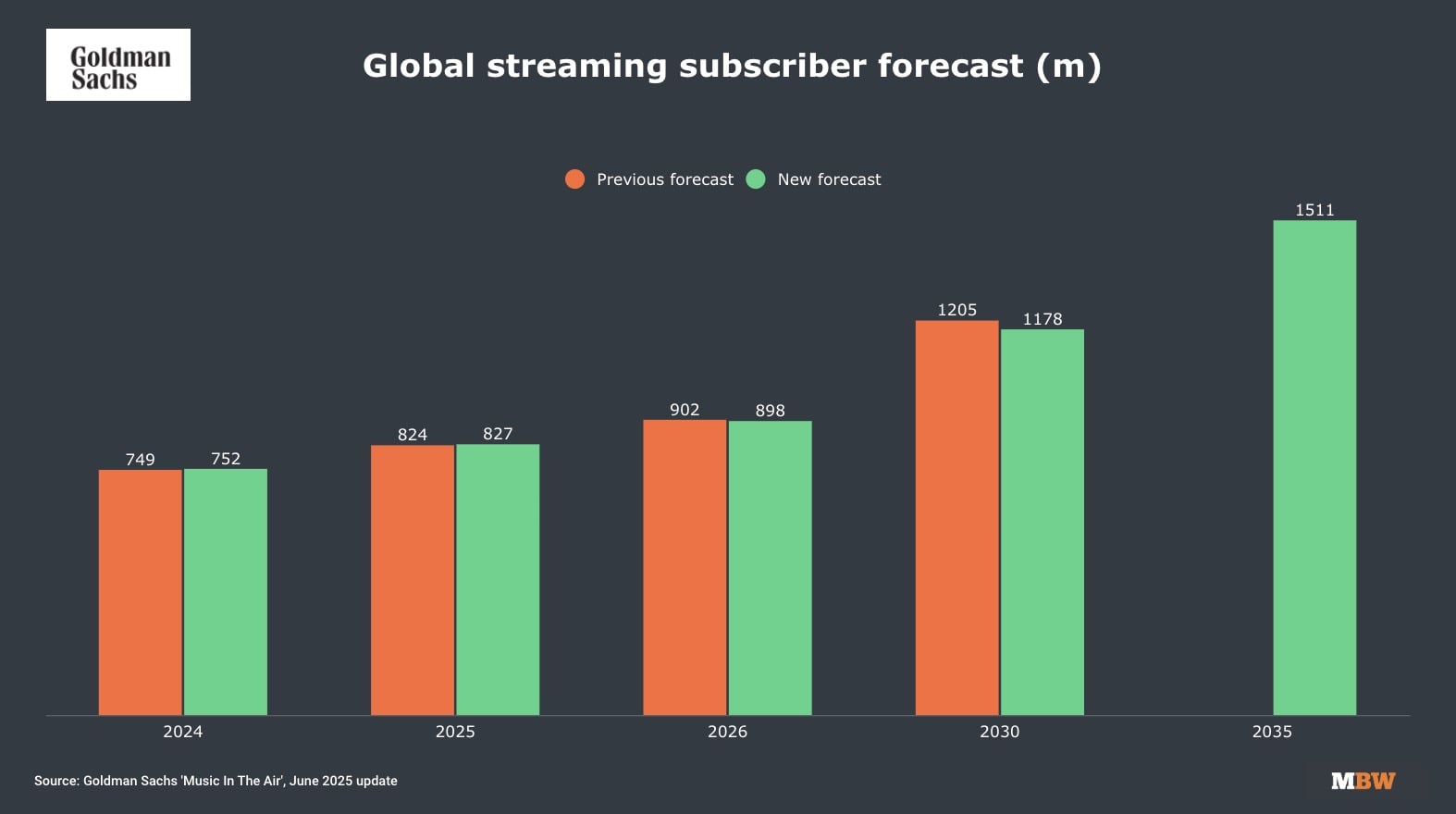
1. GLOBAL STREAMING SUBSCRIBERS EXPECTED TO REACH 827 MILLION IN 2025
Goldman Sachs forecasts that global paid music streaming subscribers will grow to 827 million in 2025, representing 10% YoY growth from 752 million in 2024.
This would represent an addition of approximately 75 million net new subscribers in 2025, though the growth rate of 10% represents a slight deceleration from 2024’s 10.6% growth, and remains well below the 12.8% growth seen in 2023.
“There were 72 million new subscribers in 2024, compared with 77 million/94 million in 2023/22, representing the slowest pace of net additions since 2017,” the report states.
Emerging markets will continue to drive the majority of this growth, where “penetration remains at only 8% of the internet population” compared to 38% in developed markets.
Photo Credit: ElenaR/Shutterstock
2. RECORDED MUSIC GROWTH SIGNIFICANTLY UNDERPERFORMED IN 2024, FORECASTS REVISED DOWNWARD. Global revenues tipped to hit $31.4bn in 2025.
Recorded music growth severely missed expectations in 2024, growing only 4.8% YoY (as reported by IFPI) compared to Goldman Sachs’ forecast of 8.9% – a shortfall of over 4 percentage points.
“2024 global recorded music growth came 4ppt below our expectations,” the report states, marking the first year since Goldman Sachs began forecasting music industry trends where recorded music fell well short of projections.
“Goldman now expects 5.8% growth in 2025 (down from 8.8% previously) and 6.6% in 2026 (down from 8.4%).”
Goldman Sachs has consequently lowered its recorded music growth forecasts, now expecting 5.8% growth in 2025 (down from 8.8% previously) and 6.6% in 2026 (down from 8.4%).
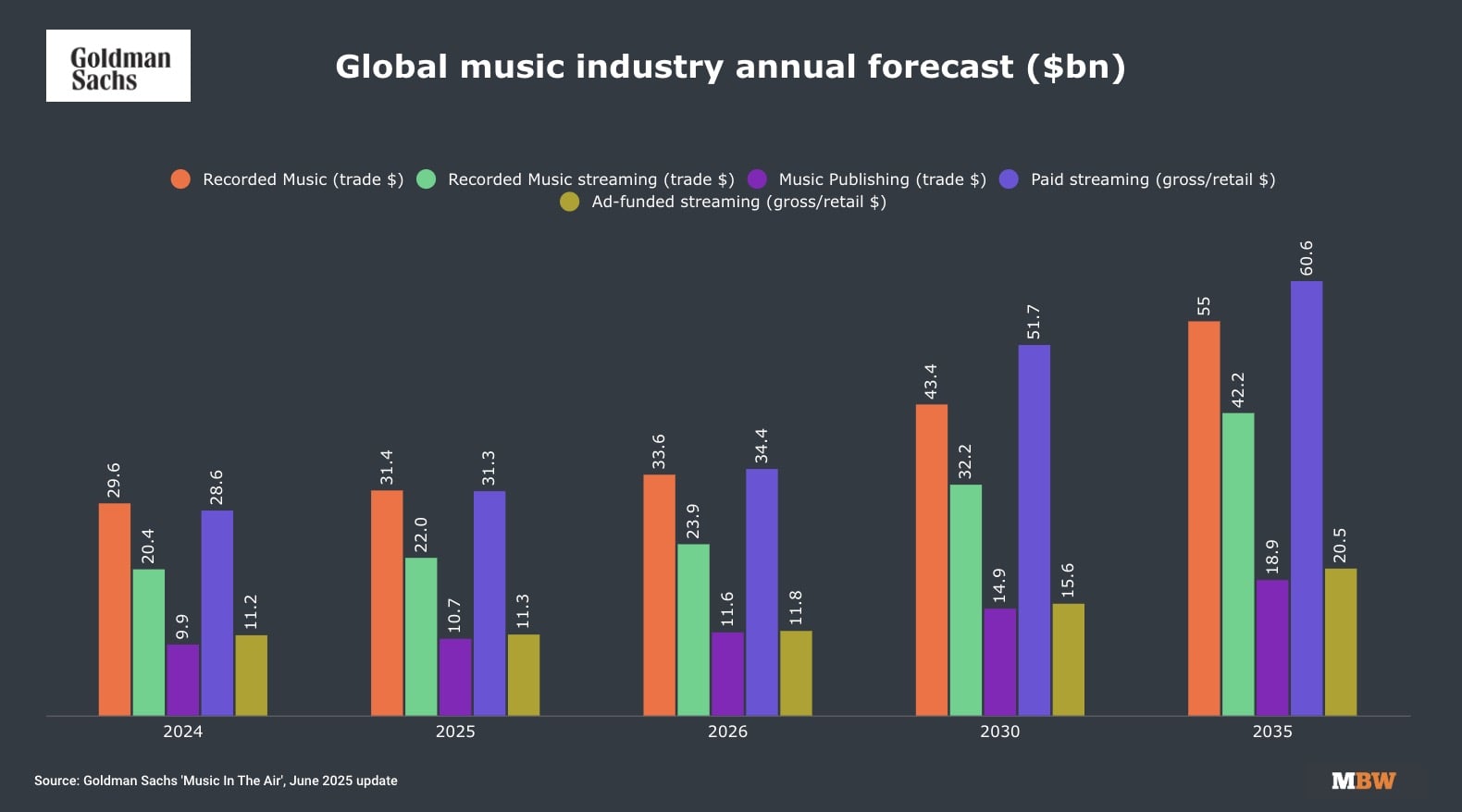
Goldman projects the recorded music market to grow from $29.6 billion in 2024 to $31.4 billion in 2025, $33.6 billion in 2026, $43.4 billion in 2030, and $55.0 billion in 2035 (see below).
Photo credit: Piotr Swat / Shutterstock.com
3. SUPERFAN MONETIZATION COULD GENERATE $4.3 BILLION IN ADDITIONAL REVENUE
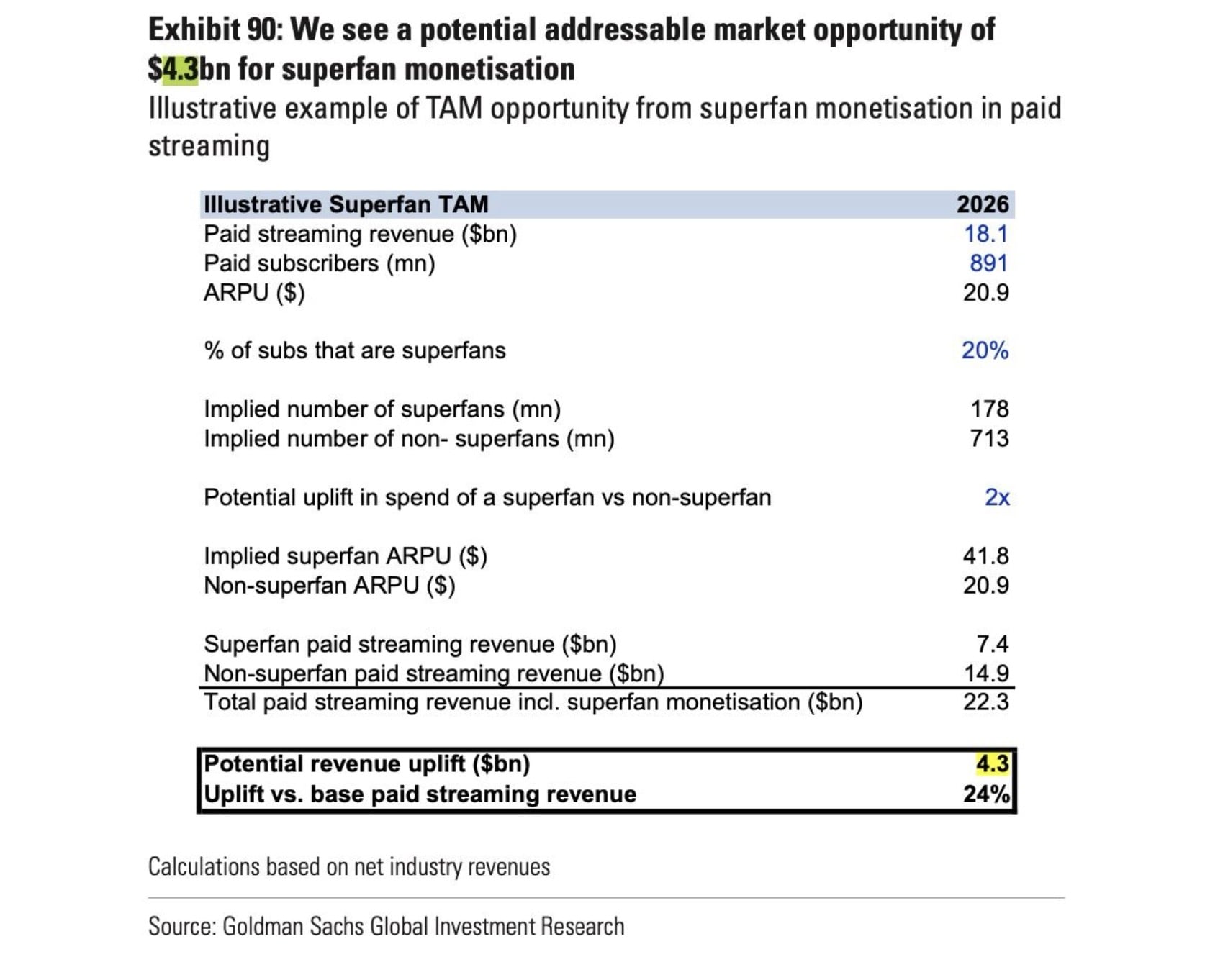
Goldman Sachs identifies superfan monetization as a significant opportunity for the music industry, estimating a potential annual revenue uplift of $4.3 billion based on 2026 projections.
The analysis assumes that 20% of paid streaming subscribers can be defined as superfans and that these users would spend twice as much as average subscribers, based on Luminate‘s finding that 20% of US music listeners are considered superfans.
“Goldman estimates a potential annual revenue uplift of $4.3 billion based on 2026 projections.”
“According to Luminate, super fans in the US spend 66% more on live music than the average music listener, and 2x as much on physical purchases,” the report notes.
Goldman points to Tencent Music’s Super VIP tier as an example of a successful superfan tier, which “costs c.2.5x as much as the premium subscription” and has seen strong adoption, with penetration reaching 12% of TME’s subscriber base in Q1 2025.
Credit: SOPA/Alamy
4. MUSIC STREAMING PRICES WILL CONTINUE RISING WITH REGULAR INCREASES EXPECTED
Goldman Sachs expects music streaming services to implement regular pricing increases, with second rounds of price hikes typically occurring 12-18 months after initial increases.
“Through 2023, all major streaming platforms have implemented their first-ever comprehensive price increases across standard and family plans. These appeared to have had little or no impact on subscriber growth and churn rates,” the report states.
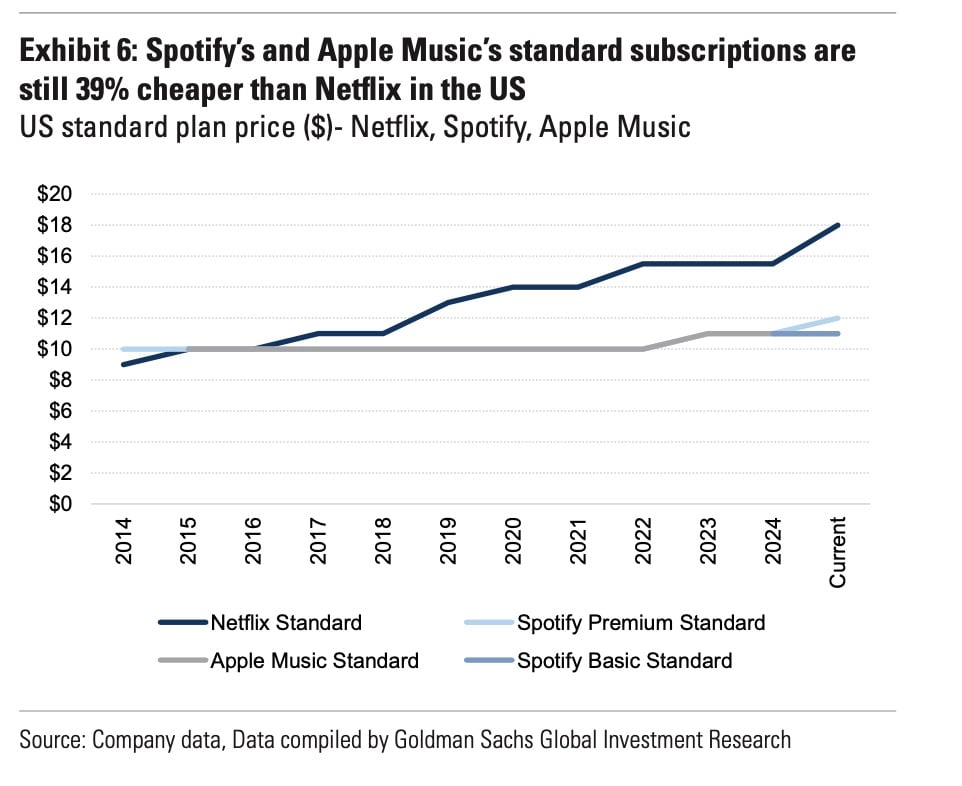
The investment bank believes music streaming remains attractively priced compared to other entertainment services, noting that “Spotify‘s and Apple Music‘s standard subscriptions are still 39% cheaper than Netflix in the US” and “in the US, the average spend per paid music streaming account is around $14 per month.
This compares to an average spend per month of $69 for SVOD users, with the average consumer having 4 SVOD services.”
Credit: NicoElNino/Shutterstock
5. EMERGING MARKETS WILL DRIVE 75% OF SUBSCRIBER GROWTH BY 2035
Goldman forecasts that emerging markets will become the dominant driver of music streaming growth, accounting for 75% of net subscriber additions by 2035, up from 57% in 2024.
“Emerging markets have become the major driver of subscription growth, accounting for over half of new subscribers since 2021 (on our estimates), including nearly 60% in 2024, although penetration remains at only 8% of the internet population,” the report states.
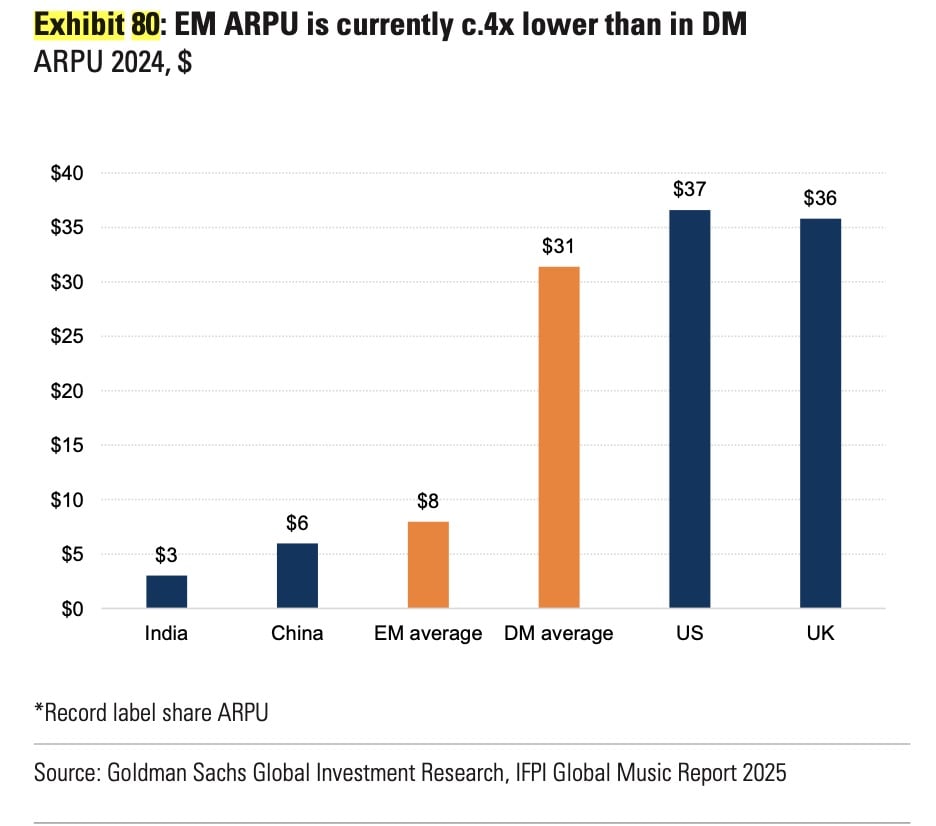
However, emerging markets will continue to contribute a smaller share of streaming revenue due to lower average revenue per user (ARPU) each year.
Goldman calculates – based on IFPI figures – that annual ’emerging market’ ARPU sat at around USD$8 in 2024, compared to USD$31 in ‘developed’ markets.
(These numbers will be impacted by telco deals, multi-user subscription bundles etc.)
The analysis highlights China as a key market, where “Tencent Music’s paying ratio has increased significantly since 2018” from 4.2% to 21.5% in 2024, and India with an estimated “20 million paid users across all streaming services out of a total MAU of [circa] 200 million users in 2023.”
Photo credit: Phonlamai Photo/ Shutterstock
6. AI’s IMPACT ON MUSIC UPLOADS and the industry’s revenue pool APPEARS LIMITED SO FAR
Despite concerns about artificial intelligence flooding streaming platforms with generated content, Goldman Sachs’ report notes that “the total number of tracks uploaded daily decreased YoY for the first time in 2024 (citing Luminate data) in spite of the rising availability of AI-powered music apps to generate songs.”
The bank’s analysis suggests AI’s impact on the music industry revenue pool remains minimal, with industry checks suggesting “AI music accounts for 0.1% of the royalty pool.”
“Ongoing concerted efforts among the large music players are necessary to further evolve royalty payment structures and protect music copyrights.”
Some platforms are seeing significant AI content, however. “Deezer disclosed in April 2025 that [over] 20,000 AI-generated tracks were uploaded to its platform daily (representing 18% of all tracks), double the 10k disclosed in January 2025,” while “Sony Music disclosed that it has taken down [over] 75,000 AI deepfakes based on its artists, heavily skewed towards its most popular artists.”
Goldman emphasizes that “ongoing concerted efforts among the large music players are necessary to further evolve royalty payment structures and protect music copyrights.”
7.Goldman Sachs expects the global value of Live music to accelerate
Goldman Sachs expects live music to be a key growth driver, forecasting 10.0% growth in 2025 following 4.4% growth in 2024.
The bank has raised its long-term outlook for the sector, now expecting a 7.2% compound annual growth rate between 2024-2030, up from 6.7% previously.
Live music revenues are projected to grow from $34.6 billion in 2024 to $38.2 billion in 2025, $52.6 billion in 2030, and $67.1 billion in 2035.
“We see a robust demand and supply outlook for the live music industry, with upside from increased integration of live music ticketing with streaming services”.
“The Live Music industry should benefit from an increasing supply of diverse & popular artists touring over the next decade” driven by “stronger financial incentives to tour as tours make up a higher percentage of artist income,” the report states.
Goldman Sachs highlights demographic trends as particularly supportive, noting that “the rise of Millennials & Gen Z fans” who “place the highest relative importance on live experiences vs prior generations” will drive growth as these cohorts see their “income, wealth and spending power as a group grow rapidly over the next several years.”
The bank also notes strong pricing power, with “average ticket prices” rising 40% for stadiums and 37% for clubs between 2019-2024, while emphasizing that live music has “proven to be more recession resilient than other forms of entertainment.”
Goldman Sachs’ analysts said that they “see a robust demand and supply outlook for the live music industry, with upside from increased integration of live music ticketing with streaming services”.
Reservoir (Nasdaq: RSVR) is a publicly traded, global independent music company with operations across music publishing, recorded music, and artist management.
It was early morning in Kabul, Afghanistan, when Fatima Amiri first heard the gunshots from inside her classroom. She and hundreds of other students had been preparing for college entrance exams at the time, but then the girls began screaming in panic. Amiri swiftly stood up to calm the class down, but when she turned around, she saw a man with a gun deliberately firing at students.
“I was afraid; I tried to take shelter under the desks when an explosion happened,” the 17-year-old said.
Amiri lost an eye and an eardrum as a result of the explosion. Her jaw was also badly damaged. In all, 54 other students, mostly girls, were killed.
As a minority, Shiites in Afghanistan have been targeted and persecuted for a long time.
Amiri lives in the Dasht-e-Barchi vicinity, a predominantly Shiite neighborhood in western Kabul city. Terrorists have been targeting Shiite mosques, schools, athletic clubs, and cultural centers. A horrific assault on a maternity ward in 2020 killed 20 civilians, including women and their newborn babies.
Amiri knew attending school from a security perspective was risky. However, she never thought that one day a terrorist would be trying to kill her inside a classroom.
Undeterred, two weeks after the attack, Amiri showed up for a university entrance exam and was declared one of the top scorers.
“I want to tell the terrorists that no matter how much oppression you would impose on us, you can’t defeat us!” Amiri said. “Your attacks inspire us to rise again and again.”
The UN Security Council and other world leaders condemned the attack on the Kaaj education center in Kabul, where Amiri went for two years to prepare for the university entrance exam, but no robust security measures had been taken by the political regimes in Afghanistan to ensure the safety of the Shiites who now feel more marginalized under the Taliban.
In recognition of her courage and resilience, the BBC placed Amiri on a list of 100 inspiring and influential women from around the world for 2022.
The attack came in the wake of a ban by the Taliban on girls schools beyond the sixth grade in Afghanistan after the group swept into power in the summer of 2021. But young Afghans like Amiri are still hopeful that the international community will put pressure on Taliban leaders to respect the right of girls to education and the right of women to work.
“I appeal to the international community to do something for Afghan women and girls,” she said. “Hear their voice and take action. It’s almost two years now that schools are closed for girls. There is the possibility that the university will be closed too. Currently, the situation is hard. Afghan women and girls can’t work.”
Amiri’s prediction of a restriction on higher education for girls was proved right after the Taliban imposed a complete ban on women’s access to university on Dec. 20. Five days later, the regime also ordered nongovernmental organizations to stop women from coming to work. Although the ban on women’s access to education and work sparked strong condemnation from the international community, Taliban leaders have said that they will not compromise.
Your guide to what Trump’s second term means for Washington, business and the world
Donald Trump has described Xi Jinping as “extremely hard to make a deal with” as the two countries face off over claims from the US that China is reneging on a trade truce signed in Geneva last month.
“I like President Xi of China, always have, and always will, but he is VERY TOUGH, AND EXTREMELY HARD TO MAKE A DEAL WITH!!!” the US president said on his Truth Social platform.
It was not immediately clear if Trump’s comments were in response to recent direct contact with Xi.
The comments follow accusations from Washington last week that China is failing to live up to a promise to approve licences for exports of rare earths, leading to shortages that are threatening to shut down parts of US industry.
China in turn accused the US this week of “seriously violating” the trade truce that the two economic powers agreed in Switzerland.
US federal prosecutors have charged two Chinese nationals with smuggling a toxic fungus into the United States, which authorities claim could be turned into a “potential agroterrorism weapon”.
The charges against Jian Yunqing, 33, and Liu Zunyong, 34, two researchers from China, were unsealed by the US Attorney’s Office for the Eastern District of Michigan on Tuesday. The pair face additional charges of conspiracy, visa fraud and providing false statements to investigators.
Prosecutors allege that Liu smuggled the fungus, called Fusarium graminearum, into the US so he could carry out research at a University of Michigan laboratory where his girlfriend, Jian, worked.
Fusarium graminearum causes “head blight”, a disease in crops like wheat, barley, maize and rice, and is “responsible for billions of dollars in economic losses worldwide each year”, according to the charges.
The pathogen also poses a danger to humans and livestock, and can cause “vomiting, liver damage, and reproductive defects”.
Allegedly toxic plant pathogens that a Chinese scientist entered the US with last year, federal authorities said on Tuesday [US District Court For The Eastern District Of Michigan via AP]
The investigation was carried out by US Customs and Border Protection and the FBI, whose mandate includes investigating foreign and economic espionage as well as counterterrorism.
Jian was earlier arrested by the FBI and is due to appear in federal court this week, where her ties to the Chinese government are also under scrutiny at a time of increased paranoia within the US government about possible Chinese infiltration.
Jian allegedly received funding from the Chinese government to carry out research on the same toxic fungus in China, according to the charges.
The Associated Press news agency, citing the FBI, said that Liu was sent back to China from Detroit in July 2024 after airport customs authorities found the fungus in his backpack. He later admitted to bringing the material into the US to carry out research at the University of Michigan, where he had previously worked alongside his girlfriend, the AP said.
During their investigation, the FBI found an article on Liu’s phone titled “Plant-Pathogen Warfare under Changing Climate Conditions”. Messages on the couple’s phones also indicated that Jian was aware of the smuggling scheme, and later lied to investigators about her knowledge.
It is unlikely that Liu will face extradition as the US does not have an extradition treaty with China.
FBI director Kash Patel claimed on X that China was “working around the clock to deploy operatives and researchers to infiltrate American institutions and target our food supply, which would have grave consequences”.
New… I can confirm that the FBI arrested a Chinese national within the United States who allegedly smuggled a dangerous biological pathogen into the country.
The individual, Yunqing Jian, is alleged to have smuggled a dangerous fungus called “Fusarium graminearum,” which is an…
— FBI Director Kash Patel (@FBIDirectorKash) June 3, 2025
The Chinese Embassy in Washington, DC did not immediately respond to a request for comment.
The University of Michigan on Tuesday issued a brief statement condemning “any actions that seek to cause harm, threaten national security, or undermine the university’s critical public mission”.
The case comes just a week after US Secretary of State Marco Rubio pledged to start “aggressively” revoking the visas of Chinese students in the US on national security grounds.
Targeted students include Chinese nationals with ties to the Chinese Communist Party (CCP), an institution that counts about 100 million members. While some Chinese may join for ideological reasons, membership in the CCP comes with perks like access to better jobs and educational opportunities.
It is not uncommon for students from elite backgrounds, like those studying in the US, to also be members of the CCP.
China’s Ministry of Foreign Affairs has previously pledged to “firmly safeguard the legitimate rights and interests” of its students studying overseas following news of the visa crackdown.