

2.2 C
New York
Sunday, March 29, 2026
Home Blog Page 683

Music Business Worldwide and Luminate Host Music Leaders’ Dinner at SXSW London Gallery

0

An array of UK and international music industry leaders joined Music Business Worldwide and co-host Luminate at a special event at SXSW London on Thursday (June 5).

The Music Leaders’ Dinner at Little House, Mayfair was an intimate gathering of around 60 executives and entrepreneurs.

Influential figures from recorded music, music publishing, artist management, rights management, finance, and more attended the mixer, including many who had flown in from the US, Europe, and elsewhere.

Luminate CEO Rob Jonas and MBW founder/publisher Tim Ingham jointly hosted the dinner.

Guests included: Adrian Sarosi (Luminate), Alec Boateng (0207 Def Jam/EMI), Alexandra Hannaby (Big Machine), Amy Thomson (ATM Catalog Management), Ben Katovsky (Recognition), Bill McGoey (TikTok), Charles Goldstuck (Goldstate), Colin Batsa (EDA), David Willie (MAIA Universe), Dan Chalmers (YouTube), Daniel Glass (Glassnote), David Ventura (Sony Music Publishing), Dickon Stainer (Universal Music UK), Dipesh Parmar (Columbia UK), Drew Hill (Proper), Emmy Lovell (SoundCloud), Fred Davis (Raine), Giorgio D’Ambrosio (Amuse), Gideon Mountford (Believe), Glyn Aikins (RCA UK), Hannah Karp (Billboard), Hannah Moradi (Luminate), Howard Corner (ADA), Ian McAndrew (Wildlife), James Blake, Jamie Oborne (Dirty Hit), Jennifer Breithaupt (All&), Jim Chancellor (Virgin Music Group), Joe Puthenveetil (Raine), Jonathan Dickins (September Management), Kat Bassett (MBW), Kim Frankiewicz (Concord), Marie Clausen (Ninja Tune), Mark Collen (Night Manager), Mark Krais (Bray & Krais), Matt Spetzler (Jamen), Max Lousada, Merck Mercuriadis (Hipgnosis), Michael Adex (NQ), Murray Stassen (MBW), Nick Raphael (NWS), Niclas Molinder, Oscar Hoglund (Epidemic Sound), Paul Hitchman (AWAL), Paul Redding (Beggars), Per Sundin (Pophouse), Pete Simmons (UMPG), Sam Eldridge (UROK), Shani Gonzales (Warner Chappell), Simon Lai (Coutts), Tim Major (Sony Music Publishing), Yonas Aregai (Goldstate).

Tim Ingham, MBW’s founder/publisher, said: “A great night with unanimously great people. And a room full of laughter! Looking forward to the next one.”

Rob Jonas, CEO of Luminate, said: “We had the idea to host this dinner and wondered who would attend. The answer was – everyone. For some, this was the first time reconnecting in person since the pandemic, at a time when discussion and collaboration is more important than ever.”

See a gallery of snaps from the dinner below, all courtesy of PhotographerLondon.


Music Business Worldwide

Largest Drone Attack by Russia Targets Ukraine’s Kharkiv

0

Paul Adams

Diplomatic correspondent

Watch: Firefighters battle flames after Kharkiv apartments hit by Russian strikes

Russian has launched a massive drone attack on Ukraine’s second-largest city, the mayor of Kharkiv has said, killing at least three and injuring a further 21.

Ihor Terekhov said that overnight Russia launched 48 drones, two missiles and four gliding bombs in an attack he described as “open terror”.

It comes after a massive wave of drones and missiles struck across Ukraine on Thursday night. Moscow said the strikes were in response to “terrorist attacks by the Kyiv regime”, following Ukraine’s surprise raids on Russian air bases last Sunday.

Meanwhile, Russian and Ukrainian officials released conflicting accounts about when a prisoner swap agreed at earlier talks will take place.

Some 18 apartment buildings and 13 other homes in Kharkiv were hit overnight during Friday’s attack, the city’s mayor said. A baby and a 14 year-old girl were among the injured, he added.

One civilian industrial facility was attacked by 40 drones, one missile and four bombs, Kharkiv governor Oleh Syniehubov said, adding that there may still be people buried under the rubble.

Two people were also killed in Russian strikes on Kherson, in southern Ukraine, local authorities said.

Ukrainian Foreign Minister Andriy Sybiha urged allies to increase pressure on Moscow and to take “more steps to strengthen Ukraine” in response to Russia’s latest attacks.

Six people were killed and 80 injured across Ukraine the previous night, when Russia attacked the country with more than 400 drones and nearly 40 missiles.

EPA Black smoke billows out over the Kharkiv skyline from a large building that appears bombed out.EPA

Kharkiv, located close to the Russian border, has been subjected to continuous Russian strikes

Ukrainian President Volodymyr Zelensky said his Russian counterpart Vladimir Putin was “buying himself time to keep waging the war”, and that “pressure must be applied” to stop the attacks.

During the latest round of direct talks in Istanbul earlier this week, the two warring sides agreed to exchange all sick and heavily wounded prisoners of war, those aged under 25, as well as the bodies of 12,000 soldiers.

Moscow’s chief negotiator at the meeting, Vladimir Medinsky, claimed on Saturday that Ukraine had “unexpectedly postponed both the acceptance of bodies and the exchange of prisoners of war for an indefinite period”.

He further claimed that the bodies of more than one thousand slain Ukrainian soldiers had been taken to an agreed exchange point but that Ukrainian officials never arrived.

A list of 640 prisoners of war had also been handed to Ukraine “in order to begin the exchange”, Medinsky wrote on social media.

Ukrainian officials responded angrily to the allegations, telling Russia to “stop playing dirty games”.

Reuters Firefighters attempt to put out a blaze at a building hit by a Russian drone strikeReuters

Kharkiv’s mayor said 18 apartment buildings and 13 other homes had been hit overnight

A statement from Ukraine’s Coordination for PoWs office said that the comments “do not correspond to reality or to previous agreements”.

The Coordination HQ said both sides had been working on preparations for the exchange over the past week and alleged that Russia was not sticking to the agreed parameters of the swap.

It added that Ukraine had submitted its PoW lists according to the “clearly defined categories” of the deal, but that Russia had submitted “alternative lists that do not correspond to the agreed-upon approach”.

While an agreement on the repatriation of bodies had been reached, a date had not been set, Ukraine said, with Russia taking “unilateral steps that had not been coordinated”.

The barrages over the past two nights came after Ukrainian drone strikes targeted Russian strategic warplanes at four air bases deep inside Russia.

Ukraine’s security service SBU said at least 40 Russian aircraft were struck during the so-called “Operation Spider’s Web” last Sunday.

Ukraine says it used 117 drones that were first smuggled into Russia, then placed inside wooden cabins mounted on the back of lorries and concealed below remotely operated detachable roofs.

The lorries were then apparently driven to locations near the Russian air bases by drivers who were seemingly unaware of their cargo. The drones were then launched remotely.

US President Donald Trump said on Friday that the Ukrainians had given Putin “a reason to go in and bomb the hell out of them last night”.

He earlier said that during a phone call, Putin had told him “very strongly” that Moscow would “have to respond” following Ukraine’s airfield attacks.

Russia launched a full-scale invasion of Ukraine in February 2022. It currently controls around 20% of Ukrainian territory, including the Crimean peninsula it annexed in 2014.

Peace talks between the two sides have so far failed to secure a ceasefire, and both sides remain deeply divided on how to end the war, with Ukraine pushing for an “unconditional ceasefire” as a first step, something Russia has repeatedly rejected.

Additional reporting by Jaroslav Lukiv and Vitaliy Shevchenko

Private equity firms revamp exit strategies in response to IPO market closure

0

Unlock the White House Watch newsletter for free

Private equity groups are overhauling their exit strategies after accepting that a years-long downturn in initial public offerings is unlikely to end soon.

Buyout executives at the industry’s annual European conference this week said they were prioritising other options for exiting their investments, including breaking up businesses to sell them off in smaller parts or selling companies to themselves via “continuation funds”.

“I can’t remember in my 20 years of growth equity investing, not having an IPO window open for this kind of long period of time,” said General Atlantic co-president Gabriel Caillaux at the Berlin SuperReturn event. “That is obviously calling us to rethink not strategy, but some tactical aspects.”

Buyout firms have a record backlog of ageing and unsold assets, as higher interest rates and market turmoil have made it harder to float companies or sell at acceptable prices, putting pressure on them to find other ways to return cash to their investors.

The volume of private equity-backed IPOs has slumped since the frenzy of 2021, with only nine across Europe and the US this year compared with 116 in the same period in 2021, according to Dealogic.

The head of private equity at a large international firm said IPOs now ranked behind break-ups and minority stake sales as an exit option.

“The IPO is number three on the list these days,” they said.

Permira in January sold a minority stake in its €2.2bn luxury sneaker company Golden Goose after abandoning an IPO. EQT, which was last year reported to be considering a listing for its schools business Nord Anglia, eventually cashed out its older fund by selling to a consortium that included one of its newer funds.

Sellers were increasingly securing sales by offering buyers greater protection against risks, including through earnouts — where part of the price is linked to future performance, the private equity executive said. “The toolbox is really being opened now,” they added.

Executives had hoped the election of US President Donald Trump would lead to a revival in IPOs, but instead his policy volatility has closed the capital markets to most potential issuers.

In March, Permira and Hellman & Friedman postponed a planned IPO of US software group Genesys, while Bain Capital and Cinven did the same with their listing of German pharmaceuticals company Stada.

The head of private equity at a large global asset manager said that in the wake of Trump’s April 2 tariff announcements, listings were “gone”.

A top dealmaker at another of the world’s largest private capital firms said “the only thing that’s worse” than the current IPO market was “the perception of how strong it was supposed to be compared to how it’s turned out”.

Structural changes in the markets were also making it harder to list businesses, they added, including the rise of passive exchange traded funds that do not typically buy IPOs.

Daniel Lopez-Cruz, head of private equity at Investcorp, said the IPO market “for all intents and purposes is closed for private equity companies”.

The secondary market — where buyout firms sell assets to themselves with so-called continuation funds, or investors in private equity funds sell on their stakes in those funds — had become “a great help”, he said.

Continuation vehicles have soared in popularity in recent years as a means to return cash to fund investors. Private capital firms sold $75bn of assets on the secondary market last year, up 44 per cent from the previous year, according to Jefferies. The vast majority of that went into continuation funds.

Some executives remained positive about the possibility of IPOs making a comeback, however.

“Things can change very, very fast,” said the head of a major European buyout firm. “We have businesses in our pipeline that we’re considering IPOs for in nine or 12 months. It’s about being well prepared and going for it when you can.”

Tragic Halloween Crowd Surge in Seoul Leaves More Than 100 Dead

0

Janelle Story, 35, told BuzzFeed News she was going on a bar crawl when she came across the crowds in the street. By 8:30 p.m., Story, an American who lives in Seoul, said the area was already full of people. “Even just getting out of the subway station was intimidating,” she said via Twitter messages early Sunday. “It took 20 minutes to exit the station.”

As she was moving from bar to bar near Hamilton Hotel, she said the crowds were packed tightly together, but nothing at that point seemed to be dangerous.

“Even though I was uncomfortable, no one was ‘out of control,'” she said. “We were all just moving very slowly and orderly.”

But then around 10:30 p.m., Story said she started to feel more panicked by the situation as she was capturing footage of the scene, which she posted to Twitter.

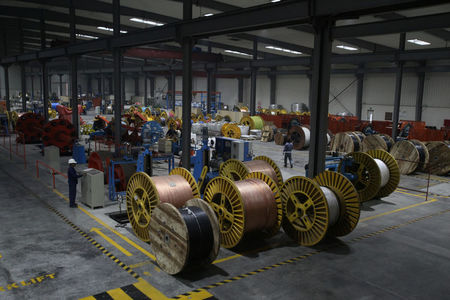
UBS predicts timing for equipment makers to benefit from upcoming copper projects

0


What are next big copper projects? UBS tells when equipment makers could benefit

High School Players of the Year in 2024

0

SHAE WOZNIAK
Conestoga High School
Senior – Midfield/Forward

32 goals, 22 assists (Career: 139 goals, 60 assists)


AAA First Team All-State
First Team Central League
Daily Local News All-Area First Team
All-Main Line First Team
MAXFH All-American First Team
MAXFH Pennsylvania Region First Team
NFHCA First Team All-American
NFHCA All-Pennsylvania First Team
MAXFH HSNI All-Tournament First Team
MAXFH Preseason Player to Watch

ICE conducts raids in Los Angeles with goal to deport one million within a year

0

Nayna Gupta of American Immigration Council says US authorities go after non-citizens to rack up their arrest numbers.

The Implications of Elon Musk’s Conflict with Trump on Tesla Investors

0

© 2025 Fortune Media IP Limited. All Rights Reserved. Use of this site constitutes acceptance of our Terms of Use and Privacy Policy | CA Notice at Collection and Privacy Notice | Do Not Sell/Share My Personal Information
FORTUNE is a trademark of Fortune Media IP Limited, registered in the U.S. and other countries. FORTUNE may receive compensation for some links to products and services on this website. Offers may be subject to change without notice.

Success rate of blood clot removal improves with new device

0

When trying to remove life-threatening clots from blood vessels, current technologies are successful on only about half of the first attempts – if at all. A new surgical tool, however, is claimed to boost that figure to an astounding 90%.

Although blood clots are partially made up of red blood cells, they’re held together by tangles of a thread-like protein known as fibrin. Existing clot-removal treatments typically involve inserting a device into the affected blood vessel via a catheter, then using that device to either suck up the fibrin clump or snare it then drag it out.

Whichever the case, the fibrin often gets inadvertently broken up in the process, with some of the pieces proceeding to travel down the blood vessel. Those fragments could ultimately form into new blood clots, in locations that are more difficult to reach.

That’s where the milli-spinner comes in.

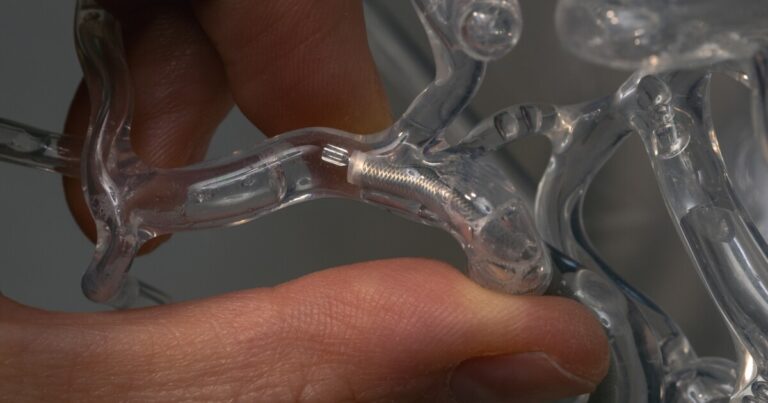
Developed by Asst. Prof. Renee Zhao, Assoc. Prof. Jeremy Heit and colleagues at Stanford University, the catheter-delivered device takes the form of a rapidly rotating tube with a series of fins and slits at the tip. As that tip spins near the clot, it creates both compressive and shear forces.

Jeremy Heit (left) and Renee Zhao demonstrate how to insert the milli-spinner using a life-sized model of the human circulatory system

Aaron Kehoe

The compressive force presses the fibrin threads together as they’re sucked up against the open end of the tube, while the shear force rolls them up into a small, tight, fully intact ball. That ball is then easily and completely removed via suction. The freed-up red blood cells get carried away by the bloodstream.

In blood-vessel-model and live pig tests, the milli-spinner was able to reduce the volume of clots by up to 95%, allowing for successful clot removal on approximately 90% of first attempts. This would constitute a huge life-saving difference when treating clot-related conditions such as stroke and heart attack.

“It works so well, for a wide range of clot compositions and sizes,” says Zhao. “Even for tough, fibrin-rich clots, which are impossible to treat with current technologies, our milli-spinner can treat them using this simple yet powerful mechanics concept to densify the fibrin network and shrink the clot.”

The scientists have now started a spinoff company to commercialize the technology, which they believe could be adapted to treat other conditions such as kidney stones.

A paper on the research was recently published in the journal Nature.

Source: Stanford University

Deceiving the Palace of Versailles: The Furniture Scam

0

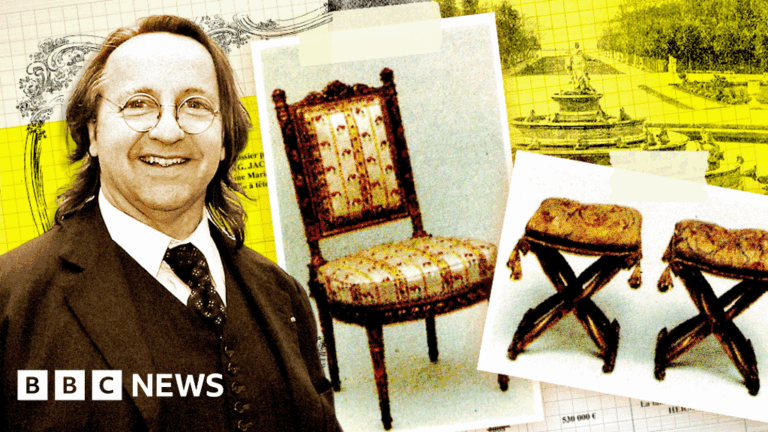
BBC A collage featuring Bill Pallot wearing round glasses and a dark three-piece suit, a picture of a forged chair that looks as if it's been taped to the collage, a picture of two forged stools that have also been taped to the collage - all imposed on a yellow background featuring a water fountain in the gardens of Versailles Palace.BBC

In the early 2010s, two ornate chairs said to have once belonged on the grounds of the Palace of Versailles appeared on the French antiques market.

Thought to be the most expensive chairs made for Marie Antoinette, the last queen of France’s Ancien Régime, they were stamped with the seal of Nicolas-Quinibert Foliot, a celebrated cabinet maker who worked in Paris in the 1700s.

A significant find, the pair were declared “national treasures” by the French government in 2013, at the request of Versailles.

The palace, which displays such items in its vast museum collection, expressed an interest in buying the chairs but the price was deemed too dear.

They were instead sold to Qatari Prince Mohammed bin Hamad Al Thani for an eye-watering €2m (£1.67m).

The chairs made up a remarkable number of 18th-Century royal furniture that had appeared on the antiques market in the past few years.

Other items included another set of chairs purported to have sat in one of Marie Antoinette’s chambers in Versailles; a separate pair said to have belonged to Madame du Barry, King Louis XV’s mistress; the armchair of King Louis XVI’s sister, Princess Élisabeth; and a pair of ployants – or stools – that belonged to the daughter of King Louis XV, Princess Louise Élisabeth.

Most of these were bought by Versailles to display in its museum collection, while one chair was sold to the wealthy Guerrand-Hermès family.

But in 2016, this assortment of royal chairs would become embroiled in a national scandal that would rock the French antiques world, bringing the trade into disrepute.

The reason? The chairs were in fact all fakes.

The scandal saw one of France’s leading antiques experts, Georges “Bill” Pallot, and award-winning cabinetmaker, Bruno Desnoues, put on trial on charges of fraud and money laundering following a nine-year investigation.

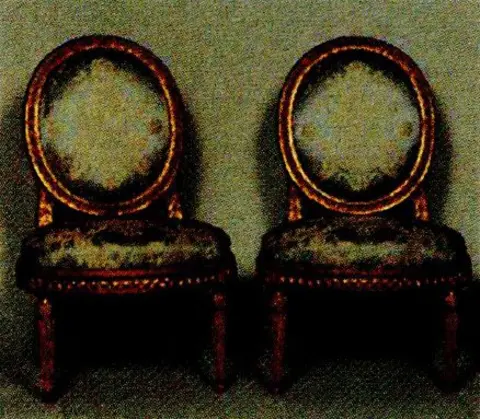
Supplied Grainy picture of two upholstered 18th-Century style chairs that were falsely sold as items that once belonged to Madame du Barry.Supplied

A print out of a court document shows two chairs said to have belonged to Madame du Barry, the mistress of King Louis XV, which sold for €840,000 in 2008

Galerie Kraemer and its director, Laurent Kraemer, were also accused of deception by gross negligence for selling on some of the chairs – something they both deny.

All three defendants are set to appear at a court in Pontoise, near Paris on Wednesday following a trial in March. Mr Pallot and Mr Desnoues have admitted to their crimes, while Mr Kraemer and his gallery dispute the charge of deception by gross negligence.

It started as a ‘joke’

Considered the top scholar on French 18th-Century chairs, having written the authoritative book on the subject, Mr Pallot was often called upon by Versailles, among others, to give his expert opinion on whether historical items were the real deal. He was even called as an expert witness in French courts when there were doubts about an item’s authenticity.

His accomplice, Mr Desnoues, was a decorated cabinetmaker and sculptor who had won a number of prestigious awards, including best sculptor in France in 1984, and had been employed as the main restorer of furniture at Versailles.

Speaking in court in March, Mr Pallot said the scheme started as a “joke” with Mr Desnoues in 2007 to see if they could replicate an armchair they were already working on restoring, that once belonged to Madame du Barry.

Masters of their crafts, they managed the feat, convincing other experts that it was a chair from the period.

And buoyed by their success, they started making more.

Foc Kan/WireImage/Getty Images Bill Pallot poses for a photo next to an artwork at a gallery exhibition in Paris in April. He wears a three-piece dark suit, round-rimmed spectacles and has shoulder-length hair.Foc Kan/WireImage/Getty Images

Bill Pallot was photographed at an art exhibition opening in Paris in April following his trial

Describing how they went about constructing the chairs, the two described in court how Mr Pallot sourced wood frames at various auctions for low prices, while Mr Desnoues aged wood at his workshop to make others.

They were then sent for gilding and upholstery, before Mr Desnoues added designs and a wood finish. He added stamps from some of the great furniture-workers of the 18th Century, which were either faked or taken from real furniture of the period.

Once they were finished, Mr Pallot sold them through middlemen to galleries like Kraemer and one he himself worked at, Didier Aaron. They would then get sold onto auction houses such as Sotheby’s of London and Drouot of Paris.

“I was the head and Desnoues was the hands,” Mr Pallot told the court smilingly.

“It went like a breeze,” he added. “Everything was fake but the money.”

Prosecutors allege the two men made an estimated profit of more than €3m off the forged chairs – though Mr Pallot and Mr Desnoues estimated their profits to be a lower amount of €700,000. The income was deposited in foreign bank accounts, prosecutors said.

Getty Images Bruno Desnoues poses next to a reconstructed door wearing a check shirt and with his face leaning on one hand.Getty Images

Bruno Desnoues pictured in 2000 after winning the prestigious Lilianne Bettencourt prize for “intelligence of the hand”

Lawyers representing Versailles told the BBC that Mr Pallot, a lecturer at the Sorbonne, managed to deceive the institution because of his “privileged access to the documentation and archives of Versailles and the Louvre Museum as part of his academic research”.

A statement from lawyer Corinne Hershkovitch’s team said that thanks to Mr Pallot’s “thorough knowledge” of the inventories of royal furniture recorded as having existed at Versailles in the 18th Century, he was able to determine which items were missing from collections and to then make them with the help of Mr Desnoues.

Mr Desnoues also had access to original chairs he had made copies of, they added, “enabling him to produce fakes that had all the visual appearance of an authentic, up to the inventory numbers and period labels”.

“The fraudulent association between these two professionally accomplished men, recognised by their peers, made it possible to deceive the French institutions that regarded them as partners and to betray their trust, thereby damaging the reputation of Versailles and its curators,” they said.

Prosecutor Pascal Rayer said the trial highlighted the need for more robust regulation of the art market, and also shone a light on the standards antiques dealers should abide by.

The court heard authorities were alerted to the scheme when the lavish lifestyle of a Portuguese man and his partner caught the attention of French authorities.

Questioned by police about the acquisition of properties in France and Portugal worth €1.2m while on an income of about €2,500 a month, the man – who it turned out worked as a handyman in Parisian galleries – confessed to his part in working as a middleman who collaborated in the furniture fraud, AFP news agency reported. The money trail then led investigators to Mr Desnoues and Mr Pallot.

A case of deceit by gross negligence?

Charges against some of those originally indicted in the case, including middlemen, were later dropped.

But charges against both Laurent Kraemer and Galerie Kraemer, which sold on some of the forged chairs to collectors such as Versailles and Qatar’s Prince al-Thani, were upheld.

Prosecutors allege that while the gallery itself may have been duped into first buying the fake pieces, Mr Kraemer and the gallery were “grossly negligent” in failing to sufficiently check the items’ authenticity before selling them on to collectors at high prices.

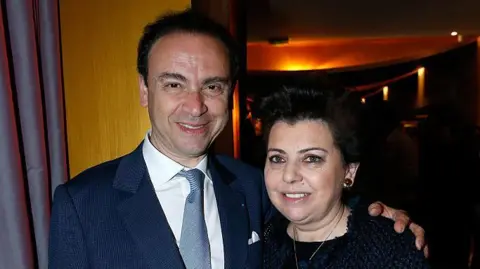
Getty Images Laurent Kraemer has his arm around his wife Nicole as they pose for a photo at an event in 2016.Getty Images

Laurent Kraemer and his wife Nicole at a cocktail party in 2016

In his closing arguments, prosecutor Mr Rayer said that based on Galerie Kraemer’s “reputation and contacts, they could have taken the furniture to Versailles or the Louvre to compare them.

“They could also have hired other experts given the amounts at stake and considering the opacity on the origin of the chairs.”

Speaking in court, a lawyer representing Mr Kraemer and the gallery insisted his client “is victim of the fraud, not an accomplice”, stating Mr Kraemer never had direct contact with the forgers.

In a statement to the BBC, lawyers Martin Reynaud and Mauricia Courrégé added: “The gallery was not an accomplice of the counterfeiters, the gallery did not know the furniture was fake, and it could not have detected it”.

“Like the Château de Versailles and the specialists who classified the furniture as national treasures, the Kraemer gallery was a victim of the forgers,” they added.

“We are waiting for the judgement to recognise this.”

The BBC has contacted Mr Pallot’s lawyer for comment. The BBC was unable to reach Mr Desnoues or his lawyer.