10.9 C
New York
Monday, March 30, 2026
Home Blog Page 666

Maps and Photos of Israel’s Attacks on Iran’s Nuclear Program

0

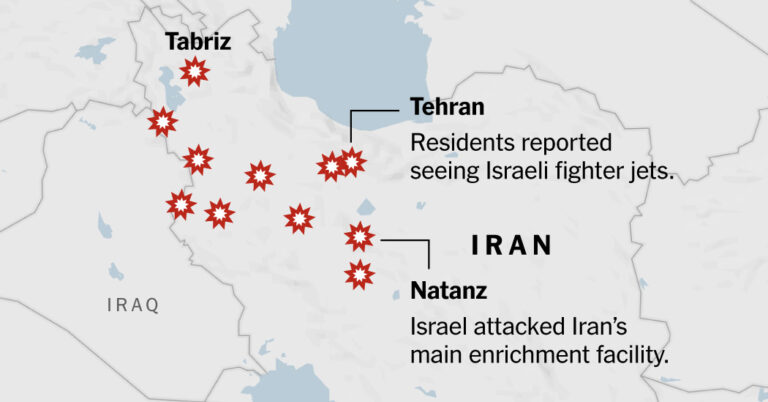
Israel launched a series of strikes against Iran on Friday morning, targeting nuclear sites, missile facilities and other military infrastructure. The strikes were also a major blow to Iran’s chain of command, killing top generals.

Where Israel attacked Iran

Iran vowed a harsh response, and launched at least 100 drones in an initial wave. There were no immediate indications of significant damage caused by the drones, and it was not clear if they succeeded in penetrating Israel’s airspace.

Iran launched retaliatory attacks

Tehran

Residents of the Iranian capital reported hearing huge explosions and seeing Israeli fighter jets. Iranian state television broadcast images of smoke and fire billowing from buildings.

A building in Saadat Abad Street was hit after Israel’s attack in Tehran.

Jrash Khamooshi for The New York Times

Israel attacked military bases around Tehran, including Parchin. Multiple residential buildings were also attacked, including highly secure complexes for military commanders, in what appears to be targeted assassinations, according to four senior Iranian officials.

Natanz nuclear enrichment complex

Social media footage verified by The Times, as well as an Iranian news report, show flames and thick black smoke billowing from the Natanz nuclear enrichment complex.

Natanz is Iran’s main nuclear enrichment facility. It is where Iran has produced the vast majority of its nuclear fuel — and, in the past three years, much of the near-bomb-grade fuel that has put the country on the threshold of building nuclear weapons.

Tabriz

Tabriz, a city located in northern western Iran, was under multiple rounds of attacks on Friday.

Social media footage verified by The Times shows that an airport in the city was hit by Israeli strikes.

Large plumes of thick black smoke were seen over Tabriz as several apparent strikes continued to hit the area.

Fears grew that the long-simmering tensions between the heavily armed rivals could explode into a full-blown regional war.

Videos and Maps Show Israel’s Attacks on Iran

0

Unlock the Editor’s Digest for free

Israel’s strikes on Iran in the early hours of Friday have hit nuclear sites, military bases and weapons facilities across the country.

The co-ordinated assault, Operation Rising Lion, also hit high-security residential compounds home to some of Tehran’s top military generals, an attempt to take out the country’s senior command. The Israel Defense Forces said 100 sites had been targeted so far.

Verified social media footage, photos and official statements from Israel and Iran confirm some of the key locations that have been hit.

Tehran

In the capital, numerous residential buildings were ablaze after being hit by strikes. Verified photos and videos show that in some cases the damage appears confined to one floor. In others, entire buildings appear at risk of collapse.

The strikes assassinated a number of Iran’s top military leaders in the city, including Major General Mohammad Bagheri, chief of staff of the armed forces, Major General Hossein Salami, head of the elite Revolutionary Guards, and General Gholamali Rashid, commander of the Revolutionary Guards’ central headquarters.

Prominent nuclear scientists were also targeted. Mohammad Mehdi Tehranchi, a physics professor, and Fereydoon Abbasi, a former head of Iran’s atomic organisation, were killed, Iran’s state news agency said.

Natanz

Videos show thick black smoke billowing out of a nuclear facility in the central city of Natanz. Much of the infrastructure of the plant, which is the country’s primary uranium enrichment site, is below ground. While Iran says its atomic programme is purely peaceful, Israel has long accused it of seeking to develop nuclear weapons.

On Friday morning, the International Atomic Energy Agency, the UN’s nuclear watchdog, confirmed that the facility in Natanz had been hit, but said Iranian authorities had informed them that there were “no elevated radiation levels”. The Iranian Atomic Energy Organizaton said there had been some radiation and chemical contamination underground.

The IDF said its fighter jets had damaged the underground area of the site containing “a multi-story enrichment hall with centrifuges, electrical rooms, and additional supporting infrastructure”.

Tabriz

Iran has numerous missile and air force facilities in the north-west of the country near the city of Tabriz, in East Azerbaijan province. Videos show multiple fires in nearby hills, with smoke streaming from military facilities.

The city also contains a nuclear research centre, which was reportedly targeted in the barrage.

Subashi radar facility

The Subashi radar base, in Hamadan province in western Iran, is one of the country’s most important air defence facilities. The site is used for detecting and tracking aircraft and helps Iran control its airspace in the region. Videos show smoke billowing from a building reportedly struck by the Israeli missiles.

Piranshahr military facility

Piranshahr Garrison, in West Azerbaijan Province, is situated near Iran’s border with Iraq. The site is part of Tehran’s broader military infrastructure. It is unclear what was targeted at the facility.

A video verified by the FT shows a series of explosions in rapid succession at the site, suggesting an ammunition or missile storage facility could have been hit. Other videos show the garrison on fire.

Kermanshah missile base

The strikes appear to have hit a large underground missile base in the mountains north of the city of Kermanshah. Photos and videos show multiple large fires across hills north of the highway running into the city.

There are several military installations below ground around the city that are a key component of Tehran’s ballistic missile defence system. According to Alma, an Israeli security research non-profit, the mountains are home to “dozens of missile bunkers”.

The IDF has also released footage of the strikes, including videos of the air force reportedly destroying ballistic missiles it said were aimed at Israel.


All-Region Teams for High School in 2024

0


MAX Field Hockey is excited to announce the 2024 High School All-Region Teams!

Congratulations to the selected athletes!

[submit missing photos and updates to admin@maxfieldhockey.com]


2025 MAX Field Hockey/Longstreth High School National Invitational Registration & Applications Now Available!


MAX Field Hockey’s 2024 High School All-Region Teams

MIT’s Water Harvester Extracts Water from Air Passively

0

There are plenty of ways to suck water out of the air, whether you need a little or a lot. Massachusetts Institute of Technology (MIT) researchers may have just hit upon one of the best ways to do it, with a device that doesn’t need power, or even a filter, to deliver drinking water.

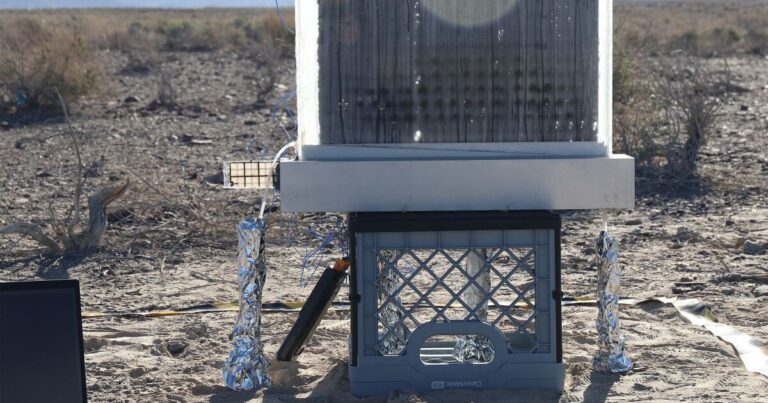
The team’s passive atmospheric water harvester uses a vertical panel of hydrogel that absorbs water vapor from the air. This isn’t entirely new: there have been other contraptions that use hydrogels for the same task.

The MIT engineers had a couple of clever tricks up their sleeve for this one. For starters, the hydrogel is molded to resemble a sheet of bubble wrap, with little ‘domes’ that swell up when they absorb water. That allows for increased surface area and a larger capacity for absorbing water vapor. This material is enclosed in a glass layer coated with a cooling polymer film.

As the captured vapor evaporates, the hydrogel domes shrink back down in an origami-like transformation. The evaporated vapor then condenses on the glass, and flows down through a tube as potable water.

A close-up of the origami-inspired hydrogel material that swells to absorb water from the air

Image courtesy of the researchers

According to the team, micro- or nano-porous hydrogels in other water harvester designs are embedded with salts to increase the materials’ absorption capabilities. These salts can leak out with the collected water, making for an unpalatable drink.

The researchers’ solution to this involves using a hydrogel with a microstructure that lacks nanoscale pores that salt can escape from. Next, they added liquid glycerol to the hydrogel to stabilize the salt, and prevent it from crystallizing and leaking out when water flowed down the tubes.

As a result, the water collected from this device contained less salt than you’d see at the standard threshold for safe drinking water – without an additional filter. With all these features, the MIT team might just have one of the most compelling designs for a passive water harvester out there.

The group tested its window-sized device in California’s arid Death Valley, where it produced between 1.9 and 5.46 fl oz (57 and 161.5 ml) of drinking water per day across a range of humidities. The researchers noted that their invention harvested more water than other passive and even some actively powered designs in the driest conditions they encountered in the valley.

Researchers Shucong Li, “Will” Chang Liu, and Xiao-Yun Yan, with two water harvesters

Image courtesy of the researchers

Now, those quantities aren’t going to go a long way towards quenching anyone’s thirst – so the team believes an array of these vertically hydrogel panels could be deployed in water-scarce regions to deliver larger amounts that could support an entire household.

The researchers conducted this test back in November 2023, and their results appeared in the journal Nature Water earlier this week. They’re now working on improving the material to improve its intrinsic properties.

If you’re curious about other ways to pull water out of thin air, check out this powered option that runs off batteries or solar, this contraption with copper fins, this spongy material made from inexpensive balsa wood, and this coffee maker that has a water harvester built in for some reason.

Source: MIT News

Brittney Griner Admits Guilt in Russia, Receives Note from President Biden

0

Basketball star Brittney Griner pleaded guilty to drug charges in a Russian courtroom on Thursday, but not before she was handed a note from President Joe Biden.

With the hope that a guilty plea might be her best shot at a lenient sentence in what experts fear is a sham trial, the WBNA player admitted to taking hashish oil into Russia by accident because she had been in a hurry when she packed.

“Brittney sets an example of being brave. She decided to take full responsibility for her actions as she knows that she is a role model for many people,” read a statement from Griner’s Russian legal team, Maria Blagovolina from the firm Rybalkin Gortsunyan Dyakin and Alexander Boykov from the Moscow Legal Center.

“Considering the nature of her case, the insignificant amount of the substance and BG’s personality and history of positive contributions to global and Russian sport, the defense hopes that the plea will be considered by the court as a mitigating factor and there will be no severe sentence,” the lawyers said.

The attorneys said they expected Griner’s trial to conclude around the start of August.

Griner has been detained in Russia for more than four months after authorities said they found small amounts of hash oil in vape pens in her luggage.

“Brittney has admitted to making a mistake, and I hope the Russian authorities recognize that humbling act and respond with compassion,” Rev. Al Sharpton said in a statement passed on by Griner’s team.

Sharpton, Britney’s wife Cherelle, and WNBA players will rally on Friday in Chicago to call for her release.

They fear that Griner, who faces a maximum sentence of 10 years, is being used as a bargaining chip by Moscow against Washington amid the fallout from Russia’s invasion of Ukraine.

“She is in the fight of her life right now, which is why we’ll be in Chicago to show our support for Brittney and for the Administration and their efforts to bring her home as soon as possible,” Sharpton said. “We must all continue to pray she finds strength through this challenging time.”

Griner’s guilty plea came a day after Biden and Vice President Kamala Harris called Cherelle Griner to offer assurances that his administration is working to free the basketball star.

That call came after Cherelle Griner criticized Biden for not meeting with her to discuss the case.

As she arrived in court on Thursday, Brittney Griner was given a note from Biden which he had earlier read to her wife over the phone.

The message was in response to one the basketball player had written to the president on July 4, begging for freedom.

“As I sit here in a Russian prison, alone with my thoughts and without the protection of my wife, family, friends, Olympic jersey, or any accomplishments, I’m terrified I might be here forever,” Griner wrote.

Criteo and Dentsu announce global partnership in commerce media

0


Criteo and dentsu form global commerce media partnershi

Scheffler and McIlroy face challenges on opening day of US Open | Golf News

0

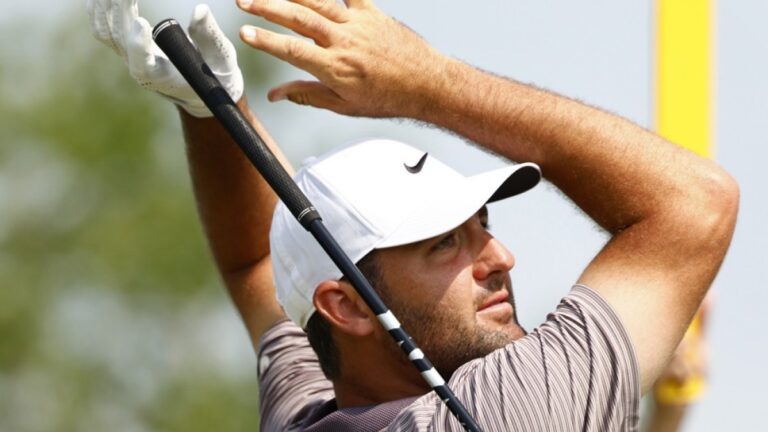
Scottie Scheffler has kept coming back to the same answer when asked in different ways about how a day that began with optimism at the United States Open turned into a five-and-a-half-hour slog that left him well off the front page of the leaderboard.

“I’ve probably got to give myself a few more looks,” the world’s top-ranked player said Thursday after a 3-over 73 left him seven shots behind frontrunner JJ Spaun.

Scheffler was talking about looks for reasonable birdie putts. Those didn’t happen nearly enough during those often arduous hours at the Oakmont Country Club in Oakmont, Pennsylvania. As for plain old “looks”, however, well, the three-time major winner had those in abundance.

Looks of frustration, like when his drive on the par-5 12th landed in the middle of a fairway that slopes massively from left to right and kept rolling, and rolling, and rolling until it was in the first cut of the course’s signature ankle-deep rough.

Looks of bafflement, like when his 1.8-metre (6ft) par putt at the par-3 13th slid by, causing him to put his hand over his mouth and turn to caddie Ted Scott as if to say, “What just happened?”

Looks of anger, like when his wedge from 76 metres (83 yards) on the easy (by Oakmont standards) par-4 14th landed 12 metres (40ft) past the hole. Scheffler slammed the club into the ground before collecting himself to two-putt.

Looks of annoyance, when his 3.7-metre (12ft) birdie attempt at the par-4 17th lipped out. Scheffler bent over, pressed his hands on his knees and appeared to sigh before standing back up.

That doesn’t even include what he described as “sloppy” bogeys on the par-4 third and par-5 fourth when he found the sand off the tee.

Caddie Ted Scott, left, hands a ball to Scottie Scheffler on the first green during the first round of the US Open [Gene J Puskar/AP]

It added up to tying his worst opening round in a major ever. He did that at the 2021 Masters, a year before he began a run of dominance not seen since Tiger Woods’s prime two decades ago. Heck, he even managed a 1-under 69 at Oakmont as a 19-year-old amateur in 2016.

Nine years later, Scheffler’s life is very different. When he walked out of the scoring area in the late spring twilight, his toddler son, Bennett, and wife, Meredith, and other members of his family were waiting.

The course, however, remains the same physically and mentally draining task it has always been.

There’s a reason Scheffler teed off at 1:25pm and didn’t tap in for par on 18 until 6:52pm even though there wasn’t a hint of rain or wind or any other external factors to gum up the works. There was only Oakmont being Oakmont.

The fairways that Spaun navigated to a 4-under 66 in the morning dried up throughout the kind of muggy, sun-baked day that’s been uncommon during Western Pennsylvania’s cool, wet spring.

Scheffler made only two putts over 3 metres (10ft), none over the final seven holes and three-putted the par-3 13th. How? He has no idea. Yet he also knows one middling round doesn’t necessarily ruin his chances of winning the third leg of the grand slam.

Play a little “sharper” in the second round, and he thinks he might be in a better position come the weekend.

“When you’re playing these types of tests that are this challenging, there’s usually still a way to score,” he said.

He might find them sooner rather than later. In each of Scheffler’s 16 PGA Tour victories, he found himself inside the top 30 after 18 holes. He’ll be outside that number when he puts his tee in the ground at No 10 on Friday morning to start his second round.

“I’ll clean up some of those mistakes, a couple three putts and stuff like that,” he said on Thursday. “And I think tomorrow will be a better day.”

Rory McIlroy, of Northern Ireland, prepares to hit from the tall grass on the fourth hole during the first round of the U.S. Open
Rory McIlroy of Northern Ireland prepares to hit from the tall grass on the fourth hole during the first round of the US Open [Seth Wenig/AP]

Rory McIlroy, still looking to regain the form that helped him complete a career Grand Slam at the Masters in April, started on the back nine and made two early birdies to reach the turn just two shots back of Spaun before a wayward second nine.

World number two McIlroy made four bogeys over a seven-hole stretch out of the turn, followed by a double bogey at the par-3 eighth, where he left his tee shot in the thick rough and failed to get out on his first attempt. He signed for a 74.

Defending champion Bryson DeChambeau, one of 14 LIV Golf players in the field and looking to become the first repeat US Open winner since Brooks Koepka in 2018, spent too much time in Oakmont’s penal rough and opened with a 73.

“It was a brutal test of golf. But one that I’m excited for tomorrow,” DeChambeau said.

Novo Nordisk surpasses SAP to become Europe’s top-valued company

0

Novo Nordisk A/S reclaimed its position as Europe’s most valuable public company, overtaking software developer SAP SE. 

Shares in the Danish drugmaker climbed as much as 2.3% on Friday after Novo said it plans to advance its experimental weight management treatment amycretin into late-stage development following feedback from regulatory authorities. 

Novo’s market capitalization stood at $365 billion as of 10:20 a.m. in Copenhagen. That compares with $364.3 billion for SAP, according to data compiled by Bloomberg.

Novo has suffered a series of setbacks since reaching a record high in June of last year, including disappointing clinical trial results for its experimental obesity treatments and mounting competition from US rival Eli Lilly & Co. The drugmaker last month decided to replace Chief Executive Officer Lars Fruergaard Jorgensen.

The shares have been boosted this week following a Financial Times report about activist hedge fund Parvus Asset Management building a stake in Novo, hoping to influence the appointment of the drugmaker’s new CEO. 

This story was originally featured on Fortune.com

Video footage captures explosions and buildings on fire in Tehran, Iran

0

Israel says it has carried out strikes on Iran’s nuclear programme, with explosions seen in the capital city of Tehran.

Security cameras captured the moment a large, bright blast hit the city.

Iran’s state media also showed footage of fires burning in buildings and plumes of smoke rising from the city’s skyline.

People can be seen gathering on streets littered with debris.

Follow our live coverage here.

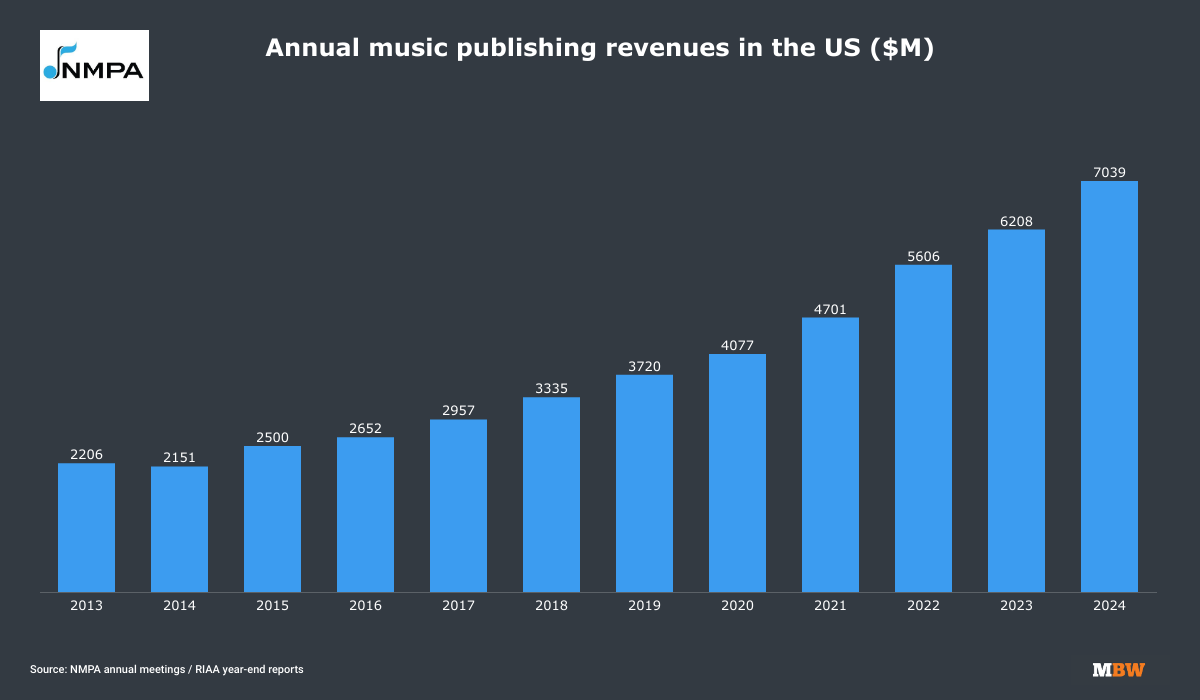
In 2024, US music publishing revenue spiked by 13.4% to reach $7 billion, surpassing the growth rate of recorded music.

0

MBW’s Stat Of The Week is a series in which we highlight a data point that deserves the attention of the global music industry. Stat Of the Week is supported by music data analytics firm Chartmetric.


Given the lacklustre growth in US recorded music revenues last year, it wouldn’t have been a surprise if music publishing revenues also showed signs of weakening.

But that hasn’t happened. New numbers from the National Music Publishers Association (NMPA) show that publishing revenue growth actually accelerated in 2024, compared to the year before, rising 13.41% to $7.039 billion.

That marks a notable increase from the 10.7% growth rate seen in 2023, and it marks the 10th consecutive year of double-digit music publishing revenue growth in the US, NMPA President and CEO David Israelite told the audience at the trade organization’s annual general meeting on Wednesday (June 11).

“To put that in perspective, consider this: Just 10 years ago, the recorded music industry was 220% larger than the music publishing industry. Today, it’s just 60% larger,” Israelite said.


According to the Recording Industry Association of America (RIAA), recorded music wholesale revenues rose 2.7% YoY in 2024, to $11.3 billion – a growth rate that was actually lower than the US’s inflation rate of 2.9% for 2024 – pulled down by declining advertising payouts. Music publishing’s growth rate just about quintupled the growth in recorded music.

(The wholesale figure for recorded music – that is, the money that actually ended up with artists, labels, and distributors – is lower than the headline $17.67 billion that RIAA reported, but it’s the appropriate comparison to the NMPA’s music publishing numbers, as the NMPA reports wholesale publishing revenues.)


So what’s behind publishing’s banner year? Israelite pointed to one key factor: Accelerated efforts at collecting unpaid royalties.

“Just last year, 27% of the total revenue paid to songwriters and music publishers came from sources that originally claimed they did not have to license or pay for songs,” Israelite said.

“We fought, we won, and now nearly $2 billion of our revenue last year came from these sources.”

The double-digit growth came despite a hit to publishers’ and songwriters’ mechanical royalty revenue when Spotify last year reclassified its paid US music subscriptions as “bundles” with audiobooks.

The streaming giant took advantage of a rule in the Copyright Royalty Board (CRB)’s Phonorecords IV regulations that allows digital service providers to pay out a lower mechanical royalty rate from bundled subscriptions than they would from a standalone music subscription. Amazon Music followed suit, shifting its own paying music subscriber base to a bundled service.

NMPA Executive Vice President and General Counsel Danielle Aguirre said Spotify’s move resulted in a loss of $230 million in mechanical royalties in its first year, and could end up costing $3.1 billion by 2032.

That assumes the bundling rule won’t be removed in the CRB’s next rate regulation, Phonorecords V, which has yet to be negotiated and will set mechanical royalty rates for the 2028-2032 period.

“This incredible [revenue] growth story is in spite of the fact that 72% of our revenue is under oppressive government price controls which have denied songwriters and music publishers the true value of their intellectual property.”

David Israelite, NMPA

In the wake of Spotify’s move, the NMPA has been calling on Congress to let music publishers opt out of the Copyright Royalty Board’s mandatory mechanism, and negotiate royalty rates with streaming services “in a free market.”

At the annual general meeting on Wednesday, Israelite renewed his call for a loosening of the regulations that govern music publishing royalties in the US.

“This incredible [revenue] growth story is in spite of the fact that 72% of our revenue is under oppressive government price controls which have denied songwriters and music publishers the true value of their intellectual property,” he said.

As a potential remedy, Israelite urged collective action – not in the sense of songwriters unionizing, but in the sense of rights holders sticking together when negotiating.

“When GMR stands up to the bullies of big radio, we should all stand behind them. When CSAC fights for better rates from Google – one of the largest companies in the history of the planet – we should all stand behind them.

“And while ASCAP and BMI don’t have the power to say no under their consent decrees when they go to rate court to fight for better rates from broadcast radio or satellite radio or live music venues, we should all stand behind them as we continue the fight to get more of your rights in a free market,” he said.

“There is an opportunity to make a meaningful difference in songwriter income if we all stand together, and all of us need to do a better job articulating why we are in these disputes, so that songwriters are armed with the information they need to help themselves… The rates achieved where we are in a free market have a ripple effect on those rates under government control.”


Chartmetric is the all-in-one platform for artists and music industry professionals, providing comprehensive streaming, social, and audience data for everyone to create successful careers in music.Music Business Worldwide