AudioSalad has partnered with Japanese music technology firm RecoChoku as the digital music distributor pushes deeper into the Asian music market.
The deal gives AudioSalad access to RecoChoku‘s local partners and distribution network in Japan as the New York-headquartered company seeks to expand beyond its existing partnership with Japanese rights management firm NexTone.
In December 2023, AudioSalad partnered with NexTone to expand its distribution reach for its Japanese content to a broader worldwide audience.
AudioSalad says since establishing its partnership with NexTone, it has built what it describes as a position in Japan’s distribution, analytics, and supply chain services sector. The RecoChoku deal accelerates that strategy through additional local partnerships, the company said.
The latest partnership comes as Japan’s digital music sector continues evolving as traditional and streaming consumption models blend, according to AudioSalad. Japan was the second-largest music market in 2024, next to the US, according to data from IFPI.
“Japan’s unique music market presents both exciting opportunities and distinct challenges. Our partnership with RecoChoku allows us to address these market dynamics with tailored solutions that honor Japan’s rich musical traditions while embracing digital innovation.”
Iain Catling, AudioSalad
Iain Catling, CEO of AudioSalad, said: “Japan’s unique music market presents both exciting opportunities and distinct challenges. Our partnership with RecoChoku allows us to address these market dynamics with tailored solutions that honor Japan’s rich musical traditions while embracing digital innovation.”
Under the latest partnership, RecoChoku will handle localized support and what RecoChoku General Manager Kaz Aida calls “meticulous distribution operation support services”.
The Tokyo-based company, founded in 2001, offers a digital music distribution service for individuals and companies. Its service offers 26 million tracks for download and streaming across a range of platforms like smartphones, PCs and the Nintendo Switch, according to Crunchbase.
Kaz Aida, General Manager, RecoChoku, said: “This partnership with AudioSalad enables us to realize both comprehensive global-standard distribution asset management and a hybrid form of music distribution with delivery-agency operations.”
“This partnership with AudioSalad enables us to realize both comprehensive global-standard distribution asset management and a hybrid form of music distribution with delivery-agency operations.”
Kaz Aida, RecoChoku
“By adding our meticulous distribution operation support services, we are able to offer each service in an all-in-one manner that meets the needs of rights holders.”
Added the executive: “Our service is designed to solve such challenges and concerns faced by domestic rights holders, and we are very pleased to be able to collaborate with AudioSalad, who shares our vision. We will continue to develop services that cater to the needs of rights holders to achieve our mission of ‘Maximize Music Market’.”
AudioSalad, founded in 2010 by Catling, was acquired by SESAC, the Nashville-headquartered music licensing/collection society, in 2023.
The Israeli military has struck Tehran’s notorious Evin prison and damaged parts of the facility, which holds many political detainees, Iran’s judiciary says.
The judiciary’s Mizan news agency reported that the situation on the ground was “under control” following the attack. CCTV footage showed an explosion at one of the prison’s gates, while state TV pictures showed first responders carrying a casualty and searching for survivors under a flattened building.
Israel’s defence minister said it was hitting “regime targets and agencies of government repression” across Tehran, including Evin.
The military also said it had struck access routes to the Fordo uranium enrichment plant south of Tehran.
It came a day after US aircraft dropped bunker-busting bombs on the underground facility.
Iranian ballistic missiles also struck various locations across Israel on Monday.
One hit an industrial area in the coastal city of Ashdod, close to a power station. Electricity supplies were disrupted in some areas.
Ten days ago, Israel launched a large-scale air campaign against Iran, saying it aimed to remove what it called the existential threats of the country’s nuclear and ballistic missile programmes.
Iran’s health ministry says Israeli strikes have killed around 500 people so far, although one human rights group has put the death toll at 950.
Iranian missile strikes on Israeli cities have killed 24 people, according to Israeli authorities.
Your guide to what Trump’s second term means for Washington, business and the world
The writer is a former senior US National Security Council and state department official
It will be many weeks — years, in fact — before we know if Saturday’s US strikes on Iran were “very successful,” as President Donald Trump proclaimed hours after the bombs fell. The bombs hit their targets and the strikes may have set back Iran’s nuclear programme for months or even years. But that is a far cry from a guaranteed “success.”
The shortest-term questions are whether and for how long the underground enrichment site at Fordow was genuinely put out of business and how much of Iran’s stockpile of highly enriched uranium was actually destroyed. Prior to the strikes, Iran had over 400kg of HEU, probably held in relatively small canisters and potentially disbursed around the country at underground sites. If even a small part of that material survived the attack, Iran today still has enough fissile material for several nuclear bombs.
Over the longer term, the main issue will be the effect the strikes have on Iran’s nuclear ambitions. The best-case scenario would be that Iran realises the decades-long enterprise of seeking a nuclear weapons option was catastrophically counter-productive. But Iranian leaders are more likely to draw the conclusion that only nuclear weapons can protect them and fairly soon resume the process of seeking to produce them — much as Saddam Hussein did after Israel bombed his incipient nuclear programme in 1981. Iran is a country of over 90mn people, three times the size of France, with extensive nuclear knowhow that is now likely to abandon its non-proliferation commitments and refuse to allow inspections. It could thus easily resume nuclear activities unless the US and Israel are willing to bomb it over and over again.
The key to making the mission a longer-term success will be avoiding near-term military escalation that could draw the US further into the war and make a renewed Iranian nuclear weapons programme more likely. Iran’s Supreme Leader Ayatollah Ali Khamenei had threatened the US with “irreparable damage” if Washington entered the war, but in truth his options are extremely limited. Iran’s proxy network has been degraded, its long-range ballistic missile force significantly depleted, and its own air defences destroyed, leaving it extremely vulnerable to US or Israeli counter-attacks.
Iran still has numerous short-range missiles that could target US forces and bases in the region and mines and naval assets that could temporarily close the Strait of Hormuz, imposing pain on the west by driving up oil prices. But most of these steps would almost surely invite the powerful US retaliation that Trump has threatened. The regime’s main goal is to hold on to power, which is why it sought a potential nuclear deterrent in the first place. Responding in a way that draws the US further into the war could threaten the regime even more than losing its nuclear programme.
It is hard to imagine Iran not responding at all to an American attack on its prized nuclear facilities. It may fire more ballistic missiles at Israel, urge its proxies in Yemen, Iraq and Syria to launch some missiles or drones towards US regional bases or Israeli targets, and perhaps try to sink or capture an oil tanker, to demonstrate seriousness and preserve some credibility with its public. But if it is smart it will calibrate that response in a way designed to avoid all-out escalation, just as it did last October when Israel conducted strikes on Iranian military sites, and Iran seethed and blustered but chose not to escalate further because its options were so bad.
Of course, Iran may also opt for the opposite strategy of deliberately killing Americans and drawing the US further in, hoping that the American appetite for another costly war in the Middle East is limited, and that Trump’s Maga base will rise up in opposition if the price in blood and treasure starts to rise.
Trump himself has a huge interest in avoiding the latter scenario and can help to do so by sending the right signals to Tehran. Some will advise him that the only way to eliminate the Iranian nuclear option is to eliminate the regime but that would be the surest way to drag the US further into war.
Instead, Trump should take regime change off the table and make it clear to Iran’s leaders that they will pay an enormous price for retaliating against the US, but that de-escalation and even co-operation is still possible. If the Iranian leadership believes that “calling it” now could preserve their rule, and maybe even pave the way for sanctions relief down the road, they might just do it given how bad their other options are.
Trump’s strikes on Iran were an enormous and unnecessary gamble. But turning them into an actual success will depend on getting the momentous decisions of the next few days right.
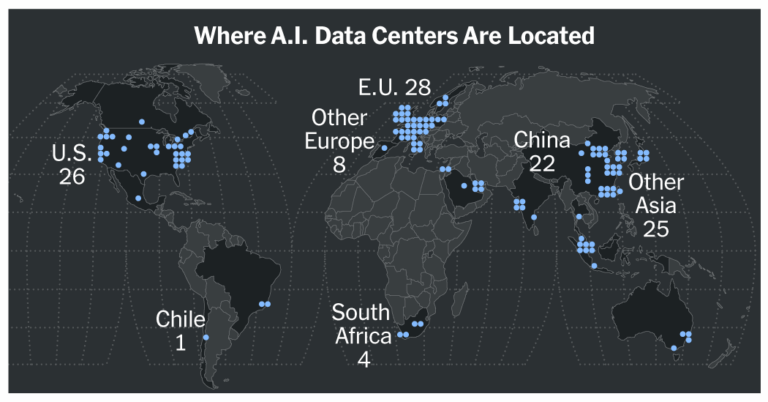
Only 32 nations, mostly in the Northern Hemisphere, have A.I.-specialized data centers.
Source: Oxford University
Note: Count of data centers in China excludes facilities in Hong Kong and Taiwan.
Last month, Sam Altman, the chief executive of the artificial intelligence company OpenAI, donned a helmet, work boots and a luminescent high-visibility vest to visit the construction site of the company’s new data center project in Texas.
Bigger than New York’s Central Park, the estimated $60 billion project, which has its own natural gas plant, will be one of the most powerful computing hubs ever created when completed as soon as next year.
Around the same time as Mr. Altman’s visit to Texas, Nicolás Wolovick, a computer science professor at the National University of Córdoba in Argentina, was running what counts as one of his country’s most advanced A.I. computing hubs. It was in a converted room at the university, where wires snaked between aging A.I. chips and server computers.
“Everything is becoming more split,” Dr. Wolovick said. “We are losing.”
Nicolás Wolovick, a computer science professor at the National University of Cordoba in Argentina. “We are losing,” he said.
Sarah Pabst for The New York Times
Artificial intelligence has created a new digital divide, fracturing the world between nations with the computing power for building cutting-edge A.I. systems and those without. The split is influencing geopolitics and global economics, creating new dependencies and prompting a desperate rush to not be excluded from a technology race that could reorder economies, drive scientific discovery and change the way that people live and work.
The biggest beneficiaries by far are the United States, China and the European Union. Those regions host more than half of the world’s most powerful data centers, which are used for developing the most complex A.I. systems, according to data compiled by Oxford University researchers. Only 32 countries, or about 16 percent of nations, have these large facilities filled with microchips and computers, giving them what is known in industry parlance as “compute power.”
The United States and China, which dominate the tech world, have particular influence. American and Chinese companies operate more than 90 percent of the data centers that other companies and institutions use for A.I. work, according to the Oxford data and other research.
In contrast, Africa and South America have almost no A.I. computing hubs, while India has at least five and Japan at least four, according to the Oxford data. More than 150 countries have nothing.
Today’s A.I. data centers dwarf their predecessors, which powered simpler tasks like email and video streaming. Vast, power-hungry and packed with powerful chips, these hubs cost billions to build and require infrastructure that not every country can provide. With ownership concentrated among a few tech giants, the effects of the gap between those with such computing power and those without it are already playing out.
Mr. Wolovick runs one of Argentina’s most advanced A.I. computing hubs out of a converted classroom at his university.
Video by Sarah Pabst for The New York Times
The world’s most used A.I. systems, which power chatbots like OpenAI’s ChatGPT, are more proficient and accurate in English and Chinese, languages spoken in the countries where the compute power is concentrated. Tech giants with access to the top equipment are using A.I. to process data, automate tasks and develop new services. Scientific breakthroughs, including drug discovery and gene editing, rely on powerful computers. A.I.-powered weapons are making their way onto battlefields.
Nations with little or no A.I. compute power are running into limits in scientific work, in the growth of young companies and in talent retention. Some officials have become alarmed by how the need for computing resources has made them beholden to foreign corporations and governments.
“Oil-producing countries have had an oversized influence on international affairs; in an A.I.-powered near future, compute producers could have something similar since they control access to a critical resource,” said Vili Lehdonvirta, an Oxford professor who conducted the research on A.I. data centers with his colleagues Zoe Jay Hawkins and Boxi Wu.
A.I. computing power is so precious that the components in data centers, such as microchips, have become a crucial part of foreign and trade policies for China and the United States, which are jockeying for influence in the Persian Gulf, in Southeast Asia and elsewhere. At the same time, some countries are beginning to pour public funds into A.I. infrastructure, aiming for more control over their technological futures.
The Oxford researchers mapped the world’s A.I. data centers, information that companies and governments often keep secret. To create a representative sample, they went through the customer websites of nine of the world’s biggest cloud-service providers to see what compute power was available and where their hubs were at the end of last year. The companies were the U.S. firms Amazon, Google and Microsoft; China’s Tencent, Alibaba and Huawei; and Europe’s Exoscale, Hetzner and OVHcloud.
The research does not include every data center worldwide, but the trends were unmistakable. U.S. companies operated 87 A.I. computing hubs, which can sometimes include multiple data centers, or almost two-thirds of the global total, compared with 39 operated by Chinese firms and six by Europeans, according to the research. Inside the data centers, most of the chips — the foundational components for making calculations — were from the U.S. chipmaker Nvidia.
An Nvidia H100 graphics processing unit.
Marlena Sloss/Bloomberg
“We have a computing divide at the heart of the A.I. revolution,” said Lacina Koné, the director general of Smart Africa, which coordinates digital policy across the continent. He added: “It’s not merely a hardware problem. It’s the sovereignty of our digital future.”
‘Sometimes I Want to Cry’
There has long been a tech gap between rich and developing countries. Over the past decade, cheap smartphones, expanding internet coverage and flourishing app-based businesses led some experts to conclude that the divide was diminishing. Last year, 68 percent of the world’s population used the internet, up from 33 percent in 2012, according to the International Telecommunication Union, a United Nations agency.
With a computer and knowledge of coding, getting a company off the ground became cheaper and easier. That lifted tech industries across the world, be they mobile payments in Africa or ride hailing in Southeast Asia.
But in April, the U.N. warned that the digital gap would widen without action on A.I. Just 100 companies, mostly in the United States and China, were behind 40 percent of global investment in the technology, the U.N. said. The biggest tech companies, it added, were “gaining control over the technology’s future.”
Few Companies Control A.I. Computing
Tiles show total availability zones for A.I. offered by each company, a metric used by researchers as a proxy for A.I. data centers.
Source: Oxford University
The gap stems partly from a component everyone wants: a microchip known as a graphics processing unit, or GPU. The chips require multibillion-dollar factories to produce. Packed into data centers by the thousands and mostly made by Nvidia, GPUs provide the computing power for creating and delivering cutting-edge A.I. models.
Obtaining these pieces of silicon is difficult. As demand has increased, prices for the chips have soared, and everyone wants to be at the front of the line for orders. Adding to the challenges, these chips then need to be corralled into giant data centers that guzzle up dizzying amounts of power and water.
Many wealthy nations have access to the chips in data centers, but other countries are being left behind, according to interviews with more than two dozen tech executives and experts across 20 countries. Renting computing power from faraway data centers is common but can lead to challenges, including high costs, slower connection speeds, compliance with different laws, and vulnerability to the whims of American and Chinese companies.
Qhala, a start-up in Kenya, illustrates the issues. The company, founded by a former Google engineer, is building an A.I. system known as a large language model that is based on African languages. But Qhala has no nearby computing power and rents from data centers outside Africa. Employees cram their work into the morning, when most American programmers are sleeping, so there is less traffic and faster speeds to transfer data across the world.
“Proximity is essential,” said Shikoh Gitau, 44, Qhala’s founder.
“If you don’t have the resources for compute to process the data and to build your A.I. models, then you can’t go anywhere,” said Kate Kallot, a former Nvidia executive and the founder of Amini, another A.I. start-up in Kenya.
Kate Kallot, founder of Amini, an A.I. start-up, at the company’s office in Nairobi, Kenya.
Natalia Jidovanu for The New York Times
In the United States, by contrast, Amazon, Microsoft, Google, Meta and OpenAI have pledged to spend more than $300 billion this year, much of it on A.I. infrastructure. The expenditure approaches Canada’s national budget. Harvard’s Kempner Institute, which focuses on A.I., has more computing power than all African-owned facilities on that continent combined, according to one survey of the world’s largest supercomputers.
Brad Smith, Microsoft’s president, said many countries wanted more computing infrastructure as a form of sovereignty. But closing the gap will be difficult, particularly in Africa, where many places do not have reliable electricity, he said. Microsoft, which is building a data center in Kenya with a company in the United Arab Emirates, G42, chooses data center locations based largely on market need, electricity and skilled labor.
“The A.I. era runs the risk of leaving Africa even further behind,” Mr. Smith said.
Jay Puri, Nvidia’s executive vice president for global business, said the company was also working with various countries to build out their A.I. offerings.
“It is absolutely a challenge,” he said.
Chris Lehane, OpenAI’s vice president of global affairs, said the company had started a program to adapt its products for local needs and languages. A risk of the A.I. divide, he said, is that “the benefits don’t get broadly distributed, they don’t get democratized.”
Tencent, Alibaba, Huawei, Google, Amazon, Hetzner and OVHcloud declined to comment.
The gap has led to brain drains. In Argentina, Dr. Wolovick, 51, the computer science professor, cannot offer much compute power. His top students regularly leave for the United States or Europe, where they can get access to GPUs, he said.
“Sometimes I want to cry, but I don’t give up,” he said. “I keep talking to people and saying: ‘I need more GPUs. I need more GPUs.’”
Few Choices
The uneven distribution of A.I. computing power has split the world into two camps: nations that rely on China and those that depend on the United States.
The two countries not only control the most data centers but are set to build more than others by far. And they have wielded their tech advantage to exert influence. The Biden and Trump administrations have used trade restrictions to control which countries can buy powerful A.I. chips, allowing the United States to pick winners. China has used state-backed loans to encourage sales of its companies’ networking equipment and data centers.
The effects are evident in Southeast Asia and the Middle East.
In the 2010s, Chinese companies made inroads into the tech infrastructure of Saudi Arabia and the Emirates, which are key American partners, with official visits and generous financing. The United States sought to use its A.I. lead to push back. In one deal with the Biden administration, an Emirati company promised to keep out Chinese technology in exchange for access to A.I. technology from Nvidia and Microsoft.
In May, President Trump signed additional deals to give Saudi Arabia and the Emirates even more access to American chips.
A similar jostling is taking place in Southeast Asia. Chinese and U.S. companies like Amazon, Alibaba, Nvidia, Google and ByteDance, the owner of TikTok, are building data centers in Singapore and Malaysia to deliver services across Asia.
Globally, the United States has the lead, with American companies building 63 A.I computing hubs outside the country’s borders, compared with 19 by China, according to the Oxford data. All but three of the data centers operated by Chinese firms outside their home country use chips from Nvidia, despite efforts by China to produce competing chips. Chinese firms were able to buy Nvidia chips before U.S. government restrictions.
Where the World Gets Its A.I.
Companies and countries throughout the world rely mostly on major American and Chinese cloud operators for A.I. facilities.
Source: Oxford University
Even U.S.-friendly countries have been left out of the A.I. race by trade limits. Last year, William Ruto, Kenya’s president, visited Washington for a state dinner hosted by President Joseph R. Biden Jr. Several months later, Kenya was omitted from a list of countries that had open access to needed semiconductors.
That has given China an opening, even though experts consider the country’s A.I. chips to be less advanced. In Africa, policymakers are talking with Huawei, which is developing its own A.I. chips, about converting existing data centers to include Chinese-made chips, said Mr. Koné of Smart Africa.
“Africa will strike a deal with whoever can give access to GPUs,” he said.
If You Build It
An aerial view of the construction underway on an A.I. infrastructure site that is a collaboration between OpenAI, SoftBank, and Oracle in Abilene, Texas.
Daniel Cole/Reuters
Alarmed by the concentration of A.I. power, many countries and regions are trying to close the gap. They are providing access to land and cheaper energy, fast-tracking development permits and using public funds and other resources to acquire chips and construct data centers. The goal is to create “sovereign A.I.” available to local businesses and institutions.
In India, the government is subsidizing compute power and the creation of an A.I. model proficient in the country’s languages. In Africa, governments are discussing collaborating on regional compute hubs. Brazil has pledged $4 billion on A.I. projects.
“Instead of waiting for A.I. to come from China, the U.S., South Korea, Japan, why not have our own?” Brazil’s president, Luiz Inácio Lula da Silva, said last year when he proposed the investment plan.
Even in Europe, there is growing concern that American companies control most of the data centers. In February, the European Union outlined plans to invest 200 billion euros for A.I. projects, including new data centers across the 27-nation bloc.
Mathias Nobauer, the chief executive of Exoscale, a cloud computing provider in Switzerland, said many European businesses want to reduce their reliance on U.S. tech companies. Such a change will take time and “doesn’t happen overnight,” he said.
Still, closing the divide is likely to require help from the United States or China.
Cassava, a tech company founded by a Zimbabwean billionaire, Strive Masiyiwa, is scheduled to open one of Africa’s most advanced data centers this summer. The plans, three years in the making, culminated in an October meeting in California between Cassava executives and Jensen Huang, Nvidia’s chief executive, to buy hundreds of his company’s chips. Google is also one of Cassava’s investors.
The data center is part of a $500 million effort to build five such facilities across Africa. Even so, Cassava expects it to address only 10 percent to 20 percent of the region’s demand for A.I. At least 3,000 start-ups have expressed interest in using the computing systems.
“I don’t think Africa can afford to outsource this A.I. sovereignty to others,” said Hardy Pemhiwa, Cassava’s chief executive. “We absolutely have to focus on and ensure that we don’t get left behind.”
President Donald Trump on Sunday called into question the future of Iran’s ruling theocracy after a surprise attack on three of the country’s nuclear sites, seemingly contradicting his administration’s earlier calls to resume negotiations and avoid an escalation in fighting.
“It’s not politically correct to use the term, ‘Regime Change,’ but if the current Iranian Regime is unable to MAKE IRAN GREAT AGAIN, why wouldn’t there be a Regime change???” Trump posted on social media. “MIGA!!!”
The posting on Truth Social marked something of a reversal from Defense Secretary Pete Hegseth’s Sunday morning news conference that detailed the aerial bombing.
“This mission was not and has not been about regime change,” Hegseth said.
What the administration has made clear is that it wants Iran to stop any development of nuclear weapons, with Secretary of State Marco Rubio warning on Fox News’ “Sunday Morning Futures” that any retaliation against the U.S. or a rush toward building a nuclear weapon would “put the regime at risk.”
But beyond that, the world is awash in uncertainty at a fragile moment that could decide whether parts of the world tip into war or find a way to salvage a relative peace. Trump’s warning to Iran’s leadership comes as the U.S. has demanded that Iran not respond to the bombardment of the heart of a nuclear program that it spent decades developing.
The Trump administration has made a series of intimidating statements even as it has simultaneously called to restart negotiations, making it hard to get a complete read on whether the U.S. president is simply taunting an adversary or using inflammatory words that could further widen the war between Israel and Iran that began earlier this month.
Up until the U.S. president’s post on Sunday afternoon, the coordinated messaging by Trump’s vice president, Pentagon chief, top military adviser and secretary of state suggested a confidence that any fallout would be manageable and that Iran’s lack of military capabilities would ultimately force it back to the bargaining table.
Hegseth had said that America “does not seek war” with Iran, while Vice President JD Vance said the strikes have given Tehran the possibility of returning to negotiate with Washington.
But the unfolding situation is not entirely under Washington’s control, as Tehran has a series of levers to respond to the aerial bombings that could intensify the conflict in the Middle East with possible global repercussions. Iran can block oil being shipped through the Strait of Hormuz, attack U.S. bases in the region, engage in cyber attacks or double down on a nuclear program that might seem like more of a necessity after the U.S. strike.
All of that raises the question of whether the strikes will open up a far more brutal phase of fighting or revive negotiations out of an abundance of caution. Inside the U.S., the attack quickly spilled over into domestic politics with Trump choosing to spend part of his Sunday going after his critics in Congress.
Trump, who had addressed the nation from the White House on Saturday night, returned to social media on Sunday to lambaste Rep. Thomas Massie, R-Ky., who had objected to the president taking military action without specific congressional approval.
“We had a spectacular military success yesterday, taking the ‘bomb’ right out of their hands (and they would use it if they could!)” Trump said as part of the post on Truth Social.
What Trump’s national security team had to say
At their joint Pentagon briefing, Hegseth and Air Force Gen. Dan Caine, chairman of the Joint Chiefs of Staff, said that “Operation Midnight Hammer” involved decoys and deception, and met with no Iranian resistance.
Caine indicated that the goal of the operation — destroying nuclear sites in Fordo, Natanz and Isfahan — had been achieved.
“Final battle damage will take some time, but initial battle damage assessments indicate that all three sites sustained extremely severe damage and destruction,” Caine said.
Vance said in a television interview that while he would not discuss “sensitive intelligence about what we’ve seen on the ground,” he felt “very confident that we’ve substantially delayed their development of a nuclear weapon.”
Pressed further, he told NBC’s “Meet the Press” that “I think that we have really pushed their program back by a very long time. I think that it’s going to be many many years before the Iranians are able to develop a nuclear weapon.”
The vice president said the U.S. had “negotiated aggressively’ with Iran to try to find a peaceful settlement and that Trump made his decision after assessing the Iranians were not acting “in good faith.”
“I actually think it provides an opportunity to reset this relationship, reset these negotiations and get us in a place where Iran can decide not to be a threat to its neighbors, not to be a threat to the United States, and if they’re willing to do that, the United States is all ears,” Vance said.
Rubio said on CBS’s “Face the Nation” that “there are no planned military operations right now against Iran, unless, unless they mess around and they attack” U.S. interests.
Trump has previously threatened other countries, but often backed down or failed to follow through, given his promises to his coalition of voters not to entangle the United States in an extended war. It was not immediately clear whether Iran saw the avoidance of a wider conflict as in its best interests.
How Iran and others are reacting to the US strikes
Much of the world is absorbing the consequences of the strikes and the risk that they could lead to more fighting across the Middle East after the U.S. inserted itself into the war between Israel and Iran. Israeli airstrikes that began on June 13 local time targeted Iran’s nuclear facilities and generals, prompting retaliation from Iran and creating a series of events that contributed to the U.S. attack.
While U.S. officials urged caution and stressed that only nuclear sites were targeted by Washington, Iran criticized the actions as a violation of its sovereignty and international law.
Iran’s foreign minister, Abbas Araghchi, said Washington was “fully responsible” for whatever actions Tehran may take in response.
“They crossed a very big red line by attacking nuclear facilities,” he said at a news conference in Turkey. “I don’t know how much room is left for diplomacy.”
China and Russia, where Araghchi was heading for talks with President Vladimir Putin, condemned the U.S. military action. The attacks were “a gross violation of international law,” said Russia’s Foreign Ministry, which also advocated “returning the situation to a political and diplomatic course.” A Turkish Foreign Ministry statement warned about the risk of the conflict spreading to “a global level.”
British Prime Minister Keir Starmer said the United Kingdom was moving military equipment into the area to protect its interests, people and allies. His office said he talked on Sunday with Trump about the need for Tehran to resume negotiations, but Trump would have posted his remarks about regime change after their conversation.
The leaders of Italy, Canada, Germany and France agreed on the need for “a rapid resumption of negotiations.” France’s Emmanuel Macron held talks with the Saudi crown prince and sultan of Oman.
Iran could try to stop oil exports through the Strait of Hormuz, which could create the same kind of inflationary shocks that the world felt after Russia invaded Ukraine in 2022. Oil prices increased in the financial markets as the war between Israel and Iran had intensified, climbing by 21% over the past month.
Hegseth offers an explanation for the timeline
The Pentagon briefing did not provide any new details about Iran’s nuclear capabilities. Hegseth said the timeline for the strikes was the result of a schedule set by Trump for talks with Iran about its nuclear ambitions.
“Iran found out” that when Trump “says 60 days that he seeks peace and negotiation, he means 60 days of peace and negotiation,” Hegseth said. “Otherwise, that nuclear program, that new nuclear capability will not exist. He meant it.”
That statement was complicated as the White House had suggested last Thursday that Trump could take as much as two weeks to determine whether to strike Iran or continue to pursue negotiations. But the U.S. benefited from Iran’s weakened air defenses and was able to conduct the attacks without resistance from Iran.
“Iran’s fighters did not fly, and it appears that Iran’s surface to air missile systems did not see us throughout the mission,” Caine said.
Hegseth said that a choice to move a number of B-2 bombers from their base in Missouri earlier Saturday was meant to be a decoy to throw off Iranians. Caine added that the U.S. used other methods of deception as well, deploying fighters to protect the B-2 bombers that dropped a total of 14 bunker-buster bombs on Iran’s sites at Fordo and Natanz.
The strikes occurred Saturday between 6:40 p.m. and 7:05 p.m. in Washington, or roughly 2:10 a.m. on Sunday in Iran.
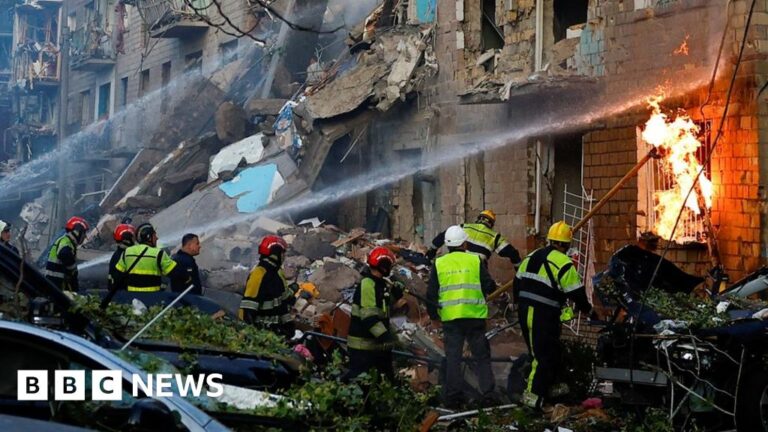
At least seven people have been killed and several injured in an overnight Russian missile and drone attack in the Kyiv region, the interior minister has said.
In a post on social media, Ihor Klymenko said residential areas, hospitals and sports infrastructure had been hit.
At least six of those who died were in the high-rise building in the capital, Kyiv’s mayor Vitaliy Klitschko said, adding that 19 others were injured in the city.
In recent weeks, Russia has been carrying out massive aerial attacks on Ukrainian cities.
In the latest barrage 352 Russian drones and 16 missiles targeted Ukrainian territory, mostly in the Kyiv area, the Ukrainian air force said.
A number of blazes were reported across the capital.
Ukraine’s emergencies service posted footage showing shocked residents being led away from a destroyed high-rise building that was still burning.
An entrance to an underground metro stations was damaged, local officials say. Many residents spent the night sheltering in such stations.
Russian President Vladimir Putin launched a full-scale invasion of Ukraine in February 2022.
Fitter and Faster Swim Camps is the proud sponsor of SwimSwam’s College Recruiting Channel and all commitment news. For many, swimming in college is a lifelong dream that is pursued with dedication and determination. Fitter and Faster is proud to honor these athletes and those who supported them on their journey.
McKenna Smith, a versatile swimmer with particular strength in sprint freestyle and butterfly events, has decided to continue her swimming career at Davidson College this fall. Smith attends Berkeley Preparatory School and also trains with the Berkeley Barracudas.
“I am extremely excited to announce my verbal commitment to continue my athletic and academic career at Davidson College! I would like to thank Coach Kevin and my parents for their constant support and the coaches at Davidson for this incredible opportunity. I would also like to thank all of my friends and lane buddies for making this journey so fun. I can’t wait for the next four! Go Wildcats! ❤️🖤”
Smith secured her fastest 100 fly time of 56.59 during prelims at the 2024 FHSAA Class 1A State Championship (SCY) in November. She went on to become a two-time finalist at the meet, placing 6th in the 50 free (23.99) and 8th in the 100 fly (57.97).
The year prior, she recorded her best 100 breast time at the same championship, finishing 10th in 1:05.61. She also placed 15th in the 100 fly (58.76).
More recently, at the 2025 Florida Senior Championship (SCY) in March, Smith swam a personal-best 23.80 in the 50 free prelims, qualifying for the Futures Championship in Justin. She went on to place 8th in the finals (23.88). She also set a personal best in the 50 fly, clocking 25.17 in prelims and finishing 6th in the finals (25.29). Additionally, she posted her fastest 200 fly in prelims with a time of 2:13.86.
Smith’s fastest 100 free came in 2022 at the FL SPA Spring Fling (SCY), where she placed 2nd overall in 52.95. She also earned second swims in five other events, finishing 1st in the 50 free (24.48), 3rd in the 50 breast (31.38), 5th in the 50 fly (26.70), and 6th in both the 100 breast (1:08.06) and 200 breast (2:29.24).
Top Yard Times
50 Free – 23.80
100 Free – 52.95
100 Fly – 56.59
100 Breast – 1:05.61
Davidson College finished 6th out of 11 teams at the 2025 Women’s Atlantic 10 Championships. Smith would have been Davidson’s 2nd fastest performer in the 50 free last season, making her a strong asset for relays. The fastest time, 23.07, was held by Adelyn Donaldson, who was a senior last season. Smith’s 100 fly would have ranked 3rd on the team.
Smith will join Elizabeth Palmer, Reece Ramseur, Ellery Bracall, Frances Bohner, Julia Pisano, and Caroline Furbay on Davidson’s campus this fall. Pisano also holds a strong 50 free time of 23.81, as does Furbay (23.56).
If you have a commitment to report, please send an email with a photo (landscape, or horizontal, looks best) and a quote to [email protected].
About the Fitter and Faster Swim Tour
Fitter & Faster Swim Camps feature the most innovative teaching platforms for competitive swimmers of all levels. Camps are produced year-round throughout the USA and Canada. All camps are led by elite swimmers and coaches. Visit fitterandfaster.com to find or request a swim camp near you.
In a major milestone for modular nuclear power on the way to the mainstream, the US Department of the Air Force has issued a Notice of Intent to Award (NOITA) to Oklo that may lead to the construction and operation of a military reactor in Fairbanks, Alaska.
Small nuclear reactors yielding less than 50 MW that can be mass produced in factories and shipped to where needed have very much been in the news in recent years. They promise a new way to provide heat and electricity that is cheaper than current nuclear power plants, being faster to build, easily scalable, and inherently safer.
Such reactors are also a power source that’s much easier to set up in remote locations, which is why the US military is so interested in them. Presently, the Air Force wants to test that concept at Eielson Air Force Base (AFB), located 26 miles (42 km) southeast of Fairbanks, Alaska, as a way of replacing the tonnes of coal that regularly have to be shipped in to power the facility.
The latest agreement was made in coordination with the Defense Logistics Agency (DLA) Energy Office and is not a firm contract, so many technical details about what the Alaskan reactors would look like are unknown. However, it is in line with American legislation and executive orders going back to 2019, as well as the current administration’s commitment to increasing US energy production and promoting nuclear energy in general, so it is a significant advancement.
If a contract is awarded, it will be for a 30-year power fixed-price purchase agreement after securing an NRC license that will include construction, operation, maintenance, and decommissioning of the reactor.
Based on previous designs, the new demonstration reactor will have an output of about 5 MW and provide part of the base’s 35-MW requirements, though the modular design allows for easy scalability by adding more modules if need be. The reactor would provide heat as well as light, which is important in Alaska, where it can reach minus 50 °F (-45 °C).
The type of reactor built will depend on the kind of nuclear fuel selected. The main candidates are some form of high-assay, low-enriched uranium (HALEU), with uranium-235 concentrations higher than that found in conventional commercial power reactors, or TRISO (Tristructural-isotropic) pebbles, where each spherical uranium particle is encapsulated by multiple protective layers of carbon and ceramics. Both of these share the ability to operate for up to 15 years without refueling.
“This microreactor pilot could position Alaska and the nation at the forefront of energy innovation – leading us to a new era of safe, secure, and reliable energy,” said Secretary of the Air Force Troy Meink. “It has the potential to shape future approaches to powering national security infrastructure, especially in the Arctic –where energy reliability is vital in the face of evolving threats.”