Chinese smartphone brand Honor launched what promises to be the world’s thinnest foldable phone—just 4.1 millimeters thick when unfolded—on Wednesday as it seeks to regain lost ground in China’s competitive phone market.
The Magic V5’s thinness is made possible by innovations in its silicon-carbon battery, which stacks cells just 0.2 millimeters thick to create a battery that’s as thin as a bank card. The new phone is also light: At just 217 grams, the Magic V5 weighs less than the iPhone 16 Pro Max.
Behind these innovations is a “massive” amount of research and development, Hope Cao, Honor’s product expert on foldables, told Fortune ahead of the Magic V5 launch.
Honor invested 1 billion Chinese yuan ($139 million) towards researching its silicon-carbon battery technology. The company invests over 10% of its total revenue towards R&D each year.
“In terms of materials, structure, craftsmanship…everything is extremely costly from an R&D perspective,” Cao said.
Foldables represent a small but rapidly expanding segment of the Chinese smartphone market. Sales in this category grew by 27% last year, according to Counterpoint Research. Book-type foldables, which open along the longer edge to create a larger screen, are particularly popular.
Cao suggests this aligns with Chinese consumer preference for versatile devices for both work and entertainment. A larger screen means more space for productivity apps, meaning users can do their work on a foldable smartphone rather than a laptop. The rise of “short dramas”—soap operas designed to be watched on a phone and easily shared on social media—are also pushing shoppers to invest in larger displays.
Honor was once Huawei’s budget smartphone division. U.S. sanctions forced the Chinese tech giant to offload the company in late 2020. The company had a 13% share of China’s smartphone market in the first quarter of 2025, according to Counterpoint, close behind Vivo, Oppo and Apple.
China’s budget brands are now venturing into the premium market, seeking growth from selling higher-value phones, rather than a larger volume of cheaper models.
Still, the return of Huawei to the smartphone market in 2023 is weighing on Honor’s business. Counterpoint Research puts Huawei in first place in China’s smartphone market, alongside Xiaomi.
Huawei’s success is also weighing on Apple, whose iPhone once dominated the Chinese market. Local smartphones now offer designs and features that Apple’s tried-and-true iPhone is struggling to match. Apple plans to release a book-style foldable phone in 2026, The Informationreported last year.
The iPhone maker is also struggling to launch its AI services in China. Earlier this year, Alibaba announced that it was going to be Apple’s local partner to offer Apple Intelligence to users. Yet the deal has reportedly drawn scrutiny in both Washington and Beijing.
AI is quickly becoming a key differentiator for Chinese smartphones, including those designed by Honor. The Chinese company is experimenting with on-device AI, or services that run on the phone as opposed to the cloud. Honor plans to invest $10 billion over the next five years to develop AI for its product lineup, which it hopes to expand to include PCs, tablets and wearables.
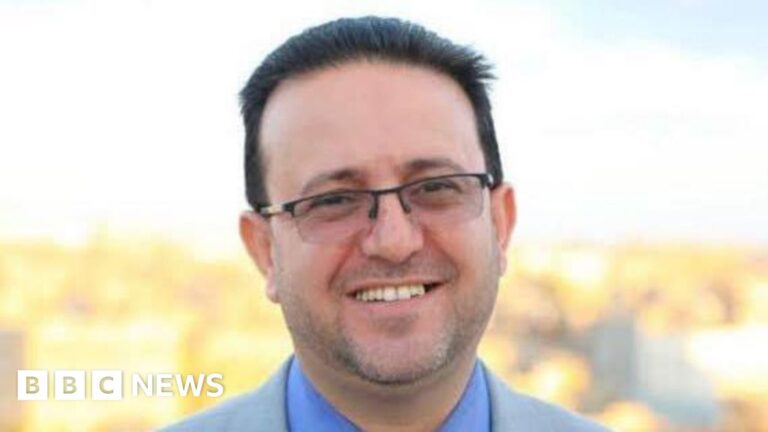
The director of Gaza’s Indonesian Hospital has been killed in an Israeli air strike on his home in Gaza City along with several family members, the Hamas-run health ministry has said.
The ministry said Dr Marwan Sultan had a long career in medicine, and condemned “this heinous crime against our medical cadres”.
The Israeli military said it had struck a “key terrorist” from Hamas in the Gaza City area and that claims “uninvolved civilians” were harmed as a result of the strike were being reviewed.
Meanwhile, at least five people were killed and others injured, including children, in a strike on the al-Mawasi “safe zone”, one of several other attacks reported by news agencies.
The health ministry said Dr Sultan’s career was one of compassion “during which he was a symbol of dedication, steadfastness and sincerity, during the most difficult circumstances and most trying moments experienced by our people under continuous aggression”.
Dr Sultan was the director at the Indonesian Hospital, declared out of service by the health ministry after what the UN later described as “repeated Israeli attacks and sustained structural damage”. The Israeli military had said it was fighting “terrorist infrastructure sites” in the area.
There are now no functioning hospitals in the north Gaza governate, according to the UN.
In its statement, the Israel Defense Forces (IDF) said it “regrets any harm to uninvolved individuals” and “operates to mitigate harm to them as much as possible”.
The IDF said Hamas “systematically violates international law while using civilian infrastructure for terrorist activity and the civilian population as human shields”.
But Dr Sultan’s doctor’s daughter, Lubna al-Sultan, said “an F-16 missile targeted his room exactly, right where he was, directly on him”.
“All the rooms in the house were intact except for his room, which was hit by the missile. My father was martyred in it,” she told the Associated Press.
She said he was “not affiliated with a movement or anything, he just fears for the patients [he] treats, throughout the war”.
Across Gaza, at least 139 people were killed by Israeli military operations in the 24 hours before midday on Wednesday, the health ministry said.
In the al-Mawasi area of Khan Younis, at least five people were killed and others, including children, wounded in an Israeli strike that hit a tent housing displaced people, news agencies reported.
Family members of those killed said it hit at 00:40 local time (22:40 BST) while they were sleeping.
Tamam Abu Rizq told AFP the strike “shook the place like an earthquake”, and she “went outside and found the tent on fire”.
The al-Mawasi area was declared a “safe zone” by the Israeli military, as the UN says 80% of Gaza is either an Israeli military zone or under an evacuation order.
“They came here thinking it was a safe area and they were killed… What did they do?” Maha Abu Rizq said.
At the scene, surrounded by destruction and a jumble of personal items, one man held up a pack of nappies and asked: “Is this a weapon?”
Footage recorded by AFP shows men alighting from a car in front of nearby Nasser Hospital in Khan Younis and rushing inside carrying blood-covered children in their arms. Inside the hospital, young children cry as doctors treat their wounds.
Women weep over the bodies of their relatives in funerals at the hospital in other AFP footage.
“Anyone of any religion must take action and say: Enough! Stop this war!” Ekram al-Akhras, who lost several cousins in one of the strikes, said.
In Gaza City, another four people from the same family were killed in an Israeli air strike on a house, news agencies reported.
The four people killed were Ahmed Ayyad Zeno, his wife Ayat Zeno, and their daughters, Zahra Zeno and Obaida Zeno, according to Palestinian news outlet WAFA.
The BBC has contacted the IDF for comment about the two incidents.
Rachel Cummings, who is working in Gaza with Save the Children, told reporters that during “wishing circles” at the charity’s child-friendly spaces, children have recently been “wishing to die” in order to be with their mother or father who has been killed, or to have food and water.
As a heatwave spread across the UK and Europe this week, temperatures also topped 30C in Gaza.
Displaced people living in tents said they were struggling to stay cool without electricity and fans, and with little access to water.
Reda Abu Hadayed told the Associated Press the heat is “indescribable” and her children cannot sleep.
“They cry all day until sunset, when the temperature drops a little, then they go to sleep,” she said. “When morning comes, they start crying again due to the heat.”
Hamas attacked Israel on 7 October 2023, killing around 1,200 people and taking 251 back to Gaza as hostages.
Since then, Israel’s military offensive in Gaza has killed more than 57,000 people, including more than 15,000 children, according to the territory’s Hamas-run health ministry.
MBW Views is a series of op/eds from eminent music industry people… with something to say.
The following commentary comes from Kenny Gates, the CEO and co-founder of [PIAS], a powerhouse of independent music that was established 43 years ago. [PIAS] was fully acquired by Universal Music Group last year.
IMPALA represents the interests of a group of independent music companies in Europe. It is currently lobbying against Universal Music Group’s proposed acquisition of Downtown Music Holdings in the EU.
Gates and his fellow [PIAS] co-founder, Michel Lambot, were two of the original founders of IMPALA 25 years ago.
I recently read an opinion piece penned by Helen Smith, the Executive Chair of IMPALA, regarding the proposed sale of Downtown to UMG.
I was astounded by the misleading propaganda within Helen’s comments, and felt compelled to respond.
So, I spoke to my wife, and she advised: “Do nothing.” Then I spoke to my new colleagues at UMG, and they said: “We’re not getting involved in that.”
Then I spoke to my PR guru and he said, “Frankly mate, this is not your battle to fight.”
After that, I called my long-time business partner, and one of my oldest friends, Michel Lambot, who, like me, was a co-founder of IMPALA.
Michel said, wisely: “It’s all going to blow back on you Kenny. You know that, right? They are going to question your integrity and say you’re a Universal stooge. Why bother?”
But I have always spoken my mind, and the whole ethos of [PIAS] has always been to stand up for what we believe in.
I truly appreciate the advice my friends and family have offered me. But I’ve decided to address some of Helen’s claims, because I feel I must.
I’ll start with something that, as a long-standing advocate for the independent music community, particularly infuriates me.
Helen points to UMG’s bust-up with TikTok last year to support her claims of Universal’s supposed market control.
On this, let me be very clear: at least UMG had the guts to confront TikTok and try to resolve that issue. Because – surprise, surprise – IMPALA did next to nothing.
So many independent companies and organisations publicly applauded UMG’s stance vs. TikTok. Including, to name a few: A2IM, NMPA, Artist Rights Alliance, Hipgnosis, Primary Wave, The Association of Independent Music Publishers (AIMP), and others.
But IMPALA? Crickets.
“On UMG vs. TikTok? IMPALA simply sat on the sidelines.”
UMG had everything to lose taking on one of the world’s biggest and most powerful entertainment tech companies. They faced immense pressure from artists and their representatives during those negotiations, but decided it was worth it in the name of copyright’s value.
I remember a time when IMPALA led the charge on issues like this – as they did during the YouTube ‘value gap’ negotiations a decade ago.
But on UMG vs. TikTok? IMPALA simply sat on the sidelines.
Worse: Instead of joining forces with other companies/organisations within music to help avert a crisis – that of music rightsholders being underpaid and exploited by ‘Big Tech’ – IMPALA now decides to criticize a company that actually stood up for music.
The recorded music industry’s entire annual turnover is equivalent to just one week’s turnover for GAFA (Google, Amazon, Facebook, and Apple).
With that in mind, refresh my memory: who are the real ‘big dogs’ of the music world again?
Where is the real case for ‘market dominance’?
It saddens me: IMPALA was once a proudly pro-independent body. Today, it sounds more like an anti-major clique.
IMPALA wishes to appear virtuous while painting the majors as ‘bad actors’. This falsehood recalls the absurdity of Boris Johnson’s pro-Brexit London bus.
A huge global community of successful independents – including IMPALA members – are already using the distribution services of major music companies and affiliates such as ADA, The Orchard, AWAL, and Virgin Music Group.
Helen’s points about the majors’ distribution “control” being “bad for artists” must bewilder all those independent acts (and labels) that are settled, successful, and happy in these business relationships. Not to mention FREE TO LEAVE these business relationships!
“This must bewilder all those independent acts (and labels) that are settled, successful, and happy in business relationships with major-owned distributors.”
It’s naïve to pretend that the major music corporations haven’t been in the business of independent distribution for over a decade now. It’s disingenuous to suggest that there are longstanding and ongoing problems within this market.
If supposed market abuses in independent distribution exist, I’ve genuinely never seen them – or heard about them from anyone in music’s independent community.
(Remember: Universal Music Group is a publicly listed company. Any suggestion that it would contemplate bending fiduciary/market laws for its own gain is ludicrous.)
Another claim from IMPALA: there is a lack of “independent options” in distribution for artists and labels today.
This too is a falsehood. Respected independent music industry body Merlin is happy to recommend 19independent distributors to its members.
Nineteen! Nananana nineteen (with apologies to Paul Hardcastle)!
Doesn’t nineteen distribution options for modern independents – and these are just the ones endorsed by Merlin – demonstrate a fair amount of market choice?!
The 19 independent distributors Merlin recommends to its members. The list doesn’t include the majors or Believe/TuneCore, plus other leading indie distributors such as TooLost and oneRPM (source: Merlin)
Perhaps my biggest issue here? IMPALA’s claim to represent the independent music community.
There are literally thousands of self-releasing artists, independent labels, and entrepreneurs who are not members of IMPALA.
In reality, IMPALA’s mandate to operate on behalf of ‘independents’ actually comes from only a tiny fraction of the sector.
I have always been a proud co-founder of IMPALA (there’s a reason it’s headquartered in Brussels). Yet it’s a great shame that it’s become a small-minded, inward-looking organization, more concerned with focusing on imaginary problems than contributing solutions that actually help the music industry.
The times, they are a-changing… and make no mistake: the times have changed.
Independent music rightsholders – whether artists or labels – are thriving in a new ecosystem. The whole binary ‘indies vs. majors’ narrative is passé.
It’s time to move on from this tired old story and address the real issues, such as: the ‘value gap’ in short-form video; the growing influence of venture capital and private equity in music rights ownership and music distribution; the ever-present threats to copyright; and, of course, the elephant in the room: A.I.
The independents’ real enemy lies outside the major music companies.
Open your eyes.
Let’s all focus together on the real issues – rather than a pointless combat d’arriere garde (i.e. rearguard action) that solves nothing.Music Business Worldwide
Your guide to what Trump’s second term means for Washington, business and the world
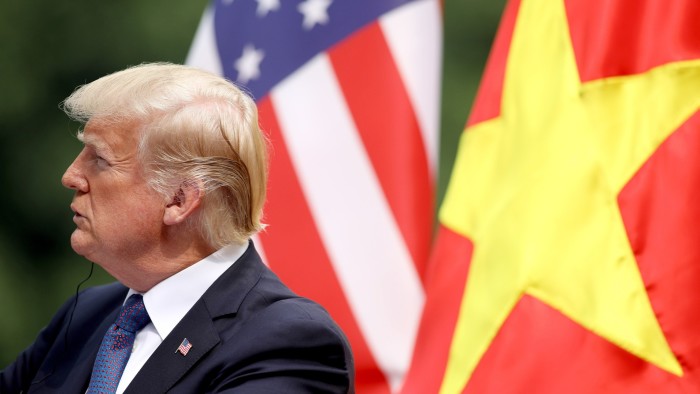
Donald Trump said the US had struck a trade agreement with Vietnam in a deal that would lower Washington’s “reciprocal tariff” on exports from the Asian country to 20 per cent.
The new tariff level represents a more than halving of the 46 per cent levy Trump initially imposed on Vietnam during his “liberation day” tariff blitz on April 2, but is higher than the 10 per cent rate it was lowered to for 90 days as trade talks took place.
The deal makes Hanoi one of the few capitals to reach a trade agreement with Washington in the past three months. But the steepness of the tariffs remaining in place could unnerve countries still hoping to secure significant relief from the levies announced in April, which triggered a financial market sell-off at the time and upended global trade.
Describing the deal as “something that they have never done”, Trump said in a Truth Social post on Wednesday detailing the agreement that Vietnam would give the US “TOTAL ACCESS” to their market and that “we will be able to sell our product into Vietnam at ZERO Tariff.”
The US will also charge Vietnam a 40 per cent tariff on “trans-shipping” as Washington seeks to crack down on businesses sending products made in China through other countries to avoid high levies on Chinese goods.
Vietnam’s official state media reported that Vietnam’s Communist party chief To Lam held a phone call with Trump on Tuesday and the two sides reached a consensus on a “fair and balanced reciprocal trade agreement framework”.
During the call, Trump “affirmed that the US will significantly reduce reciprocal tariffs on many Vietnamese exports”, state media reported, without referring to any specific tariff rates.
“The 20 per cent baseline tariff for Vietnamese imports is higher than expected, undoubtedly causing angst among other trading partners trying to finalise deals,” said Wendy Cutler, a former US trade official who now serves as vice-president at the Asia Society Policy Institute.
Hanoi, though, had a “strong interest” in reaching a deal with Washington given almost 30 per cent of Vietnam’s exports are destined for the US, Cutler said.
The south-east Asian country’s exports to the US have risen in recent years as manufacturers have moved production out of China to avoid US tariffs, with Vietnam hosting the likes of Apple, Samsung and Nike. In 2024, the US exported $13.1bn in goods to Vietnam, according to US government figures, but imported $136.6bn over the same period.
The Trump administration has accused Vietnam of being a conduit for Chinese exporters trying to avoid punitively high US tariffs on Beijing. The practice, known as trans-shipment, had become a critical issue in Hanoi’s negotiations with Washington.
Many companies assemble components manufactured in China in other countries including Vietnam and its south-east Asian peers, or add enough value to the products to legally change their place of origin. However, some merely relabel their products without any added value, a practice that is illegal but difficult to trace.
Markets broadly took the announcement in their stride. The dollar was down less than 0.1 per cent, extending a recent slide, while the S&P 500 climbed steadily through the day to finish at a record high.
Shares of several companies with significant manufacturing operations in Vietnam rose. On Wall Street, Nike climbed 4.1 per cent and toymakers Mattel and Hasbro each gained 1.6 per cent, while Adidas rose 1 per cent in Frankfurt.
The lower levies may offer some relief for Vietnam, but it is unclear how the two-tier tariff system announced by Trump would work. It is also unclear how Hanoi can trace trans-shipment and what percentage of its exports would be hit with the higher 40 per cent rate.
Alicia García-Herrero, chief Asia-Pacific economist at French investment bank Natixis, said the 20 per cent flat tariff was “not too bad” for Vietnam so long as US tariffs on China remained relatively higher.
“The question is whether there is any fine print — for example, Vietnam imposing tariffs on products and inputs imported from China which are vital to its manufacturing economy,” she said.
The deal with Vietnam comes a day after Trump threatened to increase levies on Japan, casting doubt that Washington would reach a deal with Tokyo.
A wildfire in Spain and high temperatures elsewhere in Europe have claimed another six lives as the continent swelters in temperatures topping 40C.
Two farmers died when they became trapped by flames near the town of Coscó in Spain’s Catalonia region. Authorities said a farm worker had appealed to his boss for help, but they were unable to escape as fire spread over a large area.
In Italy, two men died after becoming unwell on beaches on the island of Sardinia, and a man in his 80s died of heart failure, after walking into a hospital in Genoa.
A 10-year-old American girl collapsed and died while visiting the Palace of Versailles south-west of Paris , reports said.
According to French broadcaster TF1, she collapsed at the courtyard of the royal estate, in front of her parents, at around 18:00 local time on Tuesday. Despite efforts by the castle’s security team and emergency services, she was pronounced dead an hour later.
France’s ecological transition minister Agnès Pannier-Runacher said earlier that two heat-related fatalities had been recorded in France and that more than 300 people had been given emergency care.
The European continent is experiencing extremely high temperatures, a phenomenon that the UN’s climate agency said is becoming more frequent due to “human-induced climate change”.
For Spain and England, the month of June marked their hottest June since records began. Spain’s weather service, Aemet, said last month’s average temperature of 23.6C (74.5F) “pulverised records”, surpassing the normal average for July and August.
The two men who died in the fire in Catalonia were identified later as the farmer owner and a worker aged 32 and 45.
Emergency services said the fire had spread to an area of up to 6,500 hectares.
Aemet forecast temperatures of 41C in the southern city of Córdoba on Wednesday, and said overnight temperatures were as high as 28C in the nearby town of Osuna the night before.
France has registered its second-hottest June since records began in 1900. June 2023 was hotter.
Four departments in France remained on the red alert level for heat on Wednesday, the highest level. These include Aube, Cher, Loiret and Yonne, according to Météo-France.
In Sardinia, where temperatures have exceeded 40C in recent days, a 75-year-old man died after falling ill on a beach in Budoni. Another man, 60, became sick while on the beach of Lu Impostu in San Teodoro.
Two construction workers in the Italian province of Vicenza were rushed to hospital at 15:30 local time on Tuesday because they fell ill as a result of the heat while working in a hole. One of the workers is in a coma, according to the Ansa news agency.
Meanwhile two wildfires have prompted emergency evacuations in Greece, as authorities warn of a very high fire risk across many regions, including Attica, Crete, and parts of the Peloponnese and Aegean islands.
In Halkidiki, a fast-moving blaze near the coastal village of Vourvourou burned through highly flammable pine forest, forcing residents and campers to flee. Power cuts have been reported in the area, while 65 firefighters, ground teams, and aerial units are battling the flames in steep terrain.
Meanwhile, in Crete, a separate wildfire near Ierapetra triggered emergency alerts in Achlia, Ferma, Agia Fotia and Galini, prompting evacuations of homes and hotels.
Strong winds pushed the fire dangerously close to tourist accommodation, with helicopters and fire crews working to prevent further spread.
Dimple Rana, heat and microclimate specialist at sustainable development consultancy Arup, told the BBC there was “a big link between heat-related impact and age”.
In the UK, for example, most heat-related deaths were among older adults, Ms Rana said. Younger children, particularly those under five, were also at risk.
Another factor to consider is that often people on lower incomes undertake more manual work, Ms Rana said, meaning they are more exposed to higher temperatures.
Heatwaves are becoming more common due to human-caused climate change, according to the UN’s Intergovernmental Panel on Climate Change.
Extreme hot weather will happen more often – and become even more intense – as the planet continues to warm, it has said.
The World Meteorological Organization (WMO), which is the UN’s weather and climate agency, said on Tuesday that human-induced climate change meant “extreme heat is becoming more frequent and intense”.
In a statement, the WMO added: “The effect of heat on human health is more pronounced in cities as a result of the urban heat island effect.
“This is where urban environments are significantly warmer than surrounding rural areas, especially during hot periods, due to an abundance of paved surfaces, buildings, vehicles, and heat sources.”
“This additional heat in cities exacerbates heat stress and can increase mortality during hot periods,” the agency said.
Microsoft announced today it will cut approximately 9,000 jobs, representing just under 4% of its global workforce, in its largest round of layoffs since 2023. The reductions, which span multiple divisions, geographies, and levels of seniority, come as the company continues to report robust financial results but seeks to streamline operations and adapt to rapid shifts in the technology landscape.
In its official statement, Microsoft said: “We continue to implement organizational changes necessary to best position the company and teams for success in a dynamic marketplace.”
The layoffs are part of a broader restructuring effort that has now seen over 15,000 jobs eliminated this year, including 6,000 positions in May.
This latest round is expected to impact sales, customer-facing roles, and the Xbox gaming division. Xbox head Phil Spencer told staff the company would “end or decrease work in certain areas of the business and follow Microsoft’s lead in removing layers of management to increase agility and effectiveness.”
Broader implications for the tech sector
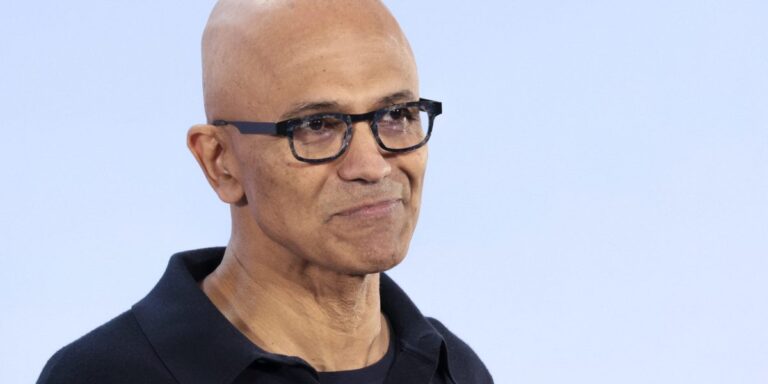
Microsoft’s move reflects a wider trend among major technology companies, many of which are undergoing similar workforce reductions as they double down on artificial intelligence. The company has invested billions in AI infrastructure, and CEO Satya Nadella recently noted that up to 30% of Microsoft’s code is now written by AI tools. While Microsoft has not directly attributed the layoffs to AI replacing human workers, the timing and focus of the cuts suggest a shift toward a leaner, more automated organization.
The layoffs underline that the job market in tech is tightening even as companies like Microsoft continue to deliver strong earnings.
Disclaimer: For this story, Fortune used generative AI to help with an initial draft. An editor verified the accuracy of the information before publishing.
Introducing the 2025 Fortune 500, the definitive ranking of the biggest companies in America. Explore this year’s list.
Iceland is a country full of fascinating statistics. Known for its unique climate and distinctive national character, it has the highest number of writers per capita in the world: one in ten residents has published a book. It’s also a leader in renewable energy consumption, with nearly 100% of its energy coming from geothermal or hydroelectric sources. Recently, Iceland has set another record by hosting the world’s largest carbon sequestration plant. Read on to discover more about carbon sequestration and the intriguing features of Iceland’s new plant.
What is carbon sequestration and how is it achieved?
Before diving into the Arctic installation, let’s explore carbon sequestration, a crucial technique for reducing atmospheric carbon dioxide levels. Carbon sequestration helps lower global temperatures and combat climate change by capturing and storing CO₂ from the atmosphere. This process reduces CO₂ concentration, helping to mitigate global warming. It is vital for achieving the CO2 emission reduction targets set by the Paris Agreement.
Currently, three main techniques are used for carbon sequestration:
Carbon capture and storage (CCS): This method captures CO₂ emissions from industrial and power plants before they enter the atmosphere. The CO₂ is then transported through pipelines and stored in underground geological formations, like depleted oil and gas fields or saline aquifers, where it can be safely stored for thousands of years.
Biological sequestration: This approach uses natural processes to capture and store carbon. Reforestation, sustainable soil management in agriculture, and restoring marine ecosystems like mangroves and seagrass meadows allow plants and soils to absorb and retain CO₂ from the atmosphere, integrating it into biomass and soil naturally.
Direct air capture (DAC) technologies: These cutting-edge technologies use mechanical devices to extract CO₂ directly from the air. The captured CO₂ can be stored underground or reused in the production of industrial materials and synthetic fuels, offering a flexible solution for reducing atmospheric CO₂ levels.
Project Mammoth, the carbon sequestration plant in Iceland
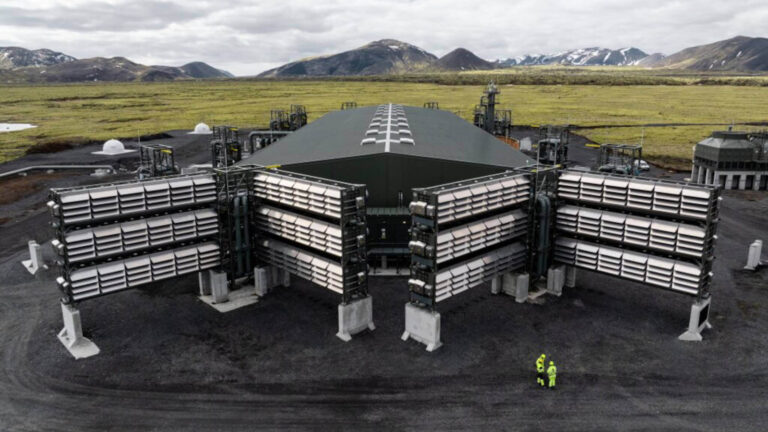
Of these techniques, Iceland has chosen the third option, utilizing DAC technologies to capture atmospheric carbon. Named the Mammoth project, the plant began operations in May 2024. Designed to capture up to 36,000 tons of CO₂ annually, it is the largest plant of its kind worldwide. Although the technology is still in its early stages, its predecessor, the Orca plant, captures around 4,000 tons per year.
Iceland is committed to using renewable energy in all its processes, and the Mammoth plant is no exception. Thus, it uses geothermal energy from the Hellisheidi power plant to power its operations and minimize its carbon footprint. CO₂ capture is achieved through 72 collection units that filter the air, absorb the CO₂, and then mix it with water to inject it into underground basalt formations. Here, the CO₂ reacts with the basalt and is mineralized, becoming stone and remaining permanently stored, as we told you in this article on carbon mineralization.
The Swiss company behind this project aims to scale up this technology to capture megatons of CO₂ by 2030 and gigatons by 2050, significantly contributing to global climate goals. The technology has already attracted interest from countries such as Norway, Kenya, Canada, and the USA. For example, the US plans to invest over $600 million in developing carbon sequestration technologies.
Currently, the main challenge for DAC technology is reducing its costs and improving energy efficiency. Capturing one ton of CO₂ costs about $1,000, but this figure is expected to decrease to $300 by 2030. Meanwhile, ongoing efforts to reduce emissions of CO₂ and other greenhouse gases through renewable energy sources remain crucial.