

18 C
New York
Saturday, April 4, 2026
Home Blog Page 609

Lawyers claim Kilmar Abrego Garcia was subjected to torture in El Salvador prison, according to reports

0

New court filings detail man’s ordeal after his mistaken deportation became a flashpoint in Trump’s immigration crackdown.

Kilmar Abrego Garcia, a Salvadoran man legally residing in the US state of Maryland, whom the Trump administration mistakenly deported in a high-profile case in March, was severely beaten and subjected to psychological torture in prison there, his lawyers say.

The alleged abuse was detailed in court documents filed in Abrego Garcia’s civil lawsuit against the Trump administration on Wednesday, providing an account of his experiences following his deportation for the first time.

Abrego Garcia’s case has become a flashpoint in the US government’s controversial immigration crackdown since he was mistakenly deported to his native El Salvador in March, despite an earlier order by an immigration judge barring such a move.

According to his lawyers, Abrego Garcia fled El Salvador as a teenager to avoid gang violence, arriving in the United States around 2011. He has lived for more than a decade in Maryland, where he and his American wife are raising three children.

He was returned to the US last month and is currently locked in a legal battle with the US government, which has indicted him on charges of migrant smuggling and says it plans to deport him to a third country.

“Plaintiff Abrego Garcia reports that he was subjected to severe mistreatment upon arrival at CECOT, including but not limited to severe beatings, severe sleep deprivation, inadequate nutrition, and psychological torture,” his lawyers said in the filing, referring to the Salvadoran mega-prison known as the Terrorism Confinement Centre, or CECOT.

Severe beatings, threats

The filings, made in a civil suit in federal court against the US government brought by Abrego Garcia’s wife in Maryland, said her husband was hit and kicked so frequently upon his arrival at the prison that the next day his body was covered in lumps and bruises.

The filings also said he and other inmates were forced to kneel for nine hours straight throughout the night, or were hit by guards, in a cruel exercise of sleep deprivation.

It said prison staff repeatedly threatened to transfer Abrego Garcia to cells with gang members who would “tear” him apart, and claimed that he lost 31 pounds (14kg) in his first two weeks in jail as a result of the abuse.

‘Administrative error’

Abrego Garcia was detained by immigration officials and deported to El Salvador on March 15. Trump and US officials have accused him of belonging to the notorious MS-13 gang, which he denies.

The deportation took place despite an order from a US immigration judge in 2019, which barred Abrego Garcia from being sent back to El Salvador because he likely faced persecution there from gangs.

Abrego Garcia’s treatment gained worldwide attention, with critics of Trump’s aggressive immigration policy saying it demonstrated how officials were ignoring due process in their zeal to deport migrants. The Trump administration later described the deportation as an “administrative error”.

Last month, the US government complied with a directive from the court to return Abrego Garcia to the US, but only after having secured an indictment charging him with working with coconspirators as part of a smuggling ring to bring immigrants to the US illegally.

He is currently being detained in Nashville, Tennessee, while his criminal case is pending, having pleaded not guilty to illegally transporting undocumented immigrants.

The US government is arguing that the new civil suit is now moot, as Abrego Garcia has been returned from El Salvador. It has said it plans to deport him to a third country after he is released from custody.

Abrego Garcia a ‘criminal’ for DHS

In the wake of the latest court filings, the Trump administration doubled down on its attacks on Abrego Garcia as a dangerous illegal immigrant.

In a post on the social media platform X, the Department of Homeland Security (DHS) said the “media’s sympathetic narrative about this criminal illegal gang member has completely fallen apart”.

“Once again the media is falling all over themselves to defend Kilmar Abrego Garcia,” it said.

“This illegal alien is an MS-13 gang member, alleged human trafficker, and a domestic abuser,” DHS claimed, without providing any evidence.
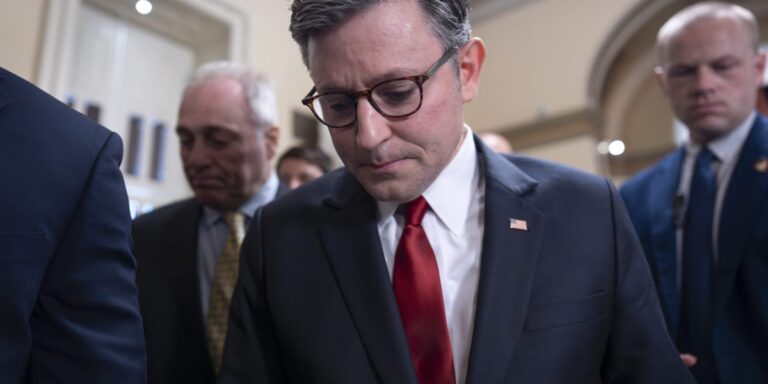

House GOP Struggles to Pass Trump’s Tax Bill as Members from Center and Far-Right Resist During Late-Night Session

0

House Republicans strained through a day of starts and stops trying to advance President Donald Trump’s tax and spending cuts package, GOP leaders working almost around the clock to persuade skeptical holdouts to send the bill to his desk by the Fourth of July deadline.

A procedural roll call that started late Wednesday night was held open into Thursday morning as several Republicans refused to give their votes. With few to spare from their slim majority, the outcome was in jeopardy. House Speaker Mike Johnson had recalled lawmakers to Washington, eager to seize on the momentum of the bill’s passage the day before in the Senate, and he vowed to press ahead.

“Our way is to plow through and get it done,” Johnson said, emerging in the middle of the night from a series of closed-door meetings. He expected votes later Thursday morning. “We will meet our July 4th deadline.”

But as voting stalled Trump, who hosted lawmakers Wednesday at the White House and spoke with some by phone, lashed out in a midnight post: “What are the Republicans waiting for??? What are you trying to prove???” He also warned starkly of political fallout from the delay “COSTING YOU VOTES!!!”

The idea of quickly convening to for a vote on the more than 800-page bill was a risky gambit, one designed to meet Trump’s demand for a holiday finish. Republicans have struggled mightily with the bill nearly every step of the way, often succeeding by the narrowest of margins — just one vote. Their slim 220-212 majority leaves little room for defections.

Several Republicans are balking at being asked to rubber-stamp the Senate version less than 24 hours after passage. A number of moderate Republicans from competitive districts have objected to the Senate bill’s cuts to Medicaid, while conservatives have lambasted the legislation as straying from their fiscal goals.

It falls to Johnson and his team to convince them that the time for negotiations is over. They will need assistance from Trump to close the deal, and lawmakers headed to the White House for a two-hour session Wednesday to talk to the president about their concerns.

“The president’s message was, ‘We’re on a roll,’” said Rep. Ralph Norman, R-S.C. “He wants to see this.”

Republicans are relying on their majority hold of Congress to push the package over a wall of unified Democratic opposition. No Democrats voted for bill in the Senate and none were expected to do so in the House.

“Hell no!” said House Democratic Leader Hakeem Jeffries, flanked by fellow Democrats outside the Capitol.

In an early warning sign of Republican resistance, a resolution setting up terms for debating Trump’s bill barely cleared the House Rules Committee on Wednesday morning. As soon as it came to the full House, it stalled out as GOP leadership waited for lawmakers who were delayed coming back to Washington and conducted closed-door negotiations with holdouts.

By nightfall, as pizzas and other dinners were arriving at the Capitol, the next steps were uncertain.

Trump pushes Republicans to do ‘the right thing’

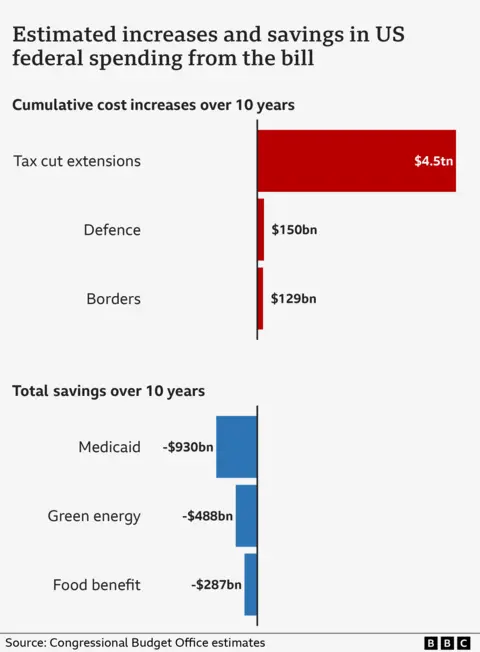
The bill would extend and make permanent various individual and business tax breaks from Trump’s first term, plus temporarily add new ones he promised during the 2024 campaign. This includes allowing workers to deduct tips and overtime pay, and a $6,000 deduction for most older adults earning less than $75,000 a year. In all, the legislation contains about $4.5 trillion in tax cuts over 10 years.

The bill also provides about $350 billion for defense and Trump’s immigration crackdown. Republicans partially pay for it all through less spending on Medicaid and food assistance. The Congressional Budget Office projects the bill will add about $3.3 trillion to the federal debt over the coming decade.

The House passed its version of the bill in May by a single vote, despite worries about spending cuts and the overall price tag. Now it’s being asked to give final passage to a version that, in many respects, exacerbates those concerns. The Senate bill’s projected impact on the nation’s debt, for example, is significantly higher.

“Lets go Republicans and everyone else,” Trump said in a late evening post.

The high price of opposing Trump’s bill

Johnson is intent on meeting Trump’s timeline and betting that hesitant Republicans won’t cross the president because of the heavy political price they would have to pay.

They need only look to Sen. Thom Tillis, R-N.C., who announced his intention to vote against the legislation over the weekend. Soon, the president was calling for a primary challenger to the senator and criticizing him on social media. Tillis quickly announced he would not seek a third term.

One House Republican who has staked out opposition to the bill, Rep. Thomas Massie of Kentucky, is being targeted by Trump’s well-funded political operation.

Democrats target vulnerable Republicans to join them in opposition

Flanked by nearly every member of his caucus, Democratic Leader Jeffries of New York delivered a pointed message: With all Democrats voting “no,” they only need to flip four Republicans to prevent the bill from passing.

Jeffries invoked the “courage” of the late Sen. John McCain giving a thumbs-down to the GOP effort to “repeal and replace” the Affordable Care Act, and singled out Republicans from districts expected to be highly competitive in 2026, including two from Pennsylvania.

“Why would Rob Bresnahan vote for this bill? Why would Scott Perry vote for this bill?” Jeffries asked.

Democrats have described the bill in dire terms, warning that Medicaid cuts would result in lives lost and food stamp cuts would be “literally ripping the food out of the mouths of children, veterans and seniors,” Jeffries said Monday.

Republicans say they are trying to right-size the safety net programs for the population they were initially designed to serve, mainly pregnant women, the disabled and children, and root out what they describe as waste, fraud and abuse.

The package includes new 80-hour-a-month work requirements for many adults receiving Medicaid and applies existing work requirements in the Supplemental Nutrition Assistance Program, or SNAP, to more beneficiaries. States will also pick up more of the cost for food benefits.

The driving force behind the bill, however, is the tax cuts. Many expire at the end of this year if Congress doesn’t act.

The Tax Policy Center, which provides nonpartisan analysis of tax and budget policy, projected the bill would result next year in a $150 tax break for the lowest quintile of Americans, a $1,750 tax cut for the middle quintile and a $10,950 tax cut for the top quintile. That’s compared with what they would face if the 2017 tax cuts expired.

Trump’s major legislation set for final vote during late-night House session in the US

0

Brandon Drenon

BBC News, Washington DC

Watch: Trump reacts to the Senate narrowly passing his budget bill

The US House of Representatives is working in the middle of the night as Donald Trump and his allies try to pressurise holdouts in the president’s own Republican Party to back his mega-bill on tax and spending in a final vote.

The sprawling legislation, which could define Trump’s second term in office, passed a key procedural vote after 03:00 EDT (07:00 GMT).

Trump’s bill has been opposed not only by opposition Democrats, but by a handful of Republicans who criticise its potential impact on national finances, healthcare and other issues.

The bill ground through the Senate earlier this week in another overnight session. Trump hopes it will pass by Friday.

Both chambers of Congress are controlled by Trump’s Republicans, but within the party several factions are fighting over key policies in the lengthy legislation.

The House, or lower chamber, approved an earlier version of the bill in May with a margin of just one vote, and this bill, with new amendments that have frustrated some Republicans, must now be reconciled with the Senate version.

The bill narrowly cleared the Senate, or upper chamber, on Tuesday. Vice-President JD Vance cast a tie-breaking vote after more than 24 hours of debate and resistance from some Republican senators.

It has so far proven equally tricky for Trump’s allies to pass the bill through the House.

After about seven hours of wrangling that led to most lawmakers clearing from the chamber on Wednesday, House Speaker Mike Johnson scheduled a vote on the rule – a procedural vote that allows the legislation to be brought to the floor for a full vote.

This hurdle was ultimately cleared several hours later, and was seen as a signal that Republicans might have the support they needed after all.

The president has been very involved in attempting to persuade the holdouts and held several meetings at the White House on Wednesday in hopes of winning them over.

On Wednesday, he took to social media to apply further pressure, saying that the “House is ready to vote tonight”. He added that Republicans are “united” to deliver “massive growth”.

Ralph Norman, a House Republican from South Carolina, attended one of the meetings but wasn’t persuaded.

“There won’t be any vote until we can satisfy everybody,” he said, adding he believes there are about 25 other Republicans who are currently opposed to it. The chamber can only lose about three Republicans to pass the measure.

“I got problems with this bill,” he said. “I got trouble with all of it.”

Sticking points include the question of how much the bill will add to the US national deficit, and how deeply it will cut healthcare and other social programmes.

During previous signs of rebellion against Trump at Congress, Republican lawmakers have ultimately fallen in line.

House Majority Leader Steve Scalise told reporters that Republicans were still on their way to Washington to vote, and that several had flight delays due to bad weather.

What is at stake this time is the defining piece of legislation for Trump’s second term. But several factions stand in its way.

The deficit hawks

The Congressional Budget Office (CBO) estimated that the version of the bill that was passed on Tuesday by the Senate could add $3.3tn (£2.4tn) to the US national deficit over the next 10 years. That compares with $2.8tn that could be added by the earlier version that was narrowly passed by the House.

The deficit means the difference between what the US government spends and the revenue it receives.

This outraged the fiscal hawks in the conservative House Freedom Caucus, who have threatened to tank the bill.

Many of them are echoing claims made by Elon Musk, Trump’s former adviser and campaign donor, who has repeatedly lashed out at lawmakers for considering a bill that will ultimately add to US national debt.

Shortly after the Senate passed the bill, Texas congressman Chip Roy, of the ultraconservative House Freedom Caucus, was quick to signal his frustration.

He said the odds of meeting Trump’s 4 July deadline had lengthened.

Getty Images Congressman Ralph Norman with his head in his hands looking exasperated at a hearingGetty Images

Congressman Ralph Norman is among the Republicans threatening to vote down the bill

Freedom Caucus chairman Andy Harris of Tennessee told Fox News that Musk was right to say the US cannot sustain these deficits. “He understands finances, he understands debts and deficits, and we have to make further progress.”

On Tuesday, Conservative congressman Andy Ogles went as far as to file an amendment that would completely replace the Senate version of the bill, which he called a “dud”, with the original House-approved one.

Ohio Republican Warren Davison posted on X: “Promising someone else will cut spending in the future does not cut spending.”

A pair of bar charts compare the estimated increases and savings in US federal spending from Trump's budget bill. The first bar chart shows the cumulative cost increases over 10 years. It highlights tax-cut extensions (worth $4.5tn), defence (worth $150bn) and borders (worth $129bn). The bar representing tax-cut extensions is much longer than any of the bars on the bar chart that shows total savings. This second bar chart highlights Medicaid (worth $930bn in savings), green energy (worth $488bn) and food benefits (worth $287bn)

The Medicaid guardians

Representatives from poorer districts are worried about the Senate version of the bill harming their constituents, which could also hurt them at the polls in 2026.

According to the Hill, six Republicans were planning to vote down the bill due to concerns about cuts to key provisions, including cuts to medical coverage.

Some of the critical Republicans have attacked the Senate’s more aggressive cuts to Medicaid, the healthcare programme relied upon by millions of low-income Americans.

“I’ve been clear from the start that I will not support a final reconciliation bill that makes harmful cuts to Medicaid, puts critical funding at risk, or threatens the stability of healthcare providers,” said congressman David Valadao, who represents a swing district in California.

This echoes the criticism of opposition House Democrats, whose leader, Hakeem Jeffries, posted a picture of himself on Wednesday to Instagram, holding a baseball bat and vowing to “keep the pressure on Trump’s One Big Ugly Bill”.

Other Republicans have signalled a willingness to compromise. Randy Fine, from Florida, told the BBC he had frustrations with the Senate version of the bill, but that he would vote it through the House because “we can’t let the perfect be the enemy of the good”.

House Republicans had wrestled over how much to cut Medicaid and food subsidies in the initial version their chamber passed. They needed the bill to reduce spending, in order to offset lost revenue from the tax cuts contained in the legislation.

The Senate made steeper cuts to both areas in the version passed on Tuesday.

Changes to Medicaid and the Affordable Care Act (better known as Obamacare) in the Senate’s bill would see roughly 12 million Americans lose health insurance by 2034, according to a CBO report published on Saturday.

Under the version originally passed by the House, a smaller number of 11 million Americans would have had their coverage stripped, according to the CBO.

Hakeem Jeffries/Instagram US House Minority Leader Hakeem Jeffries holds a brown baseball bat while standing in an office. He is surrounded by chairs including a brown couch with yellow cushions which is behind him. He is wearing a blue dress shirt and black trousersHakeem Jeffries/Instagram

House Democrats, led by Hakeem Jeffries, are united against the bill

The state tax (Salt) objectors

The bill also deals with the question of how much taxpayers can deduct from the amount they pay in federal taxes, based on how much they pay in state and local taxes (Salt). This, too, has become a controversial issue.

There is currently a $10,000 cap, which expires this year. Both the Senate and House have approved increasing this to $40,000.

But in the Senate-approved version, the cap would return to $10,000 after five years. This change could pose a problem for some House Republicans.

Watch as the Senate narrowly passes Trump’s bill

A thin, grey banner promoting the US Politics Unspun newsletter. On the right, there is an image of the Capitol Building against a background of vertical red, grey and blue stripes. The banner reads: "The newsletter that cuts through the noise.”

Follow the twists and turns of Trump’s second term with North America correspondent Anthony Zurcher’s weekly US Politics Unspun newsletter. Readers in the UK can sign up here. Those outside the UK can sign up here.

Warner and Bain Announce $1.2 Billion Joint Venture; Plan to Secure $700 Million in Debt Financing

0

Yesterday (July 1), Warner Music Group and private investment giant Bain Capital unveiled their plans for a $1.2 billion music rights-buying joint venture.

MBW reported that roughly half of the $1.2 billion would be made up of debt, half with cash, with equal liability on both sides of the JV.

Now we know the finer details of the arrangement between WMG and Bain, courtesy of a fresh SEC filing.

The joint venture was formally established on June 29, 2025, through agreements between a WMG subsidiary called WMG BC Holdco and a Bain Capital subsidiary called BCSS W JV Investments (B), L.P (BainCo).

This duo have formed a joint entity called “Beethoven JV 1 LLC” (WMBC) as their 50/50 partnership vehicle.

According to the SEC filing, the partnership’s $1 billion-plus war chest is broken down as $500 million in equity capital split equally between the partners (which obviously equals each party investing $250 million apiece).

The fund also includes “approximately $500 million in initial warehouse debt commitments” secured directly by WMBC’s music catalog assets, with the ability to “increase the size of the [debt] facility to $700 million,” bringing the total to $1.2 billion.

Interestingly, the SEC filing reveals that JV is designed as the first of potentially multiple joint ventures.

According to the filing, “the JV Agreement contemplates the formation of additional 50/50 WMGCo/BainCo JVs,” suggesting Warner and Bain could launch additional acquisition vehicles.

Each partner has also granted the joint venture a “right of first opportunity” on any catalog acquisitions they’re considering that meet specified financial criteria.

WMG and Bain Capital said in their official announcement on Tuesday (July 1) that they will source and acquire the catalogs together, while WMG will manage all aspects of marketing, distribution, and administration.

As we pointed out yesterday, the funds might be deployed swiftly: Warner and Bain are understoof to be mulling the acquisition of the Red Hot Chili Peppers’ recorded music catalog for around $350 million.

WMG and Bain Capital said that they’d be targeting “legendary” music catalogs across both recorded music and music publishing.

“Augmenting our deep expertise and global infrastructure with Bain Capital’s financial prowess and belief in music will make us the destination of choice for preeminent catalogs.”

Robert Kyncl, WMG (via statement issued July 1)

In a statement issued on Tuesday, Warner Music Group CEO Robert Kyncl said: “Iconic artists and songwriters choose WMG to grow their legacies and introduce their art to new generations through impactful and innovative campaigns.”

He added: “Augmenting our deep expertise and global infrastructure with Bain Capital’s financial prowess and belief in music will make us the destination of choice for preeminent catalogs.”


Meanwhile, as reported in a separate story on Tuesday, Warner announced what it refers to as “a strategic restructuring plan… designed to free up funds to invest in music and to accelerate the Company’s long-term growth”.

In a note to staff sent on Tuesday and obtained by MBW, Warner Music Group CEO Robert Kyncl referred to it as the “remaining steps in our plan to help future-proof the company”.

WMG says in its SEC filing that it “expects the Plan to generate pre-tax cost savings of approximately $300 million on an annualized run-rate basis by the end of fiscal year 2027 and expects the majority of the cost savings under the Plan to be accretive to Adjusted OIBDA”.

Just over half of that annual $300 million cost-cutting target ($170 million) will be achieved via headcount reductions at WMG, said the company.

A further $30 million of savings will be achieved by reducing costs (like admin and real estate expenses) directly related to the headcount reductions. The rest of the cost-cutting will target SG&A expenses.

In its SEC filingWarner said it expects this plan to be “fully implemented by the end of calendar year 2026”.Music Business Worldwide

Russia-Ukraine war: Major events on day 1,225 of the conflict | Latest updates on Russia-Ukraine war

0

Here is how things stand on Thursday, July 3:

Fighting

  • A woman in her 70s was killed and two people were injured when debris from a destroyed Ukrainian drone fell on a residential building in Russia’s southwestern region of Lipetsk, Regional Governor Igor Artamonov said on Thursday.

  • Russia has made incursions near two towns, Pokrovsk and Kostiantynivka, that are crucial to army supply routes in eastern Ukraine, Viktor Trehubov, a spokesperson for the Khortytsia group of forces, told the Reuters news agency. Trehubov said Russian forces are carrying out “constant attacks with the intent of breaking through” to the border of the Dnipropetrovsk region, according to Reuters.

  • Russia’s air defence systems destroyed 69 Ukrainian drones overnight, Russia’s state-owned RIA Novosti reported early on Thursday.

Weapons

  • Ukraine’s Ministry of Foreign Affairs said it had called in the acting US envoy to Kyiv, Keith Kellogg, to stress the importance of US military aid after the Pentagon decided to halt some shipments of critical weapons over concerns that stockpiles are running low.
  • “The Ukrainian side emphasised that any delay or procrastination in supporting Ukraine’s defence capabilities will only encourage the aggressor to continue the war and terror, rather than seek peace,” the Foreign Ministry said.
  • Deputy White House Press Secretary Anna Kelly said the halt to some shipments was made “to put America’s interests first” following a Department of Defense review of military support around the world.
  •  Russia is using an online media outlet to sow discord in Germany as part of disinformation efforts being carried out alongside its war in Ukraine, the German Foreign Ministry said on Wednesday.

  • The outlet, Red, portrays itself as a “revolutionary platform for independent journalists” but has “close links” with the Russian state media outlet RT, a ministry spokesperson told reporters in Berlin.

  • The European Union’s top diplomat, Kaja Kallas, warned that Chinese businesses’ support for Russia’s war posed a threat to European security, the EU’s diplomatic service said in a statement, following a meeting between Kallas and Chinese Foreign Minister Wang Yi.
  • Kallas urged China “to immediately cease all material support that sustains Russia’s military industrial complex” and support “a full and unconditional ceasefire” and a “just and lasting peace in Ukraine”, the statement said.

House Rebels Delay Passage of Donald Trump’s Tax Bill, Putting it On the Brink of Approval

0

Unlock the White House Watch newsletter for free

Donald Trump struggled to crush a late rebellion in the House of Representatives from Republican critics of his flagship tax and spending bill, as the US president made a final push to get it passed by July 4.

On Thursday, the president lashed out on Truth Social at the Republican holdouts, as a procedural vote to advance the bill to a final vote in the lower chamber of Congress was on track to fail.

“Largest Tax Cuts in History and a Booming Economy vs. Biggest Tax Increase in History, and a Failed Economy. What are the Republicans waiting for??? What are you trying to prove??? MAGA IS NOT HAPPY, AND IT’S COSTING YOU VOTES!!!,” Trump said.

With a narrow majority in the House, Republicans can only afford to lose three votes on the bill.

On Wednesday, Trump met privately at the White House with Republican dissidents to prevent them from torpedoing his “big beautiful bill”.

Since then five Republicans opposed advancing the bill, enough to stop it from moving forward, in a key procedural vote. The final tally has been kept open as Trump, House Speaker Mike Johnson and other party leaders hope to flip the votes from those Republicans.

Several conservative and centrist Republican lawmakers have raised concerns about the legislation that was approved by the Senate this week.

Some are unhappy that the bill — which implements a big chunk of Trump’s domestic agenda — does not go far enough to rein in the US debt, or roll back clean energy subsidies. Others are worried about cuts to healthcare programmes.

Still, it is unclear how long the rebellion will last, since many conservative hardliners have a history of buckling to the will of the White House and congressional leaders.

One group of conservatives including Tennessee’s Tim Burchett emerged from the White House upbeat following a “very productive” two-hour meeting with Trump and his vice-president JD Vance on Wednesday.

“The president was wonderful, as always,” Burchett said in a video posted to his social media accounts. “We will hopefully get this worked out and do some great things for this country.”

The “big, beautiful bill” extends vast tax cuts from Trump’s first administration, paid for in part by steep cuts to Medicaid, the public health insurance scheme for low-income and disabled Americans, and other social welfare programmes.

The bill would also roll back Joe Biden-era tax credits for clean energy, while scaling up investment in the military and border protection.

A version of the sweeping legislation was narrowly passed in the Senate after three Republicans sided with Democrats against the bill, forcing Vance to cast a tiebreaking vote.

That sent the legislation back to the House, which must approve the bill before Trump signs it into law. An earlier version of the legislation passed the House by a single vote in May.

“The Senate bill moved way far away from the House bill,” Andy Harris, a Maryland Republican who chairs the influential House Freedom Caucus, told CNBC. “We should take the time to get this right.”

Fiscally conservative lawmakers, including many Freedom Caucus members, object to the cost of the legislation, which the non-partisan Congressional Budget Office says will add $3.4tn to the deficit over the next decade. The group has circulated a three-page memo detailing what it described as “failures” of the Senate bill.

More moderate members have argued that the cuts to Medicaid, which would strip an estimated 12mn people of their health insurance, are too steep.

The White House has dismissed the CBO’s projections and argued that the bill would more than pay for itself in the long term by generating stronger economic growth.

Many still missing after ferry sinks near Bali

0

At least four people have died and dozens are missing after a ferry sank off Indonesia’s tourist island of Bali, rescuers said.

The boat was carrying 53 passengers and 12 crew members when it sank at 23:20 local time (15:35 GMT) on Wednesday while on its way to Bali from Banyuwangi on the eastern coast of Java island, the Surabaya office of the National Search and Rescue Agency said.

Twenty-nine survivors have been rescued, authorities say, as the search continues.

Photos published by Antara news agency showed ambulances on standby and residents waiting for updates by the roadside.

Authorities are investigating the cause of the sinking.

The ferry operator told local media that the vessel had reported engine trouble shortly before it sank.

The vessel’s route is often used by locals going between the islands of Java and Bali.

Four survivors who were found on a lifeboat were all residents of Banyuwangi, the Surabaya search and rescue team said.

Marine accidents are frequent in Indonesia, a sprawling archipelago of around 17,000 islands, where uneven enforcement of safety regulations is a longstanding concern.

An Australian woman died in March after a boat capsized off Bali with 16 people on board.

Regional governor of Lipetsk in Russia confirms one person killed in Ukrainian drone attack

0


Ukrainian drone attack kills one in Russia's Lipetsk, regional governor says

US claims its attacks have set back Iran’s nuclear program by one to two years | Updates on Israel-Iran tensions

0

Washington, DC – The Pentagon has announced that United States military strikes against Iran set back the country’s nuclear programme by one to two years, an assessment that follows President Donald Trump’s claims that the programme was “obliterated”.

Defense Department spokesperson Sean Parnell said on Wednesday that the three Iranian nuclear facilities targeted by Washington were destroyed, echoing the president’s remarks. He praised the strikes as a “bold operation”.

“We have degraded their programme by one to two years at least,” Parnell told reporters. “Intel assessments inside the department assess that.”

Since the US sent a group of B-2 stealth bombers to Iran on June 21, Trump has consistently lashed out at any suggestions that the attacks did not wreck the country’s nuclear facilities.

He has maintained that Iran’s nuclear programme has been “obliterated like nobody’s ever seen before”.

An initial US intelligence assessment, leaked to several media outlets last month, said the strikes failed to destroy key components of Iran’s nuclear programme and only delayed its work by months.

For its part, Tehran has been coy about providing details about the state of its nuclear sites.

Some Iranian officials have said that the facilities sustained significant damage from US and Israeli attacks. But Supreme Leader Ali Khamenei said last week that Trump had “exaggerated” the impact of the strikes.

There has been no independent assessment of the aftermath of the US attacks, which came as part of a 12-day war between Israel and Iran. Visual analyses via satellite images cannot fully capture the scope of the damage at the underground sites, especially the country’s largest enrichment facility, Fordow.

Another persistent mystery is the location and state of the stockpiles containing Iran’s highly enriched uranium.

Iran’s nuclear agency and regulators in neighbouring states have said they did not detect a spike in radioactivity after the bombings, as might be expected from such strikes.

But Rafael Grossi, the head of the United Nations nuclear watchdog, the International Atomic Energy Agency (IAEA), did not rule out that the containers holding the uranium may have been damaged in the attacks.

“We don’t know where this material could be or if part of it could have been under the attack during those 12 days,” Grossi told CBS News last week.

“So some could have been destroyed as part of the attack, but some could have been moved.”

Satellite images showed trucks moving out of Fordow before the US strikes.

Grossi also said that Iran could be enriching uranium again in a “matter of months”. Enrichment is the process of enhancing the purity of radioactive uranium atoms to produce nuclear fuel.

The facilities targeted in the US strikes had been under constant IAEA surveillance. But now, Iran’s nuclear programme is in the dark, away from the scrutiny of international inspectors.

After the war, the Iranian parliament passed a law suspending cooperation with the IAEA, citing the agency’s failure to condemn the US and Israeli attacks on the country’s nuclear facilities.

The Geneva Conventions prohibit attacks on “installations containing dangerous forces, namely dams, dykes and nuclear electrical generating stations”.

Before the war started on June 13, Tehran claimed to have obtained Israeli documents that show that the IAEA was passing off information to Israel about Iran’s nuclear programme – allegations that the agency denied.

Earlier on Wednesday, the US State Department called on Iran to allow the IAEA access to its nuclear programme.

“It is … unacceptable that Iran chose to suspend cooperation with the IAEA at a time when it has a window of opportunity to reverse course and choose a path of peace and prosperity,” State Department spokeswoman Tammy Bruce said in a statement.

Israel launched a massive attack against Iran on June 13 without direct provocation, claiming that it was preemptively targeting Iran’s push towards a nuclear weapon.

Tehran denies seeking a nuclear bomb. Israel, meanwhile, is widely believed to have an undeclared nuclear arsenal.

Israeli air strikes during the conflict killed hundreds of Iranian civilians, including nuclear scientists and their family members, as well as top military officials.

Iran responded with barrages of missiles that left widespread destruction and killed 29 people in Israel.

Ten days into the war, the US joined the Israeli campaign and bombed Iran’s nuclear facilities. Tehran, in turn, launched a missile strike against a US air base in Qatar, an attack that resulted in no casualties.

Hours later, Trump announced a ceasefire between Israel and Iran. Officials in both countries have described the outcome of the war as a “historic victory”.

Israel has similarly claimed that Iran’s nuclear programme was destroyed. But Iran has insisted it foiled Israel’s goals by maintaining the stability of its government as well as its nuclear and missile programmes.

New 3D-Printing Resin Combines Hard and Soft Materials

0

If an object that’s composed of two types of material is going to fail, the break will usually occur at the interface where the two meet. A new type of light-activated 3D printing resin addresses that problem, by gradually morphing from hard to soft states within a single object.

Developed by Asst. Prof. Zak Page and colleagues from The University of Texas at Austin, the liquid resin was inspired by natural materials such as rigid bone which smoothly melds with flexible cartilage.

The substance incorporates an epoxy–acrylate monomer combined with a photosensitizer compound. It’s used in a type of 3D printing known as digital light processing (DLP), in which focused patterns of light are shone through the transparent sides of a vat of photosensitive resin – doing so causes select areas of the resin within to polymerize into layers of solid material.

When an area of the new resin is exposed to violet-colored light, the resin in that region forms into a solid yet stretchy rubber-like material. On the other hand, wherever the resin is exposed to ultraviolet light, the photosensitizer in that area causes it to take on a hard, rigid consistency.

And importantly, by softly blending the boundary line between the two types of light, it’s possible to likewise gradually transition from soft rubber to hard polymer within a single print job.

“Nature does this in an organic way, combining hard and soft materials without failure at the interface,” says Page. “We wanted to replicate that.”

The technology has so far been demonstrated in 3D-printed items such as a shock absorber consisting of hard springs embedded in a soft cylinder; a stretchable electronic device with a rigid section to prevent an embedded gold wire from breaking; and a model knee joint featuring both rigid bones and stretchable ligaments.

Possible future applications could include surgical training models, wearable sensors, or perhaps even soft-bodied robots.

Model knee joint made from single dual-nature 3D-printing resin

It should be mentioned that scientists at Case Western Reserve University previously developed a somewhat similar material, inspired by squid beaks, which can be made harder or softer by varying the amount of light it’s exposed to.

And more recently, researchers from the University of California Santa Barbara and the Lawrence Livermore National Laboratory created a resin that can form a permanent or dissolvable solid, depending on whether it’s exposed to ultraviolet or visible light.

A paper on the UT Austin resin was recently published in the journal Nature Materials.

Source: The University of Texas at Austin