


Houston Astros donate $1M to help recovery from Texas floods
Volcano in Indonesia Erupts, Sending Ash Up to 11 Miles into the Sky

new video loaded: Indonesian Volcano Spews Ash 11 Miles High
Recent episodes in Latest Video
Whether it’s reporting on conflicts abroad and political divisions at home, or covering the latest style trends and scientific developments, Times Video journalists provide a revealing and unforgettable view of the world.
Whether it’s reporting on conflicts abroad and political divisions at home, or covering the latest style trends and scientific developments, Times Video journalists provide a revealing and unforgettable view of the world.
Carla Hayden, the first woman and African American Librarian of Congress, finds success after being ousted by Trump
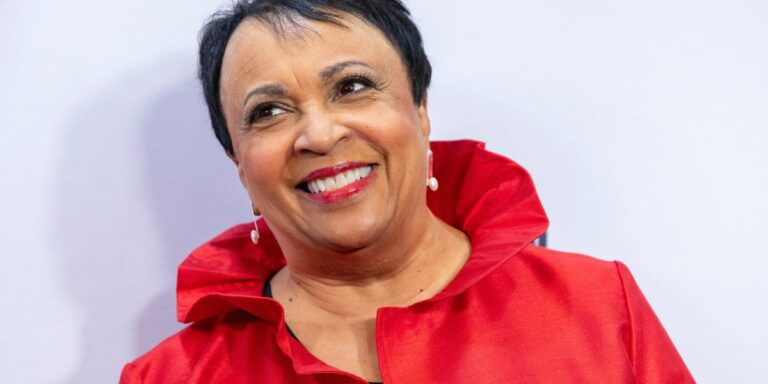
The Andrew W. Mellon Foundation exclusively told The Associated Press that Carla Hayden will join the humanities grantmaker Monday as a senior fellow whose duties will include advising on efforts to advance public knowledge through libraries and archives.
The year-long post places Hayden back at the center of the very debates over American culture that surrounded her dismissal. The White House ousted Hayden, the first woman and the first African American to hold the title, after she was accused of promoting “radical” literary material by a conservative advocacy group seeking to squash Trump opposition within the federal government.
Hayden acknowledged existing threats to “the free exchange of ideas” in a statement to the AP.
“For generations, libraries, archives, and cultural institutions have been the guardians of knowledge and the catalysts for human progress,” she said. “Together, we will work to strengthen the public knowledge ecosystem and ensure that the transformative power of information remains accessible to all.”
Mellon’s response to government funding cuts
Meanwhile, the Mellon Foundation has been working to fill fiscal holes for arts communities reeling from federal cuts. Its $15 million “emergency” fund aims to offset the $65 million that were supposed to go to the state humanities councils that organize book fairs, heritage festivals, theater productions and other programs fostering cultural engagement.
The foundation has previously supported the American Library Association’s efforts to counter book bans, increase scholarships for librarians of color and boost adult literacy.
Mellon President Elizabeth Alexander said the foundation is thrilled to welcome Hayden, “a leader with an unshakable regard for the public good of the American people,” during such a “crucial time.” Public knowledge institutions are navigating “historic challenges and transformative advances,” according to Mellon, including artificial intelligence, digital technologies, federal funding withdrawals and censorship efforts.
Who is the Librarian of Congress and what is the job?
The acting librarian is Deputy Attorney General Todd Blanche, who represented Trump during his 2024 criminal trial.
Responsibilities range from looking after collections to selecting the country’s poet laureate to awarding the Gershwin Prize for Popular Song and the Library of Congress Prize for American Fiction. The library also manages the nonpartisan Congressional Research Service.
Librarians serve 10-year terms, and Hayden’s was scheduled to end in 2026. Her tenure included modernizing its reservoir of the nation’s books and history. She oversaw new initiatives reaching out to rural and online audiences. Recent campaigns sought to improve accessibility for everyday visitors. And she arranged for Lizzo’s 2022 performance where the artist played a crystal flute owned by President James Madison — among the Library’s troves of artifacts.
Before her confirmation in 2016, Hayden spent more than two decades as CEO of Baltimore’s Enoch Pratt Free Library system and was president of the American Library Association from 2003 to 2004. A graduate of Roosevelt University and the University of Chicago, she is a member of the American Philosophical Society and the American Academy of Arts and Sciences.
US diplomat praises Lebanon’s reaction to Hezbollah’s disarmament suggestions | Hezbollah Updates
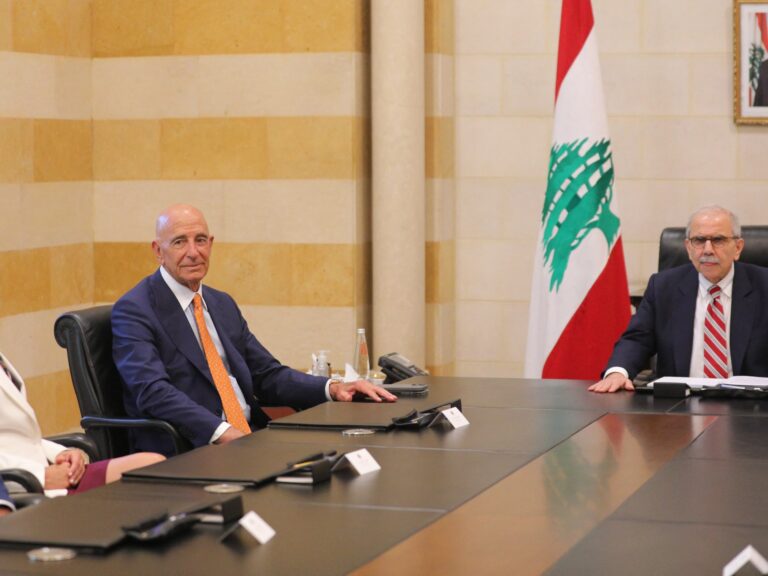
Hezbollah has rejected disarmament while Israel continues to attack Lebanon, after US calls for it to give up weapons in four months.
A senior United States envoy has praised the Lebanese government’s response to a US proposal aimed at disarming Hezbollah amid Israel’s continued military presence in the country.
Thomas Barrack, an adviser to US President Donald Trump who serves as Washington’s ambassador to Turkiye and special envoy for Syria, returned to Beirut on Monday after delivering the US proposal during a June 19 visit.
The plan called for the Shia Lebanese group Hezbollah to fully disarm within four months in exchange for a halt to Israeli air strikes and the full withdrawal of Israel’s military from the five positions it continues to occupy in southern Lebanon.
“What the government gave us was something spectacular in a very short period of time,” Barrack told reporters on Monday after meeting Lebanese President Joseph Aoun. “I’m unbelievably satisfied with the response.”
While Barrack confirmed that he had received a seven-page reply from the Lebanese side, he offered no details on its contents.
Barrack said that he believed both Lebanon and Israel were seeking a path toward de-escalation. “Both countries are trying to give the same thing – the notion of a stand-down agreement, of the cessation of hostilities, and a road to peace.”
The remarks come as tensions remain high as Israel continues to bombard Lebanon despite agreeing to a ceasefire in November.
The conflict between Israel and Hezbollah erupted in October 2023 after the Lebanese group attacked Israel in solidarity with the Palestinian group Hamas in Gaza. It spiralled into full-scale conflict by September the following year, killing more than 4,000 people – including Hezbollah leader Hassan Nasrallah and other senior officials – and displacing nearly 1.4 million people, according to Lebanese authorities.
Lebanon’s president and prime minister – both installed earlier this year – have promised to strengthen the state and the army, and said that Hezbollah, long viewed as the most powerful military force in Lebanon, must not be more powerful than the government.
However, Israel has continued to strike Lebanon, claiming its operations are aimed at preventing Hezbollah from rearming. Lebanese health officials say around 250 people have been killed and more than 600 wounded in Israeli attacks since the ceasefire.
Hezbollah has not issued a formal response to the US proposal. However, its leader, Naim Qassem, said on Sunday that the group would not disarm while Israel continued its aggression.
“We cannot be asked to soften our stance or lay down arms while [Israeli] aggression continues,” Qassem told thousands of supporters during Ashura commemorations in the southern suburbs of Beirut.
Barrack acknowledged that Hezbollah would need guarantees that it could continue operating as a political force within Lebanon.
But signs of de-escalation were absent on the ground. Just hours before Barrack’s arrival, Israel launched a wave of air strikes on southern and eastern Lebanon and carried out a ground invasion into a border village.
Lebanese officials and diplomats said the latest military action appeared to be an attempt to increase pressure on Hezbollah ahead of diplomatic discussions.
On Saturday, Lebanon’s Ministry of Public Health reported that an “Israeli enemy drone attack on a vehicle” in the Saf al-Hawa area of southern Lebanon’s Bint Jbeil killed one person and injured two others.
Earlier that day, the ministry said a separate Israeli drone strike wounded one person in the town of Shebaa. Lebanon’s National News Agency reported the attack hit a house in the village, which lies along Lebanon’s border with Syria and the Israeli-occupied Golan Heights.
The ministry said another Israeli drone strike targeted the town of Chaqra in Bint Jbeil, wounding two people, while on Thursday, an Israeli attack killed at least one person and injured three near the Lebanese capital, Beirut.
Competition probe launched by Turkey into Spotify following government minister’s complaint about ‘provocative’ playlists

Spotify says it’s cooperating with Turkey’s competition bureau in a probe into whether the streaming giant engaged in anti-competitive practices.
The competition bureau announced the probe the same day that a cabinet minister criticized Spotify on social media for what he described as content that disregards the country’s religious sensitivities and attacks Turkish President Recep Tayyip Erdoğan’s wife.
In a statement issued on Friday (July 4), the competition authority said it would examine whether Spotify had violated Turkish law “by engaging in practices that complicate the operations of its rivals in the online music streaming services market and/or affect the distribution of the royalties paid to various parties within the framework of its licensing relationships.”
It also said Spotify may be “discriminating between artists and content creators on the platform in various ways, including their visibility on the platform.”
The same day, Batuhan Mumcu, the Deputy Minister of Culture and Tourism, launched a broadside against the streaming platform on X, accusing it of hosting “content that targets our religious and national values and insults the beliefs of our society.”
Mumcu said that “Spotify insists on not taking the necessary steps despite all the warnings we have made before” regarding content, and that “the discrimination and rights violations against our artists have been ignored.”
He specifically called out “insidious and provocative, immoral content that targets our President Recep Tayyip Erdoğan’s precious wife Emine Erdoğan,” which he said is “incompatible with the cultural and moral values of our nation, and targets the unity and solidarity of our society.”
Mumcu’s X post included an embedded video showing searches on Spotify that brought up playlist titles like “Songs Prophet Muhammad listened to in the cave,” “Emine Ergodan hotgirl playlist,” and “Songs Emine Erdogan listened to when her golden faucet broke,” in apparent reference to claims that the Erdogans have gold-plated bathroom fixtures in the presidential palace.
“This irresponsibility and lack of control, which ignores the sensitivities of our society, has now become a legal issue,” Mumcu wrote. “For this reason, I personally think that a judicial process should be initiated and I call on our authorized institutions to take action.”
“We are cooperating with the investigation, are actively seeking to understand it, and will work toward a swift, constructive resolution with the Turkish Competition Authority.”
Spotify
In a statement to MBW, a Spotify spokesperson said the Sweden-headquartered streaming platform is aware of the actions taken by the competition bureau.
“We are cooperating with the investigation, are actively seeking to understand it, and will work toward a swift, constructive resolution with the Turkish Competition Authority. We comply with all applicable laws in all our operations, but we are unable to comment further as we lack details on the inspection’s scope or focus.”
The spokesperson said Spotify had paid out more than 2 billion Turkish lira to local artists in 2024, which equates to USD $60.9 million at the average exchange rate for that year.
Spotify entered the Turkish market in 2013, and in a recent Loud & Clear report on the country, the platform highlighted the rapidly increasing popularity of local artists.
The share of streams by local artists in Turkey rose from 11% in 2013 to 65% in 2025, while the number of Turkish artists in Spotify’s yearly top 100 grew from 11 in 2013 to 93 in 2024, Spotify said.Music Business Worldwide
Former captive believes Trump can bring remaining hostages home from Gaza
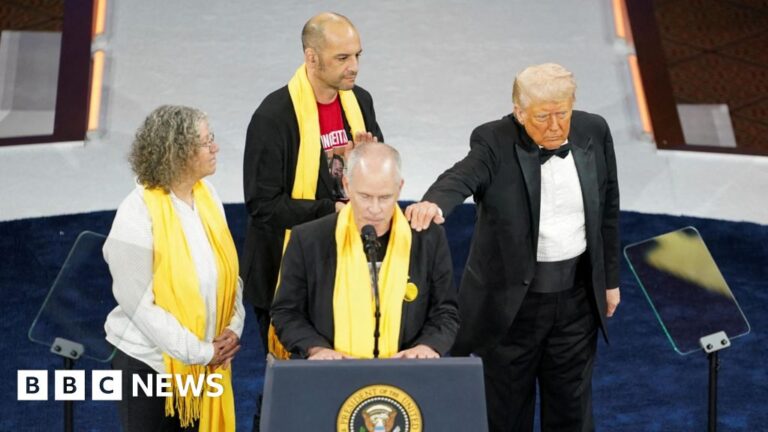
An American Israeli man who was held captive by Hamas has told the BBC that US President Donald Trump has the power to secure the release of the remaining hostages and end the war in Gaza.
Keith Siegel, 66, was kidnapped from Kibbutz Kfar Aza during the Hamas-led attacks on Israel on 7 October 2023. He was released this February after 484 days in captivity under a ceasefire deal that Trump helped broker just before he took office.
He was taken along with his wife, Aviva, who was held for 51 days before being freed during an earlier ceasefire.
Mr Siegel was speaking ahead of a meeting between Israeli Prime Minister Benjamin Netanyahu and President Trump at the White House on Monday evening.
In an interview in Tel Aviv, he thanked Trump for securing his own release and said the president could now do the same for the remaining 50 hostages, up to 20 of whom are believed to still be alive.
“I believe he has a lot of strength, power and ability to put pressure on those that need to be pressured, on both sides in order to get the agreement, get the deal signed, and get all of hostages back and bring an end to the war,” he said.
Trump has said he hopes a new ceasefire and hostage release deal will be agreed this week, but it appears there are still significant gaps between Israel and Hamas.
The two sides resumed indirect talks in Qatar on Sunday evening but they ended after three hours without a breakthrough, according to a Palestinian official.
Before he flew to Washington DC, Netanyahu said he believed his meeting with Trump could “definitely help advance that result we are all hoping for”.
It is believed the plan includes the staggered release of 10 living hostages and the bodies of 18 dead hostages in exchange for Palestinians held in Israeli jails.
Hamas said on Friday that it had delivered a “positive response”. But a Palestinian official said it had requested several changes, including a US guarantee that hostilities would not resume if negotiations on an end to the war failed – an idea Netanyahu has previously rejected.
 Reuters
Mr Siegel described in vivid detail how Hamas members beat and taunted him, and said he was still haunted by the torture of a female captive he witnessed.
He said Hamas operatives had moved him through the streets of Gaza, sometimes in daylight, to 33 different locations during the course of his captivity.
When asked whether he would support a deal which released the hostages but saw Hamas remain in power in Gaza, he replied: “It’s of the highest priority and urgency to get all of the 50 hostages back as soon as possible.”
But he continued: “We cannot let Hamas continue to threaten people and to kill and murder people, and I think Hamas is responsible for death on both sides.”
Gaza’s Hamas-run health ministry says more than 57,000 people have been killed there since Israel launched military operations in response to the 7 October attacks, during which about 1,200 people were killed in Israel and 251 others taken hostage.
I asked Mr Siegel, as he continues to campaign for the release of the remaining hostages, whether his thoughts also focus on the suffering of the Gazan population.
“I believe that peace and security for all people and freedom… are basic human rights that every person deserves,” he said.
“I think it’s the responsibility of all leadership to ensure that that happens. Any innocent person that is hurt or killed or murdered is something that I hope or I dream will not happen.”
Additional reporting by Samantha Granville
Challenging Client

A required part of this site couldn’t load. This may be due to a browser
extension, network issues, or browser settings. Please check your
connection, disable any ad blockers, or try using a different browser.
Typhoon Danas Hits Taiwan

The storm left hundreds of thousands of homes without power and crushed the gate of a well-known temple in southwest Taiwan.
JPMorgan gives JMDC stock an Overweight rating due to healthcare data growth

JPMorgan initiates JMDC stock with Overweight rating on healthcare data growth
New method utilizes artificial lightning to produce green ammonia

We currently use a lot of ammonia to produce fertilizer, refrigerants, and other chemicals, and unfortunately rely heavily on an energy-intensive process developed in the 19th century – the Haber-Bosch process – to make it in large quantities.
There are many efforts at play to figure out greener ways to produce ammonia, but this new one out of the University of Sydney might be the most electrifying of the lot: researchers there are using human-made lightning to produce the compound in gaseous form from air.
This new method doesn’t require a lot of energy, nor does it need any fossil fuels or expensive raw material, and it has a significantly lower environmental impact – the latter being hugely important when you consider the scales at which ammonia is produced and used worldwide.
Back to the fun stuff: human-made lightning! What’s happening at the start of this process is that electricity is being used to excite nitrogen and oxygen molecules directly from the air. This isn’t just heating them up; it’s about giving them energy to break their strong bonds and become more reactive in a plasma phase.
PJ Cullen
That’s similar to a lightning strike, where lightning strips electrons from air molecules to create a conductive plasma channel in the air. The activated nitrogen oxide (NOx) molecules from that plasma treatment are then passed into a special membrane-based electrolyzer.
Inside this electrolyzer, there’s a unique catalyst called highly defective Fe2O3 nanoparticles on copper. The catalyst has special active sites called “oxygen vacancies” – these are like tiny gaps or imperfections on its surface that make it very reactive and provide spots for the NOx molecules to attach.
When the NOx molecules come into contact with this catalyst, they undergo an electrochemical reduction reaction. In essence, hydrogen atoms are successively added to the nitrogen-containing species. This process largely follows an optimal chemical route known as the “NHO pathway.”
The catalyst significantly lowers the energy required for these key steps where hydrogen is added, making the conversion to ammonia much easier and more efficient than using just copper.
The result is the direct production of gaseous ammonia (NH3). Because the ammonia is produced as a gas, it can be easily separated and collected, avoiding issues with dissolving in liquids and subsequent separation steps – making it a lot less demanding than the Haber-Bosch process.

PJ Cullen
“Currently, generating ammonia requires centralized production and long-distance transportation of the product,” lead researcher Professor PJ Cullen said. “We need a low-cost, decentralized and scalable ‘green ammonia’.” Given that this method doesn’t require high temperatures and pressures, or even high-purity nitrogen and hydrogen, it appears the chemical engineering team might have succeeded.
The group published a paper on this method in the AngewandteChemie International Edition journal in April. “To create a more complete solution to a sustainable ammonia productive, we need to push the energy efficiency of the electrolyzer component,” Professor Cullen said. The goal there would be to make this method more energy efficient that the Haber-Bosch process.
Alongside the Sydney team’s work, researchers elsewhere in the world are trying to greenify ammonia production in different ways, in the hopes of reducing its enormous 1% contribution of all greenhouse gas emissions on the planet. A group at MIT is looking into ‘brewing’ ammonia beneath the Earth’s surface, and chemists at the University of New South Wales are throwing AI at the problem of identifying a suitable catalyst out of 8,000 options. And last year, researchers at Stanford University developed a portable device that can produce ammonia anywhere at room temperature.
Source: University of Sydney