Beverage giant declines to either confirm or deny change to ingredients in its signature soft drink.
United States President Donald Trump has announced that Coca-Cola will start using cane sugar instead of high-fructose corn syrup in its US-made soft drink at his urging.
“I have been speaking to Coca-Cola about using REAL Cane Sugar in Coke in the United States, and they have agreed to do so,” Trump said in a post on Truth Social on Wednesday.
“I’d like to thank all of those in authority at Coca-Cola.”
Trump said the switch would be a “very good move”, adding: “You’ll see. It’s just better!”
Coca-Cola neither confirmed nor denied Trump’s announcement, but said it appreciated the president’s “enthusiasm for our iconic Coca-Cola brand”.
“More details on new innovative offerings within our Coca-Cola product range will be shared soon,” the Atlanta, Georgia-based company said in a brief statement.
“I have been speaking to @CocaCola about using REAL Cane Sugar in Coke in the United States, and they have agreed to do so. I’d like to thank all of those in authority at Coca-Cola. This will be a very good move by them — You’ll see. It’s just better!” –President Donald J. Trump pic.twitter.com/9L27oxlYUj
Trump, who is known for his love of Diet Coke, did not explain his push to change the original version of the soft drink’s ingredients, but his health secretary, Robert F Kennedy Jr, has harshly criticised the prevalence of high-fructose corn syrup in the American diet.
Kennedy, who has pledged to wage war on ultra-processed foods containing ingredients rarely found in kitchen cabinets, has called the sweetener “just a formula for making you obese and diabetic”.
High-fructose corn syrup, which is derived from corn starch, is favoured by many US manufacturers because it is cheaper than sugar, in part due to government subsidies for corn and tariffs on sugar imports.
Coca-Cola began using high-fructose corn syrup in its US production in the 1980s, but still uses cane sugar in many versions of its signature beverage made overseas, including Mexico, whose version of the drink has developed a cult-like following for its supposedly superior taste.
While Americans’ high sugar intake is a major contributor to nearly three-quarters of the population being overweight or obese, there is currently no scientific consensus to suggest high-fructose corn syrup is less healthy than cane sugar or other sweeteners.
In a 2018 fact sheet, the US Food and Drug Administration said it was “not aware of any evidence” of a “difference in safety” between foods containing high-fructose corn syrup and those with other sweeteners, such as sugar and honey.
MBW Reacts is a series of analytical commentaries from Music Business Worldwide written in response to major recent entertainment events or news stories. Only MBW+ subscribers have unlimited access to these articles.
The latest music consumption stats are out from industry-standard market monitor, Luminate.
They tell a story of a rapidly changing industry – and how the United States, while still comfortably the world’s largest market, is becoming increasingly less dominant global player.
In fact, now MBW has cast our eye over the full Luminate Midyear Report (download it here), we’d suggest one thing in particular sings out:
Any music company that remains fixated on making ‘here today, gone tomorrow’ hits for the US chart… may want to question the long-term benefit of this strategy.
Here are the conclusions from the Luminate report that led us to this summation.
Conclusion 1: The US market will soon make up less than a quarter of global streams
We already knew that the US market was starting to lose its status as the runaway king of streaming.
The IFPI‘s latest Global Music Report, issued earlier this year, told us so: it revealed that the US, combined with Canada, saw its annual share of global trade revenues fall to 40.3% in 2024 – down from 41.6% just two years prior.
This, however, didn’t tell us what’s happening to music consumption.
With the USA’s per-stream royalties significantly higher than those in other parts of the world, the trade revenues metric arguably downplays how dramatic the shift in actual worldwide fan behavior has become.
“We are observing the continued expansion of global streaming, significantly driven by ex-U.S. markets.”
Rob Jonas, Luminate
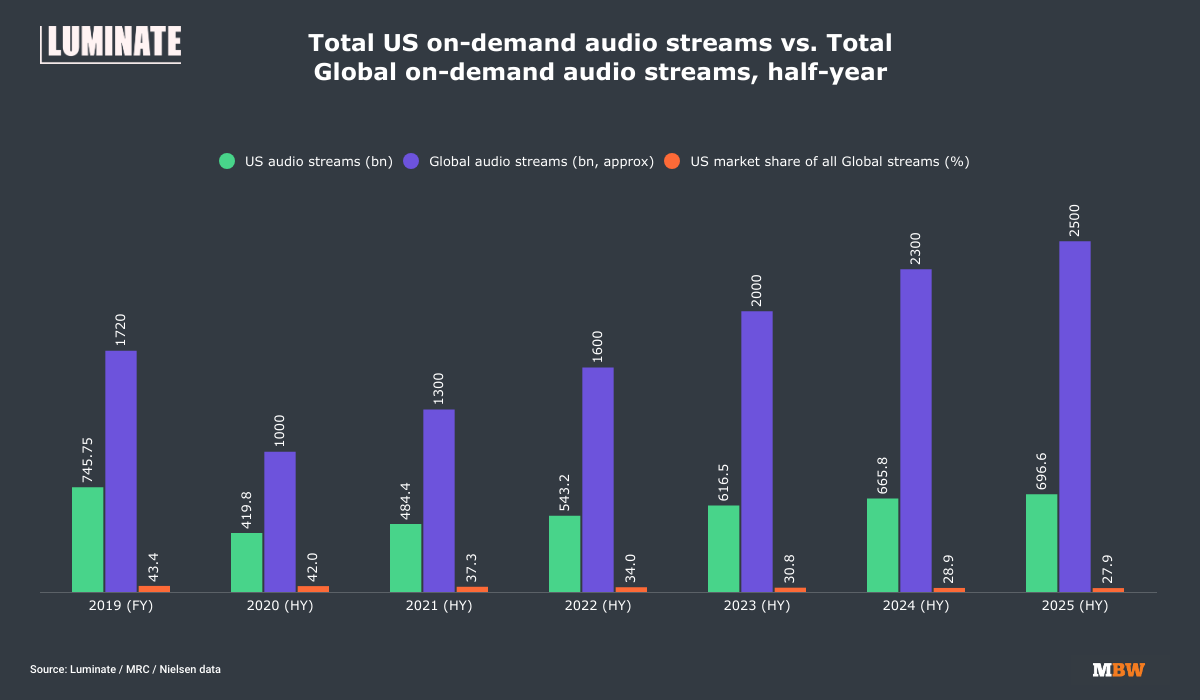
According to Luminate’s new report, total on-demand audio streams in the first half of 2025 in the USA stood at 696.6 million.
That was up 4.6% YoY.
Yet, audio streams outside the US jumped by a much bigger margin — up by 12.6% YoY to 1.8 trillion.
Luminate CEO, Rob Jonas, said: “We are observing the continued expansion of global streaming, significantly driven by ex-U.S. markets.”
He ain’t kidding.
Below, based on MBW’s review of historical data, you can see how the USA’s global market share of total audio streams has substantially fallen – down from 43.4% in 2019 to just 27.9% in H1 2025.
The USA’s market share of global audio streaming volume is on course to fall beneath a quarter (25%) in the next year or two.
Conclusion 2: The continuing death of the megahit (!)
The above explains how the USA is losing global market share.
But what about the market share of the most popular music within the USA?
Based on mid-year data, it showed how the USA’s Top 10 biggest tracks of the period were claiming a much smaller overall market share than they once did.
The reason: listener behavior was becoming spread across many more tracks, from many more artists, than was once the case.
The latest Luminate data shows this trend hasn’t reversed.
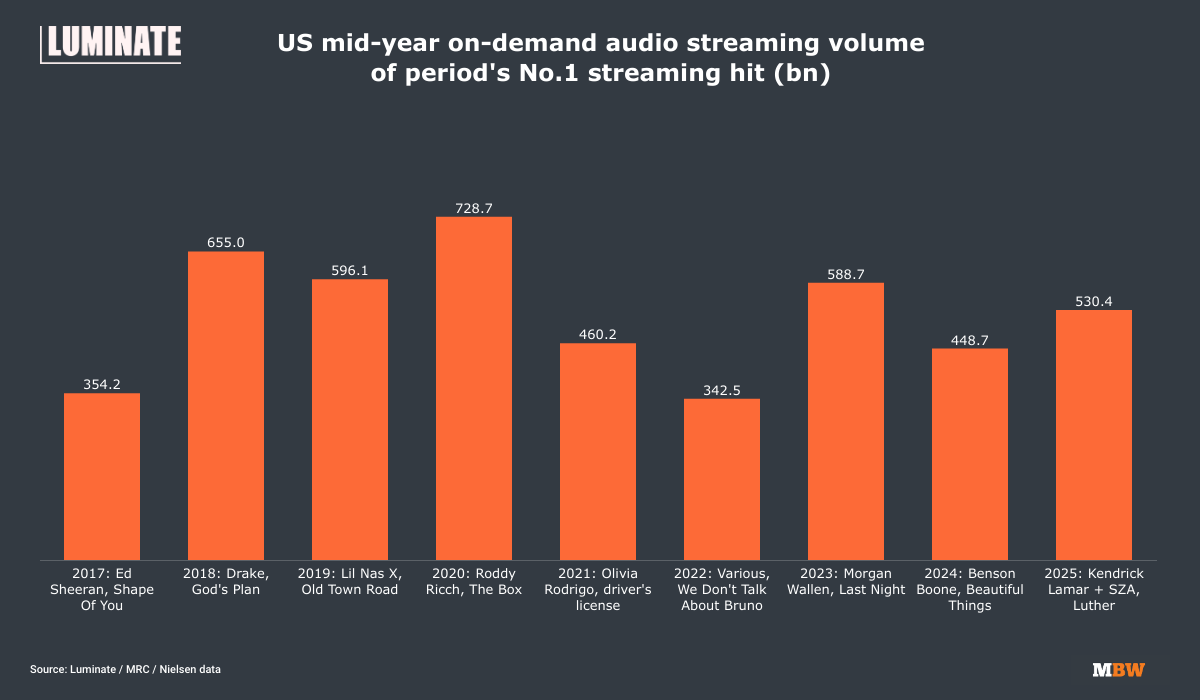
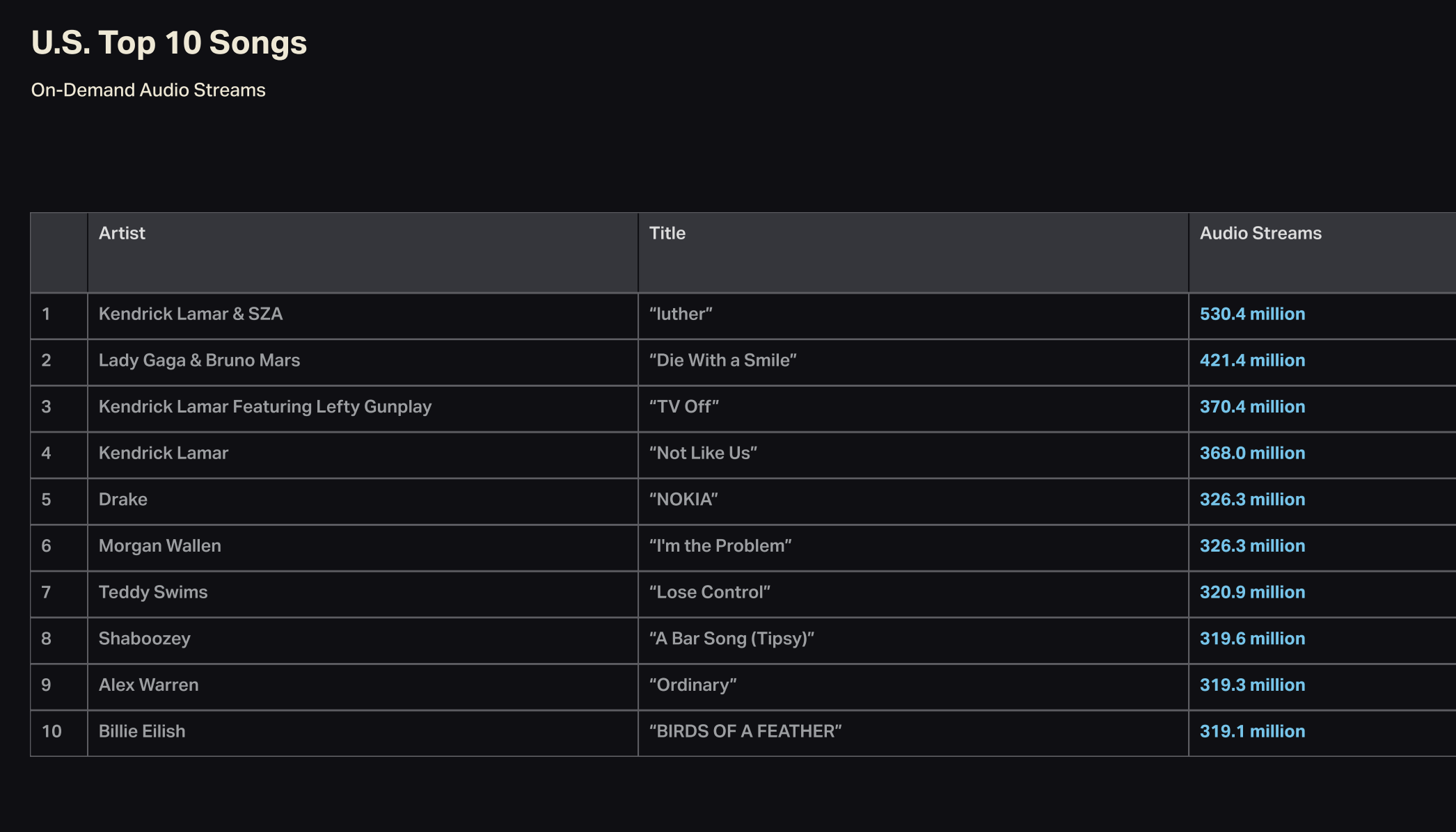
The biggest track in the USA in the first half of the year was Luther by Kendrick Lamar and SZA.
It racked up 530.4 million audio streams in the Jan-June period, says Luminate.
A hefty volume of plays, for sure – but a smaller total amount than the biggest hits of H1 2023 (Morgan Wallen), H1 2020 (Roddy Ricch), H1 2019 (Lil Nas X), and H1 2018 (Drake).
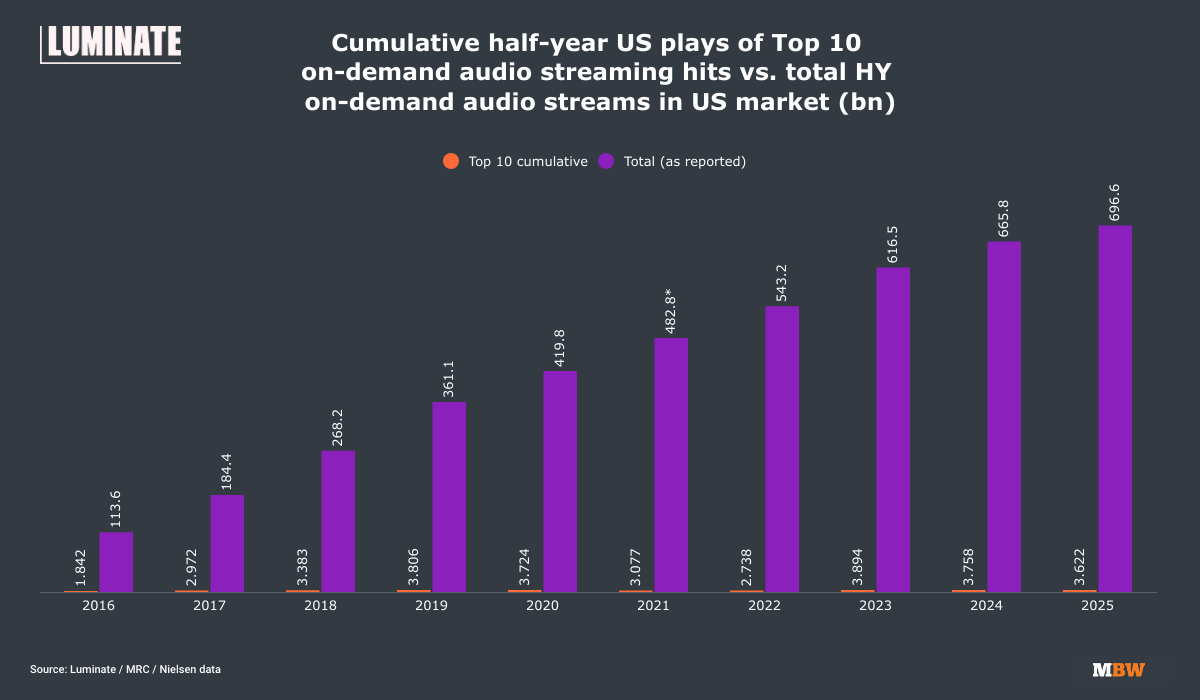
Meanwhile, according to Luminate, the USA’s Top 10 biggest audio streaming tracks combined in H1 2025 racked up 3.62 billion plays.
According to MBW’s calculations, that was actually down, in volume terms, on the equivalent figures from H1 2024 (3.76 billion) and H1 2023 (3.89 billion) – see below.
Luminate’s H1 2025 list of the Top 10 biggest audio streaming tracks in the USA. (Source: Luminate)
Here’s the critical stat in this section: the USA’s Top 10 tracks in H1 2025 claimed a half-a-percent share of the market’s total audio streams (0.52%).
Go back just a few years, and the equivalent stat was as high as 1.6% (see below).
Conclusion 3: In with the Old, out with the New….
So we’ve demonstrated (see: Conclusion 1) that the USA is losing market share of global streams, and that (see: Conclusion 2), the biggest chart tracks within the USA are losing market share of national streams.
But what about that warning over ‘here today, gone tomorrow’ tracks on the US chart?
This requires nuance.
When a record company or artist has a track like Luther by Kendrick Lamar (or indeed Not Like Us or TV Off, which both also made H1 2025’s Top 10), they can be confident, what with the quality and cultural cachet of the artist, that they are creating ‘evergreen catalog tracks’ which will be streamed long into the future.
But if a label or artist is creating novelty tracks that will get listened to in 2025, but not in, say, 2029, 2039, or 2049?
That’s becoming a much harder game.
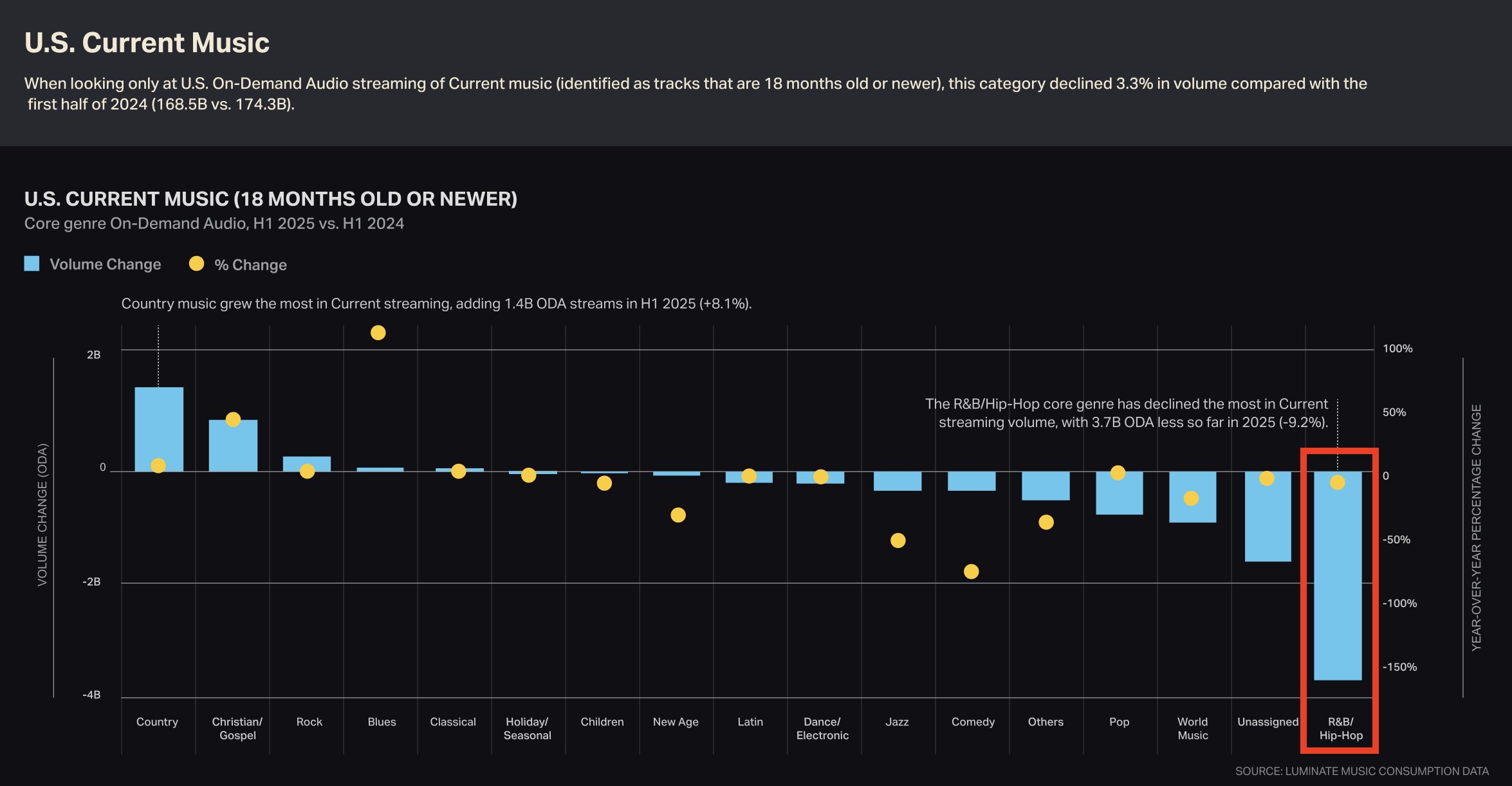
According to Luminate’s new report, tracks younger than 18 months old (‘current’ releases) were streamed 168.5 billion times in the first half of 2025.
That was down in volume terms by 3.3% YoY vs. the same period of 2024, when ‘current’ tracks racked up 174.3 billion streams.
To reiterate: ‘current’ music in the USA is seeing its total plays decline, even as the market’s overall streams grow.
Whipping out MBW’s calculator for a second, the above stats seem to indicate:
(a) ‘Current’ tracks claimed a mere 24.2% market share of total US audio streams in H1 2025; and
(b) ‘Catalog’ tracks (those older than 18 months) claimed a whopping 75.8% market share.
Or, in simpler terms: Less than a quarter of every stream in the US these days is of a ‘current’ release.
The most notable decline in ‘current’ release popularity is occurring in the ‘Hip-hop/R&B’ genre.
According to Luminate’s report, total on-demand audio streams of ‘current’ Hip-hop/R&B releases were down by 9.2% YoY in H1 2025 – a real-terms drop of 3.7 billion plays vs. H1 2024.
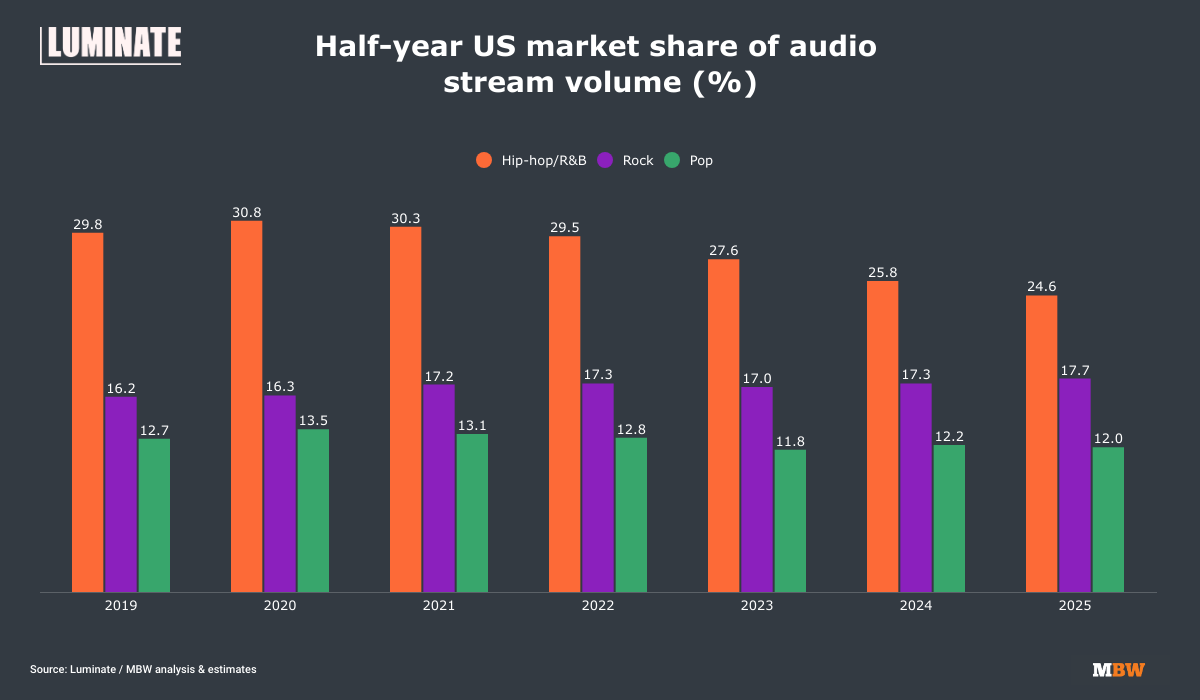
Despite this, ‘Hip-hop/R&B’ remains the USA’s No.1 genre overall, with 24.6% of total audio streams in the market in the first half of this year.
That was down on 25.8% in the prior-year period.
Meanwhile, the ‘Rock’ genre continues to gain ground.
The USA’s second-biggest genre on audio streaming in H1 2025, it grew market share to 17.7% vs. 17.3% in the prior-year period.Music Business Worldwide
The US Department of Justice has fired a veteran federal prosecutor who worked on the cases against sex offender Jeffrey Epstein, his accomplice Ghislaine Maxwell, and hip hop mogul Sean “Diddy” Combs.
It is not clear why Maurene Comey was removed from her job at the Southern District of New York, but her exit was confirmed by sources to the BBC’s US partner CBS.
She is the daughter of former FBI Director James Comey, whom President Donald Trump fired in 2017.
The justice department has been firing lawyers who worked on cases that angered the president, including the 2021 US Capitol riot and a special prosecutor investigation of Trump.
Ms Comey – who had been a trial lawyer at the high-profile justice department office in Manhattan since 2015 – was given no explanation for her firing, a person familiar with the matter told Politico.
Her exit comes as Trump and the justice department’s leader, Attorney General Pam Bondi, face backlash over the administration’s handling of files relating to Epstein.
The well-connected convicted paedophile died by suicide while awaiting trial in 2019.
Earlier this month it was reported that the justice department had launched an investigation into the former FBI director.
Prosecutors were said to be examining Comey’s statements to Congress over an inquiry into alleged Russian attempts to influence the 2016 White House election. That probe failed to find Trump had criminally conspired with the Kremlin.
The BBC has contacted the justice department for comment.
A required part of this site couldn’t load. This may be due to a browser
extension, network issues, or browser settings. Please check your
connection, disable any ad blockers, or try using a different browser.
Records from the 3rd century B.C. suggest the presence of automatons at the court of the Han dynasty in China. As noted in the Encyclopedia Britannica, these early instances included a commissioned mechanical orchestra for the emperor. Over time, these mechanisms evolved into remarkable technical achievements, particularly during the Enlightenment era. However, the pivotal leap in robotics occurred in the 20th century with the integration of industrial robots onto vehicle assembly lines, sparking a revolution in the automotive industry. Notably, the 21st century heralded the arrival of robots equipped with artificial intelligence, signifying a significant leap forward in the development of autonomous learning-capable machines.
In this article you can read about the following topics:
What were the first robots with artificial intelligence?
The first mobile robot with early artificial intelligence and autonomous operational capabilities in an environment is considered to be Shakey, introduced in 1968. A highly advanced machine for its time, it incorporated television cameras, laser and collision sensors, and a radio connection to a computer.
However, the term “artificial intelligence” was coined a decade prior to Shakey’s appearance at a 1956 conference at Dartmouth University in the USA. Even earlier, mathematicians like Alan Turing were exploring similar concepts in the 1940s.
During the 1970s and 1980s, the development of artificial intelligence experienced a certain stagnation due to perceived insurmountable challenges, commonly referred to as the “AI winter.”
Fortunately, in the 1990s, interest in AI surged with the emergence of Deep Blue, an artificial intelligence system that defeated Kasparov in chess. This evolution has continued to the present day with the introduction of ChatGPT and multimodal AIs. Notably, Boston Dynamics has entered into an agreement to incorporate OpenAI’s AI into its machines, enabling robots with intelligence capable of autonomous learning and performance enhancement over time.
Current robots
Presently, numerous companies are in various stages of developing prototypes, ranging from bipedal humanoids to quadrupeds akin to Boston Dynamics’ “dogs.” Notable initiatives include:
Sophia: Unveiled in 2016, it was among the first modern machines capable of detecting and responding to human emotions.
Apollo: A humanoid created in the laboratories of the University of Texas.
Digit: Amazon’s ongoing development of a biped aimed at collaborating with humans in warehouses.
Atlas: One of the most prominent bipeds, developed by Boston Dynamics.
Optimus: Elon Musk’s personal venture aimed at competing in the realm of robots with artificial intelligence.
Phoenix: A multifunctional bipedal robot launched in March 2023, adept at translating natural language into physical actions.
Ameca: An advanced robot capable of displaying human-like facial gestures and engaging in conversation, although its current capability doesn’t extend to autonomous movement.
Robotics applications with AI
While some robots have striking appearances, others discreetly transform real-world production systems across various industries:
Health: Advancements in artificial intelligence and robotics are revolutionizing medical diagnostics and physical therapies, in addition to surgical applications like robotic arms.
Automotive: Robots equipped with artificial intelligence are pivotal in tasks from body welding to painting and assembly in the automotive industry. Collaborative robots, or cobots, are used when multiple models work on an assembly line. This technology is also applied in other sectors such as robotic recycling.
Customer Service and Hospitality: The use of robots in sectors like customer service and hospitality is on the rise. A hotel in Nagasaki has achieved the milestone of becoming the world’s first fully robotized establishment in areas like reception, cloakroom, and check-out.
Agriculture: The fusion of robotics and artificial intelligence is transforming processes such as precision viticulture. Robotic harvesters, for instance, can discern the fruit’s ripeness and selectively pick only the optimal ones.
Trade and Logistics: The automated identification, transport, and placement of packages is a significant advantage of AI-enabled robotics. Amazon has initiated the use of robots to assist warehouse employees with their tasks.
To delve deeper into future-shaping technologies beyond robots with artificial intelligence, consider subscribing to our newsletter at the bottom of this page.
Israel launched deadly airstrikes on Syria’s capital on Wednesday, and threatened to escalate unless Syrian government forces withdrew from Sweida, a southern province dominated by the country’s Druse minority.
US president has pushed other countries to crack down on manufacturing and exportation of fentanyl.
United States President Donald Trump has said that China may start sentencing people to death for involvement in the manufacture or distribution of fentanyl, whose trafficking Trump has sought harsh measures to counteract.
Speaking as he signed anti-drug legislation on Wednesday, the US president said that the need to combat fentanyl was one of the reasons for his imposition of tariffs on countries across the world.
“I think we’re going to work it out so that China is going to end up going from that to giving the death penalty to the people that create this fentanyl and send it into our country,” Trump said. “I believe that’s going to happen soon.”
China, which has long imposed severe penalties on people involved with drug distribution, including capital punishment, has been at the centre of Trump’s ire over the opioid that helped fuel an overdose epidemic in the US.
The country raised outrage when it executed four Canadian dual citizens earlier this year for drug-related offences, despite pleas for clemency from the Canadian government.
Experts have questioned whether such penalties will help address the distribution of fentanyl, which China has said is driven largely by demand from people in the US.
Trump has previously linked his tariffs on countries such as Mexico and Canada to fentanyl, although trafficking from the latter into the US is close to nonexistent.
Drug overdoses in the US have been a subject of concern and political debate for years, with the country’s opioid epidemic beginning with the aggressive promotion of painkillers by pharmaceutical companies but later being mostly driven by synthetic opioids such as fentanyl.
Overdose deaths have started to drop in recent years, giving experts cause for optimism after years of communities being ravaged by opioids. Overdoses over a 12-month period ending in June 2024 dropped by 12 percent compared with the same period the previous year, down from 113,000 to 97,000.
President Donald Trump sent the U.S. stock market on a jagged round trip Wednesday after saying he had “talked about the concept of firing” the head of the Federal Reserve. Such a move could help Wall Street get the lower interest rates it loves but would also risk a weakened Fed unable to make the unpopular moves needed to keep inflation under control.
The S&P 500 rose 0.3% after whipping through an earlier drop and subsequent recovery.
The Dow Jones Industrial Average gained 231 points, or 0.5%, and the Nasdaq composite added 0.3% to its record set the day before.
Stocks had been rising modestly in the morning, before news reports saying that Trump was likely to fire Fed Chair Jerome Powell quickly sent the S&P 500 down by 0.7%.
When later asked directly if he was planning to fire Powell, Trump said, “I don’t rule out anything, but I think it’s highly unlikely.” That helped calm the market, and stocks erased their losses, though Trump added that he could still fire Powell if “he has to leave for fraud.” Trump has been criticizing a $2.5 billion renovation project underway of the Fed’s headquarters.
Trump’s main problem with Powell has been how the Fed has not cut interest rates this year, a move that would have made it easier for U.S. households and businesses to get loans to buy houses, build factories and otherwise boost the economy. Lower interest rates could also help the U.S. government, which is set to borrow and add a lot more to its debt after approving a wide range of tax cuts.
Powell, meanwhile, has been insisting that he wants to wait for more data about how Trump’s stiff proposed tariffs will affect the economy and inflation before the Fed makes its next move.
The Fed has two main jobs: keeping the job market strong while keeping inflation under control. Lowering interest rates would help boost the economy but would also give inflation more fuel when tariffs may be set to push prices for U.S. households higher.
Trump’s tariffs are making their weight felt across financial markets. ASML, the world’s leading supplier of chipmaking gear, warned that it can’t guarantee growth next year, after delivering an expected 15% growth in sales for 2025.
Conditions still look strong for ASML’s customers in the artificial-intelligence business, but CEO Christophe Fouquet said in a video that “the level of uncertainty is increasing, mostly due to macroeconomic and geopolitical consideration. And that includes, of course, tariffs.”
Shares that trade in the United States of ASML, which is based in the Netherlands, fell 8.3%.
Stocks of several U.S. companies reporting stronger profits for the latest quarter than analysts expected helped offset that.
Johnson & Johnson jumped 6.2% after the drug and medical device giant beat analysts’ sales and profit targets and raised its full-year forecasts for both. CEO Joaquin Duato said it expects “game-changing approvals and submissions” in the second half of 2025 on an array of products, including for lung and bladder cancer.
PNC Financial Services Group added 0.9% following its better-than-expected quarterly report, thanks in part to loan growth despite what CEO Bill Demchak called “an uncertain macro environment.”
GrabAGun, an online retailer of firearms and ammunition, swung sharply after combining with Colombier Acquisition Corp. II and taking its spot on the stock market under the ticker symbol “PEW.” Donald Trump Jr., the son of President Trump, is joining the company’s board.
The stock quickly went from an early gain of 19% to a drop of 31% before finishing with a loss of 23.9%, with several halts in trading along the way.
All told, the S&P 500 rose 19.94 points to 6,263.70. The Dow Jones Industrial Average added 231.49 to 44,254.78, and the Nasdaq composite gained 52.69 to 20,730.49.
In the bond market, the yield on the 10-year U.S. Treasury fell to 4.45% from 4.50% late Tuesday. It had been as low as 4.44% earlier in the day, but it climbed following the reports that Trump was likely to fire Powell.
A new Fed chair friendlier to Trump could mean lower short-term interest rates but also the opposite effect on longer-term yields. That’s because a less independent Fed would raise worries that it may also let inflation run higher in the future by being slow to raise interest rates.
Stocks rose 0.7% in Jakarta after Trump said Tuesday that he plans to charge imports from Indonesia a tariff of 19%, instead of the 32% that he had threatened earlier, after reaching a trade deal.
Indonesia’s central bank also cut its key interest rate by 0.25 percentage points on Wednesday, to 5.25%.
“We have calculated everything and discussed everything. The most important thing for me is my people, as I must protect the interests of our workers,” Indonesian President Prabowo Subianto told reporters, adding that “this is our offer, and we are not able to give more (to the United States).”
___
AP Business Writers Matt Ott, Kelvin Chan and Elaine Kurtenbach contributed.
A fire has destroyed the main stage at Tomorrowland festival in Belgium, just two days before the event was due to open.
“Due to a serious incident and fire on the Tomorrowland Mainstage, our beloved Mainstage has been severely damaged,” festival organisers said on Wednesday evening.
The statement said nobody was injured during the blaze.
The electronic dance music festival is due to start on Friday, with 400,000 people expected to attend over two weekends.
Videos posted to social media show flames and grey smoke engulfing the stage. Firefighters are at the scene in the town of Boom, south of Antwerp.
Some media reports suggested the fire may have been sparked by pyrotechnic devices.
In an update posted on the festival’s website, organisers said the campsite would still open on Thursday as planned, and that they were “focused on finding solutions for the festival weekend”.