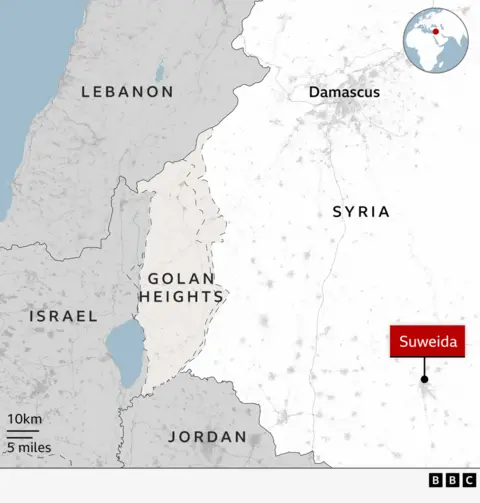
Syrian security forces in Suweida. Photo: 16 July 2025
The Syrian presidency says it will deploy a new force to halt the deadly sectarian clashes between Bedouin and Druze fighters in the south of the country.
Syrian interim President Ahmed al-Sharaa’s office urged “all parties to exercise restraint”, amid reports of renewed fighting near the city of Suweida on Friday.
More than 700 people are reported to have been killed since the violence erupted on Sunday. Government troops deployed to the area were accused by residents of killing Druze civilians and carrying out extrajudicial executions.
Israel later struck targets in Syria to force the troops to withdraw from Suweida province. On Friday, the US ambassador to Turkey said that Israel and Syria had agreed a ceasefire.
In a post on X, ambassador Tom Barrack said that Israeli Prime Minister Benjamin Netanyahu and Sharaa “have agreed to a ceasefire” embraced by Syria’s neighbours Turkey and Jordan.
“We call upon Druze, Bedouins, and Sunnis to put down their weapons and together with other minorities build a new and united Syrian identity in peace and prosperity with its neighbours,” the envoy said.
Israel and Syria have not publicly commented on the reported ceasefire agreement.
Shortly before Sharaa’s office announced its planned military deployment to the south, an Israeli official said Israel had agreed to allow the limited entry of Syrian Internal Security Forces personnel into Suweida for 48 hours to protect Druze civilians “in light of the ongoing instability”.
Suweida’s predominantly Druze community follows a secretive, unique faith derived from Shia Islam, and distrusts the current jihadist-led government in Damascus. They are a minority in Syria, as well as in neighbouring Lebanon and Israel.
The BBC’s Middle East correspondent Lina Sinjab, reporting from Syria, said violence towards the Druze is spreading across the country.
According to the UK-based Syrian Observatory of Human Rights (SOHR), 718 people have been killed since the violence erupted.
Earlier this week, the UN human rights chief, Volker Türk, said his office had received credible reports indicating widespread violations and abuses during clashes, including summary executions and arbitrary killings in Suweida.
Among the alleged perpetrators were members of the security forces and individuals affiliated with the interim government, as well as local Druze and Bedouin armed elements, Türk said in a statement.
“This bloodshed and the violence must stop,” he warned, adding that “those responsible must be held to account”.
The BBC has contacted the Syrian government and security forces about allegations of summary killings and other violations.
In a televised address early on Thursday, Sharaa vowed to hold the perpetrators accountable and promised to make protecting the Druze a “priority”.
“We are eager to hold accountable those who transgressed and abused our Druze people because they are under the protection and responsibility of the state,” he said.
He went on to blame “outlaw groups”, saying their leaders “rejected dialogue for many months”.
Record rainfall is expected to continue hammering parts of South Korea until Monday as more warnings are issued to the public.
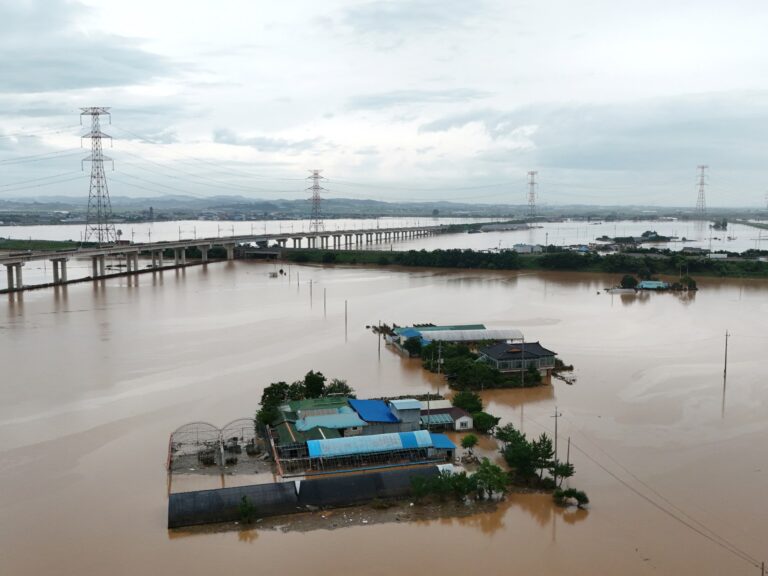
Four people have been confirmed dead and at least two others missing as torrential rains continue to batter South Korea for a fourth consecutive day, forcing thousands of people from their homes and stranding livestock in rising floodwaters, authorities said.
Authorities warned on Saturday that up to 250mm (9.8 inches) of additional rain could fall throughout the day, raising concerns of further damage and casualties, the country’s official Yonhap news agency reports.
Rain is forecast to last until Monday in some areas, and weather officials have urged extreme caution against the risk of landslides and flooding, with warnings issued for most of South Korea.
More than 2,800 people are still unable to return to their homes out of a total of more than 7,000 people evacuated in recent days, the Ministry of Interior said.
Rainfall since Wednesday reached a record of more than 500mm (almost 20 inches) in South Chungcheong province’s Seosan, located to the south of the capital, Seoul, the ministry added.
According to Yonhap, areas of the country have received 40 percent of their annual average rainfall in just the past four days.
A resident inspects the damage to his home following torrential downpours in Yesan, South Chungcheong Province, South Korea, on July 18, 2025 [Yonhap via EPA]
Among those reported dead was a person who suffered a cardiac arrest inside a flooded vehicle on a road in Seosan. The man was taken to a nearby hospital but died later, officials were quoted by Yonhap as saying.
A man in his 80s was found dead in the flooded basement of his home, while a third person died when a retaining wall collapsed onto a moving vehicle. Another person was also found dead in a stream, officials said. Two people remain missing in the southwest city of Gwangju.
In the province of Chungcheong, cows were desperately trying to keep their heads above water after sheds and stables were flooded by the rainwater.
Yonhap also reported a total of 729 cases of damage to public infrastructure, including flooded roads and the collapse of river facilities. Cases of private property damage have reached more than 1,000, including 64 flooded buildings and 59 submerged farmlands, it added.
Rains were also expected in neighbouring North Korea.
In July 2024, torrential rains also hammered parts of South Korea’s southern regions, killing at least four people and causing travel chaos.
If you’re like me, disconnecting from the constant pressures and distractions of everyday life can be hard, even on vacation. Getaway House is a vacation rental that’s designed specifically to help you slow down, relax, and detox from technology and the always-on stress of our world.
Here’s how it works: Getaway House has a collection of Tiny Cabins at locations around the country. Each site is within a two-hour drive of a major city, but is located in a quiet, beautiful area surrounded by nature. They make it as easy to get in and disconnect as possible with contactless check-in and lots of included perks. These tiny cabins range from 140-200 sq ft (so they’re small), and they’re furnished with everything you need and nothing extra.
Each cabin has a bed, bathroom, small kitchen, and not much else. They come stocked with linens, towels, dishes, and some non-perishable cooking supplies like oil and spices. I also love that every cabin has a private outdoor space with a fire pit and picnic table. It’s pretty clear that the goal is to get you to spend time relaxing out of doors.
One of the most unique things about Getaway House is the emphasis on disconnecting from technology and making time for relaxation and creativity. There is no WiFi at any of the cabins, and most of them have pretty spotty cell reception (or none at all).
Getaway House has dozens of locations, but most of them are in the Midwest or East Coast. There are a few on the West Coast, but if you’re hoping to find somewhere in the Rocky Mountain area, you’re out of luck.
You can read our full Getaway House Review to learn more about what to expect from the experience.
In previous articles, we explored the realm of smart textiles and their distance from achieving the elusive invisibility cloak seen in Harry Potter and fictional characters such as the Predator alien. However, a recent development suggests that a Chinese scientist may have brought us closer to J.K. Rowling’s fantastical fabric. The inventor asserts that, someday, an invisibility cloak could become a fashionable wardrobe accessory for everyone. How was this breakthrough achieved?
How an invisibility cloak works
The fundamental principle behind an invisibility cloak is to manipulate light rays, directing them in a manner that reaches objects positioned behind the cloak. Essentially, the aim is to bend light, as conventional reactions involve either light absorption, obscuring the background, or light reflection, illuminating and revealing the object. Three primary approaches are explored for achieving invisibility:
Metamaterials: A theoretical method involves using metamaterials—materials intentionally designed with electromagnetic properties that are not naturally occurring. These materials can bend or deflect light around an object, rendering it invisible to the naked eye.
Optical Manipulation: Other research delves into manipulating light using lenses or optical devices to bend it around an object, effectively rendering it invisible.
Camouflage Techniques: A third option utilizes cameras and projectors to create the illusion of invisibility. Cameras capture an image, and projectors reproduce it from the other side, creating the appearance of transparency.
Donghua University invisibility cloak
At a recent scientific conference in Shanghai, Professor Chu Junhao from Donghua University unveiled what appears to be the most realistic invisibility cloak to date. During the demonstration, he described it as a sheet featuring multiple rows of cylindrical convex lenses. Each lens can compress objects parallel to it, causing light refraction. Consequently, the image is fragmented into millions of identical particles, rendering them indistinguishable to the human eye. Junhao asserts that this technology is poised to “change our lives.”
To witness the technology in action, you can check out a video uploaded to X that showcases its capabilities. Initially, the researcher’s legs are visible through the panel but become blurred. When two individuals turn him, the researcher and his captors vanish, revealing the scene’s background.
Magic! Chu Junhao, academician of the Chinese Academy of Sciences, demonstrated “invisibility”. pic.twitter.com/qNESHCVvPK
Invisibility technologies, though prominent in books and fiction like H.G. Wells’ “The Invisible Man,” the Star Trek series, and previously mentioned examples, have been subjects of scientific exploration for decades. While not as striking as the developments by Donghua University’s team, recent years have witnessed crucial milestones in advancing invisibility cloaks. Here are some significant moments:
2006: Duke University researchers in the USA reveal the first cloak, albeit limited to two dimensions and functioning solely with microwaves.
2007: The British Army experiments with an “invisible” tank employing a blend of cameras and projectors to create a fictitious image, concealing the vehicle.
2008: The University of California conducts initial trials with metamaterials, altering the direction of visible and infrared light to achieve invisibility effects.
2010: Nature reports two scientists working on a metamaterial derived from calcite crystals that could enable cost-effective invisibility.
2011: The University of Texas demonstrates advancements in invisibility using carbon nanotubes.
2012: Duke University achieves another breakthrough: its invisibility system can completely obscure objects as small as a few centimeters.
2013: The University of Texas refines its invisibility technology, achieving effectiveness with a material only 0.15 mm thick.
2014: The University of Rochester successfully renders small objects of a few centimeters invisible, irrespective of the observer’s position.
2015: A U.S. National Science Foundation scientist wins the Waterman Award for crafting metamaterials capable of masking three-dimensional objects.
2019: A Canadian company specializing in camouflage clothing unveils Quantum Stealth, a paper-thin material utilizing lenticular lenses capable of concealing soldiers and vehicles.
To delve deeper into materials with remarkable functionalities, alongside the latest strides in technology and renewable energies, consider subscribing to our newsletter at the bottom of this page.
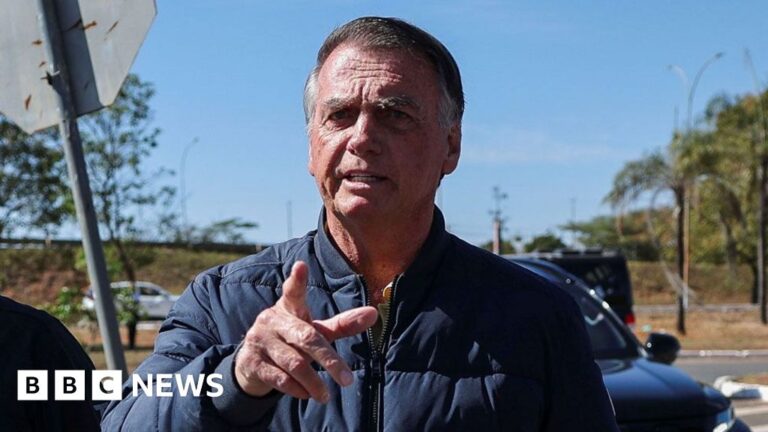
A court has ordered Brazil’s former president Jair Bolsonaro to wear an ankle tag and put him under curfew over fears he might abscond while standing trial.
Bolsonaro – in power in 2019-22 – is accused of plotting a coup to prevent President Luiz Inacio Lula da Silva from taking office in 2023. He denies any wrongdoing.
US President Donald Trump has been attempting to quash the case against his ally, which he calls a “witch hunt”, by threatening steep tariffs on Brazilian goods. On Friday, the US revoked visas for Brazilian judicial officials involved in the case.
Bolsonaro said the court restrictions amounted to “supreme humiliation” and that he had never considered leaving Brazil.
On Friday, police raided his home and political headquarters on orders from the Supreme Court.
Judge Alexandre de Moraes also ordered that Bolsonaro be banned from social media and barred from communicating with his son, Eduardo Bolsonaro, who has been lobbying for him in the US, and foreign ambassadors, diplomats or embassies.
The ex-president will be placed under 24-hour surveillance and have to comply with a nighttime curfew.
Judge Moraes said Bolsonaro was acting deliberately and illegally, together with his son Eduardo, to have sanctions imposed on Brazilian public officials.
In a statement, Bolsonaro’s lawyers expressed “surprise and outrage” at the court’s decision, adding that the former president had “always complied with the court’s orders”.
According to the Federal Police, Bolsonaro has attempted to hinder the trial and undertaken actions that constitute coercion, obstruction of justice and an attack on national sovereignty.
Late on Friday, US Secretary of State Marco Rubio said he had ordered “visa revocations for Moraes and his allies on the court, as well as their immediate family members effective immediately”.
Lula hit back, saying he would match any tariffs imposed on Brazil by the US. In a post on X, the president said Brazil was a “sovereign country with independent institutions” and “no one is above the law”.
On Thursday, Trump posted a letter on Truth Social that he had sent to Bolsonaro in which he said the criminal case amounted to political persecution and that his tariff threat was aimed at exerting pressure on Brazilian authorities to drop the charges.
The US president has compared the prosecution to legal cases he himself faced between his two presidential terms.
Bolsonaro is standing trial along with seven accused over events which culminated in the storming of government buildings by his supporters a week after Lula’s inauguration in January 2023.
The eight defendants are accused of five charges: attempting to stage a coup, involvement in an armed criminal organisation, attempted violent abolition of the democratic rule of law, aggravated damage and deterioration of listed heritage.
If found guilty, Bolsonaro, 70, could face decades behind bars.
The former president has consistently denied the charges against him, calling them “grave and baseless” and claiming to be the victim of “political persecution” aimed at preventing him running for president again in 2026.
He narrowly lost the presidential election to his left-wing rival Lula in 2022.
Bolsonaro never publicly acknowledged defeat. Many of his supporters spent weeks camped outside army barracks in an attempt to convince the military to prevent Lula from being sworn in.
Bolsonaro was in the US at the time and has always denied any links to the rioters.
A federal investigation into the riots and the events leading up to them was launched. Investigators subsequently said they had found evidence of a “criminal organisation” which had “acted in a coordinated manner” to keep then-President Bolsonaro in power.
Their 884-page report, which was unsealed in November 2024, alleged that “then-President Jair Messias Bolsonaro planned, acted and was directly and effectively aware of the actions of the criminal organisation aiming to launch a coup d’etat and eliminate the democratic rule of law”.
Brazil’s Attorney General Paulo Gonet went further in his report published in February, accusing Bolsonaro of not just being aware of but leading those that he says sought to overthrow Lula.
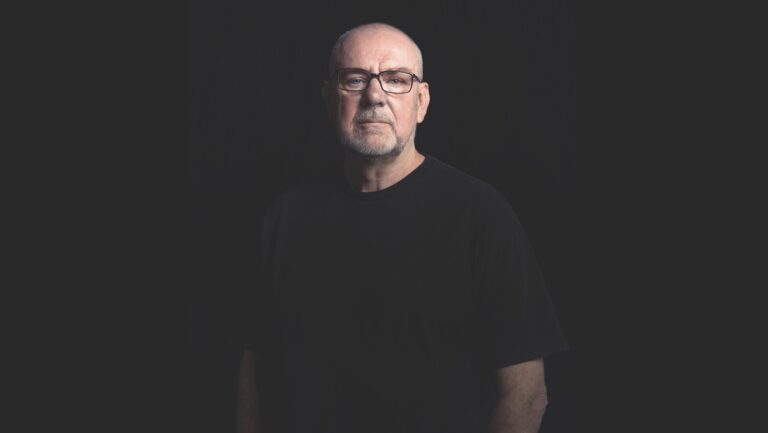
Andy Saunders has seen the music industry at its messiest.
As founder of Velocity Communications – celebrating its 25th anniversary this year – he’s spent decades building stories and shaping strategies for some of music’s most prominent companies. But there’s another side to his work that rarely gets discussed over polite industry lunches: crisis management for artists whose worlds have suddenly imploded.
“My first question is always, ‘Did you do it?’” Saunders tells MBW. “I have to be 100% confident they’re telling me the truth. Because if you don’t tell me the truth, I can’t help you.”
It’s a stark opening to our conversation, but it gets to the heart of what Saunders does when he’s not promoting the latest signing or industry deal. He’s on speed dial for artists (and their reps) when accusations surface on social media, when tabloids come knocking, or when a moment of poor judgment threatens to derail everything they’ve built.
Saunders’ ‘reputational management’ clients fall into two distinct categories: (i) those who’ve been falsely accused of misdeeds and need their reputations defended, and (ii) those who’ve genuinely transgressed and need help navigating the consequent fallout.
As you’d expect, this sees Saunders wade into challenging territory. Yet he’s steadfast about his moral boundaries. “I never wanted to be Max Clifford; I do not defend the indefensible,” he says. “If you’re a racist, a rapist, or an abuser, I don’t want to know you, let alone work with you.”
With typical straightforwardness, he adds: “You can’t come back from something unforgivable that harms another person. You can come back from being a fucking idiot.”
Below, Saunders discusses the moral lines he won’t cross, the strategies that actually work in crisis situations, and why social media has fundamentally changed the game for anyone in the public eye…
You work with artists accused of serious things, but you say there are strict moral limits to the cases you take on. What are those limits?
I’m very clear on this: I don’t defend racists, I don’t defend rapists, and I don’t defend abusers. I could take the lawyer/solicitor view – ‘everybody deserves a defense’. But I’d be lying to myself. Some people, some actions, are indefensible.
My role is to mitigate situations for people who have made genuine mistakes, or who have been falsely accused. I’m here to work with artists to articulate an apology if needed. And I’m here to help them navigate the bad actors in the media who wish to exploit their fame – their ‘fall from grace’ – for clicks.
I’ve turned down much more of this work than I’ve taken on. Why? Because I’ve got a wife and daughter, because I’ve got a diverse group of friends, and because I like to think I’m a reasonable, decent human being.
What gives you the confidence that an artist is being falsely accused – that they’re not lying to you?
First, I look them in the eye and say: ‘Did you do it?’ And even if they then say no, I ask: ‘What were the circumstances behind this even becoming an accusation?’
If, at the end of that conversation, their story seems credible, I begin a process of evidence building. That can be as simple as internet research or as complex as working closely with lawyers and private detectives.
One of the most serious cases I ever took on was a rock band who were accused, via an anonymous social media account, of assaulting one of their fans. This account basically said: ‘They assaulted my friend at this particular hotel in this particular town.’ But having conducted research in tandem with the band’s management, we concluded it couldn’t be true.
Meanwhile, the [accusatory] tweet was getting amplified, and the band’s career was suddenly in free fall. Cover shoots were drying up, gigs were being cancelled and people were piling in on social media with comments like “I always thought they looked like wrong ‘uns”.
We were eventually able to identify the person behind the anonymous account, and they agreed to post a public apology, having confirmed the information they received was incorrect. The band then asked their fans not to bully this person, accepted the apology, and everyone moved on.
It blew over, causing rapid but limited damage. But it’s not an exaggeration to say that if it wasn’t dealt with quickly, it could have destroyed careers and lives.
Anonymous accusations online are a uniquely modern issue: anyone can publicly accuse anyone of anything via social media while masking their identity.
Social media has made people lonelier than ever. When we interact with other people through our devices more than we do in real life, reality can become a bit blurred. We’re certainly seeing that with AI and ‘deepfakes’ now.
Social media allows you to easily ‘other’ people, to treat them as commodities or one-dimensional beings. It’s also gamified outrage in a way that can incentivise people to stretch the truth – or forget it entirely.
People who lack agency and power in their own lives can see it as a way of attracting attention or being in the spotlight. It makes them feel like they have influence.
What about when artists have done something wrong? One pop star you worked with a few years back broke Covid rules, which quickly became tabloid fodder.
Reassurance is a massive part of what I do, taking the heat out of the situation. When someone is in the middle of a reputational crisis, it’s usually the worst day of their life. It’s easy to lose perspective when all that’s going through your mind is: ‘What the fuck am I gonna do?!’
My job is to put a metaphorical arm around their shoulder and say, ‘You’re not the first person this has happened to, and you’re unlikely to be the last. Let’s not allow emotion get in the way of pragmatism.’
“I always tell clients who are in that initial panic mode that shouting ‘it’s not fair!’ is not a strategy.”
After that, the solution can be as simple as issuing a statement: ‘I shouldn’t have done this; I apologize.’ And meaning it!
In the Covid artist story you’re talking about, the transgression – serious though it was – was being made out by certain media outlets to be the end of the world, when anyone with half a brain could see that wasn’t the case. Once everyone understood the dynamics of that, our strategy fell into place.
I always tell clients when they’re in that initial panic mode that shouting, ‘It’s not fair!’ is not a strategy. You have to work out what you need to communicate and who you need to communicate it to, and then execute.
Is it true that you’re working with Kneecap – the Irish band who’ve attracted media criticism for their pro-Palestine statements, as well as some troubling public comments made in years gone by?
I know it’s boring, but I won’t confirm or deny working with any clients. I will say this about Kneecap: I’m pleased to see they have held their hands up, and openly regret, some of the stupid – potentially illegal – things they have said in the past. At the same time, I’m pleased to see they’ve doubled down on the political viewpoints they fundamentally believe in.
Those are two separate issues that were in danger of becoming conflated in the narrative.
It doesn’t matter if you strongly disagree or strongly agree with Kneecap’s political statements. Artists have always had the freedom to say uncomfortable things, and I support every artist’s right to do so. I also support everyone’s right to challenge those statements.
“Artists have freedom to say uncomfortable things. I support their right to do so.”
We’re a poorer society when we start clamping down on freedom of expression from any political ‘side’. ‘Cancellation’ in that way is pure cultural cowardice.
I remember being upset about Morrissey [writing about and using imagery connected to] Myra Hindley. But I still support his right to do it. If we start cancelling artists for expressing themselves, especially when they’re saying things we don’t like, where does it stop?
You mentioned working closely with lawyers on these cases. How does that play out?
Sometimes the lawyers actually bring the cases my way, especially if there’s potential media blowback.
I’m always comfortable getting referrals from lawyers that I have a lot of respect for, and who take the same approach to things that I do. Russells is a great example of that, and I particularly like working with their litigation specialistsSteven Tregear, Dan Hoyle and Eliot Leggo.
Working with lawyers can lead to really interesting philosophical conversations about why we’re doing it, what we’re doing it for, and what we’re hoping to achieve. Sometimes I help them soften the litigation edges, and they give me a much clearer framework in which to operate. In certain circumstances, the communications element – the public message – becomes just as important as the court filings.
I’m an artist falsely accused of something – or in hot water over a mistake. What are the first three things you’d advise?
1) Tell me everything. Why would this person even think of accusing you? It won’t go outside this conversation; you can NDA me if you want. But I have to know everything, because without all the facts on the table, there’s no route to properly figuring a way out of this.
2) Don’t comment. Don’t respond. Don’t post. Don’t do anything until we figure out the plan. I know every fibre of your being wants to post on social media ‘I DIDN’T DO THIS!’ but if you do, you could fan the flames, especially if it’s becoming a national or international media story.
3) Do you need to apologise? If you do, don’t fake it. I’m not going to just give you a template ‘Yeah, sorry about this’ statement. First, you’re going to appreciate why you need to apologise. Then you’re going to tell me why you’re apologising, in authentic language – and what you’ve learned from this experience. Then we go from there.
When executives fall from grace
While much of Andy Saunders’ crisis work involves artists, he’s equally experienced in managing reputations for music industry executives who find themselves in hot water. The dynamics, he says, are fundamentally different from artist cases.
“With executives, the first thing you have to understand is the corporate reality,” Saunders explains. “Artists can’t really get ‘fired’ – executives can.”
He adds: “I had one particularly high-profile exec case in the past few years, a classic ‘my life’s ended, what am I going to do?’ situation. I had to tell him, ‘There’s no way your company allows you to survive in your job after this. Yes, you haven’t harmed anyone. But you’ve been stupid, and your employer won’t protect you at all costs.’
The strategy then shifts from damage limitation to planning for the future, says Saunders. “Once they’ve accepted the reality, which isn’t always instant, you can have a more honest conversation about how they can come back from it – and how long that’s going to take.”
Working with American lawyers on executive cases brings additional complexity, particularly in what Saunders calls “adversarial situations” between US competitors or former partners.
“When I’ve worked with music industry professionals who’ve found themselves in a legally adversarial situation with a company, it’s really important that they have a narrative that will play well with the judge and/or jury,” he says.
“Sometimes, in the US especially, the best way to push that narrative into the wider world is actually through court filings. There are specific circumstances where, if you get the messaging right, court filings can be the best ‘press release’ you could hope for.”
Here are the key events on day 1,241 of Russia’s war on Ukraine.
How things stand on Saturday, July 19:
Fighting
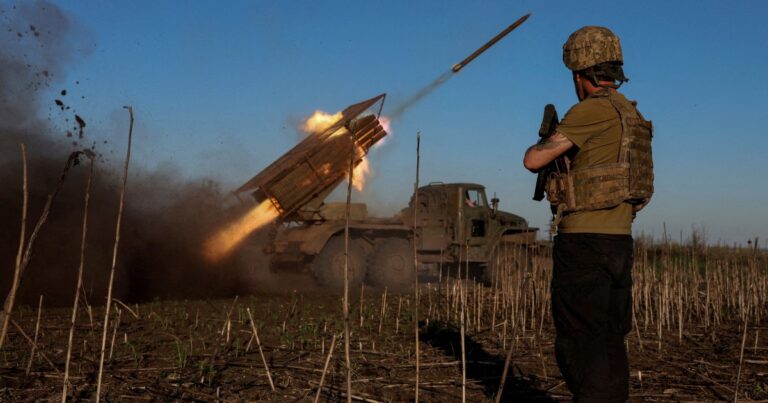
Russian drones and glide bombs killed several people in Ukraine on Friday, officials said, including a 52-year-old train driver in the Dnipropetrovsk region, a 66-year-old woman killed in her home in Kostiantynivka, and a 64-year-old man killed in a glide bomb attack on a building site in the Zaporizhia region.
Russian forces have staged a mass drone attack on the Ukrainian Black Sea port of Odesa, setting fire to at least one multistorey apartment building, the city’s mayor, Gennadiy Trukhanov, said early on Saturday. At least 20 drones converged on the city in the early hours of this morning.
Russian air defences intercepted or destroyed 10 Ukrainian drones headed for Moscow overnight on Friday, the city’s mayor, Sergei Sobyanin, said.
Ukraine’s top military commander, Oleksandr Syrskii, said his forces are standing firm in defending the city of Pokrovsk, a logistics hub in the eastern Donetsk region that has weathered months of Russian attacks, and the Novopavlivka settlement in the Zaporizhia region.
Praising the troops defending Pokrovsk, Ukrainian President Volodymyr Zelenskyy said Russian forces “trying to advance and enter Ukrainian cities and villages” will not have “a chance of survival”.
Authorities in Russian-controlled Crimea have introduced an information blackout designed to counter Ukrainian drone, missile and sabotage attacks. Sergei Aksyonov, the Russian-installed head of Crimea, said he signed a decree banning media outlets and social media users from publishing photos, video or other content that revealed the location of Russian forces or details of Ukrainian attacks on the Black Sea peninsula.
Military aid
Australia’s government said it delivered M1A1 Abrams tanks to Ukraine as part of a 245 million Australian dollar ($160m) package to help the country defend itself against Russia in their ongoing war.
The United States has moved Germany ahead of Switzerland to receive the next Patriot air defence systems to come off production lines in the US. The expedited delivery to Germany will allow Berlin to send two Patriot batteries it already has to Ukraine, according to a US media report.
Leaders in Ukraine and Washington are in detailed talks on a deal involving US investment in Kyiv’s domestic drone production, Ukrainian Prime Minister Yulia Svyrydenko said. She added the deal would also lead to the US purchasing “a large batch of Ukrainian drones”.
President Zelenskyy said he discussed missile supplies and funding for interceptor drones to counteract Russian attacks in a call with French President Emmanuel Macron. “I would especially like to highlight our agreement on pilot training for Mirage jets – France is ready to train additional pilots using additional aircraft,” Zelenskyy said on X.
Sanctions
The European Union approved its 18th package of sanctions against Russia over its war in Ukraine, aimed at dealing further blows to Russia’s oil and energy industry.
Eighteen officers working for Russian military intelligence, known as the GRU, along with three units, have been hit with sanctions by the United Kingdom over their role in a 2022 bomb attack on a theatre in southern Ukraine that killed hundreds of civilians. The officers were also accused of targeting the family of a former Russian spy who was later poisoned in the UK with a nerve agent.
President Zelenskyy thanked the European Union for the latest sanctions targeting Russia and called for further punitive measures against Moscow. “This decision is essential and timely, especially now, as a response to the fact that Russia has intensified the brutality of the strikes on our cities and villages,” he said.
Former Russian President Dmitry Medvedev said the Russian economy would withstand the EU sanctions package and said Moscow would intensify its strikes against Ukraine. India has said it does not support “unilateral sanctions” by the EU, after Brussels imposed penalties on Russia that included a Rosneft oil refinery in the western Indian state of Gujarat.
Greek tanker operators involved in shipping approved Russian oil exports are expected to continue doing so despite the new wave of tougher sanctions by the EU that will further tighten restrictions, shipping sources told the Reuters news agency.
WhatsApp should prepare to leave the Russian market, a lawmaker in Moscow who regulates the IT sector said on Friday, warning that the messaging app owned by Meta Platforms is very likely to be put on a list of restricted software in Russia.
Politics and diplomacy
The Kremlin said that it did not believe the tougher stance that Donald Trump has adopted towards Russia over its war in Ukraine means the end of US-Russia talks aimed at reviving their battered ties.
The Kremlin also said that it agreed with a statement by Zelenskyy that there needed to be more momentum around peace talks between the warring sides.
Zelenskyy appointed former Defence Minister Rustem Umerov as the secretary of the country’s National Security and Defence Council, according to a decree published on Friday on the president’s website. Umerov’s appointment follows a reshuffle of the Ukrainian government and the appointment of a new prime minister.
Russian President Vladimir Putin discussed Ukraine during a phone call with Turkish President Recep Tayyip Erdogan on Friday, the Kremlin press service said. Putin said Russia was “committed to a political and diplomatic settlement of the conflict in Ukraine” and thanked Erdogan for facilitating Russia-Ukraine bilateral talks.
German Chancellor Friedrich Merz has cast doubt on the possibility of Ukraine joining the EU by 2034, saying accession was unlikely to come at a point affecting the bloc’s medium-term finance plans, which run to 2034. European Commission President Ursula von der Leyen had said Kyiv could join the EU before 2030 if the country continues its reforms.
Russian courts sentenced 135 people to lengthy prison sentences in connection with a mass anti-Israel protest in October 2023 at an airport in the predominantly Muslim Dagestan region, the country’s Investigative Committee said on Friday. Hundreds of anti-Israel protesters stormed an airport in the city of Makhachkala, where a plane from Tel Aviv had just arrived, over Israel’s war on Gaza.
Regional security
Russia views recent comments by a top US general about NATO’s ability to swiftly capture the Russian Baltic exclave of Kaliningrad as hostile, Kremlin spokesman Dmitry Peskov said. General Christopher Donahue, the US Army Europe and Africa commander, said NATO could seize Kaliningrad “from the ground in a timeframe that is unheard of and faster than we’ve ever been able to do”, according to a report.
Almost a third of Italians believe the country will be directly involved in a war within five years, but only 16 percent of those of fighting age would be willing to take up arms, a new survey shows.
The survey by the Centre for Social Investment Studies showed 39 percent of Italians aged between 18 and 45 would declare themselves as pacifist conscientious objectors, 19 percent would try to evade conscription another way, and 26 percent would prefer Italy to hire foreign mercenaries.
A required part of this site couldn’t load. This may be due to a browser
extension, network issues, or browser settings. Please check your
connection, disable any ad blockers, or try using a different browser.
The US justice department has asked a judge to unseal material related to sex offender Jeffrey Epstein, following intense criticism of the Trump administration’s handling of the case.
The request concerns transcripts from the grand jury involved in the government’s 2019 sex trafficking case against Epstein, materials that are typically kept secret and protected by law.
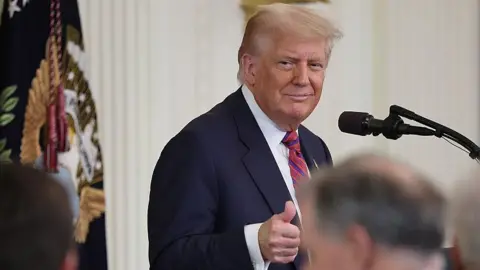
The court filing came as Trump filed a lawsuit against the Wall Street Journal’s parent company, its owner Rupert Murdoch and two reporters, over a story claiming he wrote a “bawdy” personal note to Epstein in 2003.
Trump said the note, which the paper reported he’d sent for Epstein’s 50th birthday, is “fake”.
The justice department formally made the request to a judge in New York, arguing the materials related to the case – where he was charged with trafficking dozens of girls as young as 14 – “qualify as a matter of public interest”.
The department is also asking for disclosures in the case of his associate Ghislaine Maxwell, who was convicted in the child sex trafficking conspiracy.
A grand jury – a panel of people who vet whether there is enough evidence to charge a person with a crime – can hear from confidential informants and those whose identities are protected for their safety. Materials in a grand jury are typically kept secret under the law, but a judge can unseal documents if they decide public interest outweighs the need for such legal protections in a case.
Either way, it’s unclear when or if documents will be released, or if they contain many of the details Trump’s supporters have been demanding.
Also on Friday, Trump filed a $10bn (£7.5bn) lawsuit in Miami against Dow Jones, News Corp and conservative media tycoon Rupert Murdoch.
He claims the Wall Street Journal slandered him and violated libel laws in an article alleging that a “bawdy” birthday greeting bearing Trump’s name was sent to Epstein in 2003, before the late financier was charged with sex crimes.
“We have just filed a powerhouse Lawsuit against everyone involved in publishing the false, malicious, defamatory, fake news ‘article’ in the useless ‘rag’ that is, The Wall Street Journal,” Trump said on social media.
“I hope Rupert and his ‘friends’ are looking forward to the many hours of depositions and testimonies they will have to provide in this case,” he added.
He said the newspaper and Murdoch – with whom Trump has had an up-and-down relationship for decades – were warned they would be sued if they printed the article.
Murdoch, who was seen on Sunday attending the Fifa World Cup with Trump, founded a media empire which is credited by some with helping propel the president to the White House.
Getty Images
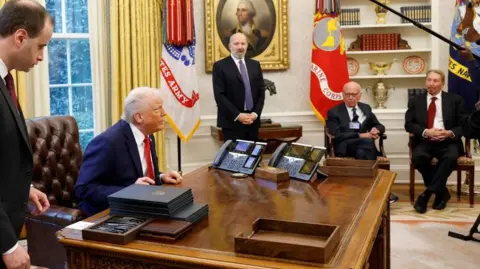
Trump and Murdoch appeared together in the Oval Office in February 2025
According to the Journal, a letter bearing Trump’s name “contained several lines of typewritten text framed by the outline of a naked woman, which appears to be hand-drawn with a heavy marker”.
“Inside the outline of the naked woman was a typewritten note styled as an imaginary conversation between Trump and Epstein, written in the third person,” the paper reported.
It reportedly contains a joking reference that “Enigmas never age” and allegedly ends with the words: “A pal is a wonderful thing. Happy Birthday – and may every day be another wonderful secret.”
Trump denied writing the note after the article was published on Thursday, posting: “These are not my words, not the way I talk. Also, I don’t draw pictures.”
The developments on Friday came amid a turbulent week for the president as some of his most loyal supporters demanded more transparency and public disclosure in the Epstein case.
Some Trump loyalists have even called for Attorney General Bondi to resign after she reversed course on releasing certain documents related to Epstein.
Chad Bianco, a Republican sheriff running for California governor, told BBC News that Trump’s handling of the Epstein files was “not what I was expecting” and that “millions” of his followers are disappointed.
“We feel like we’re being talked down to like stupid children.”
Meanwhile, members of Congress are pushing to pass a “discharge petition” that would force Bondi to “make publicly available in a searchable and downloadable format all unclassified records, documents, communications, and investigative materials in the possession of the Department of Justice, including the Federal Bureau of Investigation and United States Attorneys’ Offices” relating to Epstein.
The effort has brought together some of Congress’s fiercest opponents, including Republican Marjorie Taylor Greene and Democrat Alexandria Ocasio-Cortez who are both signed on as supporters.


 Reuters