

7.3 C
New York
Wednesday, April 22, 2026
Home Blog Page 542

Review of Fender x Teufel Rockster Air 2 Portable Speaker

0

I love music. All sorts of music. My playlist ranges from Nine Inch Nails to Niccolò Paganini. From Spice 1 to Gymnopédie No 1. Not a single day goes by when I don’t listen to music. When Teufel shot me an email asking if I wanted to give its flagship portable speaker a listen, I said, “What’s a Teufel?

Turns out, Teufel is a German company that’s been around since before I was born (barely, since 1979 to be precise), making some of the best THX home audio systems ze Germans had ever known. Fun fact: “teufel” means “devil” in German.

It appears as though I’m not the only American to have never heard of Teufel (I did an informal poll of music lovers and industry professionals that I know). That’s probably what led the German company to pair up with world-renowned Fender to release the Fender x Teufel Rockster 2 series of portable speakers.

Fender has been around since 1946, when Leo Fender and Doc Kauffman – under the brand name K&F – built the Model 26 “Woodie” amp (that can still sell for well over ten grand). In 1948, Leo took his act solo and cranked out the first Fender Esquire, which later became the legendary Telecaster. Since then, Fender has pretty much become a household name, even for those who aren’t musicians.

And if we’re being honest, Fender lending its name to Teufel’s Bluetooth speaker speaks volumes to the credibility of an otherwise unknown company in some markets. Fender wouldn’t just stick its logo on something less-than-stellar, I don’t think. And the collab has boosted sales of the Rockster series to one of Teufel’s biggest hits.

The Rockster Air 2 looks pretty sharp in whatever room I’m in

New Atlas

Now that that’s outta the way, what’s up with the Fender x Teufel Rockster Air 2? Is it worth the currently-listed US$479.99 hype? That’s a pretty decent chunk of change for a portable Bluetooth speaker … lemme break it down for ya:

This thing ROCKS.

First impression: “It looks like a Fender amp, do like!” followed by, “Dang, it’s heavy!”

I immediately queued up my favorite “test-a-system’s-capabilities song,” DJ Magic Mike’s “Lower the Dynamite.” A 1989 Miami bass track of speaker-blowing Roland TR-808 bass with layered E-mu SP-1200 breakbeat samples, serious record scratches, and just a pinch of vocals.

I was immediately surprised. Fully cranked, the speaker did not clip. At all. Zero. And it’s loud! And it bumps! I’m the guy who modified my car doors to accept 6×9 three-ways and threw a 12″ Rockford Fosgate sealed box in the mix. I’m telling you, I really like music.

I was too excited by the loud yet clear audio that I couldn’t wait for the song to finish and I immediately went into musical-ADHD-mode, listening through at least the first chorus of songs by Die Antwoord, Baauer, Squirrel Nut Zippers, DJ Snake (Turn Down for What?!?), Led Zeppelin, Muddy Waters, etc, trying to find a flaw during playback. Nothing was immediately apparent.
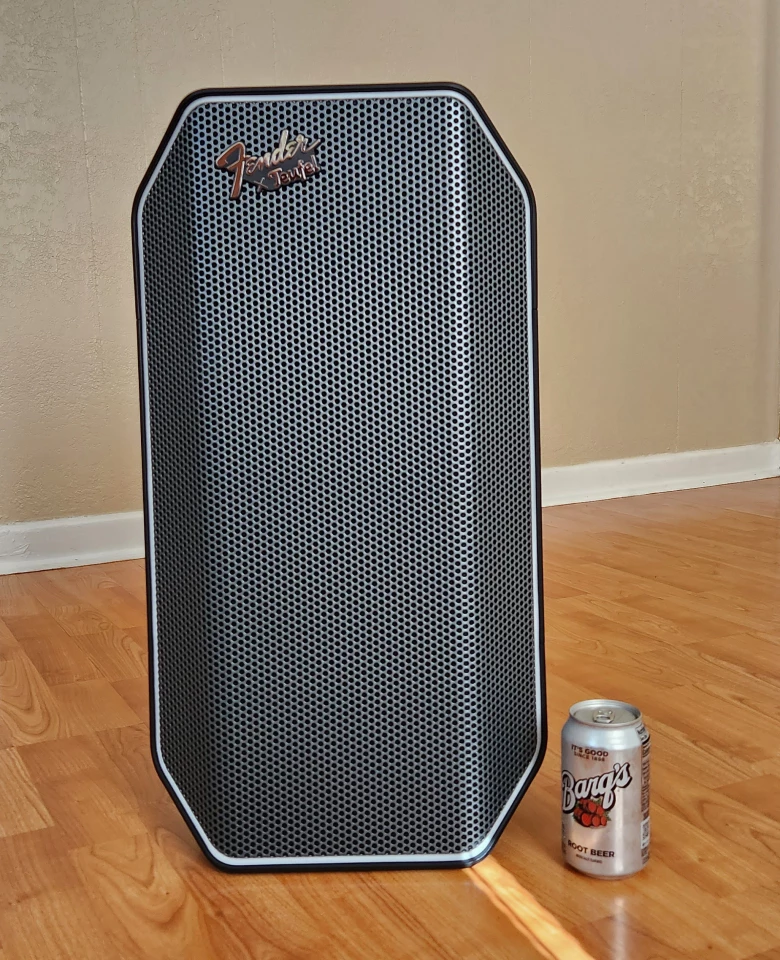
Jamming on the Fender x Teufel Rockster Air 2 while having a root brewski ain't so bad
Jamming on the Fender x Teufel Rockster Air 2 while having a root brewski ain’t so bad

New Atlas

I’ve had it for about two weeks now. I listen to it almost every day in my house and out in the backyard. It’s spent roughly half of its life at full volume (sorry, neighbors), playing nearly every genre of music (except country, of course).

Now that I’ve had some time with it in various scenarios, my only real gripe: The high-frequency treble from the 1-inch tweeter is very directional. If you’re directly in front of the speaker, even dozens of feet away, it’s crisp, sharp, and detailed. Take a couple of side-steps away from the sweet spot and the high-frequencies drop off pretty quickly, leaving you with rich bass from the 10-inch sub and less than perfect treble.

It’s not a deal-breaker, in my opinion, but it is a bit short-sighted for a portable party speaker.

But that also leads to the fact that it isn’t just a portable party speaker. It’s a speaker that pushes the limits of prosumer gear and flies just close enough to “professional” that it could get the Icarus rap and fall short.

If you take a peek at the back of the Air 2, you’ll be happy to see stuff like an XLR input AND output (for anything XLR: mics, mixers, other speakers, you name it!), a 3.5mm input (like a headphone jack, but for input), a 1/4″ input (for an instrument), and even a USB-C charging port to keep your phone or whatever topped up. Oh, and an “eco” button that I’ll get into in a minute.

The Fender-branded box sure does have a lot of fun inputs and outputs to satiate even the most greedy amateur listener/creator. That bottom compartment you see there? That's where the user-replaceable 12-volt battery lives
The Fender-branded box sure does have a lot of fun inputs and outputs to satiate even the most greedy amateur listener/creator. That bottom compartment you see there? That’s where the user-replaceable 12-volt battery lives

New Atlas

There are even volume level controls for each input. Want to Bluetooth in a backing track while you jam on your Strat and rip a lead solo? You can. Wanna to daisy-chain your Air 2 into your Fender stack? You can. You want to plug in a mic and serenade your crowd mid-solo while the backing track is still playing through both speakers, while eating Cheetos and chewing bubble gum? You totally can.

So, who is this speaker for, exactly?

Buskers. It’s the perfect speaker for the people who stop you in your tracks, cranking out covers of your favorite songs while sitting on street corners. The people doing freestyle raps. Public speakers or announcers at an event. The mobile DJs who wants quick setup and easy teardown while still sounding really, really good.

Buskers. The Rockster Air 2 is the perfect tool for those making money on public streets

New Atlas

Or anywhere that plugging into power is an issue. The Air 2 has a ridiculously long battery life at FIFTY EIGHT HOURS from its 12-volt, motorcycle battery-sized LFP battery. So, marathon-buskers, I guess. The 58-hour figure is achieved by playing the speaker at half volume. But who buys a big portable speaker like this to only play it at 5/10? Not me. Fully cranked, it’ll still run for 31 hours in Eco mode. That eco button on the back I mentioned earlier? It limits the bass to conserve battery-juice, giving it over a day’s worth of max volume playback.

Outside of plugging in my Fender acoustic electric guitar on occasion to let my neighbors know how bad I am at playing the guitar, I probably won’t use half the functions this beast is capable of. The Air 2 has the built-in ability to wirelessly connect to another Air 2 to get a full on stereo experience, where one speaker will act as the left and the other the right channel. I don’t have two to play with, but if I did, I bet my guitar playing would sound twice as good.

A professional artist, on the other hand, might find it almost good enough, but lacking in other aspects: Yes, it technically has DSP under the hood, but there’s no way to control it. There’s no companion app or parametric EQ – just a couple of twiddly knobs on top for bass and treble. And forget about vocal effects. There’s no reverb or magic button to make your drunk karaoke buddy sound like the Celine Dion she thinks she is.

Sadly, the only control over the sound you have is bass and treble. The DSP does a pretty good job with just those basic controls, but it would be nice to have full EQ control

New Atlas

And let’s not forget that the speaker doesn’t have an IP-rating for water or dust. That means that it is not at all protected against the elements. All those inputs and outputs on the back? Yeah, there isn’t even a cover plate for ’em. Teufel really missed the mark on that note.

The Rockster Air 2 is not exactly small for a portable unit. It’s a tad shy of 2 feet tall, 12.7 in wide, and 13.5 in deep (59x32x34 cm), and weighs a hefty 31.2 lb (14.2 kg). Big enough that Teufel offers a (substantial and not cheap) backpack accessory for carrying it around on your back rather than the off-balance waddle you’ll be doing using the built-in handle on top.

There’s a ton of info about the tech specs behind it on the Teufel website: Bluetooth aptX HD/AAC, 47-22,000 Hz, 80° horizontal and 40° vertical coverage area, 80 watt RMS, Class D amp, 115 dB at 1 meter, etc … but I just wanted to make this a real-world review with my real-world experience.

So to round it off: If I were in the market for a sub-500-dollar, great-sounding, portable speaker with an unbelievable battery life that I could even jam on? Then heck yeah, the incredibly long-named Fender x Teufel Rockster Air 2 would be at the top of my list. Its huge sound and lumbering size makes my JBL Flip 6 just seem silly – though I absolutely love the little JBL. Nothing compares to its size vs sound quality … But I can take my JBL in the shower with me, so there’s that …

I think I’m going to buy another one.

Source: Teufel

If you buy stuff through our Amazon links, we’ll make commission and you’ll be supporting your favorite science and tech site! Thanks!
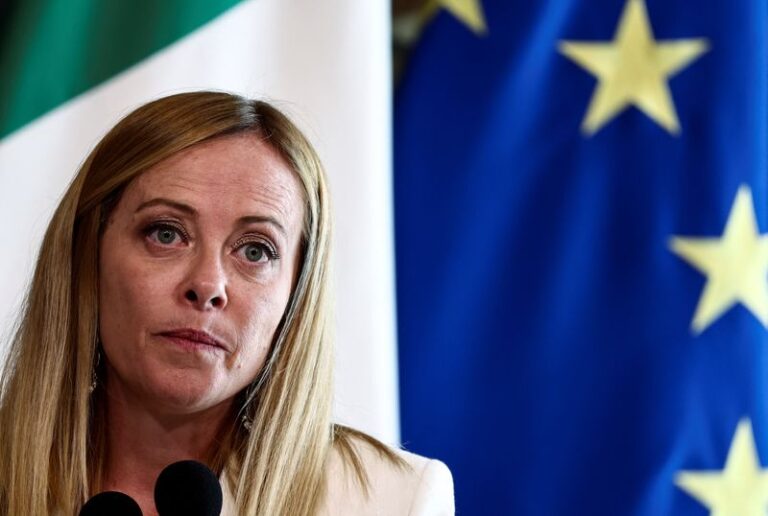

Meloni from Italy Describes Trade Deal as ‘Positive,’ Awaits Details

0

Italy's Meloni says it's a 'positive' trade deal was reached but needs to see details

German train derailment results in three fatalities and several injuries

0

Emily Atkinson & Bethany Bell

BBC News

Thomas Warnack/ dpa Emergency workers on an upturned carriageThomas Warnack/ dpa

Emergency workers on an upturned carriage

At least three people have been killed and several others have been seriously injured after a passenger train derailed in south-west Germany, police say.

Operator Deutsche Bahn said the crash at Riedlingen near Stuttgart was caused by “unknown reasons”. Reports say there had been a storm in the area shortly before.

Around 100 people were on board the train when at least two carriages derailed in a forested area around 18:10 local time (17:10 BST), German news agency dpa reported.

German Chancellor Freidrich Merz said he “mourn[ed] the victims” and offered his “deepest sympathy” to their families in a post on X.

He said he was in close contact with the interior and transport ministers, and has requested that they provide the emergency services with all the support they need.

In a statement, Ulm police said that current investigations showed “three people were killed and other passengers were seriously injured”.

Images of the crash show carriages turned on their sides and heavy emergency service presence. Fallen trees can also be seen at the scene.

Deutsche Bahn said the train was on a 90 km (55 mile) route between Sigmaringen and Ulm when it derailed.

“The exact situation is still unclear at this time,” it said on X. “Our thoughts and sympathies are with the victims and everyone who now has to process this experience.”

Thomas Warnack/ dpa An overturned train carriage is attended by emergency service personnelThomas Warnack/ dpa

US and EU agree on trade deal with 15% tariff rate and promise billions in investments

0

The U.S. and European Union agreed on trade terms that include a 15% rate on most EU products as well as hundreds of billions of dollars of investments in American industry.

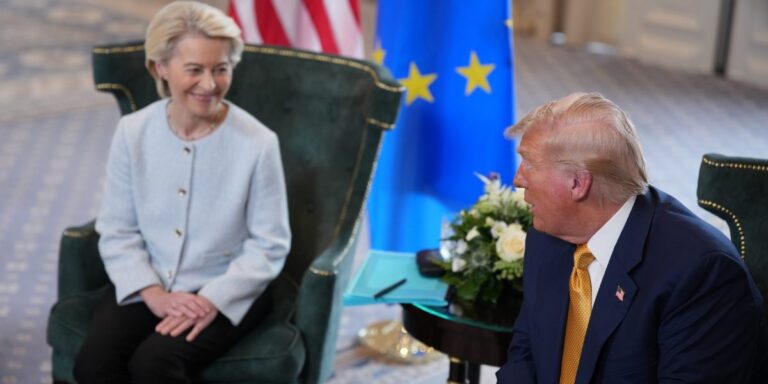
President Donald Trump and European Commission President Ursula von der Leyen met in Scotland on Sunday to iron out the agreement.

Trump said the EU will invest $600 billion in the U.S. and buy $750 billion of U.S. energy, with “vast amounts” of American weapons also in the mix. He also said the EU will be “opening up their countries at zero tariff.”

Von der Leyen said the 15% rate was “all inclusive,” but Trump said later that it didn’t apply to pharmaceuticals and metals though it does for autos.

“I think that basically concludes the deal,” he told reporters. “It’s the biggest of all the deals.”

Von der Leyen also said the agreement would “rebalance” trade between the two partners. The U.S. goods trade deficit with the 27-member EU was $235.6 billion in 2024, a 12.9% increase from 2023, according to the office of the U.S. Trade Representative.

She later confirmed that the $750 billion in U.S. energy purchases would come over the next three years, while adding that both sides will drop tariffs to zero on aircraft, plane parts, certain chemicals, and chip equipment as well as some farm products and raw materials.

But von der Leyen also introduced some uncertainty by saying the 15% rate does apply to pharmaceuticals while also suggesting more details will come from the U.S. and that pharma overall is “on a different sheet of paper.”

A deal with America’s biggest trading partner removes a key source of market uncertainty and the threat of a damaging trade war.

Michael Brown, senior research strategist at Pepperstone, said in a note that European carmakers are among the big winners from the deal as tariffs on autos will drop to 15% from the current 25%, securing a similar carveout that Japan obtained last week. U.S. defense and energy stocks also stand to gain.

“Stocks hardly need much of an excuse to rally right now, and agreement of the ‘biggest ever deal’ – Trump’s words, not mine – not only removes a key left tail risk that the market had been concerned about, but also yet again reiterates that the direction of travel remains away from punchy rhetoric, and towards trade deals done,” he wrote.

Heading into their meeting, Trump and von der Leyen said they saw a 50-50 chance of reaching a deal. Trump ruled out pharmaceuticals from any deal and said the tariff rate on the EU wouldn’t go below 15%.

The EU already faces a 50% U.S. tariff on steel and aluminum. Without a deal by Aug. 1, the EU was set to get hit with a 30% “reciprocal” tariff, up from 10%.

Last week, Trump reached a trade with Japan that set a 15% rate and included a pledge for Tokyo to invest $550 billion in key U.S. industrial sectors, with Trump able to direct the funds.

Treasury Secretary Scott Bessent said Japan’s investment offer was key to clinching a trade deal and suggested it could help other countries get a comparable rate, though Wall Street analysts have expressed skepticism that the money will fully materialize.

In fact, Trump has hinted that the EU would have to “buy down” the threatened tariff rate of 30% and pointed to the Japan deal.

In case no deal with the U.S. was made, the EU had already pre-planned retaliatory tariffs of up to 30% on more than $100 billion worth of goods American exports, such as aircraft, cars and bourbon whiskey.

Meanwhile, other U.S. trading partners are also staring down the Aug. 1 deadline, and Commerce Secretary Howard Lutnick said Sunday that no further extensions will be given.

But the U.S. and China are reportedly extending their trade truce by 90 days as talks between Bessent and Chinese Vice Premier He Lifeng scheduled to start on Monday in Stockholm. Without an extension, their tariff pause was scheduled to end on Aug. 12.

“When Japan broke down and made a deal the EU had little choice. The biggest piece in the trade deal puzzle still remains, and the Chinese are unlikely to be as willing to fold,” Jamie Cox, managing partner for Harris Financial Group, said in a note. “The next big durable theme in markets is security, and the EU deal only accelerates it.”

Countries condemn Israel but continue economic relations with it | Updates on Israel-Palestine conflict

0

As Israel’s killing of Palestinians continues fast and slow, through air strikes and starvation, the foreign ministers of 28 countries have signed a statement calling for an end to Israel’s war on Gaza.

As these countries deploy words months after the United Nations and other groups warned of an oncoming famine, there has been little action on other fronts.

Some of these countries have recognised the Palestinian state while France last week angered Israeli officials by announcing it would do the same in September.

Still, many critics have pointed out that as countries make these statements, many of them continue to benefit from trade with Israel and have not imposed sanctions or taken any other action that could push Israel to end its genocidal war on Gaza.

The war has killed at least 59,821 people in Gaza and wounded 144,477.

Here’s all you need to know about the countries profiting from Israel while condemning its military action:

How much do the signatories of the statement trade with Israel?

Belgium, France, Ireland, Italy, Japan, the Netherlands, Poland, Spain, Switzerland and the United Kingdom all have more than $1bn in imports, exports or both with Israel, according to 2023 figures from the Observatory of Economic Complexity.

What do these countries trade with Israel?

Among the top items being traded are cars and other motor vehicles, integrated circuits, vaccines and perfumes.

About $3.58bn in integrated circuits is the largest individual product going to Ireland, making up the overwhelming majority of Ireland’s imports from Israel.

Meanwhile, Italy exports to Israel more than any other country that signed the statement. Its $3.49bn of exports included $116m in cars in 2023.

Smoke rises from an Israeli air strike in the northern Gaza Strip near Beit Hanoon, as seen from Israel on July 27, 2025 [Atef Safadi/EPA]

Do these countries recognise Palestine?

Of those countries that issued the statement, Ireland and Spain recognised Palestine in 2024 and have spoken strongly against Israel’s actions in Gaza. Still, that hasn’t stopped them from continuing trade with Israel.

Seven other countries that signed the statement also recognise the State of Palestine, including Cyprus, Malta and Poland, all of which recognised Palestine in 1988, shortly after the Palestinian Declaration of Independence.

Iceland (2011), Sweden (2014), Norway (2024) and Slovenia (2024) also recognise the State of Palestine while France said it will do so in September at the United Nations General Assembly.

Who signed the statement?

Australia, Austria, Belgium, Canada, Cyprus, Denmark, Estonia, Finland, France, Greece, Iceland, Ireland, Italy, Japan, Latvia, Lithuania, Luxembourg, Malta, the Netherlands, New Zealand, Norway, Poland, Portugal, Slovenia, Spain, Sweden, Switzerland and the UK.

All of them are still trading with Israel.

What was Israel’s reaction to the statement?

As expected.

Oren Marmorstein, a spokesperson for the Israeli Ministry of Foreign Affairs, wrote on X that Israel rejects the statement, saying “it is disconnected from reality and sends the wrong message to Hamas.”

INTERACTIVE - Israel attacks Gaza tracker death toll ceasefire July 27 2025-a-1753622541
[Al Jazeera]

What else are countries trading with Israel doing?

France, Germany and the UK called for an “immediate ceasefire” in Gaza and “unconditional release of all hostages” after they held an emergency call to discuss the war and the hunger crisis created by Israel’s siege and aid blockade on the enclave.

Has any of this made Israel change its behaviour?

Attention has turned heavily towards the starvation of Palestinians in Gaza, leading even longtime Israeli stalwart supporters like former US presidential candidate Hillary Clinton to address the issue.

This pressure has led Israel to announce “tactical pauses” for “humanitarian purposes” from 10am to 8pm (07:00 to 17:00 GMT) in al-Mawasi, Deir el-Balah and Gaza City. They started on Sunday.

Despite the pauses, Israeli forces killed at least 43 Palestinians early on Sunday.

The Palestinian Ministry of Health in Gaza said on Sunday that it had recorded six more deaths over 24 hours due to famine and malnutrition, including two children.

This brings the total number of starvation deaths to 133, including 87 children.

Challenging Client

0


Client Challenge


JavaScript is disabled in your browser.

Please enable JavaScript to proceed.

A required part of this site couldn’t load. This may be due to a browser
extension, network issues, or browser settings. Please check your
connection, disable any ad blockers, or try using a different browser.

Israel extends aid measures as a gesture of support to allies appalled by Gaza’s food crisis

0

Jeremy Bowen

International editor

AFP A young Palestinian girl hangs over a wall, holding a metal bowl, while waiting for lentil soup distribution point in Gaza City in the northern Gaza StripAFP

Israel has responded to sustained and growing international condemnation that it is responsible for starvation in Gaza by announcing a series of measures the Israel Defence Forces (IDF) said would ‘improve the humanitarian response.’

It is allowing airdrops of aid, carrying out the first one itself during the night and allowing the United Arab Emirates air force to follow with another later on Sunday.

The IDF also announced that it would allow a ‘tactical pause in military activity’ in some areas and set up ‘designated humanitarian corridors… to refute the false claim on international starvation.’

Hamas has condemned the moves as a “deception”. Israel, it said, was “whitewashing its image before the world”.

Israel later carried out an airstrike during the ‘tactical pause.’ Reports from the scene say a mother called Wafaa Harara and her four children, Sara, Areej, Judy and Iyad were killed.

While Israel continues to insist it is not responsible for the humanitarian catastrophe in Gaza and does not impose restrictions on aid entering Gaza, those claims are not accepted by its close allies in Europe, or the United Nations and other agencies active in Gaza.

The new measures might be a tacit admission by the Israelis that they need to do more.

More likely they are a gesture to allies who have issued strong statements blaming Israel for starvation in Gaza.

The latest, on Friday 25 July, from Britain, France and Germany was stark.

“We call on the Israeli government to immediately lift restrictions on the flow of aid and urgently allow the UN and humanitarian NGOs to carry out their work in order to take action against starvation. Israel must uphold its obligations under international humanitarian law.”

Israel followed a total blockade of all aid into Gaza with restrictions on the approval of the contents and movement of aid convoys. With the Americans, it has set up a new system of distributing aid through the so-called ‘Gaza Humanitarian Foundation’ (GHF), intended to replace the aid network run by the United Nations. Israel claims that Hamas stole aid from the UN system. The UN says it is still waiting for the Israelis to back their claims with evidence.

The UN and other agencies will not cooperate with the GHF system, which they say is inhumane and militarised. More than 1,000 Palestinians have been shot dead trying to reach the GHF’s four sites, according to the UN.

A retired US special forces colonel who worked for the GHF in Gaza told the BBC that he saw American colleagues and IDF soldiers opening fire on civilians. Both deny they have targeted civilians.

Watch: Air drop aid seen arriving in northern Gaza

Jonathan Whittall, the head in the Occupied Palestinian Territories of the UN’s office for the coordination of humanitarian affairs (OCHA) has already condemned the methods used by the GHF. Israel told him his visa would not be renewed after he posted on social media a month ago that the GHF system had brought to Gaza “conditions created to kill… what we are seeing is carnage. It is weaponised hunger. It is forced displacement. It’s a death sentence for people just trying to survive. It appears to be the erasure of Palestinian life”.

After Israel announced its new measures, Whittall told the BBC that “the humanitarian situation in Gaza has never been worse”.

He said for Israel’s new measures to change matters for the better it would have to reduce the time it takes to allow trucks to transit the crossings into Gaza and improve the routes provided by the IDF for the convoys to use.

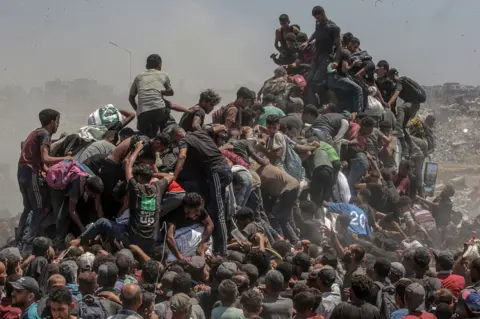
Israel would also need to provide “meaningful assurances that the people gathering to take food off the back of the trucks won’t be shot by Israeli forces”.

Whittall has been going in and out of Gaza since the war started, though that is now ending unless Israel decides not to withdraw his visa after all. He says that as IDF military operations continue “there remains an abhorrent disregard for humanitarian law”.

Prime Minister Benjamin Netanyahu and his former defence minister Yoav Gallant are already the subject of an arrest warrant issued by the International Criminal Court last year, accused of joint criminal responsibility for “the war crime of starvation as a method of warfare; and the crimes against humanity of murder, persecution, and other inhumane acts.” Netanyahu, Gallant and the Israeli state deny the allegations.

Israel released grainy footage of a transport plane dropping pallets of aid into Gaza. Lines of parachutes billowed out the back of the aircraft in the dark of the night. The IDF said it had delivered seven packages of aid containing flour, sugar and tinned food.

In other wars I have seen aid being dropped, both from the aircraft themselves and close up on the ground as it lands.

Air dropping aid is an act of desperation. It can also look good on television, and spread a feel-good factor that something, at last, is being done.

It is a crude process, that will not on its own do much to end hunger in Gaza. Only a ceasefire and an unrestricted, long term aid operation can do that. Even big transport planes do not carry as much as a small convoy of lorries.

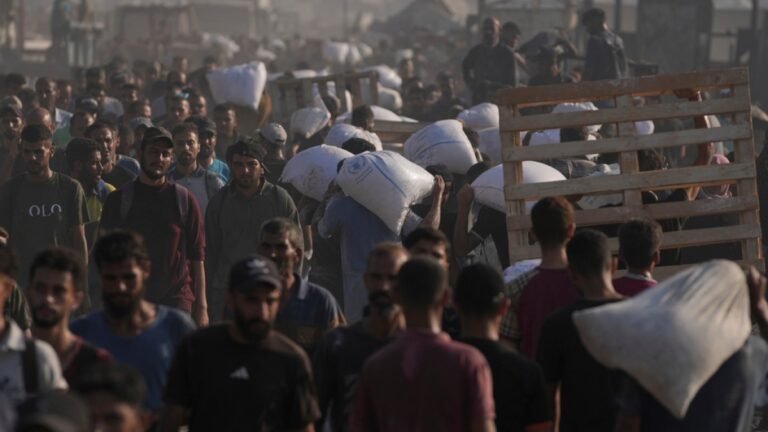
EPA Palestinians try to grab bags of flour from an aid truck near Zikim, northern Gaza Strip on 27 JulyEPA

Palestinians try to grab bags of flour from an aid truck near Zikim, northern Gaza Strip on 27 July

In Iraqi Kurdistan, after the 1991 Gulf War, the US, UK and others dropped aid from C-130 transport aircraft, mostly army rations, sleeping bags and surplus winter uniforms to tens of thousands trying to survive in the open in mud and snow high in the mountains on Iraq’s border with Turkey. I flew with them and watched British and American airmen dropping aid from the rear cargo ramps of the planes several thousand feet above the people who needed it.

It was welcome enough. But when a few days later when I managed to reach the improvised camps in the mountains, I saw young men running into minefields to get aid that landed there. Some were killed and maimed in explosions. I saw families killed when heavy pallets dropped on their tents.

When Mostar was besieged during the war in Bosnia in 1993, I saw pallets of American military ‘meals ready to eat’, dropped from high altitude, scattered all over the east side of the city that was being constantly shelled. Some aid pallets crashed through roofs that had somehow not been destroyed by artillery attacks.

Professionals involved in relief operations regard dropping aid from the sky as a last resort. They use it when any other access is impossible. That’s not the case in Gaza. A short drive north is Ashdod, Israel’s modern container port. A few more hours away is the Jordanian border, which has been used regularly as a supply line for aid for Gaza.

Gaza was one of the world’s most densely populated places before the war when the population of more than two million Palestinians had access to the entire strip. In British terms, the Gaza Strip is slightly smaller than the Isle of Wight. Compared to American cities, it’s roughly the size of Philadelphia or Detroit.

Now Israel has forced most of Gaza’s people into a tiny area on the southern coast, amounting to around 17% of Gaza’s land. Most of them live in densely packed tents. It is not clear if there is even an open space for despatchers high in the sky to aim at.

Pallets of aid dropped by parachute often land far from the people who need it.

Each pallet will be fought over by desperate men trying to get food for their families, and by criminal elements who will want to sell it for profit.

Trump and EU’s von der Leyen to meet Sunday to finalize trade agreement

0

Trump, EU's von der Leyen to meet on Sunday to clinch trade deal

Turkish Wildfires Spread to Northwest City as Hundreds Evacuate: Climate Crisis Update

0

Bursa governor’s office says 1,765 people have been evacuated as more than 1,900 firefighters battle the flames.

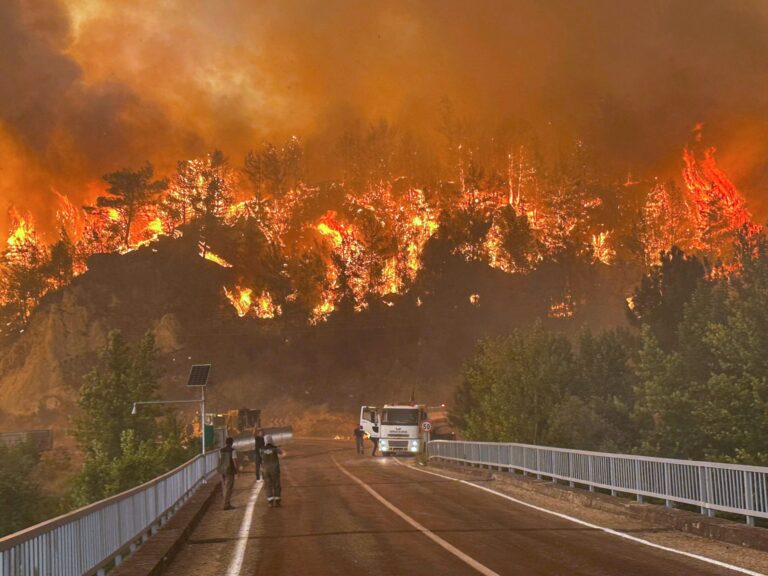
Wildfires that have engulfed Turkiye for weeks have surrounded the country’s fourth-largest city, causing more than 1,700 people to flee their homes and leaving one firefighter dead.

Fires in the forested mountains surrounding Bursa in northwest Turkiye spread rapidly overnight on Sunday, causing a red glow over the city.

Dozens of severe wildfires have hit the country since late June, with the government declaring two western provinces, Izmir and Bilecik, disaster areas on Friday.

Bursa governor’s office said in a statement on Sunday that 1,765 people had been safely evacuated from villages to the northeast as more than 1,900 firefighters battled the flames. Authorities said 500 rescue workers were also on the ground.

The highway linking Bursa to the capital, Ankara, was closed as surrounding forests burned.

A firefighter died from a heart attack while on the job, the city’s mayor, Mustafa Bozbey, said in a statement, adding that the flames had scorched 3,000 hectares (7,413 acres) around the city.

Orhan Saribal, an opposition parliamentarian for the province, described the scene as “an apocalypse”.

Relatives and friends mourn during the funeral of five rescue volunteers killed while battling a wildfire in northwestern Eskisehir province, in Ankara, Turkiye, July 24, 2025 [Yavuz Ozden/Dia Photo via AP]

Forestry Minister Ibrahim Yumakli said fire crews across the country battled 84 separate blazes on Saturday. The country’s northwest was under the greatest threat, including Karabuk, where wildfires have burned since Tuesday, he said.

Unusually high temperatures, dry conditions and strong winds have been fuelling the wildfires.

The General Directorate of Meteorology said Turkiye recorded its highest ever temperature of 50.5 degrees Celsius (122.9 degrees Fahrenheit) in the southeastern Sirnak province on Friday. The highest temperatures for July were seen in 132 other locations, it said.

The previous national record was set on August 15, 2023 in Saricakaya, Eskisehir, at 49.5C (121.1F), the Anadolu news agency reported.

At least 14 people have died in recent weeks, including 10 rescue volunteers and forestry workers killed on Wednesday in a fire in Eskisehir in western Turkiye.

Justice Minister Yilmaz Tunc said late on Saturday that prosecutors had investigated fires in 33 provinces since June 26, and that legal action had been taken against 97 suspects.

Watch Party for Day 1 Finals of the 2025 World Championships with Olivia Smoliga and Hunter Armstrong

0

By Coleman Hodges on SwimSwam

2025 World Championships

Listen along with SwimSwam as we livestream Day 1 Finals of the 2025 World Championships in Singapore.

Read the full story on SwimSwam: 2025 World Championships | Day 1 Finals Watch Party with Olivia Smoliga & Hunter Armstrong