

5.6 C
New York
Sunday, April 26, 2026
Home Blog Page 484

Yamal and Raphinha lead Barcelona to victory in La Liga opener against Mallorca | Football News

0

Lamine Yamal and Raphinha both find the net in Barcelona’s 3-0 La Liga win at Mallorca, who had two players sent off.

Barcelona began the defence of its La Liga title with a comfortable 3-0 win at Mallorca, scoring early and taking advantage of two first-half red cards for the hosts.

Raphinha and Lamine Yamal, who led Barcelona’s prolific attack last season, needed only seven minutes to impress again on Saturday. Yamal’s curling cross found Raphinha by the far post, and the Brazil forward headed in from close range.

Ferran Torres’s shot from outside the area in the 23rd was a goal that drew complaints from Mallorca because one of its players was on the ground after being hit by the ball in the head in the buildup.

Some Mallorca players stopped playing after their teammate went down, but the referee allowed play to continue. Mallorca immediately complained after Ferran scored.

The host went a man down 10 minutes later when Manu Morlanes was sent off for a second yellow card for fouling Yamal on the run. His first yellow was for protesting Barcelona’s second goal.

The second red card in the 39th came from Mallorca striker Vedat Muriqi hitting the head of Barcelona goalkeeper Joan García with his left foot while reaching up for a high ball. The referee changed the card from yellow to red after a video review.

Barcelona’s Brazilian forward Raphinha heads the ball to score the opening goal at Mallorca [Jamie Reina/AFP]

Yamal made it 3-0 in second-half stoppage time by hitting the top corner.

Barcelona, which won the league last season after scoring 102 goals, was without veteran striker Robert Lewandowski because of an injury. Newly signed forward Marcus Rashford went in as a substitute in the 69th.

New Barcelona goalkeeper García did not have to work much in his Barcelona debut after being signed in the offseason in a transfer from city rival Espanyol.

Regular starting goalkeeper Marc-Andre ter Stegen is out after undergoing lower back surgery, and García started ahead of Wojciech Szczesny and Iñaki Peña, who replaced Ter Stegen last season.

Later Saturday, Valencia hosted Real Sociedad and promoted Levante visited Alaves.

On Friday, Rayo Vallecano won at Girona 3-1, and Villarreal defeated promoted Oviedo 2-0.

Atletico Madrid is at Espanyol on Sunday, while Real Madrid hosts Osasuna on Tuesday.
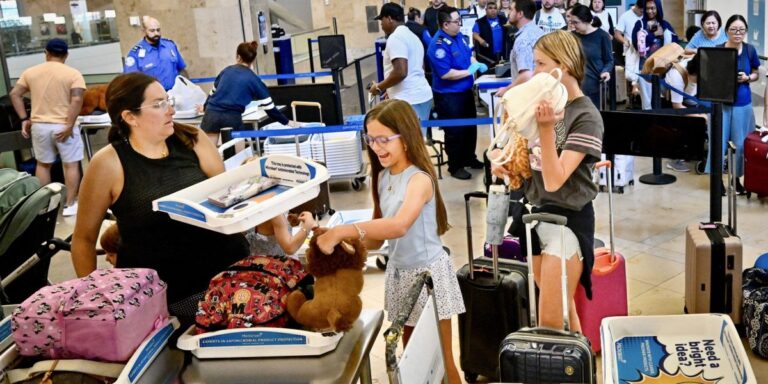
Airline prices are increasing once more following a period of decreased rates as airlines reduce flights to alleviate overcapacity.

0
  • The latest consumer price index report showed airfares jumped 4% in July from the prior month, reversing a slump that began early this year. That’s as airlines are reducing the number of flights, easing a capacity glut, while demand has rebounded after President Donald Trump’s trade war slowed travel during the spring.

Supply and demand are coming back into balance in the airline industry, meaning airfares are shooting higher again after an extended downtrend.

The latest consumer price index report showed airfares jumped 4% in July from June, marking the first monthly increase since January.

For much of the peak travel season, consumers enjoyed lower prices. Airfares ticked down 0.1% in June and fell 2.7% in May from the prior month. But those days look to be over for now.

Airlines are trimming flights more aggressively than usual as the summer winds down. Domestic capacity among U.S. airlines has dropped 6% in August versus July, according to data from Cirium cited by CNBC.

That’s bigger than the cut of just over 4% during the same period a year ago as well as the 0.6% cut in 2023. And in the pre-COVID summer of 2019, capacity fell by 1.7% between July and August.

The strike at Air Canada could throw another wrench into capacity as the carrier suspends operations. Canada’s top airline operates around 700 flights per day.

Earlier this summer, airlines found themselves with too much capacity as their expectations at the start of the year for another travel boom slammed into President Donald Trump’s trade war in the spring.

After he unveiled much steeper-than-expected tariffs in April, demand for flights slowed as consumers turned cautious about the economy and their finances. To avoid flying empty planes, airlines slashed prices.

But Trump pulled back from his highest levies and signed several trade deals. With some uncertainty easing, airlines have reported that demand is rebounding. In fact, security screenings at airports in July and so far in August are up from a year ago.

“The world is less uncertain today than it was during the first six months of 2025 and that gives us confidence about a strong finish to the year,” United Airlines CEO Scott Kirby said last month.

Introducing the 2025 Fortune Global 500, the definitive ranking of the biggest companies in the world. Explore this year’s list.

Mary T. Meagher breaks world record in 200 Butterfly for 60-64 age group

0

By Sean Griffin on SwimSwam

60-year-old Olympic legend Mary T. Meagher, now known as Mary Plant, is back to breaking world records.

The American swimming legend retired from swimming after the 1988 Olympic Games, but has returned to swimming in the masters realm in recent months.

Just minutes ago at the SPMS SW Zone LCM Championships in Mission Viejo, California, Plant threw down a new masters World Record in the women’s 60-64 200 butterfly. She stopped the clock with a time of 2:39.31, which eclipsed Laura Val‘s former mark of 2:41.03 from August 2011. Val is one of the most decorated masters swimmers of all-time, having broken nearly 450 world records during her masters career so far.

Plant negative split each 100, recording 36.62 on the first 50 and 36.59 on the second 50. She closed with splits of 44.10 and 42.00, respectively. She won her heat by 2.40 seconds and her age group by 1 minute and 36.97 seconds.

This was only her fourth officially-recorded meet since her return to racing.

Her most recent competition was the Augusta Blue Tides Dog Days of Summer Masters Meet on August 15, where she won the 50 fly (31.27), 100 fly (1:09.59), and 200 fly (2:45.99).

At the Rose Bowl Masters competition in March, she recorded times of 28.34, 1:04.03, and 2:29.84 in the yards versions of those races, but those swims were her first recorded long course swims since retiring from professional swimming.

Earlier that month at the Ski-n-Swim meet, she swam 42.52 in the 50-yard free in her first meet, back, and then a week later swam 28.34 in the 50-yard fly, 1:04.03 in the 100-yard fly, and 2:29.48 in the 200-yard fly. That 50 fly time was just 1.33 seconds off the USMS National Record for the 60-64 age group that was set by Ellen Reynolds earlier this year.

During her professional career, Plant won five Olympic medals, including golds in the 100 fly, 200 fly, and 400 medley relay at the 1984 Olympic Games in Los Angeles. She accumulated nine World Championship medals as well, two of which were gold. She held the World Record in the 100-meter fly from 1980 until 1999 and the 200 fly from 1979 until 2000, setting those records when she was 15 and 14, respectively.

Her 200 fly time of 2:05.96 from 1981 remains the U.S. National Age Group Record in that event 44 years later, one of the oldest records on the books.

Read the full story on SwimSwam: Mary T. Meagher Sets Masters World Record In 60-64 200 Butterfly

A Novel Aerogel Paves the Way for Transparent Wood

0

The thermal efficiency of a building depends on many things: the color of the paint, the orientation, or the type of construction materials, but above all, its insulating qualities. And here, the Achilles heel is often the windows: a house is estimated to lose up to 30% of its thermal energy through them. Even if they use double glazing, energy is inevitably dissipated through the glass. Ultimately, it boils down to choosing between insulation and transparency. By multiplying the layers of glass, you lose transparency; conversely, by reducing the thickness and number of glass sheets, you lose energy. Or at least that was the logic until researchers at the University of Boulder in Colorado decided to develop a transparent wood aerogel capable of insulating with the same efficiency as a wall.

Windows made from beer wort

The latest proposal from the University of Boulder was published in March 2023, but the story of transparent wooden windows goes back to 2018. That was when the U.S. university team published the results of a project in which beer wort had been used to create a transparent, insulating aerogel. The research was part of the qiuest to develop building materials for Mars, where the colonists’ food waste would be used. Thus, the process was based on using bacteria to generate cellulose from brewery waste, but that first attempt un successful.      

Five years later, they have demonstrated the feasibility of a new version of their aerogel that offers a higher transparency index than glass. And yet it is also made from cellulose. To produce the aerogel, the researchers suspended wood nanofibers in water and then replaced the water with ethanol. Next, they applied a heat and pressure treatment that replaced the ethanol with air bubbles. Finally, they added silica compounds that repel water and prevent condensation.

The result is a film that can be applied to existing windows like vinyl to multiply their insulating capacity. However, by using a thicker sheet of aerogel – about 2.5 cm -, it is possible to make a window offer the same level of insulation as a wall. Just think of the impact this transparent wood could have on the construction of skyscrapers, which rely almost entirely on glazed facades today.


In addition, the new aerogel could become a more sustainable building material than glass. The latter’s production, which requires high temperatures, generates around 100 million tons of carbon dioxide annually worldwide. All this has led the U.S. Department of Agriculture to describe transparent wood as a “window to the future”, with the potential to outperform glass in almost all areas. 

Transparent wood: a sustainable substitute for plastic?

The production of plastics with fossil fuels and the environmental problems it generates when managing the resulting waste are driving the development of alternatives. For example, research is being carried out into producing biodegradable bioplastics based on natural polymers such as potato starch or cellulose.

Transparent wood could also be part of this trend. According to a study published in Science of The Total Environment, it could become an excellent substitute for plastic. The study’s authors claim that the production of transparent wood has a 24% lower impact on global warming than other petroleum-based materials such as polypropylene or vinyl.

Transparent wood was first produced in 1992 thanks to the work of German scientist Siegfried Fink. The basic principle consists of extracting the lignin from wood – a biopolymer – and replacing it with transparent materials. Over time, the results have been improved, including its level of transparency, strength, and insulating qualities, as well as its ease of manufacture. An example of this is the work of Stockholm University, which used monomers in orange peelings to achieve a transparent and 100% renewable wood.

As can be seen, the windows of the future are likely to be very different from today’s. They may incorporate transparent wood, photovoltaic glass, pollution-trapping coatings, or even offer smart capabilities. If you want to learn more about technologies like these, subscribe to our newsletter at the bottom of the page.


Source:

Government intervenes to resolve strike, mandates negotiation between parties

0

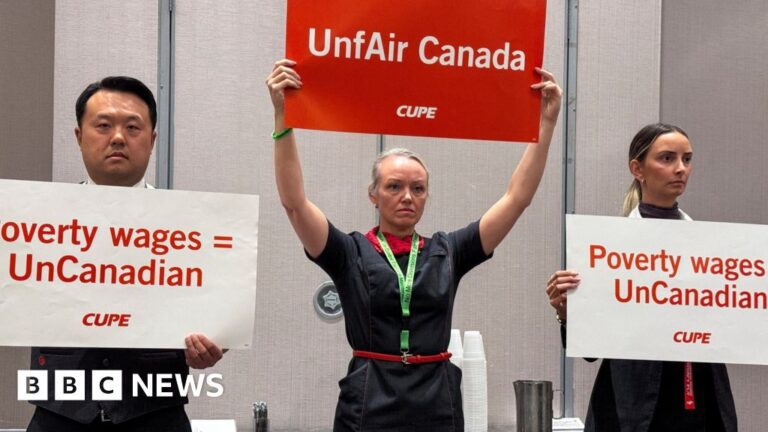
Watch: Moment Air Canada ends news conference after union activists disrupt event

The Canadian government has intervened in the Air Canada strike, forcing both parties to the bargaining table as hundreds of flights were suspended this weekend.

Jobs Minister Patty Hajdu ordered binding arbitration between the airline and the Canadian Union of Public Employees (Cupe), which represents more than 10,000 Air Canada flight attendants, hours after a strike began on Saturday morning.

“Despite significant supports from the government, these parties have been unable to resolve their differences in a timely manner,” Hadju said in a statement, adding that “stability and supply chains” must be preserved.

The country’s largest carrier says the strike will affect around 500 flights a day.

Hadju invoked Section 107 of the Canada Labour Code to bring the parties to the table.

In a statement on X, Cupe said Canada’s Liberal Party was “violating our charter rights” and the intervention “sets a terrible precedent”.

The airline said it had suspended all flights, including those under its budget arm Air Canada Rouge, and advised affected customers not to travel to the airport unless with a different airline.

Air Canada said this would disrupt travel plans for around 130,000 passengers a day.

Its flight attendants are calling for higher salaries and to be paid for work when aircraft are on the ground.

The strike took effect at 00:58 EDT (04:58 GMT) on Saturday, though Air Canada began scaling back its operations before then.

Flight attendants will picket at major Canadian airports, where passengers were trying to secure new bookings earlier in the week.

Air Canada, which flies directly to 180 cities worldwide, said it had “suspended all operations” and that it was “strongly advising affected customers not to go to the airport”.

It added that Air Canada Jazz, PAL Airlines and Air Canada Express flights were unaffected.

“Air Canada deeply regrets the effect the strike is having on customers,” it said.

By Friday night, the airline said it had cancelled 623 flights affecting more than 100,000 passengers, as part of a winding down of operations ahead of the strike.

In contract negotiations, the airline said it had offered flight attendants a 38% increase in total compensation over four years, with a 25% raise in the first year.

Cupe said the offer was “below inflation, below market value, below minimum wage” and would still leave flight attendants unpaid for some hours of work, including boarding and waiting at airports ahead of flights.

The union and the airline have publicly traded barbs about each other’s willingness to reach an agreement.

Earlier this month, 99.7% of employees represented by the union voted for a strike.

Cupe has asserted that it had been negotiating in good faith for more than eight months, but that Air Canada instead sought government-directed arbitration.

“When we stood strong together, Air Canada didn’t come to the table in good faith,” the union said in a statement to its members. “Instead, they called on the federal government to step in and take those rights away.”

Netease Cloud Music Reports 15.2% Year-on-Year Growth in Subscription Streaming Revenue in First Half of 2021, Emphasizing Support for Indie Artists and In-House Music

0

Netease Cloud Music, China’s second-largest operator of music streaming services, has reported double-digit growth in streaming and music subscription revenue for the first half of 2025.

However, the company’s overall revenue declined due to a large YoY drop in turnover from its social entertainment services division.

The company saw a 15.9% YoY increase in revenue from music services, to RMB 2.97 billion, or USD $415 million at the average exchange rate for the second quarter.

Within that figure, revenues from membership subscriptions rose 15.2% YoY to RMB 2.47 billion ($346 million) from RMB 2.14 billion in the same period a year earlier.

The company said the growth was driven by an increase in the subscriber base, which was partly offset by lower average revenue per paying user (ARPPU) due to a change in the subscriber mix.

NCM said the number of monthly active users (MAUs) “maintained steady growth momentum,” but did not disclose specific figures.

Among the company’s strategic priorities going forward, NCM said it plans to “cultivat[e] our users’ willingness to pay and subscribe to premium offerings by improving user experience, deepening user engagement, enhancing membership privileges and broadening consumption scenarios.”

NCM noted that during H1 it had expanded its relationships with copyright holders – including deals with South Korean K-pop companies RBW and Starship Entertainment – but also stressed its expansion of in-house music and the importance of the independent artists on its platform.

The company said it now works directly with 819,000 independent artists, who have contributed 4.8 million tracks to the Netease Cloud Music platform.

That’s up from 611,000 independent artists and 2.6 million tracks as of the end of 2022.

The company noted it had recently rolled out new “roles” for the artists on its platform, including “AI Musician” and “Trainee Musician,” which it says will “provide fresh opportunities for budding music creators to grow and contribute to the diversity of our content creation ecosystem.”

NCM has also partnered with various brands in a program that allows indie artists to create theme songs and background music for ads, which “boosts musicians’ visibility and provides them with valuable commercial opportunities.”

The company said its in-house music initiative has also shown results. “Our in-house studios have successfully produced and popularized multiple hit songs across our community and external platforms” since the start of the year, the company said.

“By supporting independent musicians and developing in-house music, we actively promote the growth of original Chinese music.”

NCM also said it’s “cost-effectively” expanding its long-form audio library, including self-produced audiobooks and podcasts.


Revenue drops, operating profit soars

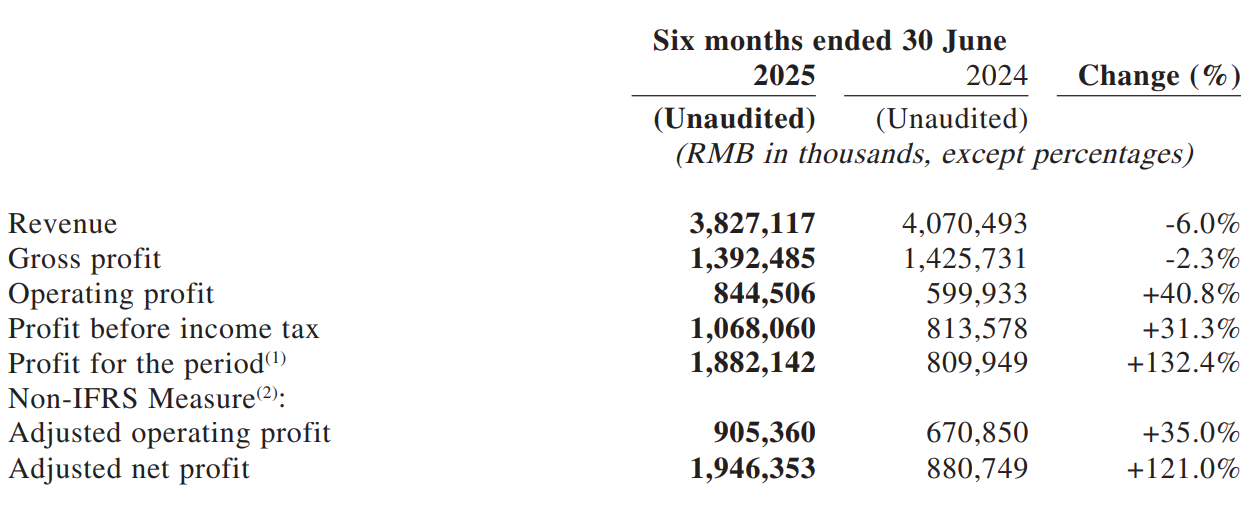
Despite the strength in its music segment, the company reported a 6.0% YoY decline in overall revenue, to RMB 3.8 billion ($525.3 million). This was due to a 43.1% YoY drop in revenues from social entertainment services, to RMB 859.8 million ($118.9 million), from RMB 1.51 billion a year earlier.

Both Netease Cloud Music and its larger competitor, Tencent Music Entertainment, have seen precipitous drops in revenue in their social entertainment divisions driven by a crackdown on online gambling by Chinese authorities.

“By supporting independent musicians and developing in-house music, we actively promote the growth of original Chinese music.”

Netease Cloud Music

In its latest earnings report, NCM suggested it is shifting its focus away from social entertainment towards its “core music business.”

The company’s gross profit declined 2.3% YoY to RMB 1.39 billion ($192.2 million), but its operating profit surged 40.8% YoY to RMB 844.5 million ($116.7 million) while pre-tax profit jumped 31.3% YoY to RMB 1.07 billion ($147.9 million).

NCM attributed the increase in part to a deferred tax credit of RMB 849.8 million that arose from “cumulative tax losses incurred by a wholly-owned subsidiary.”


Source: Netease Cloud Music

The company’s gross margin improved to 34.6%, which it attributed to “increased business scale, strong monetization of our core online music business and ongoing cost optimization.”

Netease Cloud Music stock closed the trading day Thursday (August 14) down 4.8% on the Hong Kong Stock Exchange, trading at HKD $270.20 (USD $34.50) per share.Music Business Worldwide

US halts visas for Gaza residents following backlash on right-wing social media | Latest developments in Israel-Palestine conflict

0

State Department move comes as Israel’s war and induced-famine in Gaza reach new extremes, with 61,827 killed so far.

The United States has announced that it is halting all visitor visas for people from Gaza pending a “a full and thorough” review, a day after social media posts about Palestinian refugees sparked furious reactions from right-wingers.

The Department of State’s move on Saturday came a day after far-right activist and Trump ally Laura Loomer posted on X that Palestinians “who claim to be refugees from Gaza” entered the US via San Francisco and Houston this month.

“How is allowing for Islamic immigrants to come into the US America First policy?” she said on X in a later post, going on to report further Palestinian arrivals in Missouri and claiming that “several US Senators and members of Congress” had texted her to express their fury.

Republican lawmakers speaking publicly about the matter included Chip Roy of Texas, who said he would inquire about the matter, and Randy Fine of Florida, who described the alleged arrivals as a “national security risk”.

By Saturday, the State Department announced it was stopping visas for “individuals from Gaza” while it conducted “a full and thorough review of the process and procedures used to issue a small number of temporary medical-humanitarian visas in recent days”. It did not provide a figure.

The US issued 640 visas to holders of the Palestinian Authority travel document in May, according to the Reuters news agency. B1/B2 visitor visas permit Palestinians to seek medical treatment in the US.

Loomer greeted Saturday’s State Department announcement with glee.

“It’s amazing how fast we can get results from the Trump administration,” she said on Saturday, though she later posted that more needed to be done to “highlight the crisis of the invasion happening in our country”.

The decision to cut visas comes as Israel intensifies its attacks on Gaza, where at least 61,827 people have been killed in the past 22 months, with the United Nations warning that “widespread starvation, malnutrition and disease” are driving a rise in famine-related deaths.

Israeli Prime Minister Benjamin Netanyahu has been pushing to seize Gaza City as part of a takeover of the Strip, forcibly displacing hundreds of thousands of Palestinians to concentration zones.

Challenging the Client

0


Client Challenge


JavaScript is disabled in your browser.

Please enable JavaScript to proceed.

A required part of this site couldn’t load. This may be due to a browser
extension, network issues, or browser settings. Please check your
connection, disable any ad blockers, or try using a different browser.

Kyiv likely disappointed by Trump’s shift in ceasefire strategy

0

Paul Adams

BBC Diplomatic Correspondent

Getty Images US President Donald Trump and Ukraine's President Volodymyr Zelensky sitting side by side during a meeting in the Oval Office of the White House on February 28Getty Images

Zelensky and Trump will meet on Monday

No deal in Alaska. It was always the most likely and, in the absence of Ukrainian President Volodymyr Zelensky, perhaps the most desirable outcome.

But US President Donald Trump’s pivot away from the need for an immediate ceasefire, which he said beforehand he wanted, will have caused profound dismay in Kyiv and around Europe.

Russia’s position has long been that a ceasefire can only come in the context of a comprehensive settlement taking account of Russia’s interests – and inevitably implies Ukraine’s capitulation.

That’s the position that Trump, once again, appears to have endorsed.

“It was determined by all that the best way to end the horrific war between Russia and Ukraine,” he wrote on Truth Social, “is to go directly to a peace agreement.”

Ceasefires, he noted, “often times do not hold up”.

This appears to fly in the face of Ukraine’s main demand, endorsed by all its European backers: that an unconditional ceasefire has to come first.

Crucially, it also buys Russia’s Vladimir Putin time on the battlefield, where he is convinced he’s winning.

“If Putin’s military objective was to avoid immediate constraints on Russian operations in Ukraine then he appears to have succeeded,” says Matthew Savill, the director of military sciences at the Royal United Services Institute.

At their brief press appearance last night, Putin warned Ukraine and the Europeans not to “throw a wrench” in the works of the unspecified progress he and Trump had made.

But that, for Kyiv and its allies, is precisely what Trump has done, undoing the achievements of what they all hoped was a successful preceding week of frantic diplomacy aimed at influencing the outcome in Alaska.

It’s a reminder, as if one were needed, of Trump’s tendency to echo the views of the last person to have his ear.

For a short while this morning, European leaders will have held their breath, waiting to see if their efforts had borne fruit or been cast aside.

True to his word before the summit, Trump got on the phone to Zelensky. The two men spoke for an hour, before being joined by European leaders.

Zelensky said the call was “long and substantive” and that he would travel to Washington on Monday for his first visit since the disastrous Oval Office encounter in February.

A lot has happened since then, with Kyiv’s European allies working assiduously to repair the damage and school Zelensky in the best ways of handling the capricious and volatile occupant of the White House.

“I am grateful for the invitation,” Zelensky posted, adding “it is important that America’s strength has an impact on the situation”.

But in a later post, after Trump’s statement on Truth Social, Zelensky adopted a more urgent tone.

“Killings must stop as soon as possible,” he said. “The fire must cease both on the battlefield and in the sky, as well as against our port infrastructure.”

Reuters US President Donald Trump and Russian President Vladimir Putin shake hands during a press conference following their meeting at Joint Base Elmendorf-Richardson, in Anchorage, AlaskaReuters

On his way to Alaska, Trump said he wouldn’t be happy if he left without a ceasefire, but afterwards posted on social media that ceasefires “often times do not hold up”

Europe’s “Trump whisperers” picked up this morning where they left off last week.

They highlighted the vital importance of involving Ukraine in conversations about its future but also paused, as they know they must regularly do, to show appreciation for Trump’s efforts.

“President Trump’s efforts have brought us closer than ever before to ending Russia’s illegal war in Ukraine,” said Sir Keir Starmer, the UK’s prime minister.

Starmer said he welcomed what he called the “openness” of the US, along with Europe, to provide “robust security guarantees” for Ukraine in the event of a deal.

If and when the fighting does eventually end, the precise nature of those guarantees will need to be spelled out in a great deal more detail than has so far been the case.

Getty Images Ukrainian President Volodymyr Zelensky and German Chancellor Friedrich Merz face a screen during a video conference of European leaders with the US President on the Ukraine war ahead of the summit between the US and Russian leadersGetty Images

European leaders held a virtual meeting with Trump on Wednesday ahead of the US president’s meeting with Putin

Despite Europe’s emerging role as Ukraine’s principal military, economic and political backer, everyone knows Ukraine’s future security cannot really be assured without the substantive backing of the US.

In her own comments on the Alaska summit, Italy’s leader, Giorgia Meloni, said guarantees for Ukraine could be “inspired by Nato’s Article 5” – the principle of collective defence signed on to by all Nato members.

Several reports this morning suggested the idea of guarantees outside Nato but equivalent to Article 5 were discussed during the latest call between Trump and European leaders.

But in the wake of Trump’s apparent about-face this morning, you can almost hear the sound of minds spinning across European capitals.

In London, the government appears to be putting on a brave face.

“If you can get that all done [a ceasefire and a peace agreement] in one go or in quick succession that’s obviously a good thing,” said a senior Downing Street source.

“But we all want to see the fighting stop”.

Getty Images US President Donald Trump waving as he boards Air Force One to depart Joint Base Elmendorf-Richardson Getty Images

Trump has walked away from the idea of an immediate ceasefire, no doubt informed by Putin’s highly contentious account of how ceasefires broke down in the past.

The quasi-summit in Alaska already represented a cost-free win for Putin. The return of an international pariah to the international stage (albeit one festooned with unambiguous displays of American military might at the Elmendorf-Richardson airbase) and some of the trappings of a state visit.

The threat of increased US sanctions on Moscow receded too, with Trump saying it may be two or three weeks before he even has to think about it.

All this raises a host of questions about what may greet Zelensky, both on Monday in Washington and when he finally finds himself in the room with Putin and Trump.

What advice does Trump have for the Ukrainian leader, Fox’s Sean Hannity asked.

“Make a deal,” came the blunt reply. “Russia’s a very big power and they’re not.”

Zelenskiy prepares for risky negotiations with Trump in Washington next Monday

0

Zelenskiy braces for perilous Trump talks in Washington on Monday