

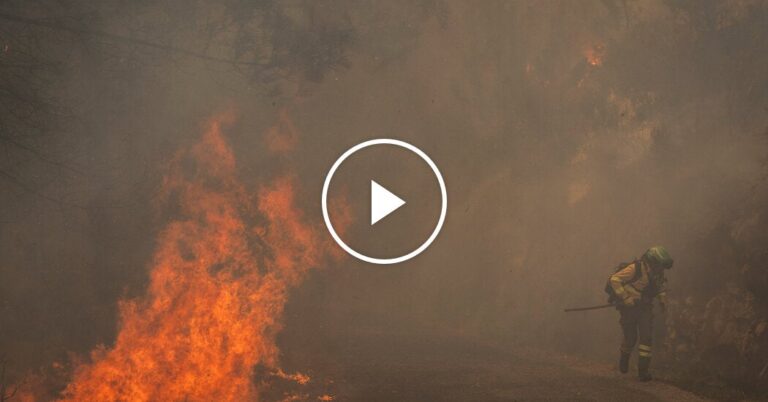
Searing temperatures were complicating attempts to suppress devastating wildfires across the Iberian Peninsula.
Is AI Leading Us into the Era of Songwriting 2.0?

MBW Views is a series of exclusive op/eds from eminent music industry people… with something to say. The following op/ed comes from Ran Geffen Levy the Founder of OG.studio, a platform that claims to be “bridging music industry evolution, technological innovation, and capital investment”. He is also the CEO of Amusica Song Management.
At this year’s Ivor Novello Awards, Charli XCX accepted ‘Songwriter of the Year’ without once mentioning artificial intelligence. Yet her message: “dare to suck” might be the clearest guidance we have for thriving in the AI era.
She reminded the room that conviction matters more than perfection; that identity, point of view, and cultural context elevate a song beyond technical quality. Her advice was simple: make what you want to hear, not what an A&R asks for; write for the niche, not the masses; embrace your own language, however odd or imperfect, follow your vibe. In short: commit to the bit.
This is precisely what the creators behind The Velvet Sundown and Aventhis have done. They took an idea – whether it was building a fully synthetic “provocation” (The Velvet Sundown) or pairing AI-generated vocals with human-written lyrics (Aventhis) – and turned it into music with a distinct identity. They weren’t chasing industry approval; they were chasing an idea that felt worth making.
Their conviction, not their conformity, made these projects stand out. And that leads to the question at the heart of this moment:
Who Gets to Be Called a Songwriter?
When I was a child, I visited my uncle Dov on a kibbutz. He was an amateur photographer who developed film in a darkroom he’d set up in an old bomb shelter. I watched him move prints from bath to bath, hanging them to dry. It felt sacred. It wasn’t the chemicals or technique that made it art; it was his intent. I wanted to be like him, but I lacked the tools, the training, the eye. Still, the desire stayed.
Years later, photography went digital. The darkroom became an app. I became an amateur photographer. Songwriting is experiencing the same transformation.
Today’s songwriters don’t always read music or play traditional instruments. They hum into voice memos, write lyrics on phones, and collaborate with AI. When desire is present, method becomes secondary.
The Ex-Puritan’s remarkable series Afterthoughts on a Month of Songwriting Critique, edited by Daniel Kincade Renton, offers essential thinking for this moment. The contributors frame songwriting not as a synthesis of poetry and music, but as the simultaneity of voice, form, feeling, and intent happening at once. If the craft itself resists clear definition, why do we insist on defining who qualifies?
Renton called for an “overpopulation” of our critical frameworks: more analogies, more disciplines, more voices. I agree. The term songwriter should stretch. It should include not just the trained, but also the instinctive, the experimental, the self-taught.
So who gets to be called a songwriter? In my opinion the only requirement to be a songwriter is the desire to write songs.
This democratisation isn’t theoretical, it’s already happening. Just as vibe coding enables single-person unicorns in tech, where one developer can build what once required entire teams, the same transformation is coming to songwriting. Call it ‘Vibe Songwriting’.
What Is Vibe Songwriting?
Harlan Howard said country music is “three chords and the truth.” The point wasn’t minimalism for its own sake; it was conviction. Vibe Songwriting takes that spirit into the present: start with the feeling, then use whatever tools you need to make those chords (literal or metaphorical) feel true. Dare to suck.
In practice, a spark, a mood, a fragment, a texture comes first. You shape it into something recognisable and memorable using today’s accessible tools. Technology doesn’t replace taste; it removes friction so taste can lead.
Rick Rubin’s project The Way of Code, a collaboration with Anthropic, is a meditation on vibe coding, drawing on Lao Tzu’s Tao Te Ching, and is designed to make coding intuitive and expressive. Rubin describes vibe coding as the “punk rock of software,” a method that begins with intuition rather than rules. In his words: ” the computer is another tool. It’s like a guitar or a sampler; it’s another tool in the artist’s arsenal. The reason we go to the artists we go to, or the writers we go to, or the filmmakers we go to, is for their point of view.”
His approach of trusting intuition over technique, prioritising authentic expression over market demands, translates perfectly to songwriting. As he explained in a16z’s The Ben & Marc Show, “you’re making your favourite thing, you’re in love with it, and then other people who like the things you like will like it.”
This isn’t about replacing human creativity but removing technical barriers. A poet can now create songs without learning piano. A storyteller can craft soundscapes without understanding mixing boards. The tools have evolved to serve the desire, not constrain it.
Which brings us to the business model that makes this sustainable.
What Is Cluster Creation?
Four months ago, I wrote about Cluster Creation, a commercial model for songwriters in the AI era. The premise was simple: instead of sprawling writing camps where a dozen names get a sliver of ownership, we form tight, complementary clusters that move faster, keep more of the pie, and adapt fluidly to new tools.
The Velvet Sundown and Aventhis are just the beginning. These formations are about to mushroom. The industry dismisses them as curiosities, side experiments outside the “real” business. I see them differently: windows into what comes next. They prove that creative control no longer needs a label’s infrastructure or even a co-writer in the room.
But to truly capture this opportunity, clusters must own more than just the song.
Own the Stack
Tomorrow’s songwriter can become a Renaissance creator: either building multi-disciplinary teams or creating everything themselves with AI assistance. Just as one person can build a tech unicorn, one songwriter can create commercially viable assets across all formats.
Timbaland understood this when he launched Stage Zero and introduced TaTa, his first AI artist. He’s not just licensing his beats to AI platforms; he’s building his infrastructure, controlling the entire creative pipeline from production knowledge to distribution. TaTa isn’t merely an AI experiment; it’s Timbaland owning the whole stack: the training data (his decades of production expertise), the artist identity, the output, and crucially, everything from streaming to merchandise. Yes, merchandise: the realm traditionally furthest from a songwriter’s reach.
This is the shift from passive licensing to active ownership. A Cluster is a project-centred formation that evolves based on creative needs: fluid, purpose-driven, and adaptable. Each creator brings specialised expertise, enhanced by AI tools they control. Together, they own everything, not just the song, but the entire creative output.
Instead of splitting diminishing streaming pennies amongst six writers, three creators in a Cluster own multiple revenue streams entirely: composition rights, master exploitation, visual IP, synthetic voice licensing, AI training data, and emerging formats we can’t yet imagine. While traditional songwriters fight for their sliver of one revenue stream, well-structured Clusters capture value across every format and platform.
The technology enabling this transformation exists today. The question is who will use it first: the platforms extracting value from creators, or the creators themselves?
History provides the answer. From piano rolls in 1908 to streaming today, songwriters have watched others get rich from their work. Each technological shift promised fairness; each one delivered new ways to exploit them.
That pattern ends now. The tools are here. The clusters are forming. The choice is binary: continue begging for scraps from a system designed to starve songwriters or build something they can’t control.
In three words: Don’t beg. Build.
Radical Self-Reliance
At Burning Man, camps form around shared themes: builders, makers, artists unite, each bringing their unique gift to create self-sustaining ecosystems. They don’t rely on external infrastructure; they build what’s needed. This is radical self-reliance: not isolation, but interdependence through collaboration.
Songwriters must embrace it now. No one is coming to save us. No stakeholder will voluntarily share more revenue. Songwriting 2.0 means creator-led clusters with full ownership, where small agile teams produce authentic work backed by clear copyright and sustainable monetisation. Ownership trumps licensing.
This is a seismic shift. It demands that managers evolve from negotiating percentages to building creative ecosystems, that rights organisations reimagine their role for multi-format IP and fluid collaborations. (I’ll tackle that in my next piece.)
Yes, the traditional market persists. But watch where the smart money goes. When Timbaland builds Stage Zero, when independent creators form clusters instead of joining writing camps, when AI democratises million-pound studios, they’re not adapting to change. They’re writing the rules. The old model doesn’t just exploit songwriters; it leaves money on the table. Clusters capture that value. All of it.
At Burning Man, they say, “We achieve being through doing.” The future of songwriting isn’t something that happens to us. It’s a world we’ll build together, one cluster at a time.
Change is wildfire. We move or we burn.
Disclaimer: I have been writing short stories since I was eleven years old. I worked as a journalist and then moved to the music industry. I love writing. I use AI as a tool and I love it. It challenges me, it helps me evolve. While the idea behind Songwriting 2.0 was entirely mine, I used AI tools for research, clarity and punchlines. By the way – (this em dash is mine) I pay subscription fees to three of them. They should share it with the people that created their datasets.Music Business Worldwide
Portugal and Spain devastated by wildfires: Climate Crisis News
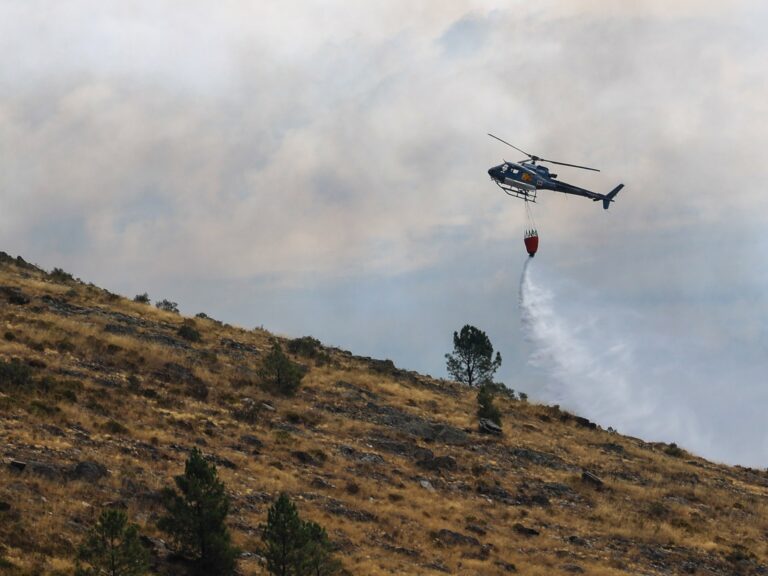
Emergency services are under strain due to the ‘worst’ fires in Portugal in years, Al Jazeera’s Sonia Gallego says.
Thousands of firefighters backed by the military are battling dozens of wildfires across Spain and Portugal as the death toll has increased to six since the outbreaks began.
Two firefighters were killed on Sunday – one in each country, both in road accidents – taking the death toll to two in Portugal and four in Spain.
The Iberian Peninsula has been particularly affected by wildfires that have ravaged Southern Europe this summer. They have been fuelled by heatwaves and drought blamed on climate change.
On Monday, five major fires remained active in Portugal with more than 3,800 firefighters tackling them, civil protection authorities said.
“We still have firefighters who are monitoring the area here, the occasional smoke which is coming out from the land here, but of course, these are the charred remains of the flames that just completely consumed these hills,” Al Jazeera’s Sonia Gallego said, reporting from Tarouca, Portugal.
The fires in the Portuguese town are now under control, but emergency services are worried about the possibility of them reigniting, Gallego said.
Emergency services are already under “enormous strain” in what appears to be some of the “worst” fires in the area in years, she added.
President Marcelo Rebelo de Sousa said a firefighter died on Sunday in a traffic accident that seriously injured two colleagues.
A former mayor in the eastern town of Guarda also died on Friday while trying to fight a fire.
About 2,160sq km (835sq miles) of land has burned across Portugal since the start of the year.
Neighbouring Spain battles blazes too
In Spain, more than 3,430sq km (1,325sq miles) of land has burned this year, setting a new national record, according to the European Forest Fire Information System.
The head of Spain’s Civil Protection and Emergencies agency, Virginia Barcones, told broadcaster TVE on Monday that there were 23 “active fires” that pose a serious and direct threat to people.
The fires, now in their second week, were concentrated in the northwestern regions of Galicia, Castile and Leon, and Extremadura.
In Ourense province of Galicia, firefighters battled to put out fires as locals in just shorts and T-shirts used water from hoses and buckets to try to stop the spread.
Officials in Castile and Leon said a firefighter died on Sunday night when the water truck he was driving flipped over on a steep forest road and down a slope.
Two other volunteer firefighters have died in Castile and Leon while a Romanian employee of a riding school north of Madrid lost his life trying to protect horses from a fire.
Challenging Client

A required part of this site couldn’t load. This may be due to a browser
extension, network issues, or browser settings. Please check your
connection, disable any ad blockers, or try using a different browser.
Desires of Each Side to be Discussed in Ukraine Negotiations at White House

Laura Gozzi and Tom Geoghegan
BBC News
 AFP via Getty Images
It promises to be a day unlike any other at the White House later, when world leaders make a rare collective visit for crunch talks on Ukraine.
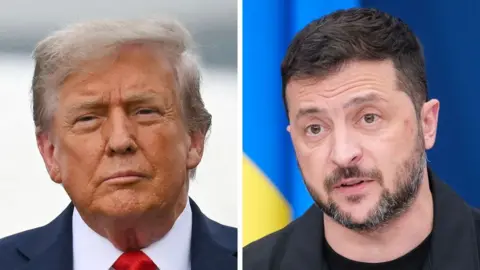
What had been billed as a meeting between two presidents, Donald Trump and Volodomyr Zelensky, has now become more of a summit.
Leaders from the UK, France, Germany, Italy, Finland, the EU and Nato have dashed across the Atlantic to have their say on how the three-year-old war with Russia should end and on what terms.
It’s a reflection of how high the stakes are and increased European concerns that the US has shifted its position to one less favourable to Ukraine.
We break down what each of those present – and one who is not – would regard as a win when the sun sets on a long day of talks.
US – a deal, any deal
Trump’s campaign promise was that he would solve this conflict on his first day in office but six months later the breakthrough he wants still eludes him.
The terms of any agreement have seemed less important to Trump than the deal itself, so the conditions have shifted over time.
Since meeting Russian President Vladimir Putin in Alaska on Friday, Trump appears to have ditched his criticism of Moscow and the threat of sanctions, and decided to pile the pressure on Zelensky instead.
In a late Sunday night social post, he warned the Ukrainian president he must forgo hopes of Nato membership and will have to concede Crimea, which Putin illegally annexed in 2014.
Trump’s envoy Steve Witkoff said on Sunday that Washington would provide security guarantees to Europe aimed at deterring further Russian aggression. But the details remain unclear.
Up to now, the US has resisted European demands that it commits to the future security of Ukraine. All eyes will be on the White House later to see if that has really changed.
Ukraine – refuse concessions on territory
Zelensky finds himself in the unenviable position of having to stand his ground in the face of an increasingly impatient Donald Trump, who appears to have been swayed by Putin and who has already accused Zelensky of standing in the way of peace.
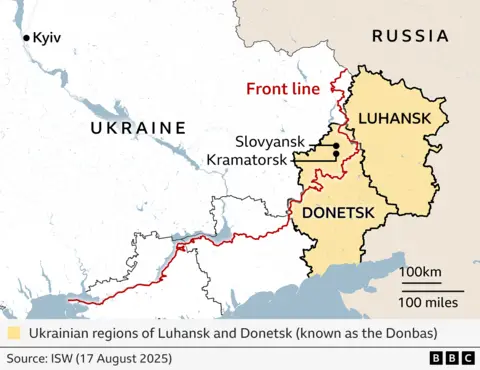
Trump will probably tell Zelensky he must agree to give up land. This will be extraordinarily difficult for the Ukrainian president to give in to as it would entrail retreating from Donetsk and Luhansk, regions which thousands of Ukrainian soldiers have fought and died to protect since 2022.
It would also allow Russia to end up in control of huge swathes of territory it could later use as a launchpad for further aggression.
So Zelensky cannot agree to land concessions without strong security guarantees that would kick in should Russia attack again. Those could have been provided by Nato, but Trump has made it clear Ukraine will not join the alliance.
Details of any alternative guarantees have likely not been worked out yet, but without them it will be difficult for Zelensky to make any commitments.
Ukraine is also concerned by the fact that Trump seems to have moved on from wanting a ceasefire to pushing for a full peace deal. This could take an exceptionally long time, allowing in the meantime for continued Russian attacks, civilian deaths and frontline losses.

Europe – a US commitment to Ukraine’s security
European leaders will be trying to push Trump to flesh out what US security guarantees for Ukraine could look like.
The vagueness of US statements on the matter is alarming to Europeans who feel protection from potential future attacks by Russia will have to come from a credible American commitment.
There is also nervousness around the idea that the US may insist Ukraine gives up land to Russia. The European continent has a long history of bloody wars and leaders want to avoid a scenario in which a sovereign country’s borders are redrawn by force.
These serious concerns explain the unprecedented decision for such a large contingent of leaders to visit the White House at the last minute.
Last week, a virtual US-EU meeting ahead of the Alaska summit seemed to have the effect of hardening Trump’s criticism of Russia; now that he is appearing to be teetering on Moscow’s side again, European leaders will try to impress on him that their concerns about the continent’s long-term security have not changed.
Russia – more Ukrainian land
There will be no Russian representative at the White House today. That may not matter: it appears Putin made enough of an impression on Trump last week that Moscow may be confident its point of view will be adequately represented.
Trump has already stated Ukraine would not join Nato – and Russia wants that commitment reiterated and ratified. It also wants full control over the Donbas, which would entail Kyiv giving up the land it still holds in the Donetsk and Luhansk regions.
Perhaps most importantly Moscow has managed to instil in Trump that it is now up to Zelensky to make a deal to end the war – while knowing fully well he cannot agree to ceding territory outright. A win for Russia would be for this friction to lead to Trump walking away from the negotiating table for good and leaving Ukraine and the Europeans to fend for themselves.
Trident Digital Tech Holdings Ltd ADR Form 6K Filed on 18 August

Form 6K Trident Digital Tech Holdings Ltd ADR For: 18 August
Passengers left stranded as Air Canada flight attendants’ strike persists
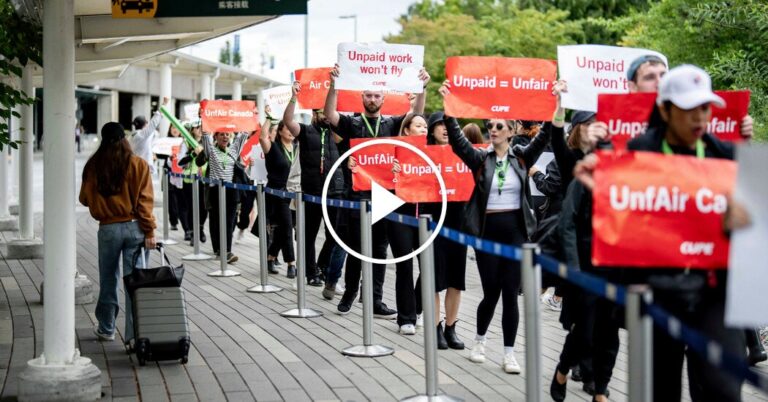
new video loaded: Passengers Stranded as Air Canada Flight Attendants’ Strike Continues
transcript
transcript
Passengers Stranded as Air Canada Flight Attendants’ Strike Continues
Passengers on Canada’s largest airline waited to be rebooked or compensated for flight cancellations as the walkout disrupted travel across the country.
-
“What do we want?” “Fair pay.” “Forced to fly, we won’t comply.” “Air Canada pays our junior flight attendants so little we had to open food banks in our union offices.” ♫ [O Canada] ♫ “They try to put us in another flight, but there is no surety.” “We’re left either stranded in Toronto or to rebook ourselves.” “I don’t have money. This is my last day here in Canada. I am a tourist.” “One day stronger.” “Shame, shame.” “What do we want?” “Fair wages.”
Recent episodes in Americas
Navarro criticizes India for purchasing Russian oil
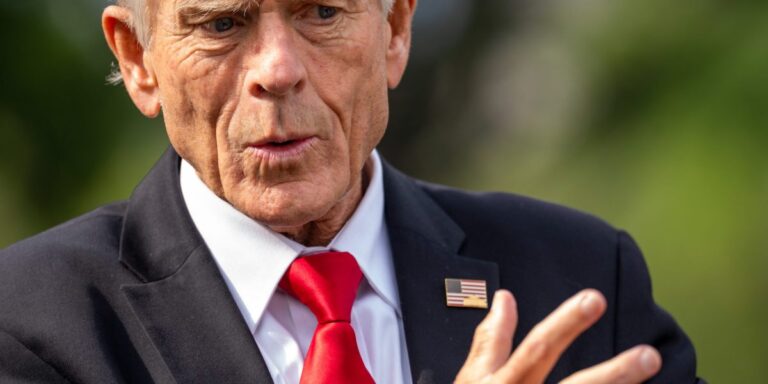
The dramatic increase in India’s purchases of Russian oil since the invasion of Ukraine is “opportunistic and deeply corrosive” of a global effort to isolate the Kremlin and curb Vladimir Putin’s war machine, White House trade adviser Peter Navarro wrote in the Financial Times.
In a strongly worded column, Navarro—long a hawkish voice and now an important force behind Donald Trump’s punitive global tariff—linked India’s trade barriers and what he characterized as its financial support for Russia, depicting dealings that come at the expense of the U.S.
“American consumers buy Indian goods,” he said. “India uses those dollars to buy discounted Russian crude.”
India’s External Affairs Ministry didn’t respond to an email seeking comment on Navarro’s column. The South Asian country has defended its right to buy oil from the cheapest source. The threat of penalties and additional tariffs for buying Russian crude is “unreasonable” and “extremely unfortunate,” Randhir Jaiswal, a foreign ministry spokesperson, said earlier this month.
Historically, India hasn’t been a significant importer of Russian crude, depending more heavily on the Middle East. That changed in 2022, after the invasion of Ukraine and a $60-per-barrel price cap imposed by the Group of Seven nations that aimed to limit the Kremlin’s oil revenue while keeping supplies flowing globally. India’s ability to purchase discounted cargoes was a feature of that mechanism acknowledged by U.S. officials.
Russia accounted for a negligible portion of India’s total imports in 2021, and the country has tended to depend far more heavily on the Middle East. Today, Russia makes up around 37% of imports, according to data analytics firm Kpler.
“This surge has not been driven by domestic oil consumption needs. Rather, what really drives this trade is profiteering by India’s Big Oil lobby,” Navarro said. “In effect, India acts as a global clearinghouse for Russian oil, converting embargoed crude into high-value exports while giving Moscow the dollars it needs.”
He also took a swipe at India’s oil tycoons and their ties to the government. Reliance Industries Ltd., owned by billionaire Mukesh Ambani, has been among the buyers of Russian crude. It has bought cargoes under long-term contracts.
“The proceeds flow to India’s politically connected energy titans, and in turn, into Vladimir Putin’s war chest,” Navarro said.
In the last few weeks, Trump has hit India with a 50% tariff rate—far higher than it placed on regional peers, partly to punish New Delhi for its Russian purchases. The doubling of an original levy comes into effect next week.
“This two-pronged policy will hit India where it hurts—its access to U.S. markets—even as it seeks to cut off the financial lifeline it has extended to Russia’s war effort,” Navarro said. “If India wants to be treated as a strategic partner of the U.S., it needs to start acting like one.”
India is the only major economy to be hit with what Trump calls “secondary tariffs”, though Beijing buys more of Moscow’s crude overall. Trump—eager to slash the U.S.’s trade deficit with India—has floated the possibility of higher levies on China over its Russian purchases, Navarro has downplayed that possibility, suggesting higher levels would hurt the U.S. economy.
Israeli Swimmer Tomer Shuster to Join University of Kentucky in January 2026 for World Championships

By Anya Pelshaw on SwimSwam

Fitter and Faster Swim Camps is the proud sponsor of SwimSwam’s College Recruiting Channel and all commitment news. For many, swimming in college is a lifelong dream that is pursued with dedication and determination. Fitter and Faster is proud to honor these athletes and those who supported them on their journey.
Tomer Shuster has announced his commitment to continue his academic and athletic careers at Kentucky. He will join the team in January 2026.
Shuster represents Israel at the international level and most recently competed at the 2025 World Championships in Singapore. There he swam in prelims of the 50 back, swimming a 25.34 for 33rd. His lifetime best is a 24.97 from May at Israel’s World Championship Trials.
Shuster’s Best LCM Times With SCY Conversions Are:
- 50 back: 24.97 (21.95)
- 100 back: 54.55 (48.06)
The Kentucky men finished 9th out of 11 teams at the 2025 SEC Championships and went on to finish 20th at 2025 NCAAs. Ryan Merani led the team at SECs and was highlighted by a 5th place finish in the 200 butterfly.
The team just finished its second season under head coach Bret Lundgaard. This offseason, the team hired Matt Martinez, Cauli Bedran, and Karissa Kruszewski and has had success bringing in recruits, especially at the international level. Martinez is the team’s recruiting coordinator.
Based on his best converted times, Shuster would have been 5th on the team this past season in the 100 backstroke. His 50 back best converted time would have been 2nd, just behind Devin Naoroz who led the team’s 200 medley relay off at SECs in a 21.49.
Although he will not arrive until the spring, Shuster is a member of the recruiting class entering in the 2025-2026 season. It is an international heavy class that also includes Lithuania’s Dziugas Miskinis, Falemana Lopez Tuufui and Lysander Osman of France, as well asGabriel Perdigao Vieira de Barros from Brazil.
If you have a commitment to report, please send an email with a photo (landscape, or horizontal, looks best) and a quote to Recruits@swimswam.com.
About the Fitter and Faster Swim Tour
Fitter & Faster Swim Camps feature the most innovative teaching platforms for competitive swimmers of all levels. Camps are produced year-round throughout the USA and Canada. All camps are led by elite swimmers and coaches. Visit fitterandfaster.com to find or request a swim camp near you.

FFT SOCIAL
Instagram – @fitterandfasterswimtour
Facebook – @fitterandfastertour
Twitter – @fitterandfaster
FFT is a SwimSwam partner.
Read the full story on SwimSwam: 2025 Worlds Swimmer Tomer Shuster Of Israel Joining Kentucky In January 2026
This Sand Battery Could Be Crucial for Renewable Energy Development

If you’ve walked along the beach barefoot at the end of a hot day, you’ll know that sand retains heat well. For example, a container with one kilogram of sand takes more than five hours to go from 40°C to 20°C. This is due to the low heat transfer coefficient of silicon dioxide, the main component of sand. And that is the principle behind an innovative sand battery recently installed in Finland to store green power throughout the harsh Scandinavian winter.
There are currently numerous renewable energy storage projects, some more fanciful, such as gravity systems, and others already operational, such as this pilot project based on recycled electric batteries from cars installed in a photovoltaic plant in Navarra. Now the sand batteries complement these experiences with a promising alternative approach.
The world’s first sand battery
Markku Ylönen and Tommi Eronen are two Finnish researchers who have set out to create what is touted to be the first commercial sand battery. The initial aim was to compensate for the intermittency of renewable energy sources such as wind and solar power by converting surplus electricity production into heat. To this end, they have accumulated 100 tons of sand in a silo with insulating materials installed next to a power plant.
This sand battery uses resistive heating, also known as the Joule effect, whereby electrons flowing through a resistor generate heat, as in a toaster or stove. Subsequently, the hot air generated is circulated through a heat exchanger, which transfers the heat to the sand. The developers claim temperatures above 500°C can be reached, storing up to 8 MWh.
The battery is already in operation and supplies heat to residential buildings, offices, and even a public swimming pool in the Finnish town of Kankaanpää. This battery is capable of storing heat from renewable energy for months. In the case of sand, using the heat directly is more efficient than converting it back into electricity, as a lot of energy is lost in the process. Once the feasibility of the project has been demonstrated, the next step is to create a thousand times larger battery to move towards a more sustainable energy system.
The ambitious U.S. sand battery
Across the pond, in the USA, NREL (the National Renewable Energy Laboratory) is working on a more ambitious prototype, although based on the same principles as its Finnish counterpart. The innovative battery, dubbed ENDURING, could reach a storage capacity of up to 26,000 MWh. But how exactly does it work?
In this case, gravity is added to the equation. NREL’s prototype uses conveyor belts that lift the sand onto heating elements that heat it to 1200º C for storage in silos, like dropping sand through the heating elements of a toaster. When power is needed, the particles are gravity-fed through heat exchangers to power steam turbines that generate electricity fed back into the grid.
In an article about the ENDURING prototype, the U.S. laboratory points out that sand is a stable, low-cost material, with a price ranging from thirty to fifty dollars per ton, and a low ecological impact in its extraction and at the end of its useful life. It also points out that although thermal energy storage has a lower density, its cost can be as low as two dollars per kWh.
Advantages of sand batteries
As they are used as heat accumulators, sand batteries are not as versatile as other technologies such as lithium, but in return, they offer numerous advantages:
- Sand is an abundant and inexpensive material
- Can store heat for months
- Substitutes gas or coal combustion in industrial processes
- Technology does not require toxic materials or rare minerals
- Can be easily installed anywhere
- Does not generate waste
- Performance does not decline over time
Sand batteries are part of a new wave of large-scale electricity storage systems, such as liquid batteries. You can read more about these types of technologies in this article or subscribe to our newsletter at the bottom of this page to keep up with the latest news.
Source: