13.3 C
New York
Monday, April 27, 2026
Home Blog Page 475

Northern Pakistan Hit by Deadly Flash Floods

0

new video loaded: Deadly Flash Floods Lash Northern Pakistan

By Axel Boada

Torrential rains continued pouring on dozens of villages in northern Pakistan, triggering flash floods that have wiped out houses and killed hundreds.

Recent episodes in Extreme Weather

Client Challenge: Overcoming Obstacles to Success

0


Client Challenge


JavaScript is disabled in your browser.

Please enable JavaScript to proceed.

A required part of this site couldn’t load. This may be due to a browser
extension, network issues, or browser settings. Please check your
connection, disable any ad blockers, or try using a different browser.

Top 20 Rankings for the New England Region in the 2025 Preseason

0

2025 NEW ENGLAND REGION HIGH SCHOOL
PRESEASON TOP 20 RANKINGS

Rank School Name City, State
1 Phillips Academy Andover Andover, Massachusetts
2 Uxbridge High School Uxbridge, Massachusetts
3 Watertown High School Watertown, Massachusetts
4 Walpole High School Walpole, Massachusetts
5 Rice Memorial High School South Burlington, Vermont
6 Middlesex School Concord, Massachusetts
7 Sandwich High School East Sandwich, Massachusetts
8 Somerset Berkley Regional High School Somerset, Massachusetts
9 Andover High School Andover, Massachusetts
10 Cheverus High School Portland, Maine
11 Belmont High School Belmont, Massachusetts
12 The Governor’s Academy Byfield, Massachusetts
13 Keene High School Keene, New Hampshire
14 Exeter High School Exeter, New Hampshire
15 Belfast Area High School Belfast, Maine
16 Norwood High School Norwood, Massachusetts
17 Brewer High School Brewer, Maine
18 Franklin High School Franklin, Massachusetts
19 Deerfield Academy Deerfield, Massachusetts
20 Williston Northampton School Easthampton, Massachusetts
OC Biddeford High School Biddeford, Maine
OC Canton High School Canton, Massachusetts
OC Lincoln-Sudbury High School Sudbury, Massachusetts
OC Nashoba Regional High School Bolton, Massachusetts
OC Pinkerton Academy Derry, New Hampshire
OC Reading Memorial High School Reading, Massachusetts
OC Winchester High School Winchester, Massachusetts
OC Winnacunnet High School Hampton, New Hampshire

The post 2025 Preseason New England Region Top 20 Rankings appeared first on MAX Field Hockey.

Exploring the Future of Employment in the Metaverse

0

Picture 150,000 new employees on their first day on the job, gathered on a single campus. This was the experiment of a well-known American consulting firm in early 2022. Of course, the campus was in the metaverse. The company provided virtual reality headsets for the staff, who could also access the digital twins of the multinational’s offices in various countries, from Spain to Bangladesh.

It was indeed a “light” experience, as they have not continued to work in the metaverse on an ongoing basis. Still, it showed the possibilities of the metaverse as the future of work. In fact, Bloomberg predicts that more than twenty-four million jobs will be created in the metaverse by 2030.

In this article, you can read about the professional impact of the metaverse in these areas:


Virtual, physical, or hybrid? Ways of working in the metaverse

If the pandemic has shown anything, it is that the work of the future will be more flexible and that remote working is here to stay, one way or another. However, a growing consensus among HR departments and consulting firms is that physical presence and “real reality” interactions will remain crucial. Far from killing off face-to-face work, the metaverse will multiply the available options.

Thanks to technologies such as mixed or virtual reality, it will be possible to work in the metaverse from home but also from a physical office where, after a virtual session, it will be feasible to meet face-to-face or work collaboratively.

In turn, an employee can be present at a face-to-face meeting in an office with mixed reality glasses in which virtual objects are observed in the physical environment. For example, examining a 3D prototype. You can then switch from mixed reality to virtual reality without changing devices. This is the hardware approach developed by Meta in the Cambria project. Meta’s glasses combine mixed reality and virtual reality, which can be swapped as needed.   

Jobs of the future in the metaverse

The recent announcement of the opening of the first Meta Lab in Spain dedicated to the metaverse with more than two thousand jobs already hinted at the creation of a new economy. While it could play out in many ways, there is a strong commitment from Meta and other players such as Microsoft. So much so that the first CMOs or Chief Metaverse Officers are already being appointed in various multinationals.

The “plumbing” of the metaverse requires programmers, usability and user interface designers, and manufacturers of immersive hardware such as virtual reality headsets or mixed reality glasses. Activities based on blockchain technology, with applications such as NFTs or smart contracts, will underpin transactions in the metaverse.

But the metaverse will also generate new ecosystems and business models. Many of them will be the translation of activities from the physical to the virtual world. An example would be the auction house Sotheby’s, which has already opened a branch in Decentraland. Or by adapting activities that already exist on the Internet, such as e-commerce. In parallel, new professional profiles such as these will be created: 

  • Avatar fashion designers. Companies such as Nike or Gucci are already launching footwear and garments with NFT certificates that can be used in the metaverse. Who knows if soon there will also be virtual shopping assistants.
  • Event organizers in the metaverse. One of the biggest concerts in history was given by rapper Travis Scott. It brought together 12.3 million spectators in Fortnite. Well, someone will have to organize those shows.
  • Architects of the metaverse. They will be the designers of buildings and virtual objects.
  • Privacy and security officers. Just as in physical reality there are security guards and police officers, in the metaverse there will be specialists preventing identity theft or the leaking of private data.
  • Content developers. Just as blogs did not exist before the Internet, new opportunities will exist to create content that combines audiovisual and interactive aspects. And who knows, maybe even haptic, i.e., with stimulation of the physical senses, such as vibrating suits.
  • Artists in the metaverse. Closely linked to content creators will also be artistic creators who can exhibit and sell digital art with NFT certificates or carry out performative art actions.

As with any disruptive technology, many of the job applications of the metaverse are still inconceivable from today’s perspective. So this list is sure to grow. Just in case, start thinking about your avatar’s dress code for your next virtual interview.

A new opportunity for the elderly or people with disabilities

We have already talked on numerous occasions about wearable technology to improve the quality of life of people with disabilities. A recent example is this device that allows quadriplegics to move and communicate. Well, the arrival of the metaverse promises to open even more opportunities for people with reduced mobility or psychomotor issues. 

Thanks to the use of avatars, they will be able to move freely in the metaverse environments and interact socially and professionally with other users. And not only that, hardware devices such as glasses or hearing systems will improve the sensory capabilities of people with visual or hearing impairments.

Ageism is becoming an increasingly prevalent form of discrimination in the fast-paced work environment of our time. It is also a loss of talent and experience. However, work in the metaverse promises to offer more opportunities for older people. Consider veteran teachers making the leap to virtual classrooms or medical specialists offering remote consultations through avatars.      

Want to learn more about what work will be like in the future? Then check out this article on the new offices and workspaces of the coming years.


Source:

Armenia assures Iran leader of its commitment to managing the Azerbaijan corridor during his visit | International Trade News

0

Iranian President Masoud Pezeshkian says in Yerevan that ‘governance in the Caucasus region must remain Caucasian’.

Armenian Prime Minister Nikol Pashinyan has told Iranian President Masoud Pezeshkian that a planned corridor linking Azerbaijan with its exclave would be under Armenian control, days after Iran said it would block the project included in a United States-brokered peace accord that puts a potential Washington presence on its doorstep.

“Roads passing through Armenia will be under the exclusive jurisdiction of Armenia, and security will be provided by Armenia, not by any third country,” Pashinyan said at a meeting with Pezeshkian in the Armenian capital Yerevan on Tuesday. He added that the corridor would open new economic perspectives between the two countries, and could offer a rail route from Iran to the Black Sea coast through Armenia.

The land corridor, dubbed the “Trump Route for International Peace and Prosperity” (TRIPP), is part of a deal signed this month in Washington between former foes Armenia and Azerbaijan.

Under the agreement, the US will hold development rights for the proposed route, which would connect Azerbaijan to its Nakhchivan exclave bordering Iran and Turkey.

“Governance in the Caucasus region must remain Caucasian – outsourcing the resolution of Caucasus issues to extra-regional forces will complicate it,” Pezeshkian said during his visit on Tuesday. “Iran’s position has always been to reject any changes to international borders in the Caucasus region.”

Iran has long opposed the planned transit route, also known as the Zangezur corridor, fearing it would cut the country off from Armenia and the rest of the Caucasus while bringing potentially hostile foreign forces close to its borders.

Since the deal was signed on August 8, Iranian officials have stepped up warnings to Armenia, saying the project could be part of a US ploy “to pursue hegemonic goals in the Caucasus region”.

The proposed corridor has been hailed as beneficial by other countries in the region, including Russia, with which Iran has a strategic alliance alongside Armenia.

Armenia and Azerbaijan have fought a series of wars since the late 1980s when Nagorno-Karabakh, a region in Azerbaijan that had a mostly ethnic Armenian population at the time, broke away from Azerbaijan with support from Armenia. Azerbaijan Baku took control of the territory in a military operation in 2023, leading to an exodus of the ethnic Armenian population.

Armenia last year agreed to return several villages to Azerbaijan in what Baku described as a “long-awaited historic event”.

Guggenheim Increases Nexstar Stock Price Target to $250 Following TEGNA Deal

0


Guggenheim raises Nexstar stock price target to $250 on TEGNA deal

The Oval Office Map’s Crucial Role in Shaping Trump’s Perspective on the Ukraine Conflict

0

Paul Kirby

Europe digital editor

The Visual Journalism team
White House Donald Trump talks to European leaders across a table in the Oval Office.White House

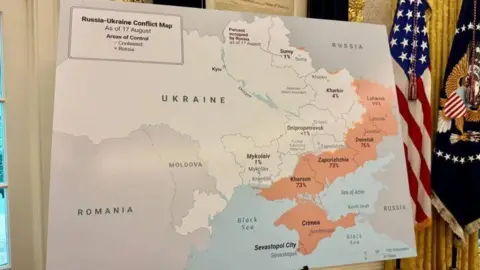
The map in the Oval Office included areas of Ukraine under Russian occupation

Russia has occupied a fifth of Ukrainian territory – and a big map showing the area shaded in red was put up in the Oval Office as if to emphasise that point for President Donald Trump’s talks with Volodymyr Zelensky on Monday.

“I assume you’ve all seen the map,” Trump told Fox News on Tuesday. “A big chunk of territory is taken and that territory has been taken.”

The message from the White House to Ukraine is unmistakable. That land has gone and it is time to consider a territorial compromise with Vladimir Putin or, as some have termed it, land swaps.

Zelensky’s team had brought their own map to the meeting and the Ukrainian leader said later he had been “fighting with what is on that map” during his conversation with Trump, regarding “who controls what – not by hearsay, but in reality”.

Although he felt he had made some headway on correcting any false impressions, by Tuesday Trump’s view was the same. It was clear, he said, that Russia’s force was “so clearly much more powerful, and you know, it’s not like they’ve stopped”.

Asked what the feeling was like in the room with European leaders regarding land swaps he said: “Now they’re talking about Donbas, but Donbas right now is… 79% owned and controlled by Russia.”

Read more: Tracking the war in Ukraine with maps

Before the war began in the east in 2014, Ukraine’s wealthy mining region of Donbas made up about 16% of Ukraine’s economic output.

Putin is reported to have told Trump he wants the whole Donbas region as part of a broad peace deal.

It would certainly save Russia’s leader a considerable amount of blood and treasure.

A map in the Oval Office shows occupied Ukrainian territories.

A close-up shows the percentages of territory under Russian control according to the US

Zelensky said he had also argued about the percentages on the White House map that showed Russian control in a number of Ukrainian regions, ranging from 99% of Luhansk and 76% of Donetsk in Donbas; 73% of Zaporizhzhia and Kherson in the south-east; 4% in Kharkiv in the north-east; and 1% in Sumy and Mykolaiv.

Analysis of latest data from the US-based Institute of War has resulted in similar figures to the White House, and any differences could be down to different methodology used, especially over the extent of Russian control of an area. Part could be under limited control or merely claimed by Moscow.

In areas where the White House suggests 1% of a region is under Russian control, that may reflect only that the Russians have some limited presence, as in Mykolaiv in the south, or where they have largely been repelled, as in Sumy in the north.

Whatever the real figure for Russian control in Donetsk, the fortress cities of Kramatorsk and neighbouring Slovyansk in Donetsk region are still home to large populations.

Local officials say about 242,000 people live in Ukrainian-controlled areas of Donetsk region, and no Ukrainian head of state would consider handing their territory to Moscow.

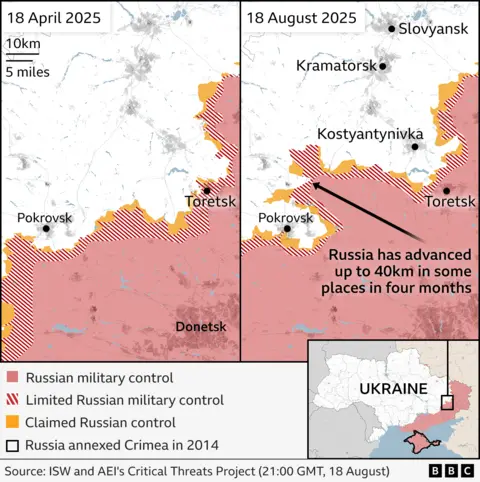
A map shows recent Russian advances in eastern Ukraine.

Although Russian forces have made advances in recent months, ISW estimates that seizing the remainder of the Donetsk region would “very likely take Russian forces multiple years to complete after several difficult campaigns”.

Zelensky said the Ukrainian map he had shown Trump showed in the past 1,000 days Russia had managed to occupy less than 1% of Ukrainian territory.

Analysts from Ukraine’s DeepStateUA mapping group said that translated to 5,842 sq km since November 2022.

While Russia did achieve operational success during the early days of the full-scale invasion, DeepState points out a large proportion of occupied territory was then liberated.

Russia has, however, made undeniable advances in the past two to three months, even if more broadly the front line has shifted little since the early months of the war.

White House Two men in black and white with the map of Ukraine as a backdrop.White House

A black and white picture of Zelensky and Trump discussing the map in the Oval Office

Defence analyst Konrad Muzyka, who heads Rochan Consulting, says the Russian advance has clearly accelerated in some areas of the east around Kupiansk in Kharkiv region and Kreminna in Luhansk.

“We are seeing far more fires and the Ukrainians are not really able to deploy enough firefighters to put them out,” he told the BBC.

Muzyka cites a lack of Ukrainian manpower to defend a long front line but also Russia’s increased use of drones targeting soldiers, their equipment and particularly their artillery.

Meanwhile, Russia has been able to recruit 30-35,000 soldiers and even with the heavy losses they have sustained on the ground they have been able to build up large operational and strategic reserve forces, he says.

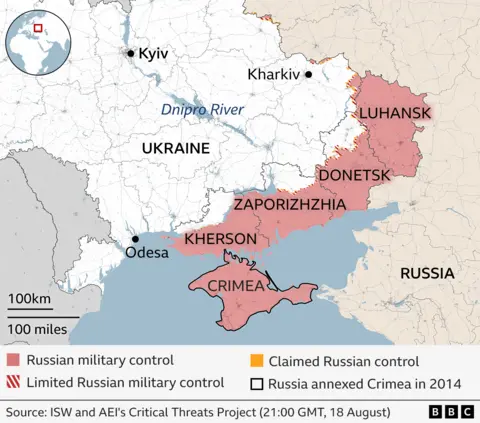
Ukraine regions map showing Russian military control in red

But Russia’s rapid gains in limited areas of the east have not so far been matched elsewhere.

One attempted Russian land grab 10-15km into Ukrainian-controlled territory near Dobropillya in Donetsk region was successfully fought off by Ukrainian forces last week, according to Ukraine’s military leaders.

And although Russia does hold some pockets of land in the Sumy and Kharkiv regions, Ukraine is still in control of an estimated 6,600 sq km of Donbas.

Putin has not just laid claim to broad swathes of Ukraine, he has already annexed four regions as well as Crimea, even though many areas are out of his reach.

The UK’s defence intelligence update estimated recently that based just on Russia’s “incremental battlefield advances so far in 2025” it would take 4.4 more years just to seize the four regions of Luhansk, Donetsk, Zaporizhzhia and Kherson.

That alone explains the different perspectives of Trump and Zelensky when it comes to maps showing the 1,200km front line in Ukraine.

“Thank you for the map, by the way, it was great,” Zelensky told him despite their differences, “I’m thinking how to take it back.”

The AI Paradox: Sam Altman’s Cautionary Tale of a Bubble Amid Trillion Dollar Investments

0

Welcome to Eye on AI! AI reporter Sharon Goldman here, filling in for Jeremy Kahn. In this edition… Sam Altman’s AI paradox…AI has quietly become a fixture of advertising…Silicon Valley’s AI deals are creating zombie startupssources say Nvidia working on new AI chip for China that outperforms the H20.

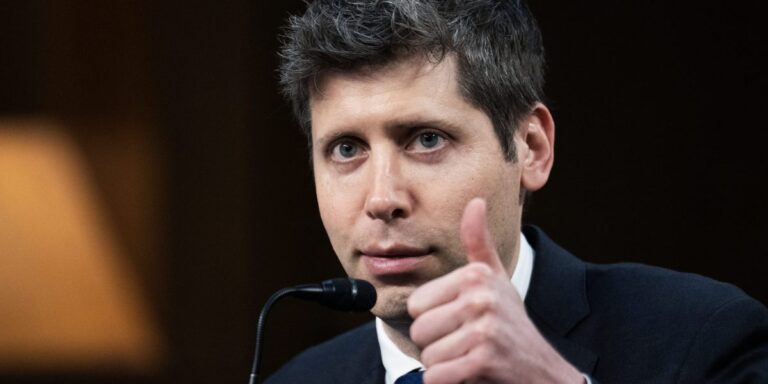
I was not invited to Sam Altman’s cozy dinner with reporters in San Francisco last week (whomp whomp), but maybe that’s for the best. I have trouble suppressing exasperated eye rolls when I hear peak Silicon Valley–ironic statements.

I am not sure I could have controlled myself when the OpenAI CEO said that he believes AI could be in a “bubble,” with market conditions similar to the 1990s dotcom boom. Yes, he reportedly said, “investors as a whole are overexcited about AI.” 

Yet, over the same meal, Altman also apparently said he expects OpenAI to spend trillions of dollars on its data center buildout in the “not very distant future,” adding that “you should expect a bunch of economists wringing their hands, saying, ‘This is so crazy, it’s so reckless,’ and we’ll just be like, ‘You know what? Let us do our thing.’”

Ummm…what could be more frothy than pitching a multi-trillion-dollar expansion in an industry you’ve just called a bubble? Cue an eye roll reaching the top of my head. Sure, Altman may have been referring to smaller AI startups with sky-high valuations and little to no revenue, but still, the irony is rich. It’s particularly notable given the weak GPT-5 rollout earlier this month, which was supposed to mark a leap forward but instead left many disappointed with its routing system and lack of breakthrough progress.

In addition, even as Altman speaks of bubbles, OpenAI itself is raising record sums. In early August, OpenAI secured a whopping $8.3 billion in new funding at a $300 billion valuation—part of its plan to raise $40 billion this year. That figure was five times oversubscribed. On top of that, employees are now poised to sell about $6 billion in shares to investors like SoftBank, Dragoneer, and Thrive, pushing the company’s valuation potentially up to $500 billion.

OpenAI is hardly an outlier in its infrastructure binge. Tech giants are pouring unprecedented sums into AI buildouts in 2025: Microsoft alone plans to spend $80 billion on AI data centers this fiscal year, while Meta is projecting up to $72 billion in AI and infrastructure investments. And on the fundraising front, OpenAI has company too — rivals like Anthropic are chasing multibillion-dollar rounds of their own. 

Wall Street’s biggest bulls, like Wedbush’s Dan Ives, seem unconcerned. Ives said Monday on CNBC’s “Closing Bell” that demand for AI infrastructure has grown 30% to 40% in the last months, calling the capex surge a validation moment for the sector. While he acknowledged “some froth” in parts of the market, he said the AI revolution with autonomous systems is only starting to play out and we are in the “second inning of a nine-inning game.” 

And while a bubble implies an eventual bursting, and all the damage that results, the underlying phenomenon causing a bubble often has real value. The advent of the web in the ’90s was revolutionary; The bubble was a reflection of the massive opportunities opening up.

Still, I’d be curious if anyone pressed Altman on the AI paradox—warning of a bubble while simultaneously bragging about OpenAI’s massive fundraising and spending. Perhaps over a glass of bubbly and a sugary sweet dessert? I’d also love to know if he fielded tougher questions on the other big issues looming over the company: its shift to a public benefit corporation (and what that means for the nonprofit), the current state of its Microsoft partnership, and whether its mission of “AGI to benefit all of humanity” still holds now that Altman himself has said AGI “is not a super-useful term.”

In any case, I’m game for a follow-up chat with Altman & Co (call me!). I’ll bring the bubbly, pop the questions, and do my best to keep the eye rolls at bay.

Also: In just a few weeks, I will be headed to Park City, Utah, to participate in our annual Brainstorm Tech conference at the Montage Deer Valley! Space is limited, so if you’re interested in joining me, register here. I highly recommend: There’s a fantastic lineup of speakers, including Ashley Kramer, chief revenue officer of OpenAI; John Furner, president and CEO of Walmart U.S.; Tony Xu, founder and CEO of DoorDash; and many, many more!

With that, here’s more AI news.

Sharon Goldman
sharon.goldman@fortune.com
@sharongoldman

FORTUNE ON AI

Wall Street isn’t worried about an AI bubble. Sam Altman is – by Beatrice Nolan

MIT report: 95% of generative AI pilots at companies are failing – by Sheryl Estrada

Silicon Valley talent keeps getting recycled, so this CEO uses a ‘moneyball’ approach for uncovering hidden AI geniuses in the new era – by Sydney Lake

Waymo experimenting with generative AI, but exec says LiDAR and radar sensors important to self-driving safety ‘under all conditions’ – by Jessica Matthews

AI IN THE NEWS

More shakeups for Meta AI. The New York Times reported today that Meta is expected to announce that it will split its A.I. division — which is known as Meta Superintelligence Labs — into four groups. One will focus on AI research; one on  “superintelligence”; another on products; and one on infrastructure such as data centers. According to the article’s anonymous sources, the reorganization “is likely to be the final one for some time,” with moves “aimed at better organizing Meta so it can get to its goal of superintelligence and develop AI products more quickly to compete with others.” The news comes less than two months after CEO Mark Zuckerberg overhauled Meta’s entire AI organization, including bringing on Scale AI CEO Alexandr Wang as chief AI officer. 

Madison Avenue is starting to love AI. According to the New York Times, artificial intelligence has quietly become a fixture of advertising. What felt novel when Coca-Cola released an AI-generated holiday ad last year is now mainstream: nearly 90% of big-budget marketers are already using—or planning to use—generative AI in video ads. From hyper-realistic backdrops to synthetic voice-overs, the technology is slashing costs and production times, opening TV spots to smaller businesses for the first time. Companies like Shuttlerock and ITV are helping brands replace weeks of work with hours, while tech giants like Meta and TikTok push their own AI ad tools. The shift raises ethical questions about displacing creatives and fooling viewers, but industry leaders say the genie is out of the bottle: AI isn’t just streamlining ad production—it’s reshaping the entire commercial playbook.

Silicon Valley’s AI deals are creating zombie startups: ‘You hollowed out the organization.’ According to CNBCSilicon Valley’s AI startup scene is being hollowed out as Big Tech sidesteps antitrust rules with a new playbook: licensing deals and talent raids that gut promising young companies. Windsurf, once in talks to be acquired by OpenAI, collapsed into turmoil after its founders bolted to Google in a $2.4 billion licensing pact; interim CEO Jeff Wang described tearful all-hands meetings as employees realized they’d been left with “nothing.” Similar moves have seen Meta sink $14.3 billion into Scale AI, Microsoft scoop up Inflection’s founders, and Amazon strip talent from Adept and Covariant—leaving behind so-called “zombie companies” with little future. While founders and top researchers cash out, investors and rank-and-file staff are often left stranded, sparking growing concern that these quasi-acquisitions not only skirt regulators but also threaten to choke off AI innovation at its source.

Nvidia working on new AI chip for China that outperforms the H20, sources say. According to ReutersNvidia is developing a new China-specific AI chip, codenamed B30A, based on its cutting-edge Blackwell architecture. The chip, which could be delivered to Chinese clients for testing as soon as next month, would be more powerful than the current H20 but still fall below U.S. export thresholds—using a single-die design with about half the raw computing power of Nvidia’s flagship B300. The move comes after President Trump signaled possible approval for scaled-down chip sales to China, though regulatory approval is uncertain amid bipartisan concerns in Washington over giving Beijing access to advanced AI hardware. Nvidia argues that retaining Chinese buyers is crucial to prevent defections to domestic rivals like Huawei, even as Chinese regulators cast suspicion on the company’s products.

EYE ON AI RESEARCH

Study finds AI-led interviews improved outcomes. A new study looked at what happens when job interviews are run by AI voice agents instead of human recruiters. In a large experiment with 70,000 applicants, people were randomly assigned to be interviewed by a person, by an AI, or given the choice. Surprisingly, AI-led interviews actually improved outcomes: applicants interviewed by AI were 12% more likely to get job offers, 18% more likely to start jobs, and 17% more likely to still be employed after 30 days. Most applicants didn’t mind the change—78% even chose the AI when given the option, especially those with lower test scores. The AI also pulled out more useful information from candidates, leading recruiters to rate those interviews higher. Overall, the study shows that AI interviewers can perform just as well as, or even better than, human recruiters—without hurting applicant satisfaction.

AI CALENDAR

Sept. 8-10: Fortune Brainstorm Tech, Park City, Utah. Apply to attend here.

Oct. 6-10: World AI Week, Amsterdam

Oct. 21-22: TedAI San Francisco. Apply to attend here.

Dec. 2-7: NeurIPS, San Diego

Dec. 8-9: Fortune Brainstorm AI San Francisco. Apply to attend here.

BRAIN FOOD

Do AI chatbots need to be protected from harm? 

AI lab Anthropic has introduced a new safety measure in its latest Claude models, which empowers the AI to terminate conversations in extreme cases of harmful or abusive interaction. The feature activates only after repeated redirections fail—typically for content requests involving sexual exploitation of minors or facilitation of large-scale violence. The company is notably framing this as a safeguard not principally for users, but for the model’s own “AI welfare,” reflecting an exploratory stance on the machine’s potential moral status.

Unsurprisingly, the idea of granting AI moral status is contentious. Jonathan Birch, a philosophy professor at the London School of Economics, told The Guardian he welcomed Anthropic’s move for sparking a public debate about AI sentience—a topic he said many in the industry would rather suppress. At the same time, he warned that the decision risks misleading users into believing the chatbot is more real than it is.

Others argue that focusing on AI welfare distracts from urgent human concerns. For example, while Claude is designed to end only the most extreme abusive conversations, it will not intervene in cases of imminent self-harm—even though a New York Times opinion piece yesterday urged such safeguards, written by a mother who discovered her daughter’s ChatGPT conversations only after her daughter’s suicide.


Mining Disruption Forces Church in Sweden to be Moved by Wheels

0

new video loaded: Church Is Wheeled Away in Sweden as Mining Disrupts the Ground

transcript

transcript

Church Is Wheeled Away in Sweden as Mining Disrupts the Ground

The church in the Swedish town of Kiruna, built in 1912, began a two-day journey on Tuesday to its new home three miles away.

It’s really sad. This is one of the landmarks now leaving the skyline. It’s all disappearing from what I used to grow up with. So it’s sad.

Recent episodes in Latest Video

Whether it’s reporting on conflicts abroad and political divisions at home, or covering the latest style trends and scientific developments, Times Video journalists provide a revealing and unforgettable view of the world.

Whether it’s reporting on conflicts abroad and political divisions at home, or covering the latest style trends and scientific developments, Times Video journalists provide a revealing and unforgettable view of the world.

TikTok broadens its live music competition approach with the launch of Music On Stage ’25 contest

0

TikTok has launched a new global music competition targeting emerging artists and music creators on TikTok LIVE.

“Music On Stage ’25,” announced Tuesday (August 19), spans 23 regions and will culminate in finals hosted from Seoul and London in September.

The new contest builds on TikTok’s push into live music programming. Last month, the company partnered with iHeartRadio on “The Next Up: Live Music” competition for unsigned US artists with at least 50,000 followers. That contest also runs through September and requires participants to own rights to original songs while remaining unsigned by major labels.

Contestants for The Next Up: Live Music contest will advance based on a combination of likes, views and comments, and judges’ scores.

Music On Stage ’25 takes a different approach, with contestants going head-to-head in “Take the Stage” battles. Contestants will advance through audience votes, small gifts, and judges’ bonus points, then head into the Regional Finals between August 29 and 31. The Global Finals will be held on September 19 for the APAC leg of the competition and September 27 for the EMEA & AMS leg.

The competition will be hosted by British singer-songwriter Sam Ryder.

“Music On Stage is all about giving that same spark of opportunity to the next wave of talent, and I can’t wait to watch their journeys unfold!”

Sam Ryder

The competition will be hosted by Ryder who became popular on TikTok during the pandemic before representing the UK at Eurovision.

Ryder said: “TikTok changed my life as an artist and I’m stoked to see how it can shape the lives of others. Music On Stage is all about giving that same spark of opportunity to the next wave of talent, and I can’t wait to watch their journeys unfold!”

Global winners will receive production support, publishing and promotional backing from SoundOn, TikTok’s music distribution platform launched in 2022. Winners also get performance opportunities at TikTok Live Fest in 2026. Last year’s event in London featured Swedish pop singer Zara Larsson and was hosted by Jason Derulo.

The initiative highlights TikTok’s efforts to bolster its LIVE streaming capabilities.

“TikTok LIVE is one of the most exciting spaces for artists right now as a launchpad for musical talent. It’s where fans can connect with music in real time, share moments, and support their favorite performers directly.”

Shen Gao, TikTok Live

Shen Gao, Head of LIVE Operations, Americas for TikTok said: “TikTok LIVE is one of the most exciting spaces for artists right now as a launchpad for musical talent. It’s where fans can connect with music in real time, share moments, and support their favorite performers directly.”

“Music On Stage takes that energy global, and with Sam Ryder and Jeon Somi as our hosts, we’re so excited to be bringing inspiration and opportunity to creators everywhere.”

Nichal Sethi, Head of SoundOn EMEA at TikTok, added: “Music On Stage is about more than a competition – it’s about giving talented creators the platform, tools, and audience to build long-lasting careers.”

“At SoundOn, we’re passionate about supporting emerging artists from their very first release through to global recognition, and we can’t wait to see the incredible talent that takes the stage this year.”

“Music On Stage is about more than a competition – it’s about giving talented creators the platform, tools, and audience to build long-lasting careers.”

Nichal Sethi, TikTok

TikTok has been doubling down on its music discovery and artist promotion offerings. Earlier this year, TikTok released its second annual Music Impact Report, carried out in conjunction with market monitor Luminate. The report shows that 84% of the songs that reached Billboard’s Global 200 last year went viral first on TikTok. Another 12% went viral on TikTok after hitting the Global 200 chart, and only 4% of tracks on the chart didn’t experience a viral moment on TikTok.

Music Business Worldwide