


Vertex Pharmaceuticals’ SWOT analysis: stock poised for growth amid challenges
Vertex Pharmaceuticals’ SWOT analysis: Potential for stock growth despite obstacles
CEO apologizes for snatching boy’s hat at US Open, calls it a ‘huge mistake’

 X
XThe man who was caught on camera snatching a hat off a young boy at the US Open has said he made a “huge mistake” after footage of the incident went viral.
Piotr Szczerek, a Polish chief executive of a paving firm, said he was “convinced” tennis star Kamil Majchrzak had been “passing his hat in my direction”.
“I know I did something that seemed like consciously collecting a memento from a child,” he wrote in a statement. “This wasn’t my intention, but it doesn’t change the fact that I hurt the boy and disappointed the fans.”
The video, taken during Majchrzak’s match on Thursday, showed the tennis player offering his cap to a child, before Mr Szczerek appears to take it.
Versions of the clip were shared widely on social media and prompted criticism of Mr Szczerek’s actions.
The 50-year-old wrote on social media on Monday: “I would like to unequivocally apologise to the injured boy, his family, as well as all the fans and the player himself.”
He added that he had given the hat back to the boy, and hoped that it had “at least partially repaired the damage that was done”.
Majchrzak, 29, who had just won his match against Russian ninth seed Karen Khachanov when the incident unfolded, told the BBC he believed he “did what most of athletes would do in this kind of situation”, adding he hoped the boy and his family “had a great day”.
He earlier indicated to the New York Post that he felt there had been some kind of confusion.
“I was pointing, giving the hat, but I had a lot going on after my match, after being super tired and super excited for the win,” he said.
“I just missed it… I’m sure the guy was also acting in the moment of heat, in the moment of emotions.”

 Getty Images
The tennis star reunited with the boy over the weekend, sharing clips of him giving the young fan a cap and other merchandise on Instagram.
“Today after warm up, I had a nice meeting,” the tennis star wrote, adding: “Do you recognise [the cap]?”
Majchrzak, ranked 76th in the world in men’s singles, came back from two sets down to beat Khachanov in a second-round match at Flushing Meadows, but was forced to retire injured during the first set of his third-round tie against Switzerland’s Leandro Riedi on Saturday.
He later confirmed he had torn an intercostal muscle.
Mr Szczerek and his wife Anna founded his paving company Drogbruk in 1999, polish outlet Tenis Magazyn reported. The company sponsors sporting events and Polish athletes.
The couple and their two sons are amateur tennis players who compete in local leagues, and have hosted Polish tennis pro Urszula Radwańska on their home court, according to Tenis Magazyn.
Additional reporting by Gabriela Boccaccio
OpenAI Employee Relocates to Sweden Due to Trump’s Presidency

Miki Habryn can finally sleep at night. For many months, in the run-up to and after President Trump had won the election, that wasn’t the case.
Up until June this year Habryn was living what many would call the American dream. She had a job at ChatGPT-maker OpenAI, surrounded by some of the brightest minds in artificial intelligence. Her pay was comfortably in the six-figures, and she owned a house in San Francisco, the first city she had ever lived in which felt like home.
Her six-year old daughter, Steffi, was enjoying school and her wife, Eden, was thriving in her career as an artist.
But the family couldn’t shake their concern about the direction U.S. politics was moving in. While Habryn was born in Poland and raised in Australia from the age of five, her partner and child had only ever known life in the States.
When President Trump returned to the Oval Office, the family made the decision to leave San Francisco—and Habryn’s dream job—and move to Stockholm, Sweden. There they hope to stay indefinitely.
Habryn said she made the choice to leave the the U.S., where she had lived since 2007, one night in March. She said: “My wife was traveling on the East Coast and I was home with Steffi. And something about that particular night, I was awake worrying about things which was not uncommon, and I just got to the point of: It’s time to go, I can’t just stay here and do nothing, but doing anything comes with such terrible risks for me because of my status.”
“If I came to the attention of, or got arrested by the federal authorities, the outcome of that could be tragic. It turns out that my wife, on the same day, reached the same conclusion.”
Habryn explains the “status” she refers to: “During the campaign it was immigrants and transgender people that was occupying the airways and since I’m both, they’ve got me coming and going effectively.”
The family are not alone in their decision to leave Trump’s America. While it’s hard to pin down the number of people leaving the U.S. every year (the Department of State previously told Fortune it does not keep such records) in 2024 applications from Americans to live in the United Kingdom alone spiked 26% compared to a year prior. More than 6,100 Americans applied for British citizenship last year, a record number.
Immigration experts also previously told Fortune their phones had been ringing off the hook—particularly since that infamous Trump and Biden debate, when many people felt the fate of the November election had been decided. Montreal-based immigration experts Moving2Canada, for example, saw inquiries spike in both 2016 and 2020 and in 2024 saw enquiries triple in volume after the Trump vs. Biden debate.
Life at OpenAI
Habryn is no stranger to working in America’s tech elite: She moved to the U.S. originally to work for Google in Mountain View where she stayed for the next 12 years. Her experience at OpenAI, where she worked from May 2024 to July 2025, is a familiar story to many in Big Tech: An intense atmosphere, “wonderful” people and riveting work.
“It’s challenging,” Habryn said. “I think it’s exciting but I was lucky enough to have a lot of security and confidence in my own abilities—I think without that it would have been very, very hard.”
The prospect of losing her dream role in the research department of one of the world’s most-talked about companies was a key issue which held Habryn back from making the move earlier. While her team was supportive of the decision, ultimately the legalities of Habryn’s work meant it couldn’t move with her.
“It was really hard,” she said. “That was probably the reason it took me as long as it did to make the decision, because honestly I had this period of grief stepping away from this. I’ve been working in tech for a long time … and really the only thing I want to be working on is AI.
“It was hard and I didn’t love making that decision but, ultimately, it was just a question of priority.”
Habryn is confident she will find interesting work when she needs to, and the family are settling into their newly purchased home in Stockholm—the family doubt they will ever return to the U.S. That comes with “guilt”, Habryn says: “I buy the narrative that you should fight for the things that you believe in and that there is value to staying and fighting for that. If it were not for Steffi, I think we would have.”
Ultimately her six-year-old daughter is their focus: “We set aside a lot of things that we love to do [because] we want Steffi to have a routine, a stable home, a stable school and all those things. The hardest thing about this whole move has been worrying about the impact on her and so the priority was that we don’t want to do this again, we’re going to move once, and we want to put down roots and spend the next 15/20 years there.”
Introducing the 2025 Fortune Global 500, the definitive ranking of the biggest companies in the world. Explore this year’s list.
Map: Afghanistan Hit by 6.0-Magnitude Earthquake

Note: Map shows the area with a shake intensity of 4 or greater, which U.S.G.S. defines as “light,” though the earthquake may be felt outside the areas shown. The New York Times
A strong, 6.0-magnitude earthquake struck in Afghanistan on Sunday, according to the United States Geological Survey.
The temblor happened at 11:47 p.m. Afghanistan time about 22 miles north of Bāsawul, Afghanistan, data from the agency shows.
As seismologists review available data, they may revise the earthquake’s reported magnitude. Additional information collected about the earthquake may also prompt U.S.G.S. scientists to update the shake-severity map.
Aftershocks in the region
An aftershock is usually a smaller earthquake that follows a larger one in the same general area. Aftershocks are typically minor adjustments along the portion of a fault that slipped at the time of the initial earthquake.
Quakes and aftershocks within 100 miles
Aftershocks can occur days, weeks or even years after the first earthquake. These events can be of equal or larger magnitude to the initial earthquake, and they can continue to affect already damaged locations.
When quakes and aftershocks occurred
Source: United States Geological Survey | Notes: Shaking categories are based on the Modified Mercalli Intensity scale. When aftershock data is available, the corresponding maps and charts include earthquakes within 100 miles and seven days of the initial quake. All times above are Afghanistan time. Shake data is as of Sunday, Aug. 31 at 3:35 p.m. Eastern. Aftershocks data is as of Monday, Sept. 1 at 1:32 p.m. Eastern.
Maps: Daylight (urban areas); MapLibre (map rendering); Natural Earth (roads, labels, terrain); Protomaps (map tiles)
Jenni Pfaff appointed as Chief People and Transformation Officer at HYBE America
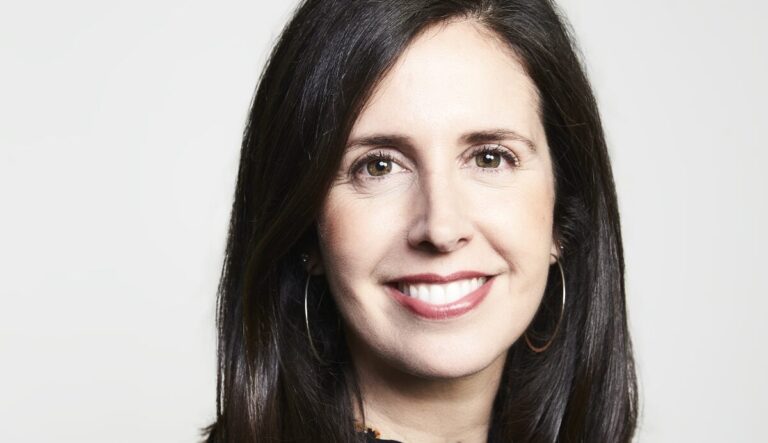
Jenni Pfaff has been appointed Chief People and Transformation Officer at HYBE AMERICA, the US division of South Korea-headquartered entertainment company HYBE.
Based in the company’s Los Angeles office, Pfaff will report directly to CEO and Chairman Isaac Lee.
Most recently, Pfaff served as Executive Vice President of Strategy, Integration, and Operations at Warner Chappell Music, a position she assumed in 2019.
Previously at Warner Chappell, she served as Global Head of People.
Earlier in her career, Pfaff held positions at PwC, Activision Blizzard, and Northrop Grumman.
In her new role at HYBE America, Pfaff will oversee all Human Resources functions, including recruiting and hiring, training and development, employee relations, performance management, feedback and coaching, and related initiatives.
She will also lead internal Corporate Communications efforts.
“A strong company culture is a top priority as we continue to build HYBE AMERICA,” said Isaac Lee.
“Given Jenni’s strong background, I’m confident we will be good partners in building a company that is a magnet for artists, employees, and partners.”
Isaac Lee, HYBE
Added Lee: “Attracting and retaining top talent and providing them with a fulfilling work environment will help us succeed as a company. I believe in a collaborative environment and am always mindful of the impact our business has on various audiences.
“Given Jenni’s strong background, I’m confident we will be good partners in building a company that is a magnet for artists, employees, and partners.”
“One of the things that attracted me to HYBE AMERICA was the chance to be part of one of the most exciting and fastest-growing parts of the music and entertainment business.”
Jenni Pfaff
Jenni Pfaff added: “I’ve always been a builder. Leading through compassion and creating the best possible work environment is a priority for me.
“One of the things that attracted me to HYBE AMERICA was the chance to be part of one of the most exciting and fastest-growing parts of the music and entertainment business.”
Pfaff’s appointment at HYBE America follows a recent leadership shakeup at the company, which saw Scooter Braun step away from his role as CEO of HYBE America.
Isaac Lee, described as “a seasoned entertainment executive” who led HYBE Latin America as Chairman since November of 2023, became Chairman and CEO of HYBE Americas.
Lee was given oversight of BMLG (Big Machine Label Group) in Nashville and QC Media Holdings in Atlanta, as well as remaining as Chairman of HYBE’s Latin American operations in Mexico, Miami, and Medellin.Music Business Worldwide
Can a US-supported economic zone persuade Lebanon to disarm Hezbollah? | Israel conducts airstrikes on Lebanon
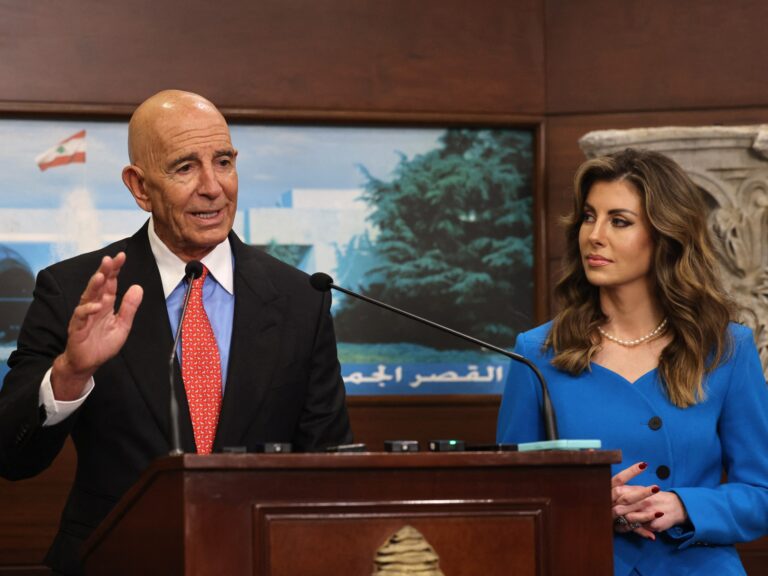
The United States has floated a proposal for an economic zone in southern Lebanon in what analysts tell Al Jazeera is a far-fetched and poorly thought-out plan to incentivise the Lebanese government to push on with disarming Hezbollah.
The US envoy to the Middle East, Thomas Barrack, floated the economic zone during a visit to Lebanon on Tuesday but provided few details other than hints at financing.
“We, all of us – the Gulf, the US, the Lebanese – are all going to act together to create an economic forum that is going to produce a livelihood,” Barrack told journalists.
Experts said the idea could be based on similar zones in Jordan and Egypt, two countries with peace deals with Israel that Lebanon would be hard-pressed to replicate after last year’s Israeli war on Lebanon.
After the war, fought primarily against Hezbollah, a regional and domestic push to disarm the Lebanese group has grown, and the relatively new Lebanese government, which took office in January and is under US and Israeli pressure, has declared the intention to disarm the group.
The pressure to disarm Hezbollah
Israel and Hezbollah fought a war that started on October 8, 2023, but intensified in September last year until a ceasefire on November 27, which Israel has repeatedly broken with no repercussions.
Hezbollah’s military capabilities took a hit during the war, and Israel succeeded in assassinating many of its leaders.
The Iran-backed “axis of resistance”, of which Hezbollah is a member, suffered other serious blows with the fall of President Bashar al-Assad in Syria in December and US-backed Israeli attacks on Iran in June, leaving Hezbollah with weakened regional support.
Domestically, Hezbollah has seen its popularity outside its core constituency plummet over the past 20 years – from its status as the only Lebanese force able to repel Israel – as a result of its takeover of Beirut in 2008, its intervention in Syria on behalf of al-Assad’s regime and its backing of counterrevolutionary forces during the 2019 Lebanese uprising.
Many of its political allies, including the Free Patriotic Movement and one-time presidential candidate Sleiman Frangieh, have shifted their tone towards Hezbollah, expressing support for its disarmament.
The domestic opposition to Hezbollah said it supports its disarmament because that would concentrate power in the hands of the Lebanese state.
And now, removed from its perch as Lebanon’s hegemon and with its opponents demanding disarmament, Hezbollah is on the back foot.
Until now, Hezbollah has rejected the idea of disarmament and has heaped criticism on the government.
“We will not abandon the weapons that honour us nor the weapons that protect us from our enemy,” Hezbollah Secretary-General Naim Qassem said in a speech on August 25.
“If this government continues in its current form, it cannot be trusted to safeguard Lebanon’s sovereignty,” he added.
Trauma left behind by war
Israel killed more than 4,000 people in Lebanon and displaced more than a million in a war in which it attacked Lebanon more than five times for every attack Hezbollah or an ally launched at Israel.
Despite the ceasefire stipulating that it withdraw from southern Lebanon, Israel has continued to occupy at least five points there and persists in destroying villages in the area.
During the fighting, Israel invaded southern Lebanon, sending people fleeing for their lives, thousands of whom still cannot go home after Israel turned the area into an uninhabitable buffer zone using intensive bombing and white phosphorus.
“People in south Lebanon are still traumatised by the recent war,” Lebanese political analyst Karim Emile Bitar said, indicating that this trauma will impede any acceptance of the US economic zone proposal.
“Many Arabs, Muslims and people in the Global South do not view the US as an honest broker,” he continued.
Analysts told Al Jazeera that Barrack was likely trying to incentivise the people of Lebanon, particularly those who support or are part of Hezbollah, to further pressure the government to carry on with the group’s disarmament.
“We have 40,000 people that are being paid by Iran to fight,” Barrack said. “What are you going to do with them? Take their weapon and say: ‘By the way, good luck planting olive trees’?”
Some media reports indicated the idea of an economic zone in southern Lebanon was first proposed in meetings between Israeli Strategic Affairs Minister Ron Dermer and Barrack in Paris, the idea being that Lebanese state-owned factories would be built in the area adjacent to the border with Israel.
Other details are sparse. Each analyst Al Jazeera spoke with said the lack of details makes it hard to imagine what such an economic zone would entail.
Joseph Daher, the author of Hezbollah: Political Economy of the Party of God, pointed out that Jordan and Egypt have something called qualifying industrial zones (QIZs), which house manufacturing operations and were built after the 1993 Oslo Agreement with Israel.
To qualify for a QIZ, goods produced must have a portion of Israeli input. But both Jordan and Egypt also have normalised relations with Israel, something that many Lebanese would still vehemently reject.

Such economic zones face heavy criticism from experts too.
“They operate as isolated enclaves, disconnected from local communities, sometimes resulting in the displacement of communities and can, through their sheer presence as they require large amounts of land, lead to serious environmental consequences,” Yasser Elsheshtawy, an adjunct professor of architecture at Columbia University in New York and author of Temporary Cities: Resisting Transience in Arabia, told Al Jazeera.
“In many instances, they play a role in the abuse of workers’ rights as the right for forming unions is typically prohibited,” he added.
No buy-in
Even if such an economic project were enabled, many analysts are sceptical that it would receive support or trust from local workers or residents.
“I don’t see any desire or buy-in,” Michael Young, a Lebanese analyst and writer, told Al Jazeera. “If it ever takes off, there will be buy-in, but all this is very premature.”
Residents of southern Lebanon do not see the US as an honest actor or one that works in Lebanon’s interests, analysts said.
“The idea is rejected because there is no trust in America,” said Qassem Kassir, a Lebanese political analyst believed to be close to Hezbollah.
After a brutal war with Israel, a close US ally and largest recipient of US military aid, many Lebanese will also struggle to believe the US is acting in their best interests.
“[The economic zone] could offer oxygen and help a struggling economy,” Bitar said. “[However] it still needs to overcome a series of obstacles, and the major obstacle today is psychological. There is a lack of trust.”
The US has stood idly by for the most part as Israel has attacked its neighbours on multiple fronts in the past 23 months, including in Gaza, the occupied West Bank, Lebanon and Syria.
“The US has not been, especially in the past year and a half, pressuring Israel to stop its violation of human rights either in the genocide in Palestine, the occupation of Lebanon or in Syria,” Daher said.
“Quite the opposite – it has been supporting them.”
Lebanese supporters of Hezbollah, many of whom live in the area where the economic zone is being proposed, have shared their severe distrust of US intentions publicly on social media and other platforms.

Some have expressed disappointment with the Lebanese government and accused it of acting on behalf of US and Israeli interests.
Still, analysts said, regardless of a lack of trust in US plans for the region, there are few other political alternatives than to accept what the US and Israel are proposing.
“As a result of the aftermath of October 7 [2023 Hamas-led attack on Israel] and its destructive regional consequences, wide sectors of the population are having this total US-Israeli hegemony imposed upon them,” Daher said.
“The process of normalisation will take time to be imposed but is moving forward de facto, … so it is more about dealing with the situation as it is and the lack of political alternatives.”
Challenging Clients

A required part of this site couldn’t load. This may be due to a browser
extension, network issues, or browser settings. Please check your
connection, disable any ad blockers, or try using a different browser.
Eduardo Moraes, NCAA Qualifier and Brazilian Olympian, to Compete for Cal in 2025-2026 Season

By Anya Pelshaw on SwimSwam

Eduardo Moraes will join the Cal Golden Bears for the upcoming 2025-2026 season. Moraes spent one season at Penn State before transferring to Michigan for two seasons. He did not swim during the 2023-2024 NCAA season.
Moraes finished this past season at the 2025 NCAA Championships. There he was 17th in the 500 free in a 4:13.41, just 0.26 seconds off of making the ‘B’ final. He also was 40th in the 200 free and helped Michigan to an 11th place finish in the 800 free relay as he split a 1:32.97.
At the 2025 Big Ten Championships, Moraes swam to a 2nd place finish in the 500 free as he posted a lifetime best 4:12.72. He also was 12th in the 200 free and 21st in the 1650 free. The Michigan men finished 3rd in the 800 free relay as he split a 1:32.78.
Moraes represents Brazil at the international level and swam in prelims of the 400 free as well as on the country’s 4×200 free relay at the 2024 Paris Olympics. In July 2025, he finished 5th in the 400 free at the World University Games.
Moraes’s Lifetime Best SCY Times Are:
- 200 free: 1:33.97
- 500 free: 4:12.72
- 1650 free: 15:14.39
The Cal men captured the 2025 ACC title in their first season in the new conference. The team went on to finish 2nd at 2025 NCAAs, just 19 points behind Texas. Cal was led by Destin Lasco and Lucas Henveaux as both scored 48 individual points.
Based on his best times, Moraes is a huge addition to the Cal roster that graduated its top six individual scorers from NCAAs this past season. The team’s 800 free relay of Lasco, Henveaux, Jack Alexy, and Gabe Jett have all graduated. That relay swam to a new NCAA record. Moraes will most likely fill one of the slots on the team’s relay. Moraes would have made the ACC ‘A’ final of the 500 free, the ‘B’ final of the 200 free, and been in the top 16 of the 1650 free.
Read the full story on SwimSwam: NCAA Qualifier And Brazilian Olympian Eduardo Moraes Joining Cal For 2025-2026 Season
Could a New Steel Alloy Lead to 3D-Printed Cars? New Steel Alloy Might Enable Production of 3D-Printed Cars 3D-Printed Cars Could Become a Reality with New Steel Alloy
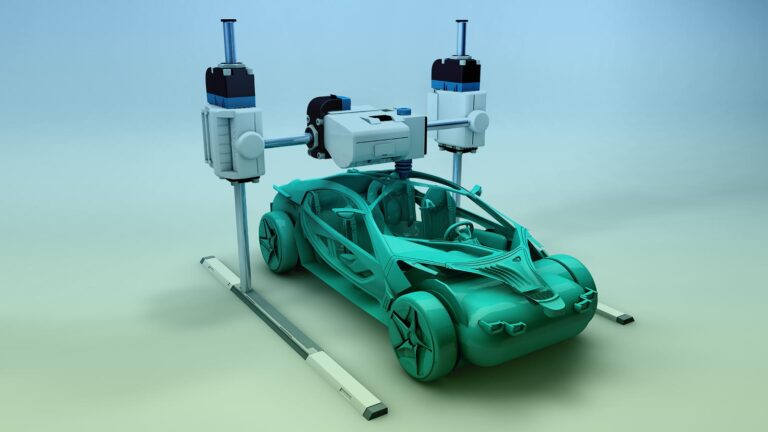
3D printing has gained more acceptance in small-scale projects than in large industrial environments. Aspects such as the slowness of the process or difficulty obtaining regular finishes have prevented mass adoption. However, there are sectors such as construction where the results are already tangible. Thanks to the latest technological breakthroughs, other sectors will benefit from the technology. The latest party joining the party is the automotive industry with a new steel alloy for 3D printing.
A novel technology for 3D printing of vehicles
Tesla’s factories have been applying the technique used to produce toy cars to their vehicles. I.e., a metal casting process by which molten metal is poured into a mold to form objects. This machine, known as Giga Press, weighs nine thousand tons and significantly reduces the number of parts needed to manufacture the chassis. However, metal cooling systems and inert gases are required to speed up the process and to obtain homogeneous results. So far, the parts have a maximum weight of fifty kilograms. But what if additive 3D printing were used?
That approach prompted two young MIT students to undertake a new project in collaboration with an advisor from the University of Paderborn in Germany to print with steel. The result has earned them a prize in the ASM Education Foundation 2022 design competition.
Based on a material property calculation system called CALPHAD, the researchers formulated a new steel alloy with the ideal characteristics. After melting and atomizing it into droplets, the droplets solidified and formed the powder used as raw material. It was now sufficient to deposit layers of steel powder and melt it with a laser.
The advantage of 3D printing is that the material cools much faster, and the quality of the results is improved, enabling the printing of more complex parts. The new alloy has already been patented and may soon be used to manufacture more sustainable electric vehicles.
Printing with wood… and light
New 3D printing techniques have bloomed recently, using alternative raw materials to plastic, cement, or resin. Here are some of the most striking ones:
Laboratory wood
The innovative steel alloy is not the only 3D printing material from MIT’s labs. In fact, it is an innovative technology that, through plant-like growth, generates a material of outstanding hardness.
To achieve this, they used living cells from a plant called zinnia, transferred to a gel where they were stimulated to accelerate their growth through plant hormones. It is hoped that the technique will manufacture one-piece furniture using molds in the future.
Printing with light
More than a matter of raw material, it is a technology that allows the resin to be solidified a hundred times faster than conventional additive printing. As explained in this article, the system projects two beams of light onto a resin and solidifies it almost immediately in a polymerization process. In addition, since the resulting pieces have no joints or points of union, they are much more resistant than those obtained with traditional techniques.
3D printing with molecules
If the above examples offer new ways to 3D print at the visible scale, researchers at the Jülich Institute for Quantum Nanoscience in Germany are applying similar strategies at the microscopic scale. In this case, they have combined artificial intelligence and tunneling microscopes to move and position molecules at will. This breakthrough opens the door to the fabrication of molecular transistors with applications in quantum computing.
The possibilities of 3D printing are limitless since, in addition to allowing the printing of structures, food, or even living organs, they are one of the most promising avenues for colonizing other planets. Thus, NASA and private companies are exploring the potential of additive printing to build structures on the Moon or Mars. If you want to learn more about the possibilities of 3D printing and other technological advances, you can subscribe to our newsletter at the bottom of this page.
Source:
Guyana holds Venezuela responsible for attack on election officials before election
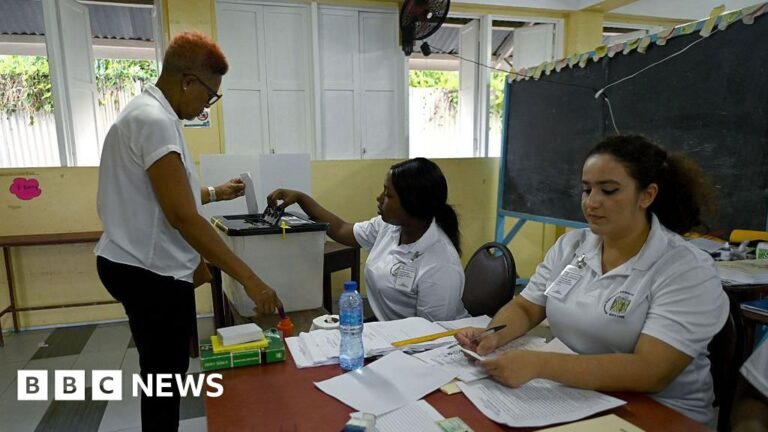
Security forces in Guyana say a boat carrying election officials and ballot boxes was shot at “from the Venezuelan shore” in the contested Essequibo region.
Police and the Guyana defence force said in a joint statement that the incident occurred on Sunday, ahead of the South American nation’s general election on Monday.
The patrol that had been escorting the officials “immediately returned fire” and no one was injured, Guyana’s security forces said.
Venezuela has not commented on the incident, which comes amid a territorial dispute between the two nations over the oil-rich Essequibo region.
The 159,500-sq-km (61,600-square-mile) area has been administered by Guyana, and British Guiana before it, for over a century.
But Venezuela lays claim to the area and, in December 2023, President Nicolás Maduro’s government held a referendum in which more than 95% of Venezuelans who voted backed its claim.
Guyana has taken the matter to the International Court of Justice, but Venezuela has disputed the court’s authority to rule on it.
The statement from the Guyanese security forces did not say who may have been behind the shooting, but they insisted the shots had been fired from Venezuelan territory.
It added that the ballot boxes onboard the boat had been delivered safely to the remote polling stations they were destined for.
Voters in Guyana are choosing a president for the next five years, as well as members of its parliament.
The incumbent, President Irfaan Ali of the People’s Progressive Party/Civic (PPP/C), is running for a second term and polls suggest he is the frontrunner.
He is being challenged for the top post by Aubrey Norton of the A Partnership for National Unity (APNU) coalition and by Azruddin Mohamed, a billionaire trying to disrupt Guyana’s two-party system.
Polls conducted before the voting started had President Ali as the favourite, buoyed by the revenue from the economic boom Guyana is experiencing following the discovery of massive offshore oil deposits.
The country of 800,000 inhabitants saw its GDP almost quintuple in the five years since 2020, according to IMF figures.
President Ali used the revenue to improve Guyana’s infrastructure, investing in road-building and education, including making attendance at state universities free of charge.
But his critics say oil revenues have been channelled disproportionally to benefit groups which traditionally support Ali’s party, an accusation the president has denied.
Guyana’s political landscape has for decades been largely split along ethnic lines, with members of the Indo-Guyanese community traditionally supporting the PPP/C and Afro-Guyanese voters mainly backing the People’s National Congress, which forms part of the coalition led by Aubrey Norton.
The party or coalition which wins the most votes gets to put forward the president.
While President Ali said he was confident of re-election, his party had only a one-seat majority in the outgoing legislature.
Analysts have pointed out that the campaign by third-party candidate Azruddin Mohamed could break open established voting patterns and produce a surprise result.
Ballots close at 18:00 local time (22:00 GMT).