
5 C
New York
Sunday, March 1, 2026
Home Blog Page 375

Denis Ladegaillerie envisions a future of music that bears no resemblance to the past.

0

Denis Ladegaillerie has had time to think.

In the months it took to orchestrate the complex machinery required to take Believe private – via a joint consortium with TCV and EQT – the CEO has been observing. Analyzing. Drawing conclusions not just about his own $2 billion company, but about the fundamental dynamics reshaping the global music business.

The result? A series of informed takes that challenge conventional wisdom at every turn.

On market structure: With 70% of record industry revenues now coming from outside the Top 200 in most markets, Believe has built an entire business philosophy around what Ladegaillerie calls “middle-first” thinking – fundamentally different tools, deals, and strategies than those designed for superstar economics.

On the Universal/Downtown merger that’s currently exercising regulators and some indie rivals? Ladegaillerie is relaxed.

“Do I think that is going to change anything for us? I can’t speak for the industry, but as a company, we feel very good about our ability to compete,” he says flatly.

The European Commission, he suggests, should perhaps spend more time pondering why algorithmic recommendations are creating an Anglo-American monoculture across non-charting streams in most EU markets.

“The number one issue for EU/UK lawmakers may not be the Downtown merger,” says Ladegaillerie. “It’s 28% of streams being from local artists in the UK, 36% in Germany, 41% in France.”

On the technology that really matters: Forget AI panic (“marginal revenue opportunity, marginal threat”). Ladegaillerie is far more focused on Spotify‘s Discovery Mode, which he claims Believe is using “at a larger scale than anyone else” – with 98% of tracks showing positive financial returns.

When I catch up with Ladegaillerie in London, Believe has just completed its transition back to private ownership, valued at around USD $2 billion.

The company that started in 2005 as a digital distribution pioneer now operates across 50+ countries, serving everyone from bedroom producers via TuneCore to established independent labels and artists seeking sophisticated marketing services.

The timing of our conversation is particularly revealing.

While larger rivals are announcing substantial cost-cutting programs, Ladegaillerie says Believe’s headcount is growing. While others worry about streaming saturation in mature markets, he sees “plenty of growth” ahead. And while segments of the business obsess over consolidation and market concentration, he’s quietly building a machine that thrives on the exact opposite principles.

“We’re in a new era of Believe,” he says, outlining a 10-year strategic plan dubbed “From Access to Success”.

“The past decade has essentially been about leveraging technology to democratize market access, which is what we’ve seen with more and more independent artists capturing market share. But access does not mean success,” he says.

“The years ahead will be defined by how, in this new landscape, record labels drive their artists to success. That’s about the quality of the music, the production, the quality of [your] videos, and how sophisticated you can be around all of the digital audience development levers.”

What emerges from our conversation isn’t just Ladegaillerie’s excitement over the future of the “middle tier” or independent distribution. It’s a comprehensive worldview about where value lies in modern music — one that sees the industry’s current evolution not as a threat to be managed, but as an opportunity to be seized…


What are the key priorities you’re looking at within Believe’s ‘access to success’ strategy?

Number one: We’re going to continue investing in scaling our artist services business. In the past three to five years, we’ve created 15 imprints record labels like KithLabo in Indonesia, PLAYCODE in Japan, and All Night Long in France. We’re going to continue doing this.

Priority number two is accelerating, expanding, and deepening our label services. Because the world is more complex than it once was, because our labels need to cut through the noise with their artists, the level of services they require goes far beyond simple distribution and financing.

“We want to deepen our partnerships with the DSPs, whether it’s Spotify through Discovery Mode, Marquee, or Showcase, or TikTok, or YouTube.”

Now you also have to offer expert strategic advice: What market signals do you need [in order] to operate? What type of contract? How do you execute marketing?

Priority three is scaling our publishing business [following the acquisition of Sentric]. We’ve done a lot of work building a solution that we think is now a significant competitive advantage in collection.

We also want to deepen our partnerships with the DSPs, whether it’s Spotify through Discovery Mode, Marquee, or Showcase, or TikTok, or YouTube. It’s all about putting these partnerships at the center of monetizing catalog and developing artists. There’s a much better alignment that needs to happen in the next 10 years with the DSPs.

Our fifth priority is people. We need to upskill everyone, in how to do [more sophisticated] digital marketing, to deliver better value to the artists and labels – and build the tools to make that happen. There’s a lot of work to do in building the software that our internal teams use to serve their clients.


Geographically, where are you focusing for growth?

We’re building on our existing strength in Europe and Asia and then making first-level investments in three specific areas: the US, the UK, and Japan – the world’s largest markets, where we have invested less than we have in other markets [to date].

In Japan, TuneCore Japan is already the third-largest player in terms of local market share. We’ve also signed a deal with Teichiku and a few large labels to distribution [deals], and we’ve launched the artist services imprint PLAYCODE around hip-hop.

“We’re making first-level investments in three specific areas: the US, the UK, and Japan.”

Can we break the top artists in the US and UK tomorrow, as we’ve done in other territories? Yes, I have no doubt about that because we have all the levers [required] at the Spotifys of the world, YouTube, TikTok.

Radio and television are now less influential in those markets. It’s just a matter of time.


You’ve said previously that you felt there was a distinct lack of acquisition opportunities in the UK at scale.

That’s correct. Our DNA as a company is to support the buildup of local ecosystems, so when I see that in the UK, local artists in 2024 represented just 28% of streams – that’s a killer for me.

If the UK had the same rate of local artists as you see in the US, Japan, or Brazil at 60-70%, you’d almost triple the market size. That means more jobs, more local labels, more people. That gives you bigger [domestic] companies, more influence, and the ability to market.

“When I see that in the UK, local artists in 2024 represented just 28% of streams – that’s a killer for me.”

People say it’s okay that the UK market is small because it exports a lot. But guess what – at some point, if your domestic market is not strong, your ability to export becomes weaker; you have a harder time breaking artists locally.

The UK needs to break out of that mindset. You need to strengthen your local market.

Earlier You mentioned Believe’s use of Spotify Discovery Mode. It’s a platform that’s SPLIT OPINION in the business, but presumably you see it as helpful to democratization?

We’ve done a lot of work with Spotify around this. I’m told that we operate Discovery Mode at a larger scale than anyone else, more profitably than anyone else.

Over 98% of the tracks we have in the program have [provided] significantly positive returns; that’s financial returns, not just growth of streams.

We move hundreds of thousands of tracks every month in and out [of Discovery Mode], and that process is purely AI-driven. You have to understand how the system works to select the right tracks – it’s super-technical.

“Over 98% of the tracks we have in Discovery Mode have significantly positive returns; that’s financial returns, not just growth of streams.”

It’s a core driver for all of our labels globally. We think we are more efficient than anyone at driving digital catalog revenues on Spotify, partially through Discovery Mode.

Discovery Mode’s limitation is not its ability to drive revenues and discovery; it works well. It’s its ability to actually support new artist development, striking the right balance between catalog and frontline artists. That’s the dialogue we’re having with Spotify at the moment.


It looks to me like you, TCV, and EQT each own around a third of the new, private Believe. How do you balance control, and beyond capital, what do they bring to the table?

When you need to raise financing capital to make acquisitions in music, you need investors who are smart.

EQT has done a lot of work around music—they looked at [a potential, pre-IPO] acquisition of Universal a few years ago and are investors in Epidemic SoundTCV has been an investor in [Believe] since 2014 and is also an investor in Spotify and Netflix. They’re definitely smart.

The second key is strategic alignment. Before taking the company private, we did a lot of work to ensure everyone was aligned on the strategy.

“On the public market, Believe was significantly undervalued, which prevented us from raising money [at the right price] to make large acquisitions. That is no longer an issue.”

The last element is that you want shareholders who can deploy capital at the right valuation. On the public market, Believe was significantly undervalued, which prevented us from raising money [at the right price] to make large acquisitions.

That is no longer an issue.

Your question about balance of power is interesting. My view as a founder is it doesn’t matter whether you have 10, 20, or 30 [percent ownership]. These private equity funds make a business out of supporting entrepreneurs and management teams. As long as you are aligned on strategy and that strategy allows you to create value, you’re in control.

You start losing control the day you’re no longer creating value.


Are you thankful that a certain aggressive takeover attempt from Warner Music Group last year ultimately WENT AWAY?

Yes, we’re happy. I’m not anti-major; I think independent labels can be served very well in a major record label setup. The Orchard and Sony have demonstrated that very well.

But when we [mapped out] this new phase of growth, I told TCV we don’t want to sell to a strategic buyer because we think there’s more value to be created here. So we’re happy it didn’t happen.

I like Robert [Kyncl]. His team is smart, and there would have been some strategic value [from a merger]. But it was not what we wanted to do.


Believe will no longer publicly report annual financials after de-listing from the Paris stock exchange

Where do you think the next phase of distribution and artist services is going? Listening is becoming more dispersed and superstardom is becoming increasingly rare.

I was just looking at the SNEP figures for H1 2025 in France.

We’re actually leading the Top 200 as the biggest record label [by chart market share in France]. But the Top 200 in France accounted for only 19.7% of the total market by value.

In most territories, the [Top 200] accounts for 25-30% of the market, which means the [biggest] value is essentially in the ‘middle’ – outside of the top chart.

“In H1 2025, the Top 200 [tracks] in France accounted for only 19.7% of the total market by value.”

We’re a ‘middle-first’ company. That’s our DNA – 70% of the [industry] revenues are in the middle. We’ve been operating in these segments for a while, and we know how they work. I feel really good about our positioning.

But there’s also an opportunity for us to move up and serve more artists at the top. You have to build a model that provides the right level of service, with the right deals that are different at each level.


Believe has not traditionally served the ‘upper tier’ of artists. Three companies in particular might say you’ll never be able to offer what they offer – look at all the people they have and the money they can offer upfront. Are those dynamics changing?

I need to find a better phrase for this, but we thrive with ‘digital artists’. A ‘digital artist’ is just a regular artist who creates music, except the way that artist connects, interacts, and gets audience discovery is digital.

That’s what’s opening up the opportunity for us [with charting artists] because the market is becoming less concentrated – it’s less about radio, it’s less about television, it’s more about partnerships with digital partners, digital marketing.

Because of that, we are able to challenge the traditional labels at the top now in a very different way.


What about fending off the threat from the majors in the ‘middle tier’, though? They’re reaching into your territory just as you’re reaching into theirs.

When we think about how we structure deals with Spotify, YouTube, what tools and services we develop, we think ‘middle-first’. That’s very different from major record labels – they think ‘top’ and ‘global top’ first.

It means that when major record labels operate in that [‘middle’] market segment, when they do [artist deals] at a smaller scale, they don’t always know how to operate with the right economics, with the right economic model vs. the right level of service.

To some extent that creates confusion in the market. A lot of time, we see [megastar] artists being served by the teams at the top with [label services] economics – the economics of the ‘middle’, which we know don’t make sense.

The fact that major labels are now scaling their business [into the middle tier] will force them to think: What economics do I actually need to achieve here? How much capital do I even want to deploy there versus the [top]?

For us, it’s good because that process is ultimately going to make the market healthier.


Sony recently confirmed that it OWNS MINORITY STAKES in around half of The Orchard’s top 20 clients. What do you make of that trend?

It’s smart and very natural. We do the same thing!

The labels we’ve seen grow the fastest [at Believe] are the labels where the quality of partnership is the highest – where the level of [collaboration] with the teams around strategy, how to develop artists, what market segments to enter, has been the highest.

When we can strike these partnerships that are really close from a commercial standpoint and then transform them into minority investments or majority investments, depending on the situation, we can deliver maximum value and cement those relationships.


The proposed Universal/Downtown merger is getting a lot of attention in Europe, with the EC evaluating if it’s anti-competitive in any way. Where do you stand on it as a competition issue?

I have two answers.

My first answer in terms of Europe, including the UK, is that the number one issue [for EU/UK lawmakers] may not be the Downtown merger. It’s 28% of streams being from local artists in the UK, 36% in Germany, 41% in France.

What the authorities in Brussels or politicians should be looking at is this: Europe is the biggest market from a [music] publishing standpoint. There’s no reason why it shouldn’t be the largest market from a recorded music standpoint. But it’s not.

“Do I think [UMG buying Downtown] is going to change anything for us? I can’t speak for the industry, but as CEO of Believe, we feel very good about where we stand and our ability to compete.”

We should have politicians focused very strongly on: What conditions do we need to create to improve [Europe’s] position? How do we foster the development of a strong local ecosystem? That’s much more powerful.

Do I think [UMG buying Downtown] is going to change anything for us?

I can’t speak for the industry, but as CEO of Believe, as a company, we feel very good about our ability to compete.

I think that we will be able to deliver a superior quality of service to our artists and labels.


To be 100% clear, if you wake up tomorrow and Universal has fully acquired Downtown, you’re not losing any sleep?

As I said, we feel very good about our ability to compete.


Believe distributed the entire Top 5 bestselling albums in France in H1 2025, according to SNEP stats, including the No.1 LP by rapper GIMS (pictured). Believe says it achieved the largest share of the Top 200 of any label company on both France’s singles and albums charts (combining both international and domestic artists) in the period.

You mentioned market share issues with local repertoire. I thought with the rise of independent hip-hop in particular, local language music was dominating more than ever in European nations?

That’s the perception, not the reality.

Take a market like France. The number one market segment is local-artist hip-hop. But the number two market segment in terms of revenues and streams? International pop. Number three? International rock. Number four? International hip-hop. Number five? French pop.

Now consider that French pop is one-fifth the size of the larger market segments. So [in terms of the total French market] you have around 60% of the streams that are international music.

“Again, look at the SNEP figures in France: The Top 200 is 70% local artists. But as soon as you go below the Top 200 or Top 500, you go from 70% local to 80% international.”

In Germany, it’s the same. You have local hip-hop as the biggest market segment, but that’s the only local segment you have [amongst the most popular genres]. Schlager is not even in the top five.

By contrast, when you look at China, Japan, Brazil, you see 60-70% of streams from local artists. That’s double the market opportunity [for local artists] than we see in European countries.

It’s super important for Europe to rebuild that – it’s directly tied to employment, including [tax] revenue and cultural influence.

Again, look at the SNEP figures in France: The Top 200 is 70% local artists. But as soon as you go below the Top 200 or Top 500, you go from 70% local to 80% international.

The top artists are very well supported by the local DSPs across all territories. But the bottom [sub-Top 200] is being driven by algorithm-based recommendation, which is not as localized as it should be. That’s what’s driving a lot of the Anglo-American content.


What can be done? Call up the EC and say: ‘Forget UMG/Downtown, no one cares. Put thresholds on streaming playlists for local artists!’?

I’m not calling for regulation. This is not about playlist quotas.

It’s as simple as asking the DSPs to publish, a couple of times a year: ‘I have delivered XYZ algorithmic recommendations. How many were local? How many were international? To what market [genres]?’

The DSPs will then be able to ask themselves questions. I think they will want to become good citizens of the world [by protecting local artists in their algorithms]. In my experience, that would be enough to influence and move the issue through normal commercial and human incentives.

We’ve seen unspectacular growth in streaming subscriptions in H1 2025 in mature markets like the US, Germany, and France. Do you have any concerns for the future of the business?

With my Believe hat on, no. We are positioned in some of the fastest-growing markets. If we were more weighted to the US, UK, or Scandinavia, yes, I would be more concerned because paid streaming adoption is [growing] slower.

There’s plenty of growth in the existing markets for us as a company, and the fact that some of these large markets are ‘new’ territories for us gives us plenty of growth opportunity.

I also think there’s plenty of growth potential in streaming pricing, both through segmentation, the ‘supremium’ tiers, and general price increases.


There’s always a discussion around AI music. Is there danger coming from Suno/Udio/Anthropic etc. or is this going to be a novelty issue?

My take on this is unchanged: marginal revenue opportunity, marginal threat. All of the data I’ve looked at supports this.

Yes, there are more and more AI tracks being distributed on the platforms. The latest data from Deezer shows 28% of tracks [being uploaded to the platform] are fully AI. But those tracks are only generating 0.5% of total streams.

“You can produce as many gen-AI tracks as you want – if there’s not something unique about them, it’s not going to hit [meaningfully] into the revenues of artists.”

You can produce as many gen-AI tracks as you want – if there’s not something unique about them, it’s not going to hit [meaningfully] into the revenues of artists.

I’m not too concerned about it. I think all of the tech players have an interest in behaving properly.

I would be worried if I thought Spotify or another service was going to use this to lower their content costs. But it’s almost impossible for them to do that because their business is predicated on working with artists.


Music Business Worldwide has run a number of headlines in the past 12 months about cuts at larger music companies. Is Believe moving in the opposite direction?

Yes, we’re investing. In 2024 there were a few countries where we made adjustments, but globally, our headcount continued growing. And it’s going to grow again in 2025.

That’s being driven by market growth. We have opportunities in publishing, so we’re hiring people on the publishing side. And as I said, we’re building new label imprints as the markets become more digital.

“Globally, our headcount continued growing in 2024. And it’s going to grow again in 2025.”

The biggest difference between us and the major record companies is that the Believe model was created originally as a global model. Our accounting, legal, financial teams – all of our tech systems – are already fully integrated and streamlined.

Major labels were built as essentially financial holding companies of local businesses, at a time when CD manufacturing logistics were mostly local. They have not yet done the move of really streamlining their businesses [to be global]. They also haven’t fully addressed: What’s being generated by catalog? What’s the real profitability of my frontline label? What should the balance be?

When you’re growing really fast, you can hide that. When you grow slower, it’s much more difficult.


Universal is suing you in the US; the main allegation is that a large amount of uploads via TuneCore have infringed copyright. Do you have an update on that situation?

We do not comment on pending litigation. [Believe has previously said it “strongly refutes” UMG’s claims, and “will fight them”.]


If I could give you a magic wand to change one thing about the music industry today, what would you change?

I’ve been expecting this question.

The record industry already has the magic wand in its hand. We’re already shaping the future of music – we’re shaping it when we’re having conversations with Spotify, YouTube, and others.

We have enough influence collectively as an industry to be able to make sure that the way these technologies are being rolled out will be in a way that creates value.Music Business Worldwide


Trump advises pregnant women to refrain from using Tylenol due to lack of evidence supporting a connection to autism

0

Madeline Halpert and

Nadine Yousif

Watch: Trump says taking Tylenol is “not good” for pregnant women

Doctors in the US will soon be advised not to prescribe the pain reliever Tylenol to pregnant women, US President Donald Trump said, citing a disputed link between the drug and autism.

Trump made the announcement on Monday in the Oval Office alongside Health Secretary Robert F Kennedy Jr.

The US president claimed that taking paracetamol, the main ingredient in Tylenol, also known in the US as acetaminophen, “is no good” and that pregnant women should only take it in cases of extreme fever.

Some studies have shown a link between pregnant women taking Tylenol and autism, but these findings are inconsistent and inconclusive. Tylenol maker Kenvue has defended the use of the drug in pregnant women.

In a statement to the BBC, it said: “We believe independent, sound science clearly shows that taking acetaminophen does not cause autism. We strongly disagree with any suggestion otherwise and are deeply concerned with the health risk this poses for expecting mothers.”

Acetaminophen – Tylenol’s active ingredient – is the safest pain reliever option for pregnant women, it added, and without it, women face a dangerous choice between suffering through conditions like fever or using riskier alternatives.

During the announcement on Monday, Kennedy said the Food and Drug Administration (FDA) will issue a physicians notice about what he described as the potential risk of taking Tylenol during pregnancy.

He said the FDA will also begin the process of initiating a safety label change on the medication and launch a public health campaign to spread awareness.

Kennedy added that the FDA will soon approve Leucovorin, a decades-old drug traditionally used to protect cancer patients against toxicity from chemotherapy, to be used as treatment for children with autism.

FDA Commissioner Marty Makary said the approval will be based on research that he said suggests the drug may help children with autism who are deficient in folate, a form of vitamin B, improve their verbal communication.

What is Leucovorin?

The Autism Science Foundation, a US charity, said low folate levels during early pregnancy have been linked in some studies to an increased risk of autism in children, though the findings are not consistent.

Studies in Norway, the US and Israel found that mothers who took folic acid supplements around conception had children with a 30-70% lower likelihood of autism. But other studies did not find a significant association.

The charity said the suggestion folate may improve some symptoms comes from trials of leucovorin, also known as folinic acid.

Some research has shown that unlike regular folic acid, folinic acid can more easily cross the blood brain barrier and address a deficiency of the vitamin.

Four small, randomised trials, all using different doses and measurements of success, have been carried out. One, from 2016, studied 48 autistic children in the US and found improvements in verbal communication compared with a placebo.

But researchers have cautioned that the science is still in the very early stages, and more work is needed before any firm conclusions can be reached.

Medical experts push back

In April, Kennedy pledged “a massive testing and research effort” to determine the cause of autism in five months.

Trump on Monday called the rise in reported autism cases a “horrible crisis”, and an issue that he has “very strong feelings about”.

But experts have cautioned that finding the causes of autism – a complex syndrome that has been researched for decades – would not be simple.

The widely held view of researchers is that there is no single cause of autism, which is thought to be the result of a complex mix of genetic and environmental factors.

Dr Steven Fleischman, president of the American College of Obstetricians and Gynecologists said in a statement that Monday’s announcement “is not backed by the full body of scientific evidence and dangerously simplifies the many and complex causes of neurologic challenges in children”.

The leading medical professional group said doctors across the country have consistently identified Tylenol as one of the only safe pain relievers for pregnant women.

“Studies that have been conducted in the past, show no clear evidence that proves a direct relationship between the prudent use of acetaminophen during any trimester and fetal developmental issues,” the group has said.

The drug is recommended by other major medical groups as well as other governments around the world.

Getty Images Tylenol and other pain relievers on a shelf in a drug storeGetty Images

Major medical groups say it is safe for pregnant women to take Tylenol, also known as Paracetamol

In August, a review of research led by the dean of Harvard University’s Chan School of Public Health found that children may be more likely to develop autism and other neurodevelopmental disorders when exposed to Tylenol during pregnancy.

Researchers argued some steps should be taken to limit use of the drug, but said it was still important for treating maternal fever and pain, which can also have negative effects for children.

But another study, published in 2024, found no relationship between exposure to Tylenol and autism.

It was conducted by looking at a population sample of 2.4 million children born in Sweden between 1995 to 2019. Around 7.5% of them were exposed to acetaminophen during pregnancy.

By comparing autism rates between those exposed versus those who were not, as well as comparing siblings who shared genetics, the study concluded that there was no increased risk of autism, ADHD or intellectual disability that can be definitively linked to acetaminophen.

“There is no robust evidence or convincing studies to suggest there is any causal relationship,” said Monique Botha, a professor in social and developmental psychology at Durham University.

Dr Botha added that pain relief for pregnant women was “woefully lacking”, with Tylenol being one of the only safe options for the population.

Autism diagnoses have increased sharply since 2000, and by 2020 the rate among 8-year-olds reached 2.77%, according to the US Centers for Disease Control and Prevention (CDC).

Scientists attribute at least part of the rise to increased awareness of autism and an expanding definition of the disorder. Researchers have also been investigating environmental factors.

In the past, Kennedy has offered debunked theories about the rising rates of autism, blaming vaccines despite a lack of evidence.

Aiden Moy, Junior Nationals Finalist, Commits to University of Michigan for Fall 2026

0

By Charlotte Wells on SwimSwam

Fitter and Faster Swim Camps is the proud sponsor of SwimSwam’s College Recruiting Channel and all commitment news. For many, swimming in college is a lifelong dream that is pursued with dedication and determination. Fitter and Faster is proud to honor these athletes and those who supported them on their journey.

Summer Juniors finalist Aiden Moy has announced his verbal commitment to swim for the University of Michigan starting in the fall of 2026.


“I’m excited to announce my verbal commitment to continue my academic and athletic career at the University of Michigan! I’m incredibly grateful for my family, friends, and coaches, John, Jack, and Dom for their unwavering support. I’d also like to thank Coach Matt, Coach Gunner, and the entire coaching staff for giving me this amazing opportunity.”


The New York native recently began his senior year at Laurel Springs School, an online K-12 school, and he currently trains year-round with Badger Swim Club. A versatile threat in the water, Moy primarily specializes in breast, fly and IM but is a strong competitor in all strokes.

Moy turned in a series of strong performances at the 2025 Junior National Championships (LCM) in July, earning a second swim in three events and clocking three lifetime bests. He placed 6th in the 200 IM (2:04.44), 19th in the 200 fly (2:02.31 – PB) and 27th in the 200 breast (2:19.08 – PB). Moy also set a best time in the 100 fly (55.90) and finished 35th in the 400 IM (4:31.74).

At the 2024 NCAP Invitational (SCY) in December, Moy was on fire in the pool; he earned a second swim in each of his individual events and notably set lifetime bests in prelims before dropping again in finals in all but one event. He won the 100 fly (48.25), was the runner-up in the 200 breast (1:59.67) and 200 IM (1:47.73) and took 3rd in the 200 fly (1:47.74) and 400 IM (3:54.46), posting personal best times in all of those performances.

Moy has made huge strides in his performances over the last two seasons. From the 2023 NCAP Invitational to the 2024 iteration of the meet, he dropped around seven seconds in the 200 breast, two and a half seconds in the 100 fly, five seconds in the 200 fly, five seconds in the 200 IM and 11 seconds in the 400 IM.

Time Progression

Event 2023 Best Time 2024 Best Time Time Drop
100 fly 50.71 48.25 2.46
200 fly 1:52.79 1:47.74 5.05
200 breast 2:06.73 1:59.67 7.06
200 IM 1:53.02 1:47.73 5.29
400 IM 4:05.69 3:54.46 11.23

Moy has since improved some of his top times even further. At the Senior Metro Winter Championships back in February, he clocked new personal best times in the 100 fly (47.77), 200 IM (1:46.81) and 400 IM (3:52.31). Moy also showed off his freestyle and backstroke skills at the meet, turning in a best time of 1:38.72 in the 200 free as the lead-off on his team’s 800 free relay and setting a best time of 49.08 in the 100 back.

Best Times SCY

  • 100 fly – 47.77
  • 200 fly – 1:47.74
  • 100 breast – 55.43
  • 200 breast – 1:59.67
  • 200 IM – 1:46.81
  • 400 IM – 3:52.00

A Division I program, Michigan competes in the Big Ten Conference against powerhouses like Ohio State and Indiana. The Wolverines took the runner-up spot at the 2025 B1G Conference Championships, a step up from their 3rd-place finish the year prior, before sending seven athletes on to compete at the NCAA Championships, where they placed 11th overall. Based on the results from last season’s conference championship, Moy would have landed in the ‘C’ final in the 200 fly, putting him in a position to score some points for Michigan early on.

Joining Moy in the Wolverines class of 2030 so far are Lucas Young (breast/IM) and Oliver Shao (distance free/IM), who should make for strong training partners over the next four years.

If you have a commitment to report, please send an email with a photo (landscape, or horizontal, looks best) and a quote to Recruits@swimswam.com.

About the Fitter and Faster Swim Tour 

Fitter & Faster Swim Camps feature the most innovative teaching platforms for competitive swimmers of all levels. Camps are produced year-round throughout the USA and Canada. All camps are led by elite swimmers and coaches. Visit fitterandfaster.com to find or request a swim camp near you.

FFT SOCIAL

Instagram – @fitterandfasterswimtour
Facebook – @fitterandfastertour
Twitter – @fitterandfaster

FFT is a SwimSwam partner.

Read the full story on SwimSwam: Junior Nationals Finalist Aiden Moy Sends Verbal to University of Michigan for Fall 2026

Drone Design Inspired by Woodpeckers for Crash-Resistance

0

Despite the fact that they bang their heads against trees on a daily basis, woodpeckers don’t suffer brain injuries. Inspired by the tough-headed birds, scientists have developed a fixed-wing drone that can survive frontal collisions.

Fixed-wing drones are both faster and more energy-efficient than their multi-rotor cousins, but when they hit an immovable object such as a tree, they really hit it – often resulting in irreparable damage to the aircraft. And while multi-rotors can be fitted with protective cages, the design of fixed-wing drones makes such appendages difficult to implement.

Instead, what’s needed is a method for the drones to non-destructively absorb impact energy in their existing form. That’s where EPFL Switzerland’s SWIFT drone – aka flying robot – comes in.

Its name an acronym for “Shockproof Woodpecker-Inspired Flying Tensegrity,” it does indeed incorporate a variation on structures known as tensegrities. These are generally defined as self-stabilizing structures made up of rigid (or in this case, semi-rigid) components held in place by taut cables.

A woodpecker skull, with the hyoid bone visible protruding from the beak and wrapping up around the back of the skull

Skye McDavid/C.C. 4.0

A woodpecker’s skull consists of a rigid beak; a flexible hyoid bone that connects the beak to the brain-containing main skull bone by wrapping around it; and a layer of spongy bone located between the hyoid and the skull bone. This arrangement, along with the relatively large amount of free space surrounding the brain inside the skull, redirects impact energy away from the brain.

In the SWIFT drone, rigid carbon fiber rods replace the beak, while bent carbon fiber strips take the place of the hyoid bone. The spongy bone is replaced by elastic cables, and the main skull is substituted by carbon fiber plates connected to carbon tubes using polylactic acid plastic brackets.

Instead of a brain, there are the electronic components, the motor, and the pusher propeller. These are suspended by rubber cables inside the “skull,” with enough room for them to travel by up to 22 cm (8.7 in) upon impact.

A nose-up view of the SWIFT drone, which measures 980 mm (38.58 in) in length, has a
A nose-up view of the SWIFT drone, which measures 980 mm (38.6 in) in length, has a wingspan of 1,500 mm (59 in) and weighs 710 g (1.6 lb)

EPFL

What’s more, the woodpecker-inspired, tensegrity-based, crash-mitigation tech extents to the aircraft’s wings.

In woodpeckers and other birds, a network of prestressed soft connective tissue in the shoulder joints helps the bones in those joints withstand the compressive force of wing-collisions with trees or other obstacles. In the SWIFT drone, that setup is replicated by a network of 12 elastic cables and carbon fiber rods that connect each wing to the main fuselage.

Not only does this arrangement absorb the impact energy that might otherwise pull the wings right off the drone, it also absorbs energy that could damage the aircraft’s “brain,” thus also protecting it in the process. All together, the SWIFT drone’s two tensegrity-based systems are claimed to reduce impact force by up to 70% as compared to a commercial drone of similar size and mass.

A paper on the research, which was led by Omar Aloui and colleagues, was recently published in the journal Advanced Robotics Research.

Collision-Resilient Tensegrity UAV

Source: EPFL via YouTube

Challenging Client

0


Client Challenge


JavaScript is disabled in your browser.

Please enable JavaScript to proceed.

A required part of this site couldn’t load. This may be due to a browser
extension, network issues, or browser settings. Please check your
connection, disable any ad blockers, or try using a different browser.

France and Other Global Leaders Acknowledge the Statehood of Palestine

0

new video loaded: France and Other World Leaders Recognize Palestinian Statehood

transcript

transcript

France and Other World Leaders Recognize Palestinian Statehood

France and three other nations joined an international movement to recognize Palestinian sovereignty at a United Nations summit on Monday.

“True to the historic, historic commitment of my country to the Middle East, to peace between the Israelis and the Palestinians, this is why I declare that today France recognizes the State of Palestine.” “The State of Palestine is the only entity eligible to assume full responsibility for governance and security in Gaza. Hamas will have no role in governing. Hamas and other factions must surrender their weapons to the Palestinian Authority. What we want is one unified state without weapons, a state with one law and one legitimate security forces.”

Allwyn acquires $1.6 billion stake in PrizePicks fantasy sports operator to enhance US presence

0

Allwyn buys $1.6-billion stake in fantasy sports operator PrizePicks to expand in US

Copenhagen Airport closes temporarily due to reported sightings of unidentified drones | Latest updates on Russia-Ukraine conflict.

0

At least 15 flights have been diverted as the airport remains closed until the situation is resolved, officials in Denmark say.

Authorities in Denmark have closed Copenhagen airport after unidentified drones were sighted nearby, causing about 15 flights to be diverted, police and airport officials told the AFP news agency.

“The airspace over Copenhagen airport has been closed since 8:30pm (18:30 GMT) due to two to three unidentified drones. No aircraft can take off or land,” airport spokeswoman Lise Agerley Kurstein said.

Recommended Stories

list of 4 itemsend of list

She said about 15 flights had been diverted to other airports.

Copenhagen police, meanwhile, said that “three or four big drones” had been observed flying over the airport.

“They are still flying back and forth, coming and going,” duty officer Anette Ostenfeldt told the AFP at 10:45pm (20:45 GMT), adding that police were at the airport investigating.

She could not say if the drones were military or civilian.

“But they are bigger than what you as a private individual can buy,” Ostenfeldt said.

Police officers walk after all traffic has been closed at the Copenhagen Airport due to drone reports in Copenhagen om September 22, 2025. [Ritzau Scanpix/Steven Knap via Reuters]

Airport officials said the airport would remain closed until the situation was resolved. “We currently have no timeline for reopening,” Kurstein, the airport spokeswoman, said.

The incident comes as several European countries have reported violations of their airspace by Russia. Estonia said on Friday that three Russian MiG-31 fighter jets had entered Estonian airspace without permission.

During a Russian air strike on Ukraine the week before, Poland said about 19 drones flew into its airspace. The Polish Air Force and NATO allies shot down some of the unmanned vehicles, marking the first time Russian drones were downed over NATO territory since Moscow’s full-scale invasion of Ukraine in 2022.

Romania also registered a Russian drone in its airspace.

The United Nations Security Council (UNSC) convened on Monday to address the issue of airspace violations.

Russia’s ambassador to the UN, Dmitry Polyansky, denied the allegations that Moscow’s fighter jets had violated the airspace of neighbouring Estonia, saying that last Friday’s flight of three of its MiG-31 aircraft was done “strictly in accordance with international airspace regulations”.

The Russian Ministry of Defence echoed his remarks, saying that “objective monitoring” confirmed that the MiGs did not breach Estonian borders.

NATO allies at the UNSC meeting condemned Russia for violating the alliance’s airspace.

“Your reckless actions risk direct armed confrontation between NATO and Russia. Our alliance is defensive, but be under no illusion we stand ready to defend NATO’s skies and NATO’s territory,” the United Kingdom foreign secretary, Yvette Cooper, said.

NATO’s North Atlantic Council will meet to discuss the issue on Tuesday.

Top Analyst Reports Trump’s Tariffs Generating ‘Very Significant’ Revenue of Approximately $350 Billion Annually

0

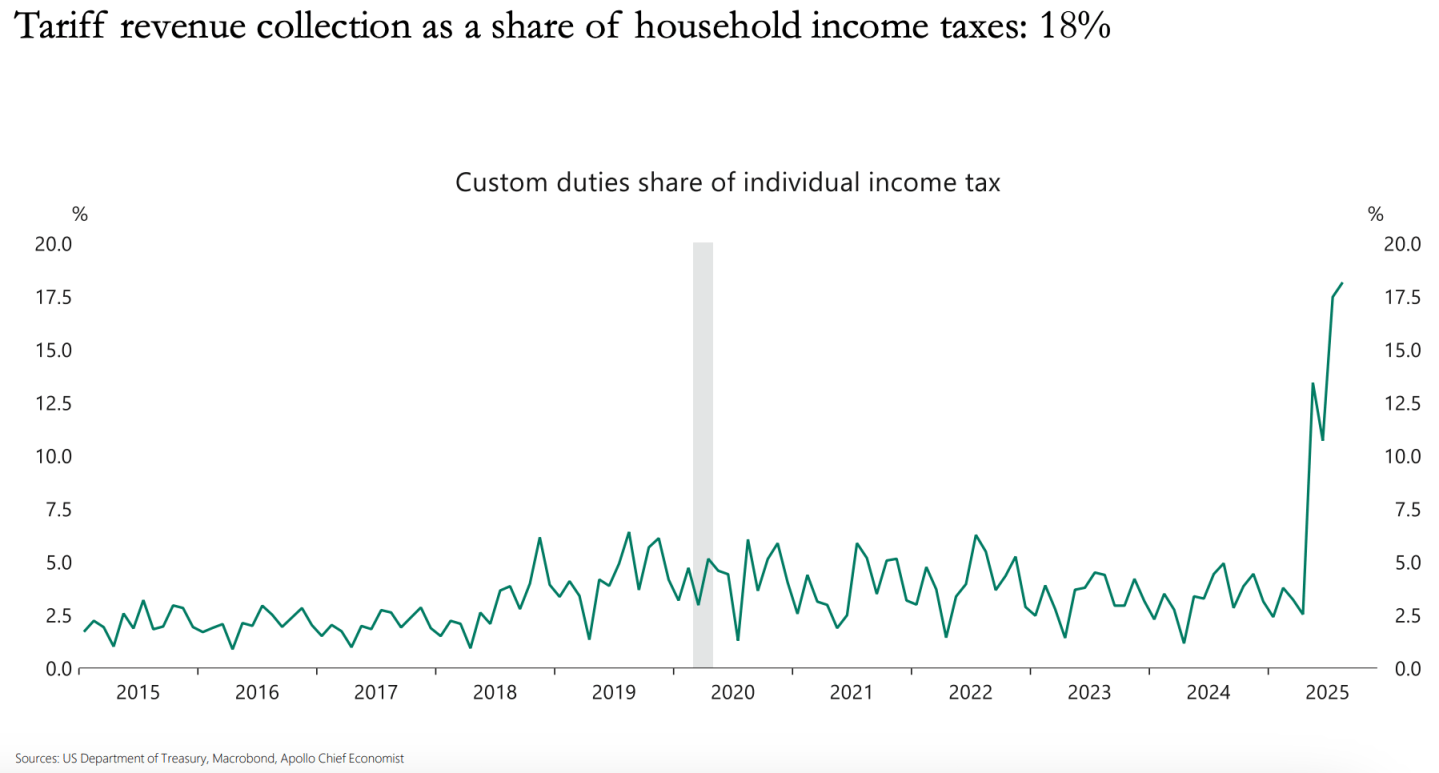
The U.S. government is currently collecting tariff revenues at an annualized pace of roughly $350 billion, a “significant” amount, according to Torsten Slok, chief economist at Apollo Global Management. In his typical style, one of brevity and striking charts, Slok added that the figure equates to roughly 18% of annual household income tax payments, underscoring that tariffs are not a marginal tool but a significant revenue source shaping America’s economic and trade landscape.

Tariffs—essentially taxes imposed on imported goods—have long been a controversial instrument in U.S. economic policy. Traditionally used to protect domestic industries or raise public funds, they have re-emerged in recent years as a centerpiece of trade strategy. The scale of collection today, at $350 billion annually, marks one of the most substantial contributions in recent history.

Fortune Senior Editor-at-Large Shawn Tully and Steve Hanke, the economist famously known as the “money doctor” for his expertise on hyperinflation, have argued that the tariffs are no more than a value added tax, something well known in Europe since shortly after the end of the Second World War. Tully and Hanke argue that the tariffs constitute “America’s answer to Europe’s fatal attraction that’s long been the leading enabler for the region’s extremely high levels of government spending.”

“The bottom line is that the amount of money collected in tariff revenue is very significant,” Slok argues. Given President Trump’s reluctance to raise taxes elsewhere, that may be the point.

Tariffs and household impact

While tariffs bring in significant funds, the burden is not evenly borne. Economists widely agree that tariff costs are passed along to consumers. When the government imposes a tax on imported goods, retailers and wholesalers often raise prices, which can lead to higher consumer costs across a range of products from electronics to household goods.

For households, this effectively means that tariffs act as an indirect tax. Unlike income tax, which is based on earnings and progressively structured, tariffs apply equally to everyone purchasing affected goods. This can make them more regressive, as lower-income families spend a higher share of their incomes on consumer staples. The $350 billion figure therefore not only signals higher fiscal collections but also a widespread, though less visible, tax on consumption. It’s a lot like a shadow VAT, to Tully and Hanke’s point.

Impact on the National Debt

The nonpartisan Committee for a Responsible Federal Budget (CRFB), while not commenting on whether the tariffs constitute a tax, has also recognized their significance as a source of federal revenue. The CRFB argued in August that the surge in tariff collections presents a significant, though not all-encompassing, step toward managing America’s $37 trillion national debt.

The Congressional Budget Office (CBO) has agreed, projecting that they could reduce the deficit by up to $4 trillion over the next decade. The CBO estimates the primary deficit would shrink by $3.3 trillion over 10 years, with an additional $700 billion in savings due to lower interest payments on the national debt—bringing total deficit reduction to $4 trillion. This revision is notably more optimistic than a CBO report from June, which tallied a $2.5 trillion deficit decrease plus $500 billion in interest savings due to more limited tariffs implemented earlier in the year.

However, even these hefty figures must be understood within context: U.S. government expenditures still far outstrip this revenue, with income and payroll taxes covering more than three-quarters of all federal receipts. That scenario would resemble a European-style escalation of spending, with books being balanced in dysfunctional fashion by a tax on consumers.

Experts caution against overestimating tariffs’ deficit-busting powers. While meaningful, the funds are only a fraction of what’s required to close the debt gap outright. The CRFB, for example, notes that recent tariff gains, if permanent, would “meaningfully reduce deficits,” but cannot halt national debt growth alone—especially given commitments to entitlement programs and rising interest costs.

Who pays—and who benefits?

While the government sees increased revenue, the real cost of tariffs is largely paid by American consumers and businesses. Retailers typically pass tariffs along as higher prices, making them function as a regressive tax that disproportionately impacts lower- and middle-income families. According to Yale Budget Lab, families in the second-lowest income tier now pay on average $1,700 more annually, while those in the highest tier shell out upwards of $8,100 due to tariff-related cost increases.

Not all effects are domestic. Defense and infrastructure advocates assert that tariffs also drive up the price of critical supplies, complicating procurement for national security and public projects.

President Trump has floated distributing “tariff dividend checks” as a direct rebate to families, but most economists say that—given government spending’s sheer scale—even record-breaking tariff inflows would mainly slow debt growth, not reverse it. Political and economic experts continue to debate whether the benefits from tariffs in the form of revenue and trade leverage are outweighed by the higher prices felt by American households and their broader economic impact.

In sum, U.S. tariffs have rapidly evolved from a modest funding tool to one of the most significant—and contested—sources of federal revenue. With projections now in the trillions, they may help slow debt accumulation, but remain only a piece of a much larger fiscal puzzle.

For this story, Fortune used generative AI to help with an initial draft. An editor verified the accuracy of the information before publishing. 

Police report drone sightings have led to the closure of Copenhagen airport

0

All flights to and from Denmark’s largest airport have been suspended after drone sightings, police have said.

Between two to three large drones were seen flying in the area around Copenhagen Airport, according to authorities.

Take-offs and landings at the airport have been suspended since around 20:30 local time (19:30 BST).

“[The airport] is currently closed for take-off and landing, as 2-3 large drones have been seen flying in the area. The time horizon is currently unknown,” police said in a statement on X.

Speaking to the Reuters news agency, a spokesperson for Copenhagen Airport confirmed that the airspace over the airport had been closed due to unidentified drones.

“Police are investigating the matter and we currently have to timeline for reopening,” the spokesperson said.