MBW’s Stat Of The Week is a series in which we highlight a data point that deserves the attention of the global music industry. Stat Of the Week is supported by music data analytics firm Chartmetric.
Nashville-headquartered non-profit organization The Mechanical Licensing Collective (MLC) held its Annual Membership Meeting on Wednesday, October 1, and revealed a number of significant stats about its operations.
The headline stat: The org confirmed that it has exceeded $3 billion in royalties distributed to publishers and songwriters since launching full operations in 2021.
The MLC was designated by the United States Copyright Office (USCO) in 2019 as the entity tasked with licensing and exclusively administering rights after the Music Modernization Act (MMA) was first signed into US law.
It then started to administer blanket mechanical licenses in January 2021 to music streaming services in the United States like Spotify and Apple Music, who have since been required to pay large sums of mechanical royalties to MLC.
The MLC reports to have processed more than $3.9 billion in total royalties to date and directly distributed more than $3.3 billion in blanket royalties to rightsholders.
The MLC also shared several key metrics and milestones during its meeting last week, including that it now has more than 68,000 Members, having added over18,000 to date in 2025.
The MLC’s database now contains data for more than 50 million songs (an increase of more than 6 million new works added in 2025 alone), allowing anyone to search The MLC’s database for free or download a complete copy of The MLC’s public data for “a nominal fee” of $25 per month
The organization noted that it has completed 54 monthly royalty distributions to date, every one of which it said “has been completed on time or early”.
The MLC has also distributed more than $225 million in historical royalties — more than 57% of the total amount of historical unmatched royalties DSPs were unable to match and distribute before transferring them to The MLC.
The org claims that its current match rate for all royalties processed through September’s royalty distribution is nearly 92%.
“Together, we’ve built an organization that is committed to providing world-class service that empowers our Members, enhances transparency, drives innovation, and transforms the way rights and royalties are administered in the music business.”
Kris Ahrend, The MLC
“We’re incredibly grateful for the support of our Members and partners,” said Kris Ahrend, CEO of The MLC.
“Together, we’ve built an organization that is committed to providing world-class service that empowers our Members, enhances transparency, drives innovation, and transforms the way rights and royalties are administered in the music business.
“We look forward to achieving more milestones in the coming year, all while remaining laser-focused on fulfilling our mission to ensure that songwriters, composers, lyricists, and their music publishing and administration partners receive their mechanical royalties from streaming and download services in the United States accurately and on time.”
Elsewhere at the MLC’s meeting, the organization’s Class A Members re-selected Kara DioGuardi to serve another three-year term as a Songwriter Director of the Board.
The MLC’s Class B Members re-elected Tim Cohan of peermusic to serve another term as a Publisher Director and elected Lidia Kim of Concord Music Publishing as a new Publisher Director.
The makeup of the Class C Members will remain unchanged in 2026.
“The MLC has become the largest single source of U.S. digital revenue for songwriters and publishers — distributing more than $3 billion in royalties since launching operations, at no cost to our Members.”
Alisa Coleman, The MLC
“The MLC has become the largest single source of U.S. digital revenue for songwriters and publishers — distributing more than $3 billion in royalties since launching operations, at no cost to our Members,” said Alisa Coleman, Board Chair of The MLC, following these announcements.
“With pride comes responsibility. Our job now is to sustain this success, keep improving, and ensure every songwriter and publisher—no matter their size or background—can rely on The MLC as a trusted partner in their creative journey.”
TheMLC also noted that has “successfully developed and continues to enhance its growing suite of tools that enable Members to register works, claim their shares of previously registered works, submit proposed matches of their works to unmatched usage, and more”.
TheMLC also highlighted its ongoing efforts to “conduct outreach and educational activities aimed at reaching the full cross-section of the rightsholder community, with nearly 200 outreach and education events in 2025, contributing to a total of more than 1,000 outreach and education activities to reach and educate rightsholders”.
Chartmetric is the all-in-one platform for artists and music industry professionals, providing comprehensive streaming, social, and audience data for everyone to create successful careers in music.Music Business Worldwide
Herut Nimrodi says she is clinging to hope that her son Tamir is “still hanging on” two years after his abduction
The mother of an Israeli man taken by Hamas on 7 October 2023 says she still does not know if her son is dead or alive, but has “real hope” that US President Donald Trump’s peace plan will bring the return of all the hostages held in Gaza.
Herut Nimrodi told BBC News she was “fearing the worst” for her son Tamir, a non-combat soldier, but she was clinging to hope that “he’s still hanging on” two years after his abduction.
She said he was the only Israeli hostage whose family had not been told if they were alive or dead.
The peace plan proposed by Trump has been gaining momentum, with indirect talks expected to continue on Tuesday between Hamas and Israel to end the war and return the hostages.
“They have been trying to create an agreement for a while but it didn’t take off. This time it feels different,” Ms Nimrodi said. “There is real hope that this is the one, this is the last deal.”
She said it was particularly important that all hostages – living and dead – would be released in the plan’s first phase.
“This is huge, this is a blessing for us,” she said.
“It’s urgent to release the hostages – those that are still alive, and even the ones that have passed. We don’t know what state their bodies are in. We have to release them so the families have some kind of closure. Even the families that got the message that their loved ones are deceased, they don’t accept it because they need proof.”
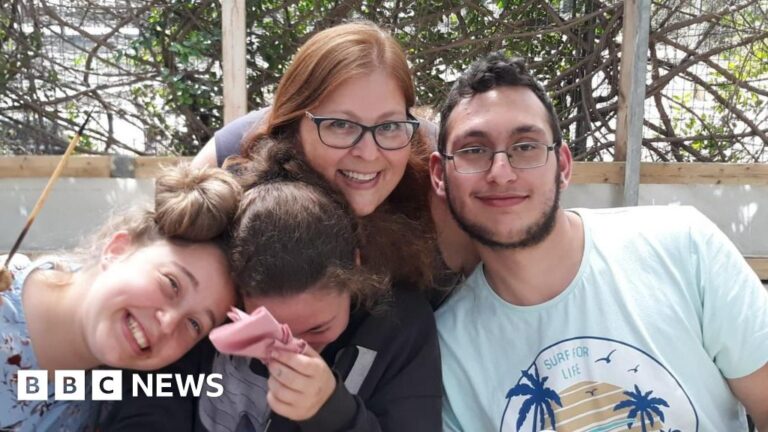
Tamir Nimrodi pictured with his mother and other family members
The last time she saw her son was in a video of his abduction posted on social media on 7 October 2023.
“My youngest daughter – she was 14 at the time – came screaming that she had seen her brother being abducted on Instagram,” she recalled.
“I saw Tamir wearing his pyjamas. He was barefoot. He had no glasses on. He can hardly see without them. He was terrified.”
Since seeing her son – an education officer in the Israeli military who was 18 at the time – forced into a jeep and driven away, “fading away into Gaza”, she has received no signs of life.
“He’s the only Israeli with no indication about what happened or where exactly he is,” she said.
The fate of a Nepalese hostage, Bipin Joshi, is also unknown.
Like other families the BBC has spoken to whose relatives were killed or kidnapped that day, Ms Nimrodi said life had been frozen for two years.
“People ask me: ‘It’s been two years, how are you holding on?’ And I say, ‘It doesn’t feel like two years. It feels like one long exhausting day’,” she said.
That day two years ago was the deadliest in Israel’s history, when some 1,200 people were killed by armed men from Hamas and other groups, and 251 others taken hostage, most from southern communities and a music festival.
The attacks sparked a war in which more than 67,000 people in Gaza have been killed by Israeli military action, according to the territory’s Hamas-run health ministry. Almost the entire population has been displaced and much of its infrastructure flattened.
Family handout
Ms Nimrodi says Tamir messaged her about “non-stop” rockets on the morning of 7 October
Ms Nimrodi said she was at her home near Tel Aviv when she received a message from Tamir early on 7 October 2023 from his post at the northern side of the Gaza border.
“He said ‘there are rockets and it’s non-stop’,” she recalled.
Tamir told her he would return soon to the family home, as he usually would during such moments because of his non-combat role.
“I told him to take good care of himself and text me whenever he can and he said he would try. Those were the last words between us. It was 06:49 in the morning, and I found out later on that 20 minutes after our last message he was taken away,” she said.
She has been lobbying for her son’s return, including at rallies with other hostage families.
But she said there were also days when she “can’t get out of bed”.
“I try to listen to my body – what can I do? How much strength do I have?”
The momentum behind the peace plan has brought some hope for the remaining hostage families that their loved ones could soon be returned home.
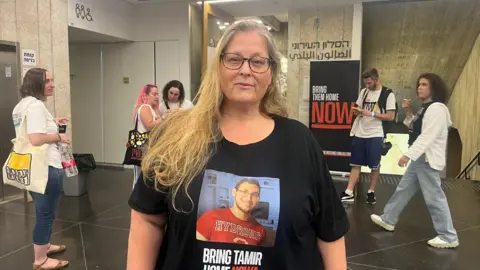
Ms Nimrodi joined tens of thousands of people – including the families of hostages, and former hostages themselves – who had gathered in Tel Aviv on Saturday night to call for the deal to be implemented.
She wore a T-shirt with her son’s photo on the front, smiling and bespectacled.
“I believe in this deal, and I believe that Trump will not let this slip away,” she said, as she called on Israel’s Prime Minister Benjamin Netanyahu to “do the right thing – bring the hostages home and bring peace to this region”.
She said that when she tried to sleep that night, she would be met with the “terrified look” in her son’s eyes as he was abducted, which plays in her head every day.
“To hope for two years – it’s absolutely exhausting.”
A required part of this site couldn’t load. This may be due to a browser
extension, network issues, or browser settings. Please check your
connection, disable any ad blockers, or try using a different browser.
We’ve interviewed more than 700 people in Gaza over the past two years. Their stories stayed with us.
We kept wondering: Did they find their missing relatives? Are their homes standing? Did they bury their dead? Were they forced to flee again? Were they even still alive?
So we tried to find them again. This is what they said.
No single experience can fully contain the agony of Gaza, the near-obliteration of a society and a place.
Collectively, however, the people we spoke to over the past two years have helped us see how the war has crushed those who have lived it.
They told us about the raw wounds of their grief, their fear of the next airstrike, their dread of tomorrow. About the first time they fled home as Israeli bombs and shells fell closer, the first time they put up a makeshift tent, the second time, the third.
About their weakening bodies, their children crying for bread, their days searching for baby formula and lentils. About their hopes of being evacuated for medical treatment, of going back to school, of reuniting with their families.
This article is by Vivian Yee, Lauren Leatherby, Samar Abu Elouf, Bilal Shbair, Iyad Abuheweila, Abu Bakr Bashir and Aaron Boxerman.
We tried to get back in touch with many of them. Many did not respond. Some phone numbers no longer worked. Others had escaped Gaza. Some, we learned, had been killed.
Of the nearly 100 we reached, everyone lost something or someone: a family member, a friend, their home, hope.
I lost a sister, a brother, and nearly 40 relatives. That alone feels like more than enough grief for one lifetime.
Samar al-Jaja’s nephews, from left, Mahmoud, Mohammed, Ahmed and Abdullah.
via Samar al-Jaja
When we spoke last summer to Samar al-Jaja and her nephews, Mohammed, Mahmoud, Ahmed and Abdullah Akeila, it had been 10 months since the brothers’ parents and baby sister had been killed in an airstrike.
Under their tent at a charity camp, they still held out hope that they would see their parents when they were allowed to go home to Gaza City.
But when they got home earlier this year, only their parents’ bedroom was still standing.
There was no one inside. The five of them stood there, numb.
“The kids said sadly, ‘We wish we were buried with them,’” Ms. al-Jaja, 32, said when we contacted her again recently.
They have never been able to mourn properly. The sweets that people in Gaza traditionally distribute on the anniversary of a death were too expensive to make, given the wartime price of flour and sugar.
They couldn’t even say a prayer at their parents’ graves. They do not know where they are.
“Even that closure has been taken from us,” she said.
She spoke to us from a half-destroyed building in Gaza City where she and her nephews were sheltering.
Days later, Israeli forces stormed the city, the latest operation in the two-year campaign against Hamas in Gaza, which began after the militant group’s deadly Oct. 7, 2023, attack on Israel.
Negotiators from Israel and Hamas began holding talks in Cairo on Monday about a possible swap of Israeli hostages in Gaza for Palestinians in Israeli prisons. If they agree, the war could be one step closer to ending.
But as they wait to hear what will happen to them, Palestinians in Gaza must keep trying to survive.
Ms. al-Jaja and her nephews moved to another neighborhood to escape the offensive in Gaza City, then fled south. They paid nearly $4,000 to a truck driver to load half their belongings — it was “pay or risk death,” the driver told them, Ms. al-Jaja said.
After a 14-hour journey, they ended up back in the same charity camp they were living in last year. This time, they have no tent.
Almost everyone we spoke to has been displaced from homes or shelters multiple times. Many have no home to return to.
If, God forbid, an evacuation happens to my family, it would be the 10th time so far since the start of this war.
Hammam Malaka and his family in their tent in Deir al-Balah this month, without their 3-year-old daughter Seela, who was killed.
Bilal Shbair for The New York Times
Last October, when we wrote about Hammam Malaka and his wife, Najia Malaka, they had been separated for almost the entire war.
They had gotten stuck less than 20 miles apart after Israeli troops cut off northern Gaza from southern Gaza.
He was trapped in the south with Yamen, 6, and Sandy, 4. She was in the north with Seela, 3, Ashraf, the baby, and Mohammed, their newborn.
When we spoke to Mr. Malaka again recently, he said they had finally managed to reunite in January, during the brief cease-fire.
He told us how they found each other at what had been the border between north and south Gaza: “I switched on the flashlight of my old Nokia phone and began shouting into the dark — ‘Ashraf! Mohammed!’ — hoping she could hear me and find me more easily,” he said.
Then he saw her. “I ran and hugged her and our children with everything in me,” he said.
But their 3-year-old, Seela, was not there. She had been killed while they were apart.
After reuniting, the family returned home to Gaza City, but then were forced to flee south again.
Since Israel broke the cease-fire in March, their days have been spent in a perpetual struggle against hunger and danger, which Mr. Malaka said were like “endless waves crashing over us.”
Without work, he said, he has taken the risk of grabbing supplies from passing aid trucks or lining up at aid distribution points.
Hundreds of Palestinians have been killed searching for something to eat, according to aid officials.
Many people we spoke to told us about hunger: suffering from malnutrition, losing significant weight or going days at a time without food, even as they tried desperately to find it.
I lost 20 kilograms during the time of famine. There were times when I just collapsed and could not carry injured people and run for 100 meters to reach the ambulance.
Aead Abu Karsh and his children, from left, Huda, Jury, Nijma and Walid.
Alaa Abu Karsh
Aaed Abu Karsh, 35, had managed to carve out a sliver of something like normal life when we first spoke to him last November.
He was managing a shawarma place in Deir al Balah, one of the few places where ordinary life went on amid the agony all around it.
In January, during the cease-fire, he moved home to Gaza City.
That was the last good thing that happened, he told us recently.
He lost his wife’s sister to an airstrike in June and his uncle to another strike in September. He has been displaced four times since January.
Since August, he has also been injured twice: once when an airstrike hit near his house, wounding him and his wife with shrapnel, and again when he was passing a Gaza City high-rise that was bombed.
“The hardest thing is living with the feeling that all you can do is wait for death,” he said.
He added: “Now I look at my children and wonder, will I see them alive in the months ahead? Will they be safe? And as a father, will I have the strength to protect them?”
He no longer sells shawarma to eager customers. Instead, he spends his days scrounging for food, clean water and cash to pay the astronomical prices at the markets.
There have been many days when all he could bring his family was bread with cheese and thyme.
“Daily life is another kind of war,” he said. “This is what life has been reduced to: moving from one danger to another, trying to feed my children, trying simply to survive.”
The anguish of just getting through the day came up again and again as we spoke to people about what it feels like to live through the war.
Even animals, if they were subjected to what we’ve lived through, couldn’t become accustomed to it. We are living through a catastrophe.
I try to hold on to hope — to be the father who reassures his children, and the son who stands with his extended family. But fear and despair haunt us everywhere, as if this tragedy has no end.
Some died, or were killed, after we first spoke to them.
In October 2024, when we talked to Mohamed Kilani, a lawyer in the northern Gaza town of Beit Lahia, he was barely able to feed his twin 2-year-old daughters.
“We have been given one option only: that is to die,” he told us at the time.
Later, we saw social media posts from his family that mourned his death. When we reached his cousin, she said he had gone to look for food for his family and never returned.
After he disappeared, family members saw some photos of stray dogs eating corpses in northern Gaza, the cousin said. They thought they recognized his body among them.
Many people spoke about waiting — or wishing — for death.
I wish for a missile at any moment. It would strike us all together, so that it would be better than this life.
Niveen Foad with four of her children, from left, Heba, Ruqaia, Awsam and Wedad.
via Niveen Foad
Some people we spoke to were lucky: They managed to leave, whether by paying their way out, through their foreign passports or because they were evacuated for medical treatment.
But it is a tainted prize.
They all have loved ones in danger back in Gaza. And for all the safety of where they are now, it is not, in the end, home.
Niveen Foad is one of them. She was the only available caretaker for her 6-year-old cousin, Sarah Yusuf, who was badly injured in an airstrike. Israel allowed Ms. Foad, her three daughters and Sarah to be evacuated to Italy in February 2024.
Since we first spoke to her there, two more of her children have managed to join her in Bologna.
Sarah, the 6-year-old, is doing better after intensive medical treatment, and her parents and brother have also come to Italy.
Ms. Foad is learning Italian and training to be an assistant chef: moving forward.
Yet thoughts of what, and who, she left behind sit heavily in her mind.
“I feel like I betrayed my own country by leaving, but sometimes I also think that I deserve a chance in life,” she said. And her kids deserved that chance, she said.
“It’s a confusing and constant fight with myself,” she added.
On the bus home from buying fish recently, she thought of her father in Gaza, who loves fish.
“My tears poured down, thinking I can afford to buy food and eat, but they can barely get anything,” she said.
Italy is her present, she said. Gaza, she believes, is still her future.
She wants her daughters to continue their education in Italy. But for them to get married and settle in Italy — impossible, she said.
“Whatever happens, I’ll end up in Gaza,” she said. “Staying in Italy is just a temporary solution.”
We reached dozens of people who had been able to leave Gaza for places like Italy, Jordan and Egypt. Some, like Ms. Foad, were determined to go back. A few were less sure. Though physically safe, all are tormented by Gaza.
Guilt claws at them, and worry keeps them up at night.
I try to stay away from people and sit alone all the time because I am constantly thinking about my mother, my sister, and my two brothers who are still in Gaza.
If I were in Gaza it would have been easier for me, because my situation would be similar to that of the people around me, but the emptiness I live in now abroad is extremely exhausting.
Maher Ghanem and his wife, Fida, in May 2024. She died one month later, in June.
via Maher Ghanem
When we first spoke to Maher Ghanem last year, his grief was fresh.
His wife had died from cancer weeks before. She had been prevented from leaving Gaza for treatment after Israeli forces seized a crucial border crossing out of the enclave.
He told us when we called him again recently that he had remarried — a traditional, arranged union — so he wouldn’t have to care for his seven children alone.
In September, he went to a graduation ceremony for one of his daughters, who had just nominally finished middle school. But it seemed absurd to Mr. Ghanem, he said.
Realistically, his children have had almost no schooling for the last two years.
His youngest son was in first grade when the war began. Now the child talks to his father about trying to make some money ferrying passengers on a donkey cart, Mr. Ghanem said.
“There isn’t a school for him to attend, anyway,” he said.
Mr. Ghanem, a former security officer with the Palestinian Authority, recalled attending joint Israeli-Palestinian meetings at a kibbutz in central Israel in the late 1990s.
The point was to discuss how to co-exist peacefully.
Those meetings, too, now seemed absurd.
“There isn’t a glimmer of hope left in Gaza,” he said. “Me, and everyone else I know, just wants to get out.”
Many of the people we spoke to wanted to leave Gaza.
Even if the war ended somehow, few still thought there was any future left for them in Gaza.
The future has gone, the shop has gone, my sons’ and daughters’ future has gone, the feeling of happiness has gone.
But I don’t want to die. I still want to grow up, become an architect, rebuild Gaza, become a football player in Palestine’s national team, and win the World Cup.
Fitter and Faster Swim Camps is the proud sponsor of SwimSwam’s College Recruiting Channel and all commitment news. For many, swimming in college is a lifelong dream that is pursued with dedication and determination. Fitter and Faster is proud to honor these athletes and those who supported them on their journey.
Daisy Collins from Chapel Hill, North Carolina, has made a verbal commitment to the University of Texas for the 2027-28 season and beyond.
“I’m incredibly excited to announce my verbal commitment to continue my academic and athletic career at the University of Texas, Austin! A huge thank you to my parents, friends, and everyone at NCAC, especially Coach Brown, Coach DeSelm, Coach Watts, and Coach Sean, for always believing in me. I’m extremely grateful to Coach Carol and Coach Erik for this amazing opportunity. I can’t wait to be a Longhorn! HOOK ’EM! ”
Collins, a junior at Woods Charter School who swims year-round with North Carolina Aquatic Club, is our #8 pick from our Way Too Early list of top girls swimmers in the high school class of 2027. She leads the cohort by a large margin in the 1650 free and represented Team USA at World Aquatics Junior Championships this summer, where she placed 7th in the 1500 (16:39.38).
In high school swimming, Collins won the 200/500 free distance double as a sophomore at the 2025 North Carolina Independent Schools 1A/2A State Championships with times of 1:47.92 and 4:45.36. Those were PBs by 1.5 and 3.1 seconds, respectively. A month later, competing at SwimAtlanta’s Best of the South meet, she won the 1650 freestyles with a PB of 16:02.94 (-7.4 seconds, establishing the #1 time in the class of 2027. She also improved her 1000 free (9:43.45, going out in the 1650), 200 fly (2:02.08), and 400 IM (4:20.65). At Tar Heel States at the end of March, she lowered her 1000 time yet again (9:42.78), becoming the #2 performer in the class behind Audrey Derivaux.
She kicked off long-course season at PSS in Fort Lauderdale, clocking PBs in the 200 free (2:05.02), 800 free (8:49.08), and 1500 free (16:45.82). At U.S. Nationals in June, she dropped 7.5 seconds off a month-old 400 free PB to finish 14th with 4:13.13 and placed 9th in the 1500 with a PB of 16:27.99, earning a spot on the World Juniors team.
Collins dropped time in the rest of her events (shorter freestyle distances, back, breast, and fly) throughout the rest of the summer – in some cases, multiple times – and ended her stateside season at NCSA Summer Championships before going on to World Juniors in Otopeni, Romania, at the end of August. At NCSAs, she won the 800 free and 1500 free, was runner-up in the 200 free (PB of 2:01.63), and came in 3rd in the 400 IM (PB of 4:53.01). She also hit a PB of 57.60 in the 100 free in prelims.
Collins will join a Longhorns distance group led by Jillian Cox and Kate Hurst, who went 1-3 (15:30.33 and 15:47.93) in the mile at SEC Championships last year; Collins’ time would have placed 5th. As both were freshmen last season, Collins will overlap with them during her first year.
Best SCY times:
1650 free – 16:02.94
1000 free – 9:42.78
500 free – 4:45.36
200 free – 1:47.92
200 fly – 2:02.08
400 IM – 4:20.65
If you have a commitment to report, please send an email with a photo (landscape, or horizontal, looks best) and a quote to Recruits@swimswam.com.
About the Fitter and Faster Swim Tour
Fitter & Faster Swim Camps feature the most innovative teaching platforms for competitive swimmers of all levels. Camps are produced year-round throughout the USA and Canada. All camps are led by elite swimmers and coaches. Visit fitterandfaster.com to find or request a swim camp near you.
Portable power stations keep getting smarter, smaller, and more practical – and Bluetti’s new Elite 100 V2 is no exception. Essentially an updated version of the 1,800-W AC180 unit we road tested a couple of years back, the Elite 100 V2 packs a similar power punch into a dramatically smaller, lighter body. That makes it a very appealing option for car campers, off-grid tinkerers, and anyone looking to squeeze on-the-go power into a compact footprint.
At a glance:
1,024-Wh (20-Ah) LiFePO₄ battery
Compact 320 x 215 x 250-mm (12.6 x 8.5 x 9.8-in) footprint provides impressive portability for car-based camping
Charges from 0-80% in 45 minutes
1,800 W output capable of handling up to 2,700 W
Versatile UPS modes for use around the home
Compact & Practical Design
Size – or rather, the lack of it – is what makes this unit stand out from the start. At just 11.5 kg (25 lb) and with a single, sturdy handle, this unit is noticeably easier to haul around than the AC180. It’s genuinely a one-hand-carry device that cuts down on precious space in the car and at the campsite.
The Bluetti AC180 (left) and new Elite 100 V2 (right)
Noel McKeegan/New Atlas
The design remains clean, functional and inoffensive. The edges are more rounded than its predecessor, the outputs are all neatly arranged on the front, and the rubber covers over the input ports are rugged enough to cope with campsite abuse. The bright display is clear and legible in daylight, showing key information without being cluttered.
Power & Performance
The Bluetti Elite 100 V2 comfortably supported our camping setup
Noel McKeegan/New Atlas
Under the hood, the 100 V2 Elite houses a 1,024-Wh LiFePO₄ battery, rated for 4,000+ cycles. Its 1,800-W output can run everything from fridges to fairy lights, and there’s a Power Lifting mode that can handle thirstier devices like kettles, frypans or hairdryers up to 2,700 W. This is a great option, but it’s not going to sustain serial coffee drinkers for long – boiling a liter of water using a standard kettle shaved about 10% off the battery in our testing.
The Elite 100 V2 has ample outlets to cater for your camping devices. There’s 2 x AC, two slots each for USB C and USB A, plus two DC5521 ports for lights and small devices and a 12-V car/cigarette outlet, though you’ll need to buy a separate cord for that. Unlike the AC180, there’s no wireless charging pad on the top, but we’re happy to forego that for the extra space in the trunk. The main challenge in this department is to make sure you’ve got enough cables on board.
As a guide, the Elite 100 V2 will charge the computer I’m typing on more than 10 times or a smartphone around 50 times, and it comfortably supported our camping setup (fridge, phones, lights, cameras, mattress pump and other assorted gizmos) for around 24 hours in mild weather. We would expect that to drop during the height of summer, but that’s where solar charging comes in – more on that later.
The Elite 100 V2 will charge a smartphone around 50 times
Noel McKeegan/New Atlas
A note on fridges and other low-power devices – you need to remember to shut the power saving Eco mode off so that the power keeps flowing when load is below the standby thresholds, which can be adjusted in the app (5–20 W for DC, 10–40 W for AC).
When it comes to charging, there’s a range of options. On the grid, TurboBoost mode ramps AC input up to 1,200 W and delivers 80% charge in around 45 minutes. In the more battery-friendly 600-W Standard Mode it took us less than two hours to reach a full charge, and there’s a Silent Mode for overnight charging with noise levels down around 30 dB – handy for when the kids are sleeping. That said, even in Standard Mode the Elite 100 V2 is noticeably quieter than its predecessor.
Solar input is supported up to 1,000-W, which provides a full charge in around 70 minutes, and there’s an MC4 to XT 60 charging cable in the box. Beyond that, you can also charge using both grid and solar power at the same time, through a generator, or from your car while driving.
By the way, if you’re diving into nitty-gritty calculations on how long you can keep your Bluetooth speaker blasting in the wilderness, keep in mind that the Elite 100 V2 has a self-consumption rate of around 10 W, a 90% depth of discharge and 90% inverter efficiency, so the real-world capacity is somewhere in the 850-900-W range.
Around the Home
Like its predecessor, the 100 V2 doubles as a UPS (uninterruptible power supply) with a 10-ms switchover, which is designed to protect sensitive devices like CPAP machines or desktop PCs from a blackout. The timer charging function adds another element by allowing you to take advantage of off-peak rates or excess solar generation during the day. For example, I’ve been running my home office virtually off grid by setting the unit to charge during the day when I have excess solar.
UPS functionality also includes a Grid Self-Adaptation mode, which smooths out power delivery if power from the grid or your generator is fluctuating, and a PV Priority mode, which switches to solar input once charge is above a preset base level.
App Control
All of the key features can be controlled through the physical interface, but for extra convenience, intel on energy use, setting advanced features like the UPS modes, and staying firmly nestled in your camp chair, there’s a companion app that connects to the unit through both Wi-Fi and Bluetooth.
The companion app connects to the unit through Wi-Fi and Bluetooth
The app is refreshingly clear and easy to use, though there is a bit of fiddling when it comes to setting up UPS modes, which is perhaps the price you pay for the level customization on offer. There’s also low battery alerts, the ability to add multiple devices, a decent FAQ, and other support features like a Power Estimate Calculator available in the app.
Verdict
The Elite 100 V2 measures 320 x 215 x 250 mm
Noel McKeegan/New Atlas
Bluetti has once again hit the sweet spot for car-based camping with the Elite 100 V2. It’s smaller, lighter, quieter, and just as easy to use as the AC180, while clever solar and timer features make it useful around the house.
If you’re looking for more grunt, the Bluetti Elite range also includes the 2,600-W/2,073-Wh Elite 200 V2, and in the other direction the 600-W/288-Wh Elite 30 V2, which weighs in at just 4.3 kg (9.5 lb)
The Elite 100 V2 is well placed among similar competitors in the market, and at its current price of AUD$1,099 (approx. US$725) it’s certainly worth a look.
New Atlas may receive commission from purchases made through our links. This does not influence our reviews. Our reviews are impartial and our opinions are our own.
Trump administration continues to send individuals to countries where they have no ties amid mass deportation push.
The United States has sent a second so-called “third-country” deportation flight to the tiny southern African nation of Eswatini, shrugging off human rights concerns.
Eswatini’s government confirmed on Monday it had received ten deportees from the US who were not nationals of the kingdom. That came after five other deportees from the US were sent to Eswatini in July.
Recommended Stories
list of 3 itemsend of list
The White House confirmed the deportations on Monday, saying the individuals had committed serious crimes.
Neither the US nor Eswatini confirmed the nationalities of the individuals who arrived on Monday. However, US-based immigration lawyer Tin Thanh Nguyen said they included three people from Vietnam, one from the Philippines, and one from Cambodia.
Rights groups have condemned the treatment of the first group of deportees sent to Eswatini — which included individuals from Vietnam, Jamaica, Laos, Cuba , and Yemen — saying they were kept in solitary confinement and not given access to lawyers.
Nguyen said he was representing two of those who arrived on Monday and two others previously sent to Eswatini, but he remained unable to speak with any of them.
“I cannot call them. I cannot email them. I cannot communicate through local counsel because the Eswatini government blocks all attorney access,” he said in a statement provided to Reuters news agency.
Amid its mass deportation push, the Trump administration has increasingly relied on sending deportees to third countries when they cannot legally send them to their homeland.
Rights advocates have challenged the practice, fearing it can leave those expelled stranded in countries where they do not speak the language and may not be afforded due process.
The Trump administration has also sent “third country” deportees to South Sudan, Ghana, and Rwanda.
White House spokesperson Abigail Jackson said the latest group of deportees sent to Eswatini had been convicted of “heinous crimes”, including murder and rape.
“They do not belong in the United States,” Jackson said.
Activists in Eswatini, a small mountain kingdom bordering South Africa, have also condemned the government’s secretive deal with the US. They have launched a legal challenge in hopes of scuttling the agreement.
For its part, the Eswatini department of correctional services has maintained that it is “committed to the humane treatment of all persons in its custody”.
The department said the individuals would be kept in correctional facilities until they could be repatriated to their home countries.
Brazilian President Luiz Inácio Lula da Silva asked U.S. President Donald Trump during a phone conversation Monday to lift the 40% tariff imposed by the U.S. government on Brazilian imports.
The leaders spoke for 30 minutes, exchanged phone numbers, and Lula reiterated his invitation for Trump to attend the upcoming climate summit in Belem, according to a statement from Lula’s office.
Later, Trump posted on Truth Social that he had had a good conversation with Lula. “We discussed many things, but it was mostly focused on the Economy, and Trade, between our two Countries,” Trump wrote, adding that the leaders “will be having further discussions, and will get together in the not too distant future, both in Brazil and the United States.”
The Trump administration had imposed a 40% tariff on Brazilian products in July on top of a 10% tariff imposed earlier. Lula reminded Trump that Brazil was one of three G20 countries with which the U.S. maintains a trade surplus.
The Trump administration justified the tariffs saying that Brazil’s policies and criminal prosecution of former President Jair Bolsonaro constitute an economic emergency. Earlier this month Bolsonaro was convicted of attempting a coup after losing his bid for reelection in 2022 and a panel of the Supreme Court sentenced him to 27 years and three months in prison.
Fortune Global Forum returns Oct. 26–27, 2025 in Riyadh. CEOs and global leaders will gather for a dynamic, invitation-only event shaping the future of business. Apply for an invitation.
A US federal judge has temporarily blocked President Donald Trump’s administration from deploying National Guard troops from Texas and California to Portland, Oregon.
The decision late on Sunday comes after the same court denied Trump’s attempt to deploy Oregon’s own National Guard members to Portland.
Portland is the latest Democratic-led city targeted as part of the president’s attempt to address what he says is out-of-control crime, amid protests over his administration’s immigration enforcement.
Trump has also authorised the deployment of National Guard troops from other states to Chicago, Illinois.
The ruling on Sunday from US District Judge Karin Immergut came shortly after the Pentagon confirmed 200 members of the California National Guard had been reassigned to Portland to “support US Immigration and Customs Enforcement and other federal personnel performing official duties”.
California and Oregon had sought a temporary restraining order against the deployment.
Judge Immergut, who was appointed by Trump, said there was no evidence that recent protests in the city made the presence of federalised National Guard troops necessary.
During Sunday’s emergency hearing, she pressed lawyers from the federal government on how the deployment of troops from other states was not simply a way to circumvent her earlier decision denying the deployment of Oregon’s National Guard.
In that decision, she said the use of the military to quell unrest without Oregon’s consent risked the sovereignty of that state and others, and inflamed tensions in the city of Portland.
Stephen Miller, Trump’s deputy chief of staff, called the ruling on X “one of the most egregious and thunderous violations of constitutional order we have ever seen – and is yet the latest example of unceasing efforts to nullify the 2024 election by fiat”.
He later told reporters that Trump was considering a “very broad” range of authorities to deploy federal assets despite the court’s intervention. He declined to offer specifics, saying that could enable local authorities to prepare their next motions in court.
On Monday, White House Press Secretary Karoline Leavitt also told reporters that Judge Immergut’s decision was “untethered in reality and in the law, and said that Trump was legally within his rights to call up the National Guard “in cases where he deems it appropriate”.
“We’re very confident in the president’s legal authority to do this,” she said. “And we’re very confident we will win on the merits of the law.”
The temporary restraining order will remain in effect until at least 19 October. The Trump administration is expected to quickly appeal against the ruling.
Meanwhile, Illinois state and the city of Chicago filed a lawsuit on Monday to block a similar planned deployment of troops to the city by the Trump administration.
“The American people, regardless of where they reside, should not live under the threat of occupation by the United States military, particularly for the reason that their city or state leadership has fallen out of a president’s favor,” Illinois Attorney General Kwame Raoul said in a statement.
Illinois Governor JB Pritzker said late on Sunday night that Trump was “ordering 400 members of the Texas National Guard for deployments to Illinois, Oregon, and other locations within the United States”.
In a statement, the governor called the proposed deployment “Trump’s invasion”, and said there was “no reason” to send troops into any state without the “knowledge, consent, or co-operation” of local officials.
He told CNN that the authorisation of troops there would incite protests and accused the administration of creating a “warzone” to rationalise the response.
Pritzker also called on Texas Governor Greg Abbott to “immediately withdraw any support for this decision and refuse to co-ordinate”.
In response, Abbott said he “fully authorized” Trump’s decision to call up the Texas National Guard “to ensure safety for federal officials”.
“You can either fully enforce protection for federal employees or get out of the way and let Texas Guard do it,” he wrote on X.
Like Portland, Chicago has also seen protests over increased immigration enforcement.
On Saturday, protests became violent, with immigration authorities saying they opened fire on an armed woman after she and others allegedly rammed their cars into law enforcement vehicles.
The woman’s condition is unclear, but officials said she drove herself to hospital.
Trump has sought to use National Guard troops in a number of US cities to crack down on what he says is out-of-control crime and support immigration enforcement – including in Washington, DC, and Los Angeles, California.
The National Guard is the primary combat reserve of the Army and Air Force. The state-based military force can be called up by either a state governor or the US president. It is often deployed to provide disaster relief after floods and hurricanes but can also support military operations overseas.
In September, a federal judge in California ruled Trump’s deployment of the National Guard to Los Angeles was illegal because it violated an act that limits the power of the federal government to use military force for domestic matters.
The administration is appealing against that decision.
(With additional reporting from Bernd Debusmann Jr at the White House)















 ”
”