


IES to acquire Gulf Island Fabrication for $192 million in cash deal
IES to purchase Gulf Island Fabrication for $192 million in cash transaction
Ishmael Davis, who sparred Conor Benn, predicts a knockout victory for Chris Eubank Jr in their rematch


The upcoming rematch between Chris Eubank Jr and Conor Benn is shaping up to be one of the most talked-about fights of 2025 — and one man has seen Benn up close and personal in the build-up.
Later this month, Eubank and Benn will renew hostilities seven months after their fight-of-the-year contender, when Eubank prevailed on points.
Ishmael Davis, 14-3 (6 KOs), has his own thoughts on how the sequel may unfold after sparring Benn in recent weeks. Both men are preparing for bouts on the same card — Benn in the headline attraction, and Davis in a must-win clash against Sam Gilley, 18-1-1 (9 KOs), for the vacant British super-welterweight title.
Speaking to Boxing News, Davis revealed what it’s been like sharing rounds with ‘The Destroyer’.
“Sparring Conor has been excellent. The output is crazy. Imagine me versus Conor. It’s fireworks.”
The 30-year-old added that the benefits of their work extend well beyond the ring.
“We’ve got a good relationship. So, we’re not just going in there, battering each other. We speak all the time, we push each other and if I’m doing something that he believes I should be better at, he’ll tell me and vice-versa. We’re both giving each other that push.”
As for the rematch between Eubank and Benn, there’s every chance their mutual disdain will once again see game plans abandoned in favour of raw emotion — something Davis noticed in Eubank’s victory in April. This time, however, he believes Benn’s evolution will be evident, with a more controlled approach and improved composure at the weight leading to a stoppage win.
“They both let the hate take over. There was no skill. It was just who could fight harder and longer.
“That will change in the second fight, which is going to play a big factor in who wins. I believe Conor is more mentally settled now and now he’s carrying the power and he’s better at the weight. He’s carrying the power better. And I believe Conor might stop him.”
All will be revealed when Benn and Eubank collide at the Tottenham Hotspur Stadium on November 15.
Explaining Broader Health Problems: The Impact of Alzheimer’s on Body Fat

A new study has revealed that Alzheimer’s disease breaks apart nerves and blood vessels in fat tissue throughout the body. The finding could help explain the disease’s ravages beyond mental impairment and offers hope for better patient care.
Individuals with Alzheimer’s disease (AD) often suffer from other ailments. In a review of scientific literature, one study found that those with the condition were more likely to suffer from diabetes and cardiovascular disease than controls, estimating that 30-74% of people with AD also have hypertension, 6-24% have diabetes, and 3-14% suffer from stroke.
Now, new research out of the Houston Methodist academic medical center may have figured out why that is.
In healthy adipose – or fatty – tissue, sympathetic nerves align closely with blood vessels, forming bundles. Sympathetic nerves are those involved in the body’s flight or fight response and are responsible for – among other things – adjusting heart rate and redirecting blood flow to muscles.
By observing body fat tissue in mice using three-dimensional imaging, the researchers found that AD splits these neurovascular bundles apart and disrupts, or abrogates, the function of the sympathetic nerves. This, in turn, impairs metabolism of fat stores, which impacts the way in which the body manages its energy and can worsen heart and metabolic conditions like diabetes, stroke, and heart disease.
Houston Methodist
“By disrupting the connection between the nervous system and fat tissue, the disease may impair the body’s ability to manage energy,” said study co-author Li Yang.
“These insights open new avenues for research into how treating or preventing autonomic dysfunction might improve overall health outcomes for people with Alzheimer’s,” said co-authors Stephen Wong and Jianting Sheng.
A brief summary of the current research along with video footage showing the destruction of the neurovascular bundles has been published in the Journal of Lipid Research.
Source: Houston Methodist
Here’s the Status 10 Years After the Paris Climate Agreement
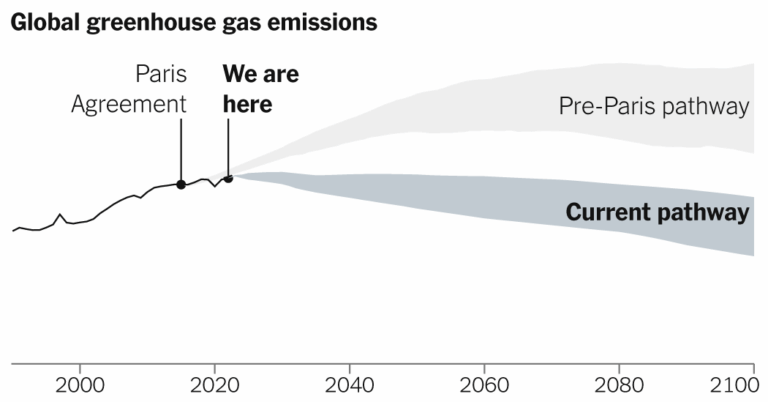
Almost exactly 10 years ago, a remarkable thing happened in a conference hall on the outskirts of Paris: After years of bitter negotiations, the leaders of nearly every country agreed to try to slow down global warming in an effort to head off its most devastating effects.
The core idea was that countries would set their own targets to reduce their climate pollution in ways that made sense for them. Rich, industrialized nations were expected to go fastest and to help lower-income countries pay for the changes they needed to cope with climate hazards.
So, has anything changed over those 10 years? Actually, yes. Quite a bit, for the better and the worse. For one thing, every country remains committed to the Paris Agreement, except one. That’s the United States.
We wanted to help you cut through the noise and show you 10 big things that have happened in the last 10 years.
1. Emissions have come down, but there’s still far to go.
Call this good-ish news. Lower emissions mean the arc of temperature increase has curved downward over the past 10 years. If countries stick to current policies, the global average temperature is projected to rise by 2.5 to 2.9 degrees Celsius by the end of the century. That’s a significant improvement from where we were 10 years ago: In 2015, scientific models said we were on track to increase the global average temperature by up to 3.8 degrees Celsius.
Global greenhouse gas emissions and expected warming
But none of the world’s biggest emitters — China, the U.S., the European Union, India — have met their Paris promises. And every degree of warming matters. A one-degree increase in average temperature, for instance, raises malaria risk for children in sub-Saharan Africa by 77 percent.
2. The last 10 years were the hottest on record.
We started burning coal, oil and gas on a large scale roughly 150 years ago. As a result, global temperatures have been rising ever since, and the last 10 years have been the hottest 10 on record.
Global temperatures compared with late-19th-century average
The most scorching was 2024. That year, extreme heat killed election workers in India and pilgrims on the hajj in Saudi Arabia. This year, it forced the temporary closure of the top of the Eiffel Tower at the peak of tourist season and shuttered schools in parts of the United States.
3. Solar is spreading faster than we thought it would.
Solar power has been the largest source of new electricity generation for the last three years. Most of this new solar infrastructure is coming up inside China, and Chinese companies are making so much surplus solar equipment — cells, modules and everything that goes into them — that prices have plummeted.
Forecasts keep underestimating solar growth
Today, solar panels hang from apartment balconies in Germany and cover vast areas of desert in Saudi Arabia. Solar and onshore wind projects offer the cheapest source of new electricity generation. Little wonder, then, that in India’s electricity sector, more than half of the generation capacity now comes from solar, wind and hydropower.
4. Electric vehicles are now normal.
The way the world moves has changed. At the time of the Paris Agreement, Tesla had just unveiled its luxury electric SUV. Fast forward to last year: Worldwide, one in five cars sold was electric.
In the United States, 265,000 children ride electric buses to school. In Kenya, electric motorcycle taxis ferry commuters to work. Chinese carmakers are assembling E.V.s abroad, including in Brazil, Indonesia and, soon, in Saudi Arabia, a petrostate.
World
United States
Electrifying transportation is important because it’s one of the biggest sources of emissions globally. Currently, electric vehicles are displacing 2 million barrels of oil demand per day, roughly equal to Germany’s total daily demand, according to BloombergNEF.
5. Rich countries have put relatively little money on the table.
One of the key tenets of the Paris Agreement was an acknowledgement that countries had different responsibilities. Wealthy industrialized countries were supposed to pony up money to help poorer countries do two things: transition to renewable energy and adapt to the problems brought on by a hotter climate.
Last year, countries agreed that a total of $1.3 trillion would be needed every year by 2035 to help developing countries manage climate harms, including $300 billion a year in public monies from rich countries. That’s far more than what rich countries have thus far made available. Where that money will come from is still uncertain.
Public climate finance from developed countries would need to increase substantially
Meanwhile, some of the poorest countries are getting clobbered by extreme weather. They’re falling deeper into debt as they try to recover.
6. Coal is in a weird place.
The growth of coal is slowing worldwide. That matters because coal, which powered the modern industrial economy, is the dirtiest fossil fuel.
Coal is waning in wealthy countries, including the United States, despite President Trump’s efforts to expand its use. Britain, the birthplace of the Industrial Revolution, closed its last coal plant in 2024. That year, more than half of Britain’s electricity came from renewables. But coal is still growing in China, which, despite its pledge to clean up its economy, has gone on to build more coal plants than any other country, ever.
In America, coal demand fell faster than expected…
…while in China, it grew faster than expected
7. Natural gas, a planet-warming fossil fuel, is ascendant thanks to America.
Over the decade since the Paris Agreement was signed, the United States has rapidly become the world’s leading producer and exporter of gas.
Liquid natural gas opened up an export boom
Mr. Trump, in his second term, has supersized that ambition. He appointed Chris Wright, a former fracking executive, as the U.S. energy secretary, and he has used the sale of American gas as a diplomatic and trade cudgel. That matters because, while gas is cleaner than coal as a source of electricity, it stands to lock the world into gas use for decades to come.
8. Forests are losing their climate superpower.
Fires are increasingly driving forest loss worldwide. That’s because rising temperatures and more intense droughts are making forests burn more easily and also because people are setting fire to forests to clear land for agriculture.
The world’s forests are absorbing less carbon dioxide
That’s limiting the ability of many forests to store planet-warming carbon dioxide. In fact, it’s pushing parts of the Amazon rainforest, often called the lungs of the planet, to a startling tipping point. Parts of the Amazon are releasing more carbon than trees and soil are absorbing. One recent study found the same pattern in the rainforests of Australia.
9. Corals are bleaching more often.
Since 2015, two separate global bleaching events have stretched over six years. They’re happening much more often than before, and affecting more reefs, because the oceans are heating up fast.
Percent of the world’s coral reefs affected by each bleaching event
Corals are important because they support so many other creatures, including fish that millions of people rely on for nutrition and income. About a quarter of all marine species depend on reefs at some point in their life cycle.
Many reefs have been ravaged, but some coral species are turning out to be more resilient to marine heat waves than we had thought. That’s good-ish news, too.
10. U.S. electricity demand is soaring, in part because of A.I.
Power demand had always been expected to increase worldwide. More than a billion people still need access to electricity, and billions of others around the globe are buying air-conditioners and plugging in electric vehicles. But a big surprise came from the United States.
American electricity demand was pretty flat in the 2010s but is now rising significantly and is projected to climb for at least another decade. One reason: energy-hungry A.I. That raises a critical question for Big Tech: Will its A.I. ambitions heat up the planet faster?
After two decades of slower demand growth, energy needs are rising.
What does all this mean for the world’s 8 billion people?
The physical damage inflicted by global warming costs the global economy around $1.4 trillion a year, according to BloombergNEF.
It means we are being forced to adapt to new conditions on a climate-altered planet. Many already are, especially the most vulnerable among us. In India, a women’s union has created a tiny new insurance plan to help workers cope when it gets dangerously hot. In China, a landscape architect has persuaded cities to create porous surfaces to let floodwaters seep in. In the United States, school playgrounds are adding shade to protect kids on exceptionally hot days. In California, an app developer created a tool to help his neighbors track the path of wildfires. In Malawi and Uganda, people are experimenting with growing different crops.
A big problem is, there’s very little money to help them, and even that has declined in the last couple of years.
Apollo’s Torsten Slok warns that the S&P 500 is at ‘historically extreme valuations’
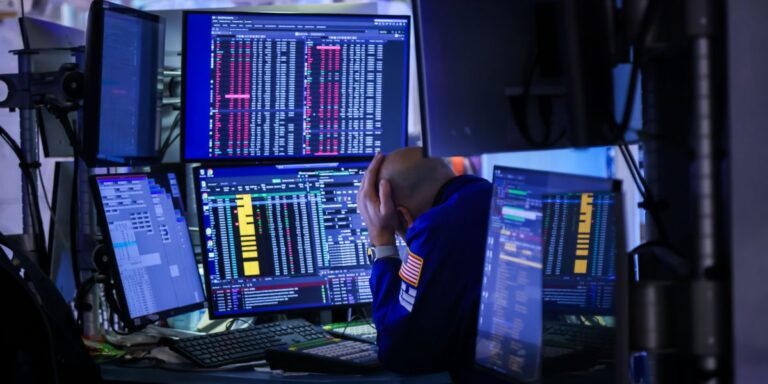
Markets are not in a comfortable place right now. The S&P 500 was down by more than a percentage at yesterday’s close, the Dow Jones by near the same, and the Nasdaq was down nearly 2%. The VIX volatility index, by contrast, is up more than 9%—suggesting the turbulence is far from over.
Even then, Apollo’s chief economist, Torsten Sløk, wrote this week the S&P is at “historically extreme valuations.” In a note to clients yesterday, Sløk charted the “Warren Buffett indicator” (U.S. stock market cap to GDP) against the Shiller cyclically adjusted price-to-earnings ratio.
The result is—perhaps unsurprisingly—that over time the Buffett indicator has increased toward the exteme end, as has price-to-earnings. However, 2025 stands out as a particularly extended outlier.
The latest data underlines a broader concern among analysts that a reckoning is looming for the markets. The CEOs of both Morgan Stanley and Goldman Sachs have stated this week that they foresee a significant selloff ahead, with markets potentially adjusting down by as much as 20% over the next two years.
High valuations themselves don’t necessarily signal an imminent correction, argued UBS’s chief investment officer, Mark Haefele, in a note to clients yesterday. He said that on the whole there is “no doubt” that valuations are above average but the market is unlikely to correct itself based purely on this fact.
Instead, he argues, declines will come “when corporate profit growth disappoints, with forward returns more correlated with changes in earnings expectations over the next 12 months.”
He added: “Results from the current earnings season have been solid, with both the breadth and magnitude of earnings beats so far exceeding historical averages. We forecast S&P 500 earnings per share to grow 10% this year, and see upside to our expectation of a 7.5% growth next year. Additionally, we believe current valuations are justified, as the increased weighting of higher-multiple sectors (such as IT) in equity benchmarks should help sustain higher valuations.”
It would be remiss not to mention the driver of valuations: AI. Capex on the revolutionary technology isn’t only pumping valuations in markets, it’s so huge that it’s a key driver for the U.S. economy as a whole. The level of funds being pumped into AI and its infrastructure has led to (arguably inevitable) bubble questions about whether the technology can live up to its promise.
“Given aggressive valuations, however, investors must be asking where the fuel for 2026 gains will come from,” chimed Lisa Shalett, chief investment officer at Morgan Stanley in a note on Monday. “In essence, portfolio positioning hinges on whether the AI capex boom will deliver as modeled. Our view remains 50/50, given that implementation may take longer than hoped for, with productivity gains limited to a few scaled companies.”
Of course, valuations also comes down to timing: When does the market see companies finally delivering the results they are being valued on?
This is the argument of Mary Callahan Erdoes, CEO of JPMorgan’s asset and wealth management business, who acknowledged that while in some stocks there is “a little too much concentration,” argued at Fortune’s Global Forum last month: “AI has not even been deployed anywhere to the extent that it will be. Less than 10% of companies actually say that it’s embedded in the services and the products that they deliver today. There’s an enormous amount of opportunity.”
She added: “That’s why you’re seeing the multiples are the way they are. And the question is, how fast will we grow into those multiples? It’s not that the multiples are wrong, they will eventually be right; they may not be right for every company.”
Here’s a snapshot of the markets ahead of the opening bell in New York this morning:
- S&P 500 futures are up 0.17% this morning. The last session closed down 1.12%.
- STOXX Europe 600 was flat in early trading.
- The U.K.’s FTSE 100 was down 0.48% in early trading.
- Japan’s Nikkei 225 was down 1.19%.
- China’s CSI 300 was up 0.31%.
- The South Korea KOSPI was down 1.81%.
- India’s NIFTY 50 is down 0.1%.
- Bitcoin was down to $100.9K.
Analyzing Nancy Pelosi’s statements over the years for accuracy | Political Updates
Almost since PolitiFact’s 2007 founding, it has been covering Representative Nancy Pelosi, who announced her retirement, effective in January 2027.
We first fact-checked the former House speaker on August 25, 2008, when she characterised then-presidential candidate Barack Obama as a state legislator with a history of bipartisanship, a claim we rated Half True. In all, we have rated Pelosi’s statements 56 times on Truth-O-Meter, with a median rating of Half True.
Recommended Stories
list of 4 itemsend of list
Political analysts consider Pelosi, 85, one of the most effective legislative leaders in recent US history. With small margins, Pelosi was mostly able to keep her caucus united behind legislative goals on healthcare, the environment and other issues.
Her ability to raise money for Democrats was one reason she remained as minority leader when she lost her speaker’s gavel after the 2010 midterms and ascended again to speaker in 2018, when the Democrats won the majority. Pelosi lost the speakership when the GOP won the chamber in 2022. She left her leadership position but remained as a rank-and-file member.
Pelosi was known for her effectiveness outside the public eye – in Capitol cloakrooms and private dinners. Republicans targeted her sometimes awkward rhetorical style in front of television cameras, combined with her representation of one of the nation’s most liberal districts, in San Francisco.
On the internet, Pelosi has been falsely accused of being drunk (many, many times); of spending extravagantly on her hair; of falling; of crying in public; of being arrested; of palling around with drug kingpin El Chapo; of calling Americans stupid; of being expelled from the House; of being divorced by her husband; of being arrested and disappeared by US marshals; of committing treason; and of being executed.
When a hammer-wielding intruder attacked her husband, Paul, in their home in 2022, conspiracy theories flourished, fanned by President Donald Trump and others, including that the entire episode was a “false flag” event.
Here’s a rundown of memorable Pelosi moments in recent fact-checking history.
Pelosi v Trump: Ripped speech, policy fights, January 6
Pelosi and Trump have a long-running rhetorical feud. When a reporter asked Trump about Pelosi’s retirement announcement hours after she made it, Trump called her “an evil woman”.
In 2018, Trump falsely said Pelosi “came out in favour of MS-13”, the criminal gang. Pelosi had criticised Trump for using the term “animals” during an immigration meeting, but she hadn’t said anything positive about MS-13.
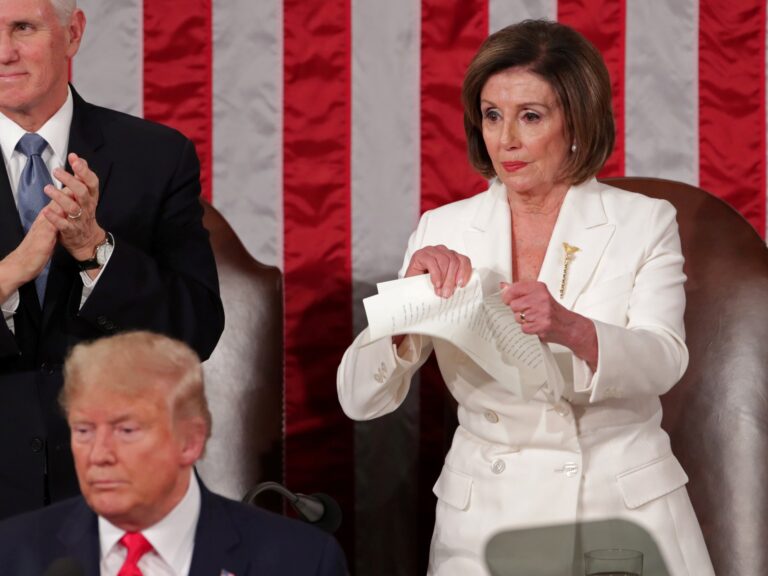
In 2020, after Pelosi dramatically ripped up a paper copy of Trump’s State of the Union address from her seat behind the president, Trump said: “I thought it was a terrible thing when she ripped up the speech. First of all, it’s an official document. You’re not allowed. It’s illegal what she did. She broke the law.”
We rated that False. Pelosi ripped up her own duplicate copy of Trump’s address, not the official version sent to the National Archives under the Presidential Records Act, so it would not have been illegal to destroy it.
Pelosi earned a Mostly True for saying in 2017 that Trump’s first-term tax bill “would have cut his taxes by $30 million in 2005”.
But she earned a False in 2020 for saying Trump is “morbidly obese”. Trump had told reporters that he was taking hydroxychloroquine to prevent COVID-19, an approach that mainstream doctors called dubious; she said it was not a sound idea for someone “in his, shall we say, weight group”. Even if Trump was fudging his official height and weight, he would have needed to be substantially heavier to meet a level of morbid obesity.
The pair’s most bitter exchanges revolved around January 6, 2021, the day Trump supporters stormed the Capitol as Congress formally counted the 2020 electoral results. Rioters entered Pelosi’s office and called for her as they marched through the Capitol.
Trump has repeatedly said he requested “10,000 National Guardsmen” to provide security at his supporters’ January 6, 2021, rally, but that Pelosi “rejected it”. As early as February 28, 2021, we rated that False. In subsequent fact-checks, we found no new information to support Trump’s assertion about Pelosi and National Guard troops.
Pelosi played a central role in landmark healthcare legislation
One of her biggest policy legacies is the enactment of the Affordable Care Act in 2010, which was Obama’s top policy priority in 2009. The bill dominated the early political debate of his presidency, and Pelosi, as speaker, had a key role in securing Democratic support for Obama’s vision.
Pelosi accurately discussed some policy differences between Democratic and Republican healthcare bills, such as the Democratic proposals’ protection for people with a preexisting condition.
But we also found truth in one Republican criticism involving the bill – that Pelosi had said Democrats “have to pass their terrible healthcare bill so that the American people can actually find out what’s in it”. That was close to what Pelosi really said, though that Republican Party of Texas’s synopsis ignored her comments about why the legislation made her proud.
Pelosi was a star fundraiser, but we found one of her money claims misleading
Between 2000 and 2024, Pelosi raised $86.6m for her campaign committee and an additional $51m for her leadership political action committee, according to OpenSecrets, a nonprofit that tracks campaign finance information.
Despite her fundraising prowess, she exaggerated in 2017 when describing Wall Street money raised by Republicans and Democrats. She said: “Wall Street comes out en masse with its money against House Democrats every election.” But she had cherry-picked three campaign cycles in which Republicans held the House majority while ignoring election cycles in which the Democrats were in control, including two in which Pelosi was speaker. We rated the statement Mostly False.
Pelosi’s False statements
Pelosi’s four False ratings included:
- Her 2010 blog post saying that then-House Minority Leader John Boehner “admits ‘we are not going to be any different than we’ve been’” by returning to “the same failed economic policies” that “wrecked our economy”. We found that Boehner had been talking specifically about social issues, not the economy, and that the video clip she shared removed that context from Boehner’s statement.
- Her decision in 2011 to promote a chart showing Obama had “increased the debt” by 16 percent, compared with his predecessor, President George W Bush, who had increased it by 115 percent. The chart included a major calculation error, ignored different lengths of presidential tenure and cherry-picked the most favourable measure.
- Her 2016 claim that until shortly before her statement, China and Russia had “never voted with us at the UN on any sanctions on Iran”. We found eight Security Council resolutions over a decade threatening, imposing or continuing sanctions against Iran in which Russia and China approved.
- Her 2019 statement that a voter-roll purge in Wisconsin would mean that more than 200,000 registered Wisconsin voters would be prohibited from voting. We found that a purge could have potentially removed more than 200,000 people from the voting rolls, but they would not be “prohibited” from voting; anyone could re-register, including on Election Day.
That one time we fact-checked Pelosi in real time
We once fact-checked Pelosi in person, on television, in real time. And this time, it wasn’t on policy.
In 2018, this reporter was president of the Washington Press Club Foundation, which mounts an annual black-tie congressional dinner. Pelosi has been a frequent guest speaker at the event, and that year, she began her remarks by thanking members of the head table, including “President Louis Jacobson of FactCheck.org”.
I interrupted her. “Actually, PolitiFact.” As the audience laughed, Pelosi quickly pivoted.
“That’s OK, staff,” she said. “It was Mostly True.”
Hannah Rouch appointed VP of Marketing Europe at AXS, while Peter Quinlan assumes role of MD for Europe

AEG ticketing subsidiary AXS has made two key leadership appointments as part of its expansion across Europe.
Peter Quinlan has been named Managing Director, Europe, and Hannah Rouch joins as the VP, Marketing, Europe – both, newly created roles.
Based in London, and reporting to Blaine Legere, President, International, Quinlan will lead AXS’s European operations, “unifying and advancing the company’s regional strategy with a focus on growth, alignment, and operational excellence,” the company said on Thursday (November 6).
Rouch, meanwhile, also based in London, will oversee AXS’s European Marketing, working closely with Quinlan to “strengthen the AXS brand and drive marketing excellence, growth and innovation across all European territories”.
Quinlan brings 18 years of experience at Live Nation Entertainment, where he held a range of senior roles spanning marketing, sponsorship, and ticketing across global markets.
Most recently, Quinlan served for four years in a Global Executive role at Ticketmaster, leading initiatives across commercial partnerships, ancillary revenues, payments, and fraud operations.
Hannah Rouch VP, Marketing will report to Quinlan to “accelerate growth across the market”. Rouch brings extensive marketing experience in e-commerce industries, having most recently joined from Gumtree/Ebay where she spearheaded a purpose and brand lead reposition of the platform.
She has also held leadership roles within Motors.co.uk and Bauer Media and brings with her a wealth of media and agency experience.
“Europe remains a critical growth engine for AXS, and these appointments mark an important step forward in our continued evolution.”
Blaine Legere, AXS
“Europe remains a critical growth engine for AXS, and these appointments mark an important step forward in our continued evolution,” said Blaine Legere, President of International, AXS.
“Peter’s global experience and operational acumen, combined with Hannah’s deep marketing expertise and track record of execution, will be instrumental as we continue to scale and deliver across the region.”
Added Legere: “These new appointments reflect AXS’s ongoing commitment to scale, unify, and empower our international teams. With this expanded leadership structure, we’re better positioned than ever to deliver world-class support for our clients and partners.”
“AXS has built a reputation as one of the most artist- and fan-friendly companies in the industry.
Peter Quinlan
Quinlan said: “AXS has built a reputation as one of the most artist- and fan-friendly companies in the industry.
“There’s tremendous opportunity for growth — especially in Europe, where promoters, venues, and artists are looking for innovative, transparent partners, with technology that can scale and deliver. I’m excited to help lead that charge.”
“I’m thrilled and energised to take on this role at a time of significant growth for AXS across Europe.”
Hannah Rouch
Hannah Rouch added: “I’m thrilled and energised to take on this role at a time of significant growth for AXS across Europe.
“Our focus will be on strengthening our brand and reach across Europe and building out marketing as a growth engine for the business – accelerating our ability to deliver for our clients and enhancing our efforts to ‘hold the hand of the fan’ from show discovery to live event.”
Music Business Worldwide
Several individuals become sick after package delivered to Air Force One facility

Multiple people have fallen ill after opening a “suspicious package” delivered to the base of operations for Air Force One.
A spokesperson for Joint Base Andrews (JBA) in Maryland, near the US capital, Washington DC, said the building the package was opened in was evacuated and those taken ill were found to be in a stable condition by medical staff.
The package contained an unidentified white powder, CNN reports, citing unnamed sources familiar with an investigation into the incident.
The air base houses the US presidential plane and its support craft, and is where the president usually departs on trips.
The JBA spokesperson said the building in which the package was opened and a connecting building were evacuated “as a precaution” and a cordon established around the area.
They added: “First responders were dispatched to the scene, determined there were no immediate threats, and normal operations have resumed. An investigation is currently ongoing.”
Initial tests by a Hazmat team did not detect anything hazardous, according to CNN.
It reports that investigators are also assessing political propaganda that was included in the package.
It is unclear the extent or the nature of the illness suffered by those near the package when it was opened.
Challenging Client Situation

A required part of this site couldn’t load. This may be due to a browser
extension, network issues, or browser settings. Please check your
connection, disable any ad blockers, or try using a different browser.
Using Radio Traffic to Monitor U.S. Drone Activity in the Caribbean

new video loaded: How Radio Traffic Let Us Track U.S. Drones in the Caribbean
The U.S. military’s buildup near Venezuela has been rapidly growing and changing. Riley Mellen, from Visual Investigations, describes what’s visible, and audible, about the deployment.
By Riley Mellen, Coleman Lowndes, David Seekamp, James Surdam and Zach Caldwell
November 6, 2025