US Senate vote to end shutdown delivers reprieve to investors worried about AI valuations and weakness in US economy.
Published On 10 Nov 202510 Nov 2025
Share
Stocks from the United States to Japan have risen sharply amid hopes that an end to the longest US government shutdown in history is imminent.
US lawmakers on Sunday moved to end a five-week impasse over government funding, a boost for investors unnerved by signs of growing weakness in the US economy and the sky-high evaluations of firms involved in artificial intelligence.
Recommended Stories
list of 4 itemsend of list
After a group of Democrats broke with the party leadership to join Republicans, the US Senate voted 60-40 to advance a bill that would fund government operations through the end of January.
The funding package still needs to win final approval in the Senate and then pass the US House of Representatives, after which it would go to US President Donald Trump for his signature – a process expected to take days.
Stock markets in the Asia Pacific made large gains on Monday, while futures in the US also rose in advance of stock exchanges reopening.
South Korea’s benchmark KOSPI led the gains, rising about 3 percent as of 4pm local time (07:00 GMT).
Japan’s Nikkei 225 and Hong Kong’s Hang Seng also rose sharply, advancing about 1.3 percent and 1.5 percent, respectively.
Taiwan’s Taiex rose about 0.8 percent, while Australia’s ASX 200 gained about 0.75 percent.
Futures for the US’s benchmark S&P 500 and tech-heavy Nasdaq-100, which are traded outside of regular market hours, were up about 0.75 and 1.3 percent, respectively.
The reprieve comes as investors are concerned that AI-linked stocks may be wildly overvalued and that Trump’s sweeping tariffs could be doing more damage to the US economy than has been captured in headline data so far.
Nvidia, whose graphics processing units are integral to the development of AI, last month became the first company in history to reach a market valuation of $5 trillion, a day after tech giant Apple surpassed $4 trillion in market value.
While the Bureau of Labor Statistics’ official jobs report has been suspended since August due to the government shutdown, several other analyses have pointed to a rise in layoffs in October.
Challenger, Gray & Christmas, an executive outplacement firm, said in a report last week that layoffs surged 183 percent last month, making it the worst October for jobs since 2003.
A separate analysis by Revelio Labs, a workforce analytics company, estimated that the economy shed 9,100 jobs during the month.
The Senate took the first step to end the government shutdown on Sunday after a group of moderate Democrats agreed to proceed without a guaranteed extension of health care subsidies, angering many in their caucus who say Americans want them to continue the fight.
In a test vote that is the first in a series of required procedural maneuvers, the Senate voted 60-40 to move toward passing compromise legislation to fund the government and hold a later vote on extending Affordable Care Act tax credits that expire Jan. 1. Final passage could be several days away if Democrats object and delay the process.
The agreement does not guarantee the Affordable Care Act subsidies will be extended, as Democrats have demanded for almost six weeks. Senate Democratic leader Chuck Schumer of New York voted against moving ahead with the package, along with all but eight of his Democratic colleagues.
A group of three former governors — New Hampshire Sen. Jeanne Shaheen, New Hampshire Sen. Maggie Hassan and Independent Sen. Angus King of Maine — broke the six-week stalemate on Sunday when they agreed to vote to advance three bipartisan annual spending bills and extend the rest of government funding until late January in exchange for a mid-December vote on extending the health care tax credits. The agreement also includes a reversal of the mass firings of federal workers by the Trump administration since the shutdown began on Oct. 1 and would ensure that federal workers receive back pay.
Senate Majority Leader John Thune quickly endorsed the deal and called the immediate vote to begin the process of approving it as the shutdown continued to disrupt flights nationwide, threaten food assistance for millions of Americans and leave federal workers without pay.
“The time to act is now,” Thune said.
Returning to the White House on Sunday evening after attending a football game, President Donald Trump did not say whether he endorsed the deal. But he said, “It looks like we’re getting close to the shutdown ending.”
Five Democrats switch votes
In addition to Shaheen, King and Hassan, Democratic Sen. Tim Kaine of Virginia, home to tens of thousands of federal workers, also voted in favor of moving forward on the agreement. Illinois Sen. Dick Durbin, the No. 2 Democrat, Pennsylvania Sen. John Fetterman and Nevada Sens. Catherine Cortez Masto and Jacky Rosen also voted yes.
The moderates had expected a larger number of Democrats to vote with them as around 10-12 Democratic senators had been part of the negotiations. But in the end, only five Democrats switched their votes — the exact number that Republicans needed. King, Cortez Masto and Fetterman had already been voting to open the government since Oct. 1.
The vote was temporarily delayed on Sunday evening as three conservatives who often criticize spending bills, Republican Sens. Mike Lee of Utah, Rick Scott of Florida and Ron Johnson of Wisconsin, withheld their votes and huddled with Thune at the back of the chamber. They eventually voted yes after speaking to Trump, Lee said.
Another Republican, Sen John Cornyn of Texas, had to fly back from Texas to deliver the crucial 60th vote.
Schumer votes no
After Democrats met for over two hours to discuss the proposal, Schumer said he could not “in good faith” support it.
Schumer, who received blowback from his party in March when he voted to keep the government open, said that Democrats have now “sounded the alarm” on health care.
“We will not give up the fight,” he said.
Independent Sen. Bernie Sanders of Vermont, who caucuses with the Democrats, said that giving up the fight was a “horrific mistake.”
Sen. Chris Murphy, D-Conn., agreed, saying that people in last week’s elections voted overwhelmingly Democratic “to urge Democrats to hold firm.”
A bipartisan agreement
Democrats had voted 14 times not to reopen the government as they demanded the extension of tax credits that make coverage more affordable for health plans offered under the Affordable Care Act. Republicans said they would not negotiate on health care, but GOP leaders have been quietly working with the group of moderates as the contours of an agreement began to emerge.
The agreement includes bipartisan bills worked out by the Senate Appropriations Committee to fund parts of government — food aid, veterans programs and the legislative branch, among other things. All other funding would be extended until the end of January, giving lawmakers more than two months to finish additional spending bills.
The deal would reinstate federal workers who had received reduction in force, or layoff, notices and reimburse states that spent their own funds to keep federal programs running during the shutdown. It would also protect against future reductions in force through January and guarantee federal workers would be paid once the shutdown is over.
House Democrats push back
House Democrats swiftly criticized the Senate.
Texas Rep. Greg Casar, the chairman of the Congressional Progressive Caucus, said a deal that doesn’t reduce health care costs is a “betrayal” of millions of Americans who are counting on Democrats to fight.
“Accepting nothing but a pinky promise from Republicans isn’t a compromise — it’s capitulation,” Casar said in a post on X. “Millions of families would pay the price.”
Rep. Angie Craig of Minnesota posted that “if people believe this is a ‘deal,’ I have a bridge to sell you.”
House Democratic leader Hakeem Jeffries blamed Republicans and said Democrats will continue to fight.
“Donald Trump and the Republican Party own the toxic mess they have created in our country and the American people know it,” Jeffries said.
Health care debate ahead
It’s unclear whether the two parties would be able to find any common ground on the health care subsidies before a promised December vote in the Senate. House Speaker Mike Johnson, R-La., has said he will not commit to bring it up in his chamber.
Some Republicans have said they are open to extending the COVID-19-era tax credits as premiums could skyrocket for millions of people, but they also want new limits on who can receive the subsidies and argue that the tax dollars for the plans should be routed through individuals.
Other Republicans, including Trump, have used the debate to renew their yearslong criticism of the law and called for it to be scrapped or overhauled.
“THE WORST HEALTHCARE FOR THE HIGHEST PRICE,” Trump said of the Affordable Care Act in a post Sunday.
Shutdown effects worsen
Meanwhile, the consequences of the shutdown have been compounding. U.S. airlines canceled more than 2,000 flightson Sunday for the first time since the shutdown began, and there were more than 7,000 flight delays, according to FlightAware, a website that tracks air travel disruptions.
Treasury Secretary Sean Duffy said on CNN’s “State of the Union” that air travel ahead of the Thanksgiving holiday will be “reduced to a trickle” if the government doesn’t reopen.
At the same time, food aid was delayed for tens of millions of people as Supplemental Nutrition Assistance Program benefits were caught up in legal battles related to the shutdown.
And in Washington, home to millions of federal workers who have gone unpaid, the Capital Area Food Bank said it is providing 8 million more meals ahead of the holidays than it had prepared to this budget year — a nearly 20% increase.
Vyacheslav Penchukov, aka “Tank”, left thousands of victims across the world
After years of reading about “Tank” and months of planning a visit to him in a Colorado prison, I hear the door click open before I see him walk into the room.
I stand up ready to give this former cyber-crime kingpin a professional hello. But, like a cheeky cartoon character, he pokes his head around a pillar with a giant grin on his face and winks.
Tank, whose real name is Vyacheslav Penchukov, climbed to the top of the cyber-underworld not so much with technical wizardry, but with criminal charm.
“I am a friendly guy, I make friends easily,” the 39-year-old Ukrainian says, with a broad smile.
Having friends in high places is said to be one of the reasons Penchukov managed to evade police for so long. He spent nearly 10 years on the FBI’s Most Wanted list and was a leader of two separate gangs in two distinct periods of cyber-crime history.
It is rare to speak to such a high-level cyber-criminal who has left so many victims behind him; Penchukov spoke to us for six hours over two days as part of the ongoing podcast series Cyber Hack: Evil Corp.
The exclusive interview – Penchukov’s first ever – reveals the inner workings of these prolific cyber-gangs, the mindset of some of the individuals behind them and never-before-known details about hackers still at large – including the alleged leader of the sanctioned Russian group, Evil Corp.
It took more than 15 years for authorities to finally arrest Penchukov in a dramatic operation in Switzerland in 2022.
“There were snipers on the roof and the police put me on the ground and handcuffed me and put a bag on my head on the street in front of my kids. They were scared,” he recalls with annoyance.
He is still bitter about how he was arrested, arguing that it was over the top. His thousands of victims around the world would strongly disagree with him: Penchukov and the gangs he either led or was a part of stole tens of millions of pounds from them.
In the late 2000s, he and the infamous Jabber Zeus crew used revolutionary cyber-crime tech to steal directly from the bank accounts of small businesses, local authorities and even charities. Victims saw their savings wiped out and balance sheets upended. In the UK alone, there were more than 600 victims, who lost more than £4m ($5.2m) in just three months.
Between 2018 and 2022, Penchukov set his sights higher, joining the thriving ransomware ecosystem with gangs that targeted international corporations and even a hospital.
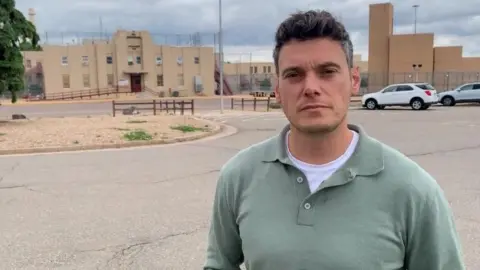
Englewood Correctional Facility, where Penchukov is being held, would not let us take any recording equipment inside the prison, so a producer and I make notes during the interview as we are watched over by a guard nearby.
Correspondent Joe Tidy outside Englewood Correctional Facility in Colorado
The first thing that stands out about Penchukov is that, although he is eager to be released, he seems in high spirits and is clearly making the most of his time in prison. He tells me he plays a lot of sport, is learning French and English – a well-thumbed Russian-English dictionary stays by his side throughout our interview – and is racking up high-school diplomas. He must be smart, I suggest. “Not smart enough – I’m in prison,” he jokes.
Englewood is a low-security prison with good facilities. The low-rise but sprawling building sits in the foothills of the Rocky Mountains in Colorado. The dusty grass verges surrounding the prison are teeming with noisy prairie dogs scurrying into their burrows whenever disturbed by prison vehicles coming and going.
It is a long way from Donetsk, Ukraine, where he ran his first cyber-crime gang after falling into hacking through games cheat forums, where he would look for cheats for his favourite video games like Fifa 99 and Counterstrike.
He became the leader of the prolific Jabber Zeus crew – so named because of their use of the revolutionary Zeus malware and their favourite communication platform, Jabber.
Penchukov worked with a small group of hackers that included Maksim Yakubets – a Russian who would go on to be sanctioned by the US government, accused of leading the infamous cyber-group Evil Corp.
Penchukov says that throughout the late 2000s, the Jabber Zeus crew would work out of an office in the centre of Donetsk, putting in six to seven-hour days stealing money from victims overseas. Penchukov would often end his day with a DJ set in the city, playing under the name DJ Slava Rich.
Cyber-crime in those days was “easy money”, he says. The banks had no idea how to stop it and police in the US, Ukraine and the UK could not keep up.
After hacking by day, Penchukov performed as DJ Slava Rich by night
In his early 20s, he was making so much money he bought himself “new cars like they were new clothes”. He had six in total – “all expensive German ones”.
But police got a breakthrough when they managed to eavesdrop on the criminals’ text chats in Jabber and discovered the true identity of Tank using details he had given away about the birth of his daughter.
The net closed in on the Jabber Zeus crew, and an FBI-led operation called Trident Beach saw arrests in Ukraine and the UK. But Penchukov slipped through the net thanks to a tip-off from someone he will not name. And thanks to one of his fast cars.
“I had an Audi S8 with a 500-horsepower Lamborghini engine so when I saw the cops flashing lights in my rear view mirror, I jumped the red light and lost them easily. It gave me a chance to test the full power of my car,” he says.
He laid low with a friend for a while, but when the FBI left Ukraine, the local authorities seemed to lose interest in him.
So Penchukov kept under the radar and, he says, went straight. He started a company buying and selling coal, but the FBI was still on the trail.
“I was on holiday in Crimea when I got a message from a friend who saw that I had been put on the FBI Most Wanted list. I thought I had got away with it all – then I realised I have a new problem,” he says, an obvious understatement.
FBI
Penchukov (R) was among the FBI’s most wanted; his two co-conspirators have yet to be caught
His lawyer at the time was calm, though, and advised him not to worry: as long as he did not travel outside of Ukraine or Russia, US police could not do much.
The Ukrainian authorities did eventually come knocking – but not to arrest him.
Penchukov had been outed as a wealthy hacker wanted by the West and he alleges that almost every day, officials would come and shake him down for money.
His coal-selling business was going well until Russia’s invasion of Crimea in 2014. President Putin’s so-called “Little Green Men” – Russian soldiers in unmarked uniforms – ruined his business and missiles struck his apartment in Donetsk, damaging his daughter’s bedroom.
Penchukov says that it was business troubles and the constant payouts to Ukrainian officials that led him to once again fire up his laptop and get back into the cyber-crime life.
“I just decided it was the fastest way to make money to pay them,” he says.
His journey charts the evolution of modern cyber-crime – from quick and easy bank account theft to ransomware, today’s most pernicious and damaging type of cyber-attack used in high-profile hacks this year, including on UK High Street stalwart Marks & Spencer.
He says ransomware was harder work but the money was good. “Cyber-security had improved a lot, but we were able to make about $200,000 a month. Much higher profits.”
In a revealing anecdote, he remembers rumours that started about a crew being paid $20m (£15.3m) from a hospital that had been crippled by ransomware.
Penchukov says the news fired up the hundreds of hackers in the criminal forums who all then went after US medical institutions to repeat the pay day. These hacker communities have a “herd mentality”, he says: “People don’t care about the medical side of things – all they see is 20 millions being paid.”
Penchukov’s gang left many victims; one said they felt “disbelief and horror” at losing their money
Penchukov rebuilt his connections and skills to become one of the top affiliates of ransomware services, including Maze, Egregor and the prolific group Conti.
When asked if these criminal groups worked with Russian security services – a regular accusation from the West – Penchukov shrugs and says: “Of course.” He says that some ransomware gang members sometimes talked about speaking to “their handlers” in the Russian security services, like the FSB.
The BBC wrote to the Russian Embassy in London, asking if the Russian government or its intelligence agencies engaged with cyber criminals to aid cyber espionage, but received no reply.
Penchukov soon rose to the top again and became a leader of IcedID – a gang that infected more than 150,000 computers with malicious software and led to various types of cyber-attack, including ransomware. Penchukov was in charge of a team of hackers who would sift through the infected computers to work out how best to make money from them.
One victim they infected with ransomware in 2020 was the University of Vermont Medical Center in the US. According to US prosecutors, this led to the loss of more than $30m (£23m) and left the medical centre unable to provide many critical patient services for more than two weeks.
Although no-one died, prosecutors say the attack, which disabled 5,000 hospital computers, created a risk of death or serious injury to patients. Penchukov denies he actually did it, claiming he only admitted to it in order to reduce his sentence.
Overall, Penchukov, who has since changed his surname to Andreev, feels the two nine-year sentences he is serving concurrently are too much for what he did (he is hoping to get out much sooner). He has also been ordered to pay $54m (£41.4m) in restitution to victims.
His view as a young hacker who started in cyber-crime as a teenager is that Western companies and people could afford to lose money and that everything was covered by insurance anyway.
But when I speak to one of his early victims from the Jabber Zeus days, it is clear his attacks did have a harmful impact on innocent people.
Lieber’s Luggage, a family-run business in Albuquerque, New Mexico, had $12,000 (£9,200) stolen in one swipe by the gang. Owner Leslee still recalls the shock years later.
“It was just disbelief and horror when the bank called because we had no idea what had happened, and the bank clearly didn’t have any idea,” she says.
While a modest sum, it was devastating for the business, as the money was used for paying rent, buying merchandise and paying staff.
They did not have any savings to fall back on and, to make matters worse, Leslee’s elderly mother was in charge of the company accounts and she blamed herself until the theft was uncovered.
“We had all of those feelings, the anger, the frustration, the fear,” she says.
When I ask them what they would like to say to the hackers responsible, they think it is futile to try to change the minds of these callous criminals.
“There’s nothing that we could say that would affect him,” Leslee says.
“I wouldn’t give him the time of day,” her husband Frank adds.
Penchukov says he did not think about the victims, and he does not seem to do so much now, either. The only sign of remorse in our conversation was when he talked about a ransomware attack on a disabled children’s charity.
His only real regret seems to be that he became too trusting with his fellow hackers, which ultimately led to him and many other criminals being caught.
“You can’t make friends in cyber-crime, because the next day, your friends will be arrested and they will become an informant,” he says.
“Paranoia is a constant friend of hackers,” he says. But success leads to mistakes.
“If you do cyber-crime long enough you lose your edge,” he says, wistfully.
FBI
Yakubets – known as ‘Aqua’ – was added to the FBI’s Most Wanted list in 2019
As if to highlight the disloyal nature of the cyber underworld, Penchukov says he deliberately avoided any further contact with his one-time Jabber Zeus collaborator and friend Maksim Yakubets after the Russian was outed and sanctioned in 2019 by Western authorities.
Penchukov says that he noticed a distinct change in the hacker community as people shunned working with Yakubets and many of his alleged Evil Corp associates.
Previously Penchukov and “Aqua”, as Yakubets was known, had hung out in Moscow drinking and eating in luxury restaurants. “He had bodyguards, which I thought was strange – almost like he wanted to show off his wealth or something,” he says.
Being ostracised from the cyber crime world did not deter Evil Corp though and last year, the UK’s National Crime Agency accused other members of the Yakubets family of being involved in the decade-long crime spree, sanctioning 16 members of the organisation in total.
But unlike Penchukov, the chances of police collaring him or others in the gang seem low. With a $5m bounty out for information leading to his arrest, Yakubets and his alleged co-conspirators are unlikely to repeat Penchukov’s mistake of leaving their country.
A required part of this site couldn’t load. This may be due to a browser
extension, network issues, or browser settings. Please check your
connection, disable any ad blockers, or try using a different browser.
McLaren’s Lando Norris won the Sao Paulo Grand Prix to surge 24 points clear in the Formula One championship on Sunday, while teammate and title rival Oscar Piastri finished fifth after being penalised for causing a collision.
Mercedes’s teenage rookie Kimi Antonelli hung on for a career-best second place, with Max Verstappen an astonishing third for Red Bull after starting from the pit lane.
Recommended Stories
list of 3 itemsend of list
Verstappen’s performance was all the more impressive after the four-time world champion, who won from 17th at Interlagos last year, suffered an early slow puncture and had to fight back from 18th.
“Crazy race,” said Norris of his second successive win and seventh of the season after snatching the championship lead from Piastri in Mexico last month.
“To be honest, I don’t think we were the quickest today, but I’m glad to take home the win.
“It’s a great win. But seeing how quick Max was, it’s disappointing we were not quicker.”
Norris leads McLaren teammate Oscar Piastri during the race [Amanda Perobelli/Reuters]
Piastri penalised for causing collision
Piastri, who started fourth with Norris on pole, served a 10-second penalty for an early clash with Antonelli, which put Ferrari’s Charles Leclerc out of the race after they went three-abreast.
It was another massive blow for the Australian, who crashed out of the Saturday sprint that Norris won on a perfect weekend for the Briton, who has moved up a gear and is now the clear title favourite.
George Russell was fourth for Mercedes, who consolidated second place overall in a constructors’ championship already won by McLaren.
With three races and a Saturday sprint remaining, Norris has 390 points to Piastri’s 366, with Verstappen falling further behind on 341 and his hopes looking slim despite his superlative drive in Sao Paulo.
Oliver Bearman was sixth for Haas, another fine performance from the British rookie after his fourth in Mexico, with Liam Lawson seventh for Racing Bulls ahead of teammate Isack Hadjar.
Nico Hulkenberg finished ninth for Sauber, and Pierre Gasly completed the points positions for Renault-owned Alpine, a year on from the team’s double podium in Brazil.
Sauber’s Gabriel Bortoleto completed a miserable weekend for Brazil’s only driver, spinning into the wall on the opening lap after being squeezed by Aston Martin’s Lance Stroll as Norris led cleanly away.
The crash brought out the safety car, with Ferrari’s Lewis Hamilton pitting for a new front wing after he collided with Williams’s Carlos Sainz and Alpine’s Franco Colapinto.
The seven-time world champion and honorary Brazilian continued with a damaged floor but was given a five-second penalty for causing a collision, and then retired.
The double driver retirement was Ferrari’s third of the season and dropped them down to fourth in the constructors’ championship, behind Red Bull in third.
Red Bull’s Max Verstappen, right, finished the Brazil Grand Prix in third place after beginning the race in the pit lane [Jean Carniel/Pool via Reuters]
Not all Piastri’s fault
The safety car came in at the end of lap five, and Piastri locked up and made contact with Antonelli, who was pushed into Leclerc at the restart.
The Ferrari lost a tyre and stopped, triggering a virtual safety car.
“He [Antonelli] left me no space,” the Australian said over the team radio, but stewards disagreed in what some pundits and even rivals felt was a harsh decision.
“I wouldn’t go as far as saying that it’s all Oscar’s fault. I don’t think it is,” said Leclerc.
Verstappen, who had a new engine and plenty of other changed parts after qualifying 16th, suffered a slow front-right puncture on lap eight after climbing to 13th.
He was up to fourth after 24 of the 71 laps, setting fastest laps, and on lap 51, he took the lead when Norris made his second and final stop.
Verstappen pitted again on lap 54, dropping to fourth and lighting the touch paper on a thrilling chase for the podium.
He passed Russell around the outside at turn one on lap 63, and Antonelli was in his sights four laps later, but the tyres then dropped off and the Italian made no mistakes.
“To be on the podium, I did not expect that at all,” said Verstappen. “To finish only 10 seconds from the lead is incredible.”
His teammate, Yuki Tsunoda, was the final driver classified after two 10-second penalties, the second for not serving the first correctly.
The next race is Las Vegas on November 22, the first of a final triple header ending in Abu Dhabi on December 7.
A marshal waves the checkered flag as Norris crosses the finish line to win the Brazil Grand Prix [Jean Carniel/ Pool via AFP]
The next 12 months could be among the brightest in the super welterweight division.
Vergil Ortiz Jr and Jaron Ennis could meet in a divisional super fight, while Britain’s Josh Kelly will have the chance to finally realise his potential against IBF champion Bakhram Murtazaliev — or risk becoming the latest casualty in the Russian’s relentless pursuit of greatness.
Add in the possible arrival of Conor Benn at 154lbs, the comeback of Tim Tszyu, and potential moves up in weight from Brian Norman Jr, Devin Haney, Mario Barrios and Rolando Romero, and it’s clear the super welterweight division could soon deliver something special.
For now, though, today’s contenders still have work to do before they can join the very best ever to have fought at 154lbs. Here are the five finest super welterweights of all time.
5. Wilfred Benitez
Benitez was only 22 when he beat Maurice Hope to win the WBC title. This was two years on from being stopped in the 15th round against Sugar Ray Leonard at 147lbs. His defensive brilliance and ring IQ were on another level. It was a short reign, but his performances at 154 — particularly the display against Hope — earned him his place among the best. A year later he would go and beat Roberto Duran, who still had plenty up his sleeve.
4. Winky Wright
A defensive master with a unique style and phenomenal jab who, like so many of the best at super welterweight, maybe isn’t celebrated enough. One of the more well-travelled American fighters, Wright will be remembered for his back-to-back wins against Shane Mosley in 2004 — part of a four-year run where he was one of the best fighters in the world. Not many wanted to take on Winky.
3. Terry Norris
There will be many who argue ‘Terrible’ Terry should be at the top. Quick, ferocious and powerful but so was Julian Jackson in 1989 and Norris paid the price. A year later Norris would destroy John Mugabi and did the same to Donald Curry, Meldrick Taylor and Maurice Blocker and outclassed a past-his-best Sugar Ray Leonard in 1991. At his peak he was almost untouchable, but his chin often left him vulnerable.
2. Thomas Hearns
We all remember ‘The Hitman’ from his highlight reel days as a welterweight and middleweight great. However, there was a reign at 154lbs that may have been short, but was explosive in typical Hearns’ fashion. Either side of his 160lbs war with Marvin Hagler, there were three impressive super welterweight world title wins against Wilfred Benitez, Roberto Duran and Mark Medal. His power was just as frightening and there is an argument that he was never better than at 154.
1. Mike McCallum
The surgical and precise ‘Body Snatcher’ is a lock for the top two spots and will be most people’s number one at 154lbs. His reign as WBA champion from 1984 to 1988 featured headline wins against Julian Jackson, Milton McCrory and Donald Curry. Two years earlier, he had beaten Ayub Kalule in a non-title bout. A vicious body-puncher who owned the division for a period but the appreciation wasn’t always there.
A rather striking cross between an oversized adventure van, toy hauler and globetrotting expedition vehicle, the Epicore Action Van does wild exploration and adventure a little differently. Instead of living like a miniaturized palace, its tall, wide, pop-top-expanded monocoque living space supplies the strict necessities and encourages occupants to spend long days immersing themselves in the surrounding mountains, deserts and forests. Its massive gear garage stores, organizes and maintains all your tools of adventure, while its roomy interior sleeps, feeds and toilets four people while ensuring they don’t get so cozy they miss dawn patrol.
If we ever saw an RV product appear like it should be rightfully covered in Red Bull livery, the Epicore Van would be it. More so than virtually any other adventure rig we can think of (this one maybe comes close), the Epicore is optimized for action sports and adrenaline-firing adventure from its tire contact patches to its rooftop solar panels. Its 35-mm-thick (1.4-in) fiberglass-sandwich module is even colored a shade of blue not far off from Red Bull’s.
Usually, we’d be inclined to call the Epicore, developed by Italian truck customizer Pichler Nutzfahrzeuge (Commercial Vehicles), an “expedition vehicle” since, despite being developed on a van chassis, it’s just too big and upfitted to feel like a van. And it’s more ruggedized and off-road-centric than what the term “Class B+ motorhome” brings to mind.
At 640 cm (252 in) long, the Epicore Van is actually well shorter than the longest camper vans on the market, but that’s the smallest model available among three different sizes. And it’s more the flared 225-cm (88.5-in) width, (3.3-m) 10.8-foot closed height and 7-ton gross vehicle weight rating that make it look so huge against the camper van masses.
The Epicore Van comes wired with solar panels and includes a central skylight
Pichler Nutzfahrzeuge
That said, the way Pichler lays out the floor plan is absolutely more in line with a bike-hauling adventure camper van than it is the luxury-showered inner sanctum of a long-range expedition vehicle. So the Epicore Van really strikes us as a supersized adventure camper van ready to chase down a remote trail access point, climbing approach or river put-in and work loyally as the homey base camp to which you return after the day’s (or days’) challenge.
The Epicore van’s biggest point of differentiation from the typical van, compact motorhome or expedition truck comes at the rear. Instead of the solid wall or dual doors you’d expect to find wrapping the back, Pichler installs a full-height drop-down tailgate that doubles as a loading platform. The interior of the door has rows of airline tie-down track that allow for mounting bikes and other gear vertically inside the van. The 750-kg (1,650-lb) load-rated tailgate opens and closes via an electro-hydraulic lift, taking the mounted bikes and gear right along with it.
A highlight of the Epicore Van is its automatic tailgate/bike carrier/sundeck
Pichler Nutzfahrzeuge
When lowered, the platform doubles as an above-ground deck area that campers can stand or sit on. It’s a place to get up off muddy or slushy ground to pull off one’s boots before entering the van, enjoy an après beverage, or take in the sunset or sunrise. It’ll be especially handy when parked on particularly rocky, muddy or otherwise unaccommodating ground surfaces, providing a better alternative for simply planting down a chair outdoors. Pichler even suggests backing up to the water’s edge and using the tailgate as a mini-dock.
Beyond the gear hanging vertically on the inside of the tailgate, the extra large rear garage includes plenty of storage space for additional cargo, accessories and clothing. Tie-down rails around the walls and ceiling provide a place to hang small items and secure strapped down cargo. Running with the Epicore mountain bike theme, you can keep your helmets, body armor, bike tools, cycling clothes and shoes all together in one place so that it’s easier to get ready and get out there come morning. The space even serves as a sheltered workshop for repairing and tuning gear.
The garage doubles as a bathroom and mud room/gear wash area
Pichler Nutzfahrzeuge
As if the garage weren’t already carrying its weight, it also double as the bathroom. There’s a shower sprayer to clean gear, boots and people and a drained floor below a rubber mat. The Boxio dry separating toilet slides out from a compartment at the bottom of the passenger-side cabinet console, and an electric roller partition splits the space off from the main living area at the push of a button. That partition is also a nice way of walling off wet, dirty, sweaty gear while eating and relaxing in the front lounge area.
We just started using a Boxio toilet ourselves, and we like it a lot … as a simple, practical solution for truck camping with a tent. We know the Epicore is all about function over form, solutions for adventure, not luxury, but we think any RV in this price and size category should have a nicer bathroom than a wide-open garage shower and portable $200 Eurobox with disposable bags and urine canister. A small partitioned room and a CompoCloset S1 or Clesana X1 toilet would probably do the trick without even making a discernible mark on the final price tag.
The rolling divider partition splits the bathroom/garage from the main kitchen/lounge area
Pichler Nutzfahrzeuge
But maybe we’ve just grown fussier about where we shower and shit than today’s Red Bull Rampage set.
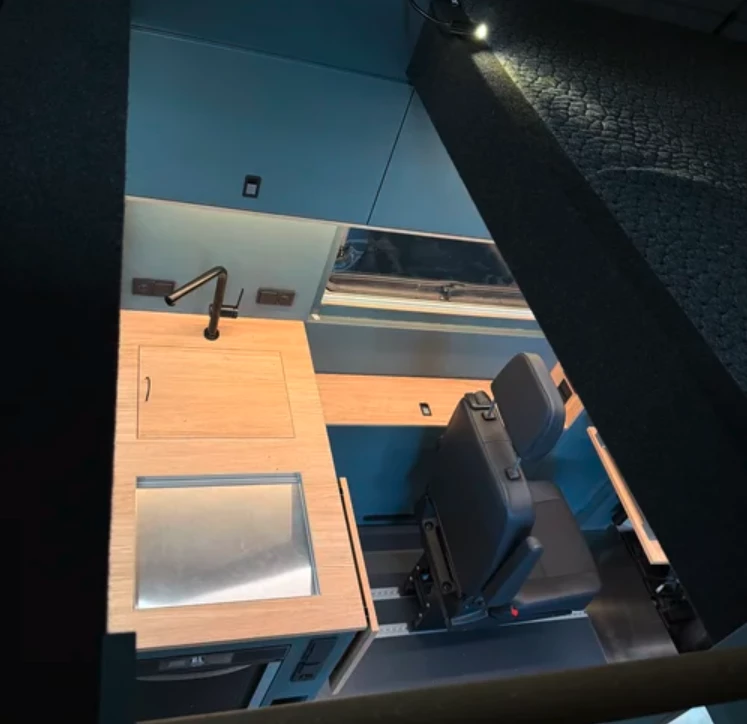
Inching forward, the Epicore kitchen is located just in front of the partition. The block includes a sink, stored portable induction cooktop, and a recessed utensil tray atop the countertop. Pichler chose not to hard-mount a cooktop so campers could also pull out the portable induction unit to cook outside.
The expandable kitchen sits on the edge of the garage and can serve as both a cooking space and a workbench
Pichler Nutzfahrzeuge
Both the utensil tray and sink have flush lids that function to connect the greater work space into single surface. Front and rear flip-up extensions further expand the work area to serve as both a cooking station and garage workbench. The 70-L Dometic fridge is located at the end of the kitchen block for easy access from both the living area and garage.
Up front, Pichler deconstructs the traditional front dinette into a more flexible space. Instead of a forward-facing two-seat bench, it installs two captain’s seats that can mount facing forward or sideways on the floor rails. The two cab swivel seats work to accommodate the other two campers on board, and a pair of floating Lagun tables let the dining space follow the campers’ seating positions.
Two console on the left across from the kitchen stores the dry toilet and includes the ladder splitting the two upper beds
Pichler Nutzfahrzeuge
The full-length electro-actuated pop-top up above doubles the sleeping space, accommodating four people on two separate 135 x 200-cm (53 x 79-in) beds. Along with the lower floor area, the upstairs space is heated via a dual air heater system that runs on diesel.
The roof itself is topped by four 150-W solar panels feeding the 480-Ah leisure battery. A 3,000-W Victron inverter, Revotion smart home control system, 10.9-in central command iPad, 70-A charge booster, Wi-Fi router, LED strip lighting, and 230-V and USB A/C outlets are also part of the electrical package. Pichler even mentions the option of a projector system with large screen for viewing and editing action cam footage on the spot – all that’s missing is a GoPro dash mount to film the ride before pulling the cam off and using it to grab biking footage.
The Epicore Van’s rear double bed
Pichler Nutzfahrzeuge
The Iveco Daily 4×4 chassis down below brings along a 180-hp 3.0-liter diesel engine, eight-speed Hi-Matic auto transmission, and all-wheel drive system with locking front and rear differentials. It’s also equipped with a leaf spring suspension, Marquart shocks and a 220-A alternator. It rides on a 348-cm (137-in) wheelbase, and Pichler offers larger models atop a 378- or 418-cm (149- or 165-in) Daily 4×4 wheelbase. Pichler is also working on a sizing the layout down into a 3.5-ton MAN TGE 4×4 van.
We love the concept of a no-holds-barred adventurer but think the Epicore needs just a little refinement, at least so far as that bathroom is concerned. Of course, Pichler is keen to work with clients on customizing floor plans, so we’re sure if one were to ask nicely, the builder wouild be willing to frame out a more proper wet bathroom.
Pichler does not list pricing information, but Germany’s Explorer Magazin mentions a price of €390,000 (approx. US$451,000) in a recent video walkthrough.
Yogita LimayeSouth Asia and Afghanistan correspondent
Family handout
Harshita Brella’s body was discovered in the boot of a car in London on 14 November last year
One year since Harshita Brella was strangled to death in the UK, there is a sense of disbelief in her family home in the Indian capital Delhi.
“Why has her killer not been caught yet? Neither the UK government nor the Indian government are doing anything,” Harshita’s mother Sudesh Kumari says, sobbing into her scarf. “I want justice for my daughter. Only then will I find peace.”
Harshita’s body was found in the boot of a car in Ilford, east London, on 14 November 2024, a day after her family contacted UK police to say they had not heard from her since 10 November.
Police believe Harshita, 24, was murdered on that day in Corby, Northamptonshire, by her husband Pankaj Lamba, who fled to India soon after the killing and is still on the run.
The couple, both Indian nationals, had moved from Delhi to the UK, settling in Corby, earlier that year.
Northamptonshire Police
A CCTV picture of the murder suspect Pankaj Lamba
In March this year, police in Northamptonshire charged him with murder. He also faces charges of rape, sexual assault and controlling or coercive behaviour.
Harshita’s sister Sonia Dabas is frustrated with the pace of investigations.
“We are very disappointed with the UK police. Maybe because we are not citizens of the UK, that’s why they are not serious about this case. They are sending out a message that foreign nationals are not safe in the UK,” she told the BBC.
Roughly two months before Harshita was killed, on 3 September, she had filed a case of domestic abuse against her husband. He was arrested and later released on bail on condition that he did not harass, pester or intimidate Harshita.
The Domestic Violence Protection Order (DVPO) expired four weeks later, on 1 October.
Sonia accuses Northamptonshire Police of being negligent in following up on the domestic abuse case. “That’s when Pankaj figured out that the UK police are not really serious about this case and he felt he could get away with murder,” she says.
Four officers of the Northamptonshire Police are being investigated over their handling of Harshita’s domestic abuse report and their interaction with her, by the Independent Office for Police Conduct (IOPC).
The IOPC told the BBC this week that their investigation was complete and had been shared with Northamptonshire Police. Northamptonshire Police say they have been given until mid-November to respond to the IOPC’s findings.
Northamptonshire Police said: “This is an exceptionally complex case and with criminal proceedings now active in the UK, we are unable to go into detail about the investigation at this time. However, we can confirm that the Indian authorities have been made aware through the appropriate channels of the charging decision.”
The Indian government has told the BBC they are in touch with the UK government on the matter, but neither side answered clearly about whether an extradition notice for Pankaj Lamba had been forwarded to the Indian authorities.
Ms Brella detailed the alleged abuse she suffered at the hands of her husband in a letter
Harshita’s family also told the BBC that they believe Pankaj Lamba is in India, being shielded by Indian police.
“He has relatives who are policemen. In March this year, he was seen on CCTV footage withdrawing money from a bank. Then how come he’s not been found yet? This is all because of corruption,” says Sonia. The family also says they have information that in the early months of this year, Pankaj was running a shop in Gurgaon, not far from where they live.
“They [the Delhi Police] are just killing time,” Sonia says.
The Delhi Police did not respond to Sonia’s accusations. They told the BBC that they have acted on the basis of a dowry complaint filed by Harshita’s parents against Mr Lamba and members of his family, including his parents and sister, who were arrested and are now out on bail.
The Delhi Police also say they issued public notices earlier this year offering a reward for information about Mr Lamba, and the search for him is still under way.
Harshita’s mother Sudesh Kumari says she still cannot believe her daughter is gone
Pankaj Lamba’s family home is in the village of Dharauli, about 40 miles (65km) north of Delhi, and not far from Gurgaon where Ms Brella’s family believe he was sighted in March. His parents Sudesh and Darshan Lamba didn’t want to be interviewed when the BBC visited.
But they rejected all the charges against them and their son. They claim they have not had any contact with him since 10 November 2024 – the same day that Harshita’s family last had contact with her.
For Harshita’s father, Satbir Singh Brella, the days are filled with visits to police stations and courts.
“My daughter was so straightforward, and kind hearted. A really terrible thing happened to her,” he says.
Her mother points to the shoes she’s wearing. They’re Harshita’s and were among her possessions from the UK returned to her family by British officials who visited them in July.
“They are tight for me, but I feel close to her when I wear them,” says Sudesh Kumari. “Sometimes I feel she’s still in the UK, I cannot believe she is gone.”
There were boos from some spectators in the stands when Trump was shown on the videoboard late in the first half — standing in a suite with House Speaker Mike Johnson — and again when the president was introduced by the stadium announcer at halftime.
The jeering continued while Trump read an oath for members of the military to recite as part of an on-field ceremony during the break in the game.
“I’m a little bit late,” Trump told reporters earlier when he got off Air Force One after landing at Joint Base Andrews, following a flyover of Northwest Stadium during the game. He then got in his armored car for the drive to the arena.
“We’re gonna have a good game. Things are going along very well. The country’s doing well. The Democrats have to open it up,” he said — a reference to the government shutdown.
In the first quarter Sunday, before the president arrived, Lions receiver Amon-Ra St. Brown celebrated a touchdown catch by pointing into the stands and moving his arms a la the “ Trump dance ” that several athletes began doing last year.
The White House said several cabinet secretaries and Republican Sen. Steve Daines of Montana also were scheduled to attend.
Only two other times did a president go to an NFL game during the regular season while in office, according to the league: Richard Nixon in 1969 and Jimmy Carter in 1978. Trump became the first president at a Super Bowl while residing in the White House when he watched the Philadelphia Eagles beat the Kansas City Chiefs 40-22 in February.
According to a report by ESPN on Saturday, an intermediary for the White House has told the Commanders’ ownership group that Trump wants the club’s new stadium — part of a nearly $4 billion project in the nation’s capital at the site of what was known as RFK Stadium — to bear his name.
“That would surely be a beautiful name,” press secretary Karoline Leavitt said.
Sunday’s visit was the latest in a series of high-profile appearances at sporting events by Trump, including golf’s Ryder Cup, auto racing’s Daytona 500 and tennis’ U.S. Open.
“We are honored to welcome President Trump to the game as we celebrate those who have served and continue to serve our country,” Commanders president Mark Clouse said. “The entire Commanders organization is proud to participate in the NFL’s league-wide Salute to Service initiative, recognizing the dedication and sacrifice of our nation’s veterans, active-duty service members, and their families this Sunday.”
Before the game, Defense Secretary Pete Hegseth chatted with principal owner Josh Harris — the leader of the group that purchased the Commanders from Daniel Snyder for about $6 billion in 2023 — and took part in an on-field ceremony with members of the military.
There was friction between Trump and the NFL during his first presidential term, when he objected to players kneelingduring the national anthem to protest social or racial injustice. That movement began in 2016 with then-49ers quarterback Colin Kaepernick.
Via social media and other public comments, Trump insisted that players should stand for the national anthem and called on team owners to fire anyone taking a knee.