


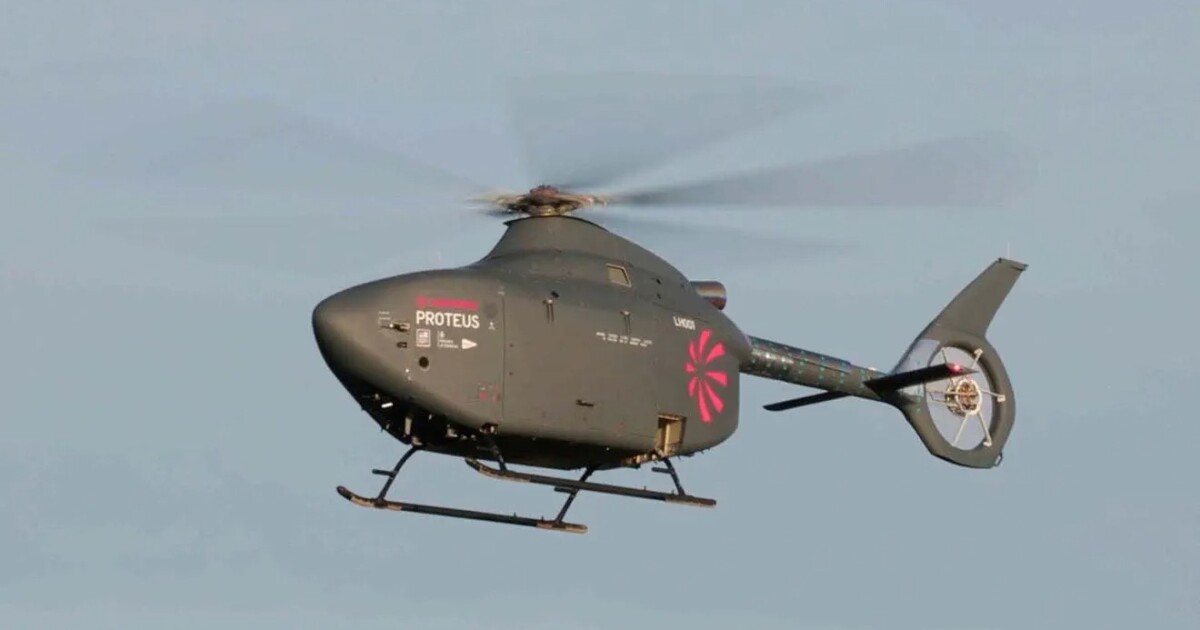
The Royal Navy highlighted its Hybrid Air Wing and Atlantic Bastion strategy as Leonardo’s full-scale Proteus autonomous helicopter completed its maiden flight on January 16, marking a key step toward mixed crewed and uncrewed operations.
With the changing geopolitical situation and a global rearmament campaign to respond to it, drones and other autonomous systems are becoming a major component of the world’s militaries. Case in point is Britain’s policy based on the 2025 Strategic Defence Review published last June. According to this, the strategy going forward will be for the Royal Navy to convert to a high-low mix of conventional crewed ships, submarines, and aircraft combined with autonomous ones.
A key element of this is the Atlantic Bastion program, which introduces a new dedicated undersea warfare strategy where conventional anti-submarine fleets are greatly supplemented by uncrewed hunters on the surface, underwater, and in the air to create a digital targeting web to track any and all submarine traffic in the Atlantic, North Sea, and Arctic regions.
Crown Copyright
A core component of this is Proteus. Developed by Leonardo in Yeovil, Somerset, Proteus is a full-scale helicopter based on the Leonardo AW09, weighing about three tonnes with a payload capacity of one tonne. It has a maximum speed of 140 knots (161 mph/260 km/h) and a flight endurance of five hours.
Its function is to act as a force multiplier for crewed Merlin and Wildcat helicopters as well as F-35B Lightning II fighter planes, allowing for greater capabilities without risking human pilots or more expensive aircraft. Its primary mission will be anti-submarine warfare, though it will also likely be assigned dull and dirty jobs like logistical support. That’s a polite way of saying schlepping rations.
Proteus boasts a modular payload bay for carrying sonobuoy dispensers, maritime search radar, and other sensors and communications systems. Currently, Proteus operates with a high degree of independent decision-making through its internal software stack rather than being a remotely piloted vehicle. This autonomy will be increased as the testing as the development program continues. It’s also not likely to look much like the current prototype as the technology matures.
“The successful first flight of Proteus is a significant step in delivering the Royal Navy’s maritime aviation transformation vision, and to demonstrating our steadfast commitment to investing in autonomy as part of a hybrid air wing,” said Commodore Steve Bolton, Royal Navy Deputy Director Aviation Future Programmes. “This milestone signals our intent to lead technological innovation, to enhance the fighting effectiveness of the Royal Navy in an increasingly complex operating environment, and to maintain operational advantage against evolving maritime threats.”
Source: Royal Navy

