


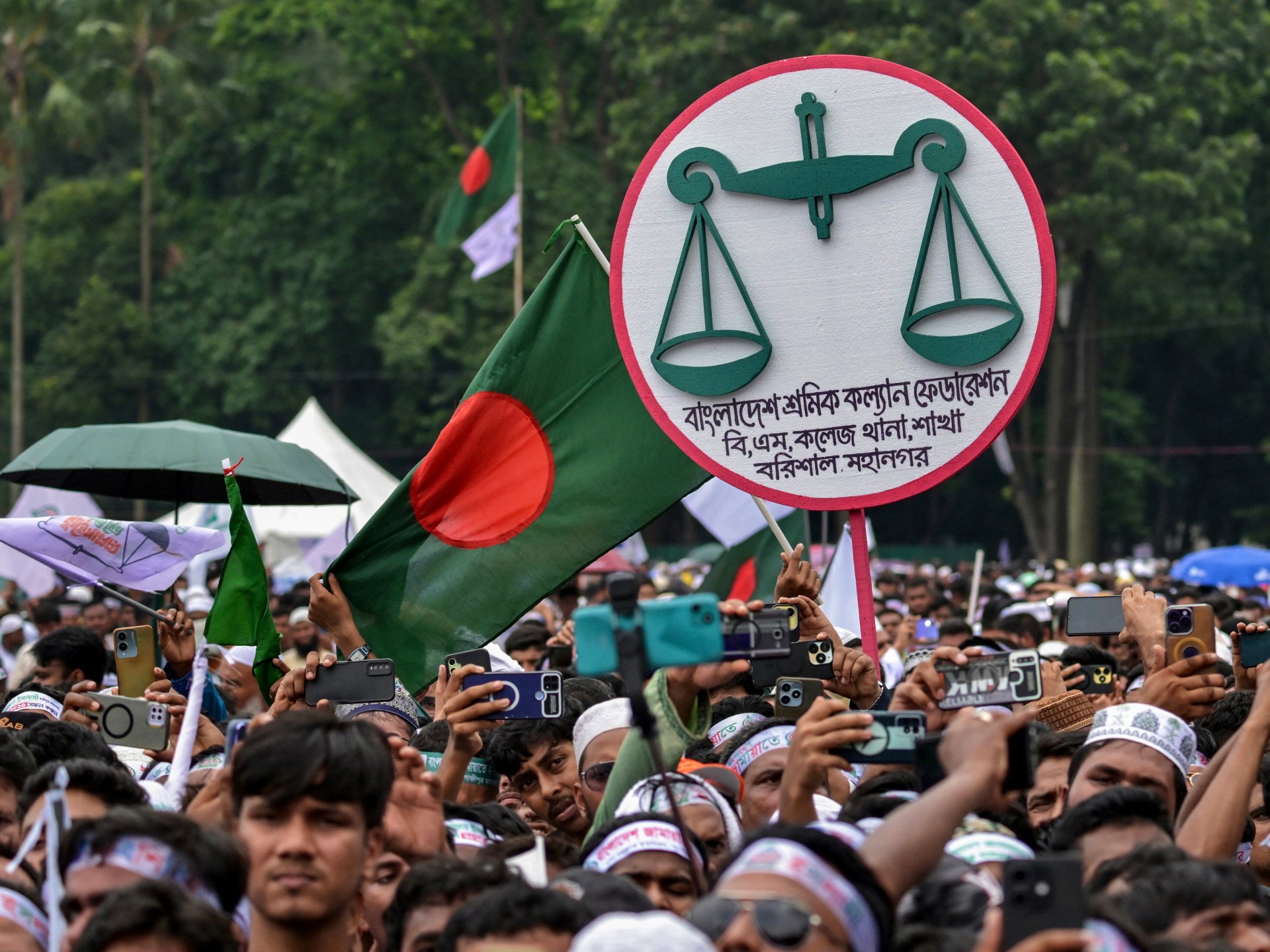
Dhaka, Bangladesh – For the first time in his life, Abdur Razzak, a 45-year-old banker in Bangladesh’s Faridpur district, believes the political party he supports has a real chance of coming to power as the leader of a governing alliance.
Campaigning for the Jamaat-e-Islami party’s “scales” symbol in his town, Razzak said people he was meeting with were “united in voting” for Jamaat, as the Islamist party is commonly referred to in the world’s eighth-most populous country, home to the fourth-largest Muslim population on the planet.
Recommended Stories
list of 4 itemsend of list
Bangladesh is scheduled to hold a general election on February 12, the first vote since a student-led uprising toppled longtime former Prime Minister Sheikh Hasina’s government in August 2024.
The interim government headed by Nobel Peace Prize laureate Muhammad Yunus, which succeeded Hasina after the uprising, banned her Awami League party. This has made the upcoming election a bipolar contest between the frontrunner, the Bangladesh Nationalist Party (BNP), and an electoral alliance forged by the Jamaat with the National Citizen Party (NCP), a group formed by student leaders of the 2024 uprising along with other Islamist parties.
Razzak’s confidence is fuelled by recent opinion polls that suggest the Jamaat is closing in on the BNP, its senior coalition partner for decades.
A December survey by the United States-based International Republican Institute put the BNP’s support at 33 percent, with Jamaat close behind at 29 percent. Another poll last week, conducted by leading Bangladeshi agencies – including NarratiV, Projection BD, the International Institute of Law and Diplomacy (IILD) and the Jagoron Foundation – found the BNP leading at 34.7 percent, and Jamaat at 33.6 percent.
If the Jamaat-led alliance is able to emerge victorious, it will be a dramatic turnaround for a party that was subjected to a brutal crackdown during Hasina’s 15-year government. Under Hasina, Jamaat was banned, its top leaders hanged or jailed, and thousands of its members forcibly disappeared or killed in custody.
The crackdown followed convictions by the International Crimes Tribunal – a controversial court that Hasina founded in 2010 – to try suspects for their alleged role in crimes committed during Bangladesh’s war of independence from Pakistan in 1971.
Ironically, the same tribunal in November sentenced 78-year-old Hasina to death for ordering a crackdown on the 2024 protesters, killing more than 1,400 of them. Hasina is in exile in India, her close ally, where she fled after the uprising. Despite several appeals by the Yunus administration, New Delhi has so far refused to hand Hasina over to face the gallows.
Resurgence after decades of repression
Jamaat supported Pakistan during the 1971 war, a move that continues to anger many in Bangladesh today. However, after Hasina’s escape to India during the uprising and the subsequent release of key Jamaat leaders from prison, the Islamist party has grown increasingly assertive.
“Our leaders and activists suffered throughout the Hasina years. Many of our leaders were executed. Jamaat and Shibir activists were killed, and our political rights were taken away,” Razzak told Al Jazeera, referring to Islami Chhatra Shibir, Jamaat’s student wing.
“Now, things have changed. People sympathise with what we went through, and they see us as honest. That is why they will vote for us,” he said.
Founded by Islamist thinker Syed Abul Ala Maududi in 1941, during the British rule on the Indian subcontinent, the Jamaat evolved from a trans-regional Islamist movement into a distinct political force in Bangladesh.
The party opposed Bangladesh’s independence from Pakistan, arguing that such a move could weaken Muslim political unity and alter the power balance in South Asia. During the 1971 war, senior Jamaat figures sided with the Pakistani state and even formed paramilitary groups that killed thousands of civilians demanding an independent Bangladesh.
Shortly after independence, the government of Sheikh Mujibur Rahman – Hasina’s father – banned Jamaat in 1972, until BNP founder Ziaur Rahman lifted the ban in 1979, when he was president. In the next two decades, Jamaat emerged as a significant political force. It supported the BNP-led coalition in 1991, when Rahman’s daughter, Khaleda Zia, became the prime minister for the first time.
It was during Khaleda’s government that the citizenship of prominent Jamaat leader Ghulam Azam, revoked after independence, was reinstated, giving the party a major boost. In 2001, Jamaat formally joined the BNP-led coalition under Khaleda and held two cabinet positions.
Jamaat’s setbacks began afresh when Hasina returned to power in 2009 and ordered war-crimes trials against senior Jamaat leaders at the International Crimes Tribunal, which her government set up. Despite rights groups saying the tribunal’s proceedings violated due process, several Jamaat leaders, including former party chief Motiur Rahman Nizami and former Secretary-General Ali Ahsan Mohammad Mojaheed, were hanged.
The crackdown decimated the Jamaat leadership and left the party politically marginalised for 15 years.
Since the 2024 uprising and the lifting of the ban on it, Jamaat – currently led by chief Shafiqur Rahman, deputy chief Syed Abdullah Mohammed Taher and Secretary-General Mia Golam Porwar – has reorganised itself into a strong contender in next month’s election.
Party leaders say the revival reflects not only public sympathy after years of repression, but a broader disillusionment with the country’s established political order.
“Over the last 55 years, Bangladesh has mainly been ruled by two parties: the Awami League and the BNP,” Jamaat deputy chief Taher told Al Jazeera. “People have long experience with both, and many feel frustrated. They want a new political force to govern.”
In the political vacuum caused by the ban on Hasina’s Awami League, Jamaat moved swiftly to position itself as the BNP’s principal challenger. That momentum has been reinforced by the recent students’ union elections in which Islami Chhatra Shibir, Jamaat’s student wing, secured victories at key campuses.
Taher told Al Jazeera that Jamaat has an estimated 20 million supporters, roughly 250,000 of whom are registered members, known as “rukon”, including women. The numbers reveal the party’s organisational strength, which a nascent political party like the NCP aims to capitalise on in the coming election.
Taher said Jamaat’s appeal across Bangladesh also explains its resilience despite decades of political marginalisation. The “public interest in the Jamaat” is “growing”, he added.
“If this trend continues, we believe we can win a majority.”
Concerns over rise of Islamist party
The Jamaat’s resurgence has however also prompted debates over whether Bangladesh is prepared to be led by an Islamist force that some fear could seek to enforce Sharia law or try to restrict women’s rights and freedoms.
But Jamaat leaders insist they would govern under the country’s secular constitution on a reform agenda, rejecting fears over Sharia law or women’s rights.
“When we come to power, we will accept and implement agreed reforms. Where new laws are needed – for example, to ensure good governance and eliminate corruption – we will examine them at that time,” Taher said.
Taher also rejected the “conservative” label on the Jamaat, instead describing his party as a “moderate Islamist force”, and arguing that it seeks to govern through constitutional reforms rather than ideological enforcement.
He said their alliance with the NCP, the party founded by 2024 uprising leaders, and with the Liberal Democratic Party, led by 1971 war hero Oli Ahmad, are attempts to “unite the spirit of 1971” with that of the 2024 movement and reflect a generational change rather than ideological hardlines.
The Jamaat is also seeking to broaden its appeal beyond its Muslim base. For the first time in its history, the party has fielded a Hindu candidate, Krishna Nandi, from the city of Khulna, where it has highlighted minority rights as part of an effort to attract non-Muslim voters, who make up around 10 percent of Bangladesh’s population, a majority of them Hindus.
Asif Bin Ali, geopolitical analyst and doctoral fellow at Georgia State University in the US, said that while several Bangladeshi voters might be more religious today than they previously were, they are also “politically pragmatic, despite personal piety” and tend to prefer politicians over clerics.
“A sizeable part of the Bangladeshi society is moving in a more Islamist direction, but that is not the same as being ready to hand the state to a conservative Islamist leadership,” Ali told Al Jazeera.
“The centrist and centre-left space is still large, and would resist any attempt to recast the state along strict Islamist lines,” he added.
Thomas Kean, senior consultant on Bangladesh and Myanmar at the International Crisis Group, said that the Jamaat’s best bet would lie in drawing voters less by using its Islamist identity and more by its reputation of being a cleaner and more disciplined political force, particularly for voters disillusioned with the BNP and the Awami League.
At the same time, Kean cautioned that the Jamaat’s past and some of its policy positions – particularly those related to its Islamist ideology – continue to deter many voters, limiting its electoral prospects.
“Clearly, Jamaat is on track to record its best-ever results in the upcoming election,” he said. “However, I am sceptical of Jamaat’s chances of winning. We are talking about a party that has never won even 20 seats previously or much more than 12 percent of the popular vote.”
Will alliance with NCP work?
Analysts say that while rising religious conservatism forms part of Jamaat’s appeal, the party’s recent gains cannot be explained by ideological Islamisation alone. Citing the Jamaat’s alliance with the NCP as key, they argue that the Islamist party’s appeal now extends beyond its core membership.
“It is wrong to interpret the rise in support for Jamaat as a growth of Islamic politics,” Mushtaq Khan, professor of economics at London’s SOAS University, told Al Jazeera. “It represents a search for clean candidates and an end to corruption and extortion. The swing towards Jamaat likely reflects this demand much more than it reflects Islamic values.”
The perception that Jamaat is relatively cleaner has been reinforced in recent months by allegations of extortion involving BNP activists, making corruption a central plank of the Jamaat-led alliance’s campaign.
Khan said the Jamaat–NCP coalition could further strengthen this momentum by positioning itself as a vehicle for change, though its prospects will depend on how clearly they articulate that change.
However, doubts remain over the extent of the Jamaat’s surge in support among Bangladeshi voters.
Ali, the analyst from Georgia State University, said that while the Jamaat may register its strongest electoral performance to date in the February polls, “I don’t see it as a credible path to overtake the BNP”.
ASM Suza Uddin, joint secretary of the NCP, said the alliance with Jamaat and other Islamist groups was a “strategic decision” shaped by the political climate following the 2024 uprising and to counter what he called the rise of “Indian hegemonic politics” in the region.
“To resist hegemonism, a broad and powerful alliance is necessary,” Suza Uddin said. “This is about ensuring the next generation sees a Bangladesh free from fascism.”
Litmus test for foreign ties
It is for these reasons that the forthcoming election – and how the Jamaat performs in it – could also prove to be a litmus test for Bangladesh’s relations with neighbouring countries, mainly India and Pakistan.
Kean of the International Crisis Group warned that a Jamaat-led government would face greater difficulty in resetting relations with India than an administration headed by the BNP following Hasina’s fall, which has strained Dhaka–New Delhi ties.
“India is looking for a reset after the election, but that will be more challenging with Jamaat in power than the BNP. Domestic politics in both countries would make it very difficult for Jamaat and the BJP to work together,” Kean said, referring to Indian Prime Minister Narendra Modi’s Hindu majoritarian Bharatiya Janata Party.
Kean said a number of “perennial issues” will continue to cause tensions with India, regardless of which party is in power in Dhaka, including issues related to immigration, border security, and the sharing of water.
Since Hasina’s fall in August 2024, Bangladesh has also taken steps to rebuild ties with Pakistan, including a renewed diplomatic engagement, discussions on expanding trade and transport links, and high-level official visits after years of limited contact.
Jamaat supporters say the February 12 vote is more than an electoral test. It is a referendum on whether a party, long defined by exclusion and controversies, can convert organisational resilience into national legitimacy as a ruling force.
Khan, the professor at SOAS University, argues the contest will be decided less by ideology and more by promises of governance.
“This election will not be about Islam versus secularism, nor about left versus right,” he said. “It will be about reform versus the status quo. The coalition that provides a more convincing agenda for reform while keeping stability will have an advantage.”

