


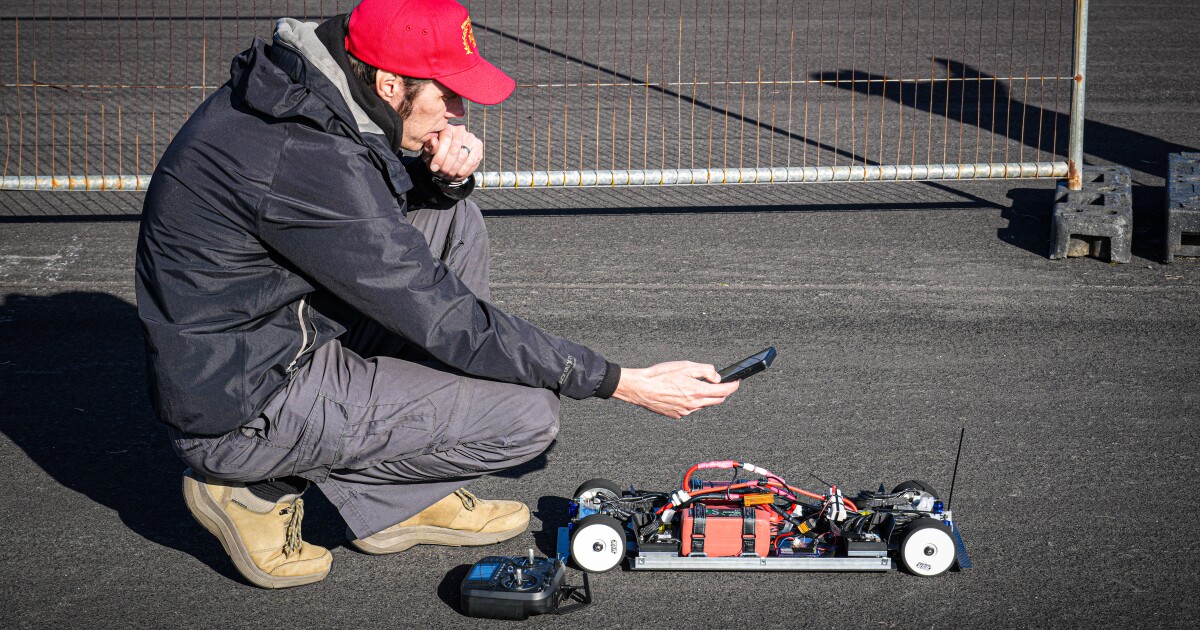
A British hobbyist has applied multicopter drone thinking to radically simplify the steering and powertrain of his high-performance radio-control car – and absolutely demolished the world top speed record in the process.
The modern world offers an endless selection of rabbit holes, into which those of us with obsessive tendencies can pour virtually unlimited amounts of time, energy and love. I’ve never felt it’s much of a choice, personally; I’m either compulsively driven to chase a particular shiny thing – in which case I can’t not find the time to pursue it – or I’m not.
My obsessions are relatively fleeting, resulting in a series of torrid flings over the decades. For others, a single rabbit hole offers a lifetime’s worth of reward – and that’s when people start to get really, really good at things.
So here’s cheers to magnificent nerds like engineer Stephen Wallis – who lives in Rugby, not far from Coventry in England, and who has spent some 20 years scratching his way to hitherto-unburrowed depths in his rabbit hole of choice: High-performance R/C vehicle design.
Stephen Wallis
Wallis named his record-breaking machine “The Beast.” The key innovation he brought to the field was … Simplicity. Where other R/C speed car builders typically run complex transmissions and steering systems, Wallis started out with the idea of taking a quadcopter drone, and sticking horizontal wheels instead of vertical props on the shafts of its high-powered motors.
So The Beast doesn’t need to run a transmission per se. It also doesn’t need a mechanical steering system; the car can be turned simply by varying the speeds of its four motors. And it turns out the drone’s flight control system, with its built-in accelerometers, gyroscopes and other sensors, does an extraordinarily good job of maintaining high-speed directional stability.
Turning a DRONE into a FAST R/C Speed Car???!
It makes sense; quadcopter drones stay rock-solid in a choppy breeze by making thousands of motor speed corrections per second. Wallis had an intuition that the flight controller could do the same to keep a car in line on the ground at high speed, and now he’s got a Guinness World Record to prove it certainly does.
After some impressive early runs, he set his sights on a world record at September’s Radio Operated Scale Speed Association (ROSSA) speed test event in Wales. For maximum power, he fitted The Beast with an eye-watering, custom 18S battery layout – three 6S packs running in series for a peak of 75.6 volts.

Stephen Wallis
He also wisely shaved about a third of the meat off the tires, reducing wheel diameter from 99 to 94 mm (3.9 to 3.7 inches) as well as saving some weight to reduce the worst effects of the crazy centrifugal forces they experience at top speed.
“I wanted to go down on tire diameter to reduce the amount of foam trying to rip itself off the wheel,” says Wallis.
There were challenging conditions at Llanbedr Airfield for the ROSSA event – the British weather did as British weather does, and Wallis couldn’t even see the car properly through the rain in his eyes on his record attempt. But the design did what it said on the tin. The Beast clocked an official speed of 234.71 mph (377.8 km/h) down the tarmac, looking exceptionally stable in the roughly seven frames of video in which you can actually see the thing flashing past:
How I Smashed the World Record at ROSSA Round 3 2025!
World records tend to be incremental; eking out a single mile per hour improvement gets extremely hard at the pointy end, and prior to this run, only six R/C cars in history had ever broken the 200 mph (322 km/h) mark in an officially-sanctioned event. The Beast had no time for increments; it very nearly broke the previous 218.53 mph (351.69 km/h) record on its warm-up run, and put daylight between itself and second place.
Wallis wasn’t able to improve on the record on the second or third days of the event due to increasingly bad weather.
Now, record in hand, he’s got himself an even chunkier set of motors and has set his sights North of 250 mph (402 km/h) for his next attempt. Why? Because he’s a fella with a nice, deep rabbit hole to dig around in, and that’s all the reason he’ll be needing.
So yes, here’s cheers to Wallis and other birds of that feather – and to the obsessions that keep us all off the street at night. Lord knows what we’d be up to otherwise, but it probably wouldn’t be pretty.
Oh, and if this kind of thing appeals to you, wait ’til you see the maniacs that fly the world’s fastest R/C planes, and the crazy ‘dynamic soaring’ techniques they use to get damn close to airliner speeds – without any onboard motors or propulsion systems…
Source: Stephen Wallis and Guinness World Records

