


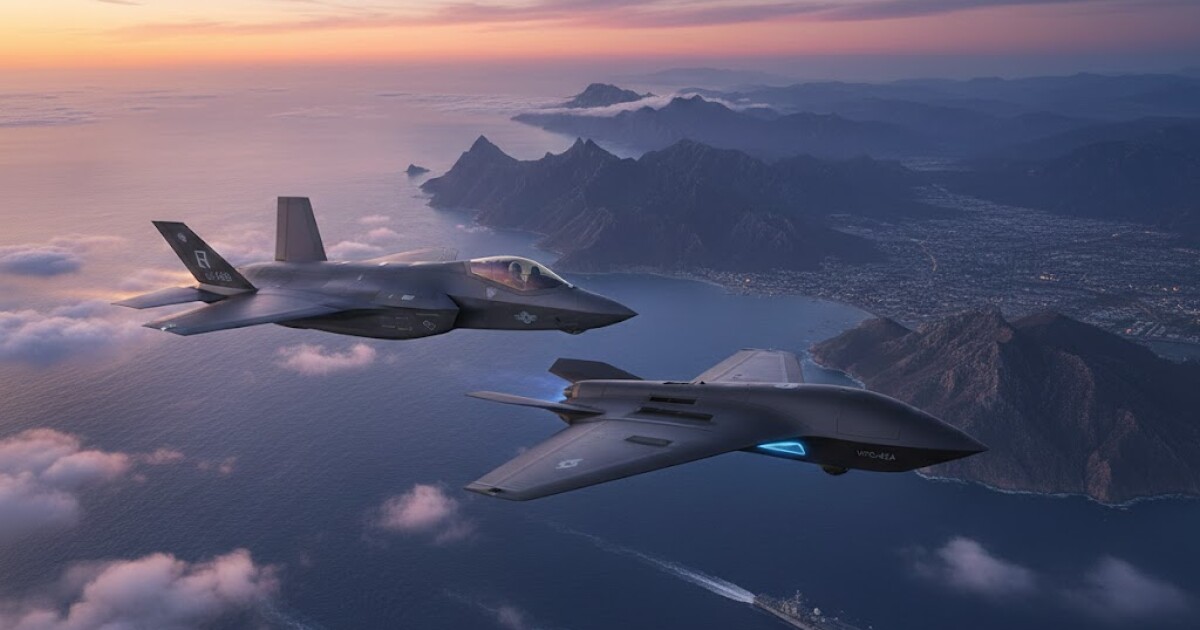
As combat drones continue to move from the laboratory to the battlefield, the US Navy is exploring how to use a digitally simulated F-35 Lightning II aircraft to develop new tactics to go with the new technology.
At the Naval Air Warfare Center Aircraft Division’s (NAWCAD) Joint Simulation Environment at Naval Air Station Patuxent River, Maryland, a test pilot sits in the cockpit of an F-35 without the actual F-35. Surrounded by advanced view screens providing highly realistic images for an array of virtual combat scenarios.
Drones have gone well beyond prophecy and promise, as they are already revolutionizing warfare faster than anyone expected. However, it’s still early days with many advances still to be rolled out. Not the least of these are the Loyal Wingman jet-propelled drones with performance comparable to the piloted fighter planes they are expected to serve alongside.
US Air Force
With these combat drones on the horizon, the US Navy has no desire to fall into the old trap of having a new weapon in its arsenal and no idea of how to use it.
It’s a story as old as the airplane itself. When the First World War broke out, heavier-than-air flight was only nine years old. The fledgling air forces could fly over the battlefields and penetrate deep into enemy territory without opposition, but neither the pilots nor commanders had any concept of the new technology’s potential or how to put it to most effective use.
The result was months of experimentation and missteps, with the aircraft being first used only for reconnaissance – and pilots throwing bricks at one another – until one day an Austro-Hungarian pilot emptied a revolver at his Serbian counterpart without effect. From then on, a crude arms race developed as pilots learned how to fight with their planes as well as fly them.

Samuel King Jr/US Air Force
It’s a lesson that’s had to be learned and relearned over the last century. In the decades after the Second World War, designers kept removing the machine guns from the new jet fighters only for the pilots to come back in short order, telling them to put them back. It was all part of the process of learning how to adapt tactics to jets, supersonic speed, missiles, smart bombs, radar, and now, AI, lasers, and hypersonics.
Along with all this are the combat drones being developed by countries all over the world. It’s easy to think of these as just robotic fighter planes that operate without a pilot aboard, but they are much more than that. They have their own unique strengths and weaknesses. In addition, this is about more than just a new airframe. It’s about integrating into a whole new way of organizing military operations.
That means developing new tactics to meet the new situation.

Staff Sgt. Kaylee Dubois/US Air Force
The US Navy is particularly keen on dealing with tactics as soon as possible because where the US Air Force is taking an incremental approach to combat drones focusing on air-to-air combat, the Navy is putting its money on a multi-role capability. This includes surface attack and intelligence, to fill the gaps in the carrier air wing’s current reach.
To this end, the Navy is using the Joint Simulation Environment (JSE) as a testing sandbox. Though it may look like the sort of simulators that have been around for decades, this is more like a digital twin of contested airspaces that the pilot and their wingman will encounter in the real world.
One example of how this works is that the JSE allows pilots to fly many more sorties in a week than they could in a year on live ranges without sacrificing the necessary realism. In fact, the realism is a bit better because the live ranges are increasingly unable to produce the density of modern electronic warfare and surface-to-air missile threats. Added to this is the JSE’s capacity to integrate with the E-2D Advanced Hawkeye and EA-18G Command and Control aircraft, which are also able to manage drone swarms as part of a unified, multi-layer offense.

Tech. Sgt. Nicolas Myers/US Air Force
Basically, what these new tactics will revolve around is the fact that an F-35 can cost up to US$120 million per plane with the pilot representing an investment of up to $13.5 million for just training. With modern air wings so small, the loss of even one plane and pilot is a major tactical setback that is far better avoided.
Another major factor is that future fighter pilots will be less dog-fighters than mission commanders with authority over drones with a high level of autonomy. They won’t be flying the drones by remote control. The drones will do this themselves. The pilots will simply assign tasks like “recon” or “suppress air defenses” and the drones will figure out the rest.
Essentially, the drones will act as force multipliers that are much cheaper than piloted aircraft. Costing “only” about $10 million each, these drones may one day allow carriers to deploy 40% more warplanes than before with the carrier flight decks redesigned to handle much greater traffic and keeping the human and machine planes separate when it comes to taking off and landing.
It’s still early days as to what these new tactics will look like, but the most common one will probably be to keep the carrier as far from the fighting as possible with the drones in the lead and the fighters behind acting as commanders and a reserve for attacking very high value targets. The drones will provide sensor data and most of the armament while the F-35 will remain silent and carry fewer arms to maintain a high degree of stealth.
Of course, one obvious question is, why have the fighter there at all and why the F-35?
Okay, that’s two questions.
The F-35 is the plane of choice because it’s the only one with the advanced systems to act as a Command and Control node able to handle huge amounts of data in real time. Why it’s there is first, because the F-35 can handle communications with zero delay while the carrier or a shore base will need at least 1.5 to two seconds to respond. Second, by the same token, the F-35 can process data on the spot while eliminating communication bottlenecks and cuts. And third, rules of engagement for drones require a human-in-the-loop to make decisions for lethal actions. These decisions are literally split second ones in a rapidly changing environment.
To put it more succinctly, when the combat drones show up for duty in a few years, there won’t be time for any slip ups. Better to sort it out before rather than end up in Dr. Strangelove territory where things get out of hand before you know it.
“Modern warfare is demanding more from our aviators,” said NAWCAD Commander Rear Admiral Todd Evans. “This milestone shows the Joint Simulation Environment’s impact on equipping them with the advanced tactics they need to win future battles.”
Source: US Navy

