


For most people, the loss of a sense such as sight is devastating, not only for intensifying vulnerability, but for undermining quality of life. While prostheses can be functionally useful, they can’t replace the sensory information such as texture, moisture, and density that our skin so easily conveys to our brains.
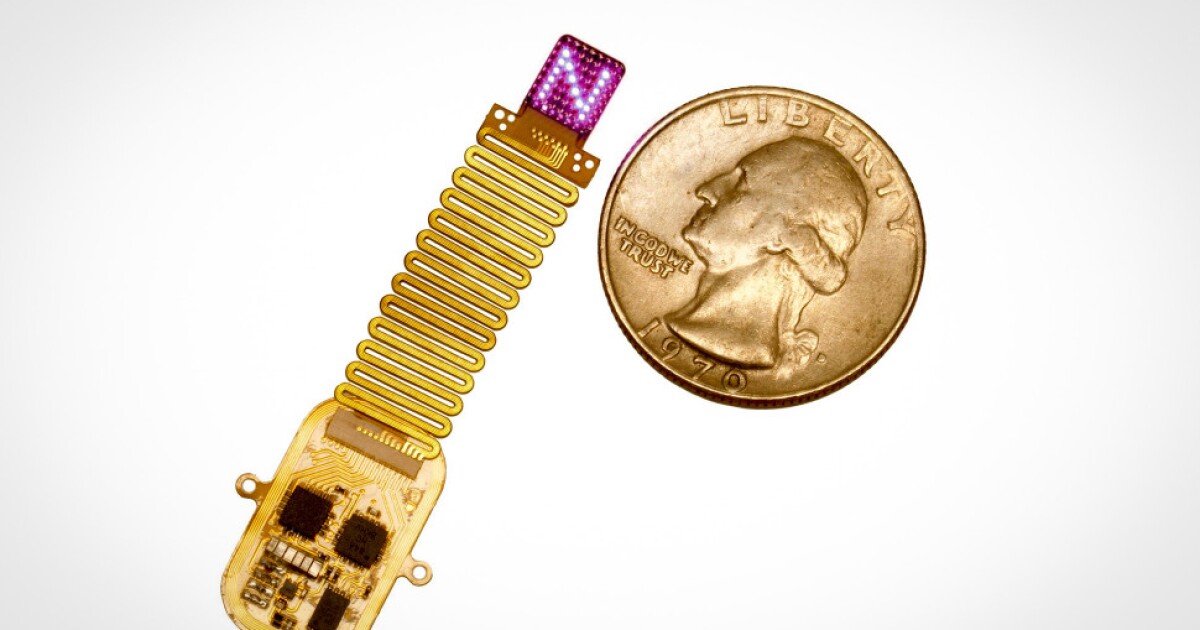
That’s why a first-of-kind optogenetic device from Northwestern University, near Chicago, offers so much hope. Roughly the size of a house key and thinner than a coin, the new wireless neuro-implant may eliminate the need for certain skull-sawing and -drilling surgeries through minimally invasive implantation beneath the scalp. Neuroscientists can apply the soft, flexible “neuro-key” to the surface of the skull where it beams neuron-activating light directly through the cranium into the cerebral cortex, entirely bypassing evolved sensory channels.
In their forthcoming Nature Neuroscience paper, lead author and postdoctoral fellow Mingzheng Wu and colleagues describe how in experiments with mouse brain models, the neuro-key precisely activated neuron groups that had been modified with a gene from a light-sensitive algae. Mice that could not see, hear, or feel were quickly able to learn to interpret the light signals to complete various tasks.
“Our brains are constantly turning electrical activity into experiences, and this technology gives us a way to tap into that process directly,” said experimental lead Yevgenia Kozorovitskiy, the Irving M. Klotz Professor of Neurobiology in Northwestern’s Weinberg College of Arts and Sciences, and a member of the Chemistry of Life Processes Institute. “This platform lets us create entirely new signals [to] see how the brain learns to use them. It brings us just a little bit closer to restoring lost senses after injuries or disease while offering a window into the basic principles that allow us to perceive the world.”
Because optogenetic implants require genetic modification of neurons to work, they are not yet approved for human use. However, for people who’ve lost the ability to see, hear, or feel, the neuro-key offers hope of radical transformation for a better life, including through devices that can relay information that stimulates the same neurons that receive information from our eyes, ears, and skin. Related uses may include rehabilitation – particularly following the neurological devastation of a stroke – and cybernetic control of robotic arms, hands, legs, and feet.
And as relief from one of the greatest curses imaginable – chronic pain – the neuro-key may offer pain modulation without the expense, side effects, and addiction risk of opioids and systemic drugs.
While the team used only a single micro-LED for its first paper, Wu said that the new approach with an array of 64 micro-LEDs allows a near-infinite number of patterns that vary in “frequency, intensity and temporal sequence.” The real-time control over each LED allows researchers to relay those complex light patterns to the brain that may mimic the sensory experience of distributed neural activity, rather than that from narrow, localized activation.
“Developing this device required us to rethink [how] to deliver patterned stimulation to the brain in a format that is both minimally invasive and fully implantable,” said John A. Rogers, director of Northwestern’s Querrey Simpson Institute for Bioelectronics. The bioelectronics pioneer led the project’s technology development, and is also the Louis Simpson and Kimberly Querrey Professor of Materials Science and Engineering, Biomedical Engineering and Neurological Surgery in the McCormick School of Engineering and Northwestern University Feinberg School of Medicine.
“By integrating a soft, conformable array of [up to 64] micro-LEDs, each as small as the diameter of a single strand of human hair, with a wirelessly powered control module,” says Rogers, “we created a system that can be programmed in real time while remaining completely beneath the skin, without any measurable effect on natural behaviors of the animals.”
The New York Times / C.C. 2.5
According to Rogers, these design aspects of the neuro-key represent “a significant step forward in building devices that can interface with the brain without the need for burdensome wires or bulky external hardware,” and offer value not only for neuroscientific research, but the potential for improving human health.
Optogenetic technology isn’t new; indeed, as New Atlas has reported, Kozorovitskiy and Rogers developed a programmable, wireless, battery-less implant in 2021 for remotely controlling mouse interactions. But many similar devices needed fiber-optic wires that hindered the animals’ movements, whereas the new neuro-key lets the mice move normally.
Because the implantation hides the device, rather than exposing it like a mad scientist’s “brain electrode,” future human users would be free from other people’s reactions, a critical component of medical technology that protects human privacy and dignity while restoring full function.
Source: Northwestern University

