


Back in 2009, a friend bet British cyclist Paul Spencer that he couldn’t ride his bike the length of the British Isles in less than a week. Spencer took up the challenge, and completed the route – from Land’s End in England to John O’ Groats village in Scotland – in just four days.
Accomplishing this feat inspired him to make other epic cycling trips over the years, including multiple treks across Europe, North America and Africa. He broke three Guinness World Records in the process.
You might think Paul would be satiated at this point, but it turns out all of that long-distance cycling merely whetted his appetite. He now plans on going all the way around the world, pedaling across almost every continent (except Australia and Antarctica) along with the stretches of ocean in between.
Spencer will be raising funds for the Lupus Foundation during his Pedal Round The World journey, while also attempting to set a new Guinness Record for the Fastest Human-Powered Circumnavigation of the Globe. While the current record stands at five years and 11 days, he hopes to make the trip in about three years.
“Riding a bike lets you see the world up close,” he tells us. “People, moments, small details you’d never notice at speed.”
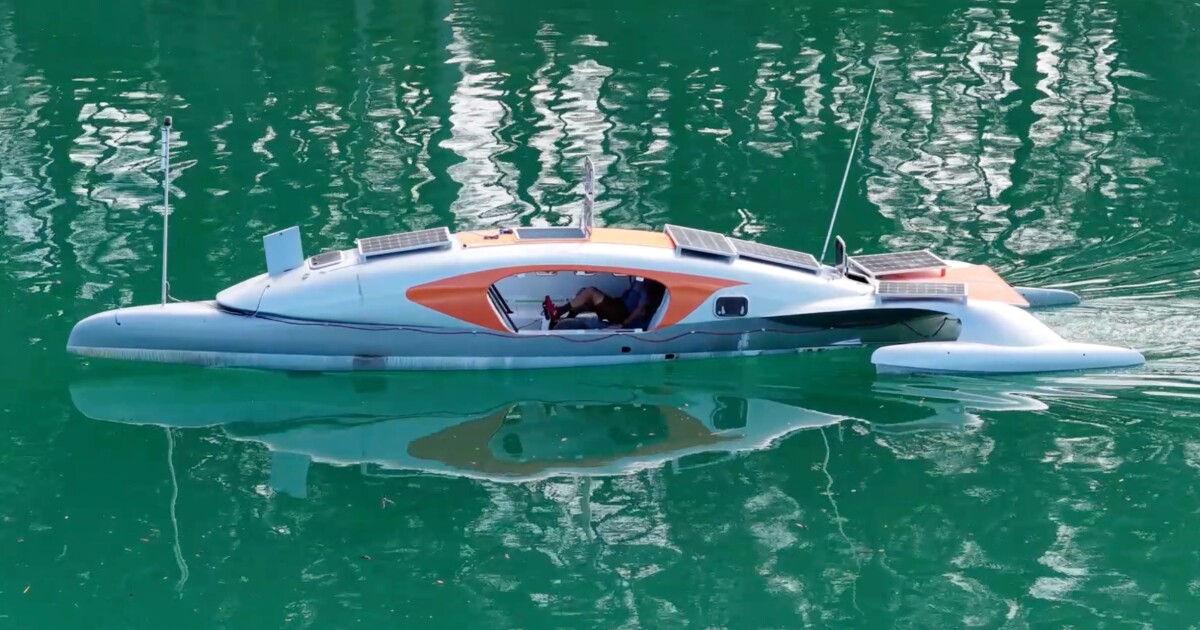
But let’s back up a bit … how is he going to pedal across all that open water? Well, he’ll be using a one-of-a-kind ocean-going trimaran pedal boat known as the Pedal Beast.

Paul Spencer
Previously named the Tasman Rower, the 38-ft (11.6-m) carbon-fiber-bodied craft was originally designed by New Zealand company LOMOcean Marine Ltd in 2012, and was built by fellow Kiwi firm Pachoud Yachts. And yes, as the boat’s name suggests, it started out as a rowboat.
Plans had called for it to be used for a record-breaking crossing of the Tasman Strait (aka Bass Strait) between Australia and Tasmania, although the trip was cancelled due to rower injury. In fact, LOMOcean designed a similar rowboat – the Samson – which was intended to make a transatlantic crossing which also never happened.
The Tasman Rower ended up in need of a new home, and it caught Spencer’s eye on the LOMOcean website. He traveled to New Zealand in 2019 and met with Craig Loomes, director of LOMOcean and designer of the watercraft.

Paul Spencer
Loomes informed him that not only was the Tasman Rower a very good candidate for a pedal-drive conversion, but that pedal drive would be a better way to go than rowing for circumnavigating the globe.
“Pedal propulsion compared to conventional rowing with oars is significantly more efficient overall,” says Loomes. “This is due to pedaling being a continuous cycle. The rowing cycle is reciprocating, with much of the rower’s energy being wasted on the recovery stroke, not to mention energy required to guide the oars in ocean sea conditions. Wind resistance drag from the oar blades on the recovery stroke is another factor that is eliminated with pedal propeller propulsion.”
Indeed, pedaling was the propulsion form of choice on watercraft such as a kayak designed to travel from Canada to Hawaii, a canoe-ish thing made to go down the River Thames to the North Sea, and an amphibious wheeled vehicle that successfully crossed the Atlantic Ocean.

Paul Spencer
That said, LOMOcean’s setup is claimed to be even more efficient than other pedal propulsion systems.
This is partially because its crankset incorporates a high-inertia flywheel that compensates for the lower-torque “dead zones” in each pedaling revolution, thus removing “the otherwise inefficient stop-start pulse the pedaler would otherwise have to endure,” according to Loomes.
Additionally, the shafts and hubs of the two counter-rotating propellers are located above the water’s surface. Although this design might seem counterintuitive at first (“Why aren’t the props all the way underwater?!”), it’s said to greatly reduce hydrodynamic drag, and to allow for the use of large-diameter high-aspect-ratio propeller blades.
It was even utilized on the Turanor PlanetSolar catamaran, which was the first-ever photovoltaic vehicle to circle the globe. You can see the Pedal Beast using it, in the following video.
Human-Powered Circumnavigation: The CRAZIEST Pedal Boat Sea Trial!
Spencer did indeed buy the Tasman Rower, renamed it, and is now in the process of getting it fully outfitted for use on his odyssey.
Along with the pedal drive system, some of the additions include side panels (with openable windows) to enclose the rear cabin; a front daggerboard that can be lifted or lowered to help the trimaran track straight as needed; deck-mounted solar panels and a communications mast; a full satellite communications and navigation system; a custom recumbent pedaling seat; plus a separate lifeboat.

Paul Spencer
Over the course of the ~50,000-mile (80,467-km) complete trip, plans call for the Pedal Beast to be pedaled over a total of 10,000 miles (16,093 km). In between the aquatic legs of the journey, it will be loaded into a 40-ft (12.2-m) shipping container which will be towed on a trailer to the next port on the route. Paul, of course, will have to ride a bike between ports.
Although Pedal Round The World was originally supposed to commence in 2021, it had to be pushed back because of the pandemic. It’s now expected to begin early in 2027 starting in Colorado, which is where Spencer now lives and works as a ski instructor and home builder.

Paul Spencer
“I once looked at doing the Guinness ‘Cycle around the world’ record, but the rules allow flying over oceans. That felt wrong,” he says. “You can’t say you cycled around the world if you flew half of it. So I created my own solution: If I can’t bike across the oceans, I’ll pedal across them.”
Paul is now raising funds for his big trip via another smaller trip in which he will be using the Pedal Beast for what it was originally made for – traversing the Tasman Strait. You can sponsor him on his GoFundMe page.
Source: YesHesMad

