


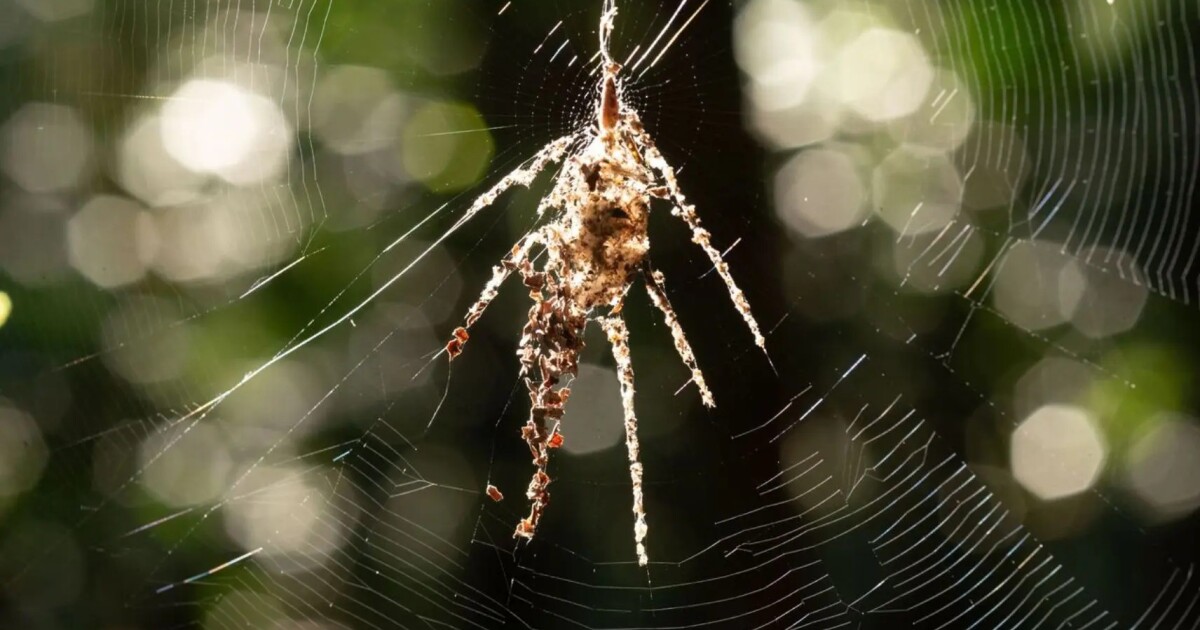
Step aside, Van Gogh. Some spiders are out here making self-portraits for survival. New research shows that several orb-weaving species construct giant web-mounted “doppelgängers” convincing enough to confuse potential predators. It’s an unexpectedly clever form of deception that blurs the line between instinct and ingenuity.
Deep in the Amazon rainforest of Peru, and on the slopes of Mount Kanlaon in the Philippines, some of the most unexpected “art” appears suspended in silk. In a recent study published in Ecology and Evolution, researchers report the first documented observations of orb-weaving Cyclosa spiders building life-like replicas into their webs, a behavior that appears far from accidental.
In both regions, researchers observed the same pattern: Cyclosa spiders constructing the replicas piece by piece directly into the web. The finished figures, often larger than the spiders themselves, occupied the center, while the living spiders positioned themselves nearby. These were not trapped insects or accidental debris, but structures that transformed the web into something that functioned as a decoy.
George Olah
Up close, these doppelgängers appear strikingly similar to the spiders themselves. Each mirrors the basic spider structure, including a central mass with the suggestion of legs. To construct them, the spiders bind silk with nearby materials, including leaf fragments, insect remains, bits of old prey, and occasionally soil. Once completed, the spiders continue to maintain and modify the decoys, keeping them suspended near the center of the web.
These oversized replicas belong to a broader category of web structures called stabilimenta, decorative elements that many orb-weavers add to their webs. Despite decades of study, their function remains debated. Researchers have proposed several explanations, from preventing birds from flying through webs and attracting prey, to reducing the risk of predation. For Cyclosa, the evidence points most strongly towards a defensive strategy against predators.
One key threat comes from helicopter damselflies (pseudostigmatinae), which hover in front of webs and selectively target small spiders measuring 3 to 6 mm. Vertebrate predators, including birds and lizards, may also be deterred by the oversized silhouette, mistaking the decoy for larger, less manageable prey. The researchers suggest the structures function as a general defense against predators that rely on visual cues.
What makes these decoys so striking isn’t just their size, but the accuracy behind the artistry. Each one echoes the spider’s proportions closely enough to pass for a real animal at a glance, suggesting a level of spatial organization and material choice that goes beyond simple web upkeep. Cyclosa isn’t weaving random clutter into place. It’s assembling a shape that mirrors its own body, then scaling it up to shift how predators perceive the web.
Researchers have also found that it isn’t just one species, but multiple Cyclosa spiders across distant forests using the same basic strategy, hinting at a widespread evolutionary solution rather than a rare behavioral quirk. It’s behaviors like this that challenge the lingering assumption that invertebrate decision-making is rigid or purely mechanical.

Olah et al, Ecology and Evolution.
In the case of Cyclosa, that challenge plays out not through changes to the spider’s body, but through changes to how it is seen. By shaping debris and silk into oversized replicas, the spiders alter the visual information predators rely on, gaining protection without confrontation. In the quiet geometry of their webs, survival may hinge less on strength or speed than on how convincingly a spider can render its own likeness.
In evolutionary terms, it may be one of nature’s most creative self-portraits. How the spider knows what it looks like is the mystery it leaves behind.
The study was published in the journal Ecology and Evolution
Source: ANU

