


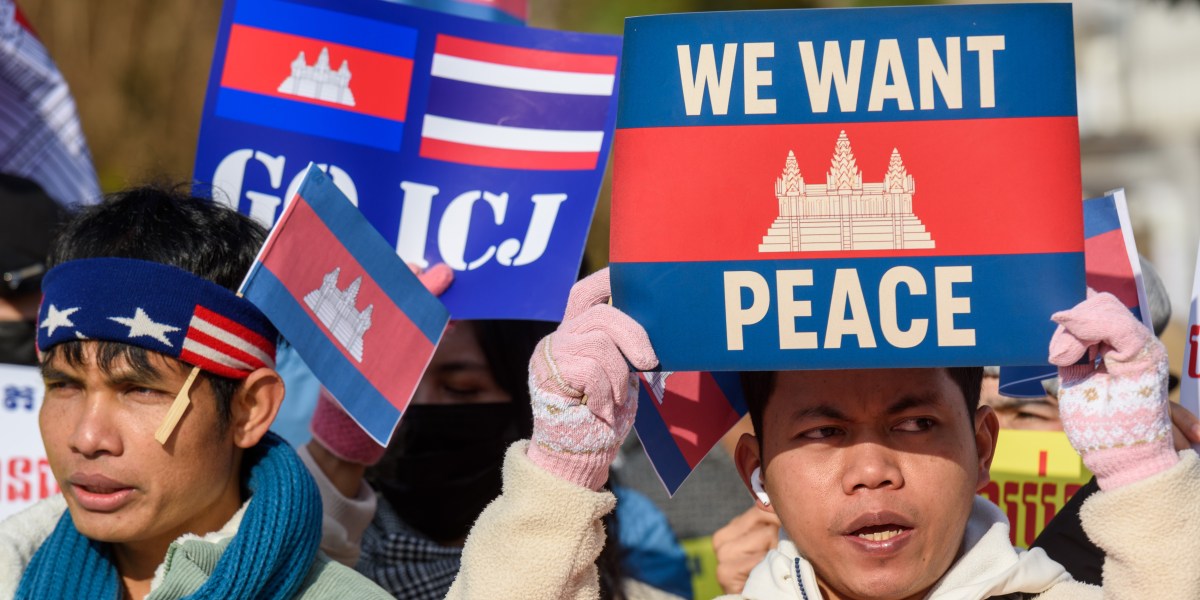
Renewed fighting between Thailand and Cambodia along their shared border has now raged for over a week, undercutting U.S. President Donald Trump’s aspirations to be a peacemaker, while also threatening an economy that spreads across Southeast Asia.
Thai and Cambodian forces clashed earlier this year, which ended after the Trump administration helped to broker a peace deal between the two countries, both members of the Association of Southeast Asian Nations, a bloc of eleven Southeast Asian countries. Trump announced the deal with great fanfare on Oct. 26, on the sidelines of the ASEAN Summit in Kuala Lumpur, and since touted the deal as evidence of his dealmaking prowess.
With skirmishes continuing along the border this week, Trump has tried to get both sides to honor the ceasefire, to no avail. The conflict’s repercussions are expanding beyond Thailand and Cambodia: on Tuesday, Thailand cut fuel trade across the border to neighboring Laos, due to concerns that shipments were being diverted to Cambodian forces.
ASEAN experts Fortune spoke with are skeptical that an agreement will stand the test of time.
“The ceasefire is inevitably fragile because it deals only with temporary matters—such as military withdrawal and monitoring—and does not address the fundamental territorial boundary issue,” says Pasha L. Hsieh, a law professor from the Singapore Management University.
Joanne Lin, a senior fellow at the ISEAS-Yusof Ishak Institute, agrees, adding that a key objective of the ceasefire was to secure Trump’s attendance at the ASEAN summit. As such, the truce was rushed and concluded quickly, with limited negotiation and few safeguards.
“It was too basic to manage a complex dispute involving border demarcation…and deep mistrust,” Lin says. “It helped pause the fighting, but once an incident occurred and nationalist sentiments took hold, the ceasefire had very little to anchor it.”
The economic fallout
The Thai-Cambodia conflict has paralyzed trade across the shared border, particularly at the Klong Luek-Poipet crossing, halting commerce worth about $4.7 billion annually, according to The Nation, a Thai newspaper.
“In any conflict, economic lifelines are among the first to be affected, and this situation is no different,” says Lin of the ISEAS-Yusof Ishak Institute. “When fighting intensifies, everything along the conflict zone from businesses, trade routes, tourism facilities to services will inevitably be disrupted, regardless of whether they are deliberately targeted or not.”
Thailand has also bombed at least five Cambodian casinos, which experts think is political signaling to the Thai public.
“One of the most salient public grievances in Thailand is the perception of Cambodia as a hub for online scams, with widespread belief that some scam operations are based in casino complexes along the border,” says Pongkwan Sawasdipakdi, a lecturer in international relations at Bangkok’s Thammasat University. “By striking these sites, the military can demonstrate to the Thai public that it is taking concrete action against what many see as a major cross-border threat.”
At the same time, striking these Cambodian casinos serves the dual purpose of undermining Cambodia’s local economy, the academic adds. “There is a popular belief in Thailand that scam networks are connected to Cambodian political elites, so targeting casinos resonates not only as a security measure but also as a way of applying pressure on Phnom Penh.”
A history of conflict
The Thai-Cambodia border dispute stems from competing territorial claims that date back to colonial times, and are centered around the Preah Vihear Temple—an 11th-century Khmer temple complex within Cambodia’s Dângrêk Mountains.
After France withdrew from Indochina in 1954, Thailand stationed troops in the area to replace withdrawing colonial forces. In 1959, Cambodia took the dispute to the International Court of Justice, which ultimately ruled in its favor in 1962.
“Standard Thai textbooks recount how Thailand lost territories—now part of Cambodia—to France during the colonial period, regained them during World War II, and was then forced to return them after the war,” says Pongkwan. The dispute thus occupies a “uniquely sensitive place in Thai historical memory.”
Nationalist sentiments and poor conflict management are making things worse, says Lin of the ISEAS-Yusof Ishak Institute. Southeast Asia has largely been able to stop conflicts before they begin, thanks to organizations like ASEAN. But “the problem arises when that equilibrium breaks down and there are no strong mechanisms to contain escalation,” she says.
Social media is also fueling division, Pongkwan says. Cambodian netizens claim that some practices widely regarded as Thai in origin—such as Muay Thai and traditional Thai dress—are actually from Cambodia, angering their Thai counterparts.
Trump’s peace deals
Trump claims to have “ended eight wars” since taking office in January, including conflicts between Thailand and Cambodia, Israel and Iran, Pakistan and India, and Armenia and Azerbaijan, among others. The president used this track record to demand this year’s Nobel Peace Prize (which eventually went to Venezuelan opposition politician María Corina Machado).
Experts say these shallow motivations explains the fragility of the Thai-Cambodian ceasefire.
“The truce fell apart largely because Bangkok calculated—probably correctly—that the Trump administration was transactional and not deeply invested in the substance of the conflict,” says Pongkwan of Thammasat University.
Thai leaders played along since there was little downside, she says, as being cooperative kept the country on Trump’s good side. This paid off as the U.S. and Thailand inked a rare earths agreement, paving the way for more trade between the two nations. (America is seeking to diversify supply chains after China’s tightened export curbs, signing trade agreements with four ASEAN nations at the recent summit.)
Yet now, Thailand appears to be pushing back against U.S. pressure to end the conflict. Thai Prime Minister Anutin Charnvirakul has fiercely pushed back against Trump’s characterization of the renewed fighting and pledged to protect Thai “sovereignty.” Anutin has also called elections for early February, which may cement nationalist and populist sentiments.
Is an off-ramp possible?
Some experts like Lin say that an off-ramp from the conflict is possible, though it is unlikely to come from another “headline deal” like Trump’s.
“It has to involve sustained de-escalation, credible monitoring through ASEAN mechanisms and parallel political and technical talks, including reviving the Thailand-Cambodia Joint Border Commission,” Lin says, referring to the bilateral body that was established to manage and resolve disputes over the contested land.
Pongkwan too believes that an end to the conflict is possible, but adds that it’s more likely to happen after Thailand’s national elections next February.
“Given that the [Thai] government was operating as a minority coalition and elections are approaching, riding a nationalist wave was politically safer than appearing conciliatory,” she says, adding that an end to the conflict could be possible following the country’s elections—given that a government emerges with a strong electoral mandate and adopts a more conciliatory approach.
Others, like Tita Sanglee, an associate fellow at the ISEAS-Yusof Ishak Institute, say that ending the ongoing conflict may prove difficult.
“The case of Thailand as the stronger power is straightforward—it has no reason to stop without external pressure,” says Tita. She adds that Cambodia’s repeated calls for peace were made to international audiences rather than to Thailand, and that the former continues to engage in actions which the latter deems provocative.
“I’m afraid there is no off-ramp for the conflict as things stand,” says Tita. “In the near term, the two countries would have to live with this “no war, yet no peace” situation.”

