


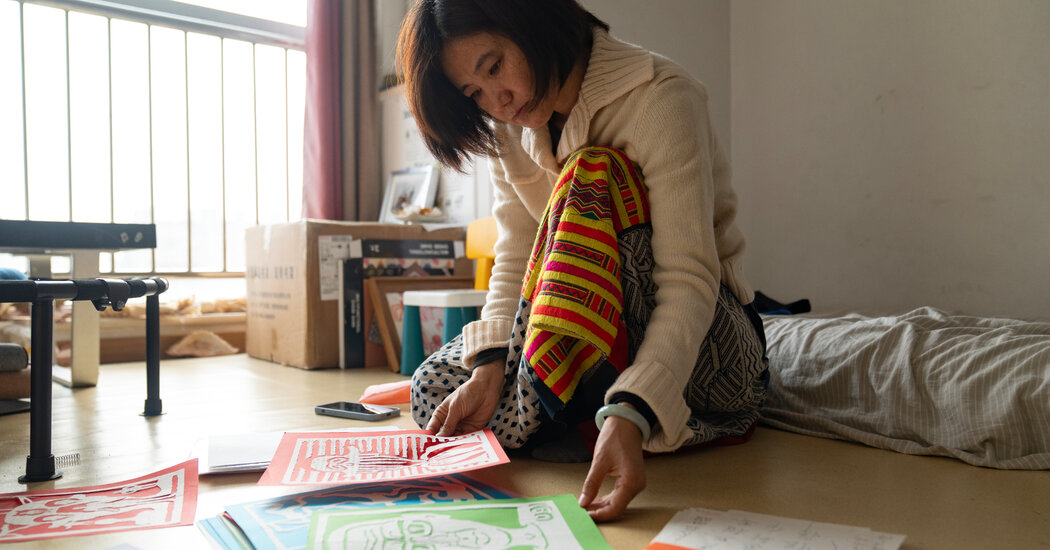
For the wife, Zhao Yaliang, the pictures are visual love letters from her husband, the imprisoned artist Gao Zhen.
Mr. Gao is in a Chinese detention center, awaiting trial and almost certain conviction on charges that he broke a law against slandering the country’s heroes and martyrs, according to Ms. Zhao. He is being prosecuted for irreverent sculptures of the revolutionary leader Mao Zedong that he made more than 15 years ago, before the law even existed.
Mr. Gao, 69, is part of a generation of avant-garde Chinese artists that achieved international fame in the 2000s. While he later emigrated to the United States, Mr. Gao was detained in August 2024 at his studio on the outskirts of Beijing when he and his family visited China.
The authorities have since blocked Ms. Zhao, a writer and photographer, from leaving the country. She and their son, who is a U.S. citizen, have been stuck in China for over a year. The State Department said in a statement that the United States was “deeply concerned” about Mr. Gao’s arrest and the restrictions placed on Ms. Zhao. “We strongly oppose any exit ban that prevents a U.S. citizen child from departing China,” it said.
Speaking by video chat, Ms. Zhao, 47, says that while in detention, her husband wrote letters and made some 80 of these hand-torn pictures — a version of the traditional folk art of Chinese paper cutting, or jianzhi.
“He’s telling me to take better care of myself and our son,” she said, pointing to an image of a woman with two streaks running down her face — a portrait of herself weeping.
Mr. Gao faces up to three years in prison for acts that “damage the reputation” of Chinese heroes and martyrs.
His arrest under that law, which was passed in 2018, is testimony to how much the space for expression has shrunk in China. In the early 2000s, he and his younger brother Gao Qiang held secret exhibitions in Beijing and got away with taking on taboo topics like the 1966-76 decade of political turmoil known as the Cultural Revolution, which resulted in the death of their father, and the 1989 Tiananmen Massacre. Known as the Gao brothers, the duo were seen as cultural ambassadors to the West, representing a China that was more willing to face its past.
In today’s China, that kind of reckoning has become nearly impossible, as the leader Xi Jinping has overseen a crackdown on the questioning of official narratives. The law against slandering martyrs and heroes has also been used to punish journalists, stand-up comedians and regular citizens making comments online.
Mr. Gao was arrested for three provocative sculptures of Mao Zedong that he made with his brother. In one, the revolutionary is depicted with breasts and a Pinocchio nose; in another, a group of Chairman Maos with guns prepare to execute Jesus Christ. The third, called “Mao’s Guilt,” portrays the former leader, who was responsible for years of famine and upheaval, kneeling in repentance.
“Mao Zedong has been dead for nearly half a century, yet his ghost still haunts China, harming Chinese people,” said Mr. Gao’s brother, who also emigrated to New York. He said the Chinese authorities had arrested Mr. Gao merely for doing his job as an artist.
“This humiliation,” the brother said, “torments me every day.”
The trigger for Mr. Gao’s detention may not have been his art but his decision to move to the United States. He and his family relocated from Beijing to New York in 2022, joining his brother and other government critics who have been driven away by Mr. Xi’s crackdown and severe pandemic-era controls.
When his mother-in-law became ill last year, his wife decided to return for a visit. Mr. Gao insisted on joining her and their son, even though friends warned it could be dangerous. He wanted to revive their work studio and argued he was not important enough for the police to bother with. As a permanent U.S. resident Mr. Gao had traveled back and forth between China and the United States without issue for the last decade.
But on the morning of Aug. 26, almost three months after he had returned to China, more than 30 police stormed Mr. Gao’s art studio in Sanhe City in Hebei Province, near Beijing. Four of the officers grabbed Ms. Zhao, forcing her and their son into the kitchen. She tried to comfort their son as they watched officers pin her husband to a couch and handcuff him.
“Now with him being taken away, I realize that we were always living on the edge of a cliff,” Ms. Zhao said.
Victoria Zhang, a friend of the Gao brothers and president of Kunlun Press and the Borderless Culture and Art Center in New York, believes the Chinese authorities want to make an example of Mr. Gao to silence others who have moved overseas.
“Don’t assume that just because you’ve fled abroad, the Chinese Communist Party can’t touch you. The moment you return home they will punish you,” Ms. Zhang said.
Ms. Zhao later attempted to return to New York with her son but was stopped at the airport in Beijing by officials who said she was not allowed to leave on national security grounds. When she tried to go to the U.S. Embassy for help, the two were intercepted by police and taken back to Sanhe City.
“It’s the strategy they always use — controlling your family to get you to confess quickly,” she said. Despite this, she says her husband will not plead guilty.
She and their son are staying in an apartment in Sanhe City, where they lead an existence in limbo. While Jia longs for New York, where he went by the name of Justin, Ms. Zhao tries to keep his life as normal as possible. After he missed the first semester of first grade, the police found a local school for him to enroll in. The mother and son’s days are now filled with school and after-school activities, and her attempts to limit his screen time. They spend weekends in the 798 Art District in Beijing, where the Gao brothers once held exhibitions.
Still, she worries about the trauma her son has experienced. For a time, he refused to leave her side, and he still wakes up at night with nightmares. Although the boy saw his father being detained by police, Ms. Zhao tells him that “Dad is just away at work.” This has also become the story that the son now repeats at school when classmates ask.
“In reality, he understands. He knows everything. He just wants to comfort me,” Ms. Zhao said.
Along with the letters, the torn paper portraits were a source of solace for Ms. Zhao, but now all their correspondence has been stopped. In August, Ai Weiwei, the dissident Chinese artist, published a letter that appeared to be from her husband. Since then, Mr. Gao has been cut off from getting pen and paper, in what Ms. Zhao believes is punishment for that public communication. And he can no longer send or receive letters.
Ms. Zhao says her husband’s health has suffered during detention. He has often needed a wheelchair, and he may be suffering a hardening of the blood vessels called arteriosclerosis, which could cause a stroke and other problems.
She worries about his mental health too. He has been banned from using the detention center’s library and he is not allowed time outdoors, she said.
Ms. Zhao now spends her days working on some of her husband’s projects and keeping a diary with Jia. Their lawyer is allowed to have weekly meetings with Mr. Gao at the detention center, but she is not allowed to see him. She and her son go anyway, waiting outside.
“I get to feel a little closer to him,” she said.

