


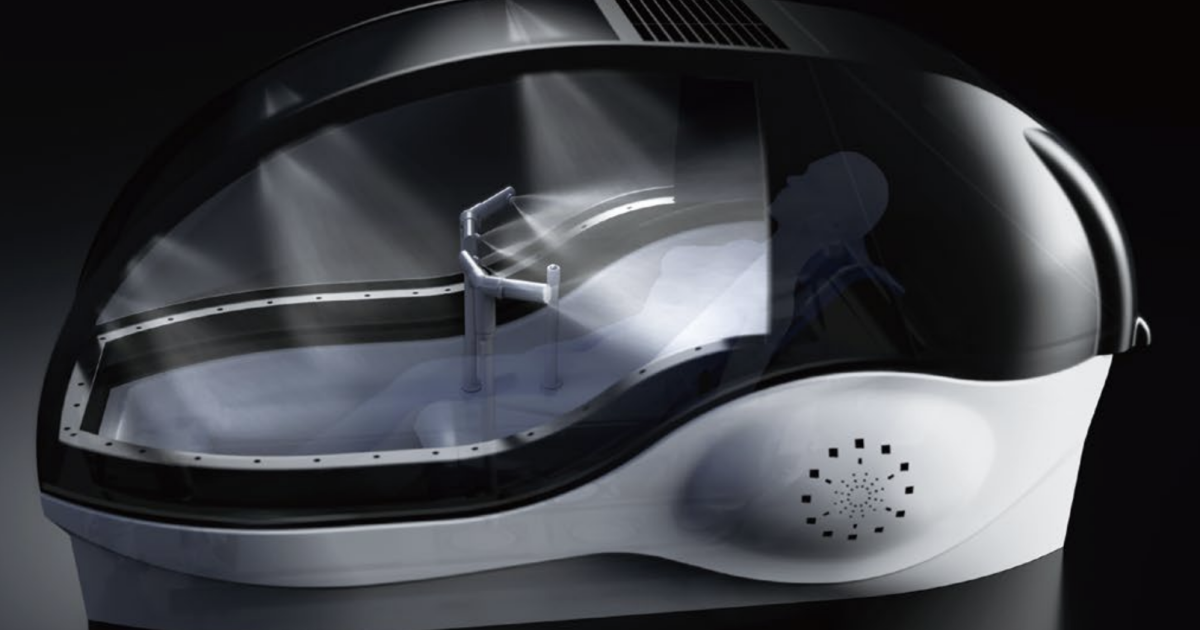
Japanese company Science is commercially producing its Mirai Ningen Sentakuki – Human Washing Machine of the Future – after an overwhelming response at the Osaka-Kansai Expo this year. Only 50 models will be made, with a price tag of US$385,000.
The pod, which was six years in the making, is set to retail locally for ¥60 million – and at that price, you know it’s no ordinary tub. It measures the bather’s biometrics via a sensor that makes contact with the individual’s back, and tailors the experience to be as much about wellbeing as cleaning. Personalized images are projected on the inside walls and the water is adjusted in real time to suit the mood of the user.
サイエンス・ミライ人間洗濯機CM(万博会場実機篇)
“The ‘Future Human Washing Machine’ is a modern-day scientific reproduction of the Human Washing Machine, which was exhibited at the Osaka Expo in 1970 and became a hot topic, and is equipped with even more futuristic features,” the company wrote in its introductory brochure. “The sensor attached to the back measures the bather’s biometric data, such as heart rate, in real time, and based on this data, optimizes the bathing environment to provide a space where they can relax and refresh. Images tailored to the bather’s physical and mental state are projected, and the strength of the water flow is controlled while observing their reaction, creating a more comfortable bathing experience.
“Through this device, Science aims to create a society that cleanses not only the body but also the mind,” it noted.
Science
That 1970s retrofuturistic model known as the Ultrasonic Bath (but was more lovingly referred to as the “human washing machine”) was a huge hit when it was showcased at the Expo by Sanyo – but it’s now frozen in time, on display at Osaka’s Panasonic Museum. Panasonic acquired iconic Japanese technology company Sanyo around 15 years ago.
“The bath incorporated the latest technology and conjured up visions of the future with its daring design,” according to the museum.

Panasonic Museum

Panasonic Museum
The 2025 human washing machine bears only a slight resemblance to that Sanyo prototype, and uses technology unheard of even a few years ago. At its core is its microbubbles system, something that Science has spent a great deal of time perfecting.
Microbubble technology is what it sounds like – using ultra-small bubbles to provide more efficient cleaning, using less water and taking up fewer minutes to wash surfaces. The company claims these bubbles are invisible to the naked eye and penetrate into pores to effectively refresh the skin like a good scrub.
“Microbubbles slowly rise to the water surface at a speed of about a few centimeters per minute,” the company explained. “Many microbubbles are negatively charged, a fact that has been confirmed in our research facilities. On the other hand, organic matter is positively charged, so the bubbles adhere to the organic matter, detach, and then rise to the water surface along with the organic matter. One application that makes the most of this characteristic is in a bath.”
サイエンス・ミラブルキッチンTVCM(トマトジュース)
Users step into the 2.5-m-long (8.2-ft), 2.6-m-high (8.5-ft) and 1-m-wide (3.3-ft) pod, slip into the reclining seat and close the lid, then the music, visuals and microbubble washing begin. If desired, the machine can then perform a drying cycle, allowing the user to emerge from the pod ready to dress in around 15 minutes. The company has stated that it’s not just about efficiency but the experience – like a personal spa session in the privacy of your own home.
The company hadn’t planned on selling the unit, but then decided to commercially produce it after the overwhelming response it received while on display – a reported 40,000 Expo visitors had applied to try out the machine. When a US resort owner contacted Science about acquiring a model, it announced it would make just 50 of them to go on sale. So far, one unnamed Osaka hotel has ordered a pod and will offer use to guests, and another has been bought by consumer-tech chain Yamada Denki, hoping it will be a drawcard to its flagship store in Tokyo.
“Our (company) president was inspired by that as a 10-year-old boy at the time,” Science spokeswoman Sachiko Maekura told newswire AFP. “Because part of the appeal of this machine is rarity, we plan to produce only about 50 units.”

Science
If it’s a little out of your price range (and even if it’s not, the company said this model won’t be sold for private use), you can see it at Yamada Denki’s LABI1 LIFE SELECT Ikebukuro center in Tokyo from December 25 – and, yes, trial experiences are available, though details are yet to be announced.
“In the future, if the technology evolves further and mass production systems are established, there is a possibility that a more affordable home-use model may emerge,” a Science representative said, according to South Korean newspaper The ChoSun Daily.
Source: Science

