


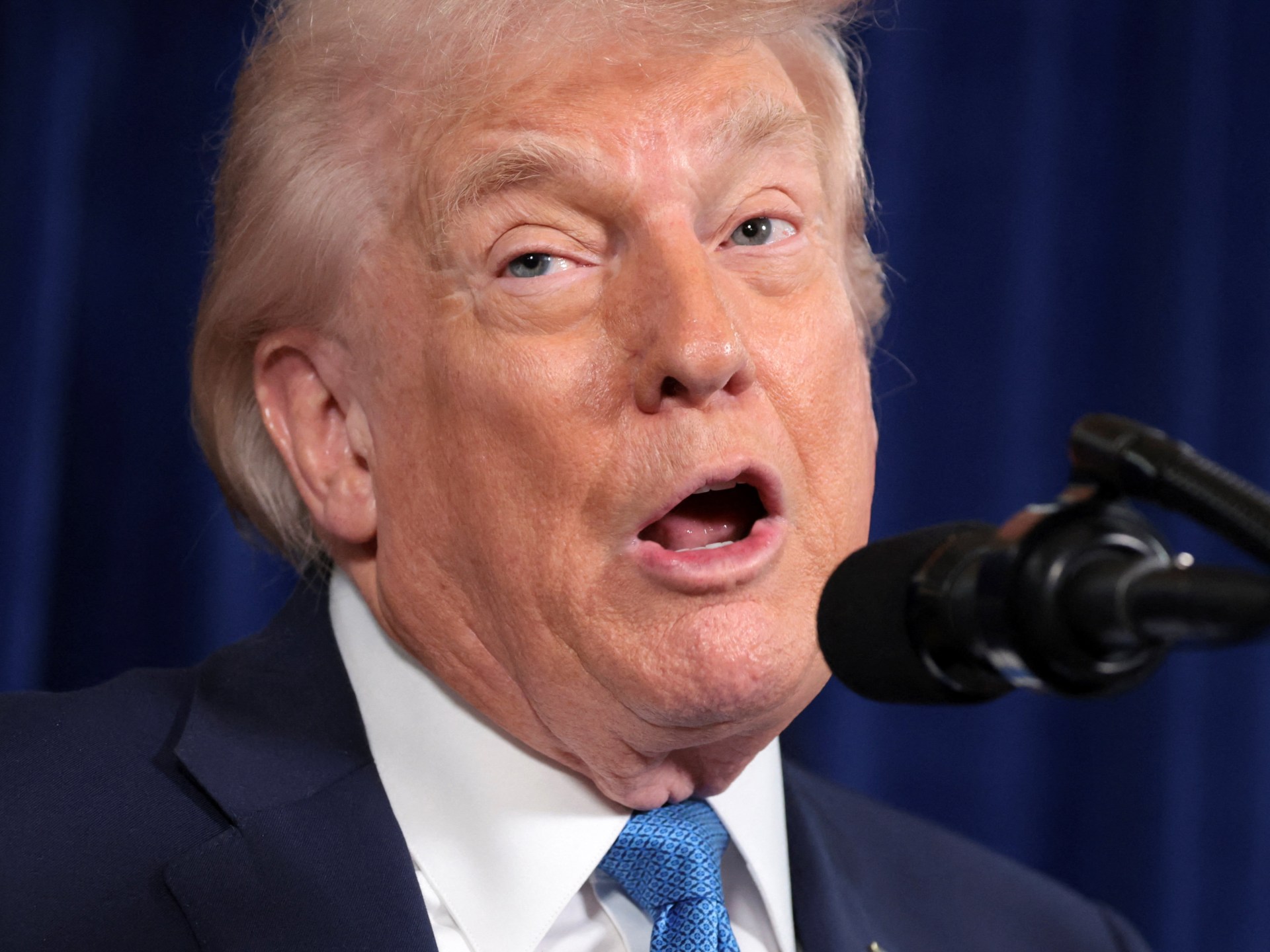
United States President Donald Trump has called on oil executives to rush back into Venezuela as the White House looks to quickly secure $100bn in investments to revive the country’s ability to fully tap into its expansive reserves of petroleum.
Trump, as he opened the meeting with oil industry executives on Friday, sought to assure them that they need not be sceptical of quickly investing in and, in some cases, returning to the South American country with a history of state asset seizures as well as ongoing US sanctions and the current political uncertainty.
Recommended Stories
list of 3 itemsend of list
“You have total safety,” Trump told the executives. “You’re dealing with us directly and not dealing with Venezuela at all. We don’t want you to deal with Venezuela.”
Trump added: “Our giant oil companies will be spending at least $100bn of their money, not the government’s money. They don’t need government money. But they need government protection.”
Trump welcomed the oil executives to the White House after US forces earlier on Friday seized their fifth tanker over the past month that has been linked to Venezuelan oil. The action reflected the determination of the US to fully control the exporting, refining and production of Venezuelan petroleum, a sign of the Trump administration’s plans for ongoing involvement in the sector as it seeks commitments from private companies.
“At least 100 Billion Dollars will be invested by BIG OIL, all of whom I will be meeting with today at The White House,” Trump said on Friday in a predawn social media post.
The White House said it invited oil executives from 17 companies, including Chevron, which still operates in Venezuela, as well as ExxonMobil and ConocoPhillips, which both had oil projects in the country that were lost as part of a 2007 nationalisation of private businesses under former President Nicolas Maduro’s predecessor, Hugo Chavez.
“If we look at the commercial constructs and frameworks in place today in Venezuela, today it’s un-investable,” said Darren Woods, ExxonMobil CEO. “And so significant changes have to be made to those commercial frameworks, the legal system, there has to be durable investment protections and there has to be change to the hydrocarbon laws in the country.”
Benjamin Radd, a senior fellow at the UCLA Burkle Center for International Relations, told Al Jazeera that he had “noted the hesitation and less-than-full-throated enthusiasm for re-entering the Venezuelan market”, citing Woods, who told the gathering that the company had its assets there seized twice already.
“The bottom line is that until Trump can outline and provide assurances of a plan towards political stability, it will continue to be a risky endeavour for these oil companies to re-engage Venezuela. And what is there is a regime change in Iran in the days or weeks or months to come, and all of a sudden that re-emerges as a place where Western oil companies can do business? Even though the reserves don’t equal what Venezuela has, the risk is far less, and the infrastructure is more sound,” Radd said.
Other companies invited included Halliburton, Valero, Marathon, Shell, Singapore-based Trafigura, Italy-based Eni and Spain-based Repsol, as well as a vast swath of domestic and international companies with interests ranging from construction to the commodity markets.
Wait and see
Large US oil companies have so far largely refrained from affirming investments in Venezuela, as contracts and guarantees need to be in place. Trump has suggested that the US would help to backstop any investments.
Venezuela’s oil production has slumped below one million barrels per day (bpd). Part of Trump’s challenge to turn that around will be to convince oil companies that his administration has a stable relationship with Venezuela’s interim President Delcy Rodriguez, as well as protections for companies entering the market.
While Rodriguez has publicly denounced Trump and the abduction and ouster of Maduro, the US president has said that to date, Venezuela’s interim leader has been cooperating behind the scenes with his administration.
Most companies are in a wait-and-see mode as they await terms from the Venezuelans, stability and wait to find out how much the US government will actually help, said Rachel Ziemba, an adjunct senior fellow at the Center for a New American Security.
Those like Chevron that are already in there are in a better position to increase investments as they “already have sunk costs”, Ziemba pointed out.
Ziemba said she expects a partial ramp-up in the first half of this year as the volumes that were going to China – Venezuelan oil’s largest buyer – are redirected and sold via the US. “But long-term investments will be slow,” she said as companies wait to find out about US commitments and Venezuelan terms.
Tyson Slocum, director of the consumer advocacy group Public Citizen’s energy programme, criticised the gathering and called the US military’s removal of Maduro “violent imperialism”. Slocum added that Trump’s goal appears to be to “hand billionaires control over Venezuela’s oil”.
So far, the US government has not said how the revenue from the sale of Venezuelan oil will be shared and what percentage of the sales would be given to Caracas.
Ziemba said she was worried that “if funds do not go to Venezuela for basic goods, among other local needs, there will be instability that will deepen the country’s economic crisis“.
In the news conference on Friday, Trump said the US had a formula for distributing payments. UCLA’s Radd said that “if the US can or will guarantee security and stability, it makes sense for it to expect a return on investment in that sense. But then this makes it sound more like a mafia-style ‘racket’ than a government-led operation”, he told Al Jazeera.
Meanwhile, the US and Venezuelan governments said on Friday they were exploring the possibility of restoring diplomatic relations between the two countries, and a delegation from the Trump administration arrived in the South American nation on Friday.

