


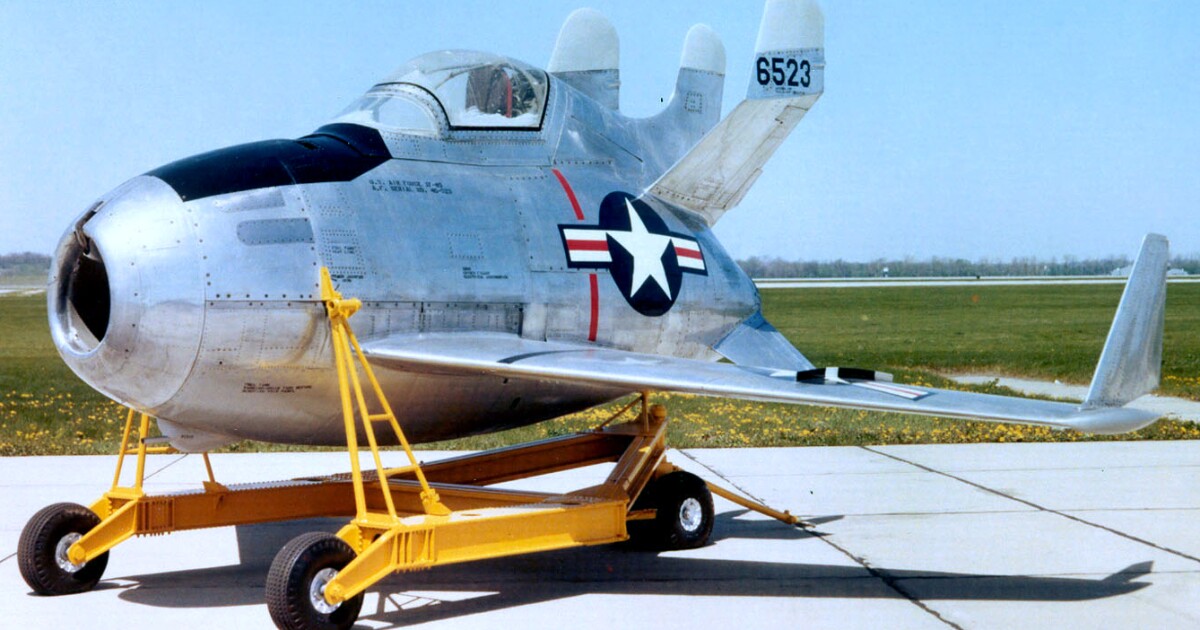
What looks like a flying egg, was never designed to land, and was so light it could be thrown off course by its own guns? Introducing the Goblin XF-85 – the Cold War compact fighter designed to be carried in the belly of a nuclear bomber.
With the Second World War shifting into the Cold War, the jet engine made possible a major shift in strategic bomber technology. Where a long-range bomber like the Boeing B-29 could fly from England to Berlin and back, the post-war Convair B-36 Peacemaker could make it to Moscow and back.
This was a really impressive improvement in power projection for the late 1940s but it turned out also to be a bit pointless because the new bombers were ridiculously vulnerable. Without a fighter escort, these new bombers might have packed a nuclear punch, yet they were also extremely vulnerable to counterattack unless they were shielded by a fighter escort wing.
Fairly obvious, one would think. Unfortunately, the range of a jet fighter in those days could only be measured in a few hundred miles. That meant that any mission to penetrate Soviet air space would have left the attacking fleet completely vulnerable, which would have been very annoying for all involved.
As a solution, the US Army Air Forces hit on a smidgen of lateral thinking. The US Navy’s fleet was protected by fighter planes by putting them on aircraft carriers that acted as floating airfields. If that works, then why not turn the bombers into aircraft carriers?
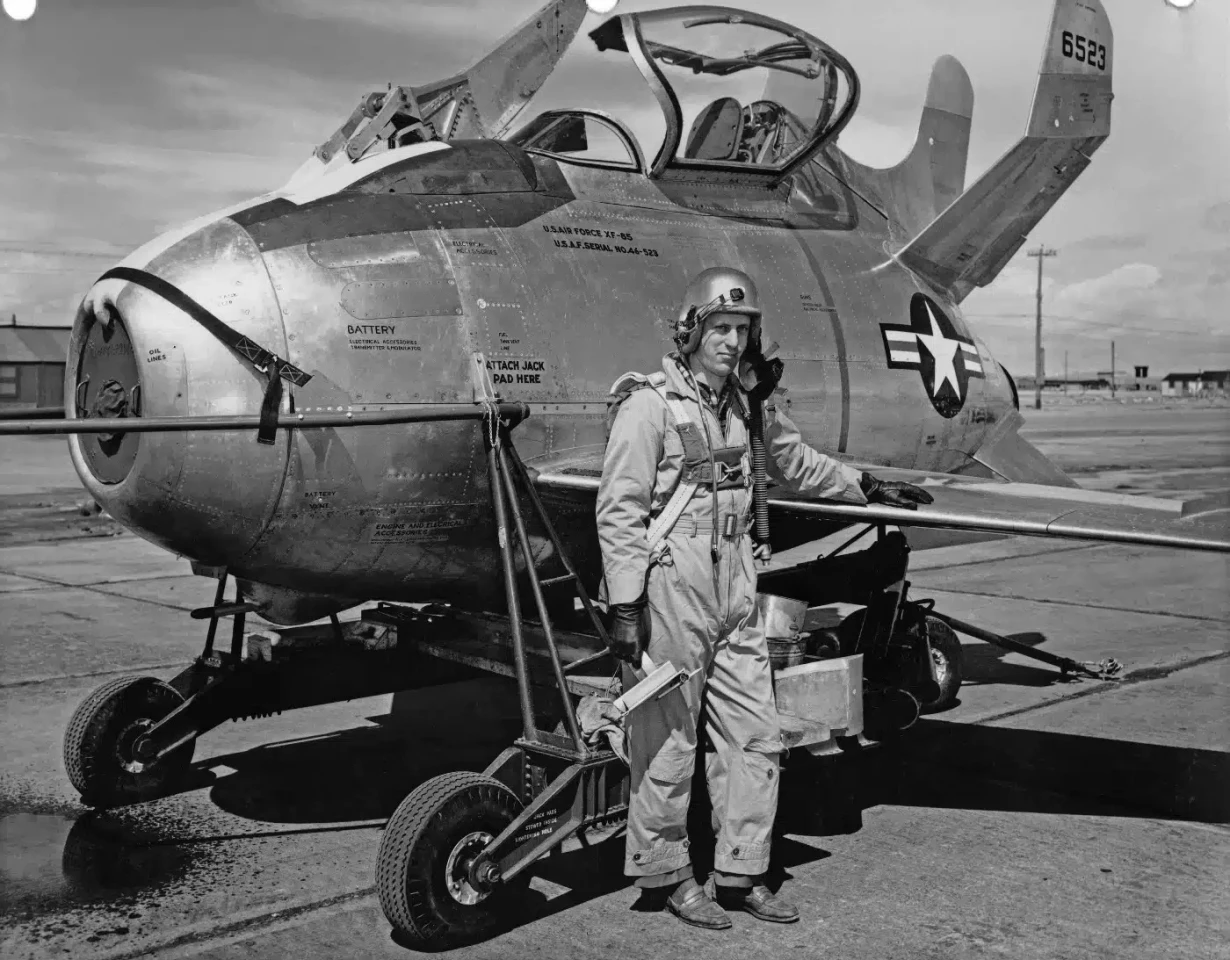
That’s where the McDonnell Goblin XF-85 parasite fighter came in. Looking like the offspring of a compact car and a fighter plane, the Goblin was so tiny because the egg-shaped aircraft had to fit inside the standard bomb bay of the B-36.
US Air Force
The concept was a simple one. When the bombers went into enemy territory, the ones carrying a Goblin would open their bomb bays and lower the tiny fighter on a dirty big trapeze. The Goblin would then power up its Westinghouse J34-WE-7 axial-flow turbojet, unfold its wings, detach, fold away its own hook, and fly off to provide escort with four .50 caliber M2 Browning machine guns for armament.
With a loaded weight of about 5,000 lb (2,270 kg), a length of less than 15 ft (5 m), and an equally short 21-ft (6 m) wingspan, the Goblin had a cruising speed of 195 knots (225 mph, 362 km/h). The self-regulating fuel supply gave it a combat endurance of 30 minutes, after which it had to return to the mothership, hook up, and be hauled inside.
Because it had to fit in the bomb bay, the Goblin not only had wings that folded like a butterfly’s, it also had an unusual five-surface tail configuration with one vertical, two angled, and two ventral fins that could control flight without having to fold and unfold.
US Air Force
But hang on, you say. What about the undercarriage? How does it fit the landing gear inside that tiny fuselage? There can’t be enough room, can there?
You’re right. There wasn’t room. In fact, there wasn’t any landing gear. That meant that if the Goblin got lost or into trouble, the pilot’s only option was to hope for a safe belly landing.
No, I have no idea how they talked the test pilots into taking the job.

US Air Force
The Goblin was a surprisingly early jet fighter project with two prototypes ordered in 1945, and the first captive flight attached to a modified Boeing EB-29B Superfortress was in July 1948 with the first free flight a month later.
That’s where things started to go pear shaped. The Goblin was a highly specialized fighter designed solely for high-altitude flight, right down to its pressurized cockpit with a high-visibility canopy.
It proved to be very stable and easy to fly after release with surprisingly good performance for such a minute aircraft. If that was all that was needed, the Goblin would have been a success, but problems cropped up – not with the fighter but with the bomber.

US Air Force
What the engineers didn’t take into account was that the airflow over the bomber’s wings and fuselage along with the open bomb bays generated violent turbulence. Added to this was an air cushion that formed between the fighter and the mothership as the former attempted to dock. When the Goblin went for the hook, it would buck about wildly so that even highly-skilled test pilots couldn’t manage the maneuver.
During the test program, half of the seven free flights ended with emergency belly landings after recovery attempts failed. Needless to say, the prototypes got a bit bent and the pilots ended up in full white-knuckle mode.
The problem was so severe that the XF-85 program was officially cancelled in 1949. Aside from being something of a death trap, the Goblin idea also fell to an alternative approach of in-flight refueling for extending the range of escorting jet fighters – a much safer way of fulfilling the mission that didn’t need to take up bomb bay space needed for munitions.
Despite being knocked about, the two surviving Goblin prototypes are on display at the National Museum of the United States Air Force at Wright-Patterson Air Force Base near Dayton, Ohio, and the Strategic Air and Space Museum in Ashland, Nebraska.

