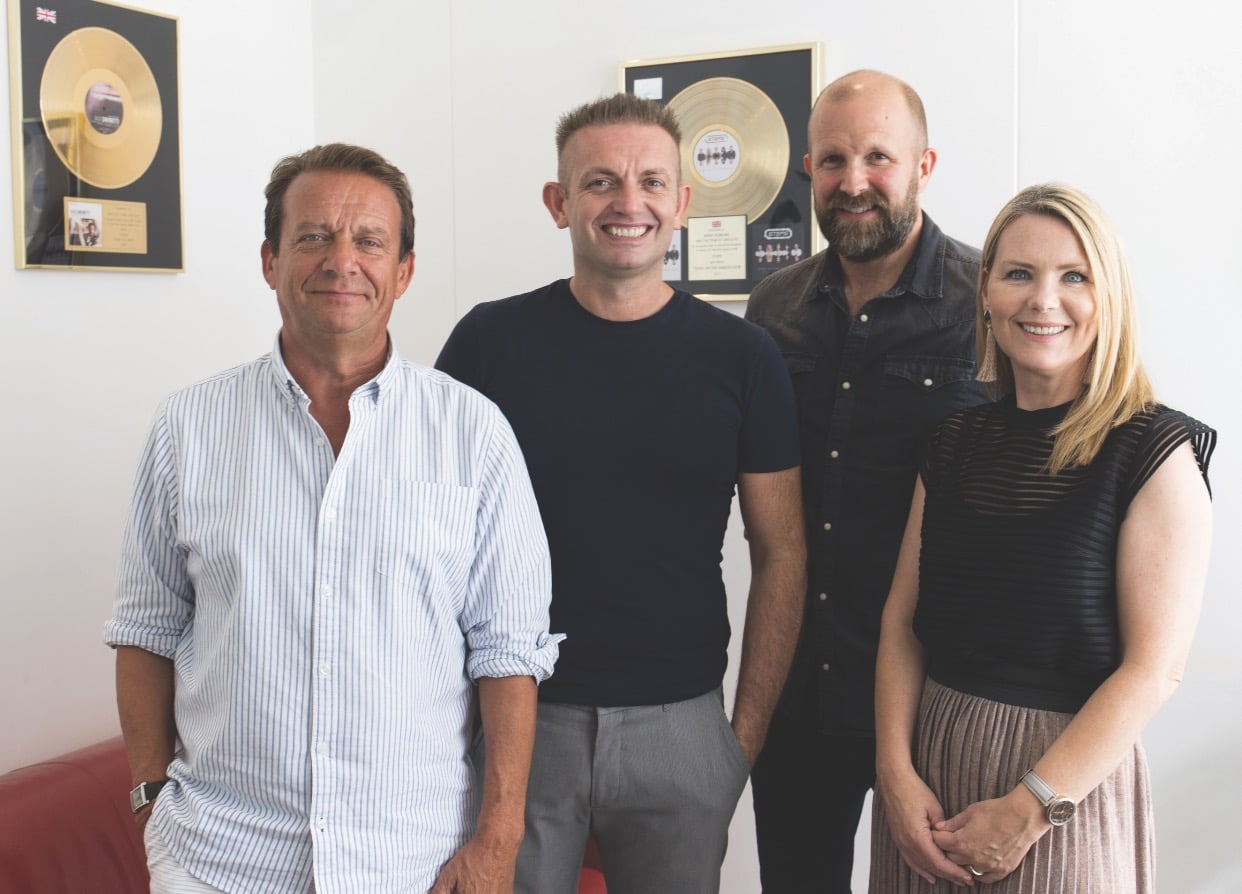



Deep in genteel Wimbledon, a tech revolution is stirring.
The home of The All England Lawn Tennis Club and The Wombles doesn’t usually find itself at the bleeding edge of music industry technology but, in Absolute Label Services’ suburban HQ, that’s all about to change.
True, at first it might seem like business as usual. The team are busily going about their Q4 business – prime time for Absolute’s eclectic roster of artist and label services clients, which famously ranges from Jane McDonald to drill.
And the bosses, co-managing directors Henry Semmence and Simon Wills, are bantering away in a manner befitting their billing as the Ant & Dec of the music business.
Today, however, it’s not the services business – the sector in which they have forged such a solid gold reputation that not even an ill-fated dalliance with the crumbling Utopia empire (which bought Absolute in early 2022, only to sell it back to Semmence and Wills in 2023 amidst its collapse) could dent it – that is on their minds.
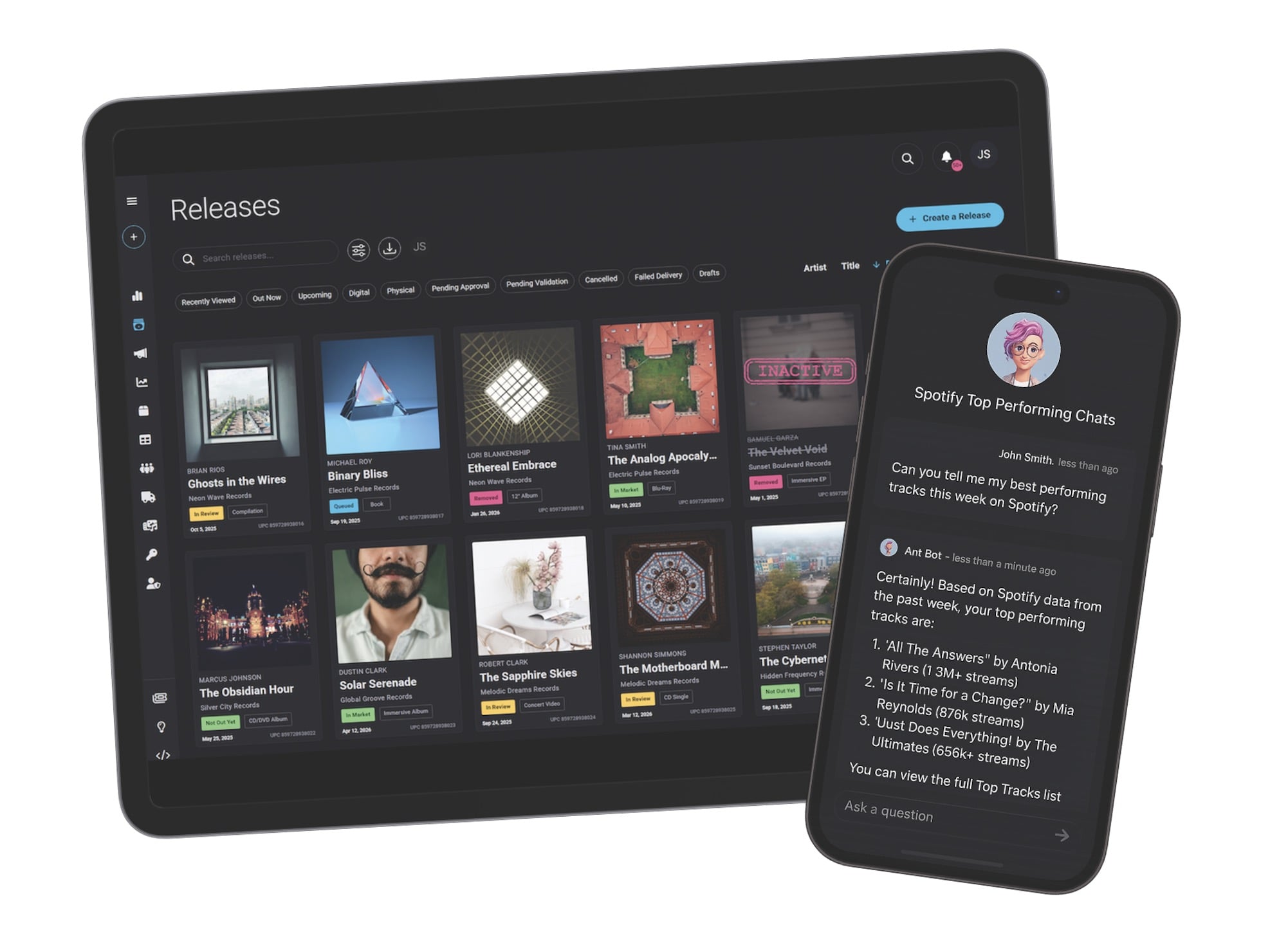
Instead, they are here to talk about Anthology – not a catalogue repackage from one of their legacy artist clients, but an AI-enhanced ‘music operating system’ that promises to give users full control over everything they do, in one place.
It even comes with an AI executive, Ant, trained on Absolute’s wealth of in-house industry knowledge, to offer 24/7 support.
“Streams, physical sales, social figures, neighbouring rights, P&L, campaign material, live dates…” says Wills. “You can see, with one single point of clarity, how every part of your business is performing, interacting and impacting. It is literally every data and operational control point for a music rights company in one place. And if we’ve missed one, tell us – we’ll add it!”
Wills speaks about the technology – which has taken five years and over £2 million to develop – with almost evangelical zeal. Semmence, in contrast, jokes about being “a bit of a Luddite” but clearly is just as much a believer in the impact Anthology will have on his – and, soon, other people’s – business.
Although it was only offically announced this year, Absolute has been using Anthology since July 2024, with Wills saying its impact on the day-to-day business has been “massive”.
“It is every data point in one place. And if we’ve missed one, tell us – we’ll add it!”
“I’m not exaggerating – it has changed the way in which we operate,” he says. “We have taken away a lot of the drag, boring, dry stuff that has to be done to make sure things operate. It’s turned processes that take days into minutes. We haven’t shrunk in terms of staff, but we’re putting those roles to better use, so that they can do more creative, cool stuff.”
And now, Absolute is putting its money where its mouth is: from Q1, they will be opening up Anthology to outside independent label clients (or ‘tenants’ as they prefer).
Their plans are to take on a modest number initially but, once it’s up and running, they see it as an almost infinitely scalable business.
“We know we’ve got a pretty powerful thing,” says Wills. “At the moment, it feels like we’ve got a Ferrari in the garage and all we’re doing is opening the garage door and going, ‘That’s pretty good, isn’t it?’ What we actually need to do is get it out and drive it and, once we’re there, the sky’s the limit.”
So, what better time for Semmence and Wills to grab some leftover Halloween snacks from the Absolute kitchen and head to the boardroom to give us their thoughts on AI, Universal’s proposed Downtown acquisition and what they learned from the Utopia debacle…
So, why does the music business need Anthology?
SW: The music ecosystem has gotten increasingly complex, and businesses are managing an ever-expanding number of data points, rights and revenue streams. But they’re still using fragmented infrastructure that is stuck in 2010.
With every new shift in the industry comes another tool that caters to that specific part of the ecosystem. But, as a result, companies have ended up with workflows based on a patchwork of different platforms, portals and programmes; all siloed, all owned by someone else and all held together by duct tape.
These platforms don’t work well together and they don’t give the whole picture. It drags on absolutely every part of what you do.
If you’re a label boss, it’s incredibly difficult to get a complete, high-definition picture of your operation at any given time. When you can’t see the whole picture, you don’t truly understand what’s going on in your business.
And then you aren’t serving the artist or the music as well as you could be. You miss trends, you miss opportunities, you miss problems and so you miss revenue. Anthology is a response to all that.
It was clearly a big commitment in terms of time, resources and money to develop this. How have you managed that without any outside investment?
SW: Through all of the efforts we’ve put into label services, getting that right and being able to operate commercially in a sensible way, that meant we were never spending more than we could afford to spend, being tight at the back and putting money away for a rainy day. Because we’ve run our business without unicorns and fairies, we could actually afford to do it.
HS: We’re investing in ourselves. We have total belief in what we’re trying to achieve and, as a result, didn’t feel the need at this point to go out and get somebody else
on board.
We believe what we’ve got is right, scalable and can be used for us and the industry going forward – we believed in it, so we’ve invested a fair chunk of Absolute’s success over the last few years back into the business, as opposed to us stripping it all out.
So, is there a lot riding on this in terms of the future of Absolute?
HS: It’s a totally huge move. It’s lots of investment, both financial and resource-wise. We believe it’s the way forward and how we can make our company grow – and grow properly.
But we’re not leaving anything behind in terms of Absolute Label Services, both will run in tandem, they complement each other.
Some people in the music industry are against any use of AI. What’s your message to those people?
HS: Obviously AI is my specialist subject [laughs], but the industry is just talking in scare terms the whole time.
I understand that totally about copyright protection and the protection of creatives, but there’s a huge positive side. So, we’ve got to embrace that and use it to our advantage to help us get to the point where we can protect creatives and
owning copyrights.
SW: It’s an easier sell for us, because we’ll never bring into play AI as a music creative. We’re never going to develop a system like Udio or Suno, that will produce a track that might sound like something else. We’re not going down that road whatsoever.
The road we’re going down is, how can we help an artist or rights-holder in getting their voice heard in what is already a vacuum? As we know, 50,000 tracks are going up to Deezer a day from AI models, and we need a way to cut through
that noise.
Every music industry company has its own portal nowadays. How is Anthology different?
SW: That’s like comparing the internet now to an Encarta CD in the ‘90s!
Portals did a job in the mid-2010s, when the levels of royalty and revenue data started to rise. They gave a certain level of visibility across a certain amount of data.
The industry has moved on by several orders of magnitude, but unfortunately many businesses are still relying on those antiquated portals. The world has changed and so should our infrastructure.
“The industry has moved on, but many businesses are relying on antiquated portals.”
For example, with Anthology we can see exactly which track is reacting on TikTok and causing a spike in streams in a certain territory, and we can generate social media copy and asset suggestions to double down on the popularity – all without leaving Anthology.
We can then generate a pitch for the track targeting specific playlists, and we might get an alert to say that the relevant vinyl stock is low, which we can replenish because sales are likely to lift there as well – again, all without leaving Anthology.
With the old way of doing things, you might not even know you had that opportunity until the heads of each department sat down for the monthly meeting to compare notes.
Are you worried that people will copy the system once they have access to it?
SW: I guess they could, but why would you copy it? If you’re a rights-holder, it’s not cost effective to copy it.
The investment we’ve put into it is in the millions. I know exactly what went into it, so to think that someone else can come along and go, ‘I should be able to knock that up in six months’… Well, I’d like to see it!
You’ve said Anthology can help indie labels challenge the majors in this era of consolidation – that’s a pretty bold claim, isn’t it?
SW: I would go as far as to say that it’s superior to anything that the majors will have.
I’m genuinely not a cocky person, but we’ve worked with people who operate within major systems and we know that they are all over the place, and there are multiple things you have to cobble together in order to get a full picture – and sometimes those systems don’t even do that.
This is very different: it’s about reshaping how we view systems, which I know is a very dry thing, but it’s so bloody important, especially when the independent community needs that access.
HS: Knowledge is power and this is giving independents knowledge, and therefore power – it’s as simple as that.
Would you let the major labels use it?
SW: No! That’s not the ambition right now at all. [Laughs] This is a tool for the power of good – no, I’m joking!
As an independent business, are you worried about the proposed Universal acquisition of Downtown, which includes FUGA?
SW: That obviously makes rights-holders nervous and I understand why. But I’ve always had the mentality, having sat on many AIM board meetings, that you can put your hand up and say, ‘This isn’t fair’, but that’s no use to anybody. What
you actually have to do is, produce something better.
HS: The whole independent industry could get more clients, because people won’t want to be associated with a major. It’s a huge opportunity.
SW: One of my bugbears is, you can’t just turn around to someone and say, ‘Don’t use that because it’s going through a major record company’.
The case has to be, ‘Don’t use that because there’s something better’. You can’t make commercial decisions like that, you have to go on the basis of which one’s going to do the better job. We’ve just got to do better and then they will come to us for a reason.
With the Downtown deal, the regulatory concerns seem to be over=restricting market access for the indies, and about Universal potentially having access to independents’ data. Which are you more worried about?
SW: Well, you can access [the market] through other points so, for me, it would be about that data. If we believe that [Universal] don’t care about that data, that’s a quite naïve point of view.
So, should Anthology clients worry about who will see their data?
SW: No. When we developed Anthology, one of the things we set out to do within the system is to give data sovereignty – every one of our tenants has its own container.
There is no cross-pollination with another tenant’s data. We made sure that was the case when we set out, because we knew that was going to be one of the questions.
How important is Anthology in helping Absolute bounce back after the Utopia experience?
SW: We went into that already planning this. It was an interference at the time, but we made sure that there was no focus lost on what we were trying to achieve. It didn’t matter if it was inside or outside of that environment – and thankfully it’s outside!
There are a lot of things we could say about it, but we went into that whole Utopia set-up, arguably naively, but on the basis that it was going to take what we were doing as a business, turbocharge it and turn it into something greater.
So, nothing changed from an ambition point of view and nothing confused us along the way, incredibly, because of the way that we operated within that structure. We didn’t merge any businesses, resources or staff, we kept that completely separate and independent. That meant that, coming out the other side, there was no change except for who owned the shares.
HS: We got some normality back, basically.
SW: There was an incredible amount to learn and we’ve come out better for it – scarred, but better for it!
It could have dragged the whole business down though, couldn’t it?
HS: It could have done. But we were clever enough, lucky enough and organised enough on the way in to make sure it was fully protected.
Because we’ve been doing it for such a long time, and I think we do still have a good reputation in the industry, we were able to come out the other side,
still intact.
It took a bit of time to get ourselves back on our feet properly but I’m very proud of all the people here that did that, all the staff stayed with us and kept going. Bumpy roads are all part of the journey.
What happens if Anthology is a huge success and someone makes you an offer for the business?
SW: [Laughs] Well, how much?
How much do you want?
SW: We’ve done this ourselves. We’re privately owned and, when we come to rolling out our five-year plan, it may be that we take investment that will help us get to another stage.
I would never cut that off, but if the question is as pointed as, ‘Are you selling to a major record company?’, the answer is no.
“If the question is, ‘Are you selling to a major record company?’, the answer is no.”
HS: Having been through that beast, we are far more educated as to how we would accept any further investment in the business, or help in developing the business.
SW: I don’t want to sound like a megalomaniac, but when you’ve got an ambition to do something, you want to achieve it, just to know you can do it.
That’s more powerful than anything else so, even if a major record company comes along and offers you millions and millions of pounds it’s like, where do you go then? There’s more to life than that.
MBUK is available as part of a MBW+ subscription – details through here.
All physical subscribers will receive a complimentary digital edition with each issue.Music Business Worldwide